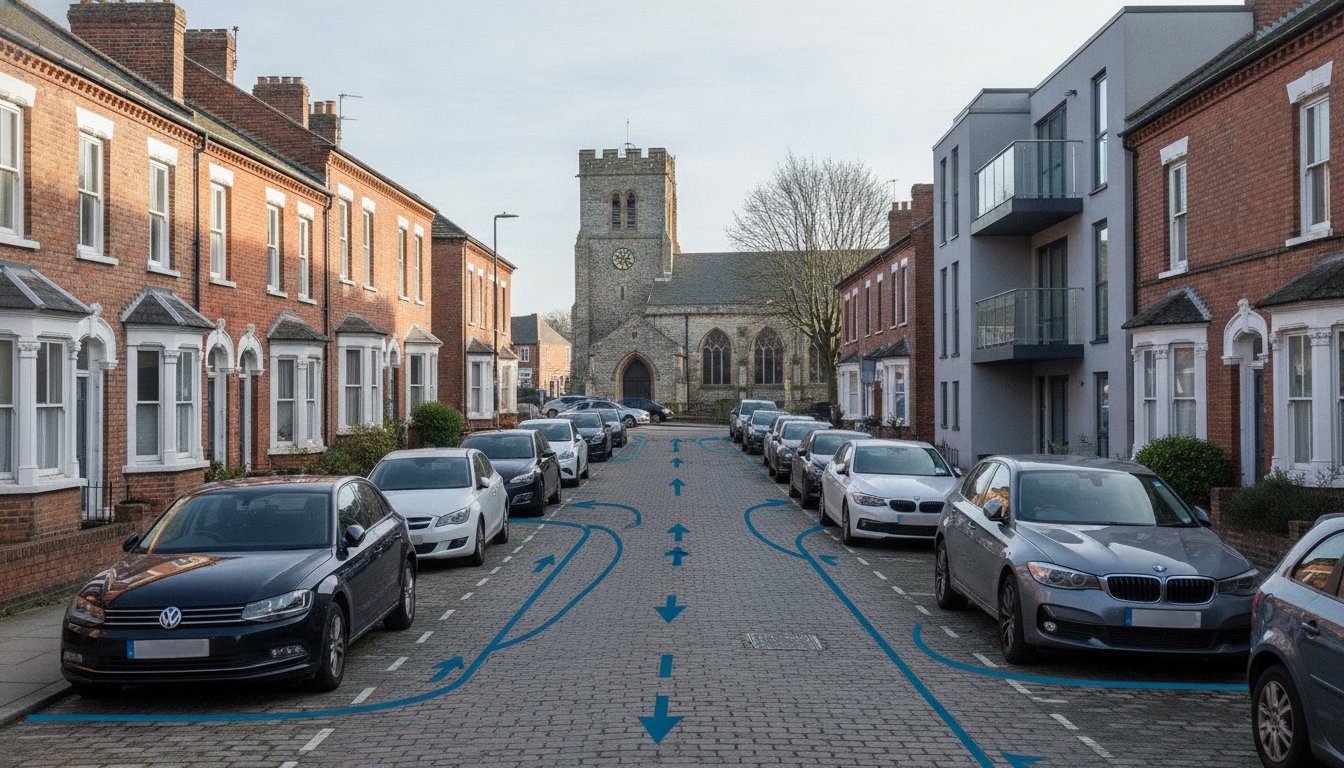
Most planning applications for places of worship fail not because of the building design, but because of a single Sunday morning parking survey. If you’re managing a new development or expansion, the “Sunday Peak” is likely your biggest regulatory hurdle. It’s frustrating to face potential refusal based on local parking complaints when you’re simply trying to serve your community. You shouldn’t have to navigate these technical requirements alone, especially when a rejected statement can stall your project for up to 16 weeks and lead to significant revision costs.
This article provides the expert guidance you need to complete a robust church transport assessment that satisfies local authorities. We’ll explore how to align your project with current standards, including London’s Vision Zero safety goals and the shift toward Active Travel infrastructure. You’ll learn exactly which data points the council requires, from swept path analysis to specific Sunday traffic counts. By the end of this guide, you’ll understand how to secure planning permission with minimal friction and avoid the high costs of unnecessary technical reporting. We focus on the precision required to move your project from inception to completion while maintaining full regulatory compliance.
Key Takeaways
- Understand how to align your project with the National Planning Policy Framework (NPPF) to prioritize sustainable travel for community hubs.
- Learn how a professional church transport assessment utilizes the Lambeth Methodology to accurately manage “Sunday Peak” parking demands and mitigate council concerns.
- Discover why technical Swept Path Analysis is essential for proving safe site access for fire tenders and community transport vehicles.
- Identify the specific trip generation modeling tools, such as the TRICS database, used to project traffic impacts for various religious uses.
- Gain insights into reducing regulatory pressure by adhering to industry benchmarks and Local Highway Authority standards for first-time planning approval.
Navigating Planning Requirements for Places of Worship in 2026
A church transport assessment is a technical study that serves as a vital component of your planning application. It evaluates how a place of worship interacts with the surrounding road network, focusing on safety and efficiency. This study is a specific application of the broader transportation planning process, tailored to the unique surges in activity associated with religious services. The National Planning Policy Framework (NPPF) dictates that community hubs must prioritize sustainable travel. Consequently, the Local Highway Authority (LHA) will closely review your proposal to ensure it aligns with local safety benchmarks and doesn’t cause severe cumulative impacts on the network.
To better understand the logistical challenges involved in these projects, watch this helpful video:
Understanding the difference between a Transport Statement and a full Assessment saves time and resources. A Statement is a concise report for developments with minor traffic implications. A full Assessment is a comprehensive document required when a project’s scale suggests a significant impact on local infrastructure. ML Traffic Engineers UK specializes in determining which path your project requires to ensure you don’t pay for unnecessary reporting.
Change of Use and Class F1 Requirements
Converting retail or industrial units into places of worship falls under Class F1 of the UK planning system. Even if your project qualifies for ‘Permitted Development,’ the council often demands transport data. This happens because planning authorities look for an ‘intensification of use.’ They want to know if a building originally used for storage can safely accommodate hundreds of people arriving simultaneously. We provide the data necessary to prove your site can handle these shifts without disrupting the local community.
When is a Full Transport Assessment Mandatory?
Mandatory thresholds vary by borough, but they typically hinge on floor area or congregation size. For example, a site exceeding 1,000sqm often triggers a full assessment. Your location also dictates the level of scrutiny. Urban sites in London must navigate stricter ‘car-free’ mandates, while rural sites must address vehicle displacement. ML Traffic Engineers UK helps you identify the exact reporting level needed for your specific site, ensuring your application moves forward without technical delays.
Core Components of a Comprehensive Church Transport Study
Trip Generation and the TRICS Database
Predicting exactly how many people will travel to your site is a technical necessity. We utilize the TRICS database, which is the national standard for trip rate analysis in the UK. By comparing your proposal to data from similar religious institutions, we can accurately forecast vehicle movements for Sunday services and weekday events. We refine this standard data by adjusting for your congregation’s specific demographics, such as age and local residency patterns. While focusing on UK standards, it’s helpful to recognize that Federal transportation regulations for churches often emphasize similar safety and operational benchmarks for faith-based groups. Incorporating TRICS data into a church transport assessment prevents the over-estimation of traffic by grounding projections in verified, observed site behavior rather than theoretical maximums.
Sustainable Transport and Accessibility
Urban planning in 2026 places a heavy emphasis on accessibility without car dependency. For sites in major cities, we calculate the Public Transport Accessibility Level (PTAL) to determine how easily your members can reach you via bus, train, or tube. We also assess pedestrian and cycle routes to ensure the site is safely reachable for everyone, regardless of their mode of transport. Integrating a Travel Plan is often the most effective way to promote non-car travel and satisfy council requirements for sustainable development. If you need assistance navigating these accessibility requirements, our experts can provide a comprehensive site review to identify the best mitigation strategies for your congregation.
Managing the ‘Sunday Peak’: Parking Surveys and Impact
Local councils prioritize the peak one-hour arrival and departure windows because these periods represent the highest risk for traffic congestion and residential friction. For a place of worship, this surge usually occurs on Sunday morning, creating a unique profile that standard weekday data cannot capture. A professional church transport assessment must quantify this impact using the Lambeth Methodology, which remains the gold standard for parking surveys in the UK. This methodology provides a transparent framework for measuring on-street capacity and ensuring that the proposed development won’t lead to “parking stress” in the immediate vicinity.
Calculating parking accumulation is a critical step in this process. We track the net change in vehicle numbers throughout the day to prove the site can handle its congregation without overflowing onto restricted roads. This data is essential for satisfying the requirements found in the official Guidance on Transport Assessment. When on-site parking is limited, we develop mitigation strategies that focus on safety and community harmony, ensuring your application remains viable even in dense urban environments. If you are concerned about local resistance to your project, our team can help you prepare a robust technical parking report to address those fears directly.
Conducting a Robust Parking Survey
Defining the survey area is the first technical hurdle. Most authorities require a 200m walking distance radius around the site to capture the likely impact on local residents. Timing is equally vital; for churches, Saturday and Sunday data is non-negotiable. We record the exact number of available spaces at 15-minute intervals during the peak windows. By calculating the “stress levels”, which is the percentage of occupied spaces, we provide a clear picture of whether the local streets can absorb any additional demand without compromising road safety.
Justifying Reduced Parking Provisions
If your site can’t meet standard parking ratios, we look for innovative justifications. “Dual Use” parking agreements are a powerful tool. These allow churches to use nearby business or school car parks that sit empty on weekends. We also analyze the impact of Controlled Parking Zones (CPZs). While a CPZ might limit congregant parking, it also prevents long-term overspill from other sources, which can actually strengthen your case. Finally, we draft a parking management strategy. This document outlines how your team will use stewards or signage to direct traffic, proving to the council that you have a proactive plan to manage your congregation’s arrival.
Technical Requirements: Swept Path Analysis for Churches
A successful church transport assessment must demonstrate that the physical constraints of the site don’t compromise public safety. While earlier sections focused on traffic volume and parking stress, this technical phase examines the actual movement of vehicles. Local planning authorities require proof that your site can accommodate the specific vehicles required for its operation without causing hazards on the public highway. We use specialized software to create these simulations, ensuring your car park layout is functional before any construction begins. Integrating these technical drawings into your church transport assessment reduces the risk of the council requesting further information, which often causes significant project delays.
Emergency and Service Vehicle Access
Statutory requirements dictate that fire tenders must be able to reach within 45 meters of all points within a community-use building. We use Swept Path Analysis as a digital simulation tool to accurately model vehicle movements against your proposed site plan. This isn’t just about the main entrance; it includes ensuring that heavy emergency vehicles can maneuver through gates and around tight corners without getting stuck. Refuse collection is another critical hurdle. Councils expect bin lorries to service church plots without blocking through-traffic or requiring dangerous long-distance reversing maneuvers. Our analysis identifies these potential “clash points” early, preventing the need for costly redesigns of car park entrances or boundary walls after the planning application is submitted.
Minibus and Drop-off Zone Design
Religious sites often operate community outreach programs that rely on minibuses and specialized transport. Many generic assessments overlook these vehicles, but we include them as a core part of our study. We design safe drop-off points specifically for elderly or disabled congregation members to ensure they don’t have to navigate live traffic lanes. It’s essential that minibuses can turn fully within the site boundaries. Reversing onto a main road is a high-risk maneuver that frequently leads to planning refusal on safety grounds. Our technical reports also verify that parking bay dimensions and aisle widths meet current standards, allowing for the wider turning circles required by community transport vehicles. To prevent expensive design errors and ensure your site is fully accessible, book a technical site assessment with our engineering team today.
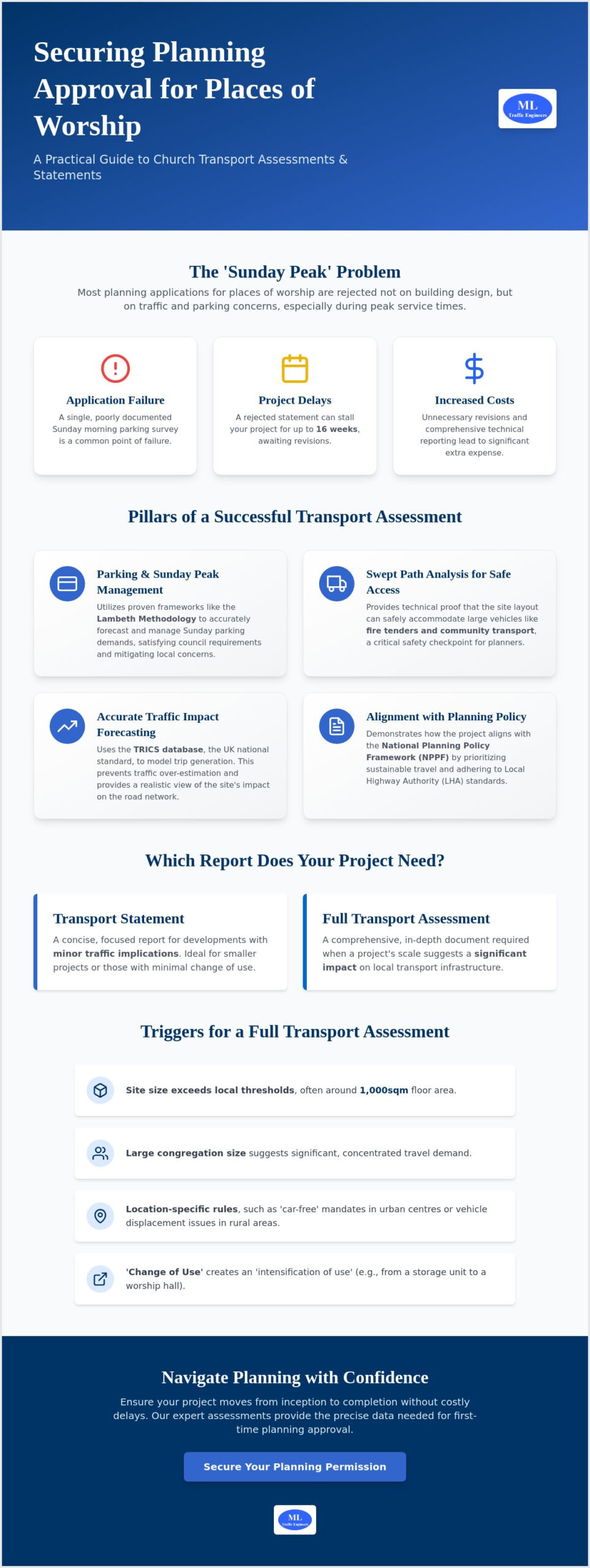
Securing Planning Approval with ML Traffic Engineers UK
ML Traffic Engineers UK provides a comprehensive service that manages the entire project lifecycle, ensuring that religious developments navigate the planning process without technical setbacks. We understand that places of worship face unique scrutiny from both local authorities and neighboring residents. Our team identifies potential hurdles before they escalate into formal objections. By adhering to strict industry benchmarks and Local Highway Authority standards, we ensure your church transport assessment is technically sound and ready for immediate submission. We maintain deep expertise in navigating the intricate transport policies across England’s boroughs, including the specific safety requirements of the London Plan 2026 and Vision Zero goals.
We take pride in our role as a vital guardian of public safety, ensuring every report we produce is rooted in precision and legislative compliance. We don’t just provide raw data; we offer a fully-managed service that reduces the regulatory burden on your congregation. Our approach moves logically from initial site surveys to ongoing support during the planning process. This efficiency is a hallmark of our brand promise, ensuring that your project stays on schedule and avoids the 16-week delays often associated with rejected technical statements or incomplete reporting.
A Reassuring Partner for Religious Developments
Our technical authority acts as a shield against planning refusal. ML Traffic Engineers UK produces tailored reporting that satisfies the rigorous demands of professional planners while respecting the mission of the parishioners. By focusing on safety-conscious and sustainable site design, we help you build a case that local residents can support. We position ourselves as a reliable partner that understands regional regulations so you don’t have to. This commitment to professional integrity ensures that every church transport assessment we deliver meets the highest standards of formal excellence and civic responsibility.
Next Steps for Your Church Project
Early engagement with transport consultants is the most effective way to avoid costly design errors. Engaging our team during the initial design phase allows us to optimize your site layout for vehicle movements and parking efficiency before plans are finalized. You can request a Transport Assessment quote to begin the process for your specific site. Before you submit your application, ensure your technical package includes:
- Verified trip generation data using the TRICS database tailored to your congregation size.
- A parking survey conducted according to the Lambeth Methodology for Sunday peak windows.
- Digital Swept Path Analysis for fire tenders and community transport vehicles.
- A comprehensive Travel Plan focused on sustainable travel and accessibility.
- A formal parking management strategy to mitigate residential overspill concerns.
Our team remains ready to support your project from inception to completion, providing the unwavering reliability and rapid response capabilities needed for a successful planning outcome.
Secure Your Planning Approval with Technical Precision
Securing planning permission for a place of worship requires more than just architectural vision; it demands a data-driven strategy that addresses the specific surges in local traffic. You can’t afford to overlook technical precision when neighbors and councils are focused on parking overspill. By prioritizing the Sunday Peak and utilizing the Lambeth Methodology for parking surveys, you proactively resolve these concerns. A robust church transport assessment provides the technical evidence needed to prove your site is safe, accessible, and compliant with the latest National Planning Policy Framework standards.
Our team brings deep expertise in UK planning law and specialized TRICS modelling to every project. We maintain a proven track record with religious and community developments, ensuring that your Swept Path Analysis and technical reporting meet the highest professional standards. We are ready to manage your full project lifecycle from initial survey to final submission. Request a Professional Church Transport Assessment Quote to move your development forward with confidence. Your community deserves a facility that is safe, reachable, and fully integrated into the local transport network.
Frequently Asked Questions
Is a transport assessment required for a change of use to a church?
Yes, local authorities typically require a church transport assessment for Class F1 change of use applications. Planners examine the “intensification of use” to see if the new religious use generates higher traffic surges than the previous occupant. Even if the building footprint remains unchanged, the shift to high-occupancy worship services creates a unique traffic profile. We provide the technical data needed to prove the site can safely accommodate these specific congregational peaks.
How much parking does a church need to provide for planning permission?
Parking requirements depend on your local authority’s standards and the site’s Public Transport Accessibility Level (PTAL) score. In high-accessibility areas, such as London PTAL 4 or higher, the 2026 London Plan mandates car-free developments. For sites in lower-accessibility areas, the council may permit limited parking provided you include 100% active electric vehicle charging points. We analyze these regional regulations to ensure your proposal meets the exact legislative threshold.
What is the difference between a Transport Statement and a Transport Assessment for a place of worship?
The primary difference lies in the scale of the development and its expected traffic impact. A Transport Statement is a shorter report for smaller sites with minor traffic implications. A full Transport Assessment is a comprehensive study required for larger congregations or sites with complex access needs. We identify the correct reporting level early in the project lifecycle to prevent you from paying for unnecessary technical work.
Can a church get planning permission with no on-site parking?
Yes, churches can secure planning permission with zero on-site parking, particularly in urban centers with high public transport connectivity. To achieve this, you must submit a robust parking survey proving that any overspill can be absorbed by the local network. We often use “Dual Use” agreements with nearby businesses or schools to demonstrate that your congregation has access to off-site spaces during Sunday peaks without causing residential friction.
How long does a parking survey for a church take to complete?
A standard parking survey for a religious site typically takes one to two weekends to complete. We must capture data during your peak service times, which usually fall on Saturday and Sunday mornings. Our team records parking occupancy at 15-minute intervals within a 200m radius of the site. This intensive data collection period provides the precise “stress level” evidence required by the Local Highway Authority to validate your application.
What happens if the local residents object to our church due to traffic?
Technical data is the most effective way to neutralize objections regarding traffic and parking congestion. When residents raise concerns, the council looks for objective evidence rather than anecdotal complaints. We provide professional church transport assessment reports and parking management strategies that outline how your team will direct traffic. This proactive approach demonstrates your commitment to community safety and professional integrity while satisfying the council’s requirements. To further support your mission, IntegraSense provides specialist consultancy in accessibility and governance, ensuring your facility is inclusive and professionally managed.
Do we need a Travel Plan if our congregation is small?
Councils frequently require a Travel Plan even for smaller congregations to support “Active Travel” goals. This document outlines how you will encourage walking, cycling, and public transport use among your members. Urban planning policies in 2026 prioritize reducing car dependency regardless of the project size. A well-drafted plan strengthens your application by showing alignment with regional sustainability and safety benchmarks like the Vision Zero safety goals.
How does Swept Path Analysis help our church planning application?
Swept Path Analysis provides digital proof that emergency services and refuse vehicles can safely access and exit your site. This simulation tool models the exact turning circles of fire tenders and community minibuses against your proposed layout. Without this evidence, councils may refuse applications over safety concerns regarding vehicles blocking the highway. We use this analysis to optimize your site plan and avoid costly redesigns of car park entrances or boundary walls.

Disclaimer
The content on mltraffic.co.uk, including all technical articles, guides, and resources, is provided for general informational and educational purposes only. It is not intended to constitute professional advice in traffic engineering, transportation planning, development approvals, or any other technical or legal field.
While ML Traffic Engineers makes every reasonable effort to ensure the accuracy, completeness, and timeliness of the information published, we do not provide any warranties or representations (express or implied) regarding its reliability, suitability, or availability for any particular purpose. Any reliance you place on the content is strictly at your own risk.
In no event shall ML Traffic Engineers, its directors, employees, authors, or affiliates be liable for any direct, indirect, incidental, special, consequential, or punitive damages (including, without limitation, loss of profits, data, or business opportunities) arising out of or in connection with the use of, or inability to use, any information provided on this website.
The articles and guides on this site are not a substitute for engaging a qualified, professional traffic engineer to assess your specific project requirements. For tailored advice, compliance assessments, or traffic engineering services, please contact a competent professional.
This disclaimer may be updated from time to time without notice. By accessing or using this website, you agree to be bound by the most current version of this disclaimer.