
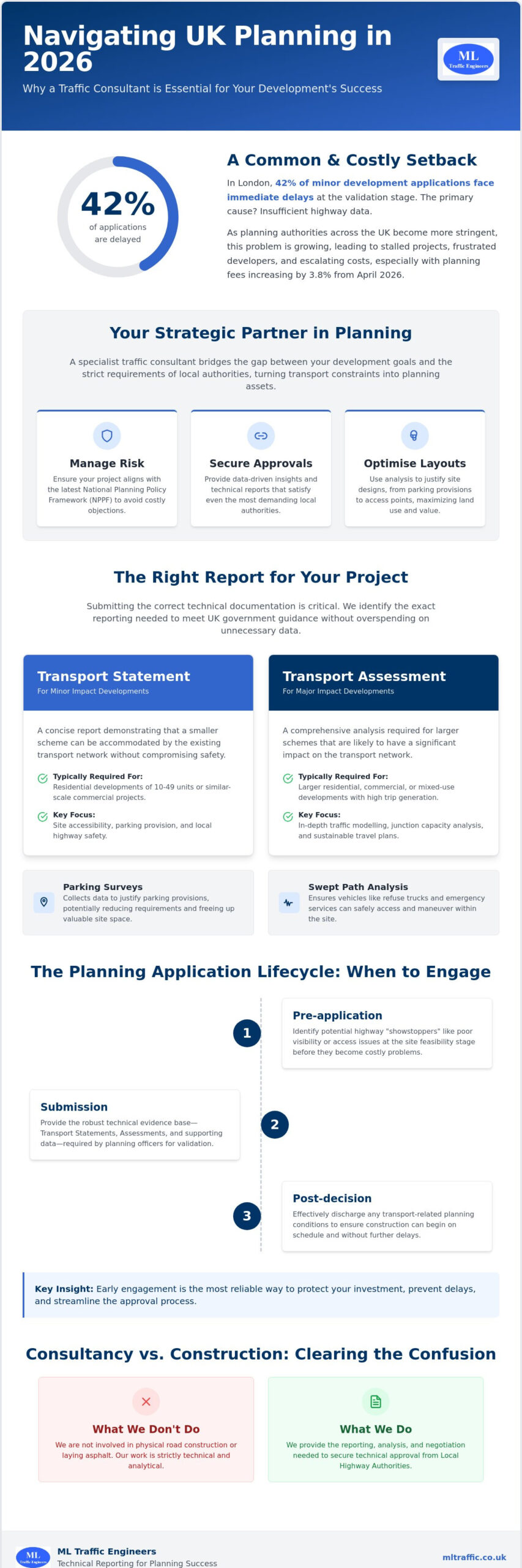
In London, 42% of minor development applications face immediate delays at the validation stage simply because they lack sufficient highway data. This statistic highlights a growing trend across the UK where planning authorities are becoming increasingly stringent about transport impact. You likely understand the frustration of seeing a project stall because of a highway authority objection or confusion over whether you need a Transport Statement or a full Assessment. Securing planning permission in 2026 requires more than just a good design; it demands technical precision and a deep understanding of evolving regulations like the revised National Planning Policy Framework. Engaging a professional traffic consultant is no longer optional for developers who want to avoid costly setbacks.
A specialist traffic consultant acts as a strategic partner to turn transport constraints into planning assets. We provide the technical reporting and data-driven insights, such as swept path analysis and parking surveys, needed to satisfy even the most demanding local authorities. This article explores how expert consultancy navigates complex 2026 regulations to secure approvals and optimize site layouts. You’ll discover how to minimize transport-related conditions and deliver cost-effective technical reports that keep your development on track and within budget.
Key Takeaways
- Understand how a traffic consultant manages transport risks to ensure your project aligns with the latest National Planning Policy Framework (NPPF) requirements.
- Learn the critical differences between Transport Statements and Transport Assessments to ensure you submit the correct technical documentation for your development size.
- Discover how technical data collection, including Parking Surveys and Swept Path Analysis, can justify lower parking provisions and optimise your site layout.
- Identify why early engagement during the site feasibility stage is essential to prevent costly highway authority objections and application delays.
- Gain insights into streamlining the approval process through comprehensive reporting that meets specific Local Highway Authority standards in England.
What is a Traffic Consultant and Their Role in UK Planning?
A traffic consultant is a technical expert tasked with managing the transport-related risks of a development project. Their primary objective is ensuring that a scheme complies with the National Planning Policy Framework (NPPF) and local highway standards. In the context of the 2026 planning cycle, where revisions to the NPPF emphasize efficient land use and sustainable transport hubs, this role is critical for securing a viable planning permission. They don’t just provide data; they act as a strategic bridge between your development goals and the strict requirements of local authorities.
To better understand the distinction between the technical roles involved in this field, watch this helpful video:
While the terms are often used interchangeably, a traffic engineer typically focuses on the physical movement of vehicles and site geometry, whereas a transport planner examines broader policy and the transportation planning process. A professional traffic consultant integrates both disciplines to provide a robust evidence base for local authorities. They ensure that your site is not only accessible but also policy-compliant in an environment where sustainable and active travel are now mandatory priorities.
Consultancy vs. Construction: Clearing the Confusion
It’s a common misconception that traffic consultants are involved in physical road construction. While Companies House often groups consultancy under “Construction of roads,” the reality is strictly technical and analytical. We specialize in what we do: reporting, analysis, and negotiation. We don’t lay asphalt; we provide the data that justifies the road layout or parking provision. Our focus remains on securing technical approval from Local Highway Authorities through rigorous reporting and adherence to industry benchmarks.
The Planning Application Lifecycle
Effective consultancy follows a logical, sequential flow that mirrors the progression of your project. This includes:
- Pre-application: Identifying potential highway “showstoppers” like poor visibility splays before they become costly.
- Submission: Providing the technical evidence base, such as Transport Statements, required by planning officers.
- Post-decision: Discharging transport-related planning conditions effectively so construction can begin.
Engaging a consultant early in the 2026 planning cycle is essential. With planning fees in England increasing by 3.8% from April 2026, the cost of a failed application is higher than ever. Precision in your initial submission is the most reliable way to protect your investment.
Core Services: From Transport Statements to Technical Surveys
Securing planning approval in 2026 requires a robust technical evidence base tailored to your development’s scale. With planning fees in England rising by 3.8% as of April 2026, getting the submission right the first time is a financial necessity. A professional traffic consultant identifies the exact reporting requirements to satisfy UK government guidance, ensuring you don’t overspend on unnecessary data while meeting every statutory obligation. These services range from preliminary statements for minor schemes to comprehensive assessments for major projects.
For residential developments of 10 to 49 units, Transport Statements are typically the standard requirement. These concise reports address minor transport impacts and demonstrate that the existing network can accommodate new residents without compromising safety. Larger schemes with significant traffic generation require full Transport Assessments. These detailed documents analyze capacity, safety, and mitigation across a wider area. Getting this distinction right at the validation stage prevents the 42% delay rate often seen in complex urban planning environments where highway data is frequently found insufficient.
The Technical Evidence Base
Digital vehicle simulations provide the precision needed to satisfy highway officers and planning committees. Swept Path Analysis (SPA) uses specialized software to prove fire tenders and refuse vehicles can safely navigate your site. Without SPA, designs often face immediate rejection due to access concerns. We also use the TRICS database for trip forecasting and Travel Plans to support sustainable transport goals. These tools ensure your layout is both functional and policy-compliant from the start.
Specialised Surveys for Local Authorities
Authorities often demand specific data like the Lambeth Methodology for parking surveys. These overnight stress assessments prove the local network can absorb parking overflow, which is vital for car-free or low-parking schemes. We also conduct traffic counts and speed surveys to determine visibility splays at site entrances. These provide the hard evidence needed for technical negotiations. Explore these options on our What We Do page. Consulting with a traffic consultant early prevents technical objections and keeps your project moving forward.
Why Developers Need a Traffic Consultant in 2026
The financial stakes of UK development have never been higher. With planning appeal rates for residential schemes dropping by 22% when robust transport documentation is used, the ROI of professional technical support is clear. A traffic consultant does more than just fill out forms; they mitigate the risk of planning refusal by addressing highway safety and capacity concerns before they reach a committee. By providing an evidence based approach, we protect your project from the subjective objections that often stall applications.
Land use optimization is another critical area where expert input pays for itself. In urban environments, the London Plan 2026 now mandates car-free developments in areas with a Public Transport Accessibility Level (PTAL) score of 4 or higher. We use empirical data from parking surveys to justify lower parking provisions, freeing up valuable square footage for additional units or amenities. Our members often hold qualifications from the Chartered Institution of Highways & Transportation, ensuring that all justifications meet the highest industry standards for technical excellence and safety.
Beyond the initial application, we manage the complex negotiation of Section 278 Agreements. These legal requirements for permanent highway works can become a significant bottleneck if not handled with technical precision. If a project does face a challenge, we provide expert witness services for planning appeals, defending our technical findings with authoritative clarity to ensure your development moves forward.
Cost Savings Through Design Optimization
Accurate data prevents the expensive over-engineering of access roads and junctions. By using precise trip generation models, we often prove that standard, less invasive designs are sufficient for the projected traffic flow. This approach can also eliminate the need for costly underground parking. A robust transport assessment might demonstrate that local network capacity can support your density without such heavy infrastructure investment. We resolve the common “architect vs. highways” conflict by providing engineering led designs that satisfy both aesthetic goals and safety requirements.
For commercial or industrial developments in 2026, ensuring that site access is optimized for heavy logistics is a key part of the planning process. To see how professional logistics providers manage complex freight movements, you can learn more about Tranzit Express Inc. and their role in the transportation industry.
Navigating Local Authority Objections
Professional credibility is your strongest asset when dealing with council engineers. We speak their language and understand their specific regional concerns. When an objection arises, we don’t just relay the bad news. We translate technical objections into actionable design changes that maintain your project’s viability. For a deeper look at how this works in complex urban settings, see our Transport Assessment London Guide. Rapid response and technical authority are essential for keeping your project on schedule.
When to Engage a Traffic Consultant for Your Project
The “Early Engagement” principle is the foundation of a successful planning strategy. Many developers make the mistake of waiting until they receive a formal objection from the Local Highway Authority before seeking expert advice. This reactive approach is costly. By the time an objection is raised, design changes are often expensive and time consuming to implement. Engaging a professional traffic consultant during the initial site feasibility stage allows you to determine if a site can actually support your proposed density. This foresight prevents you from investing in a scheme that is fundamentally flawed from a transport perspective.
Coordinating with your design team during RIBA Stage 2 and 3 ensures that transport requirements are baked into the site’s DNA. This collaboration prevents the common conflict where an architect’s vision is compromised by late stage highway requirements. Additionally, the timing of survey data collection is critical for a valid submission. We strictly avoid school holidays and bank holidays to ensure the data is representative of typical network conditions. Unrepresentative data is a frequent cause for council rejection and can force you to repeat expensive data collection exercises.
Pre-Application Strategy
Using a consultant to scope the transport requirements with the council early is a proactive step that reduces regulatory pressure. This process identifies the specific need for specialized surveys before the application is submitted, allowing for a smoother validation process. Implementing early Swept Path Analysis can save weeks of redesign time by ensuring the site layout accommodates essential service vehicles from the first draft. This technical readiness demonstrates professional integrity to planning officers from the outset.
The Submission Phase
During the submission phase, we ensure all reports are current and meet 2026 policy standards, such as the latest NPPF revisions. We also manage technical requests for further information from authorities, including formal Regulation 25 requests. Given that 42% of minor applications face delays at validation due to insufficient data, your evidence base must be beyond reproach. If you are preparing a new application, you can request a technical review of your site feasibility to ensure compliance before submission.
Checklist for developers: Is your transport evidence ready for submission?
- Is your survey data representative and collected outside of holiday periods?
- Does your Travel Plan align with the 2026 London Plan or regional standards?
- Has your SPA been conducted using the specific refuse vehicle dimensions required by the local council?
- Is your traffic consultant prepared to negotiate directly with highway engineers?
Choosing ML Traffic Engineers for Your 2026 Planning Success
ML Traffic Engineers UK has provided technical reporting and data collection for planning applications across England since 2014. We understand that precision is a functional necessity in the high-stakes environment of property development. As your traffic consultant, we manage the full project lifecycle from inception to completion. Our team balances technical authority with a client-focused approach to reduce the logistical and regulatory pressures on your business. We don’t just provide reports; we act as a reliable partner that understands intricate regional regulations so you don’t have to. This dedication to accuracy ensures that every submission meets the rigorous standards expected by planning committees and highway officers.
Our methodology is rooted in specialized industry terminology and strict adherence to legislative requirements. We take immense pride in our precision and adherence to standards, which serves as the foundation for every project we undertake. Whether you’re developing a minor residential scheme or a complex mixed-use commercial site, our solutions are tailored to meet the specific requirements of the Local Highway Authority. This commitment to formal excellence ensures that our technical reports carry the weight and credibility needed to build trust with planning officers, effectively streamlining the path to approval.
Expertise in London and Regional Planning
Managing the unique challenges of urban site constraints requires a deep understanding of evolving policies. While the London Plan 2026 places significant emphasis on connectivity and sustainable density, our role is to translate these requirements into viable site layouts that satisfy both local and national targets. We have a consistent track record in delivering Transport Statements that win approval by directly addressing local authority concerns with empirical data. Our comprehensive approach moves your project from the initial feasibility stage through to final technical approval with efficiency and readiness, ensuring that no technical detail is overlooked.
The ML Traffic Engineers UK Advantage
The ML Traffic Engineers UK advantage lies in our precision-led engineering paired with a client-focused advisory approach. We provide an all-encompassing service that includes everything from raw data collection to expert technical reporting. This fully managed service model ensures you have a single, dependable point of contact for all transport-related planning matters, reducing the need for multiple vendors. We invite you to explore our project types to see how we’ve supported various residential and commercial developments across the country.
Success in the 2026 planning cycle depends on technical accuracy and rapid response capabilities. We maintain a standard of professional integrity and civic responsibility that positions us as vital guardians of public safety. Don’t let transport objections stall your development’s progress or lead to unnecessary costs. Contact ML Traffic Engineers UK today to secure the technical expertise your project requires for a successful planning outcome.
Secure Your Development’s Future in 2026
Planning success in the current regulatory environment depends on technical precision and early strategic action. By integrating transport requirements into the earliest design phases, you avoid the common pitfalls of highway objections and validation delays. A professional traffic consultant provides the evidence base needed to justify site density and parking provisions, ensuring your project aligns with national standards. This proactive approach minimizes the risk of costly redesigns and protects your development’s timeline from unpredictable regulatory hurdles.
ML Traffic Engineers UK acts as a reliable partner for Local Highway Authority negotiations, offering specialist consultants for NPPF compliance and expert Swept Path Analysis services. We manage the full lifecycle of your transport planning needs to ensure a seamless approval process. Our team is ready to provide the technical authority required to move your project from the feasibility stage through to successful completion with unwavering reliability.
Get a Professional Quote for Your Transport Planning Needs
Your vision for a successful development starts with a solid technical foundation. We’re ready to help you move your project forward with confidence and professional integrity.
Frequently Asked Questions
What is the difference between a Transport Statement and a Transport Assessment?
The primary difference lies in the scale of the proposed development and the depth of analysis required. A Transport Statement is a concise report for smaller projects, typically residential schemes between 10 and 49 units, that have limited transport impacts. A Transport Assessment is a comprehensive document for larger developments. It requires detailed modeling of network capacity, safety, and mitigation measures to satisfy the Local Highway Authority.
How much does a traffic consultant cost for a planning application?
Fees for professional consultancy depend on the project’s complexity and the specific technical requirements of the local council. Costs vary based on whether the scheme requires a simple Statement or a full Assessment supported by extensive data collection. To ensure you receive a cost-effective solution that meets all regulatory benchmarks, it is best to request a tailored quote based on your specific site layout and development goals.
Is a Swept Path Analysis always required for a new driveway or access?
Local Highway Authorities frequently mandate Swept Path Analysis for any new access point to prove that essential vehicles, such as fire tenders and refuse trucks, can safely enter and turn. Proving these maneuvers through digital simulation is a functional necessity for modern planning approvals. Even for smaller sites, this analysis prevents immediate objections regarding highway safety and ensures your design complies with the latest street design standards.
Once planning approval is secured, working with experienced contractors such as McCready Home Improvements ensures that the physical construction of driveways and property access meets the required quality and durability standards.
How long does it take to produce a Transport Statement in 2026?
A professional traffic consultant typically requires two to four weeks to produce a standard Transport Statement. This timeline depends heavily on the availability of representative survey data. In 2026, data collection must strictly avoid school holidays and bank holidays to ensure the findings are accurate and acceptable to planning officers. Early engagement ensures that your technical evidence is ready well before your planned submission date.
Can a traffic consultant help if my planning application has already been refused?
Yes, we can analyze the specific reasons for refusal and provide the technical evidence needed for a resubmission or appeal. We specialize in translating highway authority objections into actionable design changes that maintain project viability. Using robust transport documentation has been shown to reduce planning appeal rates by 22% for residential schemes, providing a clear path forward after an initial setback from the council.
Do I need a traffic survey if my site is in a low-traffic area?
You may still need a traffic survey to determine visibility splays or to prove that the local network can absorb even a minor increase in vehicle movements. Local authorities often demand empirical data rather than assumptions, regardless of current traffic levels. Surveys provide the technical evidence needed to justify your site’s access safety and capacity, ensuring your application isn’t delayed at the validation stage due to insufficient data.
What information does a traffic consultant need from me to start?
To begin the technical assessment, we require a clear site location plan, the proposed site layout, and details regarding the development’s scale and intended use class. Providing any previous correspondence with the council or the site’s planning history is also vital. This information allows us to scope the transport requirements accurately and identify potential highway “showstoppers” before they become costly issues during the formal application process.
How does a Travel Plan differ from a Transport Assessment?
A Transport Assessment analyzes the physical impact of a development on the highway network’s capacity and safety. In contrast, a Travel Plan is a long-term strategy focused on promoting sustainable transport modes like cycling and public transport. While the Assessment deals with vehicle movements and infrastructure, the Travel Plan outlines measures to reduce car dependency, which is a mandatory requirement for many schemes under the 2026 London Plan.

Disclaimer
The content on mltraffic.co.uk, including all technical articles, guides, and resources, is provided for general informational and educational purposes only. It is not intended to constitute professional advice in traffic engineering, transportation planning, development approvals, or any other technical or legal field.
While ML Traffic Engineers makes every reasonable effort to ensure the accuracy, completeness, and timeliness of the information published, we do not provide any warranties or representations (express or implied) regarding its reliability, suitability, or availability for any particular purpose. Any reliance you place on the content is strictly at your own risk.
In no event shall ML Traffic Engineers, its directors, employees, authors, or affiliates be liable for any direct, indirect, incidental, special, consequential, or punitive damages (including, without limitation, loss of profits, data, or business opportunities) arising out of or in connection with the use of, or inability to use, any information provided on this website.
The articles and guides on this site are not a substitute for engaging a qualified, professional traffic engineer to assess your specific project requirements. For tailored advice, compliance assessments, or traffic engineering services, please contact a competent professional.
This disclaimer may be updated from time to time without notice. By accessing or using this website, you agree to be bound by the most current version of this disclaimer.