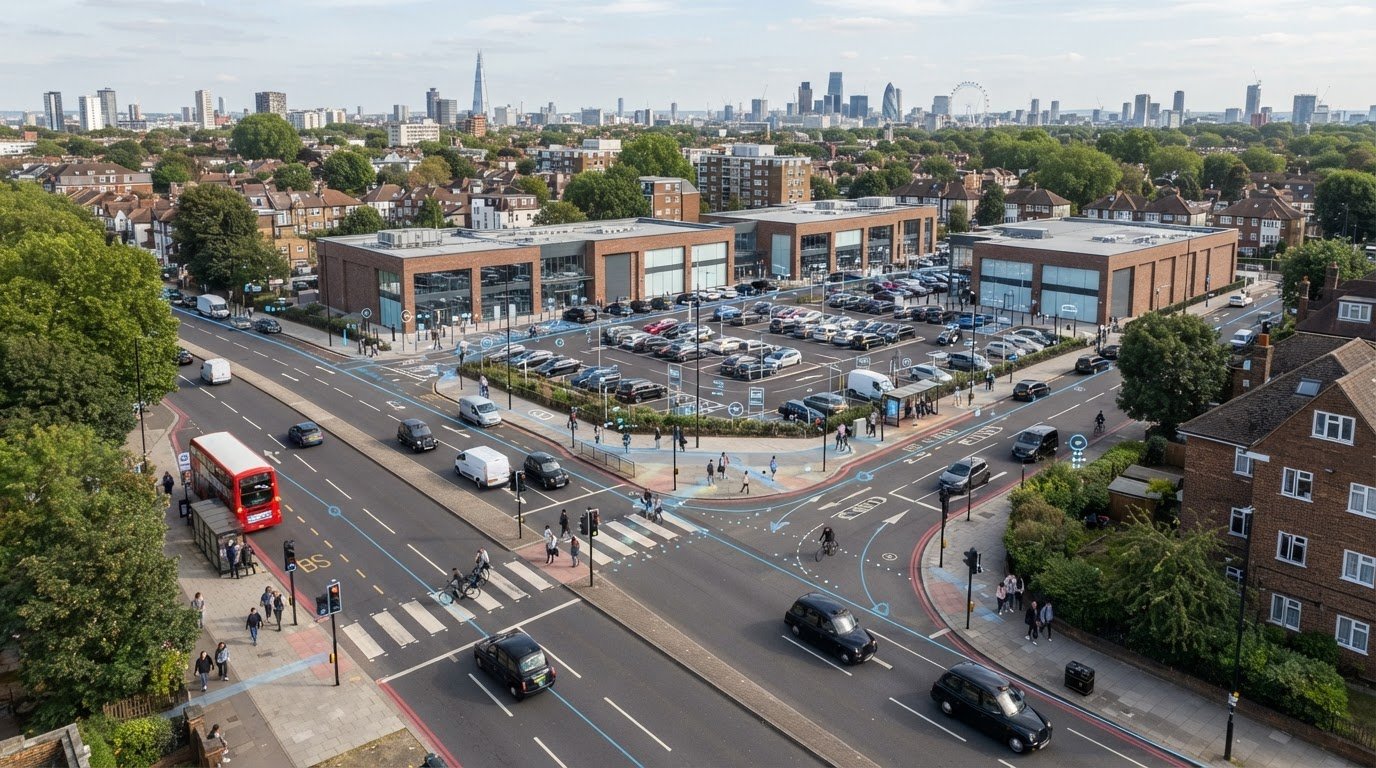
Could a retail park’s transport case be weakened by a report that counts vehicles but misses how shoppers, staff and deliveries move? A transport assessment for retail park in Brent should reflect the proposal and its actual location, not rely on a generic account of traffic. A key early decision is whether the planning application needs a detailed Transport Assessment or a more concise Transport Statement, and what evidence will explain the proposal’s effects.
This guide explains the factors that shape the assessment scope, from trip patterns, site access and parking to walking, cycling and public transport. It also outlines how the site’s local planning context can inform the evidence, so you can prepare a clear, proportionate submission.
You’ll find the project information to assemble and the local considerations to investigate before the report is developed. ML Traffic Engineers UK prepares Transport Assessments and Transport Statements tailored to the proposal and local authority context. Its hands-on approach is supported by senior staff who each have over 35 years of traffic engineering experience.
Key Takeaways
- Start by identifying how the proposal changes site access, traffic and other movement, rather than judging its transport requirements by the “retail park” label.
- A transport assessment for retail park in Brent should focus on the proposal’s relevant effects and the site’s specific circumstances.
- Understand how a detailed Transport Assessment differs from a concise Transport Statement, then consider which best fits the scheme and planning context.
- Bring together current plans, proposed uses, access details and operational assumptions to support a clear, well-grounded assessment.
- ML Traffic Engineers UK tailors planning documents to the local context, with over 35 years of traffic engineering experience for every senior staff member.
When might a Brent retail park proposal need a transport assessment?
Start by asking what the proposal would change about movement and access. A new retail park, an expansion, a change of use or a substantial alteration to an existing site can each affect travel in different ways. The development’s label alone doesn’t determine the assessment scope. The proposal, the site and the planning context do.
A Transport Assessment is a project-specific analysis of how a development may affect travel and transport, and how those effects relate to its location and design. It supports a planning application; it isn’t the planning decision itself or a guarantee of approval. A Transport Assessment is required for development of strategic importance that is legally referable to the Mayor of London. For other schemes, Brent Council determines whether a full assessment or a more concise Transport Statement is appropriate, considering the proposal and its likely effects.
Which retail park changes can affect transport assessment scope?
Focus on what is changing in practice: proposed floor space and uses, site access, parking arrangements, and how the existing operation may change. A new retail destination could generate different journeys from an extension to an established park. A change of use may alter visitor patterns, while revised access or servicing arrangements can affect how vehicles enter, leave and circulate.
Customer journeys are only part of the picture. Employees may travel at different times, and servicing and deliveries can involve distinct vehicle types, routes or operating patterns. The evidence required depends on the application and site circumstances. Define the proposed operation clearly rather than assuming a fixed survey or report scope.
Why does Brent’s local context matter?
A site’s surroundings help explain where its transport effects may be felt. Examine the streets serving the access, pedestrian routes, public transport connections and nearby destinations that could influence travel patterns. A proposal near Wembley may have a different context from one in Harlesden or Neasden. Use area-specific detail only when it accurately describes the site and its connections.
Brent’s adopted Local Plan, alongside the London Plan and wider transport policy, provides planning context for proposals. Check the current policy wording and site conditions rather than treating borough-wide assumptions as evidence about a particular location. For background on how a major retail destination connects with its surroundings, see Brent Cross Shopping Centre and its transport considerations. Brent Cross is a separate example, not a substitute for evidence about a site in the London Borough of Brent.
For a transport assessment for retail park in Brent, set out a clear chain of reasoning: what is proposed, how it changes travel, and which local connections or streets may be affected. Establishing that logic early helps the planning evidence address the actual scheme, without assuming that every retail park needs the same level of analysis.
What should a retail park transport assessment in Brent examine?
A useful assessment connects the proposed retail activity to the way people and vehicles will reach, use and leave the site. It should consider access, movement, parking, trip patterns and the effects relevant to the particular scheme. A new store, a change in the mix of retail uses and an expansion can each produce different travel patterns, so analysis should follow the proposal rather than a standard checklist.
Assessment scope should be proportionate to the proposal, its likely transport effects and the specific context of the site. The UK Government guidance on Transport Assessments and Statements provides a framework for preparing planning-related transport evidence. Use current, relevant information and explain clearly how the conclusions follow from the evidence.
How should retail trips, access, and junction effects be considered?
Start with the proposed uses and operating assumptions. Different retail activities can attract different customer patterns, while opening hours, staffing and servicing arrangements shape when and how journeys occur. Explain how the assessment estimates the number and distribution of trips, including likely arrival and departure routes. Avoid treating every visit as a car journey.
Then distinguish three things: existing transport conditions, forecast movement associated with the proposal, and any mitigation being considered. Review the site access and relevant nearby junctions in light of those forecasts. This helps show where development traffic may interact with existing movement and whether further analysis or a response is relevant. Don’t invent impacts or apply an assumed threshold. The method and focus should reflect the site and the authority’s requirements.
How do parking, servicing, and sustainable travel fit in?
Consider parking in relation to the proposed uses, expected demand, site layout and applicable Brent planning context. Stating the number of spaces alone may not explain how parking supports the operation or affects access and surrounding streets. Make the assumptions behind the provision clear, using current policy and site information to assess its suitability.
Service activity needs its own consideration. Deliveries, refuse collection and other servicing can involve different vehicle movements from customer visits, so their routes, access and interaction with site circulation may be relevant. Describe the operational assumptions used rather than implying that all movements happen in the same way or at the same time.
Assess walking, cycling and public transport through the connections people can actually use to reach the site. Consider where those routes lead and how the site entrance relates to them. Verify local conditions instead of relying on general statements about Brent’s transport network.
- Access: explain how vehicles, pedestrians and cyclists reach the site.
- Movement: set out the basis for trip estimates and route distribution.
- Parking and servicing: connect provision and operational assumptions to the proposed uses.
- Mitigation: identify responses only where the assessment establishes a relevant effect.
This evidence-led approach keeps a transport assessment for retail park in Brent focused and proportionate. ML Traffic Engineers UK tailors Transport Assessments to the proposal and local planning context. Read about transport assessment support from ML Traffic Engineers UK for planning applications.
Transport Assessment or Transport Statement: which suits a Brent retail park?
A retail park doesn’t automatically require a full Transport Assessment simply because of its name. The right document depends on what the application proposes, the likely transport effects and the relevant planning context. A new development, a change to an existing site or a revised mix of uses may each call for a different level of analysis.
In London, a Transport Assessment is required for developments of strategic importance that are legally referable to the Mayor. For other proposals, the local planning authority considers whether a Transport Assessment or Transport Statement is appropriate. The report should provide enough evidence to address the scheme’s relevant effects, without adding analysis that isn’t needed to explain them.
What distinguishes a Transport Assessment from a Transport Statement?
A Transport Assessment is the more detailed document. It may examine a wider range of transport effects and provide more in-depth analysis where the proposal and its context call for it. A Transport Statement is more concise, presenting relevant information for a scheme whose transport effects can be addressed at a simpler level.
There’s no universal floor-space, trip or cost threshold to use as a shortcut. The application, the site and the evidence needed to understand potential effects shape the report type. The London Transport Assessment guide explains the broader distinction and planning context.
What questions help define a proportionate scope?
To identify the appropriate level of evidence, work through the proposal and its likely transport implications. Useful questions include:
- What scale and mix of uses are proposed, and how do they differ from the existing site?
- Will access arrangements, site circulation or operating patterns change?
- Which customer, employee or servicing movements could be affected, and where?
- What reliable site and transport information is already available, and what gaps remain?
The answers help identify which topics are material, rather than importing a generic report template. For example, a proposal that changes site access may need focused consideration of how vehicles enter and leave. A change in use may make the revised travel pattern central to the assessment. These questions guide the scope; they are not automatic rules for requiring a particular survey or analysis.
Consider Brent-specific requirements against the current planning context and the circumstances of the site. Early discussion with the relevant planning authority can help establish what evidence it expects for the application. Record the reasoning behind the selected report type and its scope, so the submission shows how the analysis responds to the proposal.
A proportionate transport assessment for retail park in Brent is neither a generic checklist nor an oversized report. ML Traffic Engineers UK prepares Transport Assessments and concise Transport Statements tailored to the proposal and local authority context, helping applicants develop focused planning evidence.
How can applicants prepare transport evidence for a Brent retail park?
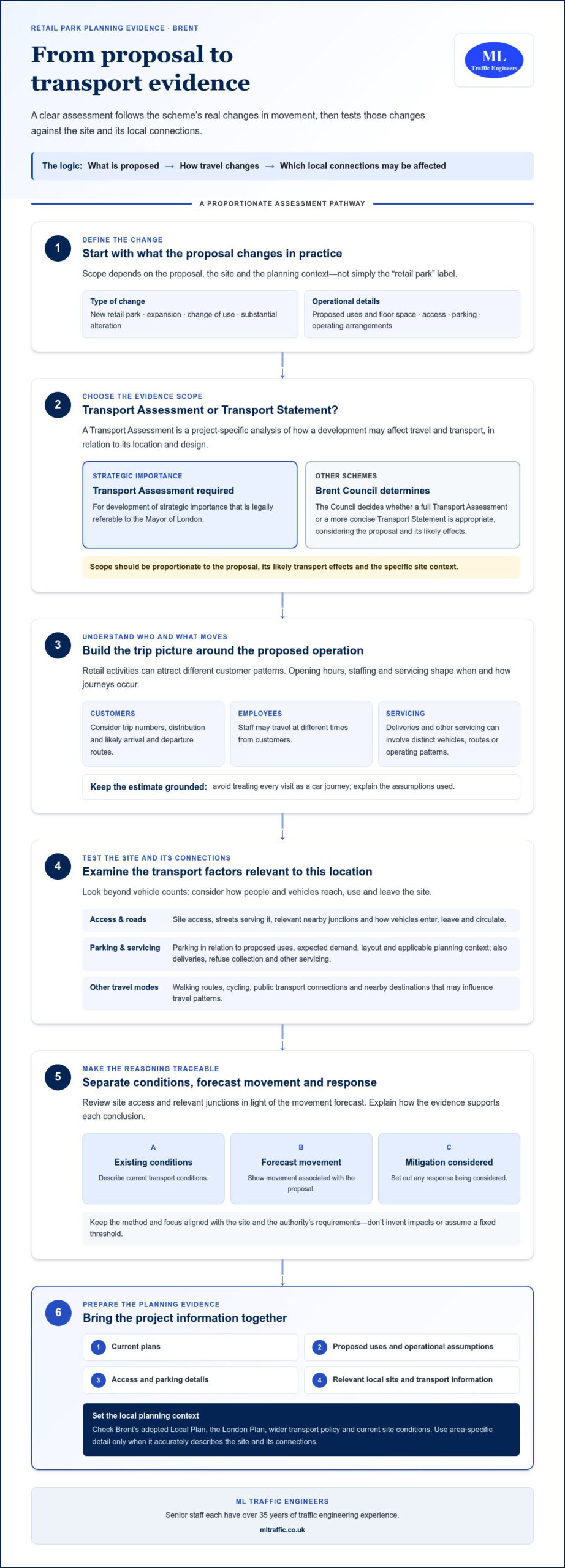
Good preparation starts with a stable description of the proposal and a clear record of what is known, what is assumed and what is still changing. This gives the assessment a reliable basis and keeps its analysis focused on the scheme. Use this sequence to organise the information before developing the transport evidence.
- Define the proposal. Set out the site location, proposed uses and scale, and explain whether the application involves a new development, an expansion or changes to an existing operation.
- Assemble current plans. Gather site and layout plans showing proposed access points, internal circulation, parking and relevant pedestrian or cycle connections. Make sure the plans reflect the design being assessed.
- Describe how the site will operate. Record known assumptions about opening hours, customer activity, staffing, deliveries, servicing and refuse collection. Distinguish confirmed details from estimates or design options.
- Set out the transport changes. Identify changes to access, parking or movement patterns, and note which surrounding routes or connections may be relevant to the proposal.
- Check the evidence base. Review current planning material and verified information about local streets, public transport, walking and cycling connections. Flag gaps that may affect the assessment scope.
What project information should be assembled first?
Start with the development description, drawings and access proposals, then add operational information that can influence travel. This may include the proposed use mix, parking arrangements, delivery assumptions and expected site activity. If the design or operating details are unsettled, identify the options clearly rather than treating a draft assumption as final. That allows the analysis to reflect the proposal being considered and makes later revisions easier to trace.
Consider how the characteristics of the development affect the transport evidence it needs. The useful question is not simply whether the site is described as retail, but which features of this particular proposal could shape the assessment.
How should local policy and evidence be checked?
Check the current wording and status of Brent planning documents and relevant transport guidance before describing a policy requirement in the submission. Then use site-specific information, such as the actual access arrangement and nearby connections, instead of assuming conditions are the same across the borough. Where information has not been verified, mark it as an assumption or identify it as a gap.
Keep the report narrative organised: explain what the evidence shows, state the assumptions used to interpret it, and distinguish both from any recommendations. This makes the reasoning easier to follow and helps ensure that proposed responses relate to identified issues. A carefully prepared transport assessment for retail park in Brent can clarify the proposal’s transport context, but it cannot guarantee a planning outcome.
ML Traffic Engineers UK takes a hands-on approach to planning-related transport evidence, tailoring Transport Assessments and concise Transport Statements to the scheme and local authority context. Read about transport assessment support from ML Traffic Engineers UK.
How ML Traffic Engineers supports retail park assessments in Brent
A retail park proposal needs transport evidence that reflects its design, use and location. ML Traffic Engineers UK prepares Transport Assessments and concise Transport Statements for planning applications, tailoring the scope to the scheme and the relevant local authority context. The aim is clear, project-specific analysis, not a universal template applied regardless of the site.
Every senior staff member has over 35 years of traffic engineering experience. The team takes a hands-on approach, considering the proposal and available information to develop transport evidence suited to Brent’s planning context. ML Traffic Engineers UK serves Greater London, Manchester, Birmingham, the West Midlands, Liverpool, Surrey, East Sussex, West Sussex, Hampshire, Berkshire and Buckinghamshire.
What does a hands-on, locally tailored assessment involve?
It starts with understanding what the application proposes and which transport questions are relevant to that specific site. The assessment can then focus on the evidence needed to explain the proposal’s transport implications, taking account of applicable local planning considerations and verified site information.
This matters because two retail schemes can differ in their uses, access arrangements and operation. An analysis tailored to one site may need to address different issues from a report for another location. ML Traffic Engineers UK’s approach keeps the assessment aligned with the project rather than treating a standard checklist as a substitute for professional judgement. Scope and analysis are shaped by the proposal and planning context; a report does not determine the planning decision or guarantee a particular outcome.
Clear communication is part of a useful assessment. The report should make its evidence and assumptions understandable, explain how they relate to the proposed scheme and identify relevant considerations without overstating what the available information shows. This gives the planning submission a coherent transport narrative to be considered alongside its other material.
What is the next step for a Brent retail park proposal?
Bring together the information already available, such as current site plans, the development description, proposed uses and access details. Explain the planning stage and identify operational details that are known, provisional or still being developed. These inputs help shape an initial discussion around the proposal and the appropriate transport evidence.
Whether the project is at an early design stage or being prepared for submission, ML Traffic Engineers UK provides hands-on support with a Transport Assessment or Transport Statement tailored to the scheme. Its work across Greater London, including Brent, takes account of differences in local authority planning context.
For a transport assessment for retail park in Brent, begin with the proposal, its planning stage and the information available. This focuses the assessment on the site’s requirements and the evidence needed to support a clear application.
Explore transport assessment support from ML Traffic Engineers UK.
Move your Brent retail proposal towards a clear next step
Transport planning is most useful when it starts early enough to inform the proposal, not just describe it after key design decisions have been made. A well-scoped transport assessment for retail park in Brent can bring transport considerations into the planning process while the scheme is taking shape.
ML Traffic Engineers UK takes a hands-on approach, tailoring assessment work to the development and local planning context. Every senior staff member brings over 35 years of traffic engineering experience, supporting clear, considered advice as project details develop. The aim is to establish a sound basis for the transport evidence, not to promise a particular planning outcome.
Share where your proposal stands and what information is available. A focused discussion can help identify a practical direction for the next stage of your planning work.
Discuss your Brent retail park transport assessment and take the next step with ML Traffic Engineers UK.
Frequently Asked Questions
Does every retail park planning application in Brent need a Transport Assessment?
No, a Transport Assessment isn’t automatically required for every retail park application in Brent. The need depends on the proposal, its likely transport effects and the planning context. For a transport assessment for retail park in Brent, establish whether the application is strategically referable and identify the proportionate evidence for the scheme. This is a decision about the evidence needed, not planning approval: submitting a report doesn’t itself secure permission.
Can an existing Transport Assessment be reused for a retail park extension?
It may provide useful background, but review its relevance before using it for an extension application. Check when the data was collected, which development and operating assumptions it examined, and whether the current proposal changes uses, access or servicing. Also consider whether surrounding transport conditions have changed since the report was prepared. Earlier material can inform the new assessment, but shouldn’t be treated as automatically current or sufficient.
How early should a developer commission a retail park transport assessment?
Consider transport evidence while the proposal and access arrangements are still being developed. This gives the project team an opportunity to identify movement questions and evidence needs before the design is fixed for submission. The right point depends on the project programme and how much reliable information is available. Early coordination can clarify the assessment scope, but there’s no single lead time that suits every scheme.
Can a Transport Assessment support a change of use at a Brent retail park?
Yes, transport evidence can help explain the effects of a proposed change of use. A different use may alter visitor travel patterns, parking demand, servicing activity or access requirements, even if the site boundaries stay the same. The appropriate document and level of analysis depend on the proposed use, site circumstances and planning context. Focus on what changes operationally, rather than assuming every change needs the same report.
Does a Transport Assessment guarantee planning permission for a retail park?
No. A Transport Assessment provides technical evidence to help decision-makers understand a proposal’s transport implications; it doesn’t guarantee planning permission. The planning authority considers the application as a whole, including relevant planning matters beyond transport. A clear, evidence-based report can explain the assessment and its assumptions, but the decision rests with the authority after considering the submitted application and applicable planning context.
Can a retail park Transport Assessment include walking, cycling, and public transport?
Yes, these modes can be examined where they’re relevant to the proposal and site. The assessment should consider actual routes and connections serving the development, using verified information rather than broad assumptions about accessibility across Brent. The borough’s transport strategy includes accessibility and inclusion objectives, but check current local documents before citing policy wording or drawing conclusions about a particular site.
What should I send a consultant before discussing a Brent retail park assessment?
Useful starting information includes a short development description, available site and access plans, the proposed uses, known parking and servicing arrangements, and the current application stage. If drawings are under revision, indicate which version reflects the latest design. These materials aren’t a fixed checklist or a prerequisite for an initial conversation. They help frame the proposal and identify what further transport evidence may be relevant.

Disclaimer
The content on mltraffic.co.uk, including all technical articles, guides, and resources, is provided for general informational and educational purposes only. It is not intended to constitute professional advice in traffic engineering, transportation planning, development approvals, or any other technical or legal field.
While ML Traffic Engineers makes every reasonable effort to ensure the accuracy, completeness, and timeliness of the information published, we do not provide any warranties or representations (express or implied) regarding its reliability, suitability, or availability for any particular purpose. Any reliance you place on the content is strictly at your own risk.
In no event shall ML Traffic Engineers, its directors, employees, authors, or affiliates be liable for any direct, indirect, incidental, special, consequential, or punitive damages (including, without limitation, loss of profits, data, or business opportunities) arising out of or in connection with the use of, or inability to use, any information provided on this website.
The articles and guides on this site are not a substitute for engaging a qualified, professional traffic engineer to assess your specific project requirements. For tailored advice, compliance assessments, or traffic engineering services, please contact a competent professional.
This disclaimer may be updated from time to time without notice. By accessing or using this website, you agree to be bound by the most current version of this disclaimer.