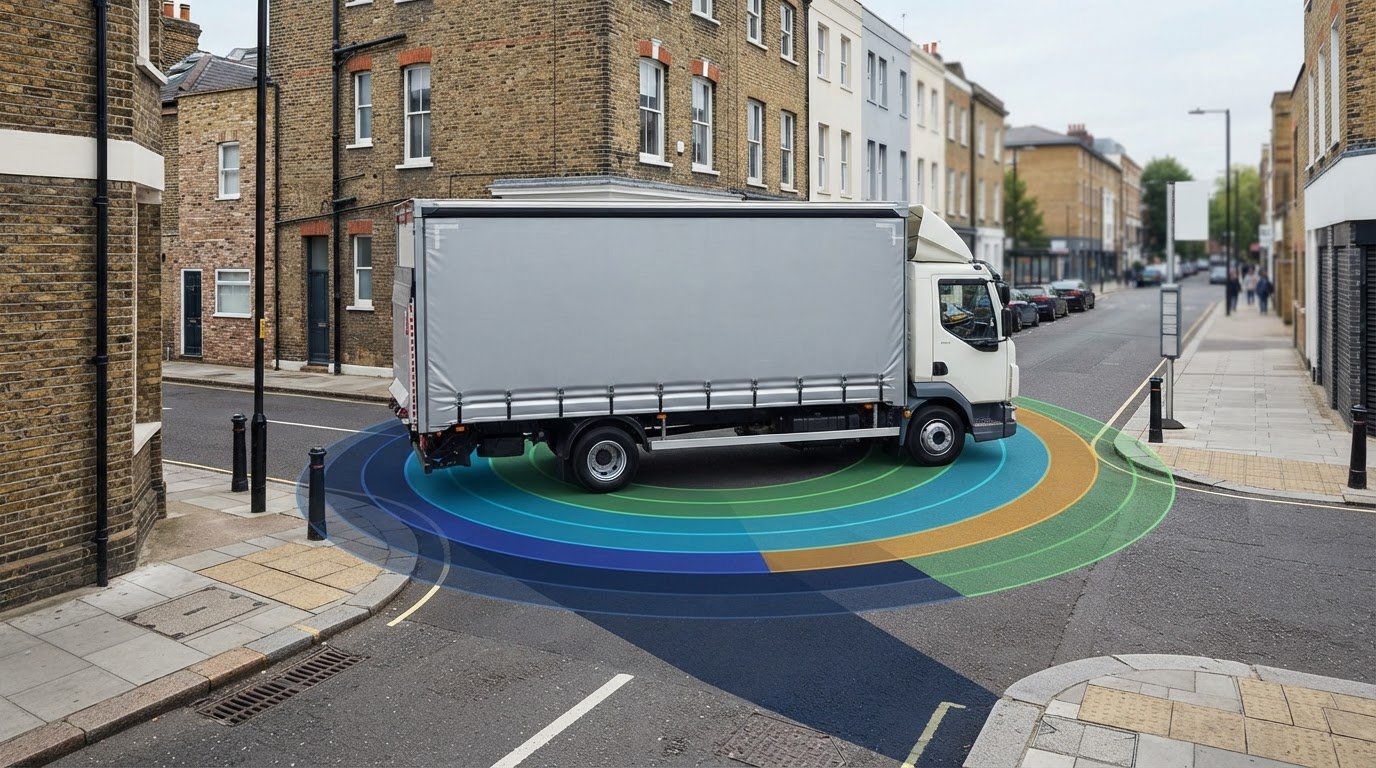
Will a delivery vehicle that can turn on paper actually fit through your proposed access? Swept path analysis for delivery vehicle turning circles answers a more site-specific question than turning-circle data alone: whether the selected vehicle can complete the required manoeuvre without its body encroaching on kerbs, buildings or pedestrian space.
It’s easy to focus on a vehicle’s turning circle when planning access. That figure describes turning capability under stated conditions, but it doesn’t show the full area the vehicle occupies while entering, turning or leaving a site. This difference matters where roads are narrow, corners are tight, or space is shared with pedestrians and other vehicles.
This article explains how turning-circle information differs from a swept path assessment, how to select a suitable design vehicle, and which manoeuvres and layout constraints to consider. It also explains how a project-specific assessment can present delivery access clearly for planning consideration. ML Traffic Engineers UK provides Swept Path Analysis tailored to the site and local planning context, drawing on senior traffic engineering experience to help identify access issues early.
Key Takeaways
- Use turning-circle data as a starting point, then assess the vehicle’s full movement against the site layout.
- Consider vehicle length, width, wheelbase and steering characteristics when reviewing rear-wheel tracking and body swing at tight corners.
- Select a design vehicle and manoeuvre that reflect the delivery movements the development needs to accommodate.
- When reviewing a tracking drawing, check that the base plan, vehicle model, route and manoeuvre match the project brief.
- Project-specific swept path analysis for delivery vehicle turning circles can help the design team identify access constraints in context.
What does a delivery vehicle turning circle show, and what does it leave out?
A turning circle describes the space a vehicle needs to change direction under stated test conditions. Swept path analysis models a vehicle’s movement through a particular manoeuvre on a drawn layout, showing where its wheels and body travel in relation to surrounding features. For delivery access, swept path analysis for delivery vehicle turning circles uses turning-circle information as a starting point, then tests whether the proposed route works in practice.
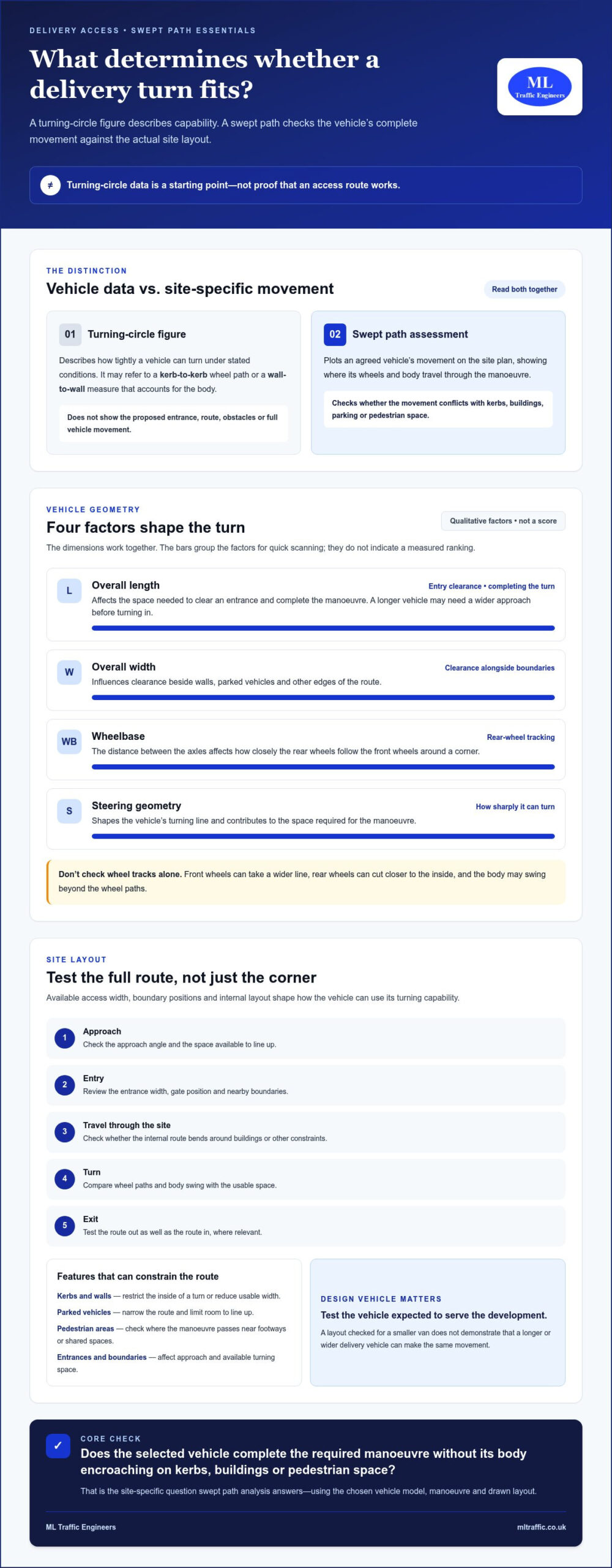
A turning-circle figure describes vehicle geometry, not every constraint on a development site. Its meaning depends on the vehicle and how the figure is measured or presented. It may refer to a kerb-to-kerb turning circle, based on the path of the wheels, or a wall-to-wall circle, which accounts for the vehicle body. The figure alone doesn’t show whether a vehicle can negotiate a site entrance, avoid an obstruction or complete a turn without encroaching on adjacent space.
For a visual introduction to vehicle movement and tracking, watch this educational video:
What information does a turning-circle figure provide?
A turning-circle measurement indicates how tightly a vehicle can turn under the conditions used to establish the measurement. It helps describe the vehicle’s turning capability, but it isn’t a drawing of a proposed access route. Two figures for the same vehicle can also describe different limits if one records the wheel path and the other includes the bodywork.
That distinction matters in a constrained layout. A vehicle might have a turning circle that appears suitable, yet still need more room at the entrance because of its approach angle, a gate position or its direction of travel. Treat the figure as vehicle data to interpret, not proof that the access works.
Why is a swept path different from a turning circle?
Vehicle tracking plots movement across a specific plan, from an agreed starting point through the manoeuvre and, where relevant, out again. It can show the front wheels taking a wider line while the rear wheels cut closer to the inside of a turn. The body may also swing beyond the wheel paths, particularly at the front or rear, so checking wheel tracks alone can miss potential conflicts.
The assessment depends on both the vehicle model and the site geometry. It can help reveal whether the tracked movement conflicts with kerbs, buildings, parking spaces or areas used by pedestrians. The AutoTrack Wikipedia page provides general background on vehicle tracking software and its use in transport design. For more detail on preparing and interpreting tracking drawings, see this practical AutoTURN swept path guide.
Turning-circle data describes a vehicle’s turning capability; a site-specific swept path tests whether its complete movement fits the proposed layout. That is the key distinction when assessing delivery access.
How delivery vehicle geometry shapes a turning manoeuvre
A vehicle’s turning performance depends on several dimensions working together. Overall length, width, wheelbase and steering geometry affect how much room it needs and where its wheels and body travel during a turn. A delivery vehicle may enter comfortably but still struggle to turn within the site or leave without crossing a kerb or entering a pedestrian area.
Assess the vehicle expected to serve the development, not a convenient substitute. A layout tested for a smaller van may not demonstrate that a longer or wider delivery vehicle can make the same movement. In swept path analysis for delivery vehicle turning circles, the chosen vehicle model and manoeuvre need to reflect the delivery operation the access is intended to accommodate.
Which vehicle dimensions matter for delivery access?
Overall length affects how much space a vehicle needs to clear an entrance and complete a turn. Width influences clearance alongside walls, parked vehicles and other boundaries. Wheelbase, the distance between the axles, affects how closely the rear wheels follow the front wheels around a corner. Steering geometry also shapes how sharply the vehicle can turn.
These factors interact. For example, a longer vehicle negotiating a tight entrance may need a wider approach before turning in. Its front wheels can take a broad line while the rear wheels track closer to the inside edge. The body may also swing out, bringing a front or rear corner nearer to an obstacle than the wheel paths suggest.
How do site constraints change the manoeuvre?
Vehicle geometry is only one part of the assessment. The available access width, boundary positions and internal layout determine how the vehicle can use its turning capability. Test the movement as a sequence: approach, entry, travel through the site, turn and exit. A vehicle that can complete a turn in an open area may not manage the same movement when an entrance is narrow or the route bends around a building.
On the drawing, identify features that could limit clearance or shape the driver’s route:
- Kerbs and walls can restrict the inside of a turn or reduce the usable width of an access.
- Parked vehicles can narrow a route and limit the space available to line up for a turn.
- Pedestrian areas need consideration alongside the vehicle’s tracked route, particularly where the manoeuvre passes near footways or shared spaces.
- Entrances and boundaries can affect the approach angle and the space needed for the vehicle to enter or leave.
The relevant constraints depend on the site plan and the movement being tested. A vehicle’s steering capability can’t be assessed in isolation from the route available to use it.
Turning performance depends on the vehicle and the layout together: change either one, and the space needed for the manoeuvre can change. A project-specific tracking assessment brings those factors into view, helping the design team review constrained access in context. For support with delivery access planning, explore ML Traffic Engineers UK transport planning services.
Which delivery vehicle and turning scenario should the assessment test?
The design vehicle should represent the delivery activity the development is intended to accommodate. A tracking drawing based on a vehicle that is smaller or easier to manoeuvre than the expected delivery vehicle may not answer the access question that matters. Match the vehicle model to the proposed use and specify the movement being tested.
The table below summarises how broad vehicle categories can create different tracking demands. These are selection prompts, not fixed specifications: actual dimensions and manoeuvring characteristics depend on the vehicle chosen.
| Vehicle type | Characteristics to consider | Manoeuvre demands to assess |
|---|---|---|
| Rigid delivery vehicle | A single rigid vehicle body; length, width and steering characteristics vary by model. | Entry alignment, turning within the site and clearance around the vehicle body. |
| Articulated vehicle | A tractor unit and trailer move in relation to each other, affecting the path through a turn. | Approach space, articulation through corners, internal circulation and room to depart. |
| Van or other project-relevant vehicle | Vehicle size and configuration should reflect the servicing activity, rather than an assumed standard model. | Access width, turning space and whether the vehicle can reach the intended loading or servicing area. |
How should the design vehicle reflect site use?
Start with the development’s intended use and the delivery arrangements it needs to support. A site expecting routine stock deliveries may need a different design vehicle from one receiving occasional smaller consignments. State the basis for the choice, including the vehicle type and relevant assumptions, so the assessment can be understood in context. These assumptions describe the scenario tested; they aren’t universal requirements for every site.
Where more than one vehicle type is relevant, assess the movements that matter to the proposal rather than assuming one model represents every delivery. Traffic engineering input can help relate the vehicle choice to the site layout and local planning context.
Which manoeuvres should the drawing examine?
Define the route as a sequence, from arrival to departure. Depending on the layout, this may include approach and entry, circulation within the site, access to a loading area shown on the plan, and the exit movement. If the vehicle needs to reverse, include that movement where it forms part of the proposed arrangement. Don’t imply the drawing tests reversing if it only shows a forward route.
Make the drawing’s scope clear. Identify the vehicle model, starting position, direction of travel and movements included. For example, a plan showing entry and a turn towards a loading area doesn’t necessarily demonstrate that the vehicle can also leave the site. A well-scoped swept path analysis for delivery vehicle turning circles tests a defined vehicle against a defined access question.
Choose the design vehicle to match the delivery activity, then test the manoeuvre the layout must accommodate. That keeps the assessment focused and makes its assumptions and limits clear to the project team.
How to review a delivery vehicle swept path drawing
A swept path drawing is useful only if it tests the right vehicle on the right layout, using the movement the project needs to accommodate. Review it against the project brief and proposed site plan, not as a standalone graphic. The sequence below helps identify mismatches and potential conflicts before the drawing informs design or planning discussions.
What should the drawing and project inputs show?
Start with the base plan. It should represent the proposed access and internal arrangement being assessed, including the relevant boundaries and site features. If the layout has changed since the tracking was prepared, check whether the drawing still reflects the current proposal. A movement plotted against an earlier arrangement may not demonstrate access under the latest design.
Then follow this review sequence:
- Confirm the base layout. Compare the entrance, internal route, turning area and relevant site features with the project plan. Look for differences that could affect usable space or the vehicle’s route.
- Identify the design vehicle. Check that the vehicle model or type matches the delivery activity described in the brief. If the vehicle is unclear, it’s difficult to relate the result to the intended use.
- Check the movement and direction. Trace the route from its starting point through the site. Confirm whether the drawing shows arrival, entry, circulation, access to the relevant area and departure, as required by the assessment brief.
- Read the assumptions and scope. Note any stated assumptions about the route or manoeuvre. Identify information that is missing or unclear, without assuming that every project or planning authority requires the same drawing format.
- Compare the result with the brief. Check that the vehicle, route and manoeuvre shown answer the access question the project set out to assess.
This review makes the scope visible. A drawing that illustrates entry and turning, for example, doesn’t necessarily show how the vehicle leaves the site. The practical swept path analysis guide explains how tracking drawings can support planning applications.
How can the drawing reveal a layout conflict?
Follow the vehicle through each stage of the manoeuvre and look for overlap between its tracked path and fixed or potentially occupied areas. Check kerbs, buildings, site boundaries, parking spaces and pedestrian areas. Consider the full vehicle envelope represented in the drawing, not just the path of its wheels. A tight corner may appear clear at one stage while the body or rear tracking conflicts elsewhere on the turn.
Check that the movement completes the stated task. Does it reach the intended access or loading area? Is the departure shown, and does the vehicle follow the route described in the brief? If the drawing tests only part of the journey, record that limit clearly.
Describe any concern precisely: identify the manoeuvre, the location and the feature affected. For instance, note that the tracked vehicle overlaps a parking space while turning into the internal route. This gives the design team a clear point to consider when reviewing the layout, without presuming a particular design response.
For a project-specific review of delivery access, see ML Traffic Engineers UK’s Swept Path Analysis service.
When project-specific swept path analysis supports delivery access planning
A delivery access question becomes specific as soon as a vehicle must negotiate a particular entrance, internal route or turning area. Project-specific swept path analysis tests the intended vehicle movement against the development layout, helping the design team see where space is constrained and what the drawing does, or doesn’t, demonstrate. This is especially useful where a tight access, nearby boundary or internal corner could affect the proposed route.
The assessment relates to the vehicle, layout and manoeuvre being considered. It can help clarify whether a delivery vehicle can arrive, reach the intended area and depart using the route shown. The result gives the project team a defined movement to discuss and a clearer basis for reviewing the access arrangement.
How does the analysis support a planning submission?
A swept path drawing can communicate the vehicle and movement assessed by showing the tracked route in relation to the site plan. Clear scope helps readers understand which parts of the journey the drawing demonstrates and how the movement relates to the proposed layout. It can support consideration of delivery access as part of a wider planning submission where relevant to the project.
Not every proposal needs the same supporting documents. Where a project also requires wider transport assessment, the delivery movement can be considered alongside other transport matters. The Transport Assessment London guide provides related context on transport planning for development proposals.
What does project-specific traffic engineering input add?
Project-specific input brings the actual vehicle, proposed layout and relevant planning context together. This matters when access is constrained or when the drawing needs to communicate a precise movement clearly. Local planning considerations can vary, so an assessment tailored to the project location helps the team present the proposed delivery route in context rather than relying on a generic turning assumption.
ML Traffic Engineers UK provides Swept Path Analysis and transport planning documentation for development projects in Greater London, Manchester, Birmingham, the West Midlands, Liverpool, Surrey, East Sussex, West Sussex, Hampshire, Berkshire and Buckinghamshire. Every senior staff member has over 35 years of traffic engineering experience, supporting careful review of vehicle movements and site layouts. The primary keyword, swept path analysis for delivery vehicle turning circles, captures the distinction: turning-circle information informs the assessment, while project-specific tracking tests a defined manoeuvre against the site.
Early assessment can make access constraints clearer while the layout is being considered. It gives the design team a practical opportunity to understand what the proposed movement shows and where further layout review may be useful, without implying a guaranteed planning outcome.
For a project-specific assessment of delivery access, explore Swept Path Analysis with ML Traffic Engineers UK.
Make delivery access part of the next design decision
Use the access assessment as a live design reference, not a drawing that sits apart from evolving plans. As the site layout develops, keep the intended delivery vehicle and movement assumptions visible to the project team. If an entrance, boundary or internal arrangement changes, revisit the tracking so it still reflects the proposal being progressed. This keeps the purpose of swept path analysis for delivery vehicle turning circles clear through design development and planning consideration.
A useful next step is to bring the access plan and delivery movement into the same conversation. That gives the team a practical basis for considering constraints early and deciding whether the layout needs further review. ML Traffic Engineers provides project-specific Swept Path Analysis, with assessments tailored to the local planning context and senior staff who each have over 35 years of traffic engineering experience.
Discuss your delivery access assessment with ML Traffic Engineers and take the next step with a clearer basis for planning your site access.
Frequently Asked Questions
Is a delivery vehicle turning circle the same as swept path analysis?
No. A turning circle describes a vehicle’s turning geometry under specified measurement conditions, while swept path analysis models its movement along a particular route. For a development access, the analysis relates the vehicle’s track to the site plan. A circle figure by itself can’t show whether the vehicle can complete the proposed route. When reviewing drawings, check what the stated turning figure measures before comparing it with the layout.
Can a delivery vehicle turn within a site if its turning circle fits the access?
Not necessarily. An access width or turning-circle comparison alone doesn’t establish that the whole manoeuvre is feasible. The outcome can also depend on the vehicle’s starting position, its angle of entry, the route through the site and nearby features such as a gate or parked cars. Assess the intended movement against the site plan, including the approach and departure, rather than relying on one dimension.
How is a delivery vehicle swept path assessed?
The assessment starts by defining the vehicle and the movement the project needs to examine. The vehicle is then tracked against the relevant site layout, and the plotted route is reviewed for potential conflicts with site features. For example, the brief might ask whether a delivery vehicle can enter and reach a servicing area. The drawing should identify the vehicle and movement assumptions so readers can understand the scope of the result.
What information is needed for a delivery vehicle swept path analysis?
Typically, the assessment needs a layout showing the access and relevant internal arrangement, the vehicle to be tested and a clear description of the manoeuvre. The project brief can help define whether the drawing should examine arrival, circulation, access to a loading area or departure. Changes to the plan or delivery assumptions can affect the assessment, so align the inputs with the current proposal rather than relying on an outdated layout.
Does a turning-circle drawing prove that delivery access is suitable?
No. A turning-circle drawing can indicate turning capability, but it doesn’t by itself demonstrate that the proposed site movement fits the available space. Suitability depends on the vehicle’s route and the layout features around it. A swept path drawing relates the movement to those features, giving the project team a clearer basis for reviewing access. It can inform planning consideration, but it doesn’t guarantee a planning decision.
Which delivery vehicle should be used for swept path analysis?
Choose a design vehicle that reflects the delivery activity the development is intended to accommodate. A site receiving routine larger deliveries may need a different assessment vehicle from one served by smaller vehicles; the relevant choice depends on the proposed use and servicing arrangements. Record the vehicle and assumptions clearly. ML Traffic Engineers provides project-specific Swept Path Analysis in Greater London, Manchester, Birmingham, the West Midlands, Liverpool, Surrey, East Sussex, West Sussex, Hampshire, Berkshire and Buckinghamshire.

Disclaimer
The content on mltraffic.co.uk, including all technical articles, guides, and resources, is provided for general informational and educational purposes only. It is not intended to constitute professional advice in traffic engineering, transportation planning, development approvals, or any other technical or legal field.
While ML Traffic Engineers makes every reasonable effort to ensure the accuracy, completeness, and timeliness of the information published, we do not provide any warranties or representations (express or implied) regarding its reliability, suitability, or availability for any particular purpose. Any reliance you place on the content is strictly at your own risk.
In no event shall ML Traffic Engineers, its directors, employees, authors, or affiliates be liable for any direct, indirect, incidental, special, consequential, or punitive damages (including, without limitation, loss of profits, data, or business opportunities) arising out of or in connection with the use of, or inability to use, any information provided on this website.
The articles and guides on this site are not a substitute for engaging a qualified, professional traffic engineer to assess your specific project requirements. For tailored advice, compliance assessments, or traffic engineering services, please contact a competent professional.
This disclaimer may be updated from time to time without notice. By accessing or using this website, you agree to be bound by the most current version of this disclaimer.