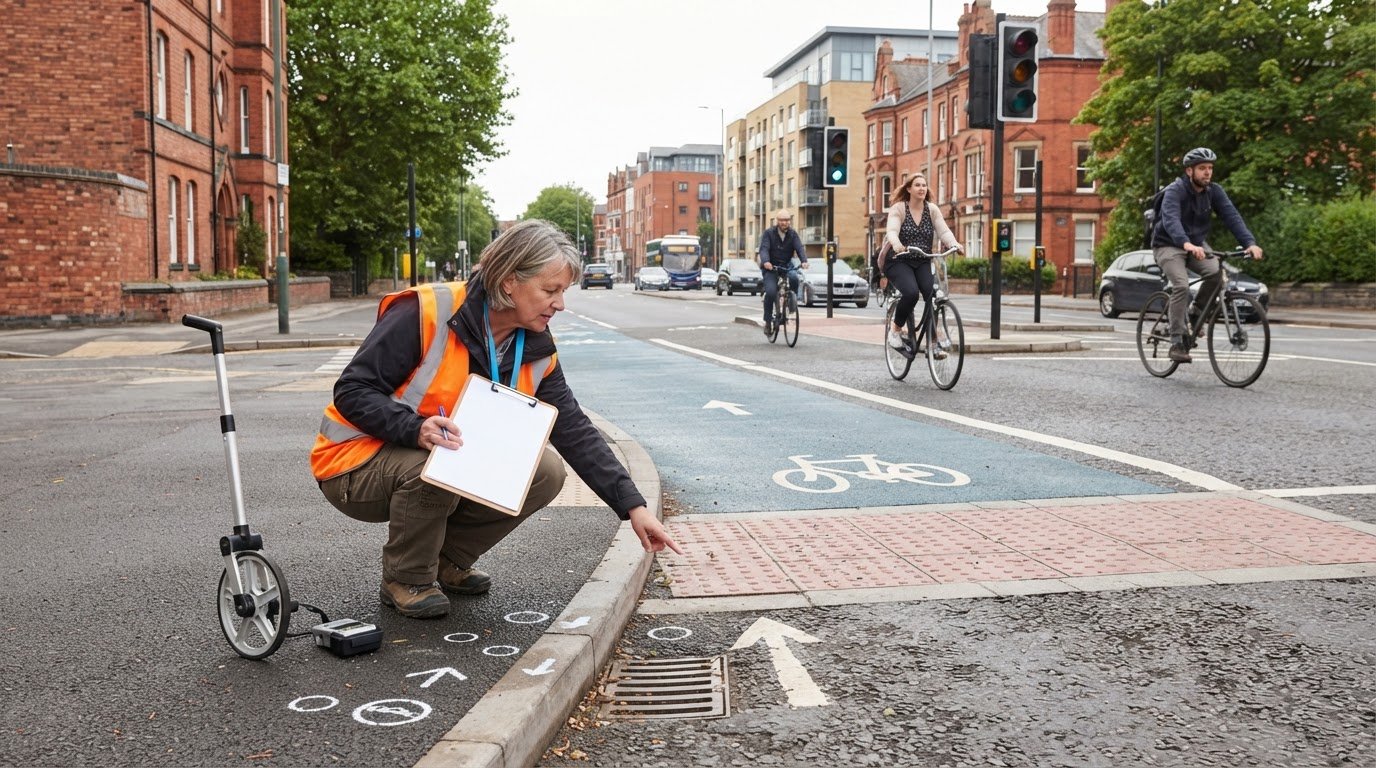
Is a cycle audit simply a road safety audit with a different name, or a review of how well a route works for people on bikes? If you’re searching for what is a cycle audit and review, the terminology can be confusing, especially when “audit cycle” also appears in clinical and financial contexts.
In transport planning, a cycle audit examines cycling infrastructure and conditions against relevant design principles and guidance. It can consider whether a route is safe, direct, comfortable and coherent, including how it connects at junctions and crossings. That is broader than checking collision risks alone, and it is not the same as a Transport Assessment, which considers a development’s wider transport impacts.
This guide explains the purpose and typical scope of a cycle audit and review, what evidence can make its findings useful, and how it differs from a Road Safety Audit and other assessments. It also explains how cycling observations can inform development planning and contribute to a Transport Statement or Transport Assessment without being mistaken for either.
Key Takeaways
- Understanding what is a cycle audit and review helps clarify how a cycling-focused assessment can identify route issues and opportunities.
- Assess a route in context by considering its users, nearby land uses and scheme objectives, alongside relevant observations, plans and data.
- Distinguish a cycle review from a Road Safety Audit and Transport Assessment by comparing each assessment’s purpose and scope.
- Set a clear review question, boundary and decision context before choosing evidence and an approach suited to the project.
- Use relevant cycling findings to inform design discussions and wider transport planning, with the development and local authority context in view.
What Is a Cycle Audit and Review, and What Is It For?
A cycle audit and review is a cycling-focused assessment of an existing route, its conditions or proposed infrastructure. It examines how people can access and use the route, where the design or connections may create difficulties, and what could make cycling more practical. The findings inform decisions about a route or scheme. They are not a one-size-fits-all pass or fail result.
If you’re asking what is a cycle audit and review, the key point is that its scope depends on the project, the question being examined and the relevant guidance. A review of a proposed access road, for example, may focus on its effect on nearby cycle connections. A route review may instead look at continuity and the experience along its length. In England, LTN 1/20 provides guidance on cycle infrastructure design; other UK nations have their own guidance.
The transport meaning is distinct from clinical and financial audit cycles. A Clinical audit concerns healthcare practice, while a financial audit examines accounts.
What does a cycle audit and review examine?
The assessment can consider whether a route is continuous and easy to follow, whether people can reach it from nearby destinations, and how junctions, crossings or changes in provision affect the journey. It may also consider how the route works for different people cycling, including those who may need more space or a less stressful environment. The relevant questions depend on the scheme, rather than a single checklist applied to every project.
Both current conditions and proposed changes can be reviewed. Site observations may reveal features that drawings alone do not show, such as a confusing transition or difficult connection. Plans and available data help reviewers understand the intended layout, network connections and scheme objectives. Together, these sources provide a fuller picture of how cycling fits into the route or proposal.
Why might a development or highway scheme need one?
For a development, cycling considerations can help explain how the site connects with surrounding routes and whether the proposed access arrangements support cycling. For a highway scheme, a review can bring potential effects on existing cycle movements into design discussions. These findings help decision-makers consider how proposed changes respond to local conditions and project objectives.
Timing matters. Considering cycling while proposals are still being developed can bring design issues into view before the layout is finalised, when alternatives may still be discussed. A review can also provide context for wider transport planning, including a Transport Statement or Transport Assessment where appropriate. It informs decisions; it does not guarantee planning approval, funding or a particular design outcome. The final decision depends on the full proposal and applicable planning context.
What Does a Cycle Audit Review? Routes, Users, and Design Context
A useful review starts with the route and the reason for examining it. It considers how the route functions within its surroundings, who may use it, and what the development or highway scheme is intended to achieve. That context keeps the review focused on relevant issues rather than applying a generic checklist without regard to the project.
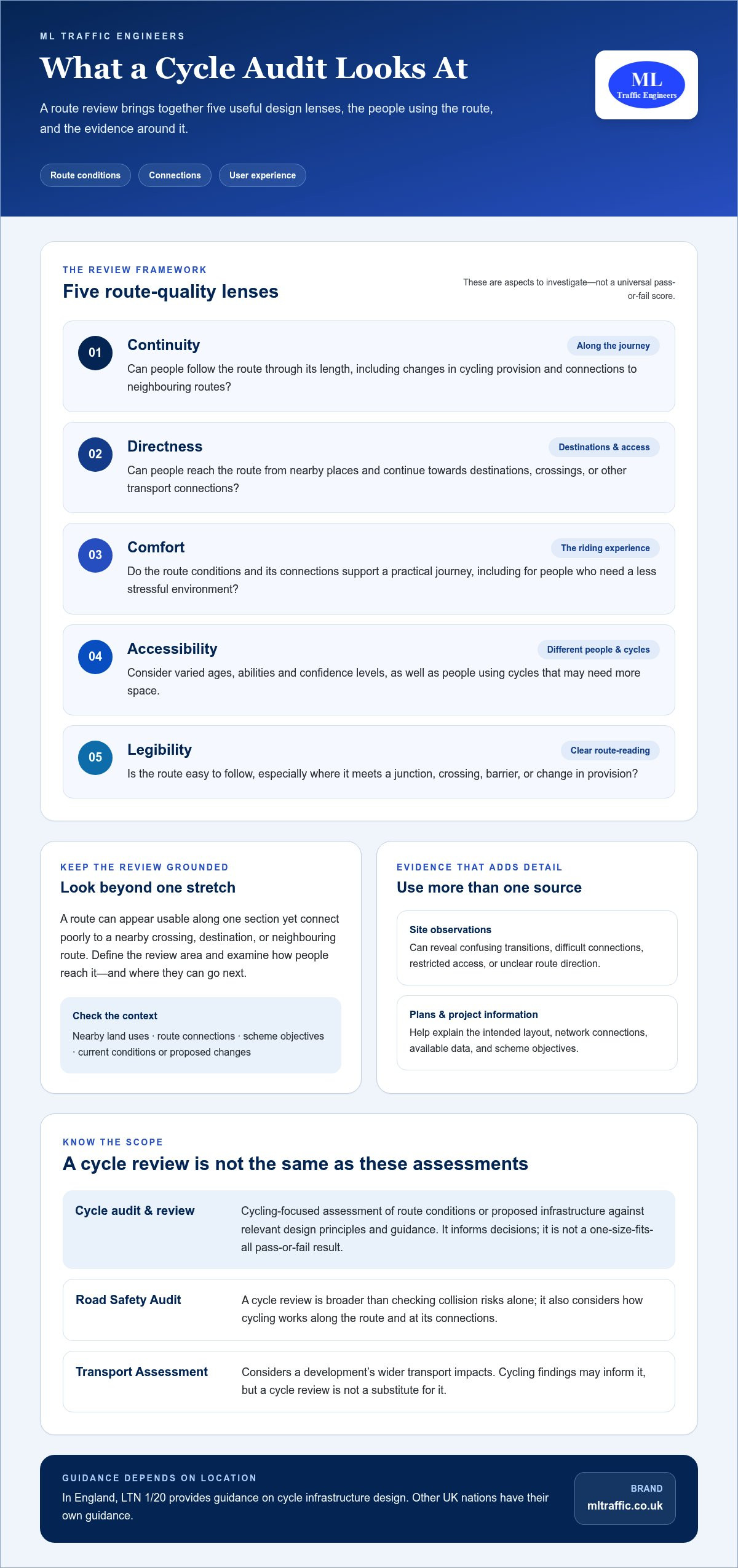
Reviewers may consider continuity, directness, comfort, accessibility and legibility. These are useful aspects to investigate, not a universal test or standard for every project. Applicable guidance depends on the location and scheme. In England, Department for Transport guidance such as Local Transport Note 1/20 may be relevant to cycle infrastructure design. The review should use guidance appropriate to its purpose and location.
How route conditions and connections shape the review
Assessing a route in isolation can miss problems at its edges. A path may appear usable along one stretch yet connect poorly to a nearby crossing, local destination or neighbouring route. Consider how people reach the route and where they can go next, including links to public transport or other existing transport connections where relevant.
At key points, the review may examine barriers, crossing locations, junction arrangements and transitions between different types of cycling provision. For example, a proposed development access could affect how people cycling move past an entrance or continue towards a nearby route. Plans show the intended layout and connections; site observations help relate those features to actual surroundings. Neither source answers every question on its own.
The scheme’s objectives also matter. A review focused on access to a new site may ask different questions from one examining changes to an established route. Define the review area and its connections to identify whether an issue is specific to one feature or affects the wider journey.
Whose cycling experience should be considered?
People cycle for different reasons and have varied ages, abilities and levels of confidence. A route that feels straightforward to an experienced commuter may present challenges for a less confident rider, a child, or someone using a cycle that needs more space. Considering inclusive access means examining how conditions may affect different users, rather than assuming one design or experience suits everyone equally.
Ground those judgements in evidence. Site observations can record changes in provision, restricted access or places where a route’s direction is unclear. Plans and project information help assess how the proposal is expected to function and which destinations it serves. Where evidence is limited, distinguish observed conditions from assumptions rather than presenting an unverified user pattern as fact.
For development proposals, cycling observations can sit alongside wider transport planning. A transport planning assessment can consider how site access and the surrounding transport context relate to the scheme, with its scope shaped by the planning context.
Cycle Audit and Review vs Road Safety Audit and Transport Assessment
These terms describe different kinds of work, even when they relate to the same development or highway scheme. A cycle audit and review focuses on cycling conditions or the implications of a proposal for people cycling. A Road Safety Audit has a distinct road-safety remit, while a Transport Assessment considers a development’s wider transport effects. The name alone does not determine scope: the project question and applicable requirements matter.
| Assessment | Purpose and typical focus | Planning context |
|---|---|---|
| Cycle audit and review | Examines cycling conditions, route function or how a scheme may affect cycling. | Can inform consideration of a route or proposed development or highway scheme. |
| Road Safety Audit | Considers road safety implications associated with a highway scheme. | May be required or commissioned within a scheme’s design and delivery process, depending on its context. |
| Transport Assessment | Considers the transport effects of a proposed development, with scope shaped by the project. | Supports planning decisions by addressing relevant transport matters. |
How a cycle review differs from a Road Safety Audit
A cycle review might ask whether a proposed access interrupts an existing cycling connection or whether people can follow the route clearly. A Road Safety Audit asks road-safety questions about a highway scheme. The assessments may consider some of the same features, such as a junction, but that does not make their processes interchangeable. One does not automatically replace or include the other.
Terminology and requirements can vary with the scheme and the relevant highway authority. Clarify the project scope so that cycling experience and road safety are considered appropriately, without treating one assessment as a substitute for another.
How cycling considerations fit within transport planning
A Transport Statement or Transport Assessment can address cycling where it is relevant to a development’s transport context. For example, the document may explain how site access relates to nearby routes or consider how a proposal could affect connections to local destinations. The extent of this analysis should reflect the project and planning context.
Including cycling within a planning document does not automatically make that document a cycle audit. A cycle-focused review examines cycling conditions or scheme implications; a Transport Assessment considers the wider transport effects of a development. They may provide complementary information, but their purposes remain distinct.
For a London development, London Transport Assessment guidance can help explain the planning-document context. Local authority expectations can differ, so establish the appropriate scope for the specific proposal rather than assuming it is identical across locations.
How to Carry Out a Useful Cycle Audit and Review
A useful review starts with a clear question, uses evidence suited to the project and records how findings relate to design or planning decisions. There is no fixed method for every scheme. Define the scope and relevant guidance first, then choose a proportionate desk-based review and site observations where they will help answer the question. The aim is a transparent assessment, not a score based on an assumed universal checklist.
Set the scope and gather relevant evidence
Establish what the work needs to inform before reviewing details. This keeps the assessment focused and makes its limitations clear.
- Define the review question and boundary. Identify the route or scheme, the features under consideration and the decision the findings will support. Set out how far the review extends beyond the site, including relevant links to existing routes or destinations.
- Understand the local context. Identify the relevant local authority and planning context. Establish which guidance applies to the project and location, rather than assuming a single standard governs every UK scheme.
- Gather available information. Review current layouts, relevant planning documents and available cycling data. Drawings can show proposed geometry and connections; existing data may help explain route use or network context. Use evidence relevant to the stated question.
- Observe the site where it adds value. A site visit can help relate drawings to conditions on the ground, such as access points, crossing locations or transitions between types of provision. Record what was observed and the circumstances of the observation.
Keep evidence gaps visible. If current cycling data is unavailable, do not present an assumption about route use as an observed fact. State what information was reviewed, what remains uncertain and how that affects the conclusions. This distinction matters when findings inform a planning submission or design discussion.
Record findings and make them useful
For each finding, identify the location, describe the supporting evidence and explain the potential implication for the scheme. For instance, a drawing may show a route connection ending at a site boundary. The review can record that feature and explain why continuity beyond the boundary may warrant further consideration. Separate the observation from any recommendation, then explain the reasoning behind the suggested action.
Prioritise findings to suit the project. Explain which issues most directly affect the review question, which need more evidence and which may be addressed through design development. Do not imply that a rating or ranking is an official standard unless the applicable method says so. A concise record should state the review’s scope, evidence sources, limitations and implications, so readers can understand how conclusions were reached.
Where cycling forms part of a development’s wider transport context, ML Traffic Engineers UK prepares Transport Statements and Transport Assessments tailored to local planning considerations. Read more about transport planning assessments.
Using Cycle Audit Findings in Development and Transport Planning
Once a cycle review has identified relevant conditions or scheme implications, its findings can make design discussions and planning documents more evidence-led. For example, a documented gap between a site access and a nearby cycle route may prompt consideration of how the proposal connects with the surrounding network. The value lies in relating an observation to the development, not presenting it as a conclusion about the entire transport system.
Local planning context matters. The information an authority expects and the issues that need attention can vary with the proposal and its location. A review can contribute evidence to the wider case, but it cannot promise planning permission, determine a design decision or replace the judgement of the relevant decision-makers.
Connecting cycling findings to a planning application
Planning documents can set cycling observations alongside other relevant transport considerations, such as site access and connections to nearby destinations. The detail should be proportionate to the proposal. A finding about a route connection may help explain how a development relates to its surroundings, while a design-specific point may be more useful in a scheme discussion. In either case, state the evidence and its relevance clearly.
Different development types and planning projects raise different transport questions. A Transport Statement or Transport Assessment can address relevant cycling context within its wider scope, but neither document is automatically a cycle audit. ML Traffic Engineers UK prepares Transport Statements and Assessments for planning submissions and appeals, tailoring its work to the project and local planning context.
Choosing a proportionate next step
Start with the planning question the evidence needs to answer. Is the issue how a proposed access relates to a nearby route, or how the development’s transport context should be explained? Clarifying the question helps identify relevant information and whether further project evidence is needed. It also keeps the review’s conclusions within the limits of its scope.
ML Traffic Engineers UK takes a hands-on approach to each project. Senior staff have over 35 years of traffic engineering experience, and assessments are fine-tuned to the local planning context and variations between local authorities. The consultancy works across Greater London, Manchester, Birmingham, the West Midlands, Liverpool, Surrey, East Sussex, West Sussex, Hampshire, Berkshire and Buckinghamshire.
Explore how transport planning can support your development proposal with ML Traffic Engineers UK.
Turn Cycling Evidence Into a Clear Planning Direction
Knowing what is a cycle audit and review helps you ask a more useful question at the next stage: what does the available cycling evidence mean for this particular development? The answer may shape which transport issues need further consideration, how the proposal explains its relationship with local routes, or what should be discussed as the design develops.
That judgement depends on project details and planning context. ML Traffic Engineers UK draws on over 35 years of traffic engineering experience among its senior staff and tailors assessments to the local planning context. This helps connect relevant transport evidence to a specific development without treating one approach as suitable for every location.
Set out the planning question your evidence needs to address, then discuss your development’s transport planning needs with ML Traffic Engineers UK.
Frequently Asked Questions
What does a cycle audit and review assess?
It assesses how route conditions or a proposed scheme affect cycling. The review might examine whether a site entrance interrupts an existing cycle connection, whether route signs help people find their way, or whether a crossing creates a point of difficulty. The specific questions depend on the project. Tie findings to identifiable locations and evidence so the design team can understand what may need further consideration.
When should a cycle audit and review be carried out?
Carry it out when cycling evidence can still inform the decision at hand. For a development, that could mean reviewing relevant connections while access and layout options are being considered, rather than after the design has been fixed. A review may also help when a change to a route raises a new question. Agree its purpose and timing with the project team so findings can feed into the appropriate stage.
Who is involved in a cycle audit and review?
Involvement depends on the project, but may include the organisation responsible for the scheme, transport or highway professionals, and the design team. A local authority may help set the planning or highway context, depending on the proposal. Where appropriate, evidence from people who use the route can add useful context. Agree responsibilities early, including who supplies plans or data and who will consider the findings.
Is a cycle audit the same as a Road Safety Audit?
No. A cycle audit and review examines cycling conditions or the implications of a scheme for people cycling. A Road Safety Audit has a separate road-safety remit and should not be treated as interchangeable with a cycle review. A scheme may raise questions relevant to both, but one process does not automatically replace or include the other.
Can an existing route be subject to a cycle audit and review?
Yes. An existing route can be reviewed to understand how its current layout and connections work for cycling, or to examine a specific concern such as an unclear transition between sections. Define the purpose first so the review focuses on relevant conditions rather than assuming every route needs the same assessment. If a proposed development could affect the route, that relationship may also be considered.
Does a cycle audit guarantee planning permission?
No. A cycle review can provide evidence to inform design discussions or transport planning, but it cannot determine the planning decision. Permission depends on the proposal as a whole and the relevant planning considerations. Identifying a cycle connection in supporting material does not by itself demonstrate that every transport or design issue has been resolved. Present findings accurately, including their scope and limitations.
What UK guidance may inform a cycle audit and review?
Guidance depends on where the project is located and what it proposes. In England, Local Transport Note 1/20 provides guidance on cycle infrastructure design. Scotland has its Cycling by Design guidance, while Wales has separate active travel design guidance. These documents do not replace the need to establish the project’s scope or local context. Consider which guidance applies to the scheme and the particular question being reviewed.

Disclaimer
The content on mltraffic.co.uk, including all technical articles, guides, and resources, is provided for general informational and educational purposes only. It is not intended to constitute professional advice in traffic engineering, transportation planning, development approvals, or any other technical or legal field.
While ML Traffic Engineers makes every reasonable effort to ensure the accuracy, completeness, and timeliness of the information published, we do not provide any warranties or representations (express or implied) regarding its reliability, suitability, or availability for any particular purpose. Any reliance you place on the content is strictly at your own risk.
In no event shall ML Traffic Engineers, its directors, employees, authors, or affiliates be liable for any direct, indirect, incidental, special, consequential, or punitive damages (including, without limitation, loss of profits, data, or business opportunities) arising out of or in connection with the use of, or inability to use, any information provided on this website.
The articles and guides on this site are not a substitute for engaging a qualified, professional traffic engineer to assess your specific project requirements. For tailored advice, compliance assessments, or traffic engineering services, please contact a competent professional.
This disclaimer may be updated from time to time without notice. By accessing or using this website, you agree to be bound by the most current version of this disclaimer.