A single highway authority objection can stall a development project for months, inflating costs and jeopardising your entire investment. You likely know that navigating the labyrinth of local regulations, such as s278 agreements or the latest 2026 London Plan mandates, is a high-stakes challenge where precision is a functional necessity. It’s frustrating when generic advice leads to avoidable delays, but your planning submission doesn’t have to be a gamble.
By partnering with specialized transport planning consultants, you can unlock a smooth planning process through expert guidance and rigorous technical reporting. This guide provides a comprehensive look at how data-driven site analysis, accurate Transport Assessments, and precise Swept Path Analysis reduce the risk of design errors. You’ll learn how to navigate complex highway regulations efficiently. We’ll show you how to ensure your submission is both cost-effective and fully compliant with the latest 2026 industry benchmarks, turning regulatory hurdles into a clear path for project completion.
Key Takeaways
- Understand how transport planning consultants navigate the latest 2026 national strategies to ensure your development meets rigorous regulatory standards.
- Identify whether your project requires a Transport Statement or a full Transport Assessment based on current residential and commercial development thresholds.
- Learn how Swept Path Analysis uses CAD simulations to provide technical proof of vehicle maneuverability and prevent costly design errors.
- Discover the role of bespoke Traffic and Parking Surveys in providing the data-driven evidence needed to overcome highway authority objections.
- Gain insights into managing the full project lifecycle from initial feasibility to final planning submission through expert technical reporting.
The Role of Transport Planning Consultants in the UK Planning System (2026)
Transport planning consultants are specialist advisors who manage the technical transport implications of new development projects. They act as the primary interface between developers and Local Highway Authorities (LHAs), ensuring that proposed infrastructure aligns with local and national safety standards. The field of transportation planning has evolved rapidly, moving beyond simple traffic counts to a holistic evaluation of sustainability, safety, and digital connectivity.
As of June 2026, the UK planning system demands more robust transport evidence than ever before. This shift stems from the “Better Connected” national strategy published on April 2, 2026, and the updated Road Safety Strategy launched in January. These policies require developers to provide granular data on how their projects impact regional targets, such as the 65% reduction in road deaths aimed for by 2035. Consultants provide the data-driven defense needed to navigate these stricter thresholds, effectively mitigating the risk of expensive planning refusals.
To better understand the daily impact of these professionals, watch this overview of the role:
Consultants don’t just produce reports; they manage the entire lifecycle of the transport element. They translate the developer’s vision into the technical lexicon required by LHA engineers. This technical authority is vital when negotiating s278 and s38 agreements, where precision is a functional necessity to avoid costly delays. By taking a proactive approach, they ensure that transport considerations support the commercial viability of the site rather than hindering it.
Supporting Planning Applications with Technical Evidence
The role of transport planning consultants is to translate complex regulatory requirements into actionable design solutions that secure planning consent. Key responsibilities include:
- Providing technical documentation required by the National Planning Policy Framework (NPPF) to prove a development’s sustainability.
- Addressing highway safety and capacity concerns during the design phase to prevent later objections.
- Developing mitigation strategies that satisfy LHA requirements while remaining cost-effective for the developer.
Feasibility and Site Appraisals
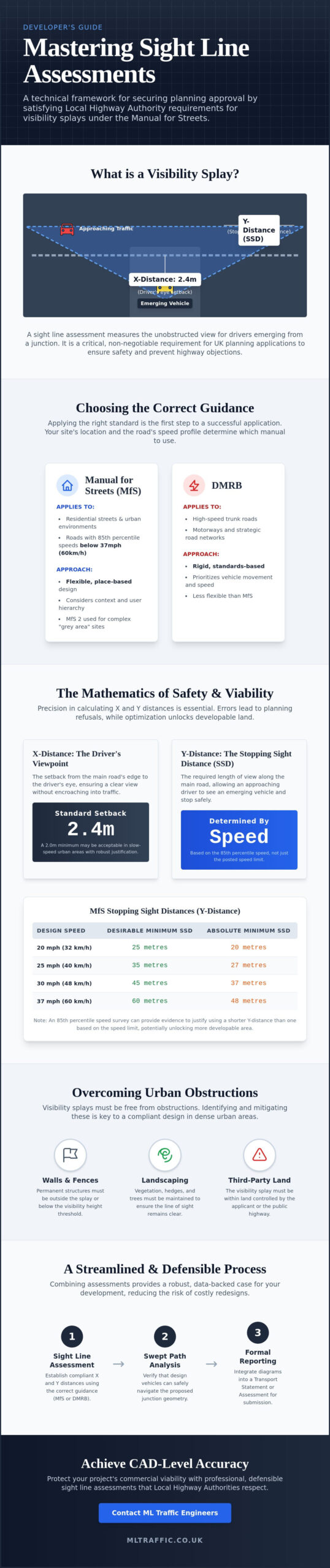
Effective site appraisals happen before land purchase to ensure a project is viable from the outset. Consultants evaluate site access and transport connectivity to identify “showstopper” issues, such as inadequate visibility splays or restricted vehicle maneuverability, that could derail a project. You can learn about our project types to see how early-stage analysis protects your investment from unforeseen regulatory hurdles.
Essential Documentation: Transport Statements vs. Transport Assessments
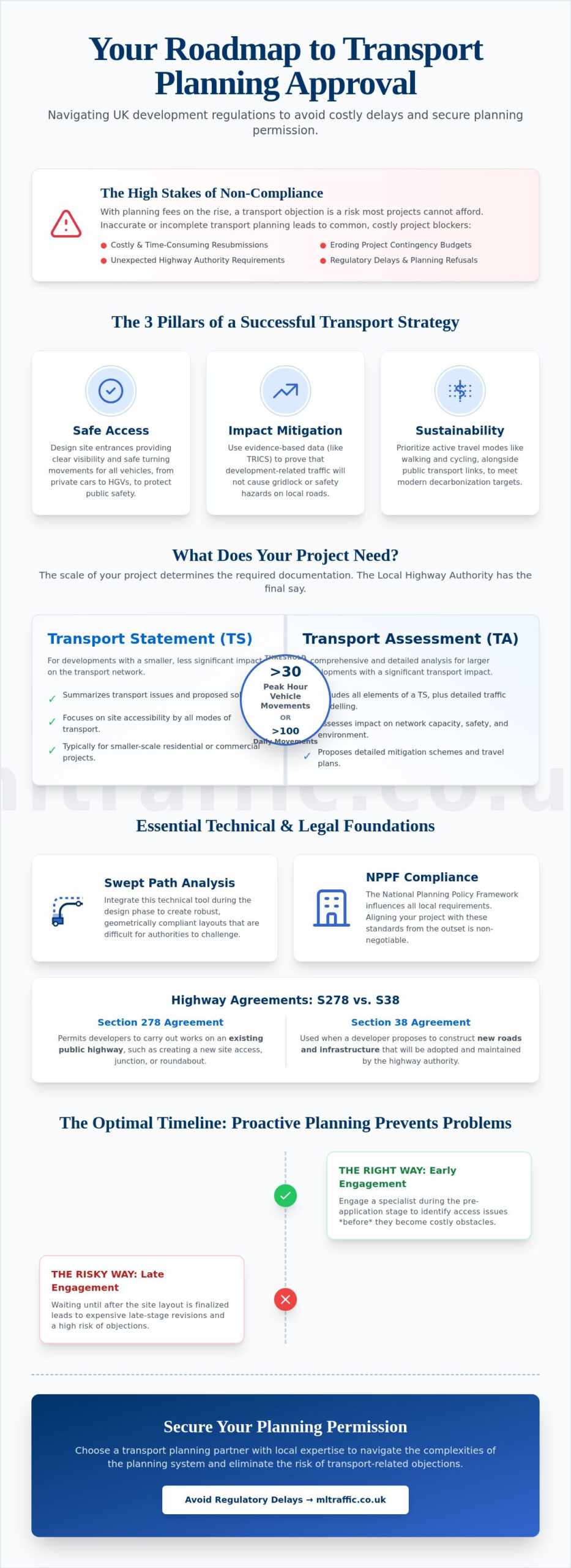
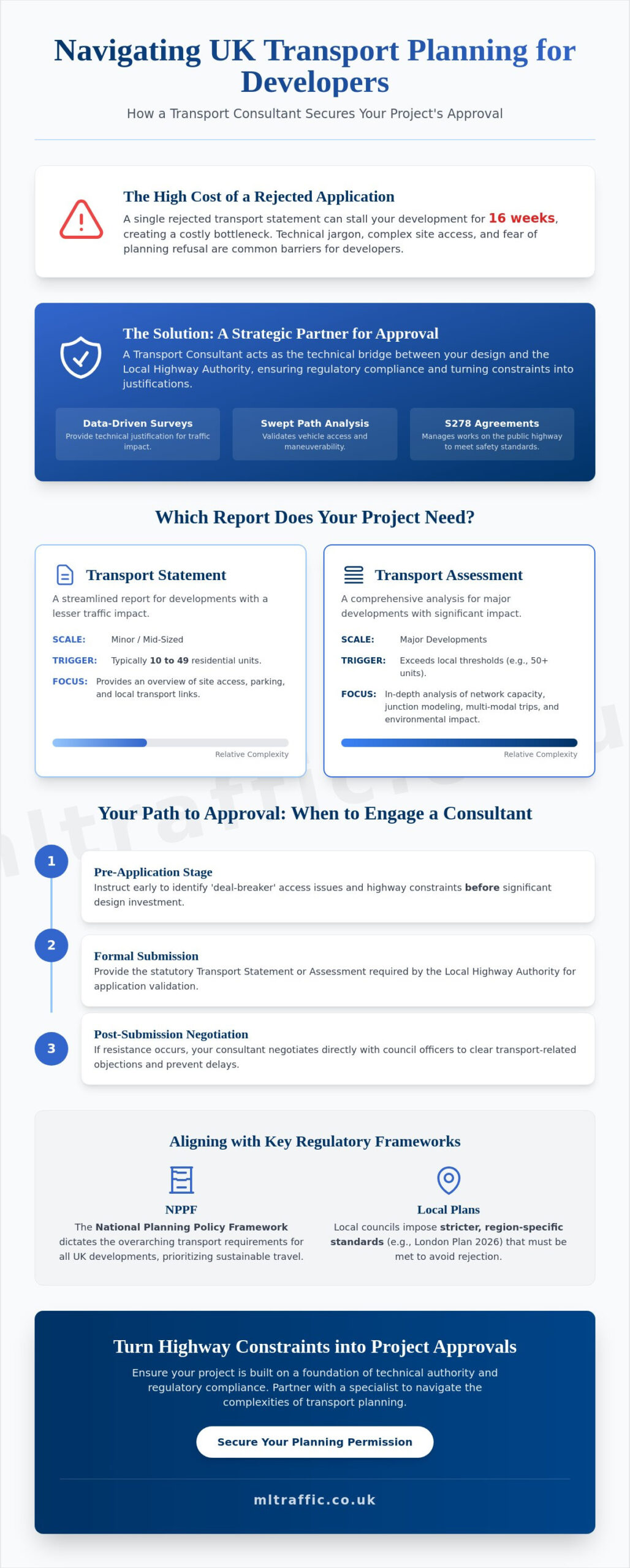
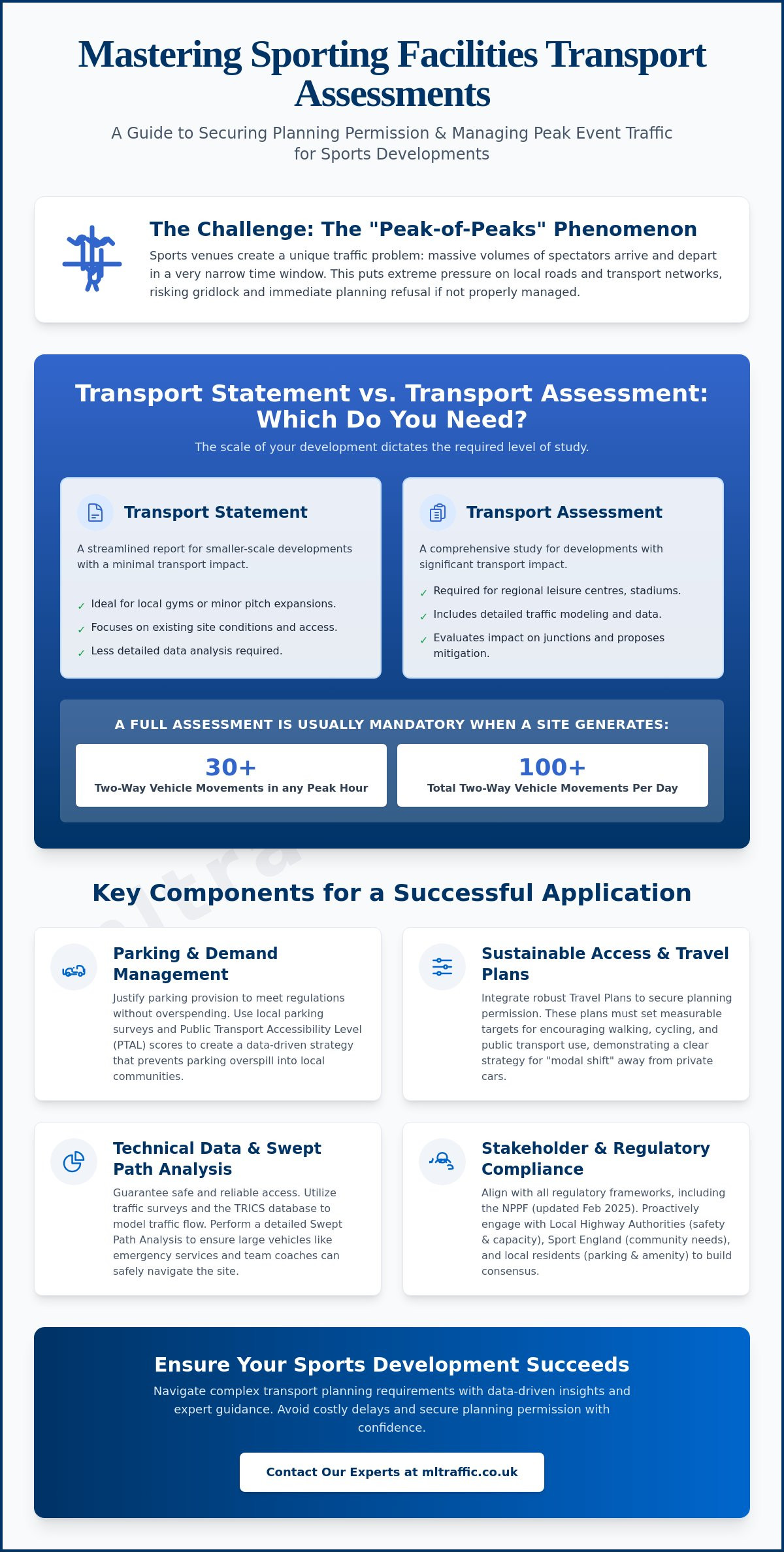
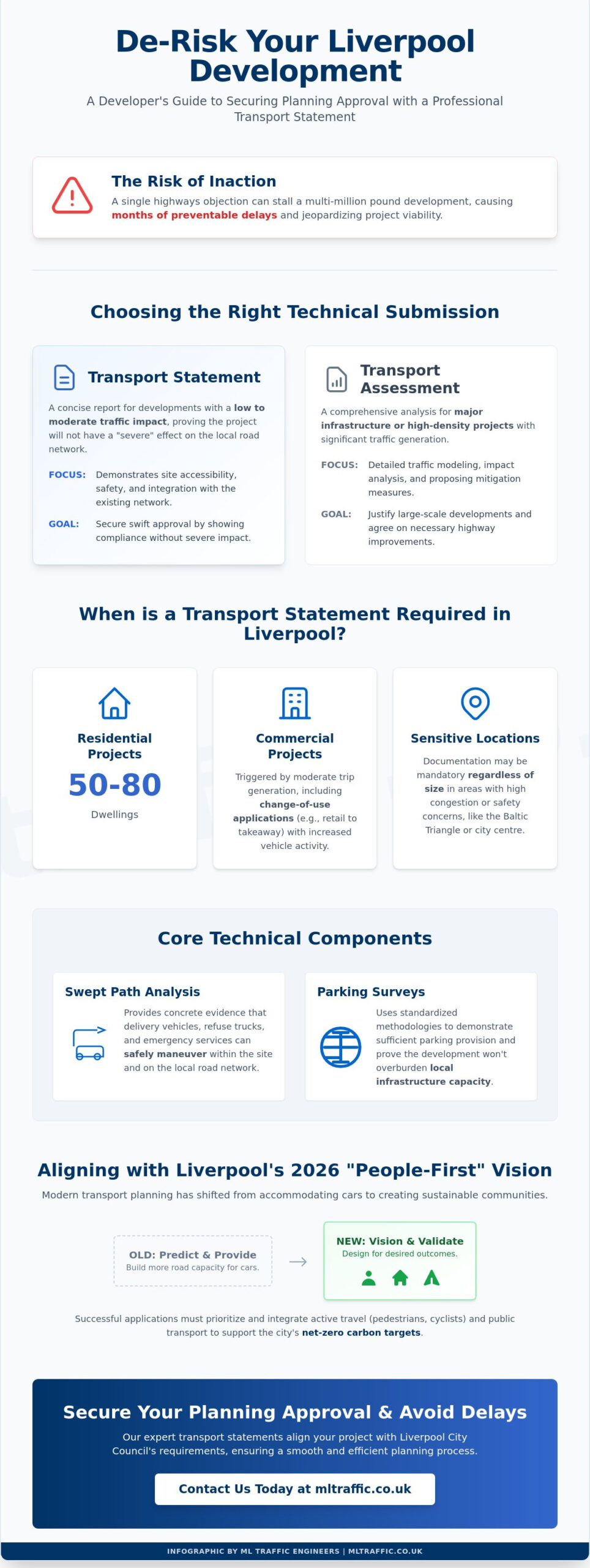
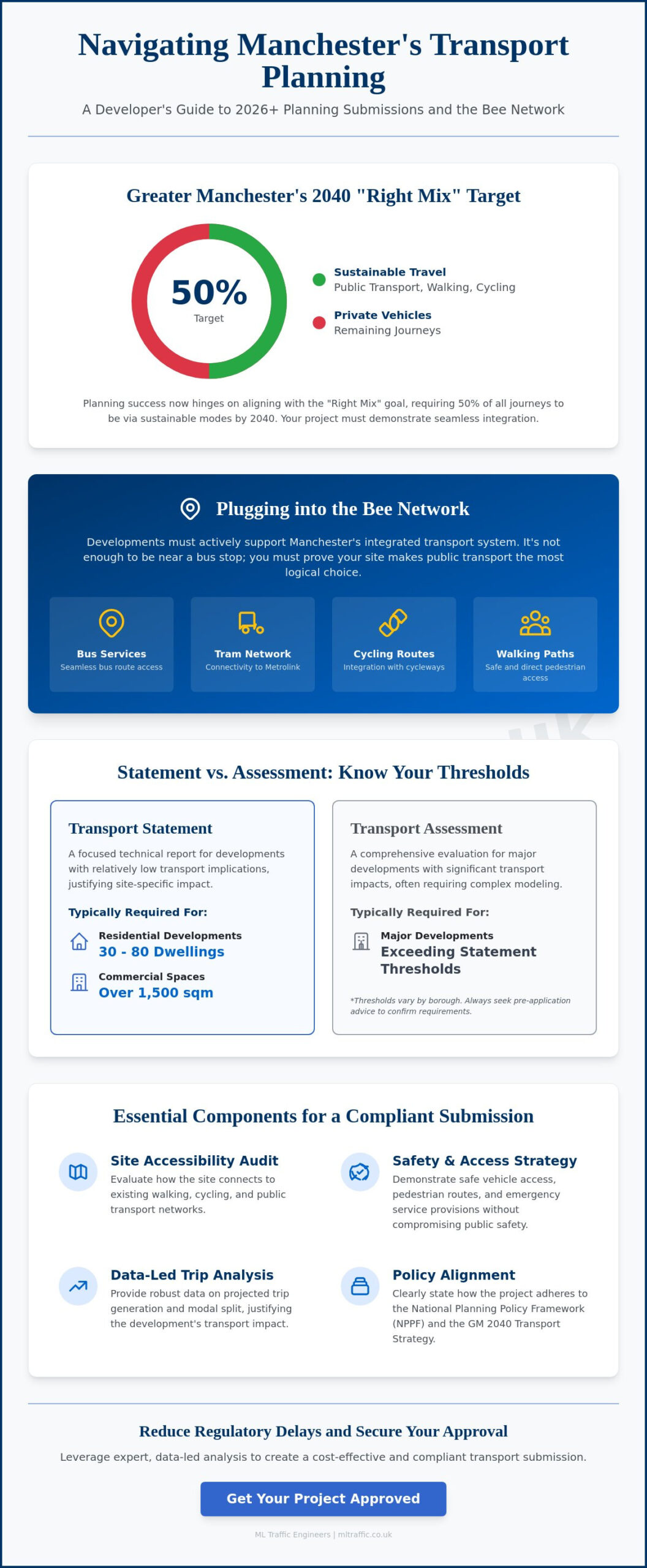
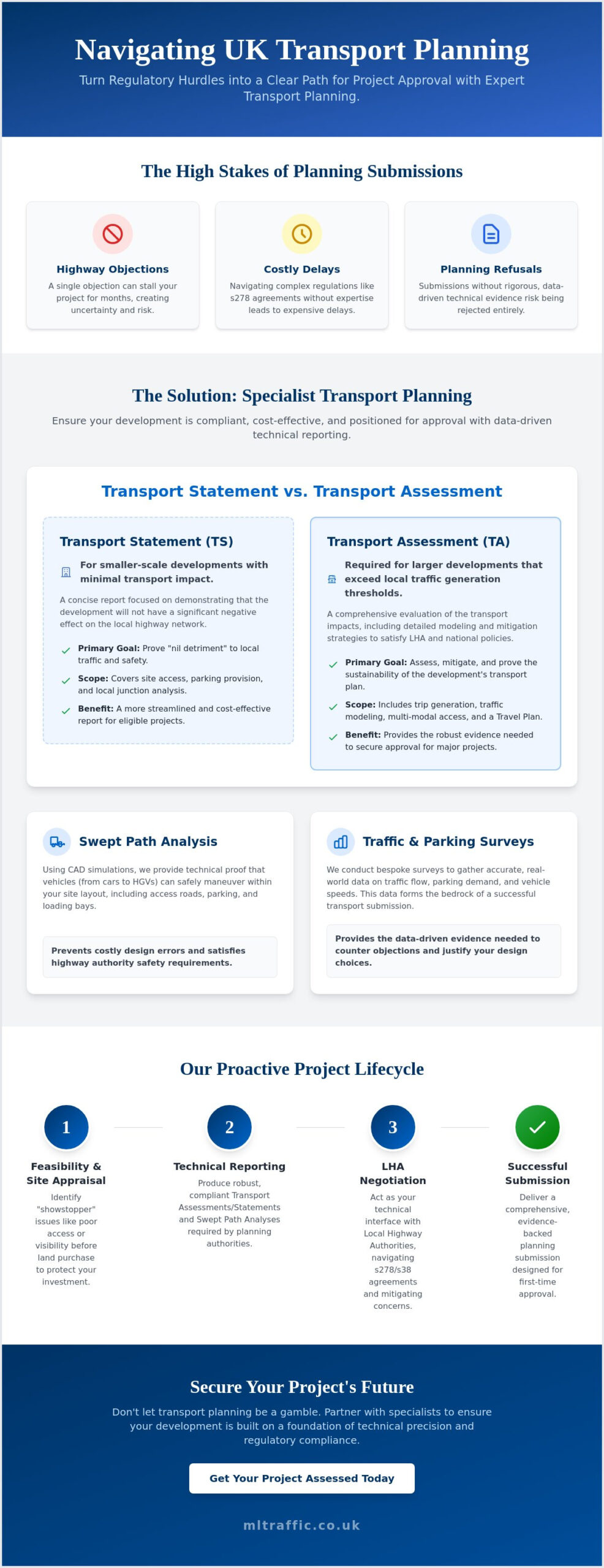
Determining whether your project requires a Transport Statement (TS) or a full Transport Assessment (TA) is a critical technical hurdle that impacts both your budget and your planning timeline. Experienced transport planning consultants use specific thresholds set by local authorities to advise on the appropriate level of reporting. The primary goal of both documents is to demonstrate “nil detriment.” This proves that the proposed development won’t negatively impact the safety or capacity of the existing highway network. Detailed guidance on Transport Assessments and Statements provided by the government sets the foundation for these technical requirements.
The choice between a TS and a TA isn’t arbitrary. It’s dictated by the scale of the development and the potential volume of traffic it will generate. Getting this wrong leads to immediate objections from highway authorities, causing avoidable delays. Professional consultants ensure your submission is proportionate to the project’s impact, saving you from over-investing in unnecessary analysis while still meeting every regulatory benchmark.
When Do You Need a Transport Statement?
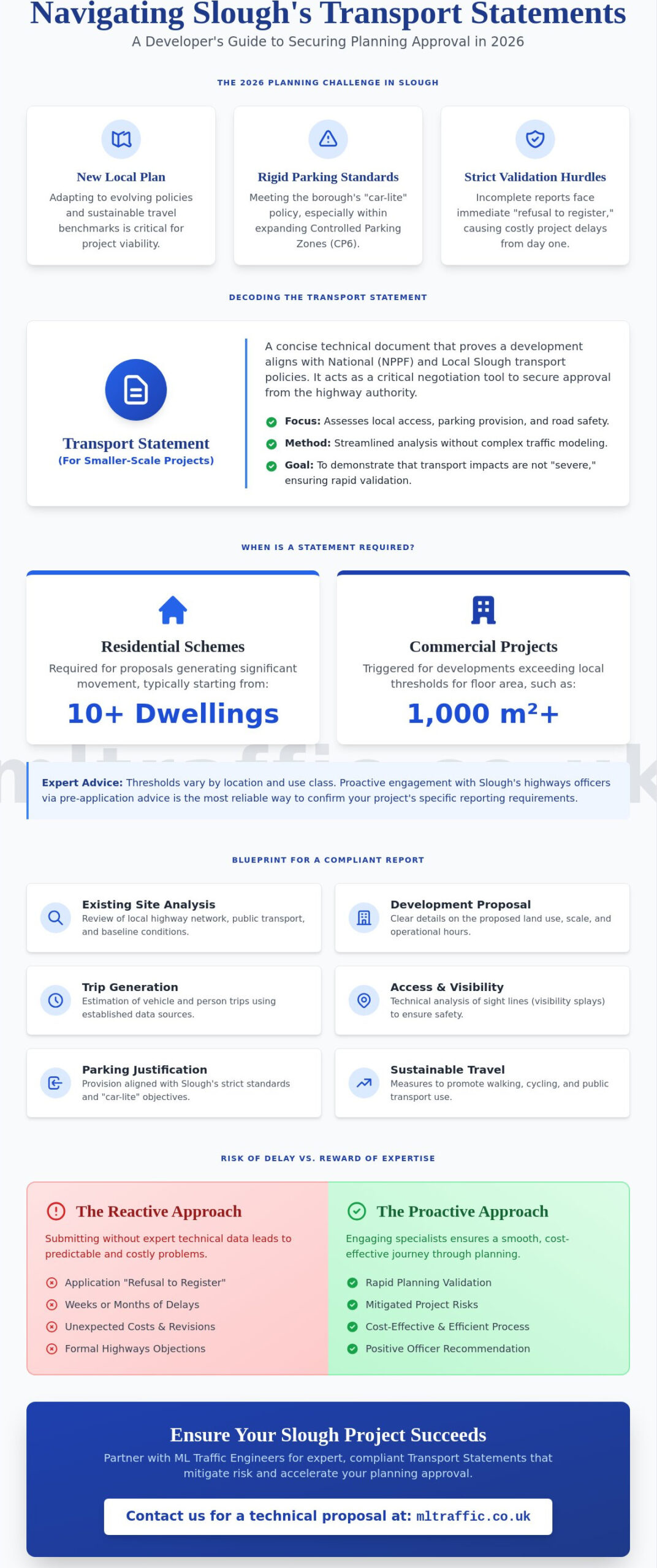
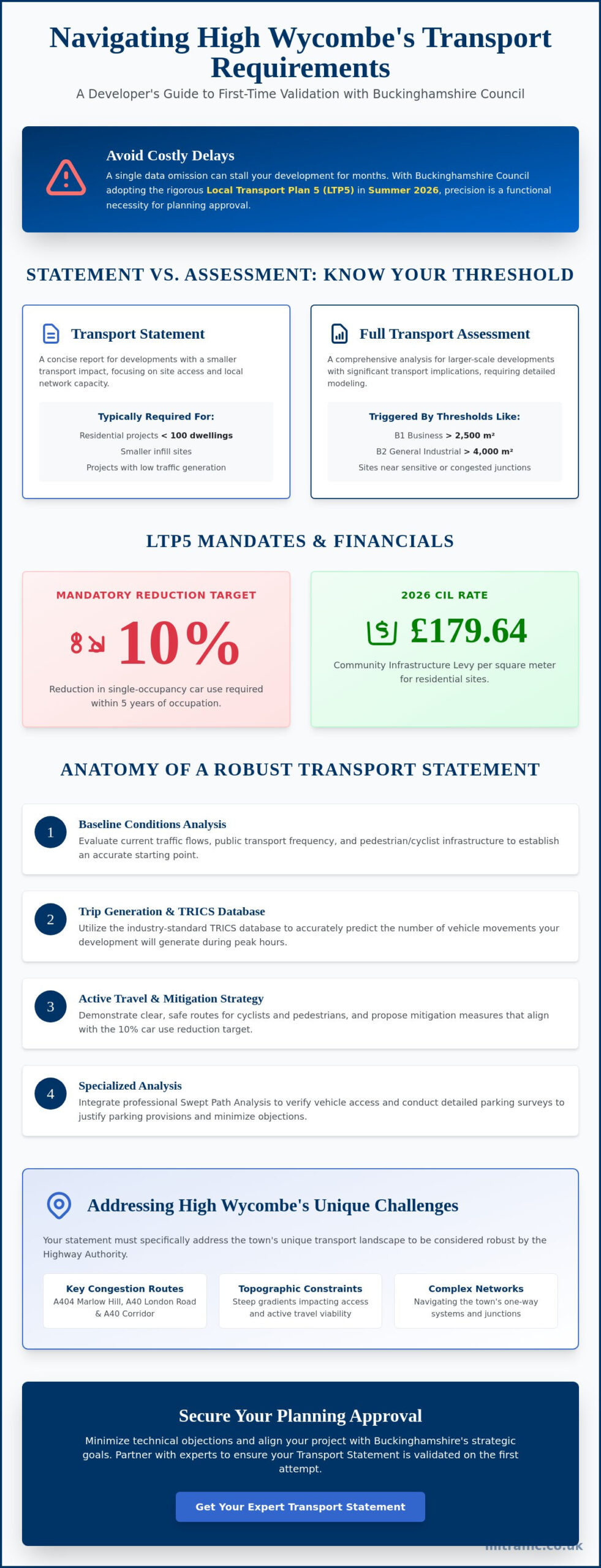
A Transport Statement is typically sufficient for smaller developments where the anticipated trip generation is relatively low. As of June 2026, for residential projects in London with fewer than 50 units or commercial spaces under 1,000 square meters, a TS is generally the standard requirement. This document focuses on the immediate site vicinity. It covers existing conditions, proposed access points, and options for sustainable travel. It’s a focused technical defense of your site’s accessibility. For specific regional requirements, you can refer to our London Transport Statements Guide to ensure your submission meets local expectations.
The Depth of a Full Transport Assessment
Larger developments trigger the need for a comprehensive Transport Assessment. In London, this requirement applies to residential schemes of 80 or more units or commercial developments exceeding 2,500 square meters. Unlike a statement, a TA involves rigorous junction modelling and capacity analysis. Consultants use the TRICS database to predict trip generation accurately based on comparable sites across the UK. This analysis evaluates the cumulative impact of your project alongside other committed developments in the area. It ensures that the wider network remains safe and functional, even during peak hours.
Precision in these reports prevents costly design errors and highway authority objections. If you’re unsure which document your project requires, exploring our technical reporting services can provide the clarity needed to move forward with confidence. By addressing these requirements early, you reduce the risk of planning delays and ensure a more efficient path to approval.
Technical Precision: Swept Path Analysis and Vehicle Maneuverability
Swept Path Analysis (SPA) is the digital simulation of vehicle movements within a proposed site layout. It’s a non-negotiable requirement for modern planning applications. By using sophisticated CAD software, such as the 2026 versions of AutoTURN or Kobi Swept Path, transport planning consultants can map the exact path a vehicle’s body and wheels take during a turn. This technical precision provides the empirical evidence needed to satisfy highway authorities that a design is safe and functional. Adherence to the standards set by the Chartered Institution of Highways & Transportation ensures that these simulations reflect real-world operational requirements.
Without SPA, developers risk significant post-construction errors that are both expensive and difficult to rectify. If a refuse truck cannot clear a corner or a fire tender cannot reach a building’s entrance, the development fails to meet basic safety and serviceability benchmarks. Consultants use standardized vehicle templates—ranging from 11.4m refuse collection vehicles to heavy articulated HGVs—to stress-test every junction and turning head before a single brick is laid. This proactive analysis transforms a conceptual drawing into a technically sound site plan.
Demonstrating Access for Service and Emergency Vehicles
Meeting the strict requirements of Building Regulations, specifically Approved Document B, is a primary concern for any new development. You must prove that emergency vehicles have unobstructed access to all parts of the site. Similarly, local authorities require evidence that refuse collection vehicles can enter, turn, and exit in a forward gear. Our Swept Path Analysis Services in London focus on these critical maneuvers to clear the way for planning approval. We ensure your layout accommodates these essential services without compromising on safety or regulatory compliance.
Optimising Car Park and Access Layouts
Precision in design doesn’t just ensure safety; it also protects your bottom line. By verifying that parking bays and access roads are functional for all users, transport planning consultants help you avoid over-engineered roads that waste valuable land. SPA justifies tight site designs to planners by providing mathematical certainty that the layout accommodates the largest anticipated vehicles without compromising safety. This allows you to reduce the footprint of infrastructure and maximize the developable area of your site. It’s a balance of technical authority and commercial awareness that ensures your project remains viable and efficient.
Data-Driven Development: The Importance of Accurate Traffic and Parking Surveys
Relying on generic or “off-the-shelf” data is a common mistake that leads to immediate planning refusals. Transport planning consultants provide the site-specific evidence needed to satisfy highway authorities and justify your development’s impact. Accurate data acts as a technical defense, ensuring that your proposals are grounded in reality rather than theoretical averages. Timing is also critical; surveys must avoid school holidays or atypical local events to ensure the data is representative and legally robust. Precision in data collection reduces the risk of highway authority objections and keeps your project moving forward.
Parking Surveys and the Lambeth Methodology
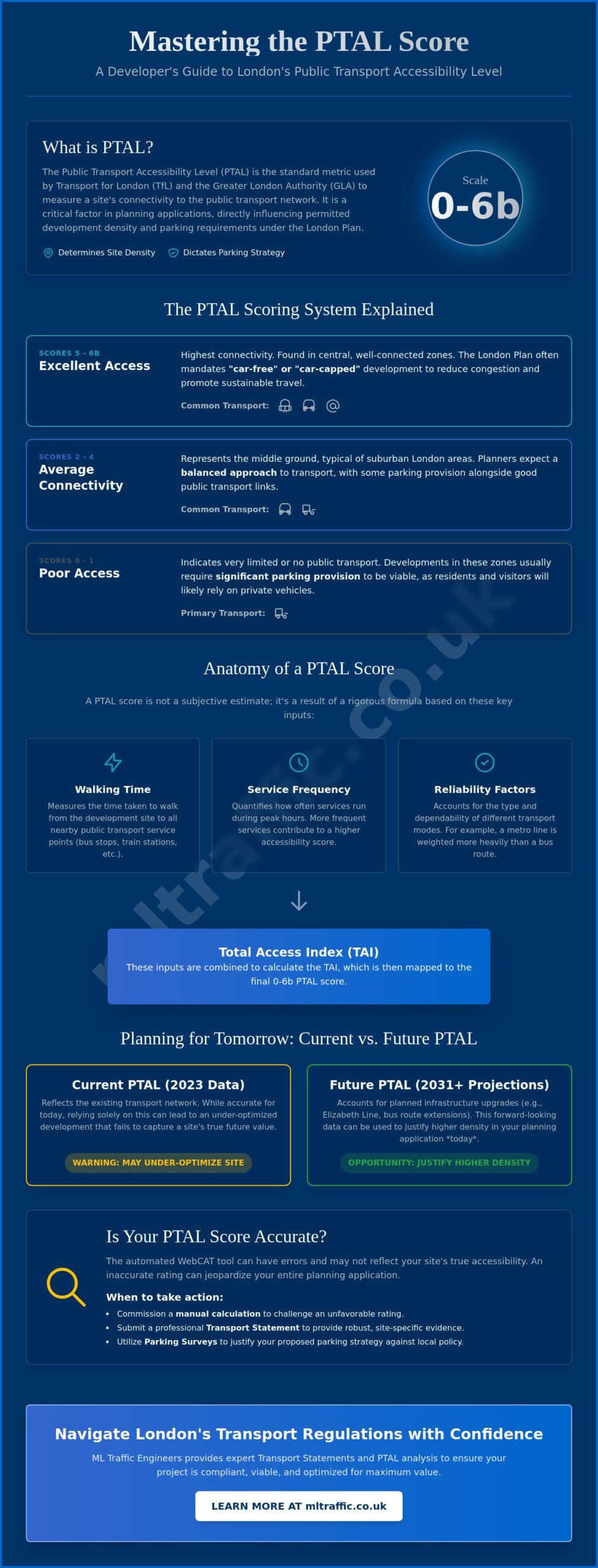
In urban environments, parking stress is a major concern for planners. The Lambeth Methodology has become the industry standard for measuring this stress, requiring surveys to be conducted during the early hours of the morning when residential parking demand is at its peak. This data is essential for justifying reduced parking provision, particularly in areas with a high Public Transport Accessibility Level (PTAL). Under the London Plan 2026, developments in areas with a PTAL score of 4 or higher must often be car-free. Accurate parking surveys prove that the surrounding streets can accommodate any small increase in demand without compromising safety or local amenity. This technical authority is vital for securing approval in high-density regions.
Traffic Data Collection for Capacity Analysis
Traffic surveys provide the foundation for junction modeling and capacity assessments. We use Automatic Traffic Counts (ATC) for long-term volume and speed data, while Manual Turning Counts (MTC) capture specific vehicle movements at junctions. This data calibrates software like Junctions 9, which includes ARCADY for roundabouts and PICADY for priority junctions. Without this calibration, your capacity models lack the precision required by Local Highway Authorities. Precise data ensures that your proposed junction designs are both safe and functional under peak load conditions.
You can explore our data collection resources to understand how we gather the evidence required for successful submissions. If you need site-specific data to support your application, you can book a professional traffic survey today to ensure your project remains on track and compliant with the latest 2026 standards.
Navigating Local Highway Authorities with ML Traffic Engineers UK
Interaction with Local Highway Authorities (LHAs) is where technical data meets regulatory reality. ML Traffic Engineers UK provide the technical authority required to navigate these discussions with the urgency your project schedule demands. As transport planning consultants, we know that administrative delays directly impact construction financing and delivery windows. We manage the full project lifecycle, ensuring that every report anticipates and resolves potential regulatory hurdles before they become formal objections. This proactive stance ensures that your project maintains momentum from inception to approval.
Our approach centers on constant availability and unwavering reliability. When an LHA engineer raises a technical concern regarding junction capacity or highway safety, we provide immediate, data-backed responses. This rapid response capability is a hallmark of our brand promise. By taking ownership of the technical dialogue, we reduce the logistical and regulatory pressures on your team. This allows you to focus on the broader aspects of development while we secure the necessary highway approvals.
Why Precision Matters for s278 and s38 Agreements
Section 278 and Section 38 agreements are the legal gateways to construction on the public highway. Precision during the initial design phase is a functional necessity to ensure works meet the exacting standards of the LHA. Our expertise in these negotiations reduces the risk of unforeseen costs and design changes during the construction phase. We ensure that all proposed highway works are technically sound and fully compliant with the latest 2026 industry benchmarks. For a deeper dive into these requirements, see our Highway Design S278 & S38 Guide.
Comprehensive Support for Your Planning Submission
Every site has unique constraints that require a tailored approach. We provide bespoke transport reporting that addresses site-specific issues, whether it involves a complex junction or restricted urban access. By maintaining a proactive dialogue with authority engineers, we resolve objections through technical evidence rather than costly compromise. This level of precision significantly reduces the need for expensive planning appeals. We take pride in our adherence to standards and our role as a vital guardian of public safety throughout the planning process.
Securing professional guidance early in the project lifecycle is the most effective way to avoid regulatory friction. Contact ML Traffic Engineers UK for a project review to ensure your next planning submission is backed by technical authority and data-driven precision.
Secure Your Planning Success with Expert Transport Guidance
Achieving a successful planning submission in 2026 requires more than just standard reporting. It demands technical authority and a proactive approach to highway regulations. By integrating precise Swept Path Analysis and site-specific data from Parking Surveys, you eliminate the guesswork that often leads to highway authority objections. Professional transport planning consultants act as your technical defense; they ensure every aspect of your development’s infrastructure is safe, functional, and fully compliant with the latest national strategies.
Founded in 2014, ML Traffic Engineers UK brings deep UK planning expertise to every project. We specialize in providing the technical evidence needed to navigate complex s278 and s38 agreements without the risk of design errors. Our safety-conscious approach to highway engineering prioritizes your project’s timeline and commercial viability. Don’t let regulatory hurdles stall your progress. You can get a quote for your Transport Statement or Assessment from ML Traffic Engineers UK today to ensure your site is ready for approval. We are ready to help you move your project forward with confidence.
Frequently Asked Questions
What do transport planning consultants actually do?
Transport planning consultants manage the technical transport implications of new development projects to ensure safety and regulatory compliance. They act as a vital bridge between developers and Local Highway Authorities, producing essential documentation like Transport Assessments and Travel Plans. Their role involves using data-driven site analysis and technical modeling to prove that a proposed project won’t negatively impact the existing highway network or public safety.
When is a Transport Statement required for a planning application?
A Transport Statement is required for smaller developments that generate relatively low levels of traffic but still impact the local highway. As of June 2026, residential projects in London with fewer than 50 units generally trigger this requirement. It focuses on the immediate site vicinity, detailing proposed access points and sustainable travel options. It provides the technical evidence needed to satisfy planners that the development is accessible and safe.
How much does a Transport Assessment cost in 2026?
The cost of a Transport Assessment depends entirely on the scale and complexity of the proposed development. Factors such as the number of junctions requiring detailed modeling and the volume of traffic surveys needed will influence the final fee. Developers should request a tailored quote to ensure the reporting is proportionate to their project’s impact. This approach avoids over-investing in unnecessary analysis while meeting all local authority benchmarks.
What is Swept Path Analysis and is it always necessary?
Swept Path Analysis is a digital simulation used to prove that specific vehicles can maneuver safely within a site layout. It’s almost always necessary for developments that require access for service vehicles like refuse trucks or emergency fire tenders. Planners require this technical proof to ensure that the site design is functional and safe. It prevents costly design errors that might otherwise be discovered only after construction begins.
Is a Travel Plan mandatory for residential developments?
Travel Plans are mandatory for residential developments that exceed specific size thresholds set by the Local Highway Authority. These documents outline strategies to encourage sustainable travel, such as walking, cycling, or public transport use. In many urban areas, they are a standard requirement to mitigate the environmental impact of new housing. They help developers meet the sustainability targets mandated by the 2026 National Planning Policy Framework.
How long does it take to complete a transport planning report?
Completing a transport planning report typically takes between two to four weeks, depending on the complexity of the site and the data required. If new traffic or parking surveys are necessary, these must be scheduled during neutral periods to ensure the data is representative. Professional consultants prioritize technical rigor to ensure the final report withstands authority scrutiny. This timeline ensures a robust submission that reduces the risk of later delays.
What is the difference between Section 278 and Section 38 agreements?
Section 278 agreements cover works on the existing public highway, while Section 38 agreements involve the adoption of new roads by the local authority. Both require precise engineering drawings and technical approval from the highway authority. Consultants manage these negotiations to ensure all infrastructure meets the exacting safety standards required for legal adoption. This precision reduces the risk of unforeseen costs during the construction phase of a project.
Can a transport consultant help if my application has already been objected to?
Yes, transport planning consultants can review highway authority objections and provide the technical evidence needed to resolve them. This process often involves conducting bespoke parking surveys or refining a Swept Path Analysis to address specific safety concerns. A proactive technical defense can frequently overturn initial objections without the need for a full planning appeal. This expert intervention saves time and protects the commercial viability of your development project.

Disclaimer
The content on mltraffic.co.uk, including all technical articles, guides, and resources, is provided for general informational and educational purposes only. It is not intended to constitute professional advice in traffic engineering, transportation planning, development approvals, or any other technical or legal field.
While ML Traffic Engineers makes every reasonable effort to ensure the accuracy, completeness, and timeliness of the information published, we do not provide any warranties or representations (express or implied) regarding its reliability, suitability, or availability for any particular purpose. Any reliance you place on the content is strictly at your own risk.
In no event shall ML Traffic Engineers, its directors, employees, authors, or affiliates be liable for any direct, indirect, incidental, special, consequential, or punitive damages (including, without limitation, loss of profits, data, or business opportunities) arising out of or in connection with the use of, or inability to use, any information provided on this website.
The articles and guides on this site are not a substitute for engaging a qualified, professional traffic engineer to assess your specific project requirements. For tailored advice, compliance assessments, or traffic engineering services, please contact a competent professional.
This disclaimer may be updated from time to time without notice. By accessing or using this website, you agree to be bound by the most current version of this disclaimer.