Tag: PTAL Ratings

  • Transport Consultant for Architects in London: Securing 2026 Planning Approvals

    Transport Consultant for Architects in London: Securing 2026 Planning Approvals

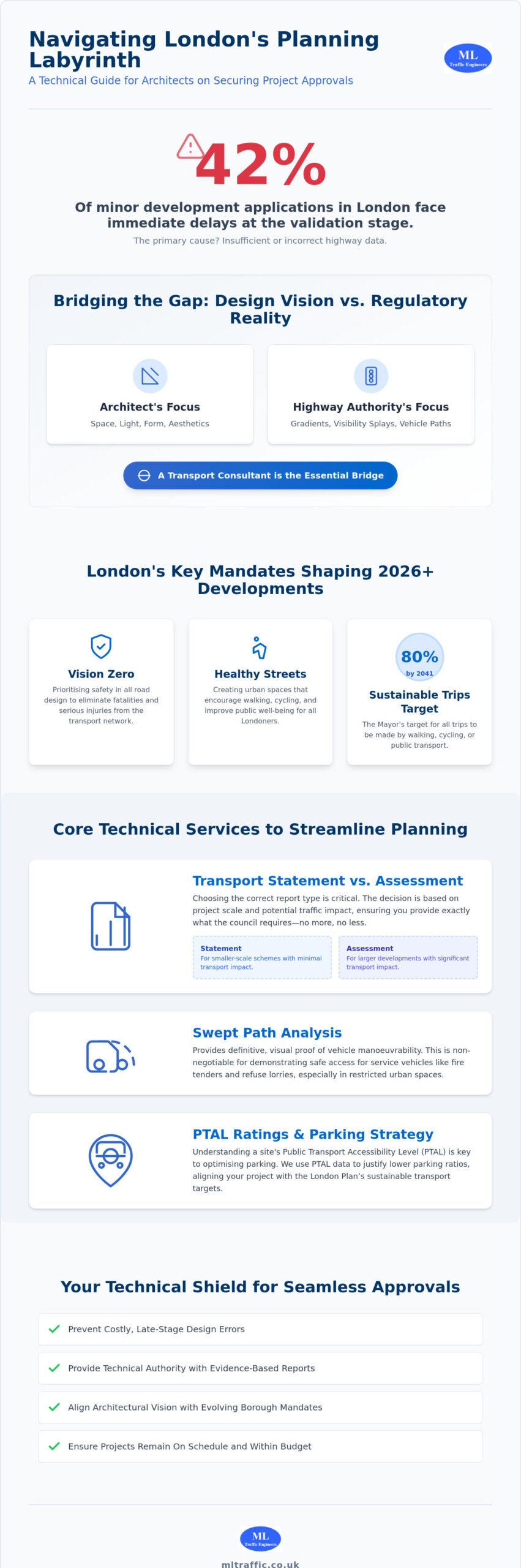
    Did you know that 42% of minor development applications in London face immediate delays at the validation stage simply because of insufficient highway data? For architects, these regulatory hurdles often manifest as late-stage design errors or conflicting instructions between TfL and local highway authorities. Engaging a specialist transport consultant for architects London at the inception phase transforms these technical pressures into manageable project milestones. Our team provides the technical authority and rapid response needed to navigate the capital’s complex 2026 planning landscape.

    You already know that a successful project requires more than just aesthetic excellence. It demands rigorous compliance with the London Plan’s Vision Zero and Healthy Streets standards. We’ll show you how professional transport consultancy streamlines your workflow, from executing precise Swept Path Analysis to delivering cost-effective Transport Statements that satisfy borough requirements. This article previews the essential strategies for optimising site access and securing planning approvals without transport-related delays, ensuring your 2026 developments remain on schedule and within budget.

    Key Takeaways

    • Learn how early integration with a transport consultant for architects London prevents late-stage design errors and ensures alignment with evolving borough mandates.
    • Identify whether your project requires a Transport Statement or a full Assessment based on 2026 scale thresholds and impact criteria.
    • Utilise Swept Path Analysis to provide definitive proof of vehicle manoeuvrability for fire tenders and refuse lorries in restricted urban spaces.
    • Navigate the complexities of PTAL ratings to optimise your site’s parking strategy while meeting the London Plan’s sustainable transport targets.
    • Partner with ML Traffic Engineers UK for a technical, full-lifecycle approach that streamlines the planning process from initial data collection to final approval.

    Why Architects in London Require a Specialist Transport Consultant

    London’s architectural landscape is defined by extreme density and rigorous regulatory oversight. For an architect, the challenge isn’t just creating a functional building; it’s ensuring that building integrates into the city’s complex infrastructure without causing safety hazards or congestion. This is where a transport consultant for architects London becomes essential. We don’t just provide data. We provide a technical shield that protects your design from the scrutiny of local highway authorities.

    Modern transportation planning in the capital has shifted from simply accommodating cars to prioritizing the “Vision and Validate” model. With the Mayor’s target for 80% of trips to be made via walking, cycling, or public transport by 2041, every square metre of your site must contribute to this goal. Failing to account for these requirements during the initial massing phase often leads to planning refusal or costly redesigns late in the project lifecycle. Our role is to identify these constraints early, allowing you to design with confidence.

    To better understand how specialist consultancy supports the architectural process in London, watch this helpful video:

    Bridging the Gap Between Design and Regulation

    Architects focus on space, light, and form. Highway authorities focus on gradients, visibility splays, and vehicle swept paths. We translate your vision into technical reports that satisfy both. By providing expert interpretation of the London Plan 2026 transport policies, we ensure your project aligns with the latest sustainable transport targets. This includes navigating the expansion of the Lane Rental scheme and the strict Healthy Streets indicators. We manage the delicate relationship between the developer and the council, ensuring that technical constraints don’t compromise your architectural intent.

    The Value of Technical Authority in Planning Meetings

    When a highway officer objects to a proposed entrance or parking layout, you need more than an opinion; you need evidence. We provide technical authority through evidence-based rebuttals, using hard data from Parking Surveys and Swept Path Analysis to justify deviations from standard guidance. Whether it’s proving that a refuse vehicle can safely navigate a tight mews or justifying lower parking ratios based on PTAL ratings, our technical reports carry weight in planning committees. A transport consultant serves as the vital guardian of planning compliance for architects, ensuring every design decision is defensible under regulatory scrutiny.

    Determining whether your project requires a Transport Statement or a full Transport Assessment is a critical decision that influences both your budget and your timeline. While both documents evaluate the impact of a development on the highway network, their scope varies significantly. In London, where 42% of minor development applications experience delays at the validation stage due to insufficient data, choosing the wrong report type can be a costly error. A specialist transport consultant for architects London ensures your submission meets the specific thresholds set by the individual borough and the London Plan.

    The choice between these documents generally depends on the scale of the development and its anticipated impact on the local area. Following official government guidance, we assess your project’s characteristics against local policy to provide the most efficient reporting route. Our goal is to provide technical clarity that satisfies planning officers while minimizing unnecessary data collection for smaller schemes.

    Transport Statements for Smaller Developments

    Small-scale projects, such as residential conversions or minor commercial units, typically require a Transport Statement. These reports focus on localized issues like trip generation and immediate highway safety. In high PTAL areas (ratings 5 or 6), we use these statements to justify car-free or low-parking designs, aligning with the Mayor’s sustainable transport targets. We provide clear evidence that the existing infrastructure can absorb the minor increase in activity without compromising safety or accessibility. For a deeper look at navigating these requirements, see our Transport Assessment London: The Developer’s 2026 Guide.

    Comprehensive Transport Assessments for Major Sites

    Major developments, generally those exceeding 80 residential units or 2,500 square metres of commercial space, necessitate a full Transport Assessment. These are far more technical and involve detailed junction capacity modelling and multi-modal analysis. We must demonstrate how the project fits into the wider London network, often addressing the cumulative impact of several nearby developments. These reports are strictly aligned with TfL’s “Healthy Streets” approach, requiring us to prove that the design encourages walking and cycling while meeting “Vision Zero” safety standards. If you’re managing a large-scale site, our team can provide a rapid review of your site’s specific requirements to ensure your technical reporting is robust from day one.

    Engaging a transport consultant for architects London early in the design phase allows us to manage these complex requirements as a fully-managed service. We take the technical burden off your desk, allowing you to focus on the architectural vision while we secure the necessary highway approvals.

    Swept Path Analysis: Optimising Site Access and Manoeuvrability

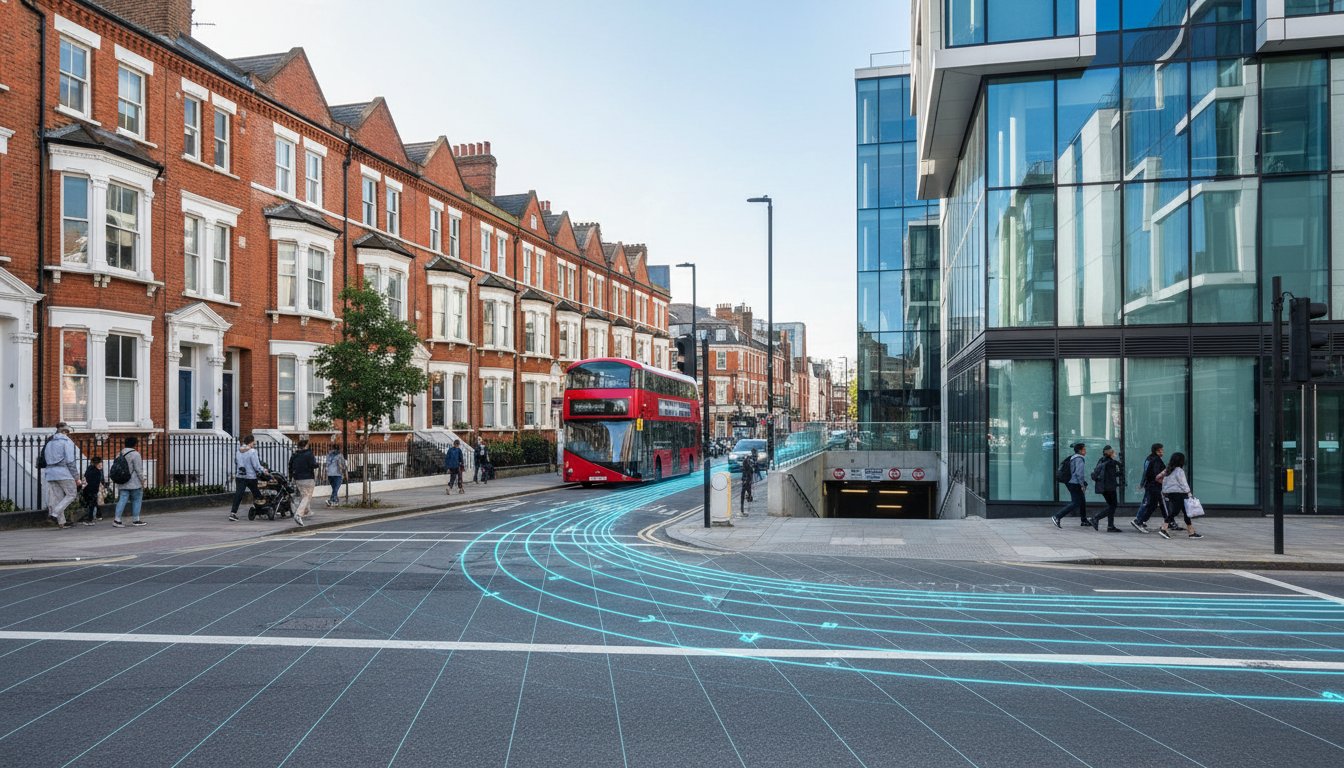
    Swept Path Analysis (SPA) is the digital simulation of a vehicle’s movement and turning circle. For a transport consultant for architects London, this analysis is a non-negotiable component of a successful planning submission. London’s tight urban grain leaves no room for error. A refuse vehicle or fire tender that cannot turn safely within the site boundary is a primary reason for planning refusal. We use sophisticated software like AutoTurn to map these movements against your CAD layouts, identifying design flaws long before construction begins.

    Demonstrating safe and suitable access is a core requirement for all developments under the UK Government Planning Practice Guidance. Our Practical Guide to Swept Path Analysis 2026 details how these simulations protect your design from highway authority objections. By visualising the exact footprint of a vehicle’s body and wheel path, we provide the technical evidence needed to secure approval for challenging sites.

    Designing for Modern Vehicle Dimensions

    Modern vehicle dimensions are evolving. Delivery vans are larger, and emergency service vehicles require specific clearance heights and turning radii. We ensure your car park ramps, basement access, and internal turns meet these modern safety standards. SPA reduces the ‘safety margin’ risk in high-density London plots by providing millimetre-accurate simulations that eliminate guesswork. This precision allows you to maximise the developable area without compromising on operational safety or accessibility.

    Integrating SPA into the RIBA Plan of Work

    Technical analysis shouldn’t be an afterthought. We integrate SPA into the RIBA Plan of Work to ensure design viability from the start. At Stage 2 (Concept Design), we perform initial feasibility and access checks to confirm that the site can accommodate the necessary vehicle types. Moving into Stage 3 (Spatial Coordination), we finalise the layout for planning submission. Accurate CAD data is vital here. We work directly with your architectural drawings to ensure the analysis reflects the exact site conditions, including kerb lines, pillars, and street furniture. This proactive approach prevents the need for costly redesigns after you’ve already submitted your application to the borough.

    London-Specific Challenges: PTAL Ratings and Parking Surveys

    London’s planning environment is governed by data-driven metrics that can make or break an architectural design. A transport consultant for architects London understands that Public Transport Accessibility Level (PTAL) scores are the heartbeat of any urban development. These ratings, ranging from 0 to 6b, determine exactly how much parking the borough will permit. With the city aiming for 80% sustainable travel by 2041, the pressure to reduce car dependency is immense. We provide the technical precision needed to interpret these ratings and defend your design choices before planning committees.

    Mastering the PTAL Factor

    PTAL directly affects project viability. For sites with a rating of 5 or 6, car-free development is often a non-negotiable requirement under the London Plan. However, “borderline” ratings often present opportunities for negotiation. We use detailed technical analysis to prove whether a site truly possesses the connectivity the score suggests. High PTAL scores also trigger the mandatory requirement for a Travel Plan. This strategic document outlines how your development will manage the long-term transport needs of its occupants without increasing local congestion.

    Conducting Robust Parking and Traffic Surveys

    Snapshot data or anecdotal evidence won’t satisfy London boroughs in 2026. If your project relies on on-street parking or faces objections regarding local capacity, you must provide a rigorous Parking Survey. Most boroughs now mandate the Lambeth Methodology for these assessments. This standard requires us to survey all available parking spaces within a 200-metre walking distance of the site on two separate weekday nights, specifically between 00:30 and 05:30. This precision is vital. It allows us to prove “no net loss” of highway safety and demonstrates that local streets can absorb residual demand without creating hazards for emergency vehicles or pedestrians.

    Our team provides the technical authority to manage these complex data requirements from start to finish. We ensure your surveys meet the strict methodological standards required for 2026 approvals. Don’t let technical data hurdles stall your project; contact our expert team today to commission a Lambeth-compliant parking survey for your London development.
    Transport Consultant for Architects in London: Securing 2026 Planning Approvals

    Partnering with ML Traffic Engineers UK for Seamless Approvals

    Architects in the capital require a partner who understands that planning is a high-stakes environment where technical precision is mandatory. ML Traffic Engineers UK has built a reputation as a trusted transport consultant for architects London by delivering technical reports that withstand the most rigorous scrutiny. We don’t just provide data snapshots; we manage the full project lifecycle from inception to completion. Our team ensures that every technical requirement, from initial traffic surveys to complex junction modelling, is handled with unwavering reliability and professional integrity.

    Our approach is rooted in technical authority and a deep understanding of the capital’s infrastructure. We recognize the logistical and regulatory pressures architects face. Just as local businesses rely on Networking2000 for expert IT infrastructure and network security, we act as a comprehensive partner rather than a simple service provider, reducing burdens through rapid response and constant availability. This readiness is a hallmark of our brand promise, ensuring that urgent planning deadlines are met without compromising the quality of the technical submission.

    Tailored Consultancy for Architectural Firms

    Each development has unique goals and site-specific challenges. Whether you’re designing a residential conversion in Camden or a major commercial hub in the City, we provide bespoke reporting that aligns with your architectural vision. Our expertise spans all 32 London boroughs and the City of London, meaning we understand the specific nuances of local highway authority expectations. We maintain a standard of formal excellence and regulatory compliance, ensuring your design remains protected from technical objections. Discover why architects choose ML Traffic Engineers UK for their London projects to see how our technical authority translates into planning success.

    Ready to Secure Your Planning Permission?

    Time is a critical factor in infrastructure and development projects. We maintain a constant state of readiness to meet urgent planning deadlines, offering rapid response capabilities that reflect the fast-moving nature of the industry. By choosing a comprehensive, fully-managed transport service, you reduce the risk of validation delays and design errors. Engaging a specialist transport consultant for architects London allows your firm to focus on design while we handle the technical complexities of highway data and borough negotiations.

    Start your transport planning review today to ensure your 2026 submissions are robust and delay-free. Partner with an expert who understands the London landscape and takes immense pride in adherence to industry benchmarks. Our team is ready to provide the technical precision needed to secure your next planning approval. Contact ML Traffic Engineers UK today to discuss your project requirements and see how our specialist consultancy streamlines the planning process.

    Future-Proof Your London Architectural Projects

    London’s planning environment in 2026 demands a shift from simple documentation to strategic design-enabling partnerships. By integrating technical tools like Swept Path Analysis and robust parking surveys early, you eliminate the risk of late-stage redesigns. Whether your project requires a concise Transport Statement or a multi-modal Assessment, engaging a transport consultant for architects London ensures your development aligns with the capital’s evolving sustainability and safety mandates.

    Just as you meticulously plan for the longevity of your architectural projects, it is wise to apply the same foresight to your personal assets; Aiker Wills and Trusts offers dedicated support for estate planning and legal document preparation to help secure your future.

    ML Traffic Engineers UK has provided technical authority for London planning applications since 2014. We specialize in navigating the intricate requirements of all 32 boroughs, delivering the expert Swept Path Analysis and Transport Statements needed for a seamless approval process. Get a Professional Transport Consultancy Quote for Your London Project today to secure your site’s future. We remain ready to manage your full technical lifecycle with unwavering reliability and professional integrity.

    Frequently Asked Questions

    What is the difference between a transport consultant and a civil engineer?

    A transport consultant focuses on the planning, policy, and functional movement of people and vehicles to secure planning permission. We specialize in technical reports like Transport Assessments and parking surveys required for the regulatory phase. A civil engineer typically handles the structural design and physical construction of the infrastructure once the project moves past the planning stage. We ensure your design is compliant and defensible before construction begins.

    At what stage of the design process should I hire a transport consultant?

    You should engage a transport consultant for architects London during RIBA Stage 2 (Concept Design). Early involvement allows us to perform initial access checks and feasibility studies. This proactive approach prevents you from finalizing a layout that the local highway authority might later reject due to inadequate vehicle manoeuvrability. Integrating technical analysis at the inception phase ensures your architectural vision is operationally viable from day one.

    Do I need a transport statement for a small residential extension in London?

    Most small residential extensions don’t require a Transport Statement unless they involve a new site access or a significant change in parking arrangements. However, London boroughs have diverse local policies that can trigger technical requirements for smaller schemes. If your project is in a high-density area or involves a new driveway, we can verify the specific borough mandates to help you avoid validation delays at the council.

    What happens if the local highway authority objects to my architectural design?

    If an objection occurs, we provide evidence-based rebuttals using technical data from Swept Path Analysis or parking surveys. We work directly with the highway officer to understand their concerns and provide technical justification for your design. Our role is to manage this negotiation and find a compliant solution that preserves your architectural intent while meeting the safety standards required by the council.

    How long does it take to produce a Swept Path Analysis for a London site?

    We typically produce a Swept Path Analysis within 24 to 48 hours of receiving your accurate CAD site layouts. Our rapid-response capability ensures that technical analysis doesn’t stall your project timeline. This speed allows for multiple design iterations during the spatial coordination phase, ensuring the final layout is operationally safe and meets the strict turning circle requirements of London’s emergency and refuse vehicles.

    Can a transport consultant help reduce the number of parking spaces required by the council?

    Yes, we use PTAL ratings and local census data to justify lower parking ratios for your development. By proving high public transport accessibility or demonstrating existing on-street capacity through a Lambeth Methodology survey, we can support a case for car-free or low-parking schemes. This strategy aligns with the London Plan’s sustainability targets and allows you to maximize the developable area of your site.

    What are the current London parking standards for 2026?

    Current 2026 standards prioritize car-free development in areas with high PTAL ratings of 5 and 6. The London Plan generally mandates zero parking for residential schemes in central locations and well-connected inner London boroughs. We analyze these specific thresholds to ensure your site layout meets mandatory cycle parking and disabled access requirements while avoiding the inclusion of unnecessary car parking spaces that the council might reject.

    Is a Travel Plan always required for new office developments in London?

    A Travel Plan is mandatory for office developments exceeding 2,500 square metres under the 2026 London Plan requirements. Smaller developments might still require a Travel Plan Statement if the local borough policy is more stringent or if the site is in a sensitive area. We assess these thresholds during the initial assessment phase to ensure your planning submission includes the necessary long-term transport management strategy for the occupants.

    Michael Lee

    Article by

    Michael Lee

    Transport planner with over 35 years' experience.

    Disclaimer

    The content on mltraffic.co.uk, including all technical articles, guides, and resources, is provided for general informational and educational purposes only. It is not intended to constitute professional advice in traffic engineering, transportation planning, development approvals, or any other technical or legal field.
    While ML Traffic Engineers makes every reasonable effort to ensure the accuracy, completeness, and timeliness of the information published, we do not provide any warranties or representations (express or implied) regarding its reliability, suitability, or availability for any particular purpose. Any reliance you place on the content is strictly at your own risk.
    In no event shall ML Traffic Engineers, its directors, employees, authors, or affiliates be liable for any direct, indirect, incidental, special, consequential, or punitive damages (including, without limitation, loss of profits, data, or business opportunities) arising out of or in connection with the use of, or inability to use, any information provided on this website.
    The articles and guides on this site are not a substitute for engaging a qualified, professional traffic engineer to assess your specific project requirements. For tailored advice, compliance assessments, or traffic engineering services, please contact a competent professional.
    This disclaimer may be updated from time to time without notice. By accessing or using this website, you agree to be bound by the most current version of this disclaimer.
  • Transport Planning Consultants Haringey: A Developer’s 2026 Guide to Planning Approval

    Transport Planning Consultants Haringey: A Developer’s 2026 Guide to Planning Approval

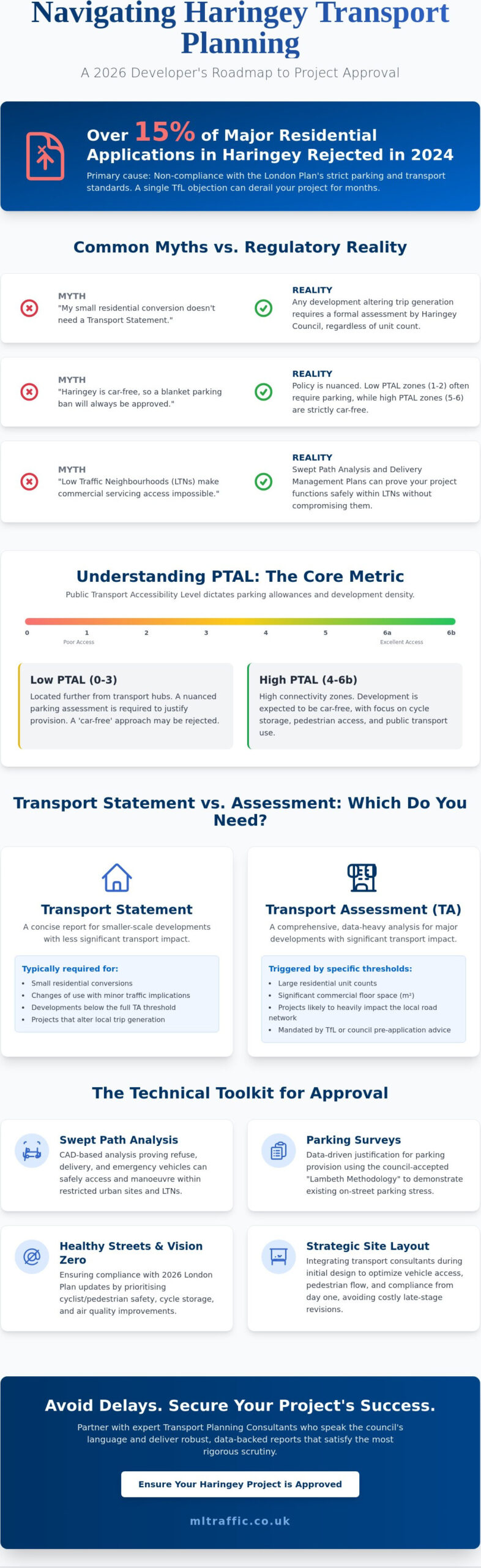
    Haringey Council rejected over 15% of major residential applications in 2024 due to non-compliance with the latest London Plan parking standards. For developers, a high-density site in a PTAL 6 zone isn’t just a design challenge; it’s a regulatory minefield where a single TfL objection can stall a project for months. Partnering with expert Transport Planning Consultants Haringey is no longer optional if you want to avoid these logistical headaches. We understand that your project’s viability depends on precise CAD designs and robust transport assessments that speak the council’s language from day one.

    You’ve likely felt the frustration of seeing a profitable site layout compromised by rigid vehicle access requirements or excessive Section 106 demands. It’s a common struggle for developers aiming to maximize footprint while meeting strict safety and sustainability criteria. This 2026 guide provides the technical roadmap to unlock your site’s potential through data-driven planning and strategic mitigation. We’ll walk you through the exact steps to optimize your access points, satisfy Chapter 8 safety requirements, and ensure your submission moves from consultation to construction without unnecessary friction.

    Key Takeaways

    • Understand how PTAL ratings influence parking maximums and why small-scale Haringey conversions still necessitate formal technical documentation.
    • Determine if your development triggers a full Transport Assessment or a Statement based on specific unit counts and floor space thresholds.
    • Secure council acceptance by applying the “Lambeth Methodology” to parking surveys and utilizing Swept Path Analysis for restricted urban access.
    • Professional Transport Planning Consultants Haringey provide the technical authority needed to navigate 2026 regulatory requirements and ensure project safety compliance.
    • Leverage expert representation to streamline the Planning Committee process and overcome common logistical hurdles within the London Borough of Haringey.

    Common Myths About Transport Planning in the London Borough of Haringey

    Developers often underestimate the complexity of securing approval in North London. Relying on outdated assumptions leads to costly delays at the planning committee stage. Engaging expert Transport Planning Consultants Haringey provides the technical precision required to navigate these hurdles. Many project managers believe small residential conversions don’t need a Transport Statement. This is a mistake. Haringey Council requires a formal assessment for any development that alters trip generation, regardless of the unit count. Ignoring this leads to immediate requests for further information, stalling your timeline.

    Understanding the fundamentals of transport planning helps developers realize that every square meter of a site must be justified through data. Another frequent misconception involves parking. While Haringey pushes for car-free developments, these policies don’t apply equally across the borough. PTAL 5 and 6 zones are strictly car-free, but PTAL 1 or 2 areas on the borough’s fringes often require nuanced assessments. You can’t assume a blanket ban on parking will satisfy officers in areas with poor public transport access.

    Modern transport planning isn’t just about cars. The Borough’s cycling and walking focus is now the primary metric for success. Many developers wait until the final submission to hire a consultant. This reactive approach often results in a site layout that doesn’t accommodate mandatory cycle storage or pedestrian flow. Integrating Transport Planning Consultants Haringey during the initial design phase ensures your site footprint is optimized for compliance from day one.

    Debunking the “Checkbox” Mentality

    Haringey Council officers look for proactive sustainable transport solutions rather than a simple list of features. The 2026 London Plan updates place higher emphasis on Healthy Streets indicators and Vision Zero safety targets. You need a strategy that actively reduces carbon emissions and improves local air quality. ML Traffic Engineers specialize in these London-specific requirements, moving beyond basic compliance to deliver robust, data-backed reports that satisfy the most rigorous council scrutiny.

    The Reality of LTNs and Development Access

    Low Traffic Neighbourhoods (LTNs) in areas like St Ann’s or Bruce Grove don’t prevent all new commercial servicing access. They change how you plan for it. The myth that LTNs make new development impossible is false. However, you must prove that servicing vehicles won’t compromise the integrity of the LTN. Technical reports using swept path analysis and delivery management plans can mitigate objections. These documents demonstrate that your project functions safely within restricted zones without increasing traffic on residential side streets.

    Understanding Haringey’s Local Transport Requirements: PTAL and Beyond

    Haringey Council utilizes the Public Transport Accessibility Level (PTAL) as the primary metric for evaluating development density and parking capacity. This 0 to 6b rating system measures the distance from any point to the nearest public transport access points, accounting for frequency and reliability. For developers, a high PTAL score often dictates a shift toward car-free housing. The London Plan 2021, and its anticipated 2026 updates, sets the benchmark for these local decisions. It forces boroughs to prioritize sustainable modes of travel over private vehicle ownership. Every transport strategy we develop focuses on these regulatory shifts to ensure long-term compliance.

    Maximum parking provisions are dictated strictly by these accessibility ratings. In areas with high connectivity, the council often permits zero residential parking spaces, excluding mandatory disabled bays. However, securing approval involves more than just a high score. Transport Planning Consultants Haringey must demonstrate how a project mitigates its impact on the existing network. This often requires a detailed Transport Statement vs. Assessment to satisfy planners that the local infrastructure can absorb the new residents without increasing congestion or safety risks. We provide the technical authority needed to address these logistical burdens before they become planning hurdles.

    Navigating PTAL Ratings in Wood Green and Tottenham

    Wood Green and parts of Tottenham frequently achieve PTAL scores of 6 or 6b. In these high-density zones, Haringey Council mandates car-free developments. Residents are legally restricted from applying for local parking permits. For projects like Flat Conversions in London, proving a site is “car-free ready” is essential for planning success. Suburban fringes with lower PTAL scores require a different approach, often involving parking surveys to prove that overspill won’t impact neighboring streets. We provide the technical data needed for these varying requirements, ensuring comprehensive support throughout your application.

    Haringey Council’s Active Travel Priorities

    The borough’s “Healthy Streets” approach means every application faces scrutiny regarding pedestrian and cyclist safety. Developers must provide high-quality cycle storage exceeding the London Plan standards. We focus on site layouts that promote active travel while maintaining safety for all road users. Haringey’s Vision Zero goal for 2026 aims to eliminate all deaths and serious injuries from the borough’s transport network through improved infrastructure design and strict enforcement of safety standards. This safety-first mindset is a foundation of our planning advice. Our 24/7 readiness ensures that even the most complex urban challenges are met with precise, compliant solutions.

    Transport Planning Consultants Haringey: A Developer’s 2026 Guide to Planning Approval

    Transport Statement vs. Assessment: Which Does Your Haringey Project Need?

    Selecting the wrong reporting tier results in an immediate “invalid” status from Haringey Council. Planning officers use specific thresholds to determine whether your site requires a Transport Statement (TS) or a full Transport Assessment (TA). While both documents analyze impact, the TA demands significantly more data, modeling, and mitigation strategies. Transport Planning Consultants Haringey help you identify these triggers before you submit, saving weeks of back-and-forth communication with the local highway authority.

    The cost and time implications are substantial. A Statement might take 10 to 15 working days to finalize; a full Assessment often requires 4 to 6 weeks due to the complexity of junction modeling and data collection. Haringey follows the London Plan 2021 standards, but local 2026 policy updates place higher scrutiny on “Healthy Streets” indicators and active travel scores. If your project falls on the boundary of these thresholds, opting for the higher-level report is often the safer path to approval.

    • Residential Thresholds: Schemes under 50 units usually need a TS; 50 or more units trigger a TA.
    • Commercial Thresholds: Floor space under 1,000 sqm typically requires a TS.
    • High-Impact Zones: Projects near congested junctions like the A10 may require a TA regardless of size.

    When a Transport Statement Suffices

    Haringey typically requests a TS for developments that don’t generate heavy traffic volumes. This includes residential schemes under 50 units or small-scale commercial changes of use. Officers expect a clear breakdown of trip generation, existing site access, and a parking survey that adheres to the Lambeth Methodology. We provide bespoke report types tailored to these specific local requirements. A basic statement must prove that your project won’t negatively impact the safety or capacity of the surrounding road network.

    The Complexity of a Full Transport Assessment

    Major developments, such as large residential blocks or retail spaces over 1,000 square meters, trigger a full TA. This is a comprehensive technical document. It includes detailed junction capacity assessments using software like LinSig or ARCADY. It also requires a draft Travel Plan to encourage sustainable transport use among future occupants. In Haringey, these assessments must align with the latest logistics guidelines to ensure construction traffic doesn’t paralyze local arteries. Expert Transport Planning Consultants Haringey ensure these complex data sets are accurate, preventing costly delays during the validation phase.

    Data-Driven Success: Parking Surveys and Swept Path Analysis for Haringey

    Haringey Council demands rigorous technical evidence for every new development. You cannot rely on guesswork when proposing a site in a borough known for its complex road layouts and high parking stress. Expert Transport Planning Consultants Haringey provide the empirical data needed to satisfy both planning officers and local highway authorities. By using site-specific traffic data, we challenge generic council assumptions that might otherwise lead to a refusal.

    Mastering Swept Path Analysis in N8 and N17

    Tight mews in Crouch End or urban infill sites in Tottenham require absolute precision. Swept Path Analysis (SPA) uses advanced CAD software to simulate the movement of specific vehicles through your proposed layout. This is essential for demonstrating that a standard 11.4-meter refuse vehicle or a fire tender can enter, turn, and exit the site safely without mounting curbs or striking buildings.

    Failing to provide SPA early in the process often leads to costly post-planning redesigns of site entrances or internal road layouts. We ensure your designs work in the real world before you submit your application. For more details on technical simulations, see our Swept Path Analysis Services.

    Parking Surveys: The Lambeth Methodology in Action

    Haringey requires parking stress assessments to follow the Lambeth Methodology. This is the industry gold standard for measuring on-street parking capacity. A valid survey must cover a 200-meter walking distance from the site and identify every available legal parking space.

    Timing is critical for council acceptance. To ensure survey validity, data collection must occur when residential parking demand is at its peak. Specifically, Haringey requires surveys to be conducted between 00:30 and 05:30 on two separate weekday nights. This data proves whether the local infrastructure can absorb any potential “overspill” from your development.

    Securing Highway Design Approvals (S278/S38)

    Transitioning from a planning consent to an active construction site requires navigating Section 278 and Section 38 agreements. These legal frameworks govern works on the existing highway and the adoption of new roads. As Transport Planning Consultants Haringey, we prioritize early engagement with the Haringey Highways team to streamline these approvals.

    We also incorporate Road Safety Audits (RSA) into the design phase. An RSA identifies potential hazards for pedestrians and cyclists, ensuring the development meets modern safety standards. For a complete breakdown of this process, read our Highway Design S278 & S38 Guide.

    Why Expert Transport Planning is the Key to Haringey Planning Approval

    Haringey Planning Committee meetings are high-stakes environments where technical precision is the only currency that matters. Developers face intense scrutiny regarding traffic impact and carbon reduction. Engaging Transport Planning Consultants Haringey ensures your project stands on a foundation of technical integrity. We provide professional representation that addresses council concerns before they become grounds for refusal. Our team leverages deep borough knowledge to navigate Haringey’s specific modal shift targets for 2026. We know how the local authority views parking ratios and cycle storage requirements.

    Integrating a robust Travel Plan is a strategic move to lower Section 106 (S106) contributions. By demonstrating a clear commitment to sustainable transport, developers can often negotiate lower financial levies for local infrastructure. This transition from initial feasibility studies to the final discharge of planning conditions requires a meticulous approach. Every step must align with the latest UK road regulations and safety standards. A compliant delivery and servicing plan london developers rely on is increasingly scrutinized by TfL alongside your Travel Plan, making it essential to address both documents in tandem. We manage the entire process, ensuring that your transport strategy supports your broader commercial goals.

    Reducing Developer Risk and Costs

    Technical errors are expensive. A single mistake in a Transport Assessment can trigger a planning appeal, which often costs developers upwards of £20,000 in legal and consultancy fees. We focus on precision. Our engineers use CAD design and accurate data to prevent these setbacks. We also specialize in negotiating transport-related planning conditions. This ensures that the requirements placed on your project are both fair and achievable. You can find more technical insights in our ML Traffic Resources. We aim to secure a positive outcome while protecting your bottom line.

    Partnering with ML Traffic Engineers for Haringey Projects

    We offer a total managed solution for developers in North London. Our team remains available 24/7 to handle urgent Haringey applications or last-minute site revisions. We manage the entire lifecycle of your project’s traffic requirements. This includes initial traffic surveys, detailed report writing, and final implementation of traffic management systems. You get a single point of contact for all regulatory and logistical needs. This efficiency keeps your project on schedule and compliant with all safety standards. We understand the high-stakes nature of Haringey’s regulatory environment. Our readiness and technical authority make us the dependable choice for complex urban developments. Contact ML Traffic Engineers for a Haringey project consultation to secure your planning approval and move your project forward with confidence.

    Secure Your Haringey Development Approval for 2026

    Navigating Haringey’s complex PTAL requirements and local transport standards requires a rigorous, data-driven approach. Since 2014, ML Traffic has delivered the technical precision needed to satisfy council scrutiny across London’s most demanding boroughs. Success in the current planning climate hinges on accurate Lambeth Parking Surveys and detailed Swept Path Analysis to prove site viability. We bridge the gap between your architectural vision and the borough’s strict regulatory framework. As experienced Transport Planning Consultants Haringey, we know that critical planning deadlines don’t always follow a standard nine-to-five schedule. That’s why our team provides 24/7 availability to handle urgent technical requirements and ensure your submission remains on track. We manage the intricate CAD designs and legislative compliance so your project moves forward without delay. Don’t let logistical hurdles or shifting transport policies stall your 2026 development timeline.

    Get a Professional Transport Planning Quote for Your Haringey Project

    We’re ready to help you secure your planning consent and break ground with total confidence.

    Frequently Asked Questions

    Do I need a transport planning consultant for a small development in Haringey?

    Yes, you’ll likely need a consultant if your site impacts the public highway or sits within a Controlled Parking Zone. Haringey’s 2024 Local Plan requires a Transport Statement for even minor residential developments of 1 to 9 units. Engaging transport planning consultants Haringey ensures your submission meets the technical standards required by the borough’s highways department. We manage the regulatory burden so you can focus on construction.

    What is the required PTAL rating for a car-free development in Wood Green?

    A car-free development in Wood Green generally requires a Public Transport Accessibility Level (PTAL) rating of 4 or higher. Wood Green currently features several zones with PTAL ratings of 6a and 6b, particularly near the Underground station. Under the London Plan 2021, sites with high connectivity must prioritize sustainable travel. Our team verifies these ratings using TfL’s WebCAT tool to justify reduced parking provision for your project.

    How long does a Haringey parking survey take to complete?

    A standard parking survey takes two nights to complete, typically conducted between 12:30 am and 5:30 am on a Tuesday and Wednesday. This timeframe captures peak residential parking demand as specified in the Lambeth Methodology. Once fieldwork finishes, we deliver the final report within 5 business days. This rapid turnaround keeps your planning application on schedule and avoids costly delays in the 2026 development cycle.

    Will Haringey Council accept a transport statement without swept path analysis?

    No, Haringey Council requires a swept path analysis for any development where service vehicles or emergency services need site access. This includes refuse trucks of 11.4 meters in length and fire engines. We use CAD-based software to simulate vehicle movements, proving that your layout accommodates these essential services. Without this technical verification, your application faces a high risk of rejection by the highways officer.

    What is the Lambeth Methodology for parking surveys in London?

    The Lambeth Methodology is a standardized framework for assessing parking stress within a 200-meter walking distance of a development site. It requires surveyors to record the number of available on-street spaces during two overnight periods. Haringey Council adopted this standard to ensure data consistency across all 32 London boroughs. Our surveyors follow these strict protocols to provide the precision required for legal and planning compliance.

    How much does a transport planning consultant cost for a Haringey application?

    Costs vary based on project complexity and the range of technical reports required for your specific site. While we don’t provide fixed estimates without a project brief, industry data shows that technical transport assessments for London developments scale with the number of units and required CAD modeling. Contact us for a bespoke quote that covers your planning needs from initial consultation through to final implementation.

    Can a travel plan help secure planning permission in Haringey?

    Yes, a robust Travel Plan is often a mandatory requirement for developments exceeding 20 residential units or 1,000 square meters of commercial space. It demonstrates your commitment to reducing single-occupancy vehicle trips by 15% over a five-year period. By proposing specific measures like car club memberships or cycle infrastructure, transport planning consultants Haringey help mitigate the impact on the local road network. This proactive approach effectively alleviates council concerns.

    What happens if TfL objects to my Haringey development proposal?

    If Transport for London (TfL) objects, you must address their specific concerns regarding the Strategic Road Network or bus operations. This usually involves revising the site access design or increasing contributions to public transport infrastructure. We act as your technical liaison, negotiating directly with TfL officials to find compliant solutions. Our 24/7 readiness ensures we respond to statutory consultee feedback quickly to keep your 2026 approval timeline intact.

    Michael Lee

    Article by

    Michael Lee

    Transport planner with over 35 years’ experience.

    Disclaimer

    The content on mltraffic.co.uk, including all technical articles, guides, and resources, is provided for general informational and educational purposes only. It is not intended to constitute professional advice in traffic engineering, transportation planning, development approvals, or any other technical or legal field.
    While ML Traffic Engineers makes every reasonable effort to ensure the accuracy, completeness, and timeliness of the information published, we do not provide any warranties or representations (express or implied) regarding its reliability, suitability, or availability for any particular purpose. Any reliance you place on the content is strictly at your own risk.
    In no event shall ML Traffic Engineers, its directors, employees, authors, or affiliates be liable for any direct, indirect, incidental, special, consequential, or punitive damages (including, without limitation, loss of profits, data, or business opportunities) arising out of or in connection with the use of, or inability to use, any information provided on this website.
    The articles and guides on this site are not a substitute for engaging a qualified, professional traffic engineer to assess your specific project requirements. For tailored advice, compliance assessments, or traffic engineering services, please contact a competent professional.
    This disclaimer may be updated from time to time without notice. By accessing or using this website, you agree to be bound by the most current version of this disclaimer.