Tag: Redbridge

  • Redbridge Sports Facility Transport Assessment Guide

    Redbridge Sports Facility Transport Assessment Guide

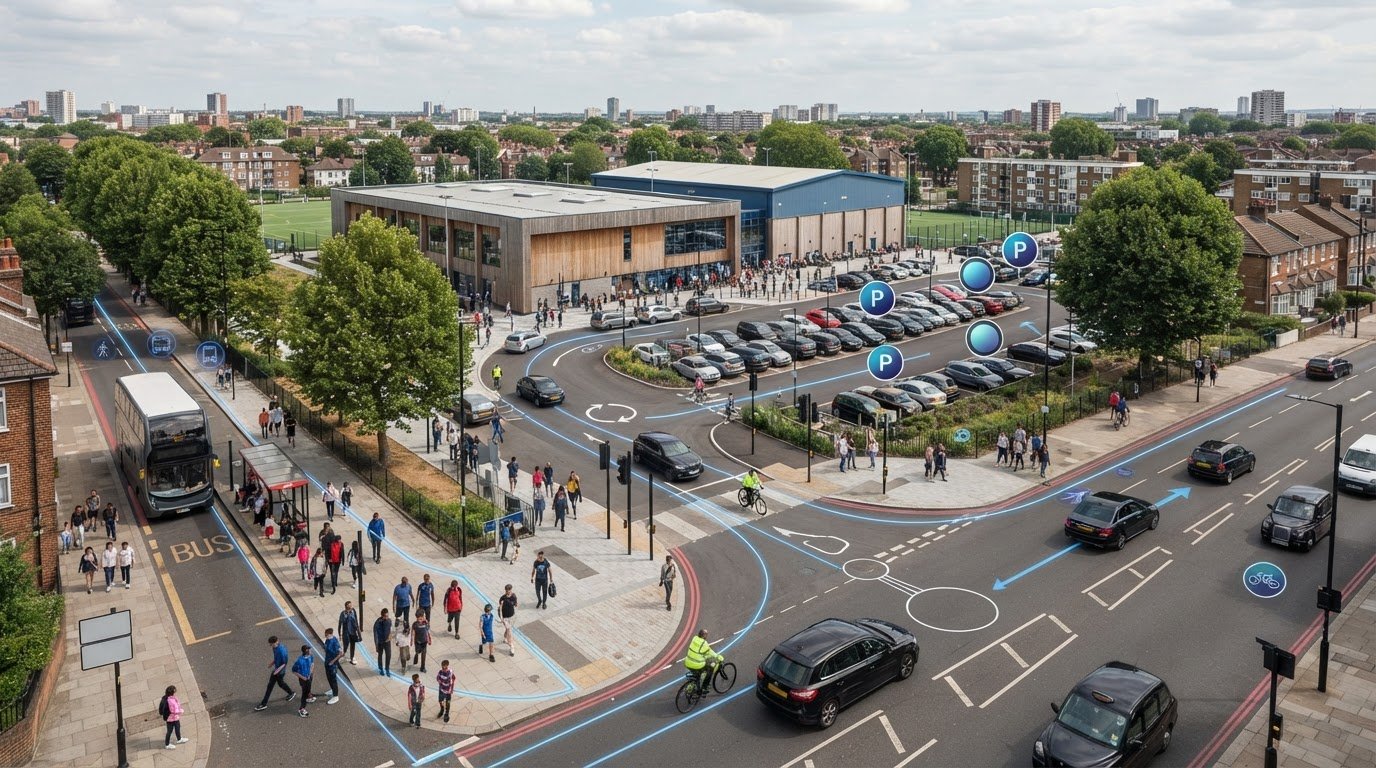
    A busy match or tournament can put very different demands on local roads, parking and public transport than an ordinary weekday. For a transport assessment for sports facility in Redbridge, the key is to show how event-day peaks relate to the site’s access and the surrounding transport network.

    It can be difficult to know whether a Transport Statement or a full Transport Assessment is appropriate, which surveys to commission, and what Redbridge planners will expect. The right scope depends on the proposal and its likely transport effects, so deciding too early can leave important questions unanswered.

    This guide explains what to consider before commissioning work and how to prepare a site-specific evidence base. It covers event and user travel patterns, vehicle access, parking, and walking, cycling and public transport connections, as well as the local policy context. It also outlines what to ask a consultant about scope, survey methods and report contents. Agreeing requirements for the specific proposal helps ensure the report addresses relevant planning questions.

    Key Takeaways

    • For a transport assessment for sports facility in Redbridge, agree the scope against the proposal’s likely transport effects and the relevant authority’s requirements.
    • Compare typical operating conditions with busy sessions, competitions and other event peaks when identifying potential transport impacts.
    • Check which current Redbridge planning requirements and London-wide guidance apply before deciding what evidence to prepare.
    • When appointing a consultant, clarify relevant experience, proposed surveys and analysis, and exactly what the report will include.
    • Coordinate assumptions and drawings across the client, architect, planning agent and transport consultant to keep the assessment consistent.

    When does a sports facility in Redbridge need a transport assessment?

    A Transport Assessment (TA) provides evidence about how a proposed development could affect transport and how people are expected to travel to and from it. Its scope should reflect the proposal and the planning authority’s requirements. For a sports venue, that means considering not only the building, but also the activity it is expected to generate and when it will take place.

    A Transport Statement (TS) generally gives a more concise, proportionate account where transport effects are more limited. There is no single facility-size rule that determines the right document in every case. Check Redbridge’s requirements for the specific application, including whether the planning or highway authority expects a TA, a TS or other supporting evidence. The broader transportation planning process helps explain why evidence should connect proposed activity with the transport network.

    A sports-facility proposal may need transport evidence when its expected travel demand or access arrangements could affect the surrounding network. Confirm the appropriate report and scope in the planning context.

    Which sports-facility proposals may prompt transport scrutiny?

    Consider what is changing, not just the venue’s floor area. A new sports centre, an extension to an existing club, upgraded pitches, a change of use or an increase in activity can each raise different transport questions. For operators also managing facility upkeep or pitch installations during venue redevelopments, learn more about professional equipment inspections and surfacing maintenance. A facility with regular classes may create steady arrival and departure patterns. A venue hosting occasional competitions may have sharper peaks and a different visitor profile.

    Capacity, opening hours, event frequency, and the balance between participants, spectators and staff can all affect the evidence needed. The local planning authority determines its requirements in light of the proposal, site and planning context. Do not assume an existing use or a modest building means transport effects are automatically limited.

    What should a Redbridge project team clarify first?

    Before commissioning a transport assessment for sports facility in Redbridge, assemble the site address, proposed use, expected capacity, operating hours and planning status. Note planned changes to event frequency or visitor numbers, and identify what is known about access and parking. These details help a consultant assess the likely scope rather than relying on a generic brief.

    Ask whether pre-application advice or a discussion with a planning officer is appropriate, and confirm current local requirements before agreeing the assessment methodology. For wider context on transport evidence for London planning applications, see the Transport Assessment London guide. ML Traffic Engineers UK prepares project-specific Transport Assessments and Transport Statements, with supporting evidence considered where required.

    What should a transport assessment for sports facility in Redbridge examine?

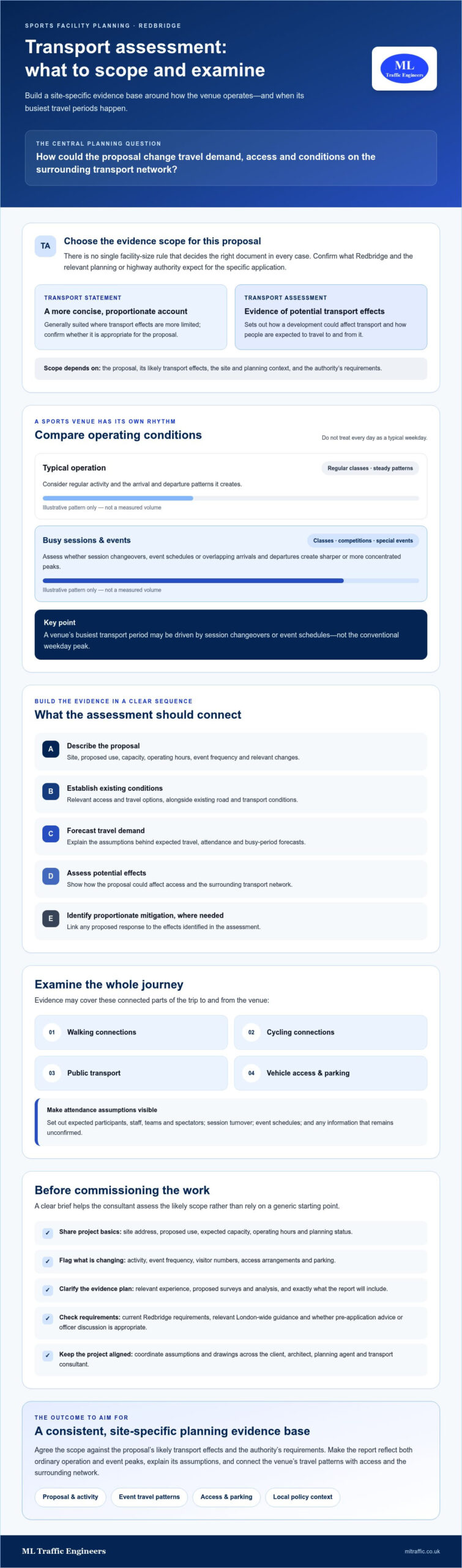
    A clear report follows a logical chain: describe the proposal, establish existing transport conditions, forecast travel demand, assess impacts and identify proportionate mitigation where needed. For a transport assessment for sports facility in Redbridge, that chain should reflect how the venue will operate, rather than treating every day as a typical weekday.

    Set out the site and proposed use, then describe relevant access and travel options. Evidence may cover walking, cycling, public transport and road conditions, alongside vehicle access and parking. The assessment should explain the basis for its forecasts and how the proposal could affect the transport network. The official government guidance is a starting point, but check survey methods and data requirements against the project and confirm them with the relevant authority.

    A sports venue’s busiest transport period may be driven by session changeovers or event schedules, not the conventional weekday peak. Assess ordinary operating periods separately from busy classes, competitions or special events, when arrivals and departures may overlap or concentrate.

    How should event-day travel demand be described?

    Make attendance assumptions clear. Explain expected numbers of participants, staff, teams and spectators, along with session turnover, event schedules and any information that remains unconfirmed. Where timings could affect nearby streets or public transport, show arrival and departure profiles separately instead of relying on a single daily total.

    For example, a competition where spectators arrive before a session ends may create a different pattern from classes with staggered start times. Identify which figures come from the client and which are estimates, so the project team can verify them before they inform the assessment.

    Which access, parking, and movement questions matter?

    Test how people can reach the facility on foot, by cycle and by public transport, as well as by car. Consider vehicle access, servicing, accessible arrival arrangements and how parking supply compares with expected demand. Check the local parking requirements that apply rather than assuming a generic standard fits the site.

    Use surveys or trip-generation methods where they are relevant to the proposal and agreed scope. If vehicle manoeuvring or access geometry needs to be demonstrated, swept path analysis can test whether relevant vehicles can move through the proposed layout. ML Traffic Engineers also prepares traffic surveys and parking surveys where appropriate to the evidence brief. See ML Traffic Engineers’ transport planning services for project-specific assessment support.

    How do Redbridge policy and local transport conditions shape the evidence?

    A transport assessment should respond to both the proposal and the policies and validation requirements that apply to its site. Redbridge’s Local Plan covers 2015-2030, while the London Plan 2021 provides a strategic London-wide framework. Before relying on either, check the council’s current planning pages for adopted updates, relevant policies and application validation requirements. A policy reference alone does not establish what evidence a particular sports-facility proposal needs.

    Review the council’s Redbridge local transport policy, including its Local Implementation Plan, and confirm whether other borough transport strategies are relevant. Establish which authority is responsible for roads or transport facilities affected by the proposal. Depending on the location and scope, confirm whether Transport for London (TfL) or another highway authority has a role. Check current Department for Transport guidance and any applicable TfL guidance before agreeing survey methods or report scope.

    Which local sources should the project team verify?

    Use current, authoritative documents rather than copied thresholds or assumptions from another site. Check Redbridge Council’s planning and local application requirements, applicable Local Plan policies, the London Plan and relevant national guidance. Where documents do not settle a question, confirm requirements with the planning or highway officer. Distinguish confirmed policy and validation requirements from points that still need officer advice.

    How should local access and travel conditions be evidenced?

    Describe the site’s actual connections: access points and surrounding streets, walking and cycling routes, public transport options, and relevant parking conditions. Use current, appropriately scoped evidence, and record its sources and dates. Include Public Transport Accessibility Level (PTAL) information only if it helps explain accessibility for this proposal, and identify its source and assessment date. Do not describe a road as congested or parking as under pressure without supporting evidence.

    The table below helps the project team track what is known and what still needs confirmation for a transport assessment for sports facility in Redbridge.

    Transport question Evidence to check Source and verification status
    Which planning requirements apply? Relevant policies and validation documents Redbridge Council; confirm against the live proposal
    Who is the relevant highway authority? Road responsibility and any TfL involvement Confirm for the site and affected routes
    How accessible is the site? Walking, cycling, public transport and, if relevant, PTAL Use current sources; record dates and applicability
    What local transport effects need evidence? Access, parking and network conditions Use suitable project evidence; agree unresolved matters with officers

    This approach keeps the report focused: cite confirmed requirements and clearly label assumptions or points awaiting authority advice.
    Redbridge Sports Facility Transport Assessment Guide

    How can you choose the right transport assessment consultant?

    Choose a consultant who can explain how the report will answer planning questions for your venue, not simply provide a standard document. For a transport assessment for sports facility in Redbridge, ask how the approach will account for event peaks, site access, parking and travel alternatives, and how it will reflect current authority requirements.

    Use this shortlist to compare potential consultants:

    1. Define the scope. Ask which planning questions the assessment will address and whether the proposal calls for a Transport Assessment or Transport Statement.
    2. Test relevant experience. Ask about comparable projects and how the consultant has considered sports-facility schedules, attendance patterns and local planning contexts.
    3. Agree the evidence. Confirm which existing information can be used, whether traffic surveys, parking surveys or swept path analysis are justified, and who will arrange any required data collection.
    4. Confirm deliverables and coordination. Agree report contents, assumptions, review stages, responsibilities and how the consultant will coordinate with the client, architect and planning agent.

    What should a sports-facility consultant brief include?

    Provide the site plan and address, proposed uses, capacity, opening hours, event calendar and known access constraints. Share available parking, travel, survey and operational information with its source and date, so the consultant can assess whether it remains suitable. Include the planning timetable, application status and any feedback already received from the planning or highway authority.

    Flag provisional information. If event attendance or session times are not confirmed, ask the consultant to record those assumptions and explain how they affect the evidence and conclusions.

    How can you compare scope and technical approach?

    Compare proposals by what each report will cover, which evidence sources it will use, and how it will handle uncertainty and planning coordination. A survey or technical analysis should have a clear purpose tied to the site, rather than appear as an unexplained default. Ask how findings will be reviewed and shared with the wider design team before submission.

    For broader context, consult ML Traffic Engineers’ Transport Assessment London guide. The company’s What We Do page also sets out its transport planning services, including Transport Assessments, Transport Statements, surveys and swept path analysis.

    Once you have prepared a project brief, review ML Traffic Engineers’ services to see how its transport planning work may fit your proposal.

    What happens after commissioning a Redbridge transport assessment?

    Once the brief is agreed, the work should move through clear stages: confirm the scope, check project information, gather or review relevant evidence, assess the proposal and prepare the report for review. For a transport assessment for sports facility in Redbridge, keep design and operating assumptions consistent. A change to access, capacity or event timings may affect the analysis, so the transport consultant needs the latest information as the scheme develops.

    What information and decisions keep the work moving?

    At the start, confirm the current site layout, access design, proposed capacity, operating schedule and planning proposals. The client should nominate a contact who can answer operational questions, verify attendance or event assumptions and provide missing information. Agree who will arrange site or survey access, when any data collection should take place and how drawing revisions will be issued.

    Coordination matters. The architect should share current drawings, the planning agent should flag application requirements and authority feedback, and the client should confirm how the facility will operate. Set review responsibilities and timings in advance. If the layout changes during the assessment, the team can identify whether the evidence or conclusions need updating before the report is finalised.

    What should the completed report enable?

    The finished report should provide a traceable account of the proposal, evidence considered, assessment undertaken and resulting conclusions. It should make clear which inputs are verified, which are assumptions, and how the findings relate to the proposed development. This gives the planning team a coherent document to submit and helps the relevant authority understand the transport matters considered.

    Submission does not guarantee planning approval. The authority may ask for clarification, further information or revisions, depending on its review of the application and evidence. If questions arise, the planning agent, client and transport consultant should coordinate responses and ensure revised drawings or assumptions remain aligned with the report.

    Before delivery, check that the report references the correct scheme version and that the client has confirmed key operational details. A final consistency check can help prevent queries caused by outdated plans or conflicting assumptions.

    For an overview of the company’s services, visit ML Traffic Engineers.

    Set your Redbridge transport evidence on a clear path

    A well-scoped assessment connects the facility’s operating pattern, including busy sessions and events, to transport evidence relevant to its site. Confirm whether a Transport Assessment or Transport Statement is appropriate, check current Redbridge and London requirements, and agree assumptions, surveys and report scope before work begins. Coordination between the client, design team and transport consultant helps keep the evidence aligned with the evolving proposal.

    ML Traffic Engineers provides transport planning services, including Transport Assessments, Transport Statements, traffic and parking surveys, and swept path analysis. The consultancy supports projects across Greater London, Manchester, Birmingham, the West Midlands, Liverpool, Surrey, East Sussex, West Sussex, Hampshire, Berkshire and Buckinghamshire. The appropriate evidence depends on the project, and the authority makes its own assessment of the application.

    If you’re ready to clarify the scope for a transport assessment for sports facility in Redbridge, contact ML Traffic Engineers to discuss your proposal and the supporting evidence that may be appropriate.

    Frequently Asked Questions

    Does a sports facility in Redbridge need a Transport Assessment?

    Possibly. A transport assessment for sports facility in Redbridge may be requested when a proposal could affect travel patterns, site access or the surrounding transport network. The appropriate evidence depends on the development, its operation and the local planning context, not just the building’s size. Check Redbridge Council’s current application requirements and seek planning or highway authority advice if the scope is unclear before commissioning a report.

    What should a sports-facility transport assessment include?

    It should explain the proposal, describe relevant existing transport conditions, forecast development-related travel demand, assess potential effects and present proportionate conclusions or mitigation. For a sports venue, the evidence may need to distinguish routine operation from classes, competitions or other busy periods. It can consider access by car, public transport, walking and cycling, as well as parking. The final scope and evidence should suit the site and confirmed authority requirements.

    How are event-day traffic peaks assessed for a sports facility?

    Start with clear assumptions about attendance, event schedules, session changeovers, staff, teams and spectators. The assessment can compare ordinary operating patterns with event-day arrivals and departures, especially where timings may concentrate trips on local streets or public transport. Traffic or parking surveys may help establish existing conditions if justified for the project. Record the source and date of inputs, and confirm provisional attendance or scheduling details with the facility operator.

    Is a Transport Assessment different from a Transport Statement?

    Yes. Both provide transport evidence for planning, but a Transport Assessment typically examines effects in greater depth, while a Transport Statement is generally more concise and proportionate where transport effects are more limited. There is no single facility-size rule that determines which applies in every case. The development proposal, likely effects and planning authority’s requirements should guide the choice. Confirm the expected report type and scope for the specific Redbridge application.

    Will Redbridge Council require traffic or parking surveys?

    Not automatically for every sports-facility proposal. Redbridge Council may require or seek survey evidence depending on the site, the proposal and the transport questions that need answering. Traffic or parking surveys can help establish existing conditions, but their location, timing and scope should suit the assessment and be checked against current application requirements or authority advice. Ask the consultant to explain why each survey is proposed and what decision it will inform.

    Can a sports facility transport assessment address walking and public transport?

    Yes. A transport assessment can examine how people could reach the facility by walking, cycling and public transport, alongside vehicle access and parking. It should describe relevant routes and connections using current, appropriately sourced information, and consider whether the proposal’s operating hours or event schedule affect those options. Accessibility measures such as PTAL should only be included where relevant, with the source and date stated, rather than treated as a substitute for site-specific analysis.

    When should I appoint a transport planning consultant for a Redbridge sports facility?

    Appoint a consultant early enough to clarify the report scope before the planning submission and while site access and layout can still be reviewed. Share the site plan, proposed use, capacity, hours, event information, planning status and any authority feedback. The consultant can then advise whether a Transport Assessment or Transport Statement is appropriate and whether surveys or swept path analysis are justified. ML Traffic Engineers prepares transport reports and supporting technical evidence.

    Michael Lee

    Article by

    Michael Lee

    Transport planner with over 35 years' experience.

    Disclaimer

    The content on mltraffic.co.uk, including all technical articles, guides, and resources, is provided for general informational and educational purposes only. It is not intended to constitute professional advice in traffic engineering, transportation planning, development approvals, or any other technical or legal field.
    While ML Traffic Engineers makes every reasonable effort to ensure the accuracy, completeness, and timeliness of the information published, we do not provide any warranties or representations (express or implied) regarding its reliability, suitability, or availability for any particular purpose. Any reliance you place on the content is strictly at your own risk.
    In no event shall ML Traffic Engineers, its directors, employees, authors, or affiliates be liable for any direct, indirect, incidental, special, consequential, or punitive damages (including, without limitation, loss of profits, data, or business opportunities) arising out of or in connection with the use of, or inability to use, any information provided on this website.
    The articles and guides on this site are not a substitute for engaging a qualified, professional traffic engineer to assess your specific project requirements. For tailored advice, compliance assessments, or traffic engineering services, please contact a competent professional.
    This disclaimer may be updated from time to time without notice. By accessing or using this website, you agree to be bound by the most current version of this disclaimer.
  • Transport Planning Consultants Redbridge: Securing 2026 Planning Approvals

    Transport Planning Consultants Redbridge: Securing 2026 Planning Approvals

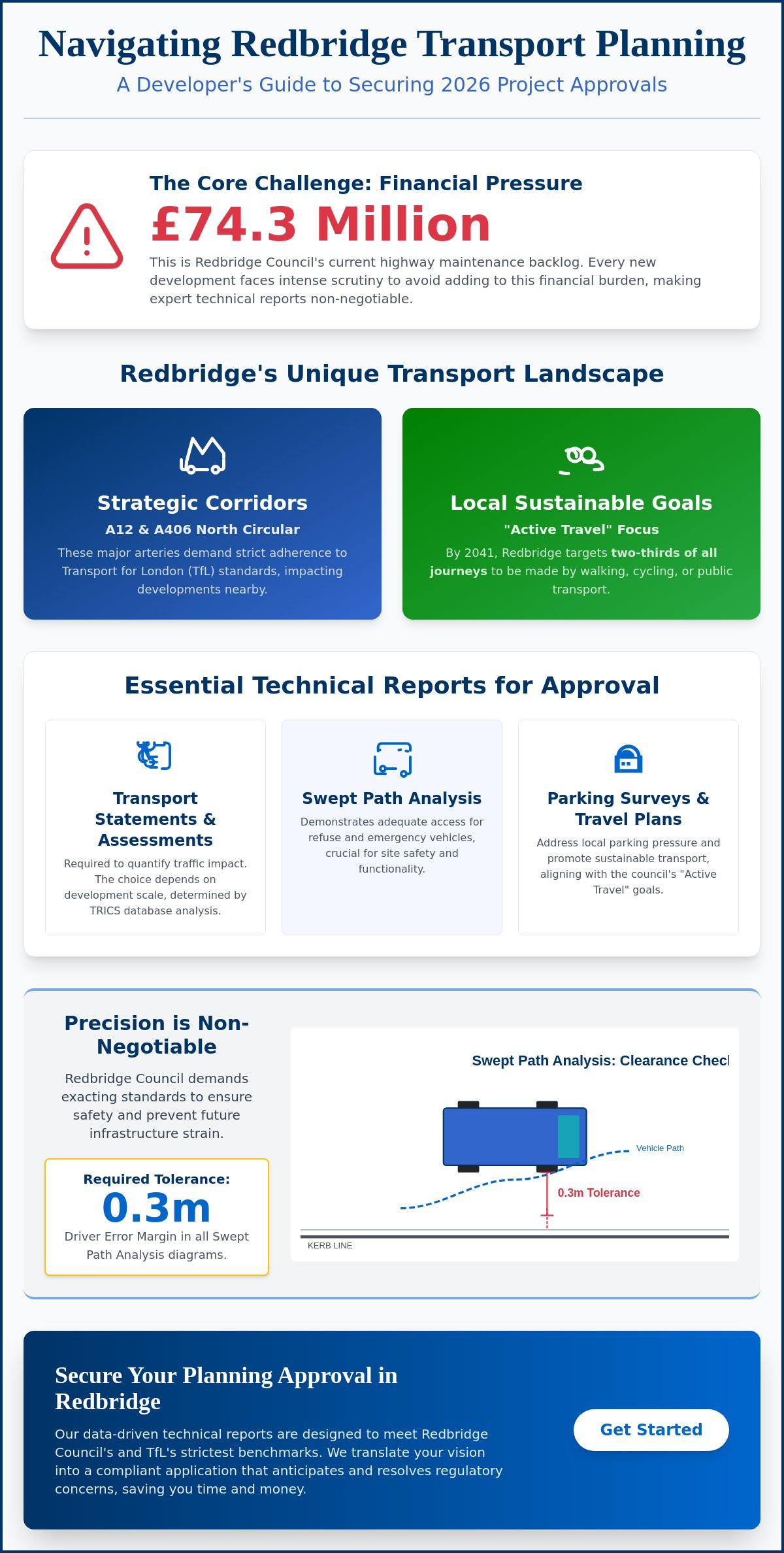
    Did you know that Redbridge Council is currently managing a highway maintenance backlog of approximately £74.3 million? This significant financial pressure means that every new planning application faces intense scrutiny regarding its impact on local infrastructure and safety. As specialized Transport Planning Consultants Redbridge, we recognize that securing a 2026 approval requires a sophisticated balance between suburban residential constraints and the strategic requirements of the TfL road network.

    It’s frustrating when a project stalls because of complex objections near the A12 or A406 corridors. You need technical reports that don’t just meet the minimum standards but actively reduce the council’s regulatory concerns. This article provides a clear roadmap for navigating Redbridge’s latest transport policies, from the updated 2026 parking permit price structures to the strict 0.3m tolerance required in swept path diagrams. We’ll examine how to utilize accurate Parking Surveys, Transport Statements, and Travel Plans to ensure your development stands up to rigorous council review while avoiding the high costs of over-engineered highway solutions.

    Key Takeaways

    • Determine if your project requires a Transport Statement or a full Assessment by understanding Redbridge Council’s specific development scale thresholds.
    • Ensure site accessibility and safety by utilizing Swept Path Analysis to demonstrate adequate clearance for emergency and refuse vehicles.
    • Learn how Transport Planning Consultants Redbridge align technical reporting with the London Plan’s “Healthy Streets” approach to reduce council objections.
    • Address local parking pressure through professional Parking Surveys and Travel Plans that support Redbridge’s sustainable transport mode share targets.
    • Secure timely approvals by utilizing data-driven technical reports that meet strict regulatory benchmarks and planning deadlines.

    The Role of Transport Planning Consultants in Redbridge

    Transport Planning Consultants Redbridge act as the vital technical link between property developers and the local planning authority. We translate complex architectural visions into data-driven reports that satisfy the rigorous safety and infrastructure requirements of Redbridge Council. Effective transport planning isn’t just about drawing lines on a map; it’s about proving that a project won’t compromise the borough’s existing road network or public safety. Our team manages the full project lifecycle, ensuring that every technical deliverable aligns with current legislative benchmarks.

    To better understand the professional standard required for these projects, watch this helpful video regarding transport planning expertise:

    Engaging with specialists at the inception of a project prevents costly planning objections later in the cycle. We provide the technical evidence, such as Transport Statements and comprehensive Transport Assessments, that highway officers require to validate an application. By identifying potential traffic impacts early, we help you avoid over-engineered solutions that inflate project costs without adding functional value. Our focus remains on providing an all-encompassing, fully-managed service that addresses every transport hurdle before it becomes a delay.

    Navigating Redbridge’s Unique Transport Landscape

    Redbridge presents a complex mix of high-speed strategic corridors and quiet residential streets. The A12 and A406 North Circular act as major arteries that require strict adherence to Transport for London (TfL) standards. Meanwhile, areas like Woodford maintain a suburban character that demands sensitive parking management. In contrast, the rapid urban regeneration in Ilford town centre must align with the 2026 Redbridge Local Plan’s focus on “Active Travel.” The council targets at least two-thirds of journeys to be made by walking, cycling, or public transport by 2041. Our role is to ensure your development supports these sustainable goals through robust Travel Plans and site-specific data.

    Why Developers Need Local Expertise

    Local knowledge is essential because Redbridge Council currently faces a £74.3 million highway maintenance backlog. This financial pressure makes officers particularly cautious about new developments that might increase wear on the network. Developers need reports that address specific local expectations, such as the 0.3m driver error tolerance required in any Swept Path Analysis. We ensure your documentation meets both borough-level requirements and TfL benchmarks for sites near red routes. Whether it’s conducting detailed Parking Surveys or navigating the administrative requirements for a Section 278 agreement, we provide the technical authority needed to secure planning approval. You can learn more about our specific approach to these reports on our services page.

    Transport Statements vs. Assessments for Redbridge Projects

    Choosing between a Transport Statement and a full Assessment is a critical technical decision for any Redbridge development. The scope of reporting is primarily determined by the scale of the proposal and its potential impact on the local highway network. Redbridge Council updated its Local and National Planning Application Requirement List in April 2024, specifying that major developments must provide comprehensive data to stand up to scrutiny. As expert Transport Planning Consultants Redbridge, we ensure that your project is categorized correctly from the start to avoid unnecessary costs or validation delays.

    Our technical team utilizes the TRICS database to perform accurate Trip Generation analysis. This data allows us to calculate the “residual cumulative impact” of a new development. Planning officers use this metric to determine if the additional traffic will push local junctions beyond their safe capacity. These reports must align with the London Plan 2021 and the broader framework of Local Transport Plans, which prioritize sustainable movement over private car use. If you’re unsure which report your site requires, reviewing our technical service overview can help clarify the requirements for your specific project type.

    When to Commission a Transport Statement

    A Transport Statement is typically appropriate for smaller residential or commercial schemes that don’t generate significant traffic volumes. These reports focus on site accessibility, local parking availability, and the quality of sustainable transport links. In Redbridge, this often involves demonstrating how a project encourages walking and cycling in line with the borough’s mode share targets. For a deeper look at the standards expected in the capital, consult our Transport Assessment London Guide. We ensure these statements provide the precise data needed to mitigate concerns regarding local parking pressure.

    The Requirements for a Full Transport Assessment

    Larger developments require a full Transport Assessment, which involves a deep dive into junction capacity modelling. This is essential for sites located near high-traffic corridors like the A12 or Ilford town centre. We model multi-modal impacts to show how the development affects buses, rail, and pedestrian infrastructure over the long term. These assessments are almost always paired with detailed Travel Plans. These plans act as a commitment to reducing single-occupancy vehicle trips, a non-negotiable requirement for securing planning permission in the current regulatory environment. Our precision in these assessments ensures that your data remains robust even under intense council cross-examination.

    Transport Planning Consultants Redbridge: Securing 2026 Planning Approvals

    Swept Path Analysis and Parking Surveys in Redbridge

    Redbridge presents unique spatial challenges, particularly in historic suburban areas where narrow road widths are common. Technical precision in Swept Path Analysis (SPA) is non-negotiable for any development seeking approval in 2026. As experienced Transport Planning Consultants Redbridge, we understand that “parking stress” is a primary reason for planning refusals. We use data-driven methodology to prove that a site can function safely without overwhelming local infrastructure. This involves aligning every project with the latest Redbridge transport policy to ensure seamless integration with the borough’s long-term infrastructure goals.

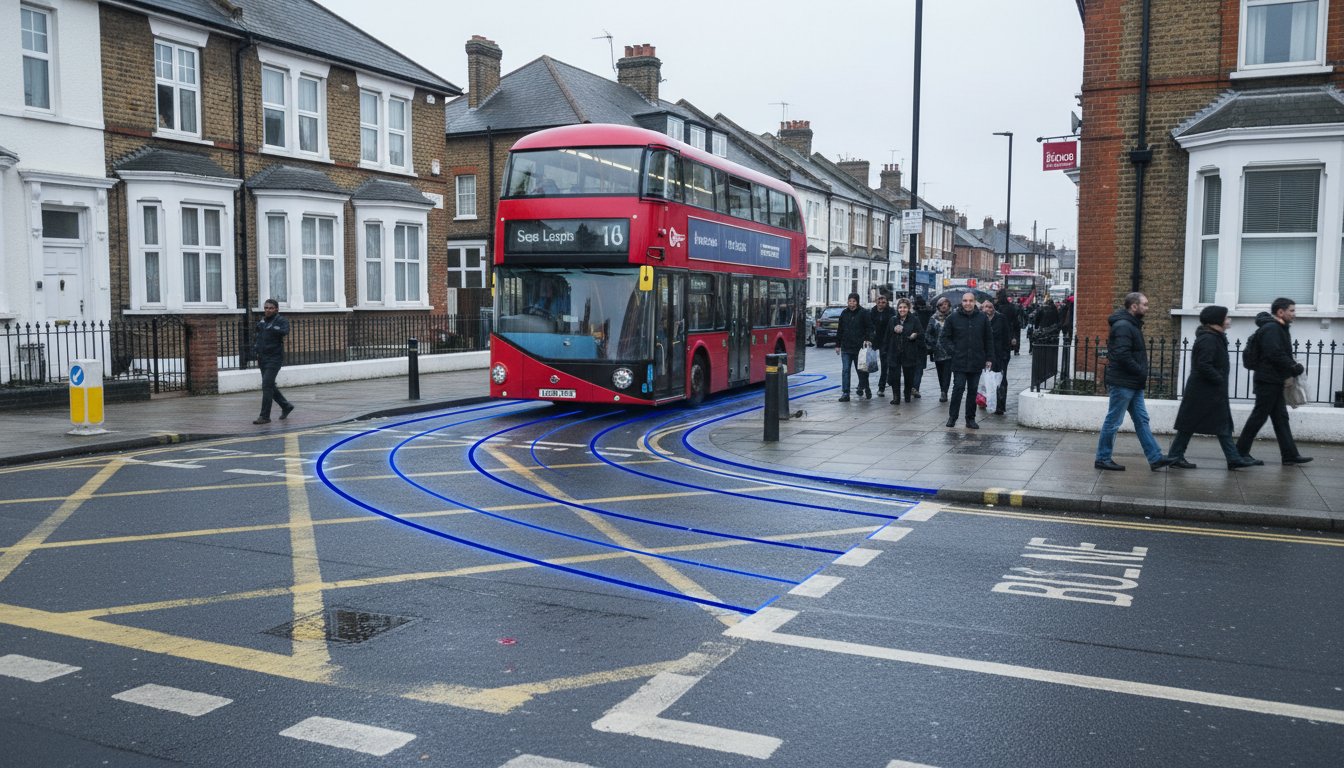
    SPA acts as a safety-conscious design tool that identifies potential conflicts before they reach the construction phase. By simulating the exact movements of large vehicles, we optimize car park layouts and site entrance visibility. This prevents over-engineered solutions and ensures that access points meet the council’s strict safety benchmarks. Our team manages the full simulation process to demonstrate that refuse and emergency vehicles can enter and exit a site in a single forward motion, which is a key requirement for modern planning validation.

    Mastering Swept Path Analysis for Tight Sites

    In suburban developments like those found in Woodford, road space is often at a premium. We use specialized software to simulate fire tender and refuse vehicle movements, accounting for the council’s specific 0.3m driver error tolerance. This level of technical authority prevents design errors that could lead to costly redesigns or immediate planning objections. Our Swept Path Analysis Services provide the visual evidence needed to reassure highway officers that emergency and service access is fully maintained without compromising pedestrian safety.

    Redbridge Parking Surveys: The Lambeth Methodology

    Parking Surveys in Redbridge must follow the recognized Lambeth Methodology to stand up to council scrutiny. We conduct overnight surveys, typically between 00:30 and 05:30, to capture the peak residential parking demand. This data is essential for developments near high-pressure areas like Snaresbrook or sites with high PTAL scores near the Elizabeth Line. By documenting the actual on-street capacity within a 200-metre radius, we can justify parking provision levels that might otherwise face resistance. Our reports provide the accurate data required to navigate Redbridge’s expanding permit parking zones and ensure your development remains viable under current regulatory standards.

    Policy Compliance: From the London Plan to Section 278

    Securing planning permission in 2026 requires more than just technical data; it demands total alignment with the Mayor of London’s “Healthy Streets” approach. This policy framework prioritizes the experience of people on the street, focusing on air quality, noise reduction, and safety. As expert Transport Planning Consultants Redbridge, we integrate these indicators into every report to ensure your development supports the borough’s long-term environmental goals. We also apply “Vision Zero” safety standards to all our Transport Assessments, demonstrating a proactive commitment to eliminating all traffic-related fatalities and serious injuries.

    Travel Plans are a non-negotiable component of this policy compliance. These documents act as a formal commitment to reducing single-occupancy vehicle trips through sustainable travel incentives. We design these plans to be actionable and data-driven, providing the council with clear evidence that your project won’t exacerbate local congestion. By focusing on precision and regulatory adherence, we reduce the likelihood of the council requesting costly post-submission revisions. To ensure your site meets these rigorous safety and policy benchmarks, contact us today for technical planning support.

    The Impact of the Elizabeth Line on Redbridge Planning

    The Elizabeth Line has fundamentally changed the transport landscape in Ilford and Seven Kings. This improved connectivity has resulted in significantly higher PTAL (Public Transport Accessibility Level) ratings for nearby sites. We leverage these high scores to support car-free or car-lite development proposals, which align with the council’s desire to reduce private car dependency. Modern Redbridge Travel Plans must now include specific incentives for rail and bus use to capitalize on this infrastructure. Our team provides the nuanced analysis required to justify reduced parking provision in these high-accessibility corridors, helping you maximize the developable area of your site.

    Highway Design and S278 Agreements

    Developments that require modifications to the existing public highway must navigate Section 278 (S278) and Section 38 (S38) agreements. Redbridge Council currently lists a £2,500 fee for these agreements in their 2026/27 charges. We manage the technical reporting and design precision needed to satisfy highway officers, ensuring that any off-site improvements meet strict safety and durability standards. For a comprehensive breakdown of these requirements, consult our Highway Design S278 & S38 Guide. Our involvement ensures that the transition from planning approval to highway execution is seamless and technically sound, avoiding the delays often associated with over-engineered or poorly documented highway works.

    Why Choose ML Traffic Engineers for Redbridge Projects?

    ML Traffic Engineers provides a level of technical rigour that goes beyond basic planning advice. We understand that securing planning permission in the London Borough of Redbridge requires a partner who manages the entire project lifecycle. From initial feasibility studies to final site occupancy, our team delivers the data-driven reports needed to satisfy both local highway officers and TfL. We take pride in our ability to navigate intricate regional regulations so our clients don’t have to. Our established track record in the borough ensures that your technical documentation aligns perfectly with local expectations and safety standards.

    Our commitment to safety and precision is reflected in our rapid response capabilities. We recognize that planning deadlines are often tight and unpredictable. Our experts are ready to act immediately, providing the technical authority required to overcome sudden regulatory hurdles or transport objections. By choosing us as your Transport Planning Consultants Redbridge, you gain a partner dedicated to professional integrity and adherence to industry benchmarks. We don’t just provide reports; we provide a functional necessity for high-stakes development projects.

    A Dependable Partner for Developers

    Developers benefit from direct access to senior consultants who specialize in Redbridge-specific challenges. This high-level oversight ensures that every Transport Statement or Parking Survey is tailored to the specific nuances of the borough. We aim to reduce the logistical and regulatory pressures on our clients by providing a fully-managed service. This all-encompassing approach covers every technical requirement mentioned in our comprehensive service list. By managing the full scope of transport planning, we allow you to focus on the broader aspects of your development while we handle the technical scrutiny.

    Precision Data Collection and Analysis

    We utilize the latest modelling software for junction capacity assessments and swept path analysis. This precision allows us to identify the most efficient site layouts, preventing the over-engineering that often leads to unnecessary project costs. Our data stands up to the most intense council scrutiny because it is rooted in accurate traffic surveys and established legislative requirements. Whether you’re developing a residential scheme in Woodford or a commercial project in Ilford, our reports provide the technical evidence needed for a successful outcome. Contact us for a Redbridge project quote to ensure your planning application is supported by industry-leading expertise and a commitment to precision.

    Secure Your Redbridge Planning Approval

    Navigating the evolving transport landscape in Redbridge requires a combination of technical precision and local policy expertise. From mastering the 0.3m driver error tolerance in Swept Path Analysis to justifying parking provision near the Elizabeth Line, your technical documentation must be beyond reproach. Relying on professional Transport Planning Consultants Redbridge ensures that your project meets the rigorous standards set by both the council and TfL without the risk of over-engineered costs.

    ML Traffic Engineers has been a dependable partner for developers since 2014. We bring over a decade of London-wide experience to every project, specializing in TRICS trip generation and high-accuracy data collection. Our team understands the specific requirements for Section 278 agreements and Redbridge’s 2026 sustainable transport targets. We provide the technical authority needed to transform complex regulatory challenges into successful planning outcomes.

    Secure Your Redbridge Planning Approval with ML Traffic Engineers. We’re ready to help you move your project from the feasibility stage to final site occupancy with unwavering reliability.

    Frequently Asked Questions

    Do I need a transport assessment for a small residential project in Redbridge?

    Small residential projects typically require a Transport Statement rather than a full Assessment. Redbridge Council’s 2024 validation list specifies that full Assessments are reserved for major developments that significantly impact the local highway network. Our role as Transport Planning Consultants Redbridge is to review your site’s scale and provide the specific level of technical reporting necessary to satisfy highway officers without over-engineering the solution.

    How long does it take to complete a transport statement in Redbridge?

    Completing a transport statement generally takes between two to four weeks depending on the complexity of the site and the availability of local traffic data. This timeline accounts for the initial site visit, data collection from the TRICS database, and the drafting of the technical report. If new traffic surveys are required during school term times, we manage the scheduling to ensure the most accurate data capture for council review.

    What is the cost of a swept path analysis for a fire tender in London?

    The cost of a swept path analysis depends on the number of vehicle types simulated and the complexity of the site layout. Each simulation must account for specific vehicle dimensions and the council’s required 0.3m driver error tolerance. Because every project has unique access requirements, we provide tailored quotes based on the specific architectural plans and the number of access points that require technical verification.

    Does Redbridge Council accept the Lambeth Methodology for parking surveys?

    Yes, Redbridge Council accepts the Lambeth Methodology as the standard for assessing on-street parking stress. This methodology requires overnight surveys, typically conducted between 00:30 and 05:30 on two separate weekday nights. This captures peak residential parking demand, providing the technical evidence needed to justify parking provision levels for new developments in high-pressure zones like Snaresbrook or Woodford.

    How does a high PTAL rating affect my parking provision requirements?

    A high Public Transport Accessibility Level (PTAL) rating significantly reduces the amount of on-site parking the council expects you to provide. Sites in Ilford town centre often achieve high scores due to proximity to the Elizabeth Line, allowing for car-free or car-lite developments. We use these ratings to support planning applications that prioritize sustainable travel and align with the London Plan’s maximum parking standards.

    Can a travel plan help secure planning permission for a commercial site?

    A Travel Plan is often a mandatory requirement for securing planning permission for commercial developments in Redbridge. It demonstrates a proactive commitment to reducing single-occupancy vehicle trips and encourages employees to use public transport or cycling. We design these plans to meet the borough’s mode share targets, which aim for two-thirds of all journeys to be made by sustainable means by 2041.

    What is the difference between a Section 278 and a Section 38 agreement?

    A Section 278 agreement is required for any permanent works carried out on the existing public highway, such as creating a new site entrance. A Section 38 agreement relates to the adoption of new roads built within a development that will eventually be maintained by the council. Redbridge Council currently lists a £2,500 fee for these agreements in their 2026/27 charges, and we provide the technical design precision needed for approval.

    How does the Elizabeth Line impact transport planning in Ilford and Woodford?

    The Elizabeth Line has increased the viability of high-density developments in Ilford and Seven Kings by improving regional connectivity. This shift requires Transport Planning Consultants Redbridge to focus more on active travel and public transport infrastructure in these areas. While Woodford remains more suburban, the overall trend toward sustainable transport across the borough means that even smaller projects must now demonstrate how they support the council’s sustainable transport strategy.

    Michael Lee

    Article by

    Michael Lee

    Transport planner with over 35 years’ experience.

    Disclaimer

    The content on mltraffic.co.uk, including all technical articles, guides, and resources, is provided for general informational and educational purposes only. It is not intended to constitute professional advice in traffic engineering, transportation planning, development approvals, or any other technical or legal field.
    While ML Traffic Engineers makes every reasonable effort to ensure the accuracy, completeness, and timeliness of the information published, we do not provide any warranties or representations (express or implied) regarding its reliability, suitability, or availability for any particular purpose. Any reliance you place on the content is strictly at your own risk.
    In no event shall ML Traffic Engineers, its directors, employees, authors, or affiliates be liable for any direct, indirect, incidental, special, consequential, or punitive damages (including, without limitation, loss of profits, data, or business opportunities) arising out of or in connection with the use of, or inability to use, any information provided on this website.
    The articles and guides on this site are not a substitute for engaging a qualified, professional traffic engineer to assess your specific project requirements. For tailored advice, compliance assessments, or traffic engineering services, please contact a competent professional.
    This disclaimer may be updated from time to time without notice. By accessing or using this website, you agree to be bound by the most current version of this disclaimer.