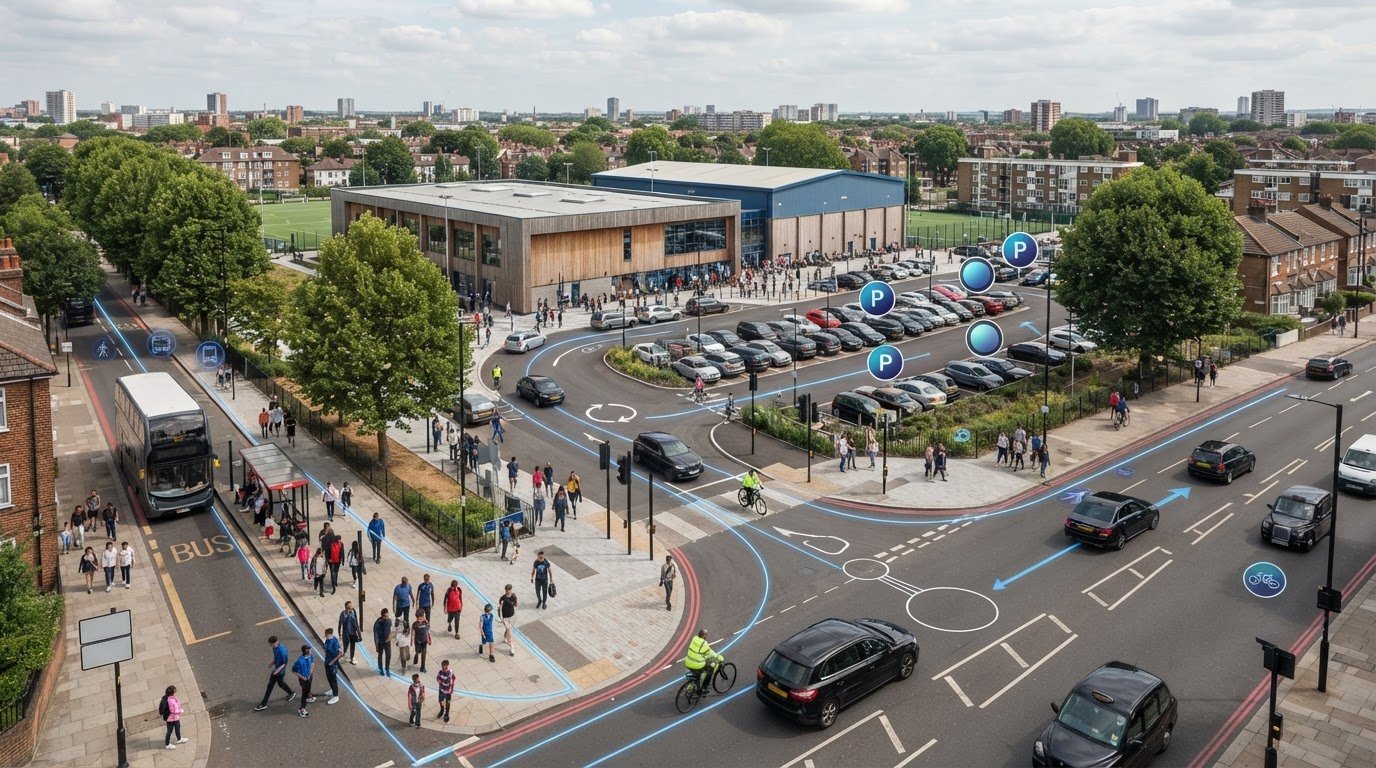
A busy match or tournament can put very different demands on local roads, parking and public transport than an ordinary weekday. For a transport assessment for sports facility in Redbridge, the key is to show how event-day peaks relate to the site’s access and the surrounding transport network.
It can be difficult to know whether a Transport Statement or a full Transport Assessment is appropriate, which surveys to commission, and what Redbridge planners will expect. The right scope depends on the proposal and its likely transport effects, so deciding too early can leave important questions unanswered.
This guide explains what to consider before commissioning work and how to prepare a site-specific evidence base. It covers event and user travel patterns, vehicle access, parking, and walking, cycling and public transport connections, as well as the local policy context. It also outlines what to ask a consultant about scope, survey methods and report contents. Agreeing requirements for the specific proposal helps ensure the report addresses relevant planning questions.
Key Takeaways
- For a transport assessment for sports facility in Redbridge, agree the scope against the proposal’s likely transport effects and the relevant authority’s requirements.
- Compare typical operating conditions with busy sessions, competitions and other event peaks when identifying potential transport impacts.
- Check which current Redbridge planning requirements and London-wide guidance apply before deciding what evidence to prepare.
- When appointing a consultant, clarify relevant experience, proposed surveys and analysis, and exactly what the report will include.
- Coordinate assumptions and drawings across the client, architect, planning agent and transport consultant to keep the assessment consistent.
When does a sports facility in Redbridge need a transport assessment?
A Transport Assessment (TA) provides evidence about how a proposed development could affect transport and how people are expected to travel to and from it. Its scope should reflect the proposal and the planning authority’s requirements. For a sports venue, that means considering not only the building, but also the activity it is expected to generate and when it will take place.
A Transport Statement (TS) generally gives a more concise, proportionate account where transport effects are more limited. There is no single facility-size rule that determines the right document in every case. Check Redbridge’s requirements for the specific application, including whether the planning or highway authority expects a TA, a TS or other supporting evidence. The broader transportation planning process helps explain why evidence should connect proposed activity with the transport network.
A sports-facility proposal may need transport evidence when its expected travel demand or access arrangements could affect the surrounding network. Confirm the appropriate report and scope in the planning context.
Which sports-facility proposals may prompt transport scrutiny?
Consider what is changing, not just the venue’s floor area. A new sports centre, an extension to an existing club, a change of use or an increase in activity can each raise different transport questions. A facility with regular classes may create steady arrival and departure patterns. A venue hosting occasional competitions may have sharper peaks and a different visitor profile.
Capacity, opening hours, event frequency, and the balance between participants, spectators and staff can all affect the evidence needed. The local planning authority determines its requirements in light of the proposal, site and planning context. Do not assume an existing use or a modest building means transport effects are automatically limited.
What should a Redbridge project team clarify first?
Before commissioning a transport assessment for sports facility in Redbridge, assemble the site address, proposed use, expected capacity, operating hours and planning status. Note planned changes to event frequency or visitor numbers, and identify what is known about access and parking. These details help a consultant assess the likely scope rather than relying on a generic brief.
Ask whether pre-application advice or a discussion with a planning officer is appropriate, and confirm current local requirements before agreeing the assessment methodology. For wider context on transport evidence for London planning applications, see the Transport Assessment London guide. ML Traffic Engineers UK prepares project-specific Transport Assessments and Transport Statements, with supporting evidence considered where required.
What should a transport assessment for sports facility in Redbridge examine?
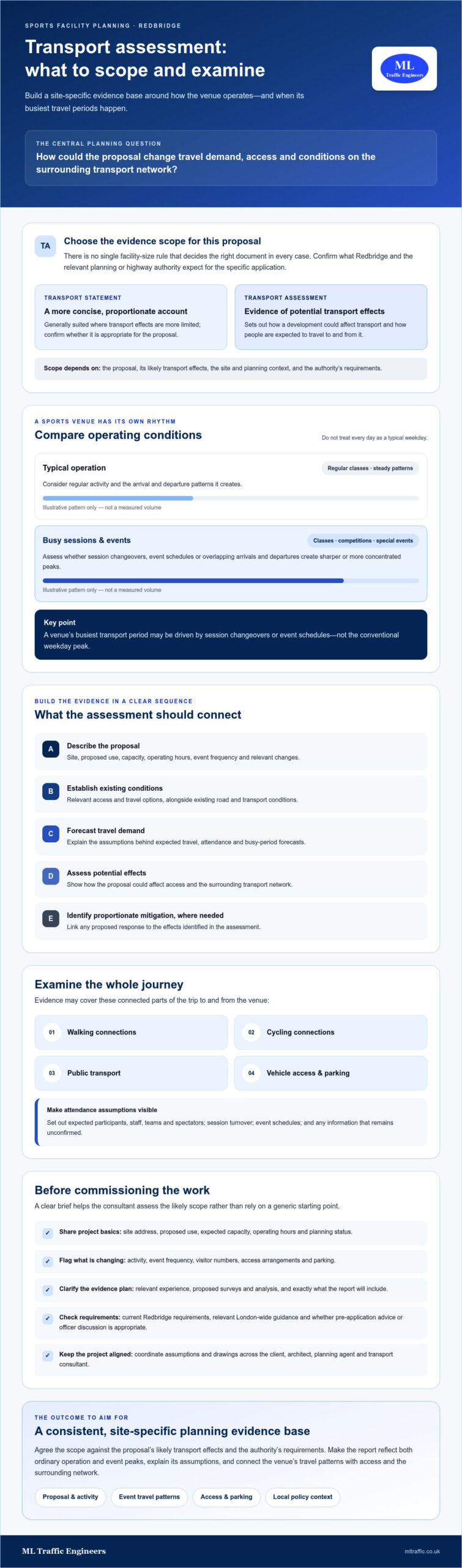
A clear report follows a logical chain: describe the proposal, establish existing transport conditions, forecast travel demand, assess impacts and identify proportionate mitigation where needed. For a transport assessment for sports facility in Redbridge, that chain should reflect how the venue will operate, rather than treating every day as a typical weekday.
Set out the site and proposed use, then describe relevant access and travel options. Evidence may cover walking, cycling, public transport and road conditions, alongside vehicle access and parking. The assessment should explain the basis for its forecasts and how the proposal could affect the transport network. The official government guidance is a starting point, but check survey methods and data requirements against the project and confirm them with the relevant authority.
A sports venue’s busiest transport period may be driven by session changeovers or event schedules, not the conventional weekday peak. Assess ordinary operating periods separately from busy classes, competitions or special events, when arrivals and departures may overlap or concentrate.
How should event-day travel demand be described?
Make attendance assumptions clear. Explain expected numbers of participants, staff, teams and spectators, along with session turnover, event schedules and any information that remains unconfirmed. Where timings could affect nearby streets or public transport, show arrival and departure profiles separately instead of relying on a single daily total.
For example, a competition where spectators arrive before a session ends may create a different pattern from classes with staggered start times. Identify which figures come from the client and which are estimates, so the project team can verify them before they inform the assessment.
Which access, parking, and movement questions matter?
Test how people can reach the facility on foot, by cycle and by public transport, as well as by car. Consider vehicle access, servicing, accessible arrival arrangements and how parking supply compares with expected demand. Check the local parking requirements that apply rather than assuming a generic standard fits the site.
Use surveys or trip-generation methods where they are relevant to the proposal and agreed scope. If vehicle manoeuvring or access geometry needs to be demonstrated, swept path analysis can test whether relevant vehicles can move through the proposed layout. ML Traffic Engineers also prepares traffic surveys and parking surveys where appropriate to the evidence brief. See ML Traffic Engineers’ transport planning services for project-specific assessment support.
How do Redbridge policy and local transport conditions shape the evidence?
A transport assessment should respond to both the proposal and the policies and validation requirements that apply to its site. Redbridge’s Local Plan covers 2015-2030, while the London Plan 2021 provides a strategic London-wide framework. Before relying on either, check the council’s current planning pages for adopted updates, relevant policies and application validation requirements. A policy reference alone does not establish what evidence a particular sports-facility proposal needs.
Review the council’s Redbridge local transport policy, including its Local Implementation Plan, and confirm whether other borough transport strategies are relevant. Establish which authority is responsible for roads or transport facilities affected by the proposal. Depending on the location and scope, confirm whether Transport for London (TfL) or another highway authority has a role. Check current Department for Transport guidance and any applicable TfL guidance before agreeing survey methods or report scope.
Which local sources should the project team verify?
Use current, authoritative documents rather than copied thresholds or assumptions from another site. Check Redbridge Council’s planning and local application requirements, applicable Local Plan policies, the London Plan and relevant national guidance. Where documents do not settle a question, confirm requirements with the planning or highway officer. Distinguish confirmed policy and validation requirements from points that still need officer advice.
How should local access and travel conditions be evidenced?
Describe the site’s actual connections: access points and surrounding streets, walking and cycling routes, public transport options, and relevant parking conditions. Use current, appropriately scoped evidence, and record its sources and dates. Include Public Transport Accessibility Level (PTAL) information only if it helps explain accessibility for this proposal, and identify its source and assessment date. Do not describe a road as congested or parking as under pressure without supporting evidence.
The table below helps the project team track what is known and what still needs confirmation for a transport assessment for sports facility in Redbridge.
| Transport question | Evidence to check | Source and verification status |
|---|---|---|
| Which planning requirements apply? | Relevant policies and validation documents | Redbridge Council; confirm against the live proposal |
| Who is the relevant highway authority? | Road responsibility and any TfL involvement | Confirm for the site and affected routes |
| How accessible is the site? | Walking, cycling, public transport and, if relevant, PTAL | Use current sources; record dates and applicability |
| What local transport effects need evidence? | Access, parking and network conditions | Use suitable project evidence; agree unresolved matters with officers |
This approach keeps the report focused: cite confirmed requirements and clearly label assumptions or points awaiting authority advice.
How can you choose the right transport assessment consultant?
Choose a consultant who can explain how the report will answer planning questions for your venue, not simply provide a standard document. For a transport assessment for sports facility in Redbridge, ask how the approach will account for event peaks, site access, parking and travel alternatives, and how it will reflect current authority requirements.
Use this shortlist to compare potential consultants:
- Define the scope. Ask which planning questions the assessment will address and whether the proposal calls for a Transport Assessment or Transport Statement.
- Test relevant experience. Ask about comparable projects and how the consultant has considered sports-facility schedules, attendance patterns and local planning contexts.
- Agree the evidence. Confirm which existing information can be used, whether traffic surveys, parking surveys or swept path analysis are justified, and who will arrange any required data collection.
- Confirm deliverables and coordination. Agree report contents, assumptions, review stages, responsibilities and how the consultant will coordinate with the client, architect and planning agent.
What should a sports-facility consultant brief include?
Provide the site plan and address, proposed uses, capacity, opening hours, event calendar and known access constraints. Share available parking, travel, survey and operational information with its source and date, so the consultant can assess whether it remains suitable. Include the planning timetable, application status and any feedback already received from the planning or highway authority.
Flag provisional information. If event attendance or session times are not confirmed, ask the consultant to record those assumptions and explain how they affect the evidence and conclusions.
How can you compare scope and technical approach?
Compare proposals by what each report will cover, which evidence sources it will use, and how it will handle uncertainty and planning coordination. A survey or technical analysis should have a clear purpose tied to the site, rather than appear as an unexplained default. Ask how findings will be reviewed and shared with the wider design team before submission.
For broader context, consult ML Traffic Engineers’ Transport Assessment London guide. The company’s What We Do page also sets out its transport planning services, including Transport Assessments, Transport Statements, surveys and swept path analysis.
Once you have prepared a project brief, review ML Traffic Engineers’ services to see how its transport planning work may fit your proposal.
What happens after commissioning a Redbridge transport assessment?
Once the brief is agreed, the work should move through clear stages: confirm the scope, check project information, gather or review relevant evidence, assess the proposal and prepare the report for review. For a transport assessment for sports facility in Redbridge, keep design and operating assumptions consistent. A change to access, capacity or event timings may affect the analysis, so the transport consultant needs the latest information as the scheme develops.
What information and decisions keep the work moving?
At the start, confirm the current site layout, access design, proposed capacity, operating schedule and planning proposals. The client should nominate a contact who can answer operational questions, verify attendance or event assumptions and provide missing information. Agree who will arrange site or survey access, when any data collection should take place and how drawing revisions will be issued.
Coordination matters. The architect should share current drawings, the planning agent should flag application requirements and authority feedback, and the client should confirm how the facility will operate. Set review responsibilities and timings in advance. If the layout changes during the assessment, the team can identify whether the evidence or conclusions need updating before the report is finalised.
What should the completed report enable?
The finished report should provide a traceable account of the proposal, evidence considered, assessment undertaken and resulting conclusions. It should make clear which inputs are verified, which are assumptions, and how the findings relate to the proposed development. This gives the planning team a coherent document to submit and helps the relevant authority understand the transport matters considered.
Submission does not guarantee planning approval. The authority may ask for clarification, further information or revisions, depending on its review of the application and evidence. If questions arise, the planning agent, client and transport consultant should coordinate responses and ensure revised drawings or assumptions remain aligned with the report.
Before delivery, check that the report references the correct scheme version and that the client has confirmed key operational details. A final consistency check can help prevent queries caused by outdated plans or conflicting assumptions.
For an overview of the company’s services, visit ML Traffic Engineers.
Set your Redbridge transport evidence on a clear path
A well-scoped assessment connects the facility’s operating pattern, including busy sessions and events, to transport evidence relevant to its site. Confirm whether a Transport Assessment or Transport Statement is appropriate, check current Redbridge and London requirements, and agree assumptions, surveys and report scope before work begins. Coordination between the client, design team and transport consultant helps keep the evidence aligned with the evolving proposal.
ML Traffic Engineers provides transport planning services, including Transport Assessments, Transport Statements, traffic and parking surveys, and swept path analysis. The consultancy supports projects across Greater London, Manchester, Birmingham, the West Midlands, Liverpool, Surrey, East Sussex, West Sussex, Hampshire, Berkshire and Buckinghamshire. The appropriate evidence depends on the project, and the authority makes its own assessment of the application.
If you’re ready to clarify the scope for a transport assessment for sports facility in Redbridge, contact ML Traffic Engineers to discuss your proposal and the supporting evidence that may be appropriate.
Frequently Asked Questions
Does a sports facility in Redbridge need a Transport Assessment?
Possibly. A transport assessment for sports facility in Redbridge may be requested when a proposal could affect travel patterns, site access or the surrounding transport network. The appropriate evidence depends on the development, its operation and the local planning context, not just the building’s size. Check Redbridge Council’s current application requirements and seek planning or highway authority advice if the scope is unclear before commissioning a report.
What should a sports-facility transport assessment include?
It should explain the proposal, describe relevant existing transport conditions, forecast development-related travel demand, assess potential effects and present proportionate conclusions or mitigation. For a sports venue, the evidence may need to distinguish routine operation from classes, competitions or other busy periods. It can consider access by car, public transport, walking and cycling, as well as parking. The final scope and evidence should suit the site and confirmed authority requirements.
How are event-day traffic peaks assessed for a sports facility?
Start with clear assumptions about attendance, event schedules, session changeovers, staff, teams and spectators. The assessment can compare ordinary operating patterns with event-day arrivals and departures, especially where timings may concentrate trips on local streets or public transport. Traffic or parking surveys may help establish existing conditions if justified for the project. Record the source and date of inputs, and confirm provisional attendance or scheduling details with the facility operator.
Is a Transport Assessment different from a Transport Statement?
Yes. Both provide transport evidence for planning, but a Transport Assessment typically examines effects in greater depth, while a Transport Statement is generally more concise and proportionate where transport effects are more limited. There is no single facility-size rule that determines which applies in every case. The development proposal, likely effects and planning authority’s requirements should guide the choice. Confirm the expected report type and scope for the specific Redbridge application.
Will Redbridge Council require traffic or parking surveys?
Not automatically for every sports-facility proposal. Redbridge Council may require or seek survey evidence depending on the site, the proposal and the transport questions that need answering. Traffic or parking surveys can help establish existing conditions, but their location, timing and scope should suit the assessment and be checked against current application requirements or authority advice. Ask the consultant to explain why each survey is proposed and what decision it will inform.
Can a sports facility transport assessment address walking and public transport?
Yes. A transport assessment can examine how people could reach the facility by walking, cycling and public transport, alongside vehicle access and parking. It should describe relevant routes and connections using current, appropriately sourced information, and consider whether the proposal’s operating hours or event schedule affect those options. Accessibility measures such as PTAL should only be included where relevant, with the source and date stated, rather than treated as a substitute for site-specific analysis.
When should I appoint a transport planning consultant for a Redbridge sports facility?
Appoint a consultant early enough to clarify the report scope before the planning submission and while site access and layout can still be reviewed. Share the site plan, proposed use, capacity, hours, event information, planning status and any authority feedback. The consultant can then advise whether a Transport Assessment or Transport Statement is appropriate and whether surveys or swept path analysis are justified. ML Traffic Engineers prepares transport reports and supporting technical evidence.

Disclaimer
The content on mltraffic.co.uk, including all technical articles, guides, and resources, is provided for general informational and educational purposes only. It is not intended to constitute professional advice in traffic engineering, transportation planning, development approvals, or any other technical or legal field.
While ML Traffic Engineers makes every reasonable effort to ensure the accuracy, completeness, and timeliness of the information published, we do not provide any warranties or representations (express or implied) regarding its reliability, suitability, or availability for any particular purpose. Any reliance you place on the content is strictly at your own risk.
In no event shall ML Traffic Engineers, its directors, employees, authors, or affiliates be liable for any direct, indirect, incidental, special, consequential, or punitive damages (including, without limitation, loss of profits, data, or business opportunities) arising out of or in connection with the use of, or inability to use, any information provided on this website.
The articles and guides on this site are not a substitute for engaging a qualified, professional traffic engineer to assess your specific project requirements. For tailored advice, compliance assessments, or traffic engineering services, please contact a competent professional.
This disclaimer may be updated from time to time without notice. By accessing or using this website, you agree to be bound by the most current version of this disclaimer.