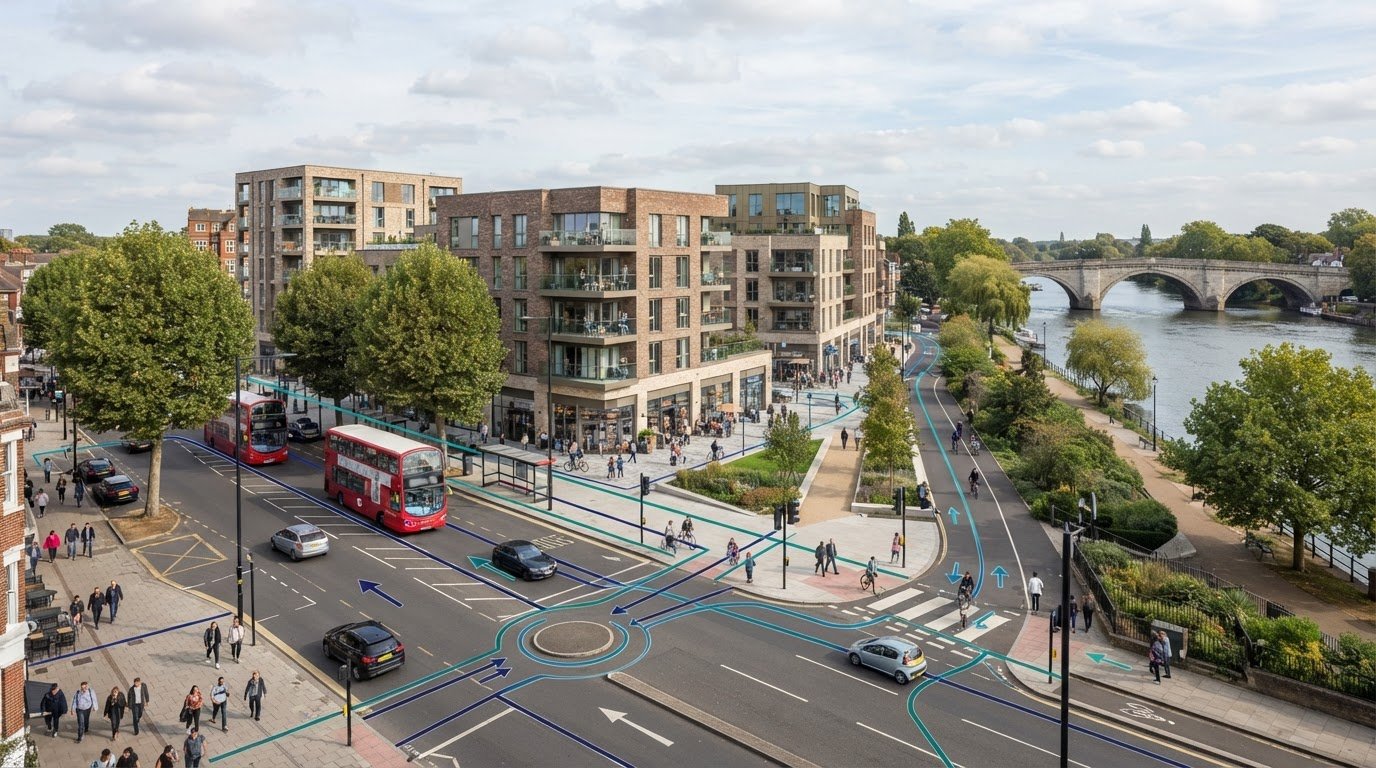
Could a scheme with individually modest uses still create a substantial combined transport impact? That’s the key question behind a transport assessment for mixed-use scheme in Kingston upon Thames. Residential, retail, office and other uses can generate different travel patterns, and their combined effects may influence traffic, parking, access and servicing. Whether a Transport Assessment or Transport Statement is appropriate depends on the proposal and its site-specific planning requirements, not just a single headline figure.
Before commissioning technical work, it helps to know what evidence the planning submission may need and which local considerations could affect the analysis. This article explains how to assess each use alongside the overall scheme, what site information can support a robust submission, and how to brief a transport-planning consultant. Checking current Kingston Council requirements and agreeing the scope early can help identify missing evidence before it affects the application programme.
Key Takeaways
- Whether a Transport Assessment or Transport Statement is appropriate depends on the scheme’s scale, context and planning requirements. Confirm the scope for the specific site.
- A transport assessment for mixed-use scheme in Kingston upon Thames should examine each proposed use and the combined effects of the development.
- Build the evidence around baseline conditions, development assumptions, trip estimates and analysis of likely transport impacts.
- Prepare site plans, a land-use schedule, access details, the project programme and known constraints to support a useful assessment brief.
- Choose a consultant who can explain their methods, evidence needs and relevant experience. Avoid relying on promises of planning approval.
When do you need a transport assessment for mixed-use scheme in Kingston upon Thames?
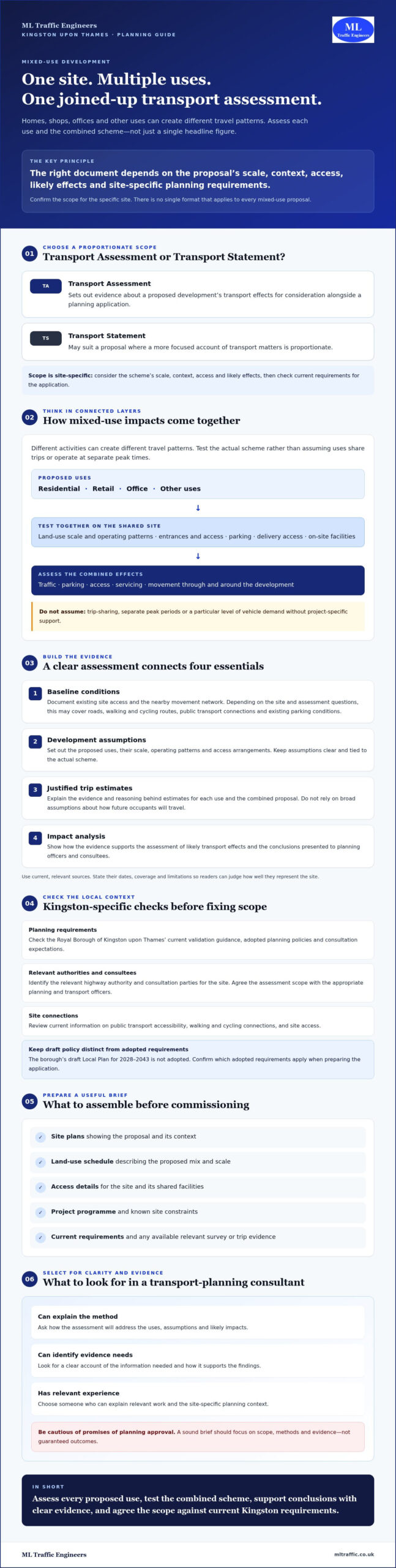
A Transport Assessment (TA) presents evidence about a proposed development’s transport effects for consideration with a planning application. A Transport Statement (TS) may suit a proposal where a more focused account of transport matters is proportionate. The right document depends on the scheme’s scale, context, access and likely effects. There is no reason to assume one format applies to every mixed-use proposal.
A mixed-use development brings activities such as homes, shops and offices together. Each can generate different travel demand, while the shared site may connect access, parking, servicing and other facilities. A transport assessment for mixed-use scheme in Kingston upon Thames should consider each use and test the combined proposal, rather than treating the uses as unrelated projects.
For a brief visual introduction to Kingston upon Thames, watch this video:
What makes mixed-use transport demand different?
Start with the proposed uses, their scale and their operating patterns. A residential element may have different travel peaks from a workplace or shop, for example, but the assessment should test those assumptions against the actual scheme. Shared entrances, parking, delivery access and on-site facilities can also affect how people and vehicles move through the development.
Use the land-use schedule, access plans and relevant survey or trip evidence to identify what needs testing. Don’t assume that uses will share trips, operate at separate peak times or create a particular level of vehicle demand without project-specific support.
Which Kingston planning and transport context should be checked?
Check the Royal Borough of Kingston upon Thames’ current validation guidance, adopted planning policies and consultation expectations before fixing the scope. The borough’s draft Local Plan for 2028-2043 is not adopted; its Regulation 19 consultation closed on 4 September 2026. The GLA’s draft London Plan consultation runs until 15 October 2026. Confirm which adopted requirements apply when preparing the application.
Identify the relevant highway authority and consultation parties for the site. Review current information on public transport accessibility, walking and cycling connections, and site access. These checks help define a proportionate scope, but they do not replace agreement with the relevant planning and transport officers. For a wider overview of assessment considerations, see this Transport Assessment guide for London developers.
What evidence should a Kingston mixed-use Transport Assessment examine?
The assessment scope should reflect the scheme’s land-use mix, scale, access arrangements and the planning questions raised by the site. It should explain what evidence supports each conclusion, rather than relying on broad assumptions about how future occupants will travel. The UK government guidance on Transport Assessments is a starting point for understanding the purpose and preparation of this evidence. Confirm the project scope against current requirements for the specific application.
Core evidence includes baseline transport conditions, clearly stated development assumptions, justified trip estimates and analysis of likely impacts. Keeping these elements distinct helps planning officers and other consultees understand how the assessment reaches its findings.
How should the baseline and development trips be established?
First, document the site’s existing access and nearby movement network. Depending on the site and assessment questions, this may include roads, pedestrian and cycle routes, public transport connections and existing parking conditions. Use current, relevant sources, and state their dates, coverage and limitations so readers can judge how well they represent the site.
Then set out the development assumptions for each use. Record proposed floorspace or unit numbers, operating patterns and access arrangements, and explain how the separate elements combine. Trip estimates should be traceable to their inputs and method. If an assumption is uncertain, identify it rather than presenting it as a confirmed travel pattern.
When might surveys and technical analysis be useful?
Surveys can answer specific questions that existing data cannot resolve. A traffic survey may provide evidence about movements on relevant roads or at access points; a parking survey may help establish existing parking conditions. Neither is automatically necessary. Agree the survey purpose, locations, timing, coverage and method with the relevant parties, then explain any limitations and how the results inform the analysis.
Further technical analysis should also be proportionate to the issues being tested. For example, the assessment may need to examine how estimated trips interact with access arrangements or nearby network conditions. The appropriate level depends on the proposal and agreed scope, not a preset assumption.
ML Traffic Engineers provides traffic and parking surveys to support evidence gathering where appropriate. Link each proposed survey or analysis task to a planning question, so data collection has a clear purpose.
- Establish the baseline and record source dates.
- Define assumptions separately for each use and the combined scheme.
- Use surveys or technical analysis to address an agreed evidence gap.
Developers and planning agents can discuss the assessment scope and programme with ML Traffic Engineers before commissioning project-specific evidence.
How should the assessment address combined impacts, access, and parking?
A mixed-use assessment should test how the proposed uses work together. Simply adding separate trip estimates may not capture the full picture. Compare likely peak periods, visitor patterns, access needs and servicing requirements using evidence and stated assumptions. Different uses may generate travel at different times, or their demands may overlap. Shared facilities could affect travel choices, but any reduction or increase in demand needs to be supported by analysis.
How can different uses affect one another’s travel patterns?
Consider whether residents, employees, customers and visitors are likely to arrive at similar times, and how long each group may stay. Check whether proposed shared parking, cycle facilities or other site arrangements could influence journeys between uses. Don’t assume people will combine trips or use shared facilities simply because they are available. Explain the basis for each assumption, and assess the proposal as a whole as well as its individual elements.
A use-specific and site-wide comparison helps clarify what the assessment needs to test:
| Use-specific questions | Shared site-wide questions |
|---|---|
| What are the likely operating hours, visitor patterns and travel needs for each use? | Do peak demands overlap, and how might combined trips affect nearby movement networks? |
| Does a use need dedicated parking, loading or servicing arrangements? | How do access points, parking provision and servicing areas work across the site? |
| What pedestrian, cycle and public transport connections are relevant to its users? | Can people move between uses and connect safely with routes beyond the site? |
What should be checked for site access and movement?
Review the access design against the proposed layout and expected movements. Relevant checks may include access geometry, visibility, pedestrian routes and cycle access. Consider vehicle access, parking, loading and servicing where they form part of the scheme, and assess how these arrangements work across the site. Match the scope to the planning questions rather than assuming every topic needs the same level of analysis.
Where vehicle movements make manoeuvring a relevant issue, swept path analysis can illustrate how the selected design vehicle moves through access points or servicing areas. It should use plans and vehicle assumptions that apply to the proposal. See this swept path analysis planning guide for more on this type of evidence.
A transport assessment for mixed-use scheme in Kingston upon Thames should bring these strands together, considering combined vehicle, pedestrian, cycle and public transport effects. The conclusions should explain how the assessment has treated shared demand and site constraints, distinguishing evidenced findings from assumptions that still need confirmation.
How can developers prepare to commission a Kingston transport assessment?
A clear brief helps a consultant identify the evidence needed, avoid using outdated design information and agree a proportionate scope with the project team. For a transport assessment for mixed-use scheme in Kingston upon Thames, cover both the separate uses and their combined effects, while leaving site-specific requirements open for confirmation.
Use this sequence to move from an initial brief to an agreed scope:
- Set out the proposal. Provide the site location, latest plans, land-use schedule and proposed access details.
- Explain the planning context. Share the application status, known planning questions and any discussions or consultation expectations identified so far.
- Confirm current requirements. Check the Royal Borough of Kingston upon Thames’ validation guidance and relevant adopted policy. Establish which highway authority and consultation parties apply to the site.
- Identify evidence needs. Review available transport data and consider whether traffic or parking surveys, or other analysis, would answer specific planning questions. Agree the scope before fixing assumptions or commissioning evidence.
- Agree the method and programme. Confirm the assessment tasks, information dependencies, deliverables and review stages with the consultant and wider planning team.
For broader context on the purpose and preparation of this work, read the Transport Assessment guide for London developers.
What information should the project team provide?
Send the latest site location and layout plans, access details, proposed uses and their scale, the project programme, and known site constraints. Include relevant planning correspondence, available surveys and design changes that could affect movement or access. A concise information pack gives the consultant a clearer basis for scoping the assessment.
Separate confirmed facts from working assumptions. For example, identify which access arrangements appear on the current design and which remain under review. Note the date and coverage of available survey information so its relevance can be checked before it informs the assessment.
What should you ask a Transport Assessment consultant?
Ask how the proposed method will address each use and the combined site-wide effects. Clarify the data sources, assumptions, survey recommendations and reasoning behind the scope. Check what information the consultant needs from the project team, which deliverables are included and when reviews will take place.
Discuss how findings will be coordinated with the wider planning team, particularly if the design or land-use mix changes. A well-defined scope should make responsibilities and evidence gaps visible early, without promising a particular planning outcome.
To discuss a project brief and assessment scope, contact ML Traffic Engineers.
Choosing a consultant for your Kingston mixed-use Transport Assessment
The right consultant should make the assessment process clear from the outset. Look for experience preparing planning evidence for mixed-use proposals and coordinating it with the wider project team. Ask how they will check current local requirements and identify relevant consultees for your site, rather than relying on general claims of Kingston expertise.
Compare the proposed scope and method, not promises of planning approval. A clear proposal should explain the work, deliverables, information needed from your team and how assumptions or limitations will be reported. This gives you a practical basis for comparing consultants.
What indicates a suitable transport-planning partner?
Ask how the consultant will respond to design changes and relevant stakeholder feedback. Check whether they will explain how updates affect the evidence, analysis or agreed scope, and how they will communicate those changes to the project team. Proposed surveys or technical work should have a defined purpose linked to planning questions.
Local context matters, but ask how the consultant will establish what applies to your site. This may include checking current Royal Borough of Kingston upon Thames guidance, access arrangements and relevant transport information.
How can ML Traffic Engineers UK support the assessment process?
ML Traffic Engineers UK prepares Transport Assessments, Transport Statements and Travel Plans for planning applications. The consultancy works across Greater London, Manchester, Birmingham, the West Midlands, Liverpool, Surrey, East Sussex, West Sussex, Hampshire, Berkshire and Buckinghamshire. Where appropriate to the agreed scope, traffic and parking surveys can provide project-specific evidence, while swept path analysis can examine vehicle manoeuvring shown in the proposed design. The consultancy was founded in 2014.
Before appointing a consultant, agree the information required from your project team, proposed deliverables and how the assessment will align with the planning programme. These discussions establish a clear basis for the work without implying a guaranteed planning decision.
Ready to discuss the scheme and appropriate next steps? Discuss your Kingston mixed-use scheme with the transport team.
Set a clear course for your planning submission
A robust assessment depends on a clear, site-specific scope and evidence that addresses the proposal’s planning questions. Confirm current local requirements, and make sure the report distinguishes established information from assumptions that still need checking.
Early coordination helps keep the assessment aligned with the scheme as it develops. ML Traffic Engineers prepares Transport Assessments, and traffic and parking surveys can support project-specific evidence where appropriate. Discussing the brief and programme early can help clarify suitable next steps.
Discuss your Kingston mixed-use scheme with the transport team to agree a suitable scope for your planning submission.
Frequently Asked Questions
Does a mixed-use development in Kingston upon Thames need a Transport Assessment?
Not automatically. The appropriate evidence depends on the proposal’s scale, land-use mix, access, location and likely transport effects, alongside current planning requirements. Check the Royal Borough of Kingston upon Thames’ current validation guidance and relevant policy, and confirm the scope with the relevant officers. Don’t rely on a single threshold without verifying whether it applies to your specific scheme.
What should a Transport Assessment for a mixed-use scheme include?
It should set out existing transport conditions, describe the development and its assumptions, estimate travel demand and assess likely effects. For a transport assessment for mixed-use scheme in Kingston upon Thames, the analysis should consider each proposed use and the combined development, including relevant effects on vehicle movement, walking, cycling, public transport, parking, access and servicing. The final scope should address the planning questions raised by the site.
How is a Transport Assessment different from a Transport Statement?
A Transport Assessment generally provides a more detailed examination of a development’s transport effects, while a Transport Statement is a more proportionate document for proposals with more limited transport considerations. The distinction is not determined by a universal rule for every site. Check the Royal Borough’s current validation requirements and discuss the proposal’s scale, context and likely effects with the relevant planning team before commissioning either document.
What surveys might a Kingston mixed-use Transport Assessment require?
Depending on the evidence gap, the assessment may use traffic surveys to understand movements on relevant roads or access points, or parking surveys to establish existing parking conditions. Surveys are not automatically required for every application. Agree their purpose, locations, timing, coverage and method for the project, and explain the data’s relevance and limitations in the report. Existing sources may also be suitable if they address the planning questions.
Who reviews a Transport Assessment for a development in Kingston upon Thames?
The planning authority considers the assessment as part of the application, and relevant transport or highway officers may provide input. The appropriate highway authority and consultation parties depend on the site and the network affected, so confirm them for the specific proposal. Other consultees may be involved where relevant. Check current Kingston validation guidance and clarify consultation expectations rather than assuming the same review route applies to every site.
When should I appoint a transport assessment consultant?
Appoint a consultant early enough to inform the development brief and coordinate transport evidence with design and planning work. Early scoping can identify what site information is available, which assumptions need confirmation and whether surveys may be useful. It also gives the team an opportunity to check current local requirements before fixing the assessment method. If plans change, share updated information so the scope and analysis can be reviewed.
Can one Transport Assessment cover several uses in a single development?
Yes. A single Transport Assessment can be scoped to examine multiple uses within one development, considering both their individual travel characteristics and their combined effects. The report should explain how its assumptions and analysis apply to each use and the site as a whole. Confirm the appropriate approach with the planning team, particularly if the proposal involves separate applications, distinct phases or changing development details.

Disclaimer
The content on mltraffic.co.uk, including all technical articles, guides, and resources, is provided for general informational and educational purposes only. It is not intended to constitute professional advice in traffic engineering, transportation planning, development approvals, or any other technical or legal field.
While ML Traffic Engineers makes every reasonable effort to ensure the accuracy, completeness, and timeliness of the information published, we do not provide any warranties or representations (express or implied) regarding its reliability, suitability, or availability for any particular purpose. Any reliance you place on the content is strictly at your own risk.
In no event shall ML Traffic Engineers, its directors, employees, authors, or affiliates be liable for any direct, indirect, incidental, special, consequential, or punitive damages (including, without limitation, loss of profits, data, or business opportunities) arising out of or in connection with the use of, or inability to use, any information provided on this website.
The articles and guides on this site are not a substitute for engaging a qualified, professional traffic engineer to assess your specific project requirements. For tailored advice, compliance assessments, or traffic engineering services, please contact a competent professional.
This disclaimer may be updated from time to time without notice. By accessing or using this website, you agree to be bound by the most current version of this disclaimer.