Tag: Site Logistics

  • Construction Logistics Plan Consultant: The London Developer’s Guide to 2026 Approvals

    Construction Logistics Plan Consultant: The London Developer’s Guide to 2026 Approvals

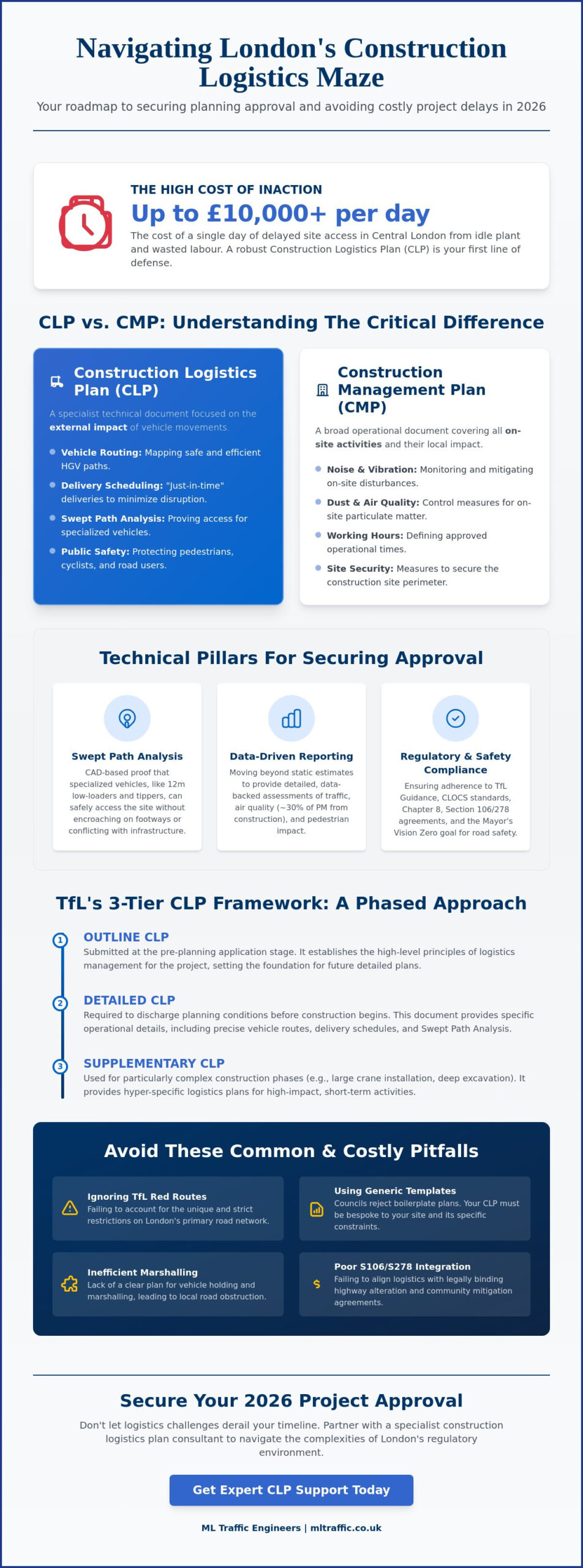
    A single day of delayed site access in Central London can cost a developer upwards of £10,000 in idle plant and wasted labour. You already know that securing planning approval is no longer just about the building’s footprint; it’s about the complex dance of heavy vehicle movements and local resident safety. Partnering with a specialist construction logistics plan consultant is the only way to ensure your 2026 project avoids the common pitfalls of rejected discharges and mounting traffic management costs.

    We understand that navigating the conflicting demands of TfL and borough-specific regulations feels like an uphill battle. This guide provides the technical clarity you need to discharge planning conditions without the usual friction. You’ll learn exactly what data points are required for a successful submission, from CAD-based sweeping path analysis to detailed pedestrian impact assessments. We’ll also preview the essential strategies for maintaining site accessibility while ensuring Chapter 8 compliance across every phase of your project. By following this roadmap, you’ll secure the approvals you need to keep your development moving forward on schedule.

    Key Takeaways

    • Learn the fundamental differences between a CLP and a CMP to ensure your project meets the specific regulatory framework required by London councils.
    • Master the technical requirements of Swept Path Analysis to prove site accessibility for specialized vehicles like 12m low-loaders and tippers.
    • Discover how a specialist construction logistics plan consultant can help you navigate complex Section 106 agreements and mitigate construction-related air pollution.
    • Avoid costly scheduling setbacks by identifying the unique restrictions of TfL-managed Red Routes and establishing efficient vehicle marshalling zones.
    • Understand the strategic timeline for coordinating your logistics documentation with broader Transport Assessments to secure seamless planning approvals through 2026.

    Table of Contents

    What is a Construction Logistics Plan (CLP) in London?

    A Construction Logistics Plan (CLP) is a mandatory framework designed to manage the environmental and transport impacts of a building project. It focuses on the movement of goods and materials to and from a site while minimizing disruption to the public. Many developers mistake a CLP for a Construction Management Plan (CMP). While construction management covers the broad oversight of site operations like noise, dust, and vibration, the CLP is a technical document dedicated to vehicle routing, safety, and delivery scheduling.

    Engaging an expert construction logistics plan consultant is now a requirement for securing planning approvals in most London boroughs. Transport for London (TfL) sets the benchmark for these documents to ensure the city remains mobile. By 2026, new regulations will demand higher levels of data-driven reporting, moving away from static estimates to real-time traffic impact assessments. This shift aims to support the Mayor of London’s Vision Zero goal of eliminating all deaths and serious injuries on the transport network.

    To better understand this concept, watch this helpful video:

    The Core Objectives of a London CLP

    Public safety is the primary driver behind every CLP. London’s narrow streets and high density leave little room for error. A robust plan ensures that HGVs and delivery vehicles don’t conflict with vulnerable road users like cyclists and pedestrians. In high-PTAL (Public Transport Accessibility Level) areas, the plan must demonstrate that construction traffic won’t compromise bus reliability or emergency access. It acts as a live roadmap, detailing exactly how vehicles enter and exit a site without causing local gridlock.

    TfL CLP Guidance: The Gold Standard

    TfL utilizes a three-tier approach to logistics planning: Outline, Detailed, and Supplementary. Each stage corresponds to a different phase of the planning and construction process. Compliance with the Construction Logistics and Community Safety (CLOCS) standard is often a non-negotiable condition of planning. A professional construction logistics plan consultant ensures that these strategies are bespoke. Central London projects often require "just-in-time" deliveries due to lack of storage, while Outer London sites might focus more on protecting residential amenity. You can learn more about how these strategies integrate into wider project types through our comprehensive support services. Precision in these documents prevents costly delays and ensures a seamless transition from planning to implementation.

    Why London Planning Authorities Demand High-Quality Logistics Documentation

    London councils face immense pressure to meet Net Zero targets by 2030. Air quality remains a critical priority for every planning department. Recent data shows that construction traffic contributes approximately 30% of particulate matter in central zones. Because of this, planning authorities require rigorous logistics documentation before a single spade hits the ground. They no longer accept generic templates. They demand data-backed strategies that prove a project won’t gridlock the capital.

    Legal frameworks like Section 106 and Section 278 agreements bind developers to specific logistics outcomes. A Section 106 agreement often mandates a detailed CLP to mitigate the impact on the local community. Section 278 agreements focus on permanent or temporary highway alterations. If your documentation lacks precision, the council will refuse to discharge these conditions. This halts your project before it starts. A specialist construction logistics plan consultant ensures your submission aligns with the latest Transport for London (TfL) guidance and local air quality objectives.

    Logistics planning isn’t just about trucks; it’s about resident amenity. Authorities prioritize the "Healthy Streets" approach. This means protecting cyclists, pedestrians, and local school routes from heavy vehicle movements. A high-quality plan demonstrates a commitment to public safety and civic responsibility.

    Borough-Specific Requirements (Hillingdon to Lambeth)

    Each borough operates its own rulebook. Hillingdon might focus on Heathrow-related traffic flow, while Lambeth prioritizes noise mitigation in dense residential pockets. The City of London requires specific proforma questionnaires that detail vehicle swept paths and timed delivery windows. Engaging with highway engineers during the design phase prevents costly revisions. You must prove how your site protects resident amenity by avoiding peak school-run hours and utilizing consolidation centres. Our team provides comprehensive support to ensure every borough-specific proforma is met with technical precision. Developers working across South London boroughs should also review the 2026 guide to Delivery and Servicing Plans from Transport Planning Consultants Sutton for granular operational data requirements specific to that area.

    The Cost of Non-Compliance

    Delays are expensive. A stalled site in London can cost a developer between £5,000 and £15,000 per day in overheads and financing. By 2026, traffic management violations carry heavier weight. Fixed Penalty Notices (FPNs) for breaching permit conditions under the Traffic Management Act 2004 often start at £120 for minor issues but can escalate to thousands for repeat offences or safety breaches. Beyond the money, you risk your reputation. Local authorities maintain records of developers who ignore compliance. This makes future approvals harder to secure. Hiring a construction logistics plan consultant is a proactive investment that protects both your budget and your professional standing.

    Construction Logistics Plan Consultant: The London Developer’s Guide to 2026 Approvals

    The Technical Pillars: How Swept Path Analysis and Transport Data Secure Approval

    A Construction Logistics Plan (CLP) is only as strong as the data supporting it. Local authorities in London require more than just promises; they demand technical proof that your site won’t cause gridlock. This is where a construction logistics plan consultant utilizes precision engineering to validate every vehicle movement. Without accurate CAD simulations and real-world traffic data, a CLP remains a theoretical exercise that’s likely to face rejection from planning officers. We provide the technical authority needed to move projects from the planning phase to implementation.

    Swept Path Analysis for Site Access

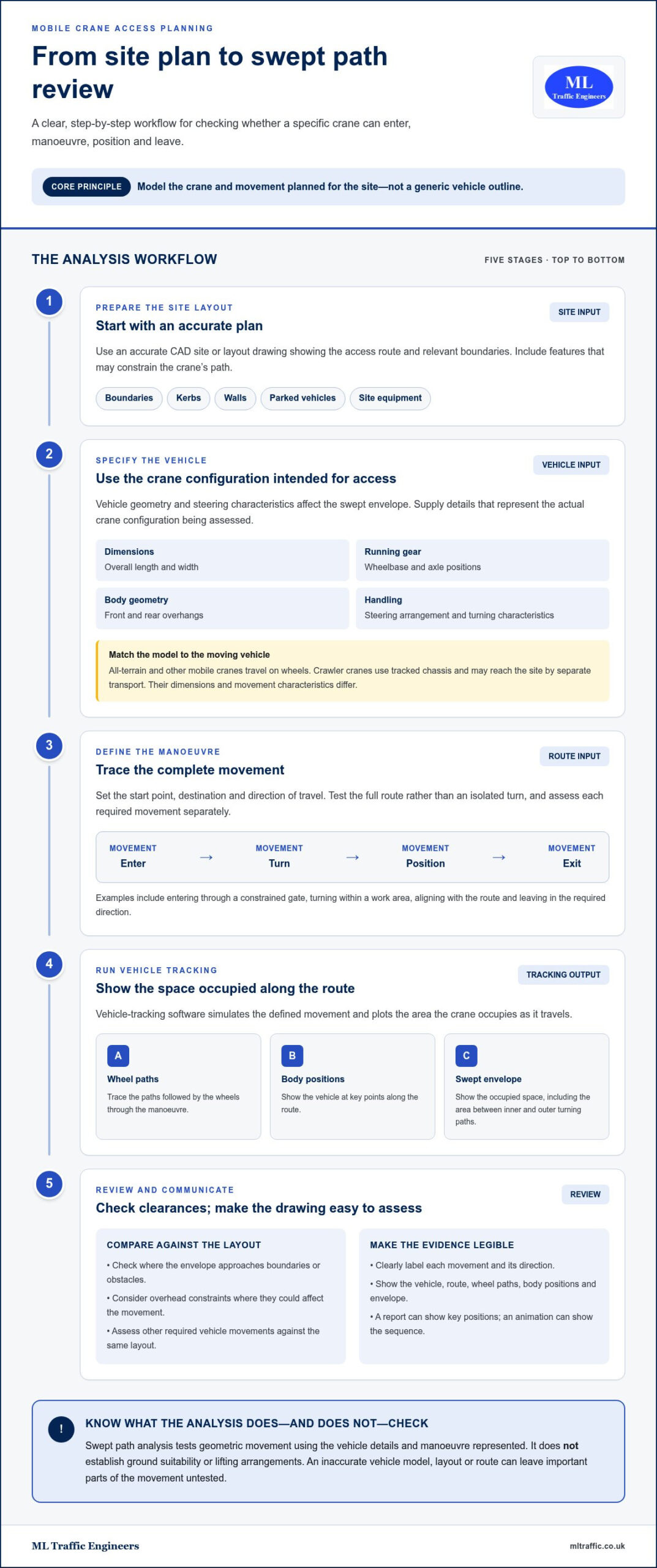
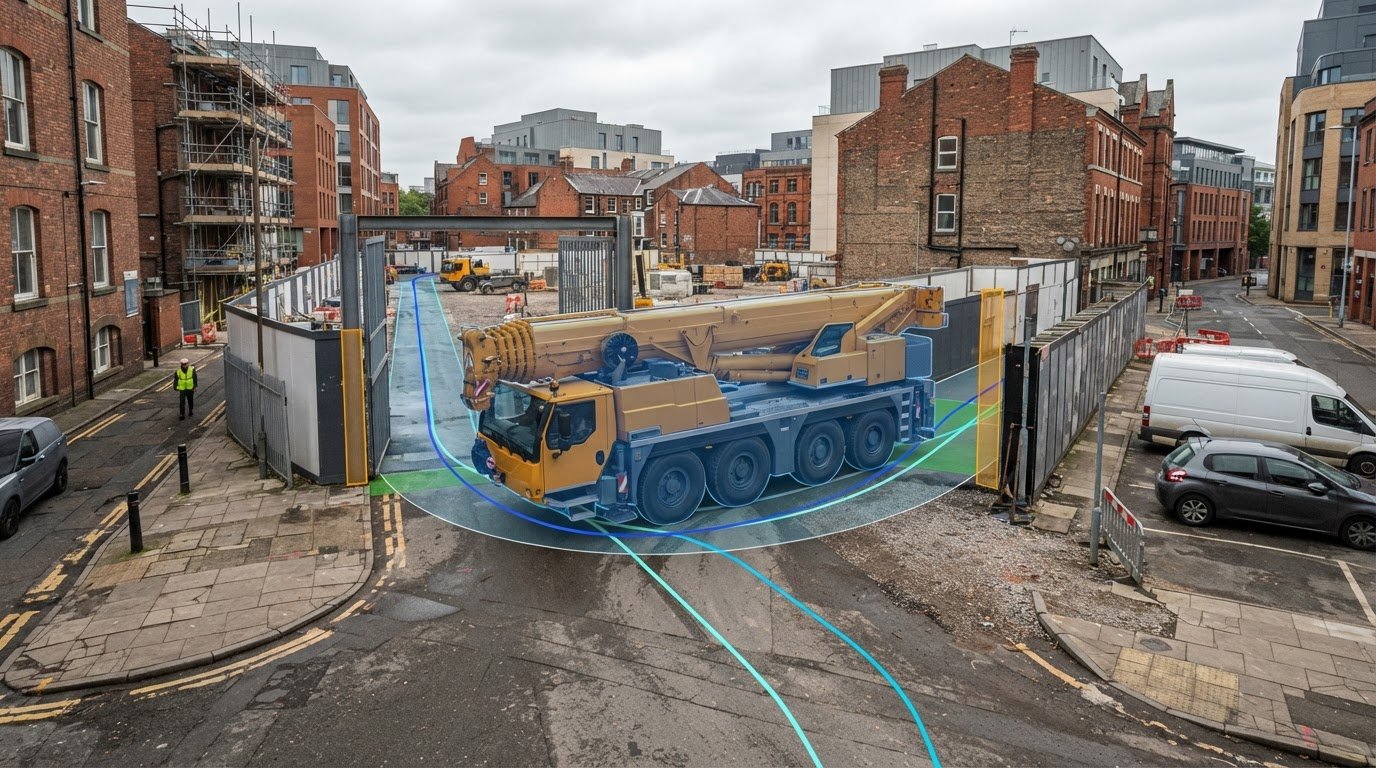
    Swept Path Analysis (SPA) stands as the most critical technical component of any modern CLP. It uses CAD software to simulate the exact movement of vehicles through tight urban spaces. We don’t guess if a 10m tipper or a 12m low-loader can make a turn. We prove it. This simulation ensures the largest anticipated vehicle can enter and exit the site in a forward gear, which is a non-negotiable requirement for many London boroughs in 2026. Using precise vehicle templates prevents "kerb-striking" and protects London’s historical street furniture from costly damage. You can learn more about Swept Path Analysis services and how they secure planning approval. These technical drawings provide the visual evidence needed to appease skeptical transport officers and demonstrate total site control.

    Data Collection: Traffic and Parking Surveys

    Reliable logistics planning starts with a baseline. You can’t propose delivery routes without understanding existing traffic volumes. Transport Statements use this data to justify construction vehicle numbers, ensuring they don’t exceed the capacity of the local road network. Parking surveys are equally vital. They identify "dead" space or underutilized kerbside areas that can serve as safe holding areas. This prevents heavy goods vehicles from idling in residential streets or clashing with local resident parking zones. ML Traffic Engineers provides the high-accuracy data that a construction logistics plan consultant relies on to build a bulletproof case for approval. Our surveys cover several key metrics:

    • Peak hour traffic counts: Essential for scheduling deliveries to avoid school runs and commuter rushes.

    • Parking stress tests: Identifying available loading windows during off-peak hours.

    • Vulnerable Road User (VRU) data: Monitoring pedestrian and cyclist flow to enhance safety at site egress points.

    By integrating these technical pillars, developers move from speculation to certainty. Precision in the planning phase eliminates the risk of operational delays once the project breaks ground. We act as a safe pair of hands, managing the intricate complexities of UK road regulations so our clients don’t have to. This data-led approach ensures that every project remains compliant, safe, and on schedule.

    Avoiding Costly Delays: Common Mistakes in London Construction Logistics

    London’s logistics environment is unforgiving. A single oversight on a Red Route can trigger immediate enforcement from Transport for London (TfL), leading to project standstills. Developers often fail to account for the strict "no stopping" rules on the Transport for London Road Network (TLRN). If your site borders a Red Route, your construction logistics plan consultant must negotiate specific loading windows or identify off-route holding areas to avoid heavy fines. Relying on luck rather than a formal agreement with TfL is a high-risk strategy that usually ends in a Stop Work order.

    Underestimating the physical footprint required for vehicle marshalling is another frequent error. Relying on generic vehicle templates instead of site-specific technical analysis leads to site-wide bottlenecks. In narrow residential areas, the "last mile" of the delivery route often contains overlooked height restrictions or weight-limited bridges. Without a detailed route assessment, vehicles may be forced to reverse long distances. This creates significant safety risks and generates immediate local complaints that can derail your planning progress.

    The "Ghost Vehicle" Problem

    "Ghost vehicle" errors refer to logistics plans that include access gates or loading bays that look functional on paper but are physically impossible for real-world HGVs to use. Planning an access gate without a robust Swept Path Analysis (SPA) is a recipe for an immediate planning refusal. You must prove that vehicles can enter and exit in a forward gear without mounting pavements. Additionally, you cannot compromise fire tender access. If a delivery vehicle blocks emergency routes even for five minutes, the CLP will fail safety audits. Precision CAD modeling ensures every vehicle fits the actual site dimensions.

    Poor Stakeholder Consultation

    Ignoring the operations of neighbouring developers on shared access roads is a common pitfall. If two major projects attempt to use the same narrow lane for heavy deliveries simultaneously, the resulting gridlock will halt both sites. Using a Transport Statement helps mitigate local opposition by providing data-backed evidence of your mitigation strategies. Modern CLPs now require 24/7 contact points. This ensures that any logistical issues are addressed instantly by a responsible person. It maintains positive community relations and ensures council compliance throughout the project lifecycle. Your construction logistics plan consultant should facilitate these conversations early to prevent legal challenges later.

    For expert guidance on site-specific technical analysis and CAD design, explore how we manage complex London logistics to keep your project moving.

    Preparing Your Site for Approval: Coordinating Your Planning Reports

    Securing planning consent in London for 2026 requires a synchronized technical strategy. It’s not just about filling out forms. Your CLP must function as an extension of your Transport Assessment or Statement. Discrepancies in vehicle trip rates or delivery windows between these reports lead to immediate delays during the consultation period. Borough officers look for a "golden thread" of data that remains consistent from the initial site survey to the final discharge of conditions.

    Engaging a construction logistics plan consultant during RIBA Stage 2 or 3 is essential for a smooth submission. Early involvement allows you to identify logistical bottlenecks, such as proximity to schools or narrow Victorian street layouts, before the site design is finalized. Professional reports provide the technical weight needed to negotiate with London Highway Authorities. If an authority suggests restrictive delivery hours that threaten your build schedule, a data-backed CLP demonstrates how safety and efficiency can coexist through managed multi-way systems or Chapter 8 compliant traffic management. Projects in outer South London boroughs should also consider the specialist requirements outlined by Transport Planning Consultants Sutton covering Delivery and Servicing Plans, where precise bay dimensions and HGV turning circles are scrutinised at the earliest design stage.

    The timeline for submission is critical. Waiting until the final planning stage to address logistics often results in expensive design changes. By integrating your logistics strategy early, you can use technical data to justify specific site requirements, such as the placement of a loading bay or the necessity of a temporary traffic signal system.

    Cohesion Between Reports

    Consistency is vital for 2026 approvals. Your Travel Plan and CLP shouldn’t provide contradictory traffic data. If one report suggests a reduction in staff vehicle movements while the other fails to account for contractor parking, the application’s credibility suffers. A unified technical approach saves time and reduces consultancy fees by streamlining data collection. For more details on aligning these documents, see our resources on London planning reports. This alignment ensures that every technical submission reinforces a single, safe vision for the site.

    Getting Started with ML Traffic Engineers

    Our technical surveys provide the precision your construction logistics plan consultant needs to secure approval. We deliver the foundational data through CAD-based Swept Path Analysis and comprehensive Parking Surveys across all London boroughs. These services ensure your site layout accommodates the largest anticipated HGVs without compromising public safety. You can view our technical services to see how we support London developments from initial planning through to final implementation. Requesting a quote early in your project lifecycle ensures your technical evidence is ready for the 2026 regulatory environment.

    Secure Your 2026 Planning Approval with Technical Precision

    Navigating London’s evolving planning landscape requires more than just a standard report. As developers look toward 2026, Transport for London and local boroughs have intensified their scrutiny of site access and vehicle movements. Success depends on high-quality technical pillars; specifically, expert Swept Path Analysis and robust traffic data that prove your site can operate without compromising public safety or road capacity. Failing to address these technicalities early often leads to expensive revisions and missed construction windows.

    ML Traffic has provided accurate parking and traffic surveys for developers across the capital since 2014. We understand the specific nuances of London Borough requirements and provide the CAD-based precision needed to satisfy strict planning officers. Engaging a specialist construction logistics plan consultant allows you to identify potential bottlenecks before they become legal hurdles. We provide a total, managed solution that bridges the gap between initial design and final implementation, ensuring your project remains compliant and on schedule.

    Don’t leave your site’s approval to chance. Get the Technical Data Your CLP Needs and move your development forward with confidence.

    Frequently Asked Questions

    Is a Construction Logistics Plan mandatory for all London developments?

    A Construction Logistics Plan is mandatory for all major London developments and any project that impacts the public highway. Transport for London (TfL) guidance classifies projects into levels, where even small sites in congested areas require a Level 1 or Level 2 CLP to secure planning permission. It’s a critical document that ensures your project doesn’t negatively impact the capital’s transport network.

    What is the difference between an Outline CLP and a Detailed CLP?

    An Outline CLP supports your initial planning application by demonstrating that construction is logistically feasible. A Detailed CLP is a mandatory pre-commencement condition submitted after you appoint a contractor. It contains granular data, including exact delivery windows, marshaling plans, and specific vehicle counts. You can’t legally start work on site until the detailed version is approved by the borough.

    How long does it take for a London borough to approve a CLP?

    Approval timelines typically range from 8 to 12 weeks for standard submissions. If your project is in a high-traffic borough like Southwark or Tower Hamlets, the process can extend to 16 weeks. Delays often occur when technical CAD drawings don’t meet the rigorous safety standards required by the local highway authority. We recommend starting the process early to avoid delaying your build start date.

    Can I prepare a CLP myself or do I need a specialist consultant?

    You can draft the text, but hiring a construction logistics plan consultant is the most reliable way to secure 2026 approvals. Specialist consultants provide the technical CAD designs and swept path analyses that planning officers demand. We ensure your plan meets FORS and CLOCS standards, reducing the risk of costly revisions and planning refusals that stall your project.

    What vehicle templates are required for a London Swept Path Analysis?

    You must use templates for the largest vehicles visiting your site, such as a 12m rigid HGV or a 16.5m articulated vehicle. TfL’s 2021 standards require these simulations to show 300mm safety margins. This precision prevents vehicle strikes on London’s narrow streets and protects vulnerable road users. Using the wrong vehicle template is one of the most common reasons for CLP rejection.

    How does a CLP impact my Section 278 agreement?

    Your CLP and Section 278 agreement must work in tandem. The CLP manages the temporary movement of plant and materials, while the S278 covers permanent changes to the road layout. Inconsistencies between these documents can lead to the local authority blocking your road space bookings or suspending your licenses. We coordinate these elements to ensure seamless site integration and total compliance.

    What happens if I deviate from my approved CLP during construction?

    Deviating from an approved CLP is a direct breach of planning control. Local authorities have the power to issue a Breach of Condition Notice or a Stop Notice under the Town and Country Planning Act 1990. These actions can shut down your site instantly, causing catastrophic delays to your construction schedule. It’s vital to update your CLP if your site requirements change mid-project.

    How much does a technical transport report for a CLP cost?

    Professional fees for a technical CLP report depend on the project’s complexity and the borough’s requirements. Industry data from 2024 indicates that technical transport reports for London developments generally start around £3,500 for standard sites. Complex urban projects requiring extensive traffic modeling or multi-way systems involve higher costs. These figures exclude local authority application fees, which are set by each borough.

    Which areas in London do you cover?

    We service Acton, Balham, Barking, Barnes, Barnet, Battersea, Beckenham, Bexleyheath, Brentford, Brixton, Bromley, Camberwell, Carshalton, Charlton, Chelsea, Chiswick, Clapham, Coulsdon, Croydon, Crystal Palace, Dagenham, Dulwich, Ealing, Edgware, Eltham, Enfield, Finchley, Forest Gate, Fulham, Golders Green, Greenwich, Hackney, Hammersmith, Hampstead, Harrow, Hayes, Highgate, Hounslow, Ilford, Islington, Kensington, Kentish Town, Kingston upon Thames, Lewisham, Mitcham, Muswell Hill, New Malden, Notting Hill, Orpington, Peckham, Pinner, Purley, Putney, Richmond, Romford, Ruislip, Sidcup, Southall, Southgate, Streatham, Surbiton, Sutton, Tooting, Tottenham, Twickenham, Uxbridge, Walthamstow, Wembley, West Norwood, Wimbledon, Wood Green, Woolwich, Bethnal Green, Shoreditch, Canary Wharf, Deptford, Leyton, Palmers Green, Stanmore, Upminster, Chislehurst, Erith, Feltham.

    Which cities in England do you cover?

    We service London, Birmingham, Manchester, Liverpool, Sheffield, Leeds.

    Michael Lee

    Article by

    Michael Lee

    Transport planner with over 35 years' experience.

    Disclaimer

    The content on mltraffic.co.uk, including all technical articles, guides, and resources, is provided for general informational and educational purposes only. It is not intended to constitute professional advice in traffic engineering, transportation planning, development approvals, or any other technical or legal field.
    While ML Traffic Engineers makes every reasonable effort to ensure the accuracy, completeness, and timeliness of the information published, we do not provide any warranties or representations (express or implied) regarding its reliability, suitability, or availability for any particular purpose. Any reliance you place on the content is strictly at your own risk.
    In no event shall ML Traffic Engineers, its directors, employees, authors, or affiliates be liable for any direct, indirect, incidental, special, consequential, or punitive damages (including, without limitation, loss of profits, data, or business opportunities) arising out of or in connection with the use of, or inability to use, any information provided on this website.
    The articles and guides on this site are not a substitute for engaging a qualified, professional traffic engineer to assess your specific project requirements. For tailored advice, compliance assessments, or traffic engineering services, please contact a competent professional.
    This disclaimer may be updated from time to time without notice. By accessing or using this website, you agree to be bound by the most current version of this disclaimer.

  • London ULEZ and Construction: The Developer’s 2026 Guide to Compliance

    London ULEZ and Construction: The Developer’s 2026 Guide to Compliance

    What if the most significant threat to your project’s 2026 profit margin isn’t material inflation, but a daily £300 charge for every non-compliant heavy vehicle entering your site? The evolving landscape of london ulez construction requirements means that technical precision in your logistics planning is no longer optional; it’s a legal and financial imperative. You likely find the constant shifting between LEZ, ULEZ, and Non-Road Mobile Machinery (NRMM) standards both confusing and a potential trigger for avoidable planning delays.

    We’re here to provide the technical authority you need to secure successful planning approvals and maintain a cost-effective site. This guide delivers a clear roadmap for 2026 compliance, ensuring your Transport Statements meet the rigorous expectations of London local authorities. We’ll break down the Euro VI standards for heavy vehicles, clarify the latest NRMM requirements for Stage V engines, and outline a strategic approach to site logistics. You’ll move from regulatory uncertainty to a position of total compliance and operational readiness.

    Key Takeaways

    • Understand why the London-wide ULEZ expansion necessitates strict adherence to emission standards across every borough for all development logistics.
    • Identify the specific Euro 6/VI and petrol standards required for vans and HGVs to ensure your fleet remains compliant and avoids daily charges.
    • Learn how to integrate london ulez construction requirements into your Transport Statements by using the TRICS database to forecast compliant vehicle movements.
    • Utilise Swept Path Analysis to account for the unique dimensions of modern Euro VI vehicles, ensuring seamless site access and planning approval.
    • Gain expert insights into navigating complex planning laws with 24/7 technical support for urgent logistics and site access revisions.

    Table of Contents

    Understanding the London ULEZ Framework for Construction Projects

    By 2026, the Ultra Low Emission Zone (ULEZ) has become the primary regulatory benchmark for

    **london ulez construction

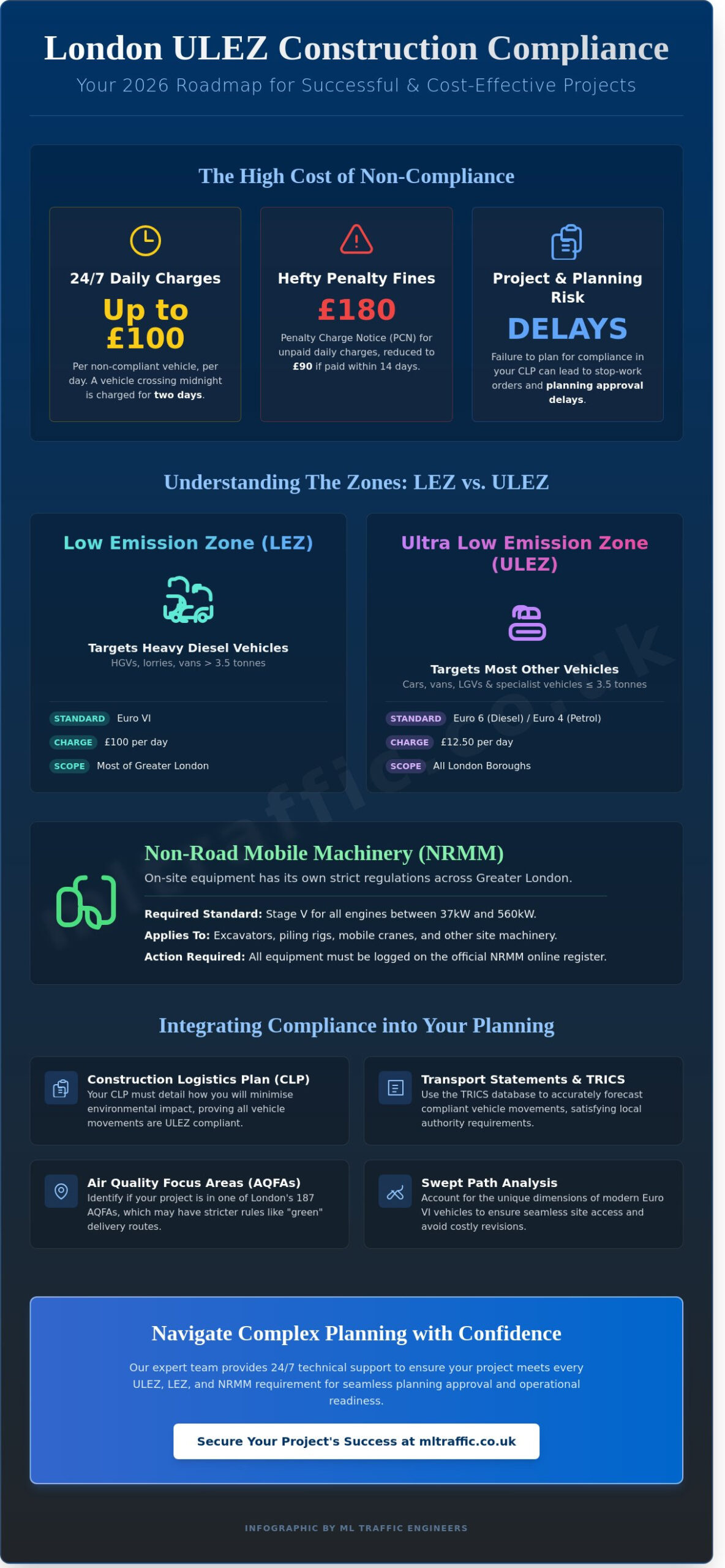
    **logistics. The zone now encompasses every London borough, stretching from Hillingdon in the west to Havering in the east. Developers must distinguish between the Low Emission Zone (LEZ) and the ULEZ to avoid significant overheads. While the LEZ focuses on heavy diesel vehicles over 3.5 tonnes, the ULEZ targets smaller vans, LGVs, and cars that don’t meet Euro 6 (diesel) or Euro 4 (petrol) standards.

    The Greater London Authority (GLA) maintains intense scrutiny on construction traffic because freight and site deliveries contribute to nearly 30% of nitrogen oxide emissions from road transport in the capital. Compliance isn’t just a daily fee; it’s a core component of modern planning obligations. Many projects now require a detailed Construction Logistics Plan (CLP) that proves how a site will minimize its environmental footprint.

    The 24/7 Nature of ULEZ Compliance

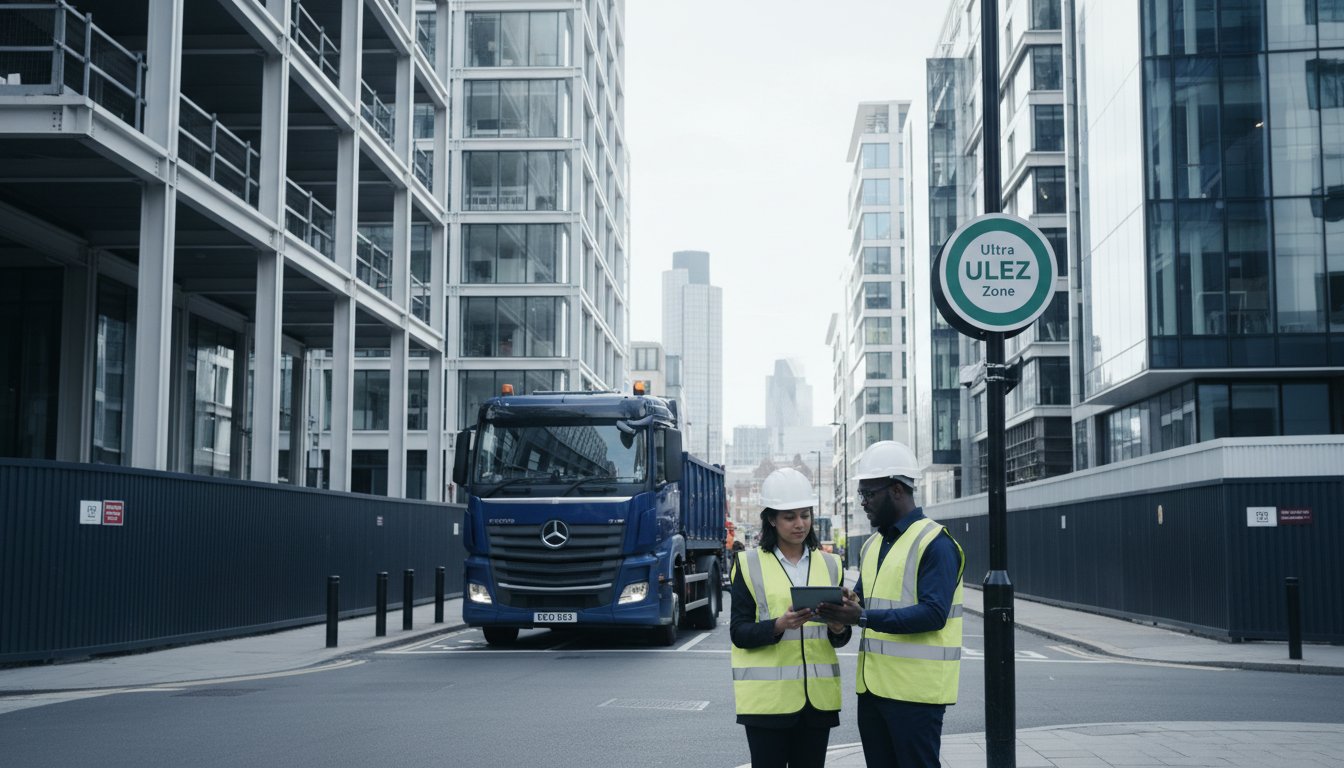
    The ULEZ operates 24 hours a day, every day of the year, with the sole exception of Christmas Day. This midnight-to-midnight charging cycle creates a logistical trap for night-time deliveries. If a non-compliant vehicle enters a site at 23:30 and departs at 00:30, the operator is liable for two separate daily charges. Transport for London (TfL) enforces this via a network of 1,400 Automatic Number Plate Recognition (ANPR) cameras. Failing to pay the £12.50 daily charge results in a Penalty Charge Notice (PCN) of £180, reduced to £90 if paid within 14 days. For a fleet of ten non-compliant delivery vans, a single week of oversight can result in fines exceeding £12,000. We provide

    [comprehensive support

    ](https://mltraffic.co.uk/what-we-do/)to help project managers coordinate these movements and maintain strict compliance.

    London Borough Specifics and Local Air Quality Management

    Baseline ULEZ rules are often just the starting point. The London Plan 2025 sets out “Air Quality Neutral” requirements that every new development must satisfy. Individual boroughs like Westminster and Camden frequently impose even tighter restrictions through Section 106 agreements. You must identify if your project falls within one of the 187 Air Quality Focus Areas (AQFAs) across London. These are locations where pollution levels are high and human exposure is greatest. In these zones, local councils may mandate specific “green” delivery routes or restrict vehicle idling times more aggressively than the standard ULEZ framework. Missing these local nuances can lead to stop-work orders or delayed permit approvals for essential road works. Developers working in north London should be particularly aware that boroughs such as Haringey present their own distinct planning challenges; partnering with specialist

    [Transport Planning Consultants Haringey

    ](https://mltraffic.co.uk/articles/transport-planning-consultants-haringey-a-developers-2026-guide-to-planning-approval/)can help navigate the council’s strict parking standards and TfL objection risks. Our team ensures that every

    [project type

    ](https://mltraffic.co.uk/project-types/)

    Vehicle Emission Standards and Non-Road Mobile Machinery (NRMM)

    Compliance on a London site depends on a clear understanding of the divide between road vehicles and site machinery. For any london ulez construction project, the 2026 standards are non-negotiable. Diesel vans and HGVs must meet Euro 6 or Euro VI standards to avoid the £12.50 or £100 daily charges. Petrol vehicles, usually lighter site cars or car-derived vans, require Euro 4. If you’re using non-UK registered specialist vehicles, you must register them with Transport for London (TfL) at least 10 days before they enter the zone. Failure to do this results in automatic daily charges, even if the vehicle technically meets the required emission levels.

    Decoding Euro VI for Heavy Goods Vehicles (HGVs)

    The technical distinction between Euro 6 and Euro VI is often misunderstood by site managers. Euro 6 applies to light commercial vehicles, while the Roman numeral VI denotes heavy-duty engines found in HGVs and large plant transporters. Euro VI standards focus on stricter NOx and particulate matter limits during real-world driving cycles. Many specialist plant vehicles built before 2014 won’t meet these requirements. Retrofitting an older HGV with an approved Selective Catalytic Reduction (SCR) system is an option, but costs often exceed £15,000 per unit. While vehicles over 40 years old can claim “historic” status, these are rarely suitable for the rigorous, high-utilisation demands of modern site logistics.

    Managing Non-Road Mobile Machinery (NRMM)

    Operating alongside the ULEZ, the NRMM Low Emission Zone targets different equipment categories. By 2026, all engines between 37kW and 560kW must meet Stage V emission standards across the entirety of Greater London. This includes excavators, piling rigs, and mobile cranes. You’re required to log every piece of equipment on the official NRMM register before it arrives on site. Local authority inspectors perform spot checks to verify that engine serial numbers match the register. Maintaining a comprehensive site log with emission certificates is the only way to avoid project delays and heavy fines. It’s a mandatory requirement that ensures your london ulez construction site stays within the law. To ensure your site logistics remain compliant from day one, consider how integrated traffic management solutions can streamline your equipment movements.

    Every piece of machinery must have its engine Stage clearly visible or documented. For generators, which are frequently used on early-stage sites, the Stage V requirement is particularly strict. If your current fleet doesn’t meet these benchmarks, you’ll need to source compliant hire equipment or invest in exhaust after-treatment systems. Precision in your record-keeping is just as important as the hardware itself, as the NRMM register is the first thing a local authority officer will request during an audit.

    London ULEZ and Construction: The Developer’s 2026 Guide to Compliance

    Integrating ULEZ Compliance into Transport Planning and Assessments

    Planning applications in the capital now face unprecedented scrutiny regarding air quality and vehicle emissions. Local Planning Authorities (LPAs) require developers to prove that london ulez construction logistics won’t compromise local air quality targets or breach legal limits. You must move beyond simple traffic counts. Modern submissions require a granular breakdown of vehicle Euro standards and fuel types. We use the latest TRICS database to model these movements, ensuring your forecast reflects the 2026 reality of ultra-low emission zones. This data informs your Transport Assessment London, turning a regulatory hurdle into a demonstration of ‘Good Design’ as defined by the London Plan 2021. Proactive planning prevents costly delays during the Section 106 negotiation phase.

    Transport Statements: More Than Just Traffic Counts

    A robust Transport Statement now hinges on a detailed delivery and servicing plan london that prioritises ULEZ-compliant fleets. It’s no longer enough to list total vehicle numbers; you must justify the fleet mix. If your strategy involves replacing one 32-tonne non-compliant HGV with several Euro 6 compliant vans to avoid the £100 daily charge, your statement must address the resulting increase in trip generation. We help you align these logistics with specific borough environmental targets. For instance, projects in Camden or Southwark must often demonstrate how they contribute to 2030 net-zero goals. Linking your vehicle justifications to these local policies increases the likelihood of a seamless approval process. Residential developers undertaking flat conversions in London should also ensure their transport statement addresses PTAL ratings and parking surveys to satisfy highways officers alongside these emission requirements. Similarly, developers working in south-east London should consult Transport Planning Consultants Lewisham specialists to navigate the borough’s unique parking standards and low PTAL constraints in areas like Deptford and Catford.

    The Role of Travel Plans in Reducing Construction Impact

    Construction worker transit significantly affects a project’s total emissions footprint. Effective London Travel Plans incentivise public transport use or car-pooling for site staff. This reduces the number of private vehicles entering the zone, lowering the risk of unexpected costs for your workforce. We implement monitoring systems to track compliance throughout the build phase, ensuring the project meets the vehicle reduction targets often required by planning conditions. London ulez construction projects that fail to monitor these movements risk enforcement action or negative post-occupancy evaluations. Our approach includes:

    • Drafting site-specific travel surveys to identify worker transit patterns.
    • Implementing digital booking systems for delivery slots to prevent idling.
    • Establishing clear reporting cycles to provide the LPA with evidence of ongoing compliance.
    • Providing 24/7 support to manage logistical shifts that impact the Travel Plan.

    By integrating these sustainable choices early, you protect the project from the financial volatility of non-compliance charges. It’s about creating a transparent, managed solution that satisfies both the developer’s bottom line and the city’s environmental standards.

    Strategic Logistics: Managing Site Access and Vehicle Scheduling

    Effective london ulez construction logistics require more than just checking engine types. Developers must rethink how vehicles physically interact with the site. Modern Euro VI HGVs often feature Direct Vision Standard (DVS) compliant cabs. Since the October 2024 DVS update, these low-entry designs have become the industry standard for London projects. However, these vehicles frequently result in different turning circles and longer wheelbases compared to the older, non-compliant trucks they replace. Precision in planning is a legal and physical necessity.

    Swept Path Analysis for Compliant Site Access

    Using CAD-based Swept Path Analysis (SPA) is now essential for securing planning approval. It proves that new-generation low-entry cabs can navigate tight urban streets without mounting kerbs or striking street furniture. We use technical CAD design to identify specific pinch points in the local road network that might hinder a compliant 32-tonne tipper. This is particularly vital in boroughs like Southwark or Tower Hamlets, where narrow Victorian layouts conflict with the increased length of DVS-rated chassis. Developers navigating the complex active travel requirements and PTAL constraints of east London sites should consult Transport Planning Consultants Tower Hamlets specialists to ensure their swept path and access strategies align with the borough’s 2026 planning expectations. Addressing these access design issues early prevents costly delays during the mobilisation phase. It ensures your 2026 fleet meets both ULEZ and DVS safety requirements without compromising site efficiency. A comprehensive road safety audit at this stage can also identify potential collision risks at site access points before they become costly late-stage design changes.

    Vehicle Scheduling and Fleet Management

    The financial logic of vehicle scheduling centres on the 24-hour ULEZ clock. Charges apply from midnight to midnight. A vehicle entering a site at 23:30 and exiting at 00:30 triggers two separate daily charges. For a fleet of ten HGVs, this oversight adds £1,250 to a single night’s operation. Implementing a strict “one-in, one-out” scheduling system minimises this exposure. We recommend integrating Auto Pay for all subcontractors. This removes the administrative burden and eliminates the risk of £180 Penalty Charge Notices (PCNs) for late payments. Data-driven logistics are the only way to maintain margins in 2026.

    • Consolidation Centres: Use fringe facilities to break down bulk loads into smaller, electric, or Euro VI compliant “last-mile” deliveries.
    • Traffic Surveys: Utilise traffic surveys to identify optimal delivery windows that avoid peak congestion and reduce idle time.
    • Compliance Audits: Conduct weekly checks on subcontractor plates to ensure no non-compliant vehicles enter the site perimeter.

    Our team provides a total managed solution to keep your project moving. If you need to secure your site access with technical precision, explore what we do to maintain full regulatory compliance.

    Expert Transport Consultancy for ULEZ-Compliant Developments

    Managing a london ulez construction project in 2026 requires more than just compliant vehicles. It demands a sophisticated understanding of how Greater London Authority (GLA) air quality targets interact with Section 106 agreements and Construction Logistics Plans (CLPs). ML Traffic Engineers operate at this exact intersection. We translate complex ULEZ policy into actionable site strategies that keep your project moving.

    Our team maintains 24/7 readiness to handle urgent site access issues and rapid transport planning revisions. When a delivery schedule shifts or a local authority denies a road closure, we respond immediately. We specialise in bespoke solutions for constrained urban sites where standard logistics fail. We move your project from the consultation phase to full implementation without regulatory friction. Our approach ensures that every vehicle movement is accounted for and every permit is secured.

    • Direct navigation of GLA and borough-specific planning requirements.
    • Rapid turnaround for amended traffic management drawings and CAD designs.
    • Strategic coordination of multi-way systems to minimise idling and emissions.
    • Total managed solutions that alleviate the administrative burden on site managers.

    Why Professional Reporting is Non-Negotiable

    Inadequate transport environmental data is a leading cause of planning refusal in Greater London. Local authorities now scrutinise every vehicle movement for its carbon and NOx impact. Our technical reports satisfy the rigorous standards of both TfL and individual borough highways departments. We recently resolved critical access conflicts for a major project involving various commercial and residential developments in Central London. By utilising precise CAD design and Chapter 8 compliant traffic management, we secured approval for a logistics hub that reduced local congestion by 12% during peak hours. Without professional reporting, these projects risk indefinite delays or costly enforcement actions.

    Partnering with ML Traffic Engineers

    Safety and legislative compliance form the foundation of our work. We don’t just supply equipment; we provide a total managed solution. You’ll have direct access to senior consultants who possess deep knowledge of the London planning landscape. This ensures your london ulez construction strategy remains robust against evolving 2026 standards. Our commitment to precision helps you avoid the £180 daily fines and potential site shutdowns associated with non-compliance. We act as a safe pair of hands, managing the intricate complexities of UK road regulations so you can focus on the build. Contact ML Traffic Engineers today to secure your project’s transport strategy and ensure seamless delivery for 2026.

    Future-Proofing Your 2026 London Developments

    Navigating the tightening standards for london ulez construction requires more than just updated vehicle fleets. Developers must integrate Euro VI compliance and Stage V Non-Road Mobile Machinery (NRMM) requirements into their initial transport assessments to avoid enforcement actions or site shutdowns. Success in the 2026 landscape depends on precise logistics and site access strategies that align with TfL’s latest planning frameworks. It’s essential to address these regulatory hurdles during the design phase to maintain project momentum and avoid the £160 daily non-compliance charges for HGVs. Commissioning a road safety audit in London during the design phase is an equally critical step to ensure your highway access arrangements satisfy GG 119 compliance requirements before submission.

    ML Traffic Engineers provides the technical authority needed to secure planning approvals across all 32 London Boroughs. We deliver specialist Swept Path Analysis using industry-standard CAD software to ensure your modern HGV fleet navigates tight urban sites safely and efficiently. Our team understands the intricate complexities of TfL requirements, providing a total managed solution that handles everything from transport planning to final implementation. We’re available 24/7 to ensure your site remains compliant and operational under the strictest environmental mandates. Developers targeting high-density sites in north London should also explore how Transport Planning Consultants Haringey can help address Haringey Council’s specific parking standards and Section 106 demands before submission.

    Ensure your London construction project is ULEZ-compliant with ML Traffic Engineers. We’re ready to help you deliver a safe, compliant, and successful development.

    Frequently Asked Questions

    Is my construction vehicle exempt from the London ULEZ charge?

    Your vehicle is only exempt if it meets Euro 6 (diesel) or Euro 4 (petrol) emissions standards. Specialist construction vehicles like mobile cranes or machinery may qualify for specific exemptions, but standard transit vans and HGVs generally don’t. You must check the TfL vehicle checker to confirm your status. Non-compliant vehicles must pay the daily charge or face a Penalty Charge Notice (PCN) of up to £180.

    What is the daily charge for a non-compliant van entering the ULEZ in 2026?

    The daily charge for a non-compliant van entering the London ULEZ remains £12.50 based on current TfL rates. This applies to most vans under 3.5 tonnes that fail to meet Euro 6 diesel standards. If you don’t pay by midnight on the third day following the journey, the PCN increases to £180. For heavier vehicles over 3.5 tonnes, the separate LEZ charge applies, which can reach £300 per day.

    How do I register my Non-Road Mobile Machinery (NRMM) for a London site?

    You must register all Non-Road Mobile Machinery (NRMM) with a power rating between 37kW and 560kW on the official NRMM London register. This is a mandatory requirement for all major development sites within Greater London. Ensure your equipment meets the Stage V emission standards required for the Central Activity Zone and Opportunity Areas. Failure to maintain an up-to-date log on the portal can lead to site-wide compliance breaches.

    Does the ULEZ charge apply if the vehicle is parked on-site all day?

    The ULEZ charge only triggers when you drive a non-compliant vehicle on public roads within the zone. If your vehicle remains stationary and parked on-site for the entire 24-hour period, you won’t incur a charge for that day. However, any movement on the public highway between 00:00 and 23:59 requires payment. We recommend planning deliveries to ensure non-compliant vehicles arrive and stay put to minimise costs.

    Can I pass ULEZ costs onto the client in a standard JCT contract?

    Passing london ulez construction costs to a client depends on your specific JCT contract terms. Under standard JCT forms, such as the Design and Build 2016 or 2024 editions, “Change in Law” clauses might allow for adjustments if regulations changed after the base date. However, since ULEZ is an established scheme, most contractors must account for these overheads within their initial tender price. Always review your Preliminary costs carefully.

    What happens if my subcontractor uses a non-compliant vehicle?

    The vehicle’s registered keeper is legally responsible for paying the ULEZ charge or any subsequent fines. However, as a lead developer, allowing non-compliant subcontractor vehicles can breach your Site Environmental Management Plan (SEMP). We provide comprehensive traffic management strategies that include vehicle monitoring to ensure all site traffic adheres to the required Euro VI standards. This protects your project from regulatory scrutiny and logistical delays.

    How does Swept Path Analysis relate to ULEZ compliance?

    Swept Path Analysis ensures that newer, often larger Euro VI compliant HGVs can safely navigate tight London site entrances without causing obstructions. By using CAD design to simulate vehicle movements, we prevent “dry runs” where non-compliant vehicles might be forced to enter the zone unnecessarily due to access issues. Efficient routing through london ulez construction zones reduces the number of required trips; this directly lowers your total daily charges.

    Are there grants available for upgrading construction fleets to Euro VI?

    Transport for London previously operated a £160 million scrappage scheme to support small businesses and charities. While many direct grants for vans closed in late 2023 after funds were allocated, you should monitor the TfL website for 2026 updates or sector-specific incentives. Some local boroughs offer independent “green” business grants. Upgrading to a compliant fleet avoids the £12.50 daily fee and ensures 24/7 access to all London boroughs.

    Which areas do you cover?

    We service Acton, Balham, Barking, Barnes, Barnet, Battersea, Beckenham, Bexleyheath, Brentford, Brixton, Bromley, Camberwell, Carshalton, Charlton, Chelsea, Chiswick, Clapham, Coulsdon, Croydon, Crystal Palace, Dagenham, Dulwich, Ealing, Edgware, Eltham, Enfield, Finchley, Forest Gate, Fulham, Golders Green, Greenwich, Hackney, Hammersmith, Hampstead, Harrow, Hayes, Highgate, Hounslow, Ilford, Islington, Kensington, Kentish Town, Kingston upon Thames, Lewisham, Mitcham, Muswell Hill, New Malden, Notting Hill, Orpington, Peckham, Pinner, Purley, Putney, Richmond, Romford, Ruislip, Sidcup, Southall, Southgate, Streatham, Surbiton, Sutton, Tooting, Tottenham, Twickenham, Uxbridge, Walthamstow, Wembley, West Norwood, Wimbledon, Wood Green, Woolwich, Bethnal Green, Shoreditch, Canary Wharf, Deptford, Leyton, Palmers Green, Stanmore, Upminster, Chislehurst, Erith, Feltham.

    Michael Lee

    Article by

    Michael Lee

    Transport planner with over 35 years’ experience.

    Disclaimer

    The content on mltraffic.co.uk, including all technical articles, guides, and resources, is provided for general informational and educational purposes only. It is not intended to constitute professional advice in traffic engineering, transportation planning, development approvals, or any other technical or legal field.
    While ML Traffic Engineers makes every reasonable effort to ensure the accuracy, completeness, and timeliness of the information published, we do not provide any warranties or representations (express or implied) regarding its reliability, suitability, or availability for any particular purpose. Any reliance you place on the content is strictly at your own risk.
    In no event shall ML Traffic Engineers, its directors, employees, authors, or affiliates be liable for any direct, indirect, incidental, special, consequential, or punitive damages (including, without limitation, loss of profits, data, or business opportunities) arising out of or in connection with the use of, or inability to use, any information provided on this website.
    The articles and guides on this site are not a substitute for engaging a qualified, professional traffic engineer to assess your specific project requirements. For tailored advice, compliance assessments, or traffic engineering services, please contact a competent professional.
    This disclaimer may be updated from time to time without notice. By accessing or using this website, you agree to be bound by the most current version of this disclaimer.