Tag: Technical Approval

  • Section 278 Design & Technical Approval Process

    Section 278 Design & Technical Approval Process

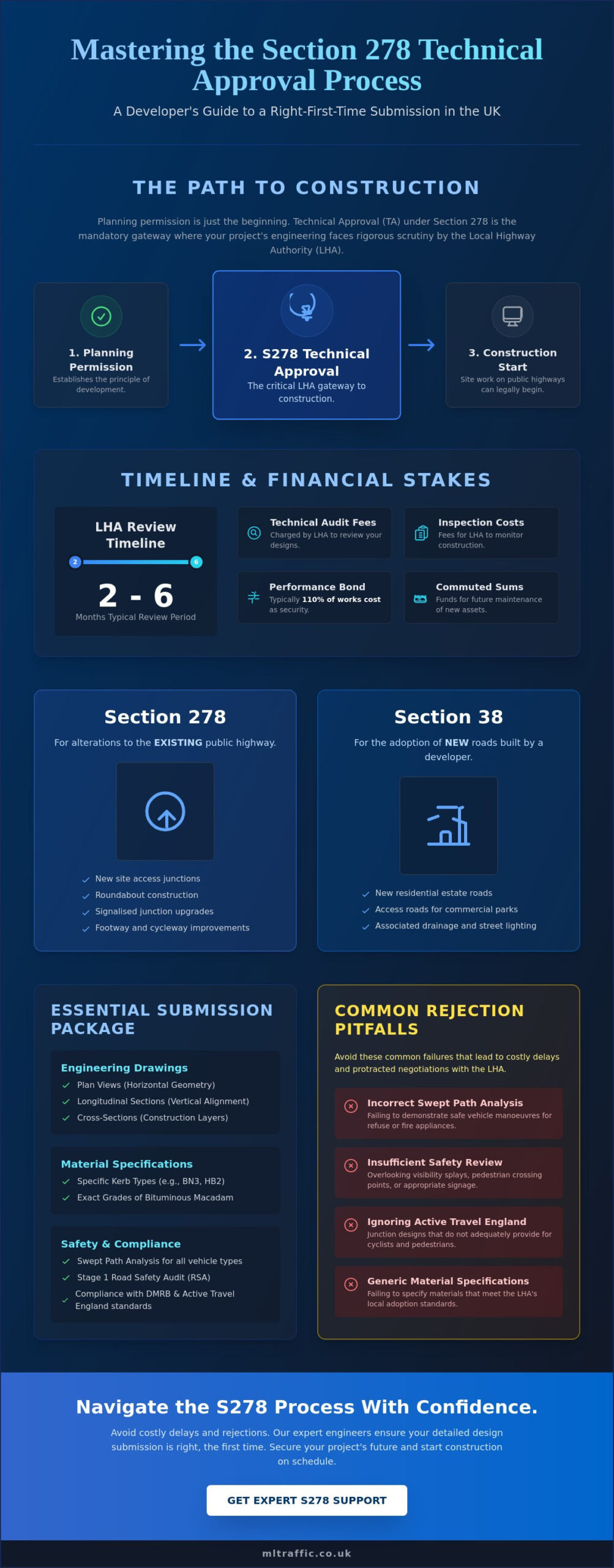
    Your engineering drawings aren’t just technical documents; they’re the primary negotiation tools that determine whether your project breaks ground on schedule or remains stalled in a Local Highway Authority’s inbox. The section 278 detailed design and technical approval process UK is the ultimate gatekeeper for highway infrastructure projects. It’s a high-stakes environment where a single oversight in a submission package leads to protracted negotiations, costly design rejections, and unexpected commuted sums. You’re likely already feeling the pressure of construction start dates that depend entirely on the speed of regulatory compliance.

    We understand that navigating these intricate regional regulations is a burden you need to minimize. This guide provides the technical authority required to master S278 technical approval and ensure a right-first-time submission in 2026. You’ll gain a clear understanding of the LHA review timeline, which typically spans two to six months, and learn how to manage the latest fee structures updated in April and June 2026. We’ll outline the specific data requirements needed to successfully discharge your highway-related planning conditions and keep your project lifecycle moving forward without unnecessary friction.

    Key Takeaways

    • Learn why planning permission is only the first step and how Technical Approval serves as the final gateway to starting on-site.
    • Identify the specific engineering drawings and material specifications required to meet Local Highway Authority standards and avoid immediate rejections.
    • Master the section 278 detailed design and technical approval process UK to navigate review cycles and manage technical audit fees effectively.
    • Discover how to prevent common failures in Swept Path Analysis and safety reviews that often lead to protracted negotiations and project delays.
    • Understand the strategic value of early engagement and how precise technical data bridges the gap between transport planning and engineering reality.

    Understanding Section 278 and the Technical Approval (TA) Gateway

    Section 278 of the Highways Act 1980 provides the legal mechanism for a developer to make permanent alterations to the public highway. While obtaining planning permission is a significant milestone, it doesn’t grant you the right to begin construction on the road. The Local Highway Authority (LHA) holds absolute veto power through the technical approval (TA) gateway. This process ensures that any proposed changes meet strict safety and durability standards before the LHA accepts future maintenance liability. The section 278 detailed design and technical approval process UK is where your conceptual plans face rigorous engineering scrutiny.

    To better understand this concept, watch this helpful video:

    Many developers encounter friction because they treat the transition from planning to construction as a formality. A Transport Statement proves a project is viable in principle. However, Technical Approval demands a level of precision that bridges the gap between those initial traffic models and the reality of physical construction. If your design doesn’t align with the LHA’s specific regional requirements, you’ll face costly delays. The financial stakes are high. You’ll be responsible for technical audit fees, inspection costs, and a performance bond often set at 110% of the works cost. Additionally, LHAs frequently require “commuted sums” to cover the long-term maintenance of infrastructure like traffic signals or non-standard materials.

    S278 vs. S38: Which Agreement Do You Need?

    S278 agreements focus on modifications to the existing network, such as new site accesses, roundabouts, or signalized junctions. Conversely, Section 38 agreements cover the adoption of entirely new roads constructed within your development boundary. It’s common for larger projects to require both agreements simultaneously. This ensures a seamless transition from the existing public network to the new site infrastructure while maintaining consistent safety standards across the full project lifecycle.

    The 2026 Regulatory Landscape for UK Developers

    In 2026, the regulatory environment remains complex. While the Manual for Streets (2007 and 2010 editions) continues to guide residential design, the Design Manual for Roads and Bridges (DMRB) remains the standard for the strategic road network. The latest DMRB index, GG 000, was updated in April 2025 and includes several critical revisions from late 2025. Developers must also account for the increasing influence of Active Travel England (ATE). Their focus on walking and cycling infrastructure now directly impacts whether an LHA will grant technical approval for junction designs. Ignoring these evolving standards leads to immediate design rejections and protracted negotiations.

    The Detailed Design Submission Package: What LHAs Require

    Securing technical approval requires a transition from conceptual planning to rigorous engineering precision. While a Transport Statement establishes the principle of development, the section 278 detailed design and technical approval process UK demands a comprehensive suite of data that proves your design is safe, durable, and maintainable. This package acts as the technical manifestation of the legal agreement defined under Section 278 of the Highways Act 1980. Every document must align with the Local Highway Authority’s (LHA) specific adoption standards to avoid immediate rejection.

    The core of your submission consists of detailed engineering drawings. Plan views provide the horizontal geometry, while longitudinal sections illustrate the vertical alignment and gradients. Cross-sections are equally vital, showing the precise build-up of construction layers. Beyond geometry, you must specify materials with exacting detail. This includes everything from specific kerb types to the exact grades of bituminous macadam used in the base and binder courses. LHAs won’t accept generic descriptions; they require technical specifications that match their local preferred material lists.

    Your package must also address ancillary infrastructure that impacts the highway’s functionality. A robust drainage strategy is non-negotiable. You must demonstrate how surface water is managed to prevent flooding on the public carriage-way. This often involves detailed hydraulic modelling. Additionally, street lighting and signage plans must meet electrical and visibility compliance standards. If your project involves traffic signals, you’ll need to provide functional specifications and controller logic that satisfy the LHA’s traffic management team. Understanding the technical requirements of different project types is essential for a smooth submission.

    Site Clearance and Earthworks Plans

    Clearance plans define the physical limits of your intervention. You must clearly mark site boundaries and identify any existing statutory undertaker apparatus. Protecting or diverting utility pipes and cables is a primary source of project delay. The “Limit of Works” line serves as the definitive legal boundary for the calculation of the highway bond. Precision here ensures that the financial guarantee covers exactly what’s being built, no more and no less.

    Pavement Design and Construction Details

    Pavement design must prove that the new road surface can handle expected traffic loads over its design life. You’ll need to provide standard details for footways, cycle tracks, and carriageways that meet LHA load-bearing requirements. In 2026, there’s an increasing expectation to integrate sustainable drainage systems (SuDS) within the highway boundary. Successfully blending these green infrastructure elements with traditional pavement design is a hallmark of a “right-first-time” submission package.

    The section 278 detailed design and technical approval process UK is rarely a linear journey. It’s a structured cycle of submission, review, and refinement. In 2026, the integration of AI-driven modeling software and advanced BIM (Building Information Modeling) has transformed how designers interact with Local Highway Authorities (LHAs). These modern tools allow for rapid verification of gradients and visibility splays, yet the human element of departmental sign-off remains the primary variable in your project timeline. Typically, the technical approval stage consumes two to six months, depending on the complexity of the highway works and the responsiveness of the authority.

    • Step 1: Initial Submission and Fee Payment. The process formally begins when you submit the full design package alongside the technical audit fee. Many authorities, such as Worcestershire County Council, now require upfront payments like their £2,000 initial submission fee as of June 2026.
    • Step 2: The First Review Cycle. This is the “check-and-challenge” phase. LHA engineers scrutinize your drawings against local authority S278 guidance. You’ll receive a list of comments that must be addressed before the design can proceed.
    • Step 3: Multi-departmental Sign-off. Your design doesn’t just sit with one person. Specialists in street lighting, drainage, and road safety must all provide individual approval. Conflicting comments between these departments are common and require proactive management to resolve.
    • Step 4: Formal Issuance of the Technical Approval Letter. Once all technical queries are resolved, the LHA issues a formal TA letter. This document confirms the design is fit for purpose and maintainable.
    • Step 5: Transition to Legal Agreement and Bond Execution. With technical approval secured, the focus shifts to the legal team. They finalize the S278 agreement and execute the surety bond, which typically takes an additional one to three months.
    • Step 5: Transition to Legal Agreement and Bond Execution. With technical approval secured, the focus shifts to the legal team. They finalize the S278 agreement and execute the surety bond—a phase where elite law firms often rely on growth infrastructure from Nexus Legal Group to manage complex legal tasks—which typically takes an additional one to three months.
    • Managing the LHA Relationship

      Success depends on early engagement. Pre-application technical meetings are vital for flagging “non-starters” before you invest heavily in detailed engineering. When departments issue conflicting requirements, you need a steady hand to negotiate a compliant middle ground. Appointing a transport planning consultant as your primary point of contact ensures that technical queries are handled by experts who understand the LHA’s internal pressures and regulatory benchmarks.

      Fees and Financial Guarantees

      Financial planning for S278 works must account for more than just construction costs. Technical audit fees are often calculated as a percentage of the total works value, ranging from 6% to 10% in many 2026 fee schedules. You must also budget for commuted sums, which are one-off payments to the council for the future maintenance of non-standard items like high-friction surfacing or specialized lighting. Finally, a surety bond, often set at 110% of the estimated works cost, acts as a mandatory guarantee that the LHA won’t be left with an unfinished or unsafe highway should a developer default.
      Section 278 Design & Technical Approval Process

      Common Technical Pitfalls and How to Avoid Them

      Even with a robust engineering package, the section 278 detailed design and technical approval process UK often stalls due to specific technical oversights. These rejections rarely stem from basic mathematical errors. Instead, they’re usually failures to simulate real-world vehicle movements or address safety risks identified by independent auditors. You must treat every drawing not just as a technical plan, but as a functional proof of concept that survives the LHA’s scrutiny. Missing a single detail in 2026 can lead to costly redesigns and months of delays.

      The Critical Role of Swept Path Analysis

      A design might look perfect on a 2D CAD map, yet an LHA will reject it immediately if a refuse vehicle or fire tender cannot navigate a junction without mounting the kerb. Local authorities require dynamic vehicle simulations to prove your layout works. You must use the correct vehicle templates for your specific site. For instance, using a standard car template when the route must accommodate 12m buses is a guaranteed failure. Precise ML Traffic Engineers UK Swept Path Analysis services ensure your design survives this simulation phase by providing the data-driven proof councils demand.

      Road Safety Audits (RSA) in the S278 Process

      Road Safety Audits are a mandatory requirement for any permanent highway modification. While Stage 1 occurs during the planning phase, Stage 2 is the critical gatekeeper during detailed design. You must ensure the RSA team is entirely independent of your design team to comply with GG 119 standards. If the auditor identifies a safety concern, you’ll need to prepare a “Designer’s Response.” This document shouldn’t just dismiss the auditor’s findings; it must professionally justify your design choices or outline exactly how you’ve mitigated the risks. Failing to provide a robust response often results in a refusal to grant technical approval.

      Utility conflicts remain one of the most significant project risks. Identifying and planning for diversions early is vital. Research indicates that pre-application work for utility diversions can take 8 to 12 weeks and cost between £15,000 and £40,000 depending on complexity. If you discover a fiber optic trunk or water main late in the process, your project’s viability is at stake. Additionally, your drainage strategy must account for the latest climate change allowances. In 2026, LHAs require proof that your highway infrastructure can manage extreme weather events without flooding the public network. Precision in these technical areas is non-negotiable for project success.

      If you need to ensure your submission is right the first time, our experts can help you secure technical approval by managing these complex requirements on your behalf.

      Strategic Advantage: Using a Consultant for S278 Approval

      The transition from planning consent to ground-breaking depends on bridging the gap between broad transport planning and the granular requirements of the section 278 detailed design and technical approval process UK. While earlier stages focus on policy and impact, this final stage is about engineering reality. Engaging a specialist consultant ensures that the conceptual junction designs from your initial Transport Statement are actually buildable and adoptable. ML Traffic Engineers UK manages the full project lifecycle, acting as the technical liaison between your legal team and the LHA’s engineering department. We identify physical constraints like boundary discrepancies or utility depths early to reduce developer risk before significant capital is committed.

      Expertise in Swept Path Analysis is a cornerstone of this support. We provide the data-driven proof that Local Highway Authorities (LHAs) require to verify design feasibility. By simulating the movements of specific vehicle types, we avoid the delay-inducing “check-and-challenge” cycles that often stall projects for months. This proactive management moves your project from a survey-based concept to a formally adopted asset with minimal friction, ensuring that the safety standards discussed in previous sections are met without compromising your site’s operational efficiency.

      Why Precision Matters in 2026

      Material costs and labor inflation in 2026 make a “measure twice, cut once” philosophy essential for commercial viability. Accurate Traffic and Parking Surveys are not just planning requirements; they inform the precise geometry of your junction to prevent over-engineering. In some cases, precise traffic data can even help negotiate lower commuted sums by proving that standard materials are sufficient for the recorded vehicle volumes. ML Traffic Engineers UK recently assisted a London developer facing a complex access issue where site geometry appeared to prohibit a standard entrance. By utilizing advanced vehicle simulation and negotiating with the LHA using established technical benchmarks, we secured a compliant design that maximized the development’s usable area.

      Next Steps for Your Development

      Reviewing your planning decision notice for S278 triggers is the first step toward project commencement. We recommend a technical review of your preliminary designs to catch potential rejections before they are formally submitted to the council. Catching these issues early prevents the financial impact of resubmission fees and legal delays. Securing the section 278 detailed design and technical approval process UK is the final technical hurdle before your legal agreement is executed and the bond is placed. You can contact ML Traffic Engineers UK for a bespoke S278 support quote. Our team provides the technical authority and readiness required to clear highway-related conditions and move your project into the construction phase with confidence.

      Secure Your Project’s Path to Construction

      Successfully navigating the section 278 detailed design and technical approval process UK requires a disciplined approach to engineering data and regulatory negotiation. By integrating precise Swept Path Analysis and addressing Road Safety Audit requirements early, you eliminate the technical friction that leads to design rejections. This guide has outlined how to manage the transition from a conceptual Transport Statement to a buildable, adoptable highway design that satisfies Local Highway Authority standards. Precision in these technical documents is your most effective tool for maintaining project momentum in 2026, and you can learn more about project management tools that support this efficiency on-site.

      ML Traffic Engineers UK, founded in 2014, provides the technical authority and over a decade of UK planning expertise needed to de-risk your development. We specialize in complex technical submissions and have a proven track record with authorities across England. Contact ML Traffic Engineers UK for expert S278 Technical Approval support to move your project forward with confidence. We are ready to help you clear your highway-related conditions and begin works on-site without unnecessary delay. Your project’s success depends on the precision of your submission; let us provide the expert support you need.

      Frequently Asked Questions

      How long does the Section 278 technical approval process take in the UK?

      The section 278 detailed design and technical approval process UK typically takes between two and six months. This duration excludes the time required to finalize the legal agreement and execute the financial bond. Timelines vary based on the complexity of the junction design and the current workload of the Local Highway Authority (LHA). Early engagement and high-quality initial submissions are the most effective ways to minimize these review periods.

      Can I start highway works as soon as I have Technical Approval?

      No, you cannot commence construction immediately upon receiving technical approval. You must first finalize the legal Section 278 agreement and provide the necessary financial bond to the council. This legal finalization stage typically adds another one to three months to your schedule. Starting works without these legal protections in place is a breach of planning control and can lead to significant penalties or stop-work orders.

      What is a commuted sum in a Section 278 agreement?

      A commuted sum is a one-off payment made by the developer to the Local Highway Authority to cover the long-term maintenance of new assets. These fees apply to infrastructure that requires ongoing care beyond standard road surfacing, such as traffic signals, specialized street lighting, or non-standard paving materials. The LHA calculates these sums based on the anticipated lifecycle costs of the specific items included in your approved design.

      Do I need a Road Safety Audit for a simple S278 access improvement?

      Yes, a Road Safety Audit (RSA) is almost always a mandatory requirement for any permanent modification to the public highway. Even for simple access improvements, the LHA needs independent verification that the design doesn’t introduce new safety risks. Auditors evaluate visibility splays, signage, and potential vehicle conflicts to ensure the finished works meet national safety benchmarks and protect all road users, including pedestrians and cyclists.

      What happens if the Highway Authority rejects my S278 design?

      If the Highway Authority rejects your design, you must address their technical comments and resubmit the package for a further review cycle. Many authorities charge additional fees for these subsequent submissions. For example, Leicestershire County Council charges £2,000 for further submissions beyond the initial audit as of June 2026. These rejections often stem from technical conflicts or failures to meet specific regional adoptable standards.

      Is a Section 278 agreement required for works on private land?

      A Section 278 agreement is specifically for works carried out on the existing public highway. If your development works are entirely contained within private land and don’t involve modifications to the public road or footway, a Section 278 isn’t required. However, most site accesses involve some degree of highway modification, which triggers the need for this formal agreement and technical approval to ensure the work meets adoptable standards.

      How much does a Section 278 bond typically cost?

      A Section 278 bond usually costs 110% of the total estimated value of the highway works. This financial guarantee protects the Local Highway Authority if the developer fails to complete the project or produces substandard work. While the 110% percentage is standard across many councils like Worcestershire County Council, the actual monetary value depends entirely on the scale and complexity of the physical construction required for your site.

      What is the difference between a Stage 1 and Stage 2 Road Safety Audit?

      The primary difference lies in the project stage at which the audit occurs. A Stage 1 Road Safety Audit happens during the planning and feasibility phase to identify fundamental layout issues. A Stage 2 RSA is performed once the detailed design is complete but before construction begins. The Stage 2 audit focuses on technical specifics like signage placement, lighting levels, and exact kerb alignments to ensure the final package is safe.

      Michael Lee

      Article by

      Michael Lee

      Transport planner with over 35 years' experience.

      Disclaimer

      The content on mltraffic.co.uk, including all technical articles, guides, and resources, is provided for general informational and educational purposes only. It is not intended to constitute professional advice in traffic engineering, transportation planning, development approvals, or any other technical or legal field.
      While ML Traffic Engineers makes every reasonable effort to ensure the accuracy, completeness, and timeliness of the information published, we do not provide any warranties or representations (express or implied) regarding its reliability, suitability, or availability for any particular purpose. Any reliance you place on the content is strictly at your own risk.
      In no event shall ML Traffic Engineers, its directors, employees, authors, or affiliates be liable for any direct, indirect, incidental, special, consequential, or punitive damages (including, without limitation, loss of profits, data, or business opportunities) arising out of or in connection with the use of, or inability to use, any information provided on this website.
      The articles and guides on this site are not a substitute for engaging a qualified, professional traffic engineer to assess your specific project requirements. For tailored advice, compliance assessments, or traffic engineering services, please contact a competent professional.
      This disclaimer may be updated from time to time without notice. By accessing or using this website, you agree to be bound by the most current version of this disclaimer.

  • Highway Design S278 & S38: The London Developer’s Guide for 2026

    Highway Design S278 & S38: The London Developer’s Guide for 2026

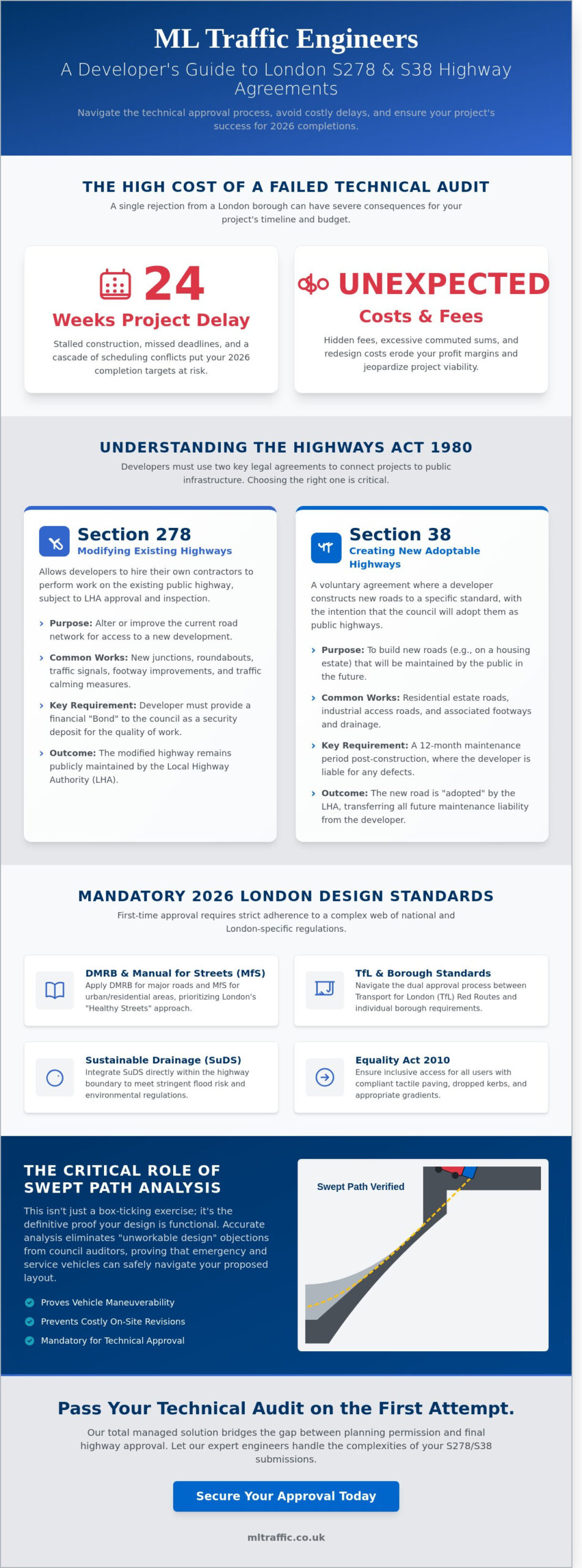
    A single failed technical audit in a London borough can delay your project by 24 weeks and trigger unexpected costs that erode your profit margins. For developers targeting 2026 completions, the pressure to secure technical approval (TA) is higher than ever as local authorities tighten their standards on road adoption and safety compliance. You likely understand that navigating the complexities of highway design S278 S38 is no longer just about engineering. It’s about managing regulatory risk and avoiding the hidden fees associated with excessive commuted sums.

    We’ve created this guide to provide a total solution for your technical submissions. You’ll learn how to refine your highway design S278 S38 drawings to pass rigorous council audits on the first attempt and ensure a seamless handover to the Local Highway Authority. We’ll break down the critical role of accurate Swept Path Analysis, the latest 2026 London-specific design standards, and strategic ways to minimize construction costs while maintaining full Chapter 8 compliance.

    Key Takeaways

    • Distinguish between Section 278 and Section 38 agreements to ensure mandatory compliance with the Highways Act 1980 for all London developments.
    • Apply the latest 2026 technical standards from the DMRB and Manual for Streets (MfS) to meet specific residential and urban design specifications.
    • Navigate the approval interface between Transport for London (TfL) Red Routes and individual London Borough standards to prevent regulatory bottlenecks.
    • Utilize advanced Swept Path Analysis to prove vehicle maneuverability and eliminate “unworkable design” objections from local council authorities.
    • Master the complexities of highway design S278 S38 to bridge the gap between initial planning permission and final technical highway approval.

    Table of Contents

    Understanding Highway Design: Section 278 vs. Section 38

    London developers face strict regulatory hurdles when connecting new projects to the capital’s infrastructure. These requirements stem directly from the Highways Act 1980. This legislation ensures that any work on public roads meets rigorous safety and quality standards. Your highway design S278 S38 strategy must align with your initial Transport Assessment to secure planning permission and avoid costly project delays. Failure to integrate these agreements early can result in site access issues that stall construction for months.

    The Local Highway Authority (LHA), which is often the specific London Borough or Transport for London (TfL), manages the technical audit process. They review every technical detail, from drainage calculations to traffic signal timings. This oversight guarantees that the finished road is safe for all users and meets long term durability requirements. We provide a total managed solution to help you clear these technical audits efficiently, ensuring your project moves from the planning phase to execution without friction.

    Section 278: Modifying the Existing London Network

    Section 278 agreements focus on alterations to the existing public highway. You’ll need this agreement for works such as new junctions, traffic calming measures, or footway improvements. In the high density environment of London, S278 design is critical for site access and safety compliance. Developers must provide a financial “Bond,” which acts as a guarantee for the council. If the work doesn’t meet the required standard, the LHA uses this bond to complete the works correctly. Our team understands the intricate complexities of London road regulations, ensuring your highway design S278 S38 submission is accurate the first time. You can view our full range of services at what we do to see how we manage these technical requirements.

    Section 38: Creating New Adoptable Highways

    Section 38 covers the creation of entirely new roads that the developer wants the council to maintain. This process is known as “adoption.” Until the council adopts the road, it remains a private street, and the developer is responsible for its upkeep. Standards for residential estate roads and industrial access are high; they must support heavy vehicle tracking and pedestrian safety. The adoption process typically includes a 12 month maintenance period after the road is built. Once this year passes and all defects are repaired, the LHA issues a final certificate of completion. This transfers all future maintenance costs to the public authority, protecting the developer from long term liability. For a detailed walkthrough of this process, our Section 38 agreement London step-by-step guide covers every stage from initial CAD design through to final road adoption.

    Technical Standards for London Highway Design in 2026

    Successful highway design S278 S38 projects in London require a dual approach to technical standards. For major network changes or trunk roads, adherence to the Design Manual for Roads and Bridges (DMRB) is mandatory. However, London’s dense urban fabric often necessitates the application of “Manual for Streets” (MfS) principles. By 2026, the shift towards “Healthy Streets” means MfS is the default for most borough-led developments. Developers must also integrate Sustainable Drainage Systems (SuDS) directly within the highway boundary to mitigate flood risks. Compliance with the Equality Act 2010 is non-negotiable; footway designs must provide inclusive access, featuring tactile paving and dropped kerbs at every crossing point. For complex schemes, following TfL’s guidance on highway works ensures the technical submission meets the high bar set for the capital’s infrastructure. This technical rigor ensures that new developments don’t just exist alongside the network but actively improve it for all users.

    Geometric Design and Visibility Splays

    Precision in geometric design prevents costly revisions during the Section 278 technical audit. Engineers must calculate Stopping Sight Distances (SSD) using actual speed survey data rather than theoretical limits, especially given London’s widespread 20mph zones. Junction radii require a delicate balance. They must be tight enough to slow turning vehicles and protect pedestrians, yet wide enough to accommodate the swept path of refuse vehicles and London buses. Visibility splays are the critical safety window for planning approval. If these splays aren’t protected through the highway design S278 S38 process, the Local Highway Authority (LHA) will likely reject the application on safety grounds. We prioritize CAD accuracy to ensure every millimeter of the visibility triangle remains unobstructed.

    Pavement and Drainage Engineering

    London’s local authorities often demand specific material palettes that vary significantly between boroughs. While standard asphalt suffices for many roads, premium finishes like York stone or high-quality granite setts are frequently required in “Streetscape Guidance” areas to maintain local character. Managing surface water runoff is a primary hurdle for modern developers. Designs must satisfy both the LHA and the Lead Local Flood Authority (LLFA), often requiring complex attenuation tanks or permeable paving systems beneath the footway. For developers needing technical analysis support, early engagement is vital. Our team ensures that every drawing aligns with 2026 standards, reducing the risk of technical rejection during the S38 adoption phase. This proactive approach helps you maintain project timelines while meeting all safety and drainage obligations. We handle the intricacies of UK road regulations so you don’t have to, providing a safe pair of hands for your infrastructure requirements.

    Highway Design S278 & S38: The London Developer’s Guide for 2026

    The London Approval Process: TfL vs. Local Boroughs

    Securing highway design S278 S38 approvals in London requires a dual-track strategy. Developers must first identify the correct Highway Authority for their site. If the project sits on the Transport for London Road Network (TLRN), commonly known as Red Routes, TfL holds the power of veto. These routes carry 30% of London’s traffic despite making up only 5% of the roads. If the site is on a side road or residential street, the local borough manages the approval process.

    Borough requirements vary significantly across the capital. Westminster City Council often demands high-specification York stone paving and bespoke street furniture to maintain heritage standards. In contrast, the London Borough of Hackney prioritizes Sustainable Drainage Systems (SuDS) and segregated cycle lanes under their green infrastructure policies. Failing to account for these local nuances during the initial highway design S278 S38 phase leads to immediate rejection during the Technical Audit (TA) phase. Developers working in outer London boroughs such as Harrow should also engage specialist Transport Planning Consultants Harrow teams who understand the specific parking standards and highways requirements that can derail a technical submission.

    The Technical Audit is a rigorous review where council engineers scrutinize every CAD drawing and drainage calculation. In the 2026 planning climate, response times are often extended due to the volume of urban densification projects. You should expect the TA phase to last between 12 and 26 weeks. Speeding this up requires submitting a “First Time Right” package that addresses road safety audits and capacity issues before the council identifies them. Our team focuses on rapid iterations to clear these hurdles efficiently.

    TfL Pre-Application Advice

    Engaging TfL early is a strategic necessity for any project impacting a Red Route. Their pre-application service provides a formal channel to discuss the Traffic Management Act 2004. This legislation mandates that authorities minimize disruption to road users. TfL will reject any design that compromises the flow of the TLRN. Reviewing our guide on Transport Assessment London helps align your initial submission with these strategic goals. Early engagement prevents costly redesigns after you’ve already committed to a site layout.

    Commuted Sums and Inspection Fees

    London councils require commuted sums to cover 20 to 60 years of future maintenance for new assets. If you install non-standard materials like granite setts or complex LED lighting systems, these costs skyrocket. Inspection fees are a separate, mandatory charge. Most London boroughs set these fees at 6% to 10% of the total estimated works cost. Developers can negotiate these sums during the S278 drafting phase by proving the long-term durability of the proposed materials or simplified drainage solutions. We help clients calculate these liabilities early to avoid budget shocks during the final stages of the legal agreement. Working with a specialist construction logistics plan consultant during this phase can also help you anticipate the heavy vehicle movement costs that feed directly into your overall budget planning.

    The Critical Role of Swept Path Analysis in Highway Design

    Swept Path Analysis (SPA) acts as the primary safeguard against local authority objections that label a project as an unworkable design. In the high-pressure environment of London development, proving vehicle manoeuvrability isn’t just a recommendation; it’s a technical requirement for securing Section 278 and Section 38 approvals. By using industry-standard CAD software, we simulate the physical footprint of vehicles as they navigate turns, junctions, and site entrances. This digital verification ensures that your highway design S278 S38 submission accounts for the real-world constraints of narrow urban corridors and complex junction geometries.

    Integrating SPA into the early stages of your layout prevents the common pitfall of designing roads that look functional on paper but fail to accommodate essential services. Councils frequently use SPA as the benchmark for safety and efficiency. If your plans don’t include these simulations, you risk immediate rejection or costly delays. We use these models to provide the technical assurance that refuse trucks, fire tenders, and heavy goods vehicles can operate without mounting kerbs or endangering pedestrians. For developers, this data represents a vital insurance policy against planning refusal. To ensure your project meets these standards, consider our Swept Path Analysis Services in London to secure your 2026 approvals.

    HGV Access and Delivery Logistics

    Designing for London requires a granular understanding of the specific service vehicle templates used across different boroughs. We often simulate the 10.2m refuse vehicle or the 12m heavy goods vehicle to justify tighter junction radii in constrained sites. This precision allows developers to maximise developable land while maintaining compliance with Transport for London (TfL) standards. It’s essential to align these designs with your Multimodal Traffic Generation checklist, ensuring that the physical road capacity matches the predicted traffic volume for your specific use-class. Using SPA helps us prove that delivery logistics won’t lead to local congestion or safety hazards. For sites in Central London, these vehicle movement strategies must also be coordinated with a construction logistics plan consultant to satisfy borough conditions around Chapter 8 compliance and pedestrian impact during the build phase.

    Emergency Vehicle Access Requirements

    Emergency access is a non-negotiable component of any highway design S278 S38 project. We design every layout to meet the strict criteria for fire tender access under Building Regulations Part B. SPA serves as the mathematical proof required by highway engineers to confirm that a fire tender, which typically requires a 3.7m clear operating width, can reach all designated points without obstruction. This rigorous testing prevents the need for expensive post-construction site modifications, such as the relocation of street lighting or the widening of site entrances. By identifying these requirements during the CAD phase, we ensure the safety of future residents and the long-term viability of the infrastructure.

    Our team provides the technical precision needed to navigate these regulatory hurdles and keep your project on schedule.

    Access our comprehensive highway design and traffic management support here.

    Securing Your S278/S38 Approval with ML Traffic Engineers

    Securing technical approval for highway design S278 S38 requires more than just standard engineering. It demands an intimate understanding of the specific requirements held by Transport for London (TfL) and the 32 individual London Boroughs. ML Traffic provides a total managed solution that bridges the gap between initial planning consent and the start of construction on-site. We don’t just draft plans; we navigate the entire regulatory lifecycle to ensure your project stays on schedule for 2026.

    Our team delivers technical reports that stand up to the most rigorous council scrutiny. We manage the delicate interface where planning permission meets technical highway approval. This proactive approach ensures that the conditions set out in your Section 106 agreement don’t become roadblocks during the detailed design phase. By coordinating early with local authorities, we resolve potential conflicts before they cause costly delays.

    Precision in your initial surveys and Swept Path Analysis (SPA) is the primary factor in accelerating council sign-off. We use the latest CAD technology to prove that your development’s access points work for refuse vehicles and emergency services alike. This level of detail minimizes the need for design revisions. It also allows us to help developers reduce commuted sums. By optimizing the footprint of new highway assets and selecting durable, council-approved materials, we ensure you aren’t paying for unnecessary long-term maintenance costs. Understanding the full financial implications of road adoption is essential; our section 38 agreement London developer’s guide details how to calculate and negotiate these costs at every stage of the process.

    London Project Expertise

    Navigating the specific nuances of authorities like Westminster, Camden, or Southwark requires deep local experience. Our engineers have successfully managed diverse ML Traffic Project Types, ranging from tight urban infill sites to large-scale commercial hubs. We understand that London projects operate on tight schedules where every day matters. That’s why we maintain 24/7 readiness to address urgent technical queries or site-specific challenges as they arise. Our team is available around the clock to keep your project moving toward its completion date.

    Next Steps for Your Development

    Don’t leave your technical approval to chance. Request a comprehensive technical review of your current highway design S278 S38 today. We act as a safe pair of hands in the complex London regulatory environment, taking the technical and logistical burden off your project managers. Our goal is to secure your Section 278 and Section 38 agreements with zero unnecessary friction. Contact us via the ML Traffic Homepage to book your initial consultation and ensure your development remains compliant, safe, and on track.

    Future-Proof Your London Development for 2026

    Navigating London’s evolving infrastructure requirements demands more than just standard compliance. You need a strategy that anticipates the 2026 technical standards set by Transport for London and individual local boroughs. Successful delivery hinges on precise highway design S278 S38 documentation and data-driven Swept Path Analysis to ensure vehicle safety and site accessibility. ML Traffic Engineers brings over 10 years of London transport planning expertise to your project, providing a seamless transition from initial CAD design to final implementation. We maintain a proven track record with TfL and all 32 London Boroughs, handling the complex regulatory burden so you don’t have to. Our team operates with 24/7 readiness to ensure your project meets every Chapter 8 requirement and safety benchmark without delay. Secure your site’s future with a partner who prioritizes precision and professional integrity.

    Get expert help with your London S278 or S38 highway design today

    We look forward to helping you achieve a seamless approval process for your next major London project.

    Frequently Asked Questions

    What is the main difference between a Section 278 and a Section 38 agreement?

    Section 278 agreements focus on altering existing public roads, while Section 38 agreements relate to the adoption of entirely new roads. A developer uses S278 to modify a junction or add a turning lane on a council-owned road. S38 is the legal mechanism for the council to take over maintenance of a new estate road once it meets specific construction standards.

    How long does it take to get a Section 278 agreement approved in London?

    Obtaining a Section 278 agreement in London usually takes between 6 and 12 months. This timeline depends on the complexity of the design and the responsiveness of the specific London borough or Transport for London. You should allow at least 26 weeks for the technical audit and legal engrossment phases to avoid project delays.

    Do I need a Section 278 agreement for a simple vehicle crossover in London?

    You don’t need a Section 278 agreement for a standard vehicle crossover; a Section 184 licence is the correct application. While S278 covers major structural modifications, the S184 process provides a faster route for installing dropped kerbs. Most London councils process S184 applications within 4 to 8 weeks, provided there are no utility conflicts.

    Who pays for the highway works under an S278 or S38 agreement?

    The developer is responsible for 100% of the costs associated with S278 and S38 highway works. This includes the physical construction, professional design fees, and council administrative costs. Authorities also charge a technical audit fee, which typically ranges from 7% to 10% of the total estimated cost of the works.

    What happens if the highway works do not meet the council standards?

    The Local Highway Authority won’t adopt the road or release the financial bond if the works fail to meet their specifications. If defects are found during the 12-month maintenance period, the developer must repair them at their own cost. Failure to rectify these issues allows the council to use the bond money to hire their own contractors for the repairs.

    Can I start construction on site before the S278 agreement is signed?

    You can’t start any works on the public highway before the S278 agreement is signed and the financial bond is secured. Unauthorised work on the highway is a breach of the Highways Act 1980 and can lead to immediate site shutdowns. You must ensure all technical approvals and insurance documents are verified by the council before your team breaks ground.

    What are commuted sums in London highway design?

    Commuted sums are financial contributions paid to the council to cover the future maintenance of highway assets for a period of 20 or 30 years. These payments are required for non-standard materials like granite setts or bespoke street furniture that cost more to maintain than standard asphalt. Councils use specific formulas to calculate these long-term liabilities during the technical audit.

    Is Swept Path Analysis mandatory for S38 adoptable road design?

    Swept Path Analysis is a mandatory requirement for any S38 adoptable road design to ensure safe vehicle movements. Developers must provide CAD simulations showing that an 11.4-metre refuse collection vehicle can navigate every turn without striking a kerb. This technical step is essential for highway design S278 S38 compliance and prevents costly redesigns during the construction phase.

    Which areas in London do you cover?

    We service Acton, Balham, Barking, Barnes, Barnet, Battersea, Beckenham, Bexleyheath, Brentford, Brixton, Bromley, Camberwell, Carshalton, Charlton, Chelsea, Chiswick, Clapham, Coulsdon, Croydon, Crystal Palace, Dagenham, Dulwich, Ealing, Edgware, Eltham, Enfield, Finchley, Forest Gate, Fulham, Golders Green, Greenwich, Hackney, Hammersmith, Hampstead, Harrow, Hayes, Highgate, Hounslow, Ilford, Islington, Kensington, Kentish Town, Kingston upon Thames, Lewisham, Mitcham, Muswell Hill, New Malden, Notting Hill, Orpington, Peckham, Pinner, Purley, Putney, Richmond, Romford, Ruislip, Sidcup, Southall, Southgate, Streatham, Surbiton, Sutton, Tooting, Tottenham, Twickenham, Uxbridge, Walthamstow, Wembley, West Norwood, Wimbledon, Wood Green, Woolwich, Bethnal Green, Shoreditch, Canary Wharf, Deptford, Leyton, Palmers Green, Stanmore, Upminster, Chislehurst, Erith, Feltham.

    Which cities in England do you cover?

    We service London, Birmingham, Manchester, Liverpool, Sheffield, Leeds.

    Michael Lee

    Article by

    Michael Lee

    Transport planner with over 35 years’ experience.

    Disclaimer

    The content on mltraffic.co.uk, including all technical articles, guides, and resources, is provided for general informational and educational purposes only. It is not intended to constitute professional advice in traffic engineering, transportation planning, development approvals, or any other technical or legal field.
    While ML Traffic Engineers makes every reasonable effort to ensure the accuracy, completeness, and timeliness of the information published, we do not provide any warranties or representations (express or implied) regarding its reliability, suitability, or availability for any particular purpose. Any reliance you place on the content is strictly at your own risk.
    In no event shall ML Traffic Engineers, its directors, employees, authors, or affiliates be liable for any direct, indirect, incidental, special, consequential, or punitive damages (including, without limitation, loss of profits, data, or business opportunities) arising out of or in connection with the use of, or inability to use, any information provided on this website.
    The articles and guides on this site are not a substitute for engaging a qualified, professional traffic engineer to assess your specific project requirements. For tailored advice, compliance assessments, or traffic engineering services, please contact a competent professional.
    This disclaimer may be updated from time to time without notice. By accessing or using this website, you agree to be bound by the most current version of this disclaimer.