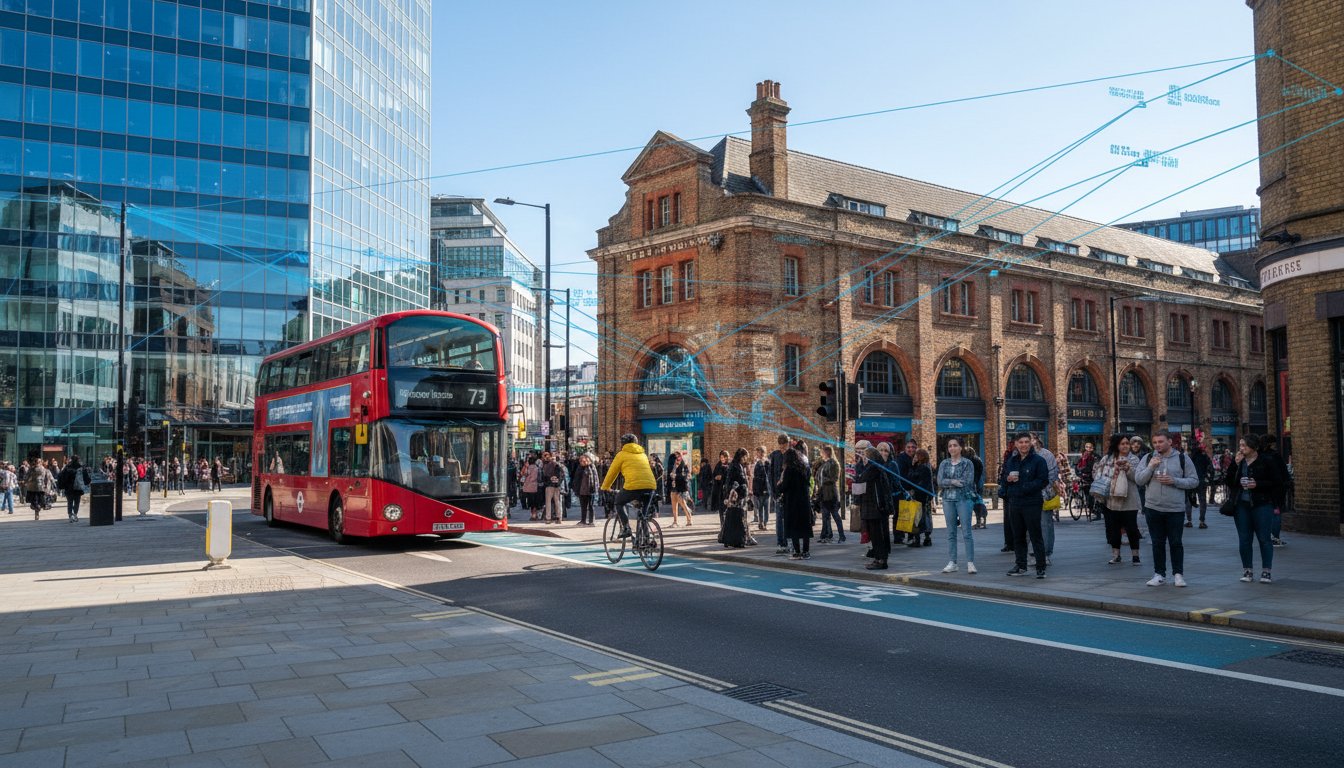
What if the 2020 Use Class overhaul actually makes it harder to justify your London development’s car-free status? Securing planning approval in 2026 requires a flawless understanding of multimodal traffic generation by PTAL and Land Uses (E, B2, B8, C1, C2, C3, F1, F2) and Sui Generis ( pubs/bars, cinemas, hot food takeaways, theatres, scrap yards, and petrol stations). You likely already know that London’s planning environment is increasingly rigid regarding parking provisions, especially in areas with a PTAL rating of 5 or 6. We understand the frustration of interpreting conflicting TRICS data when trying to prove your site’s accessibility to Transport for London (TfL).
This expert-led checklist ensures your transport assessment stands up to the strictest scrutiny from local planning authorities. You’ll master the nuances of trip generation for complex sites, from Class E commercial hubs to specialised Sui Generis scrap yards and petrol stations. We’ve compiled a clear roadmap for accurate data collection and site layout optimisation to help you achieve planning approval with minimal revisions. We’ll examine how to align your project with the latest London Plan requirements to ensure a seamless transition from the initial CAD design to final implementation.
Key Takeaways
- Understand how PTAL ratings act as a critical planning gatekeeper by defining the sustainable density and scale of developments across London’s 32 boroughs.
- Learn to calculate accurate multimodal traffic generation by PTAL and Land Uses (E, B2, B8, C1, C2, C3, F1, F2) and Sui Generis ( pubs/bars, cinemas, hot food takeaways, theatres, scrap yards, and petrol stations) using the TRICS database and bespoke arrival profiles.
- Discover why Sui Generis developments require specialised traffic analysis to account for unique arrival and departure patterns that generic data often overlooks.
- Utilise our 2026 developer’s checklist to identify Use Class overlaps early and verify site accessibility using the latest TfL WebPTAL tools.
- Mitigate the risk of costly planning delays by leveraging professional transport consultants to navigate the specific regulatory requirements of individual London local authorities.
Table of Contents
- Decoding London’s Use Classes and PTAL Ratings for 2026
- Calculating Trip Generation for Classes E, B, and C
- The Sui Generis Factor: Traffic Nuances for Pubs, Theatres, and Takeaways
- A Developer’s Checklist for Multimodal Traffic Assessments
- Why Expert Transportation Consultants are Vital for London Planning
Decoding London’s Use Classes and PTAL Ratings for 2026
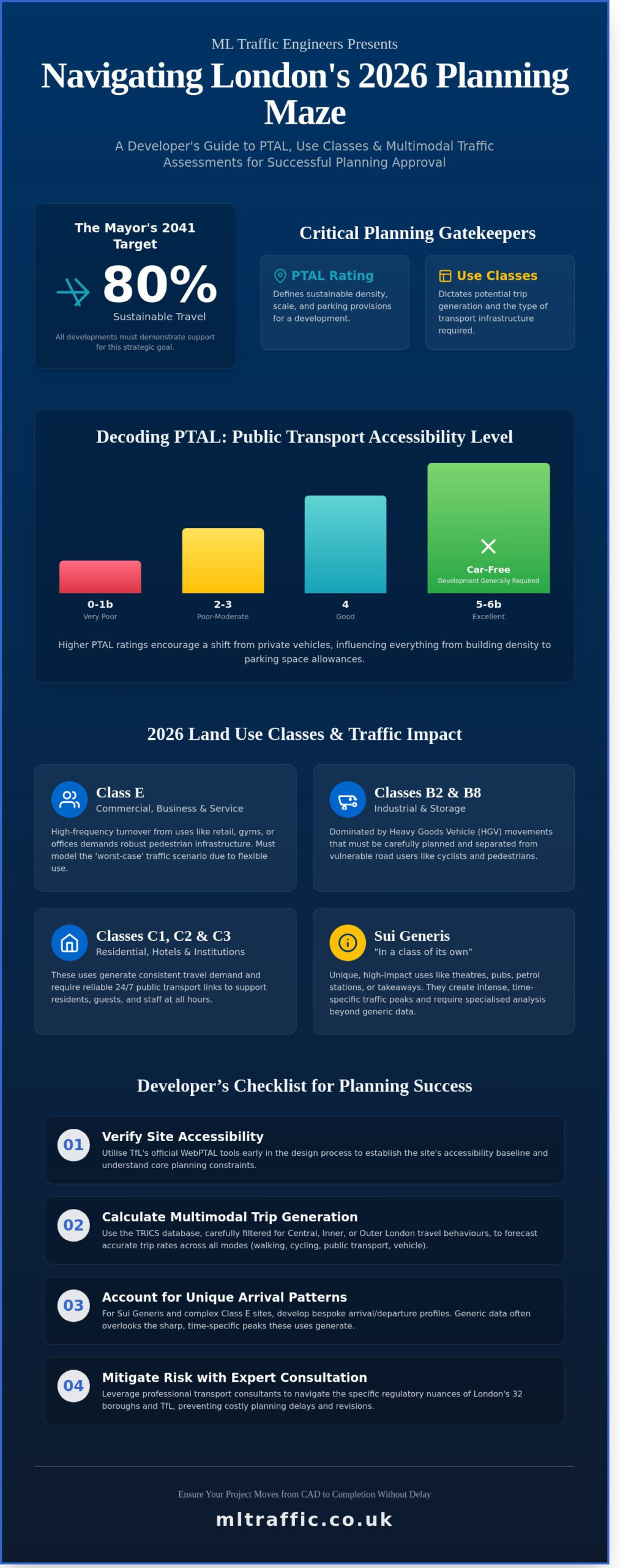
London’s planning framework requires a strict correlation between the Use Classes Order 1987 and the city’s strategic transport goals. Developers must demonstrate how their projects support the Mayor’s 2041 target for 80% sustainable travel. A central component of this is the Public Transport Accessibility Level (PTAL), which measures the proximity and frequency of the transport network. This metric serves as a critical gatekeeper, dictating everything from building density to the number of permitted parking spaces.
To better understand how these planning elements work together, watch this helpful video:
What is PTAL and Why Does it Matter?
PTAL scores range from 0 to 6b. Higher numbers represent superior access to rail, tube, and bus services. In 2026, sites with a PTAL of 5 or 6 generally require car-free development, with exceptions limited to essential blue badge provision. These ratings directly influence how residents and visitors choose to travel. High accessibility encourages a shift from private vehicles to active travel and public transport. When developers seek to deviate from these rigid standards, parking surveys in London provide the empirical data needed to justify parking reductions. We use these surveys to prove that local streets can handle any residual overspill without compromising safety.
The 2026 Landscape of Land Use Classes
The introduction of Class E has streamlined planning but complicated transport modelling for consultants. Since a building can shift from a retail shop to a gym or office without additional planning permission—often housing the kind of small UK businesses found on platforms like Anglia Market—we must model the “worst-case” scenario for trip generation. This ensures safety and capacity compliance regardless of the specific end-user. Accurate forecasting of multimodal traffic generation by PTAL and Land Uses (E, B2, B8, C1, C2, C3, F1, F2) and Sui Generis ( pubs/bars, cinemas, hot food takeaways, theatres, scrap yards, and petrol stations) is now the mandatory baseline for any successful planning application.
Each land use presents unique challenges for the 2026 transport network:
- Class E: High-frequency turnover requiring robust pedestrian infrastructure.
- B2 and B8: Heavy goods vehicle (HGV) movements that must be separated from cycle lanes.
- C1 to C3: Residential and hotel uses that demand reliable 24/7 public transport links.
- Sui Generis: High-impact uses like theatres or petrol stations that create intense, time-specific traffic peaks.
Our team ensures that your project meets these technical requirements from the initial planning phase. We provide the precise data needed to satisfy local authorities and Transport for London, ensuring your development moves from CAD design to final implementation without regulatory delays.
Calculating Trip Generation for Classes E, B, and C
Accurate forecasting starts with the TRICS database. It’s the industry standard for establishing baseline multimodal trip rates. However, London’s unique geography requires developers to filter national datasets to match the specific travel behaviours of Central, Inner, or Outer London. A site in Croydon won’t share the same trip profile as one in Southwark, even if the land use is identical. It’s vital to follow official government guidance when preparing these figures to ensure compliance with local planning authority expectations.
Our methodology ensures precise multimodal traffic generation by PTAL and Land Uses (E, B2, B8, C1, C2, C3, F1, F2) and Sui Generis ( pubs/bars, cinemas, hot food takeaways, theatres, scrap yards, and petrol stations) to meet strict Transport for London (TfL) standards. We don’t just look at vehicle numbers; we calculate the total impact across all transport modes. This includes cycling, walking, and rail usage, which are heavily influenced by the site’s PTAL rating. For projects requiring rapid turnaround, our comprehensive transport planning support ensures your submission stays on track.
Commercial and Industrial Dynamics (E, B2, B8)
B8 Storage and Distribution centres in Greater London generate intense delivery and servicing requirements. These sites often see over 15 HGV movements per hour during peak operational windows. Because of these dimensions, swept path analysis services are vital for industrial site access. They prove that large vehicles can enter and exit in a forward gear without mounting pavements or striking street furniture. Class E traffic has also shifted significantly. Since the 2020 reforms, many sites have moved from retail-heavy use to office and gym multimodal splits. This change typically flattens the midday peak but increases pressure during the 08:00 to 09:00 and 17:00 to 18:00 windows.
Residential and Institutional Impact (C1, C2, C3, F1, F2)
Forecasting school (F1) and community (F2) traffic requires a granular look at the morning peak hour. These uses often create localised congestion that conflicts with commuter traffic. Residential (C3) developments in low PTAL areas, such as levels 1a or 1b, typically show a 40% higher car dependency compared to Zone 2 locations. In contrast, short-stay C1 uses operate on a different rhythm. C1 hotel trip generation varies significantly by proximity to London Underground stations, with sites within 250 metres showing a 70% reduction in taxi and private car arrivals. Balancing these peak hour pressures is essential for securing planning approval in 2026. For residential schemes that include new roads intended for public adoption, understanding the section 38 agreement process in London from the outset is critical to avoiding costly delays before the first resident moves in.
The Sui Generis Factor: Traffic Nuances for Pubs, Theatres, and Takeaways
Sui Generis developments fall outside standard classifications because their impact on the road network is entirely unique. Relying on generic TRICS averages often leads to planning refusals in London. Local authorities require bespoke data that reflects the specific operational hours and visitor behaviours of your site. Accurate multimodal traffic generation by PTAL and Land Uses (E, B2, B8, C1, C2, C3, F1, F2) and Sui Generis ( pubs/bars, cinemas, hot food takeaways, theatres, scrap yards, and petrol stations) ensures your transport assessment stands up to scrutiny during the 2026 planning cycle. We focus on the granular details of how these sites breathe throughout a 24-hour period.
Hospitality and Entertainment (Pubs, Cinemas, Theatres)
Entertainment venues create intense surge peaks rather than steady flows. A 500-seat theatre generates a massive exodus within a 15-minute window at 22:30, which differs significantly from a Class E office. We calculate the linked trip effect, where approximately 30% of visitors might visit a local pub before a film, reducing the demand for new parking but increasing pavement crowding. Effective London travel plans help mitigate these dispersal risks by coordinating with TfL night services and designated taxi pick-up points. Managing late-night noise and transport dispersal is critical for sites near residential zones.
Hot food takeaways present a different challenge: moped volume. A single busy unit can generate 20 to 30 delivery trips per hour during peak evening times. This requires dedicated waiting bays to prevent illegal pavement parking and maintain road safety for cyclists. Without these provisions, the high-frequency nature of delivery traffic often triggers objections from Highways officers. We design layouts that keep mopeds off the footway and ensure delivery drivers don’t obstruct the main carriageway.
Industrial Sui Generis: Scrap Yards and Petrol Stations
Industrial Sui Generis sites demand precision in vehicle tracking. Scrap yards and petrol stations operate with heavy, oversized vehicles that cannot easily navigate tight London corners. We use CAD-based swept path analysis to prove that a 16.5-metre petrol tanker or a recovery low-loader can enter and exit the site in a forward gear. This is a non-negotiable safety requirement for 2026 applications.
- High-Turnover Flow: Petrol stations require clear stacking space to prevent queues from backing up onto the public highway.
- Environmental Safety: Mitigating the impact of heavy vehicle movements on residential fringes involves strict routing agreements and physical mitigation measures.
- Operational Precision: We ensure site layouts accommodate the maximum legal vehicle size allowed on UK roads to prevent kerb strikes and pedestrian risk.
Our team provides the technical authority needed to ensure these complex industrial movements don’t compromise public safety. Precision in these calculations isn’t just a regulatory hurdle; it’s a fundamental requirement for site viability. We provide the total managed solution from initial data collection to final implementation.
A Developer’s Checklist for Multimodal Traffic Assessments
Precision in the early planning stages prevents costly delays during the 2026 planning cycle. Developers must accurately identify the correct Use Class and any Sui Generis overlaps during the initial design phase. A mixed-use development might fall under Class E, but if it includes a cinema or a hot food takeaway, it triggers specific Sui Generis requirements that alter the entire traffic profile. Failing to spot these overlaps early often leads to significant revisions after the Highway Authority review.
Confirm your site’s PTAL rating using the TfL WebPTAL tool specifically for 2026. This rating is the foundation for your maximum parking allowance and trip generation forecasts. When pulling data from the TRICS database, don’t rely on national averages. Select comparable London-specific sites that match the capital’s unique density and low car ownership levels. This ensures your multimodal traffic generation by PTAL and Land Uses (E, B2, B8, C1, C2, C3, F1, F2) and Sui Generis ( pubs/bars, cinemas, hot food takeaways, theatres, scrap yards, and petrol stations) reflects reality rather than theoretical models.
- Identify Use Class and Sui Generis overlaps before finalizing site layouts.
- Use the 2026 TfL WebPTAL tool to set baseline accessibility scores.
- Filter TRICS data for London-only sites to ensure demographic accuracy.
- Include a Delivery and Servicing Plan (DSP) to manage freight and courier movements.
- Engage transportation consultants for pre-application meetings to align with borough-specific expectations.
Data Collection and Site Survey Requirements
Baseline flows must be established through 7-day automated traffic counts (ATCs). This timeframe captures the weekend spikes associated with Sui Generis uses like theatres or pubs which a standard 12-hour count might miss. Identify local pinch points, such as narrow junctions or low bridges, that could necessitate a full Transport Assessment. You also need to verify pedestrian and cycle catchment areas. This involves auditing local infrastructure to prove that multimodal accessibility is a viable alternative to car travel for future occupants.
Policy Compliance and Reporting
Your report must demonstrate strict adherence to the London Plan 2021 (and subsequent 2026 updates) regarding car-free or car-capped developments. If your multimodal traffic generation by PTAL and Land Uses (E, B2, B8, C1, C2, C3, F1, F2) and Sui Generis ( pubs/bars, cinemas, hot food takeaways, theatres, scrap yards, and petrol stations) shows capacity issues, you must draft a Mitigation Strategy. This might include funding local bus frequency improvements or installing new cycle lanes. A Transport Statement must justify how the development promotes Healthy Streets objectives through active travel and improved public realm safety.
Ensure your project meets every regulatory hurdle with expert guidance. Contact ML Traffic for professional transport planning support today.
Why Expert Transportation Consultants are Vital for London Planning
London’s 32 boroughs operate with distinct local plans and varied transport hierarchies. A project in Westminster faces different parking ratios and cycle storage mandates than one in Havering. Professional data collection eliminates guesswork and prevents the 4-6 week delays often triggered by incomplete transport assessments during the statutory consultation period. ML Traffic Engineers provide 24/7 availability for site surveys. This ensures that if a planning officer requests an emergency revision on a Tuesday morning, the data is collected by Wednesday night. Such readiness is a non-negotiable asset in the fast-moving London development market.
Accurate forecasting of multimodal traffic generation by PTAL and Land Uses (E, B2, B8, C1, C2, C3, F1, F2) and Sui Generis ( pubs/bars, cinemas, hot food takeaways, theatres, scrap yards, and petrol stations) is the foundation of a successful application. We provide the technical precision required to satisfy Transport for London (TfL) and local highway authorities. By positioning ML Traffic Engineers as your safe pair of hands, you ensure that every CAD design and multi-way system is compliant with current UK road regulations. Our approach balances technical authority with a focus on your project’s timeline.
Navigating the Planning Process with Precision
Technical authority in a Transport Statement builds immediate trust with Council Officers. We’ve managed projects where expert negotiation reduced Section 106 transport contributions by 18% through more accurate trip generation modelling. For Sui Generis sites like scrap yards or large-scale theatres, the impact on the local highway network is scrutinised heavily. In a 2024 project for a Greater London Sui Generis site, our detailed junction analysis proved that existing infrastructure could handle peak-hour loads. This saved the developer over £25,000 in redundant mitigation costs and ensured Section 278 agreements remained proportionate. Developers seeking to understand the full scope of their obligations should review the requirements for highway design S278 S38 compliance to avoid unexpected costs during the technical approval stage.
Total Managed Solutions for Developers
Our team handles the entire lifecycle, from initial feasibility and PTAL analysis to final Swept Path drawings. We’re a London-based team that understands how local traffic behaves on a Friday night in Soho versus a Monday morning in Croydon. This local intelligence ensures your project is both compliant and physically viable. When calculating multimodal traffic generation by PTAL and Land Uses (E, B2, B8, C1, C2, C3, F1, F2) and Sui Generis ( pubs/bars, cinemas, hot food takeaways, theatres, scrap yards, and petrol stations), we use the most recent TRICS data to provide a robust evidence base. We provide bespoke solutions including Chapter 8 compliance and temporary traffic signals. Our goal is to alleviate the regulatory burden on project managers through seamless integration. Contact ML Traffic Engineers for a bespoke transport quote today.
Future-Proof Your London Development Strategy
Navigating the complexities of London’s evolving planning framework requires more than just a surface-level understanding of transport data. Developers must master the technical intersection of PTAL ratings and specific site requirements to meet 2026 standards. Whether you’re converting an office to Class C3 residential or managing a high-impact Sui Generis site, precision in your transport assessment is the difference between approval and costly delays. Accurate data ensures your project aligns with the rigorous safety and environmental benchmarks set by local authorities.
Effective planning hinges on precise multimodal traffic generation by PTAL and Land Uses (E, B2, B8, C1, C2, C3, F1, F2) and Sui Generis ( pubs/bars, cinemas, hot food takeaways, theatres, scrap yards, and petrol stations). Since 2014, ML Traffic Engineers has supported developers with over a decade of hands-on experience navigating TfL and London Borough requirements. We provide 24/7 availability for urgent traffic and parking surveys, ensuring your project remains on schedule regardless of the deadline. Our team manages every stage from initial planning to final implementation with a focus on absolute legislative compliance. For developments that require new or altered highway infrastructure, understanding your S278 and S38 highway design obligations from the outset is essential to protecting your programme and budget.
Secure your planning approval with expert transport reports from ML Traffic Engineers. Your project deserves the reliability of a partner who understands the intricate realities of the UK’s road regulations. Let’s get your development moving forward today.
Frequently Asked Questions
What is the difference between a Transport Statement and a Transport Assessment for Sui Generis uses?
The primary difference lies in the scale of the development’s impact on the local road network. A Transport Statement is a concise report for smaller Sui Generis projects, like a single scrap yard or a small pub, where trip generation is limited. You’ll need a full Transport Assessment for larger schemes, such as a 500 seat cinema or a major theatre, that exceed the 1,000 square metre threshold or generate more than 30 vehicle movements during peak hours.
How does a high PTAL rating affect the number of parking spaces I can provide in London?
A high PTAL rating of 5 or 6 usually forces a car-free approach for most developments under the 2021 London Plan. In these high-accessibility areas, you’re restricted to providing only essential spaces, such as those for blue badge holders. This policy directly influences multimodal traffic generation by PTAL and Land Uses (E, B2, B8, C1, C2, C3, F1, F2) by shifting the focus from private vehicles to London’s rail and bus networks.
Can I change a building from Class E to a Sui Generis use like a takeaway without planning permission?
You can’t change a Class E site to a Sui Generis hot food takeaway without submitting a full planning application. While Class E allows flexibility between shops, offices, and gyms, takeaways don’t fall under permitted development rights. You’ll need to provide the local authority with a detailed assessment of delivery driver movements and noise impacts to secure approval for this specific change of use.
What is the TRICS database and why do transportation consultants use it for trip generation?
The Trip Rate Information Computer System (TRICS) is the industry-standard database used to predict multimodal traffic generation by PTAL and Land Uses across the UK. It contains over 8,000 site surveys that allow consultants to calculate expected arrivals by foot, cycle, and car. We use this data to provide a robust evidence base for your planning application, ensuring your projected trip rates are validated against similar existing developments.
How much does a multimodal traffic survey cost for a small London development?
A standard multimodal traffic survey for a small London site typically costs between £1,500 and £3,500. This price includes the installation of Automatic Traffic Counters and manual counts over a 12 hour period to capture peak flow data. Costs can rise to £5,000 or more if your project requires complex junction analysis or 24/7 monitoring to satisfy Transport for London’s strict data requirements.
Is a Travel Plan mandatory for all Class C3 residential developments in London?
A Travel Plan isn’t mandatory for every residential project, but you’ll almost certainly need one if your development exceeds 80 units. For smaller schemes between 50 and 80 units, the borough might only request a simplified Travel Plan Statement. These documents are vital for managing long-term traffic impact and are often secured through a Section 106 legal agreement to ensure the development meets the Mayor’s 80 percent sustainable travel target by 2041.
What happens if my development’s traffic generation exceeds local road capacity?
If your projected traffic exceeds the capacity of the local highway, the council may refuse your application or require significant mitigation measures. You might have to pay for junction upgrades, install new temporary traffic signals, or contribute to local bus service improvements via a Section 106 agreement. We identify these capacity issues early in the design phase to create bespoke engineering solutions that protect your project’s viability.
How often does TfL update the PTAL ratings for London boroughs?
Transport for London updates the underlying WebCAT data continuously to reflect minor timetable changes, but major PTAL map revisions usually happen once a year. Significant shifts in accessibility scores occurred in 2023 following the full integration of the Elizabeth Line into the network. It’s essential to check the latest 2024 or 2025 data sets before submitting your application, as a change in PTAL score can instantly alter your parking obligations.
Which areas in London do you cover?
We service Acton, Balham, Barking, Barnes, Barnet, Battersea, Beckenham, Bexleyheath, Brentford, Brixton, Bromley, Camberwell, Carshalton, Charlton, Chelsea, Chiswick, Clapham, Coulsdon, Croydon, Crystal Palace, Dagenham, Dulwich, Ealing, Edgware, Eltham, Enfield, Finchley, Forest Gate, Fulham, Golders Green, Greenwich, Hackney, Hammersmith, Hampstead, Harrow, Hayes, Highgate, Hounslow, Ilford, Islington, Kensington, Kentish Town, Kingston upon Thames, Lewisham, Mitcham, Muswell Hill, New Malden, Notting Hill, Orpington, Peckham, Pinner, Purley, Putney, Richmond, Romford, Ruislip, Sidcup, Southall, Southgate, Streatham, Surbiton, Sutton, Tooting, Tottenham, Twickenham, Uxbridge, Walthamstow, Wembley, West Norwood, Wimbledon, Wood Green, Woolwich, Bethnal Green, Shoreditch, Canary Wharf, Deptford, Leyton, Palmers Green, Stanmore, Upminster, Chislehurst, Erith, Feltham.
Which cities in England do you cover?
We service London, Birmingham, Manchester, Liverpool, Sheffield, Leeds.

Article by
Michael Lee
Transport planner with over 35 years’ experience.
Disclaimer
The content on mltraffic.co.uk, including all technical articles, guides, and resources, is provided for general informational and educational purposes only. It is not intended to constitute professional advice in traffic engineering, transportation planning, development approvals, or any other technical or legal field.
While ML Traffic Engineers makes every reasonable effort to ensure the accuracy, completeness, and timeliness of the information published, we do not provide any warranties or representations (express or implied) regarding its reliability, suitability, or availability for any particular purpose. Any reliance you place on the content is strictly at your own risk.
In no event shall ML Traffic Engineers, its directors, employees, authors, or affiliates be liable for any direct, indirect, incidental, special, consequential, or punitive damages (including, without limitation, loss of profits, data, or business opportunities) arising out of or in connection with the use of, or inability to use, any information provided on this website.
The articles and guides on this site are not a substitute for engaging a qualified, professional traffic engineer to assess your specific project requirements. For tailored advice, compliance assessments, or traffic engineering services, please contact a competent professional.
This disclaimer may be updated from time to time without notice. By accessing or using this website, you agree to be bound by the most current version of this disclaimer.