Tag: Transport Assessment

  • How Much Does a Transport Statement Cost in London (2026 Guide)

    How Much Does a Transport Statement Cost in London (2026 Guide)

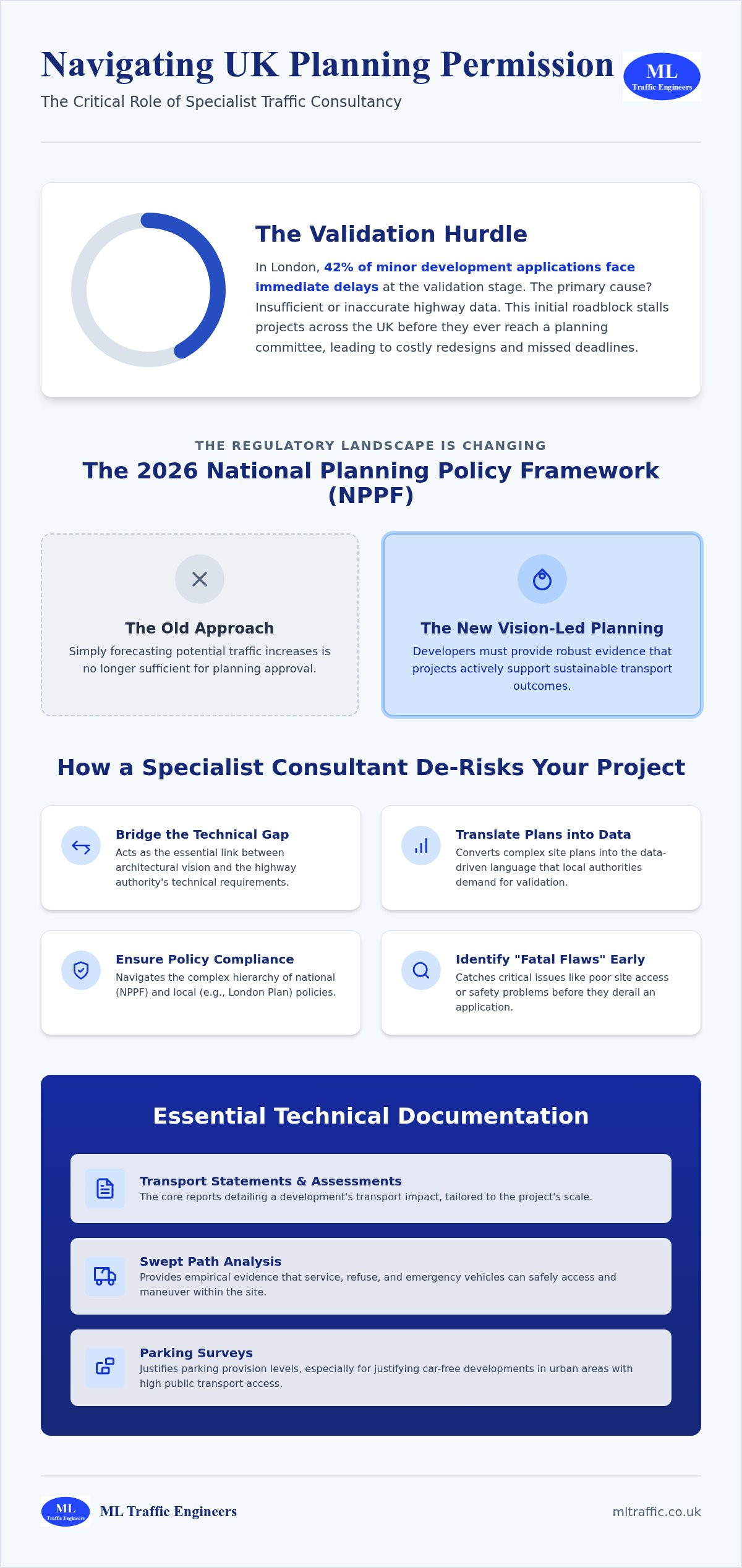
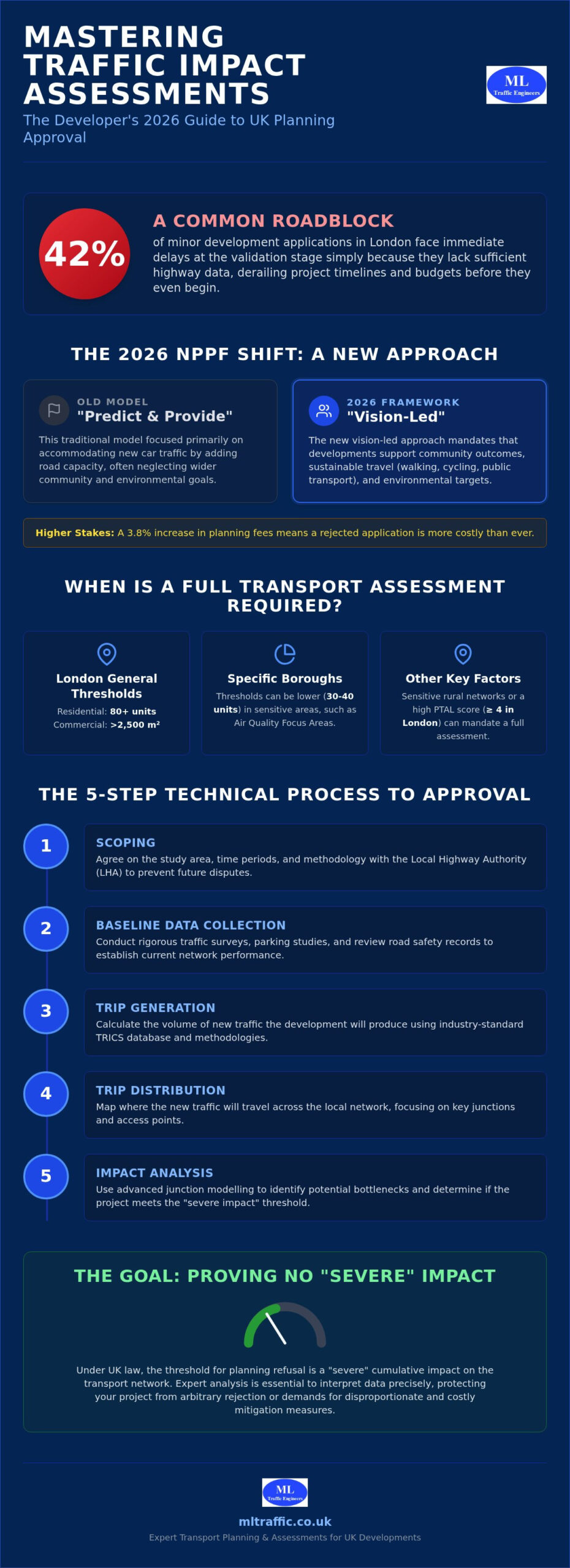
    Did you know that 42% of minor development applications in London face delays at the validation stage because of inadequate highway data? When you’re managing a complex project, these regulatory setbacks aren’t just frustrating; they represent a significant drain on your timeline and budget. You’re likely asking, how much does a transport statement cost in London 2026, and why do professional quotes seem to fluctuate so much? In a high-stakes environment where precision is a functional necessity, understanding these variables is the first step toward a successful submission.

    We recognize the pressure of navigating London’s intricate regulations, from PTAL accuracy to the strict “Vision Zero” safety targets. This guide clarifies the primary factors that drive Transport Statement pricing for your 2026 planning application. You’ll discover how to determine if your project requires a standard Statement or a full Assessment, helping you avoid the fear of choosing the wrong technical document. We’ll outline the current TfL requirements and show you how to secure a reliable, cost-effective submission that meets every legislative benchmark while reducing your overall delivery risk.

    Key Takeaways

    • Identify whether your development triggers the requirement for a Transport Statement or a more intensive Transport Assessment based on 2026 thresholds.
    • Understand how PTAL ratings and borough-specific parking standards influence the technical complexity and depth of your regulatory submission.
    • Learn exactly how much does a transport statement cost in London 2026 by evaluating the specific data requirements and site-specific challenges of your project.
    • Discover practical strategies to control technical reporting fees through early consultant engagement and the provision of accurate site documentation.
    • Leverage specialized local expertise to navigate TfL’s “Vision Zero” targets and ensure a faster, more reliable validation process for your planning application.

    Understanding Transport Statement Requirements for London Planning in 2026

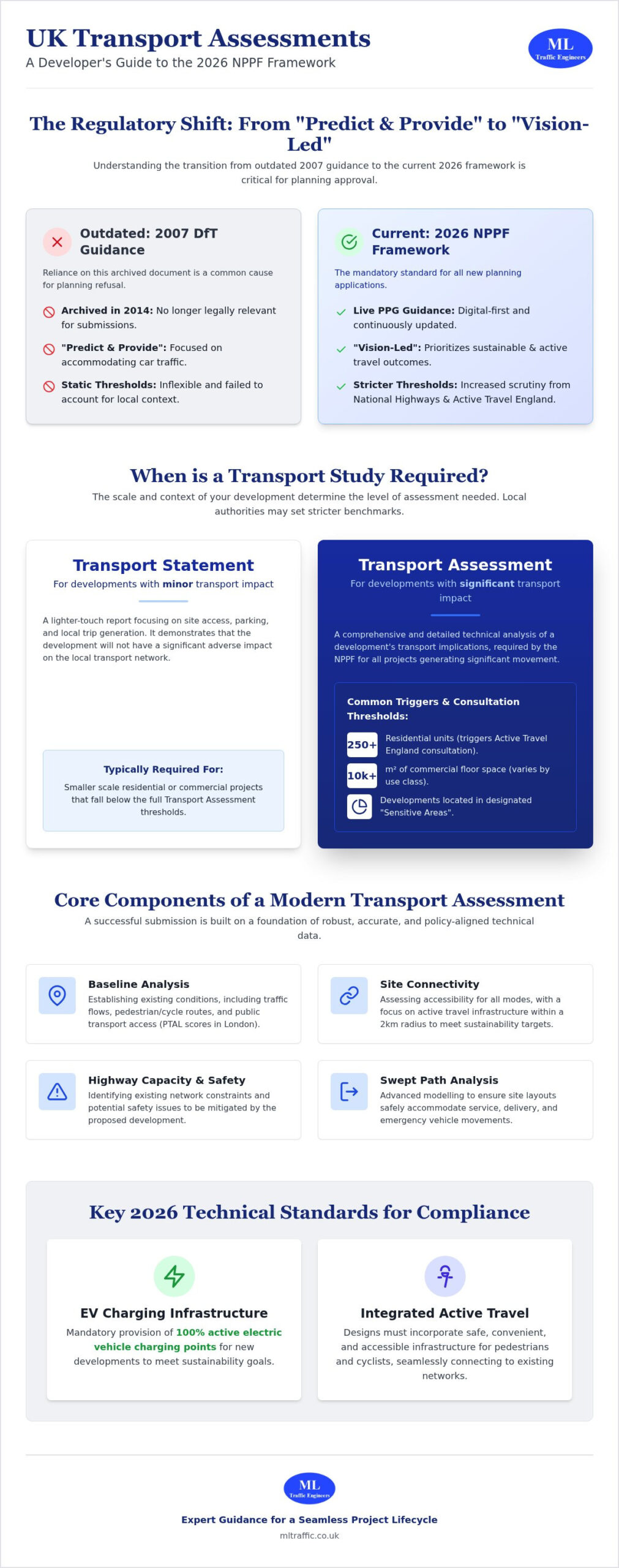
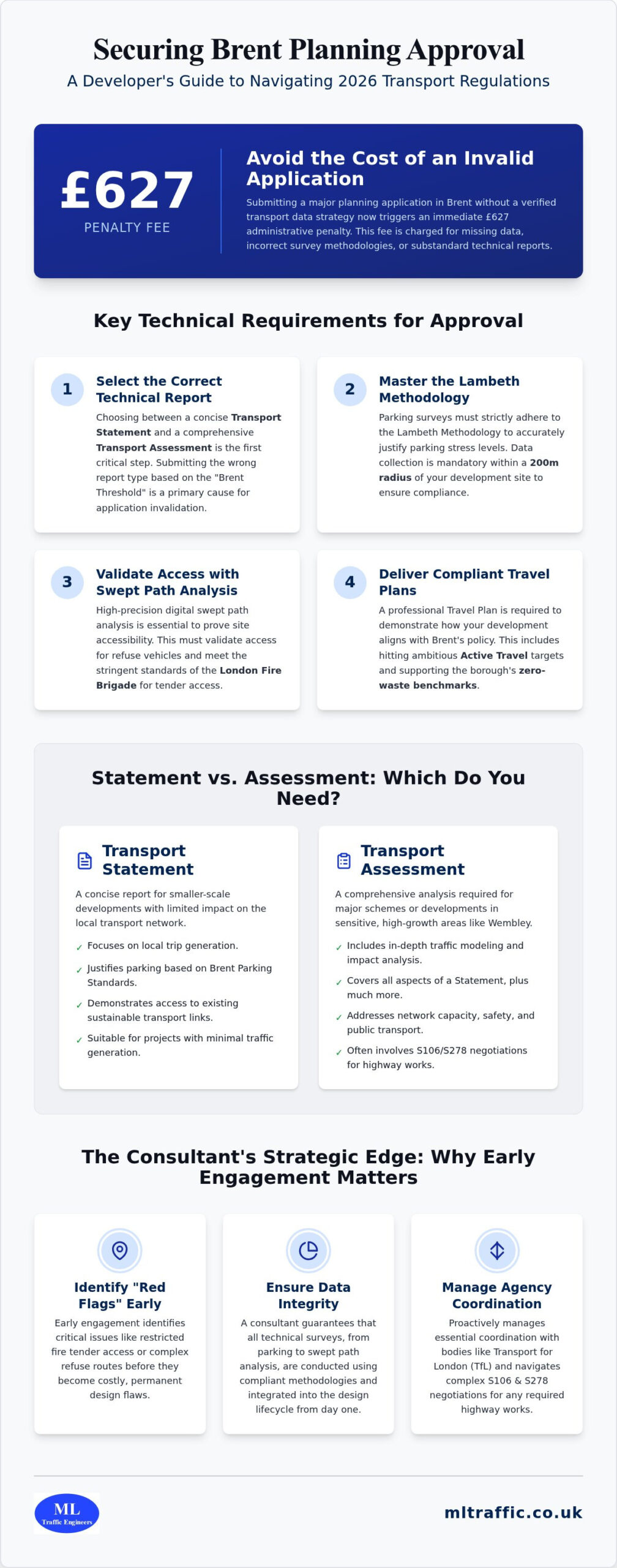
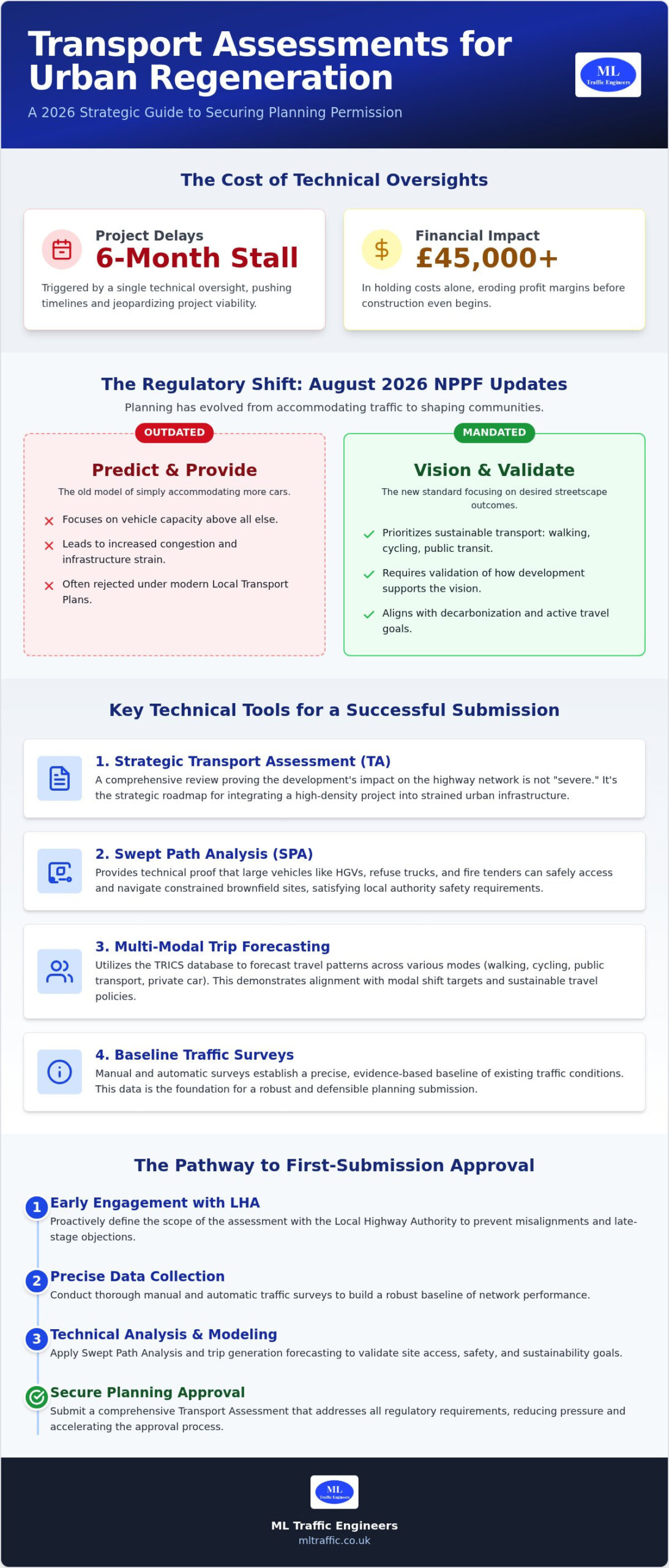
    A Transport Statement is a technical report specifically designed for developments that fall below the thresholds of a full assessment but still require a professional evaluation of their traffic impact. In the 2026 planning environment, these documents are no longer optional extras; they’re mandatory for most minor developments across London’s 32 boroughs. The National Planning Policy Framework (NPPF) demands that all applications provide proportionate evidence of their impact on the local network. By securing a well-scoped statement early, you eliminate the risk of the local authority rejecting your submission due to insufficient data. Understanding how much does a transport statement cost in London 2026 starts with recognizing that this document is your primary defense against costly validation delays.

    To better understand this concept, watch this helpful video:

    Effective transportation planning ensures that your project integrates safely with the existing infrastructure. A professional Transport Statement provides the necessary technical weight to support your application from day one. It serves as a clear record of compliance with both regional and local transport policies.

    When is a Transport Statement Required?

    Thresholds for these documents usually apply to residential projects under 50 units or commercial spaces smaller than 1,000 square metres. However, size isn’t the only factor. Local Planning Authorities (LPAs) often trigger a requirement if your site is near a busy junction, within a sensitive Air Quality Management Area, or has a low Public Transport Accessibility Level (PTAL). You should always consult with the specific borough early in the design phase. This proactive approach prevents the “validation trap” where many London applications are currently stalled for weeks because they lack technical highway data.

    The Statutory Weight of Transport Documentation

    These documents carry significant weight during Section 106 and Community Infrastructure Levy (CIL) negotiations. A precise statement proves that your development won’t place an undue burden on the public highway, potentially reducing the financial contributions requested by the council. In 2026, the focus has shifted toward “Vision Zero” and sustainable travel targets, aiming for 80% of all trips to be made by foot, cycle, or public transport. Your documentation must reflect these priorities to be considered valid. Providing proportionate evidence is the standard. It’s the only way to satisfy council officers that your project aligns with the Mayor’s Healthy Streets approach without over-investing in unnecessary reporting. A Transport Statement is the essential bridge between design and planning approval.

    Key Factors Influencing Transport Statement Costs in London

    Costs for a technical report are rarely fixed because London’s planning environment is highly variable. When you’re determining how much does a transport statement cost in London 2026, you must account for the “London Premium.” This represents the additional technical hours required to meet borough-specific standards that often exceed national UK government guidance. A document that suffices in a rural county will likely fail at the validation stage in a London borough. This is because urban technical reporting requires deeper analysis of local network constraints and public transport connectivity.

    Public Transport Accessibility Level (PTAL) analysis is a primary cost driver. A site with a low PTAL score requires a more robust argument for car-free development or extensive mitigation strategies to satisfy the Mayor’s London Plan. This increases the analytical depth and time required for the report. Conversely, a site with high accessibility might seem simpler, but it often triggers more complex pedestrian and cycle infrastructure assessments. Every data point must be verified to ensure the project remains compliant with the latest safety benchmarks.

    To ensure these complex requirements are met with precision, specialized consultants like Da Vinci Transport Planning & Research offer the traffic engineering and transport planning expertise necessary for high-stakes submissions.

    The Impact of Data Collection and Surveys

    In 2026, standards for data accuracy have reached an all-time high. Many councils now strictly enforce the Lambeth Methodology for Parking Surveys. If existing data is outdated or unavailable, you’ll need to commission fresh overnight surveys. These counts ensure your proposal doesn’t overwhelm local on-street capacity. Relying on “desk-based” estimates is often a false economy. Inaccurate data leads to immediate rejection by highway officers, which can cost your project more in delays than the initial survey fee. High-quality data collection includes traffic counts, pedestrian flow analysis, and cycle monitoring, all of which contribute to the final technical fee.

    Borough-Specific Technical Requirements

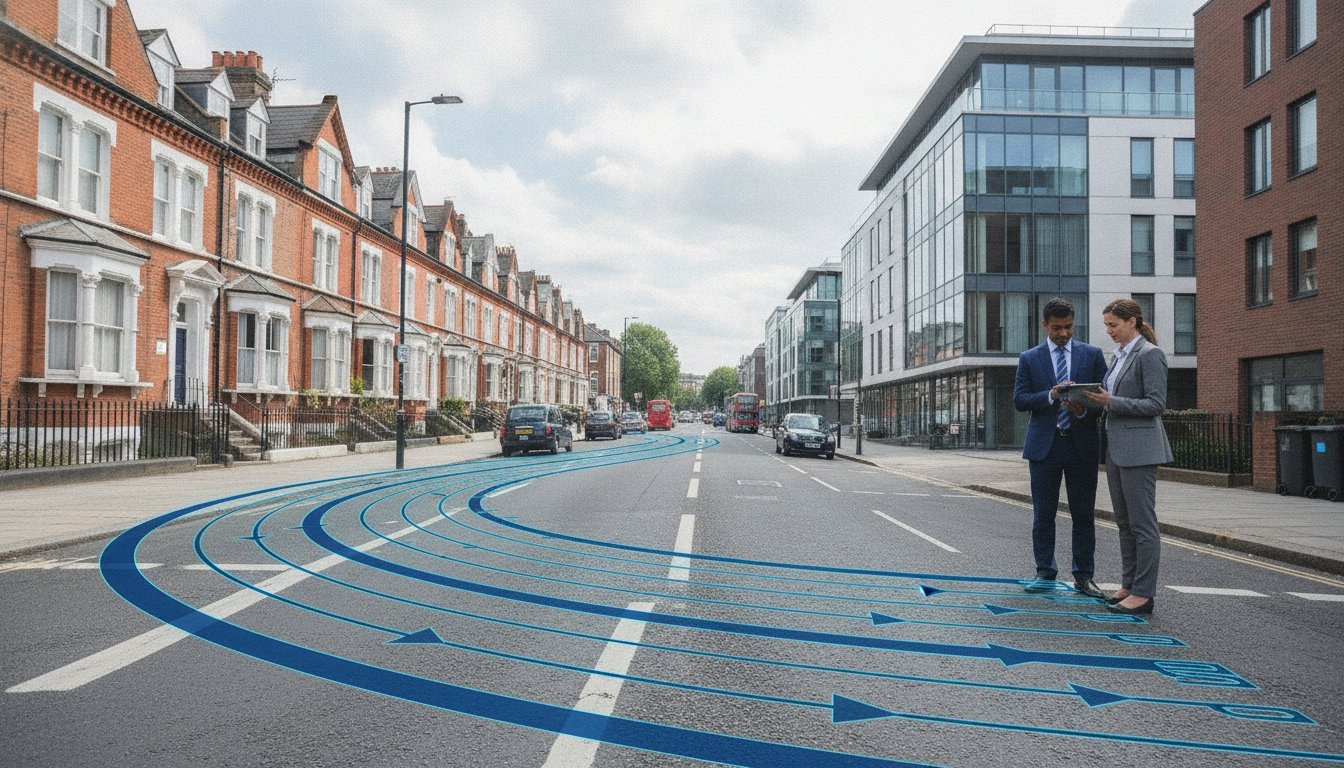
    There is a significant technical gap between Inner and Outer London requirements. Inner London boroughs often demand more rigorous analysis of “active travel” and pedestrian counts. If your site fronts a Red Route, you may also face Transport for London (TfL) pre-application advice costs. These fees cover the time TfL officers spend reviewing your access strategy before your formal submission. Specialist analysis for deliveries and waste management is also standard. Utilizing Swept Path Analysis is essential to prove that refuse vehicles can enter and exit your site in a forward gear. Precision in these early stages prevents expensive revisions later. If you’re unsure about the specific survey requirements for your site, obtaining a technical scope review can help clarify your project’s budgetary needs.

    Transport Statement vs. Transport Assessment: Comparing Costs and Scope

    Determining how much does a transport statement cost in London 2026 requires a clear understanding of where a simple statement ends and a full assessment begins. The tipping point between these two documents usually rests on the scale of the proposed development and its anticipated impact on the local highway network. While both documents serve the planning process, their technical requirements differ significantly. A Statement focuses on site-specific access and local policy compliance, whereas an Assessment examines the wider cumulative impact of a project on the city’s infrastructure.

    Resource allocation is the primary driver of the price delta between these reports. A full Transport Assessment often necessitates complex junction modelling using software like VISSIM or JUNCTIONS 9. This level of analysis requires specialized engineering hours to simulate traffic flows across multiple intersections. In contrast, a Transport Statement typically avoids these heavy computational requirements, focusing instead on qualitative arguments and basic trip generation data. Choosing the wrong document type early in the project leads to “scope creep,” where a modest budget for a Statement ballooning into a full Assessment expense because the initial impact was underestimated.

    Scope Comparison Table for 2026

    The following table outlines the technical differences that dictate reporting depth and associated consultant fees in the current planning landscape.

    Technical Feature Transport Statement (TS) Transport Assessment (TA)
    Project Threshold Small scale (e.g., < 50 residential units) Major developments (e.g., > 80 units)
    Traffic Modelling None or limited to site access VISSIM, LinSig, or Junctions 9 simulations
    Data Depth Local parking and trip generation Multi-modal network impact analysis
    Policy Focus Local borough compliance Strategic London Plan and TfL oversight

    Junction modelling significantly increases costs because it involves high-intensity data processing and rigorous validation by highway authorities. For smaller sites, we prioritize lean reporting to keep your application moving without unnecessary technical overhead.

    Choosing the Right Document for Your Project

    Submitting a Transport Statement for a project that technically triggers a full Assessment is a high-risk strategy. It often results in a “Request for Further Information” from the council, which adds weeks to your timeline and thousands to your technical reporting costs. At ML Traffic Engineers, we conduct an initial review of your site’s PTAL rating and borough-specific thresholds to determine the most cost-effective route. This ensures you don’t overpay for unnecessary modelling while still meeting every statutory requirement. A Transport Statement is a tactical tool for speed, while an Assessment is a strategic tool for scale.

    How Much Does a Transport Statement Cost in London (2026 Guide)

    How to Control and Reduce Your Transport Planning Costs

    Managing the budget for a planning application requires more than just comparing initial quotes. While you’re investigating how much does a transport statement cost in London 2026, you should also look for operational efficiencies that prevent technical rework. Early engagement with a transport consultant is the most effective way to stabilize your budget. By identifying potential highway issues during the pre-design phase, you avoid the high costs of redesigning site access or parking layouts after a submission has failed. We find that early technical input often saves developers more in design fees than the cost of the statement itself.

    Providing high-quality, CAD-ready site plans from the outset significantly reduces technical drawing time. If a consultant has to spend hours correcting inaccurate base maps, those costs will inevitably reflect in your final invoice. Precision in your initial documentation allows us to move straight to the analytical phase, ensuring a faster turnaround and a more competitive fee. Clear communication between your architect and our technical team ensures that the data we use is accurate and compliant from day one.

    Efficiency Through Integrated Technical Analysis

    Bundling your technical requirements is a proven strategy for cost control. Combining a TS with a Travel Plan or Swept Path Analysis allows for a more cohesive technical narrative. This integrated approach prevents the contradictions that often occur when different firms handle separate reports. A single consultant managing the full project lifecycle from inception to completion reduces logistical pressure and ensures all planning conditions are met simultaneously. You can use ML Traffic Resources to understand exactly what data you need to prepare before commissioning your technical report.

    Negotiating the Scope with Local Highway Authorities

    Professional advocacy plays a vital role in reducing technical overhead. We often negotiate with Local Highway Authorities to “scope out” unnecessary technical work that doesn’t add value to your specific application. For instance, if a borough requests a full parking survey where existing data is already available and valid, we challenge that requirement. Leveraging existing traffic data or recent counts from neighboring developments can save you thousands in survey fees. Proactive scoping ensures that your document is “proportionate” to the development, exactly as the NPPF requires. This strategy focuses your budget on essential data rather than “just in case” reporting.

    To get an accurate assessment of your project’s specific needs, contact our technical team for a scoped proposal today.

    Securing a Competitive Quote with ML Traffic Engineers

    Choosing a partner for your technical reporting shouldn’t involve guesswork. When assessing how much does a transport statement cost in London 2026 for your specific project, you need a partner who provides fixed-fee certainty. We utilize a transparent pricing model that accounts for the technical variables discussed in this guide, ensuring you never face unexpected costs mid-application. Our team understands that in a high-stakes planning environment, budget predictability is just as important as technical accuracy. We prioritize precision and professional integrity in every document we produce.

    Local expertise is our primary tool for reducing your project costs. Because we understand the specific requirements of each London borough, we don’t waste time on irrelevant data or unnecessary analysis. We focus exclusively on the technical benchmarks required for your specific site, whether that involves complex PTAL calculations or “Vision Zero” safety compliance. This targeted approach leads to faster approvals and lower overall technical fees. We position ourselves as a vital guardian of public safety while ensuring your development remains commercially viable.

    Why Developers Choose ML Traffic Engineers

    Our team maintains a consistent track record of success with London Local Planning Authorities (LPAs) and Transport for London (TfL). We specialize in reducing planning friction for residential developments by providing robust, data-driven arguments that satisfy even the most stringent highway officers. We’ve managed full project lifecycles from initial feasibility to final approval, often stepping in to resolve complex access issues that other firms have overlooked. Our commitment to rapid response and constant accessibility means we are ready to act whenever your project timeline demands immediate technical support.

    Request Your 2026 Transport Statement Quote

    To receive an accurate and competitive fixed-fee proposal, we require specific details about your project. This information allows us to scope the technical work precisely and identify any potential survey requirements early. Please prepare the following details for our technical team:

    • The full site address and borough location.
    • The type of development (residential, commercial, or mixed-use).
    • Total unit numbers or proposed floor space (sqm).
    • Existing and proposed site plans or CAD drawings.
    • Any previous correspondence from the local highway authority.

    We operate with a sense of readiness that matches the fast-moving nature of London’s infrastructure. Our 24/7 reliability promise ensures that your technical queries are addressed without delay, keeping your planning application on track. We manage the intricate regional regulations so that you don’t have to, acting as your comprehensive partner in transport planning. Get a Transport Statement Quote for Your London Project and secure a reliable, expert-led submission today.

    Take Decisive Action on Your 2026 Planning Application

    Securing planning approval in London requires technical precision and a deep understanding of borough-specific standards. As we’ve explored, determining how much does a transport statement cost in London 2026 depends on your site’s specific data requirements and the scale of your development. By choosing the correct document type and engaging with experts early, you eliminate the risk of costly validation delays and unnecessary technical rework. Precision in your initial submission is the most effective way to protect your project timeline and budget from the start.

    ML Traffic Engineers has been a dependable partner for developers since 2014. With over a decade of London planning expertise, we navigate the intricate requirements of all 32 London Boroughs so you don’t have to. Our team specializes in Swept Path Analysis and Parking Surveys, providing the technical authority needed for a successful submission. We offer an all-encompassing, fully-managed service that prioritizes clarity and rapid action. Request a Fixed-Fee Transport Statement Quote today to ensure your project meets every legislative benchmark with unwavering reliability. Your path to a successful planning outcome starts with expert technical support.

    Frequently Asked Questions

    How much does a Transport Statement typically cost in London?

    Professional fees for preparing these documents vary based on project complexity and the volume of technical data required. Factors such as site location, proximity to Red Routes, and the specific requirements of the local borough influence the final cost. We provide fixed-fee proposals after reviewing your site layout and PTAL rating to ensure budgetary certainty. Understanding how much does a transport statement cost in London 2026 requires a detailed review of your project’s specific highway impact.

    What is the difference between a Transport Statement and a Transport Assessment?

    The primary difference lies in the scale of the development and the depth of technical analysis required. A Transport Statement is a concise report for smaller projects with limited highway impact, typically under 50 residential units. A Transport Assessment is a comprehensive study for major developments that necessitates complex junction modelling and multi-modal network analysis. Thresholds for a full Assessment are usually triggered by projects exceeding 80 residential units or 2,500 square metres of commercial space.

    Do I need a separate Travel Plan with my Transport Statement?

    Many London boroughs require a Travel Plan alongside a Transport Statement to support the Mayor’s goal of 80% sustainable trips by 2026. This document outlines specific measures to encourage walking, cycling, and public transport use among future occupants. While a Statement assesses current impacts, the Travel Plan manages future travel behavior. Bundling these technical reports often streamlines the planning process and ensures a cohesive narrative for council officers during the validation stage.

    Can I use a Transport Statement for a residential development of 10 units?

    Yes, a Transport Statement is generally the appropriate document for residential developments of 10 units. This scale falls well below the standard threshold for a full Assessment in most London boroughs. The report will focus on site access safety, local parking capacity, and compliance with PTAL-based parking standards. It provides the proportionate evidence required by the NPPF without the need for expensive traffic simulations or wider network modelling.

    How long does it take to produce a Transport Statement in London?

    Production timelines typically range from two to four weeks depending on data availability and survey requirements. If your project requires fresh parking surveys or pedestrian counts, the schedule must account for data collection and processing. We prioritize rapid response to meet tight planning deadlines. Providing accurate CAD site plans at the start of the project significantly accelerates the technical drawing and analysis phases, allowing for a faster submission.

    Will I need to pay for traffic surveys on top of the consultancy fee?

    Traffic surveys are often separate costs because they involve specialized data collection teams and hardware. When calculating how much does a transport statement cost in London 2026, you should check if existing borough data is available or if new counts are necessary. If the local authority demands fresh data using the Lambeth Methodology, we manage the procurement of these surveys. This ensures they meet strict technical standards and provide the precise data required for your statement.

    What happens if the Highway Authority objects to my Transport Statement?

    If an objection occurs, we engage directly with the highway officer to address their specific technical concerns. This often involves providing additional data or refining the site access strategy to improve safety and compliance. Our role as a reliable partner is to negotiate these points professionally and find a viable technical solution. Proactive scoping at the start of the project minimizes the risk of such objections during the validation stage.

    Is a Transport Statement required for a change of use application?

    A Transport Statement is frequently required for change of use applications if the new use generates more trips than the previous one. For example, converting a warehouse into residential units changes the timing and volume of traffic flow significantly. The report demonstrates that the existing highway network can accommodate this shift in demand. It also addresses crucial logistical requirements like waste collection and delivery vehicle tracking to ensure the new use is sustainable.

    Michael Lee

    Article by

    Michael Lee

    Transport planner with over 35 years' experience.

    Disclaimer

    The content on mltraffic.co.uk, including all technical articles, guides, and resources, is provided for general informational and educational purposes only. It is not intended to constitute professional advice in traffic engineering, transportation planning, development approvals, or any other technical or legal field.
    While ML Traffic Engineers makes every reasonable effort to ensure the accuracy, completeness, and timeliness of the information published, we do not provide any warranties or representations (express or implied) regarding its reliability, suitability, or availability for any particular purpose. Any reliance you place on the content is strictly at your own risk.
    In no event shall ML Traffic Engineers, its directors, employees, authors, or affiliates be liable for any direct, indirect, incidental, special, consequential, or punitive damages (including, without limitation, loss of profits, data, or business opportunities) arising out of or in connection with the use of, or inability to use, any information provided on this website.
    The articles and guides on this site are not a substitute for engaging a qualified, professional traffic engineer to assess your specific project requirements. For tailored advice, compliance assessments, or traffic engineering services, please contact a competent professional.
    This disclaimer may be updated from time to time without notice. By accessing or using this website, you agree to be bound by the most current version of this disclaimer.

  • Transport Planning Consultants in London: The 2026 Developer’s Guide

    Transport Planning Consultants in London: The 2026 Developer’s Guide

    Did you know that 42% of minor development applications across London boroughs face immediate delays at the validation stage because of insufficient highway data? For developers, these setbacks often stem from complex borough-specific parking standards or unexpected technical objections late in the planning cycle. It’s frustrating to see a project stall just as it gains momentum. Engaging expert transport planning consultants london is a functional necessity to ensure your scheme meets the rigorous demands of Transport for London and local authorities.

    We understand that you need clear communication with highway authorities and cost-effective technical reports that don’t compromise on precision. This guide promises to simplify the complexities of London planning applications by providing a clear roadmap for transport strategy and regulatory compliance. You’ll gain a comprehensive overview of the 2026 landscape, including the shift toward vision-led planning, the requirements for car-free developments in high PTAL areas, and the specific thresholds for Transport Statements and Assessments.

    Key Takeaways

    • Learn how the 2026 regulatory environment requires a data-led approach to bridge the gap between development goals and highway authority expectations.
    • Identify the specific scale-based thresholds that dictate whether your London project needs a Transport Statement or a comprehensive Transport Assessment.
    • Understand how technical data from Swept Path Analysis and Parking Surveys validates your site layout for fire tenders and refuse vehicles.
    • Navigate the dual-layered requirements of local London boroughs and the Transport for London Road Network to prevent costly validation delays.
    • Discover why expert transport planning consultants london are essential for securing planning permission through precise technical reporting and strategic negotiation.

    The Role of Transport Planning Consultants in London’s 2026 Landscape

    In 2026, the gap between a developer’s vision and a highway authority’s approval is wider than ever. Professional transport planning consultants london act as the essential bridge, translating architectural intent into technically compliant reports. This involves managing the entire transport planning process from the initial site assessment through to final planning approval. By aligning project goals with the specific requirements of the 32 London boroughs, consultants ensure that developments aren’t just viable but also compliant with the latest strategic frameworks.

    The regulatory environment has moved away from simply accommodating vehicle volumes. Today, the focus is on a vision-led approach that prioritizes human health and sustainable movement over traditional traffic growth models. This shift requires a data-intensive strategy where every design choice is justified by technical evidence. You can’t rely on outdated national guidance when TfL and borough officers expect granular, site-specific data. Whether it’s proving site access via Swept Path Analysis or justifying parking levels through Parking Surveys, precision is a functional necessity to avoid immediate delays at the validation stage.

    To better understand the environmental and strategic shifts driving these requirements, watch this helpful video from Transport for London:

    Navigating the London Plan 2026

    The Mayor’s London Plan sets a strategic target for 80% of all trips to be made by foot, cycle, or public transport by 2041. For developers, this means the Public Transport Accessibility Level (PTAL) score of a site is now the primary factor in determining density and parking provision. In areas with high PTAL scores of 4 or above, “car-free” developments are often the only path to approval. Expert transport planning consultants london help you navigate these mandates by developing robust Travel Plans that promote active travel and reduce reliance on private vehicles. This proactive strategy ensures your application aligns with the “Healthy Streets” approach, which is now a non-negotiable benchmark for all major London schemes.

    Reducing Logistical Friction for Developers

    Professional reports aren’t just paperwork; they’re a vital tool for risk mitigation. High-quality Transport Statements and Transport Assessments provide the technical authority needed to address local resident objections and speed up the statutory consultation period. Early engagement prevents costly redesigns that occur when highway authorities identify technical flaws late in the cycle. We provide a fully-managed service that identifies these risks early. Visit our services overview to see how we manage the full project lifecycle from assessment to support. This rhythmic efficiency ensures your project maintains momentum from inception to completion, reducing the regulatory pressure on your team.

    Essential Documentation: Transport Statements vs. Assessments

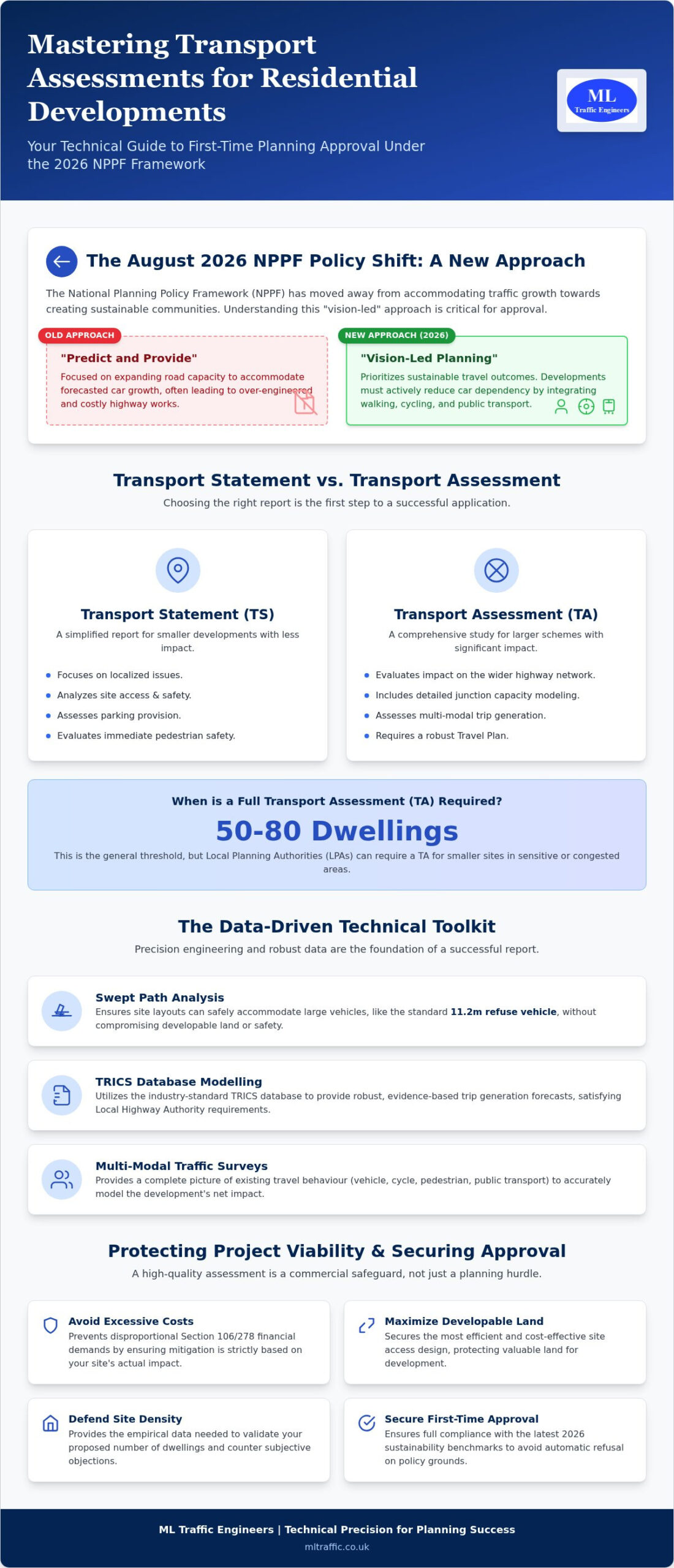
    Selecting the incorrect level of documentation is a leading cause of application rejection in the capital. Navigating highway requirements under the National Planning Policy Framework (NPPF) requires developers to scale their reporting based on the anticipated impact of their scheme. Professional transport planning consultants london provide the technical precision needed to classify your project correctly from the start. This ensures you don’t overspend on unnecessary analysis for minor sites or face technical objections for under-reporting on major developments.

    Every report serves as a legal and technical justification for your site layout. While the National Planning Policy Framework sets the broad context, London’s specific requirements are often more stringent. Missing a single data point regarding cycle storage or trip generation can lead to immediate delays at the validation stage. We prioritize the rapid delivery of these documents to keep your project on schedule. If you need to understand the specifics of our reporting process, you can explore our detailed service list.

    Transport Statements for Minor Developments

    A Transport Statement is a concise report for smaller developments with limited transport impacts. In London, this document is typically required when a proposal is expected to generate between 30 and 50 vehicle movements during peak hours. Boroughs like Tower Hamlets and Camden now demand that even these minor applications include high-quality data on cycle parking and waste strategy. We focus on site observations and local highway impact to prove that your development won’t compromise public safety or local traffic flow. Our team manages the full project lifecycle, ensuring that your Transport Statement meets all borough-specific standards.

    Transport Assessments for Major Schemes

    Major projects require the rigorous multi-modal analysis found in a full Transport Assessment. The common threshold for a residential development in London is 80 or more units, while commercial proposals often require this assessment if they exceed 2,500 square meters. These documents use the TRICS database to predict travel patterns across walking, cycling, and public transport. This is vital for developments in areas with high PTAL scores where car-free mandates apply. For a deeper look at these requirements, read our Transport Assessment London: The Developer’s 2026 Guide. We also integrate Travel Plans into these assessments to satisfy Section 106 obligations and demonstrate a long-term commitment to sustainable travel targets.

    Data-Driven Success: Swept Path Analysis and Parking Surveys

    Technical data serves as the “proof of concept” for every London development. Without empirical evidence, even the most innovative architectural designs risk rejection by highway officers. Professional transport planning consultants london use advanced data collection to demonstrate that a site can function safely within the existing infrastructure. This evidence-based approach is vital because 42% of minor applications in London face delays specifically due to insufficient highway data. By providing precise technical reporting from the start, we reduce the regulatory pressure on your project team and ensure a smoother path to approval.

    We manage the full data collection lifecycle, from initial site observations to the final submission. This includes justifying site access points and junction designs through comprehensive Traffic Surveys. These surveys provide the baseline data needed to predict how new trip generation will impact local road networks. When technical authority is backed by hard data, it becomes much harder for authorities or local objectors to stall a project based on anecdotal concerns.

    Precision via Swept Path Analysis

    Swept Path Analysis (SPA) is a non-negotiable requirement for demonstrating that a site can accommodate essential service vehicles. We utilize industry-standard AutoTURN software to simulate the exact movements of vehicles within your site layout. In London, this means designing for specific vehicle templates, such as the standard London Fire Brigade tender or borough-specific refuse trucks. Our analysis ensures that these large vehicles can enter, turn, and exit the site in a forward gear without overhanging curbs or endangering pedestrians. For a deeper look at this process, see our Practical Guide to Swept Path Analysis in 2026.

    Parking Stress Surveys and the Lambeth Methodology

    Most London boroughs require Parking Surveys to follow the “Lambeth Methodology” to assess local parking capacity. This typically involves overnight surveys conducted between 12:30 am and 5:30 am on two separate weekday nights. The goal is to identify “parking stress” on surrounding streets. This data is critical when justifying “parking-free” or “car-lite” developments in high PTAL areas. It proves to the council that any potential “overspill” parking from the new development won’t overwhelm neighbouring residential streets. As expert transport planning consultants london, we provide the detailed reporting needed to address these concerns head-on, ensuring your parking strategy aligns with both the London Plan and local borough standards.

    Transport Planning Consultants in London: The 2026 Developer’s Guide

    London developers face a unique dual-layered regulatory environment. Planning applications are split between the oversight of 32 local boroughs and the strategic requirements of Transport for London (TfL). This division creates a complex approval path that requires constant vigilance. If your site sits on or near the Transport for London Road Network (TLRN), also known as “Red Routes”, you face high-level scrutiny from strategic officers. Expert transport planning consultants london manage this friction by aligning local site goals with city-wide transport objectives—such as maintaining network flow through the prompt roadside assistance provided by Instant Recovery—ensuring that one authority’s demands don’t contradict the other’s.

    We manage the technical negotiations for Section 278 (s278) agreements. These legal contracts are essential when your development requires physical changes to the public highway, such as new site access or junction improvements. In 2026, Active Travel Zone (ATZ) assessments have become a primary focus for both TfL and local boroughs. These assessments evaluate the quality of walking and cycling routes within a specific radius of your site. Our team provides the data-led reporting needed to prove your scheme supports the city’s sustainable travel goals.

    TfL Pre-Application Advice

    Engaging TfL early is critical for any site near a Red Route or Tube station. They review applications against the Healthy Streets Approach and Vision Zero safety standards, which aim to eliminate all traffic fatalities. This process often involves high-level scrutiny of your construction logistics and delivery plans. We act as your technical authority during these pre-application meetings, reducing the risk of unexpected objections. To strengthen your position during these negotiations, consider how our Travel Plan consultants can demonstrate your commitment to sustainable transport targets.

    Borough-Specific Nuances

    A transport strategy that secures approval in Westminster may fail in Hackney due to differing local priorities. Policies regarding cycle parking standards, Controlled Parking Zone (CPZ) restrictions, and car-free mandates vary significantly across the capital. We understand these intricate regional regulations so you don’t have to. Our role extends beyond reporting; we attend planning committee meetings to provide technical clarity when members raise concerns. If you need a reliable partner to manage these complex negotiations, contact our team today to secure your project’s timeline.

    Choosing ML Traffic Engineers UK for Your London Project

    Securing planning permission in the capital requires a partner who understands that precision isn’t optional. We position ourselves as the leading transport planning consultants london by delivering technical reports that withstand the highest levels of scrutiny. ML Traffic Engineers UK manages the entire project lifecycle, from initial data collection to final negotiations with highway officers. This comprehensive approach ensures that your development remains compliant with the latest strategic mandates while meeting urgent planning deadlines.

    We take immense pride in our adherence to industry benchmarks. Our reports aren’t just documents; they’re professional tools designed to reduce logistical and regulatory pressures on your team. We maintain a consistent sense of readiness to address technical objections as they arise. This unwavering reliability has built our proven track record across all 32 London boroughs and with Transport for London. We understand intricate regional regulations so you don’t have to, acting as a vital guardian of professional integrity for your project.

    Just as we emphasize technical certification for our engineers, ensuring your broader workforce has recognized credentials is a key part of project risk management. For developers with international operations or team members seeking Australian certification, you can learn more about Right Pathway and their RPL facilitation services.

    A Reliable Partner for Complex Sites

    Complex urban sites demand a safety-conscious and reassuring approach. ML Traffic Engineers UK provides a fully-managed service that covers every technical requirement, including Swept Path Analysis and Parking Surveys. Our focus remains on reducing the administrative burden through expert advocacy. By providing clear, data-backed documentation, we speed up the statutory consultation period and mitigate the risk of late-cycle redesigns. You can view the full scope of our expertise on our what we do page. This rhythmic efficiency ensures your project maintains momentum from inception to completion.

    Ready to Secure Your Planning Approval?

    Time is a critical asset in infrastructure development. Our direct communication and active voice ensure that information reaches you and the planning authorities without delay. We offer tailored fee proposals that reflect the specific requirements of your London site. Don’t let technical objections stall your progress. We provide the technical authority needed to navigate the most challenging planning environments. Contact ML Traffic Engineers UK for a Transport Planning Consultation today to ensure your project moves from assessment to execution with absolute precision.

    Streamline Your London Planning Approval with Technical Precision

    Success in the 2026 London development market depends on technical authority and data-driven strategy. You’ve seen how vision-led planning and rigorous documentation standards, such as the Lambeth Methodology for parking stress, define modern applications. Aligning your project with the Healthy Streets Approach while balancing borough-specific mandates is a functional necessity for any developer. Professional transport planning consultants london provide the strategic negotiation skills required to bridge the gap between your architectural vision and highway authority requirements.

    ML Traffic Engineers UK provides the unwavering reliability you need to navigate these complexities. Founded in 2014, we bring over a decade of success to every project. Our expertise in TRICS multi-modal analysis and Swept Path Analysis ensures your site layout is both safe and compliant. We manage the full project lifecycle from initial survey to final submission, reducing the logistical pressure on your team. We take pride in our precision and adherence to industry benchmarks, acting as a dependable partner for even the most complex urban sites.

    Ready to move forward? Get a Quote for Your London Transport Planning Requirements and secure your project’s timeline today. ML Traffic Engineers UK is here to ensure your development reaches its full potential with professional integrity and expert advocacy.

    Frequently Asked Questions

    Do I need a transport planning consultant for a small London development?

    Yes, you should engage transport planning consultants london even for small schemes to ensure your data meets borough-specific validation requirements. Small developments often trigger technical objections regarding cycle storage or refuse collection that can stall an application. Expert reporting provides the technical authority needed to satisfy local highway officers and prevent immediate delays at the validation stage.

    What is the difference between a Transport Statement and a Transport Assessment in London?

    The difference lies in the scale of the development and its anticipated impact on the local network. A Transport Statement is a concise report for minor schemes generating limited traffic; while a Transport Assessment provides a comprehensive multi-modal analysis for major projects. Thresholds often include 80 residential units or 2,500 square meters of commercial space as triggers for a full assessment.

    How long does it take to prepare a Transport Statement for a planning application?

    A standard Transport Statement typically requires two to four weeks to prepare, including the time for site observations and policy analysis. The timeline depends heavily on the complexity of the site and the specific data requirements of the local borough. We prioritize rapid delivery to ensure your planning application remains on schedule and meets all technical benchmarks.

    Why is Swept Path Analysis required for my London site layout?

    Swept Path Analysis is required to prove that essential service vehicles, such as London Fire Brigade tenders and refuse trucks, can safely navigate your site. It uses simulation software to demonstrate that these vehicles can enter and exit in a forward gear. This technical “proof of concept” is a non-negotiable foundation for securing approval for your site layout.

    What is the Lambeth Methodology for parking surveys?

    The Lambeth Methodology is the industry-standard framework for conducting parking stress surveys in London. It involves recording the number of parked vehicles on surrounding streets during two separate weekday nights between 12:30 am and 5:30 am. This data justifies your parking provision and demonstrates that your development won’t overwhelm local residential parking capacity.

    Can a transport consultant help with TfL Red Route access issues?

    Yes, a consultant acts as your technical advocate during negotiations with Transport for London regarding Red Route access. We provide the strategic advice and technical reporting needed to navigate TfL’s Healthy Streets Approach and Vision Zero safety audits. Early engagement through pre-application advice is critical for resolving access issues before they impact your planning timeline.

    How does a high PTAL rating affect my parking requirements?

    A high Public Transport Accessibility Level (PTAL) score significantly reduces the amount of parking you are permitted to provide. In areas with a PTAL rating of 4 or higher, the London Plan generally mandates “car-free” developments, where parking is restricted to disabled persons’ spaces only. We help you justify this through robust Travel Plans and active travel strategies.

    What is a Section 278 agreement and when is it needed?

    A Section 278 (s278) agreement is a legal contract between a developer and the highway authority for permanent works on the public highway. You will need this agreement if your project requires physical changes, such as a new site entrance or junction improvements. We manage the technical documentation required to secure these agreements and ensure compliance with legislative requirements.

    Michael Lee

    Article by

    Michael Lee

    Transport planner with over 35 years' experience.

    Disclaimer

    The content on mltraffic.co.uk, including all technical articles, guides, and resources, is provided for general informational and educational purposes only. It is not intended to constitute professional advice in traffic engineering, transportation planning, development approvals, or any other technical or legal field.
    While ML Traffic Engineers makes every reasonable effort to ensure the accuracy, completeness, and timeliness of the information published, we do not provide any warranties or representations (express or implied) regarding its reliability, suitability, or availability for any particular purpose. Any reliance you place on the content is strictly at your own risk.
    In no event shall ML Traffic Engineers, its directors, employees, authors, or affiliates be liable for any direct, indirect, incidental, special, consequential, or punitive damages (including, without limitation, loss of profits, data, or business opportunities) arising out of or in connection with the use of, or inability to use, any information provided on this website.
    The articles and guides on this site are not a substitute for engaging a qualified, professional traffic engineer to assess your specific project requirements. For tailored advice, compliance assessments, or traffic engineering services, please contact a competent professional.
    This disclaimer may be updated from time to time without notice. By accessing or using this website, you agree to be bound by the most current version of this disclaimer.

  • Hindu Temple Transport Assessment

    Hindu Temple Transport Assessment

    Standard transport models often fail for places of worship because they treat a spiritual community hub like a generic office block. If you’re managing a planning application, you’ve likely encountered the friction between rigid local authority parking standards and the reality of high-intensity traffic peaks during festivals like Diwali or Holi. It’s frustrating when a project that serves the public good is met with resident objections regarding parking overspill and road safety.

    We understand that securing a successful Hindu temple transport assessment requires more than just filling out forms; it demands a technical, data-led strategy that reflects the unique peaking patterns of your congregation. This guide provides a comprehensive roadmap to mastering the complexities of planning permission. You’ll learn how to leverage the latest TRICS data and bespoke parking surveys to satisfy the Highway Authority and mitigate local concerns.

    We’ll preview the essential steps for building a robust Travel Plan and optimizing your site layout for safe vehicle access. With the National Planning Policy Framework in transition throughout 2026, now is the time to adopt a “vision and validate” approach that ensures your development is both compliant and community-focused.

    Key Takeaways

    • Differentiate between a Transport Statement and a full assessment to align your application with the latest National Planning Policy Framework standards.
    • Utilize the TRICS database and bespoke parking surveys to generate credible trip rates that reflect your temple’s specific attendance patterns.
    • Implement tiered mitigation strategies to successfully manage traffic surges during major religious festivals and resolve local resident objections.
    • Secure a robust Hindu temple transport assessment by mastering pre-application engagement with Highway Authorities and National Highways.
    • Learn how professional traffic modeling optimizes site layouts for safe vehicle access and long-term regulatory compliance.

    What is a Transport Assessment for a Hindu Temple?

    A Hindu temple transport assessment is a specialized technical document required to evaluate the impact of a religious development on the local highway network. It differs significantly from a Transport Statement, which is typically reserved for smaller projects with minimal traffic generation. For Class F1 developments, the planning process in 2026 demands a high level of precision. This is because temples don’t follow the predictable 9-to-5 traffic patterns of an office or retail site. Instead, they produce concentrated peaks of activity that require careful modeling to avoid local gridlock.

    The National Planning Policy Framework (NPPF) serves as the primary regulatory anchor for these assessments. Currently, the industry is operating in a transition phase following the major policy review that concluded in March 2026. This means your report must reflect the latest “vision and validate” principles. Rather than just predicting traffic growth, you must demonstrate a commitment to sustainable transport and active travel from the outset. This ensures the site remains functional without placing an undue burden on existing infrastructure.

    To better understand the technical depth required for these reports, watch this helpful video:

    When is a Full Transport Assessment Required?

    Local planning authorities decide the level of reporting based on the scale of the development and its potential impact. While there’s no fixed national law, a full assessment is generally expected if the site generates more than 30 two-way vehicle movements in a single hour or over 100 movements per day. For a temple, these thresholds are often triggered by the size of the main prayer hall or the expected congregation during weekend services.

    Location significantly influences the scope of the work. Urban sites often face rigid parking caps and must prioritize public transport links. Conversely, rural developments may need to address vehicle speeds and visibility splays at site entrances. Because requirements vary between counties, we prioritize early engagement with highway officers to agree on the assessment parameters before work begins.

    The Core Components of a Temple Transport Report

    Every successful report starts with a rigorous analysis of baseline conditions. We collect real-time traffic data to understand how the local road network currently performs. This includes reviewing safety records and junction capacity to ensure the new development won’t compromise public safety. It’s about establishing a factual foundation that can withstand scrutiny from local residents and planning committees.

    Accessibility audits are equally vital. We examine the quality of pedestrian footways, the safety of cycling routes, and the frequency of nearby bus or rail services. By proving the site is accessible through multiple modes of transport, we strengthen the case for approval. This alignment with Local Transport Plans is essential for satisfying statutory consultees like National Highways or Transport for London.

    Technical Data: Trip Generation and Parking Standards

    Accurate data is the foundation of any Hindu temple transport assessment. We utilize the TRICS database to predict vehicle movements, but “Place of Worship” data can be broad and occasionally misleading. Following official government guidance, we ensure the selected data set matches the specific operational characteristics of your site. This involves filtering results to find comparable locations that mirror your temple’s size and geographic setting.

    Finding truly comparable sites is often the most significant hurdle in the planning process. A temple in a dense urban center operates differently than a suburban facility. We refine these models by analyzing congregation size and specific catchment areas. This level of precision prevents the Highway Authority from overestimating traffic impact based on generic or outdated data. Our team specializes in identifying these nuances to build a credible case for your development.

    Parking accumulation studies are equally vital for a successful application. We don’t just count cars; we analyze how long they stay and when they arrive. If you need to justify a lower number of on-site spaces, professional Parking Surveys provide the evidence required. These surveys prove whether local on-street capacity can safely handle overflow during peak times without causing a nuisance to neighbors. You can view our full range of technical traffic engineering services to see how we support complex applications with site-specific data.

    Calculating Trip Generation for Religious Festivals

    Standard Sunday peaks don’t represent the full operational reality of a temple. For major festivals like Diwali or Holi, we use survey data from existing temples to demonstrate how car-sharing reduces the total number of vehicles. High vehicle occupancy is a common cultural trait within the Hindu community. By documenting an average of three to four people per car, we can significantly lower trip rate estimates in the Hindu temple transport assessment, making the project more acceptable to planners.

    This strong sense of community often extends to shared travel experiences; for those interested in organizing group visits to spiritual landmarks in India or Southeast Asia, you can learn more about Tailormade Journeys Limited.

    Meeting (and Challenging) Local Parking Standards

    UK planning policy continues to shift toward maximum parking standards to discourage private car use. In high PTAL areas, particularly across London, we frequently justify “Zero-Parking” schemes for new religious developments. However, we must still strictly adhere to 2026 requirements for disabled bays and electric vehicle (EV) charging points. We balance these rigid standards with practical site layouts that prioritize safety and accessibility for all visitors, regardless of how they choose to travel.

    Overcoming Objections: Managing Festival Peaks and Congestion

    The most frequent objection to new religious developments is the perceived impact on the local road network during major events. While a site might function perfectly on a weekday afternoon, resident concerns focus on the high-intensity peaks of Diwali, Holi, or Janmashtami. A successful Hindu temple transport assessment must address these fears with technical precision rather than vague promises. We utilize site-specific Traffic Surveys to establish exactly how much spare capacity exists at nearby junctions. This data allows us to prove that the network can absorb temporary increases in volume when the right management is in place.

    We implement tiered mitigation strategies to separate daily operations from peak festival management. According to official government guidance, mitigation must be proportionate to the impact of the development. For standard days, the focus remains on onsite parking and pedestrian safety. For festivals, we deploy advanced measures such as temporary traffic marshals, off-site parking agreements, and pre-booked arrival slots. This proactive approach reassures the Highway Authority that the community has a clear, actionable plan for every scenario.

    The Role of a Robust Travel Plan

    A Travel Plan is a dynamic document that sets measurable targets for reducing single-occupancy car journeys. We often propose shuttle bus services from local rail stations during major festivals to intercept visitors before they reach the site. Appointing a Travel Plan Coordinator is a critical step in this process. This individual monitors community compliance and ensures that sustainable travel initiatives remain effective long after the planning permission is granted. It turns a technical report into a living commitment to local road safety and civic responsibility.

    Swept Path Analysis for Temple Sites

    Temple forecourts are often architecturally complex and space-constrained. We use Swept Path Analysis to simulate the movement of refuse vehicles, fire tenders, and coaches within these tight spaces. It’s vital to demonstrate that emergency vehicles can access the site and exit in a forward gear without requiring dangerous multiple-point turns. We also ensure that delivery vehicles and visitor coaches can complete “In and Out” manoeuvres safely without obstructing the public highway. Our engineers utilize AutoTURN software to verify vehicle swept paths, which prevents costly layout revisions during the late stages of the planning phase.

    Hindu Temple Transport Assessment

    Successful planning outcomes depend on early collaboration with the Local Highway Authority. Before submitting your Hindu temple transport assessment, you should engage in pre-application discussions to agree on the study area and the scope of junction modeling. This proactive step prevents the rejection of your technical data later in the process. It also provides a platform to address resident concerns before they escalate into formal objections during the public consultation phase. We manage these early-stage meetings to ensure the assessment parameters are both fair and achievable.

    When your site sits near a major A-road or motorway, National Highways will act as a statutory consultee. Their review follows DfT Circular 01/2022, which prioritizes sustainable development over road capacity expansion. If your project is in the capital, Transport for London (TfL) will assess your application against the London Plan healthy streets indicators. We coordinate these high-stakes negotiations on your behalf. Our engineers provide the technical responses needed to satisfy every regulatory body, keeping your project moving through the planning portal without unnecessary friction.

    Understanding Section 278 (S278) Requirements

    A Section 278 Agreement is necessary when your development requires changes to the existing public highway. This often happens when a new temple needs a safe vehicle entrance or a pedestrian crossing to connect to a nearby bus stop. These agreements are legally binding and involve specific financial obligations for the developer. Common S278 works include:

    • New or improved site access points for better visibility.
    • Junction widening to accommodate coach turning circles.
    • Installation of traffic signals or zebra crossings to protect visitors.
    • Footway improvements to enhance pedestrian safety and site accessibility.

    Costs for these works include the construction itself, alongside the highway authority’s fees for design checks, legal reviews, and site supervision. You’ll likely need to provide a highway bond to guarantee the works are completed to the required standard. Because these fees are not standardized and are specific to each project, early cost estimation is vital for your project budget.

    Securing Approval via Transport Statements

    For smaller religious developments, a full assessment might be unnecessary. A well-drafted Transport Statement can often satisfy the planning officer if the expected vehicle movements fall below the 30-per-hour threshold. This shorter report still requires a high level of technical accuracy to be planning-ready. We include a summary of expected visitor numbers, an analysis of local public transport, and a clear description of the proposed temple use. Precision in your data serves as the primary defence against planning appeals and costly delays. If you need professional support for your application, contact our traffic engineers for a detailed project review.

    Why Choose ML Traffic Engineers UK for Temple Developments?

    Securing planning approval for a place of worship requires a partner who understands the intersection of religious practice and highway regulations. ML Traffic Engineers UK provides a specialized service that bridges the gap between technical engineering and community focused planning. We’ve built a reputation for securing approvals for F1 Class developments by delivering precision led reports that satisfy even the most stringent local authorities. Our team manages every stage of the process in house. From the initial Traffic Surveys to the final submission of your Hindu temple transport assessment, we maintain total control over data quality and technical accuracy.

    We prioritize a safety-first approach. This protects the interests of your congregation while addressing the safety concerns raised by planning committees. For many religious organizations, this dedication to safety also involves ensuring that volunteers and staff are prepared for medical emergencies through First Medical Training Ltd. Our experts don’t just provide data; we provide solutions that reduce regulatory pressure on your team. By handling the technical lexicon and highway negotiations, we allow you to focus on the spiritual and community aspects of your development. Our readiness to act and constant availability make us a reliable partner for high-stakes infrastructure projects.

    Our Tailored Approach to Religious Sites

    Generic engineering firms often miss the nuances of religious peaking patterns. We model these specific surges with accuracy, ensuring that your application reflects the actual behavior of your community. Our extensive experience negotiating with London Boroughs and County Councils across England gives us a distinct advantage. We understand the local variations in parking standards and accessibility requirements that can make or break an application. You can contact ML Traffic Engineers UK today for a bespoke project review to discuss your site’s specific challenges.

    Case Studies: Turning Objections into Approvals

    Our track record includes numerous urban temple projects where initial resident objections threatened to derail the planning process. Through detailed Swept Path Analysis, we’ve demonstrated that even the most constrained sites can accommodate emergency vehicles and coaches safely. Our robust Travel Plans have successfully shifted the focus from car dependency to sustainable access, often convincing highway officers to support the development.

    These technical interventions do more than just secure approval. They often result in significant cost savings for our clients. By proving that certain off-site improvements are unnecessary or by negotiating fairer terms for Section 106 or Section 278 agreements, we reduce the financial burden on the developer. Every client receives direct access to our senior consultants. This ensures that high-level expertise is applied to every Hindu temple transport assessment, providing the unwavering reliability your project demands.

    Secure Your Planning Approval with Technical Precision

    Securing planning permission for a place of worship requires a strategy that balances technical compliance with community needs. We’ve explored how data-driven trip generation models and tiered festival management plans turn local objections into a clear path for approval. A professional Hindu temple transport assessment provides the technical evidence necessary to satisfy the Highway Authority and protect your development’s future.

    Founded in 2014, ML Traffic Engineers UK brings over a decade of UK planning expertise to your project. Our team delivers professional, safety-conscious reporting that meets all statutory requirements, from Swept Path Analysis to detailed Parking Surveys. We manage the full project lifecycle, ensuring your site layout is optimized for safe vehicle access and long-term regulatory compliance. Don’t let complex highway regulations or resident concerns delay your spiritual mission.

    Request a Transport Assessment Quote for Your Temple Project to receive a bespoke review from our senior consultants. We’re ready to help you build a lasting, accessible foundation for your congregation.

    Frequently Asked Questions

    Do I need a Transport Assessment for a small community temple?

    Whether you need a full Hindu temple transport assessment depends on the scale of your congregation and the expected vehicle movements. Smaller developments that generate fewer than 30 two-way vehicle movements in any hour typically only require a Transport Statement. However, if your site is in a sensitive area or has limited access, the council might still request a more detailed report to ensure local road safety isn’t compromised.

    How does a Travel Plan help in getting planning permission for a place of worship?

    A Travel Plan acts as a formal commitment to reducing car dependency and promoting sustainable transport like cycling or public transport. It helps secure planning permission by proving to the Highway Authority that you have a proactive strategy to manage visitor numbers. By setting measurable targets and appointing a coordinator, you demonstrate that the temple won’t cause long-term congestion or parking stress in the neighborhood.

    What is the Lambeth Methodology for parking surveys, and does it apply to temples?

    The Lambeth Methodology is a standard industry practice used to measure “parking stress” on local streets. While councils originally designed it for residential developments, we often adapt it for temples to prove that enough on-street capacity exists during peak service times. These surveys involve counting parked cars late at night and during your busiest weekend hours to show that visitors won’t block access for residents.

    Can the council refuse my temple application based on traffic alone?

    The council can refuse an application if the transport impact is considered “severe” under the National Planning Policy Framework. This usually happens when a development causes dangerous levels of congestion or lacks safe access for pedestrians and emergency vehicles. Our role is to provide technical data and mitigation strategies that prove the impact is manageable, preventing a refusal based on anecdotal traffic concerns from local objectors.

    How much does a Hindu temple transport assessment typically cost?

    The cost of a Hindu temple transport assessment varies significantly based on the project’s scale and the number of junctions we need to model. Factors like the requirement for manual traffic counts, the complexity of the site layout, and the need for multi-day parking surveys will influence the final fee. We provide bespoke quotes that reflect the specific technical requirements of your local highway authority and the size of your development.

    What is Swept Path Analysis and why is it required for my site?

    Swept Path Analysis uses specialized software like AutoTURN to simulate the movement of large vehicles within your site layout. It’s a mandatory requirement for most planning applications to prove that fire tenders, refuse trucks, and visitor coaches can enter and exit the site safely in a forward gear. This analysis ensures your design functions correctly before construction begins, preventing costly revisions to the site’s physical boundaries or access points.

    How do we handle traffic management for Diwali and other major festivals?

    We manage high-intensity festival peaks through a tiered Traffic Management Plan that triggers additional measures during major events. This often includes hiring professional marshals to direct cars, using off-site “park and ride” locations, and implementing a pre-booked arrival system for visitors. These measures are detailed in your transport report to reassure planners that your community can handle surges like Diwali without disrupting the wider local road network.

    What is the difference between a Transport Statement and a Transport Assessment?

    The primary difference lies in the scale of the development and the depth of the technical analysis. A Transport Statement is a concise report for smaller projects with limited traffic impact. In contrast, a full assessment is a comprehensive document that includes detailed junction modeling and a much wider study area. We determine which report you need by reviewing your floor area and expected visitor numbers against local highway authority thresholds.

    Michael Lee

    Article by

    Michael Lee

    Transport planner with over 35 years' experience.

    Disclaimer

    The content on mltraffic.co.uk, including all technical articles, guides, and resources, is provided for general informational and educational purposes only. It is not intended to constitute professional advice in traffic engineering, transportation planning, development approvals, or any other technical or legal field.
    While ML Traffic Engineers makes every reasonable effort to ensure the accuracy, completeness, and timeliness of the information published, we do not provide any warranties or representations (express or implied) regarding its reliability, suitability, or availability for any particular purpose. Any reliance you place on the content is strictly at your own risk.
    In no event shall ML Traffic Engineers, its directors, employees, authors, or affiliates be liable for any direct, indirect, incidental, special, consequential, or punitive damages (including, without limitation, loss of profits, data, or business opportunities) arising out of or in connection with the use of, or inability to use, any information provided on this website.
    The articles and guides on this site are not a substitute for engaging a qualified, professional traffic engineer to assess your specific project requirements. For tailored advice, compliance assessments, or traffic engineering services, please contact a competent professional.
    This disclaimer may be updated from time to time without notice. By accessing or using this website, you agree to be bound by the most current version of this disclaimer.
  • Transport Planning: Everything You Need to Know

    Transport Planning: Everything You Need to Know

    A single transport objection can stall a multi-million pound development for months; however, most delays are entirely preventable with a proactive technical strategy. With nearly 42 million vehicles now on UK roads, Local Highway Authorities are more rigorous than ever regarding site impact. You understand that managing these requirements is often the most volatile stage of the pre-construction process. Whether you are addressing the 2026 London Plan car-free mandates or trying to avoid the high costs of remedial design work, professional transport planning serves as your primary tool for risk mitigation. Precision at this stage doesn’t just satisfy regulators; it protects your project’s viability.

    It’s frustrating when vague council feedback leads to expensive layout revisions. We agree that clear communication and data-backed submissions are the only ways to maintain project momentum and ensure safety. This article will help you master the complexities of the planning system to secure permission and optimize your project’s accessibility. We will preview the essential documentation you need, from Swept Path Analysis to Transport Assessments, and explain how to align your site with the latest 2026 regulatory benchmarks and National Planning Policy Framework standards.

    Key Takeaways

    • Determine the specific reporting thresholds for your development to accurately choose between a Transport Statement and a full Transport Assessment.
    • Utilize precise technical data, including Swept Path Analysis, to build a transport planning strategy that proactively addresses Local Highway Authority safety concerns.
    • Apply the Lambeth Methodology to parking surveys to provide the objective evidence needed to support high-density or car-free development proposals.
    • Streamline your path to approval by mastering the sequential planning process from initial pre-application stages to final council submission.
    • Secure a full-lifecycle partner to manage everything from onsite traffic surveys to regulatory reporting, ensuring technical consistency throughout your application.

    What is Transport Planning in the Context of UK Development?

    In the UK development sector, transport planning is a technical discipline that ensures new projects integrate safely into existing infrastructure. It isn’t just about drawing roads; it’s a multidisciplinary strategy that balances accessibility with public safety. In 2026, this process is governed by the National Planning Policy Framework (NPPF). This framework dictates how developers must manage the movement of people and goods while maintaining environmental standards and operational efficiency.

    Transport is often the decisive factor in whether a local council grants planning permission. With nearly 42 million vehicles now on UK roads, the pressure on existing networks is immense. If a proposal fails to account for traffic volume or pedestrian safety, the Local Highway Authority (LHA) will likely object. Modern planning has shifted focus away from car-centric designs. Current policies prioritize sustainable travel by mandating car-free developments in areas with high public transport accessibility. This shift requires precise data to prove that a site can function without heavy car dependency.

    To better understand the core components of this process, watch this helpful video:

    The Core Objectives of a Transport Strategy

    A robust transport strategy serves three primary functions. First, it ensures safe and suitable access for all road users, including vulnerable pedestrians and cyclists. Second, it identifies and mitigates any significant impacts on the local transport network. This often involves conducting detailed Traffic Surveys to model potential congestion and ensure road capacity. Finally, it promotes sustainable transport modes. By prioritizing walking and cycling infrastructure, developers align their projects with the government’s 2026 “Better Connected” strategy. This strategy aims for a more integrated, user-focused network across England.

    When Should You Engage a Transport Consultant?

    Engaging a consultant during the pre-application phase is a critical step for risk management. Early involvement allows you to identify technical “red flags” before they become expensive obstacles. For instance, initial Swept Path Analysis can determine if refuse or emergency vehicles can navigate your site layout. If the analysis shows a tight turn is impossible, you can adjust the design early without scrapping completed architectural drawings. Waiting until the full application stage to discover these issues leads to costly remedial design work and months of delays. Early transport planning ensures that site density and accessibility are optimized from day one, protecting your project’s financial viability and professional reputation.

    Key Documentation: Transport Statements vs. Transport Assessments

    The hierarchy of documentation in transport planning is designed to match the scale of a project’s impact. Local Highway Authorities (LHAs) require different levels of technical evidence based on the size and location of a development. Outside of London, there are no fixed national thresholds for these reports. Developers must engage with local authorities early to confirm specific local requirements. However, in major hubs, the rules are more defined. For example, in Manchester, a Transport Statement is typically required for residential developments between 30 and 80 dwellings. In London, a full Transport Assessment is usually triggered by 80 or more residential units, though this can drop to 30 units in “Sensitive Areas” like Air Quality Focus Areas.

    Predicting how many trips a new site will generate is a core requirement for both document types. We use the TRICS database to model these predictions for 2026. This data-driven approach aligns with the UK’s strategy for integrated transport, ensuring that new developments don’t overwhelm existing infrastructure. Precision here is non-negotiable. If your trip generation figures are inaccurate, the council may reject your entire application. Reviewing our project types can help you identify which document hierarchy fits your specific site layout.

    Transport Statements for Smaller Developments

    A Transport Statement is a concise report for projects with limited transport implications. It focuses on immediate site access and local safety. Typical triggers include proposals generating between 30 and 50 vehicle movements during peak hours. If you’re managing a minor residential scheme or a small commercial change, you’ll likely need a Transport Statement London: A Developer’s Buying Guide for 2026 to navigate these specific local requirements and avoid unnecessary delays.

    Full Transport Assessments for Major Schemes

    Major developments require a more rigorous technical analysis. A full Transport Assessment examines the wider impact on the road network, including detailed junction capacity modelling and multi-modal analysis. This document proves that the surrounding infrastructure can handle the increased load without compromising safety. You can find more details in our Transport Assessment London: The Developer’s 2026 Guide to Planning Success, which outlines how to manage these high-stakes submissions.

    The Importance of Travel Plans

    A Travel Plan is a long-term management strategy rather than a one-time assessment. It outlines how a development will encourage sustainable commuting patterns, such as cycling, walking, or car-sharing. Local authorities often secure these through planning conditions to meet regional environmental targets. Using expert Travel Plan Consultants ensures these strategies are both realistic for future residents and compliant with the latest 2026 standards.

    Technical Analysis: Swept Path Analysis and Traffic Surveys

    Raw technical data is the foundation of a successful planning submission. Without empirical evidence, a developer’s claims about site accessibility are merely anecdotal. For councils to approve a proposal, they require objective proof that the local infrastructure can absorb the new development’s impact. This evidence is gathered through specialized surveys and modeling software, which then populates the final Transport Statement or Assessment. This reliance on advanced data processing mirrors the digital transformation seen in other sectors, where specialists like Mkhaya MK leverage software engineering and AI-driven automation to turn complex information into actionable insights. In 2026, the demand for high-resolution data has never been higher, as Local Highway Authorities (LHAs) face increasing pressure to maintain road safety and network efficiency.

    One critical tool in this process is the parking survey, often conducted using the Lambeth Methodology. This industry-standard approach measures “parking stress” by analyzing kerbside capacity within a 200-metre walking distance of the site. By identifying exactly how many spaces are available during peak hours, we provide the council with a clear picture of the local environment. This data is essential when proposing developments with limited on-site parking. It allows us to integrate technical findings directly into your transport planning strategy, defending your site layout against objections before they’re even raised.

    Visualising Access with Swept Path Analysis

    Swept Path Analysis (SPA) is the digital simulation of vehicle movement. We use industry-standard software like AutoTURN to model the paths of fire tenders, refuse vehicles, and delivery vans. This process proves that large vehicles can enter, turn, and exit your site safely without mounting kerbs or striking buildings. Using AutoTURN Swept Path Analysis: A Practical Guide for Planning Applications helps you identify tight turns during the design phase. Spotting these issues early prevents the need for expensive architectural redesigns after you’ve already submitted your application. It’s a proactive step that ensures your site is operationally viable and safe for all users.

    The Value of Accurate Traffic and Parking Surveys

    Accurate traffic surveys provide real-time data on traffic flow and junction performance. In 2026, there’s a significant shift toward automated data collection methods, such as AI-powered cameras, which offer more reliable datasets than traditional manual counts. These surveys are vital for defending your project against council claims that the local network is at “over-capacity.” By citing the UK Government guidance on Local Transport Plans, we ensure that your data meets the statutory expectations for evidence-based decision-making. High-quality survey data doesn’t just support your application; it provides a factual shield against common planning objections and helps secure a smoother path to approval.

    Transport Planning: Everything You Need to Know

    The journey from initial concept to planning approval is defined by the quality of your engagement with the Local Highway Authority (LHA). Successful transport planning requires a logical, sequential approach to satisfy strict regulatory benchmarks. This process begins long before a formal application is submitted. It involves technical negotiations that determine the financial and operational feasibility of your development. Managing these interactions with precision ensures that your project moves through the planning system without unnecessary friction.

    Effective Pre-Application Engagement

    Presenting a draft transport strategy during the pre-application phase allows you to agree on a “scope of works” with council officers early. This agreement is vital. It prevents you from wasting resources on redundant reports that the council may not require for your specific site. By building professional rapport with highway officers, you gain a clearer understanding of local priorities and potential “red flags.” This proactive engagement reduces the risk of unexpected objections later in the cycle and helps align your site layout with council expectations from day one.

    Overcoming Common Transport Objections

    LHAs frequently raise concerns regarding highway safety and increased congestion. These objections can stall a project if they aren’t addressed with technical authority. You must counter subjective concerns with the empirical evidence discussed in previous sections, such as Swept Path Analysis and real-time traffic data. If a council claims a junction is at capacity, your traffic surveys provide the factual basis to debunk that claim. Being proactive in your responses shows a commitment to professional integrity and public safety, which often smooths the path to a positive recommendation. To further refine your ability to influence and lead in these high-stakes environments, you can visit Toby and Kate McCartney for professional NLP certification and training.

    Section 106 and Section 278 agreements are the primary legal mechanisms for infrastructure delivery in 2026. Section 106 involves planning obligations, such as financial contributions for new cycle paths or public transport improvements. Section 278 agreements are more technical; they permit developers to carry out works on the public highway, such as installing a new site entrance or modifying a junction. These agreements require careful negotiation to avoid project delays and spiraling costs. Precision in these legal documents is just as important as the technical data that supports them.

    Public consultation provides a necessary platform to address community concerns before they escalate into formal planning objections. Local residents are often sensitive to changes in traffic volume and parking availability. By presenting the findings of your parking surveys and traffic modeling clearly, you can reassure the public that the development is safe and sustainable. This transparency builds trust and aligns with the high professional standards expected by local authorities across the UK. If you need technical support to navigate these council negotiations, view our full list of transport services to see how we can assist your project.

    Choosing the Right Transport Planning Consultant in 2026

    Selecting a consultancy is a strategic decision that directly affects your project’s timeline and budget. You need more than just a report writer; you need a partner who understands the high-stakes nature of infrastructure development. Effective transport planning requires a blend of advanced technical modeling and nuanced local knowledge. In a regulatory environment that’s constantly evolving, your consultant must provide more than just data. They must offer a factual shield that protects your project from objections and delays.

    A full-lifecycle service is the most efficient way to manage this process. Fragmented services, where one firm handles surveys and another writes the report, often lead to data gaps and communication breakdowns. When a single team manages everything from onsite traffic surveys to the final Transport Assessment, technical integrity is maintained throughout. This continuity reduces regulatory pressure on your internal team and ensures that the data used in your submission is both accurate and defensible.

    Expertise in Local Regulations

    Every Local Highway Authority (LHA) has its own set of priorities and internal benchmarks. A consultant who understands the specific requirements of different London Boroughs will approach a project differently than one working with regional councils in Manchester or Bristol. This familiarity allows for smoother negotiations because the consultant speaks the “language” of the local highway officers. They know which technical arguments carry weight and which design features are likely to trigger an objection. You can explore our Project Types to see how we apply this industry-specific experience across various regional contexts.

    The ML Traffic Advantage: Precision and Reliability

    ML Traffic Engineers serves as a dependable, highly organized partner for developers across England. We take immense pride in our precision and adherence to industry standards. Our approach balances technical authority with a client-focused strategy, aiming to reduce the logistical burdens on your team. We manage the entire project lifecycle, providing essential deliverables like Swept Path Analysis, Parking Surveys, and support for Section 278 agreements. This comprehensive, fully-managed service is our hallmark.

    Our commitment to safety and regulatory compliance is non-negotiable. We view our role as a vital guardian of public safety, ensuring that every development we support is accessible and safe for all users. By maintaining a standard of formal excellence, we align our work with the strict environments in which you operate. If you’re ready to secure your planning permission with a data-backed strategy, contact us today via our homepage to discuss your next project and request a tailored quote for your specific site requirements.

    Secure Your Project’s Approval Through Technical Precision

    Mastering the complexities of the planning system requires a shift from reactive design to proactive strategy. By correctly identifying the reporting thresholds for your site and deploying precise technical tools like Swept Path Analysis, you eliminate the risk of late-stage redesigns. Clear communication with Local Highway Authorities, backed by empirical data from traffic and parking surveys, remains the most effective way to overcome objections. Professional transport planning is the foundation of a successful, accessible development that meets modern sustainability standards.

    ML Traffic Engineers was founded in 2014 and brings over a decade of planning success to your project. We’re specialists in Swept Path Analysis and Transport Statements, acting as expert navigators of UK Local Highway Authority requirements. Our team manages the full project lifecycle to ensure your submission meets every regulatory benchmark with total accuracy. We take pride in reducing the logistical pressures on our clients through unwavering reliability and technical authority.

    Get an Expert Transport Planning Quote for Your Development. Your project deserves a partner who prioritizes precision and safety at every turn. We look forward to securing your project’s success.

    Frequently Asked Questions

    How much does a transport planning report cost in 2026?

    Costs for these reports vary based on the project’s scale and the technical requirements of the Local Highway Authority. Minor residential schemes require less modeling than complex mixed-use developments that demand extensive junction analysis. You’ll need to request a tailored quote to ensure the fee reflects your site’s specific documentation needs. Factors like site location and the depth of required traffic data will influence the final investment.

    Do I need a Transport Statement or a full Assessment for my project?

    The requirement depends on the scale of your development and the volume of traffic it generates. Generally, smaller schemes producing between 30 and 50 vehicle movements during peak hours require a Transport Statement. Larger projects, such as those exceeding 80 residential units in most urban areas, typically trigger a full Transport Assessment. It’s vital to confirm these thresholds with your local council during the pre-application stage.

    What is Swept Path Analysis and is it always required?

    Swept Path Analysis is a digital simulation that proves vehicles can navigate your site layout safely. It’s almost always required for any development that involves new access points or internal roads. By modeling the movements of fire tenders and refuse trucks, you demonstrate that emergency and service vehicles can operate without hitting buildings or mounting kerbs. This technical evidence is a non-negotiable standard for most council approvals.

    Can a Travel Plan help me get planning permission in a low PTAL area?

    A robust Travel Plan acts as a management strategy to mitigate car dependency in areas with low public transport accessibility. It outlines specific measures to encourage sustainable travel, such as cycling facilities or car-sharing initiatives. By demonstrating a commitment to reducing single-occupancy vehicle trips, you align your project with regional environmental goals. This proactive approach can successfully address council concerns regarding increased traffic in less connected locations.

    How long does it take to complete a traffic survey and report?

    A standard survey and report typically take between two to four weeks to complete from the initial data collection. This timeline allows for onsite traffic counts, technical modeling, and the drafting of the final report. More complex projects requiring multi-day surveys or extensive junction modeling may require additional time. We prioritize efficient delivery to ensure your planning application stays on schedule without sacrificing technical precision.

    What happens if the Local Highway Authority objects to my application?

    If an objection is raised, you must provide technical evidence to address the council’s specific safety or capacity concerns. This often involves re-running Swept Path Analysis or providing more granular traffic data to debunk subjective objections. We act as your technical advocate during these negotiations. Our goal is to find design solutions that satisfy the authority while maintaining your project’s overall viability and density.

    What is the TRICS database and why is it used in transport planning?

    TRICS is the national standard system used to predict the number of trips a new development will generate. It uses data from thousands of existing sites across the UK to provide a reliable baseline for trip generation modeling. Using TRICS is a fundamental part of transport planning because it ensures your impact assessments are based on verified, real-world data. This consistency is essential for securing a positive recommendation from highway officers.

    Do I need a consultant for a Section 278 agreement?

    Engaging a consultant for a Section 278 agreement is essential because these legal contracts involve complex engineering and highway safety standards. A consultant ensures that any proposed works on the public highway meet the council’s strict technical specifications. This professional oversight prevents expensive delays during the construction phase. It also ensures that all legal and safety obligations are satisfied before the development is occupied or signed off.

    Michael Lee

    Article by

    Michael Lee

    Transport planner with over 35 years' experience.

    Disclaimer

    The content on mltraffic.co.uk, including all technical articles, guides, and resources, is provided for general informational and educational purposes only. It is not intended to constitute professional advice in traffic engineering, transportation planning, development approvals, or any other technical or legal field.
    While ML Traffic Engineers makes every reasonable effort to ensure the accuracy, completeness, and timeliness of the information published, we do not provide any warranties or representations (express or implied) regarding its reliability, suitability, or availability for any particular purpose. Any reliance you place on the content is strictly at your own risk.
    In no event shall ML Traffic Engineers, its directors, employees, authors, or affiliates be liable for any direct, indirect, incidental, special, consequential, or punitive damages (including, without limitation, loss of profits, data, or business opportunities) arising out of or in connection with the use of, or inability to use, any information provided on this website.
    The articles and guides on this site are not a substitute for engaging a qualified, professional traffic engineer to assess your specific project requirements. For tailored advice, compliance assessments, or traffic engineering services, please contact a competent professional.
    This disclaimer may be updated from time to time without notice. By accessing or using this website, you agree to be bound by the most current version of this disclaimer.
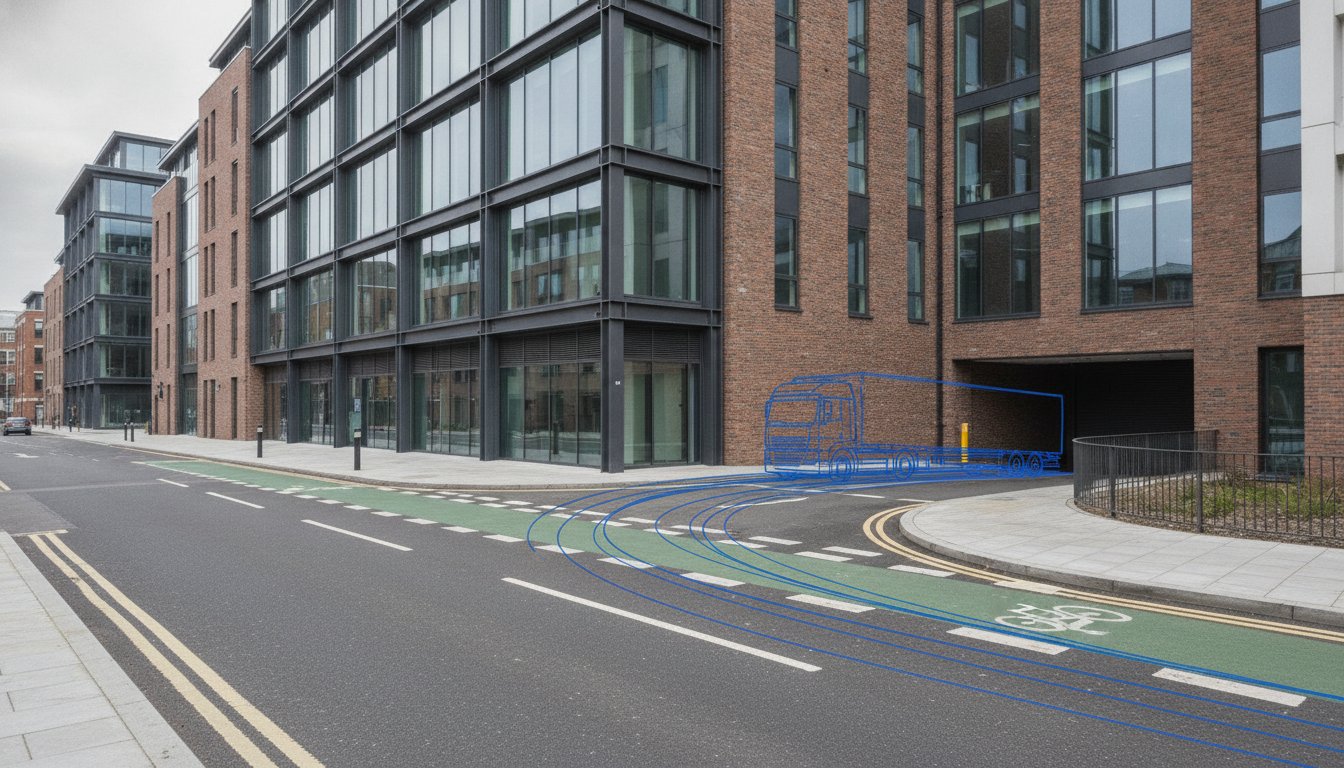
  • Residential Transport Plans for Planning Permission

    Residential Transport Plans for Planning Permission

    A single highway objection can stall a multi-million-pound residential development for months, turning a profitable site into a regulatory bottleneck. You’re likely facing increased pressure from local authorities regarding parking ratios and the rising costs of sustainability mitigation. It’s a high-stakes environment where precision isn’t just a preference; it’s a functional necessity for your project’s survival. Securing a robust transport assessment and travel plan for planning permission residential projects is no longer just a box-ticking exercise. It is a strategic defense of your site’s commercial viability.

    We understand that navigating the December 2024 National Planning Policy Framework and Active Travel England’s statutory requirements can feel like an unnecessary hurdle. This article provides a clear roadmap to help you master these technical nuances and secure planning approval with confidence. You’ll learn how to utilize specialized reports to maximize development density while minimizing S106 and S278 financial obligations through data-driven advocacy. We’ll examine the specific documentation you need to pass planning in 2026 and move your project from inception to completion without avoidable delays.

    Key Takeaways

    • Align your site design with the latest NPPF standards to maximize unit numbers while meeting stringent Active Travel England requirements.
    • Differentiate between Transport Statements and Assessments to ensure you provide the exact level of technical detail required for your scheme’s scale.
    • Implement a strategic transport assessment and travel plan for planning permission residential developments to mitigate highway objections and lower S106 financial burdens.
    • Use Swept Path Analysis and Lambeth Methodology parking surveys to defend site layouts and density in constrained urban environments.
    • Engage in pre-application consultations to identify and resolve critical transport constraints before they become formal planning refusals.

    Transport Planning for Residential Developments: Why It Is the Key to Approval

    The National Planning Policy Framework (NPPF) 2026 mandates that all residential developments prioritize sustainable transport to support the goal of building 1.5 million homes. Precision in Transportation planning is no longer a secondary consideration; it’s the primary mechanism for securing site viability. Local authorities now scrutinize how a project integrates into existing networks before considering architectural merits. A robust transport assessment and travel plan for planning permission residential schemes ensures your project meets these rigorous safety and sustainability benchmarks from the outset.

    To better understand how these strategies integrate into the planning process, watch this overview of travel plan fundamentals:

    Modern planning has shifted toward a “Vision-Led” approach. This methodology moves away from traditional “predict and provide” models that often resulted in over-engineered road layouts. Instead, it focuses on the desired outcomes for a community, such as high active travel rates and reduced car dependency. By adopting this vision early in the RIBA Stage 2 and 3 design phases, you can prevent the costly redesigns that frequently plague projects at RIBA Stage 4. Early transport intervention allows you to defend higher site densities by proving that the local infrastructure can handle the increased movement through smart mitigation rather than just physical expansion.

    The “Significant Movement” Threshold for Residential Sites

    Determining whether your project requires a simple Transport Statement or a comprehensive Assessment depends on the “significant movement” your site generates. While national guidelines often point to a range of 50 to 80 dwellings, local borough variations are common and can be much stricter. In the context of 2026 residential standards, the “significant movement” threshold is a qualitative trigger determined by the local planning authority based on a site’s potential to impact the local highway network’s safety and capacity. We help you identify these triggers early to ensure your reporting matches the specific expectations of the statutory consultees, including Active Travel England for larger schemes.

    Impact on Land Value and Planning Viability

    Transport reports directly influence the financial health of your development. High-quality data can justify lower parking ratios in areas with high accessibility, which frees up land for additional units and increases the overall land value. Conversely, poor planning leads to excessive S106 and S278 financial obligations that can render a site undeliverable. To understand how these principles apply to high-density urban environments, consult our Transport Assessment London: The Developer’s 2026 Guide to Planning Success. By establishing transport feasibility early, you ensure your site remains a “deliverable” asset in the eyes of the planning committee.

    Transport Assessments vs. Statements: Which Does Your Project Require?

    Choosing between a Transport Statement (TS) and a Transport Assessment (TA) is a decision that dictates your project’s technical scope and consultant budget. While both documents support a transport assessment and travel plan for planning permission residential application, their depth and geographic focus vary significantly. The official government guidance on transport assessments provides the foundation for this choice, but local highway authorities often apply their own specific thresholds based on local network sensitivity. Precision at this stage prevents you from over-investing in unnecessary data or, conversely, facing a refusal for insufficient evidence.

    Transport Statements for Smaller Residential Schemes

    Small sites don’t always mean simple approvals. A Transport Statement is typically required for residential schemes falling between 10 and 50 units, though this varies by borough. This report focuses on accessibility audits, local policy reviews, and fundamental safety analysis. You must demonstrate that the site is safely accessible by foot, cycle, and public transport without requiring extensive network upgrades. For those operating in the capital, our Transport Statement London: A Developer’s Buying Guide for 2026 details how borough-specific requirements can influence your submission. Even “minor” sites must prove they won’t compromise the safety of existing road users.

    Full Transport Assessments for Major Developments

    Major schemes, usually exceeding 50 to 80 units, trigger a full Transport Assessment. This document goes far beyond basic accessibility. It requires rigorous junction capacity modelling and multi-modal impact analysis to evaluate how new residents will affect the wider highway network during peak hours. You must also address the cumulative impact of neighbouring residential sites to ensure the infrastructure can handle the total growth. TRICS data is the industry standard for residential trip forecasting because it provides a statistically robust database of observed multi-modal trip rates from comparable land uses across the UK. This data allows us to predict future traffic flows with a high degree of accuracy, satisfying the demands of highway officers.

    The primary difference lies in the scope of the assessment. A TS primarily looks at the site access and its immediate vicinity. A TA expands this scope to include the wider network impact, often requiring detailed modelling of junctions several miles away. If you’re unsure which document your project requires, exploring our technical transport services can clarify your regulatory obligations before you submit. Getting the scope right during the pre-application stage is the most effective way to avoid the logistical and regulatory pressures of a planning delay.

    Designing for Sustainability: The Residential Travel Plan

    A Residential Travel Plan is a dynamic management tool rather than a static document. It creates a mandatory link between your development’s occupancy and its long-term impact on the local transport network. By securing a comprehensive transport assessment and travel plan for planning permission residential projects, you demonstrate a clear commitment to reducing single-occupancy vehicle trips. This strategic shift often allows developers to mitigate the need for extensive, and expensive, highway capacity works. Instead of widening roads or adding lanes, you invest in behavioral change and sustainable infrastructure that supports the local authority’s modal shift goals.

    The success of these plans hinges on a dedicated Travel Plan Coordinator (TPC). This individual manages the implementation of the strategy, acting as the primary liaison between residents, the developer, and the local planning authority. They ensure that the measures promised during the planning phase actually materialize once the site is occupied. Effective TPCs provide residents with the information and incentives they need to choose walking, cycling, or public transport over private car use, which is essential for meeting the strict sustainability targets set in 2026.

    To ensure residents have reliable options for longer journeys without needing a private vehicle, developers often include services like Brighton Airport Taxis in their travel packs; click here to learn more about their professional transfer offerings.

    Sustainable Mitigation Measures for 2026

    Planning requirements in 2026 place a heavy emphasis on future-proofed infrastructure. Integrating car club bays and rapid EV charging points is now a standard expectation rather than an optional extra, especially in areas with lower Public Transport Accessibility Levels (PTAL). Cycle parking must also evolve beyond the basic “shed” requirement. Local authorities now demand high-quality, secure, and accessible storage that accommodates non-standard cycles, such as cargo bikes. For those navigating these specific urban requirements, our London Travel Plans: The Essential Guide for Planning Applications in 2026 provides a detailed breakdown of current expectations and how to meet them efficiently.

    Monitoring and Section 106 Obligations

    Travel Plans are legally binding through Section 106 agreements, which often include specific monitoring fees and remedial “fallback” measures. A typical 5-year monitoring cycle for residential travel plans involves conducting baseline surveys within six months of first occupation, followed by annual or biennial monitoring reports to verify that the site is meeting its sustainability targets. If these targets aren’t met, the developer may be required to implement pre-agreed fallback measures, such as additional cycle vouchers or enhanced car club subsidies. We help you negotiate these conditions during the planning stage to maintain project flexibility while ensuring long-term compliance and safety.

    Residential Transport Plans for Planning Permission

    Technical Requirements: Parking Surveys and Swept Path Analysis

    Technical evidence serves as the backbone of any successful transport assessment and travel plan for planning permission residential application. While policy sets the strategic direction, technical data like parking surveys and swept path analysis provide the physical proof that a site functions safely. Highway authorities prioritize these reports because they address the immediate operational impacts on the existing infrastructure. Precision in these technical submissions reduces the likelihood of late-stage objections that could derail your construction timeline or force expensive last-minute redesigns.

    Justifying Residential Parking Standards

    Defending your proposed parking ratios requires a data-led approach that balances local car ownership trends with Public Transport Accessibility Level (PTAL) ratings. In high PTAL areas, “car-free” developments are increasingly the standard; however, in low PTAL zones, you must justify every space provided to ensure the development remains marketable and functional. We use 2021 Census data and local car ownership statistics to build a robust case for your specific unit mix. This evidence prevents the local authority from imposing arbitrary parking reductions that could impact the commercial appeal of your homes.

    For urban infill projects, a Parking Stress Survey using the Lambeth Methodology is often essential. This survey assesses the availability of on-street parking within a 200-meter radius of the site during peak demand times, typically between 00:30 and 05:30 on two separate weekday nights. By proving that the surrounding streets can accommodate any potential overspill, you protect your site density from being reduced due to perceived highway capacity issues. This level of technical detail is a non-negotiable foundation of our comprehensive traffic survey services.

    Proving Access with Swept Path Analysis (SPA)

    Site safety hinges on the ability of large vehicles to navigate the internal layout without conflict. Swept Path Analysis (SPA) simulates the movement of fire tenders and standard 11.2m refuse vehicles to ensure they can enter, turn, and exit the site in a forward gear. This technical validation is a mandatory requirement for modern residential planning, specifically to satisfy the access needs of emergency services and waste management teams. For developers and landlords seeking to maintain high safety standards post-occupancy, UK Fire Risk Assessments provides professional assessment services across the country. If a refuse vehicle cannot reach within 25 meters of a bin store, or a fire tender cannot reach within 45 meters of all points in a dwelling, the application faces immediate refusal.

    Beyond mere compliance, SPA allows you to refine your site layout to avoid “dead” space. Accurate simulations ensure that every square meter of the development is utilized efficiently, maximizing the number of units while maintaining safe access. Our Swept Path Analysis Services in London: Securing Planning Approval in 2026 provides a comprehensive look at how these simulations satisfy the specific requirements of the London Fire Brigade and local councils. You can order a professional Swept Path Analysis to validate your design before formal submission, ensuring your project is ready for immediate review.

    Negotiating with the Highway Authority is the final strategic hurdle for any residential project. Pre-application consultation acts as a safety net, allowing you to identify “showstopper” issues before you commit to a formal submission. These issues, such as inadequate visibility splays or severe junction capacity constraints, lead to immediate refusal if they aren’t resolved early. By engaging with officers before the clock starts, you transition from a reactive stance to a proactive partnership. This approach significantly reduces the risk of receiving Regulation 25 requests for further information, which frequently stall the determination period.

    The Pre-Application Roadmap

    The primary goal of pre-application is to agree on a formal Scope of Works. This agreement prevents scope creep during the assessment phase and ensures that the highway officer’s technical expectations align with your project scale. It’s also the stage where you should begin negotiating Section 278 and Section 38 requirements. Understanding these obligations early allows you to factor potential highway improvement costs into your initial viability assessments. For developers operating in high-density areas, our Highway Design S278 & S38: The London Developer’s Guide for 2026 offers specific insights into managing these complex legal agreements. Early agreement on the scope of the transport assessment and travel plan for planning permission residential applications ensures a smoother path through the planning committee.

    Why Partner with ML Traffic Engineers UK

    Operating within the intricate regional regulations of London Boroughs and the wider requirements of Active Travel England demands specialized expertise. We provide an all-encompassing, fully-managed service that takes the logistical pressure off your team. Our “Right First Time” approach ensures that every report adheres to current legislative requirements and industry benchmarks. We take immense pride in our precision and our ability to manage full project lifecycles from inception to completion. Our team understands that planning is a high-stakes environment where time is a critical asset, so we prioritize the rapid delivery of information.

    A dependable partner understands that precision is a functional necessity. We offer constant accessibility and rapid response capabilities to handle post-submission clarifications efficiently. Whether you’re dealing with urban infill or major residential growth, our team ensures your site meets the highest standards of safety and sustainability. You can contact ML Traffic Engineers UK today for a technical review of your residential site to ensure your project is ready for 2026 planning success.

    Secure Your Residential Development’s Future

    Mastering the technical requirements of transport reports is the most effective way to protect your site’s commercial viability against highway objections. By integrating precise data from Swept Path Analysis and parking surveys, you provide the evidence needed to maximize unit numbers while meeting strict 2026 sustainability standards. A comprehensive transport assessment and travel plan for planning permission residential schemes serves as your strategic defense against excessive S106 and S278 financial obligations.

    Navigating these complex regulations requires a partner who understands the intricate nuances of London and England-wide planning policies. We provide full lifecycle support, from initial capacity modelling using the TRICS database to final technical reviews. Our “Right First Time” approach reduces regulatory pressure and eliminates avoidable delays in your project timeline. We take pride in being specialists who manage the entire process so you don’t have to.

    Ready to move your development forward? Request a Transport Planning Quote for Your Residential Project to ensure your site meets every technical benchmark with precision. We look forward to helping you achieve a seamless path to planning approval.

    Frequently Asked Questions

    Is a Transport Assessment always required for residential planning permission?

    A full assessment isn’t always mandatory for every site. The requirement depends on the scale of the development and the potential impact on the local highway network. While major schemes usually trigger an assessment, smaller residential projects between 10 and 50 units often only require a Transport Statement. Local planning authorities make this determination during pre-application based on the “significant movement” threshold.

    What is the difference between a Transport Statement and a Travel Plan?

    A Transport Statement is a technical report that evaluates the immediate physical impact, accessibility, and safety of a development’s access point. In contrast, a Travel Plan is a long-term management strategy designed to influence how people travel. It focuses on encouraging residents to use sustainable modes like cycling and public transport, helping to meet carbon reduction targets over the project’s lifetime.

    How much does a residential Transport Assessment cost?

    Fees for these technical reports vary based on the project’s complexity and the specific requirements of the local highway authority. Factors such as the number of junctions requiring capacity modelling and the need for fresh traffic surveys will influence the final cost. We recommend requesting a bespoke quote to ensure the technical scope matches your site’s specific regulatory challenges and unit density.

    Can I get planning permission for a residential development with no car parking?

    Yes, car-free developments are entirely possible, particularly in urban areas with high Public Transport Accessibility Level (PTAL) ratings. You must demonstrate through a transport assessment and travel plan for planning permission residential applications that the site is perfectly situated for walking, cycling, and public transport. Councils may also require a Parking Survey to prove that residents won’t simply park on neighboring streets.

    How long does it take to produce a Transport Assessment and Travel Plan?

    Developing a transport assessment and travel plan for planning permission residential projects typically takes between 2 and 4 weeks. This timeframe accounts for data analysis, policy review, and report drafting. If your site requires fresh traffic surveys, you must also factor in the time to collect data during neutral weeks when traffic patterns are representative of normal conditions.

    What happens if the Highway Authority objects to my residential development?

    A highway objection indicates that the authority has concerns regarding safety, capacity, or sustainability that haven’t been fully addressed. It’s often possible to resolve these issues by providing further technical evidence or refining the site layout. We analyze the specific grounds for the objection and use tools like Swept Path Analysis to prove the site functions safely and efficiently.

    Do I need a new Transport Assessment for a change of use to residential?

    A new transport report is usually required because residential use has a different trip profile compared to commercial or industrial uses. Even if the total number of trips is lower, the timing of those trips during morning and evening peaks is critical. We assess how this change affects the local network to ensure the new residential use doesn’t compromise highway safety.

    What is a Section 106 agreement in relation to transport planning?

    Section 106 agreements are legal contracts used to offset the impact of a development on local infrastructure and the community. In a transport context, these agreements often secure financial contributions for highway improvements or cycle path extensions. They also mandate the implementation of travel plans, ensuring that developers remain accountable for the long-term sustainability and safety of their residential schemes.

    Michael Lee

    Article by

    Michael Lee

    Transport planner with over 35 years' experience.

    Disclaimer

    The content on mltraffic.co.uk, including all technical articles, guides, and resources, is provided for general informational and educational purposes only. It is not intended to constitute professional advice in traffic engineering, transportation planning, development approvals, or any other technical or legal field.
    While ML Traffic Engineers makes every reasonable effort to ensure the accuracy, completeness, and timeliness of the information published, we do not provide any warranties or representations (express or implied) regarding its reliability, suitability, or availability for any particular purpose. Any reliance you place on the content is strictly at your own risk.
    In no event shall ML Traffic Engineers, its directors, employees, authors, or affiliates be liable for any direct, indirect, incidental, special, consequential, or punitive damages (including, without limitation, loss of profits, data, or business opportunities) arising out of or in connection with the use of, or inability to use, any information provided on this website.
    The articles and guides on this site are not a substitute for engaging a qualified, professional traffic engineer to assess your specific project requirements. For tailored advice, compliance assessments, or traffic engineering services, please contact a competent professional.
    This disclaimer may be updated from time to time without notice. By accessing or using this website, you agree to be bound by the most current version of this disclaimer.
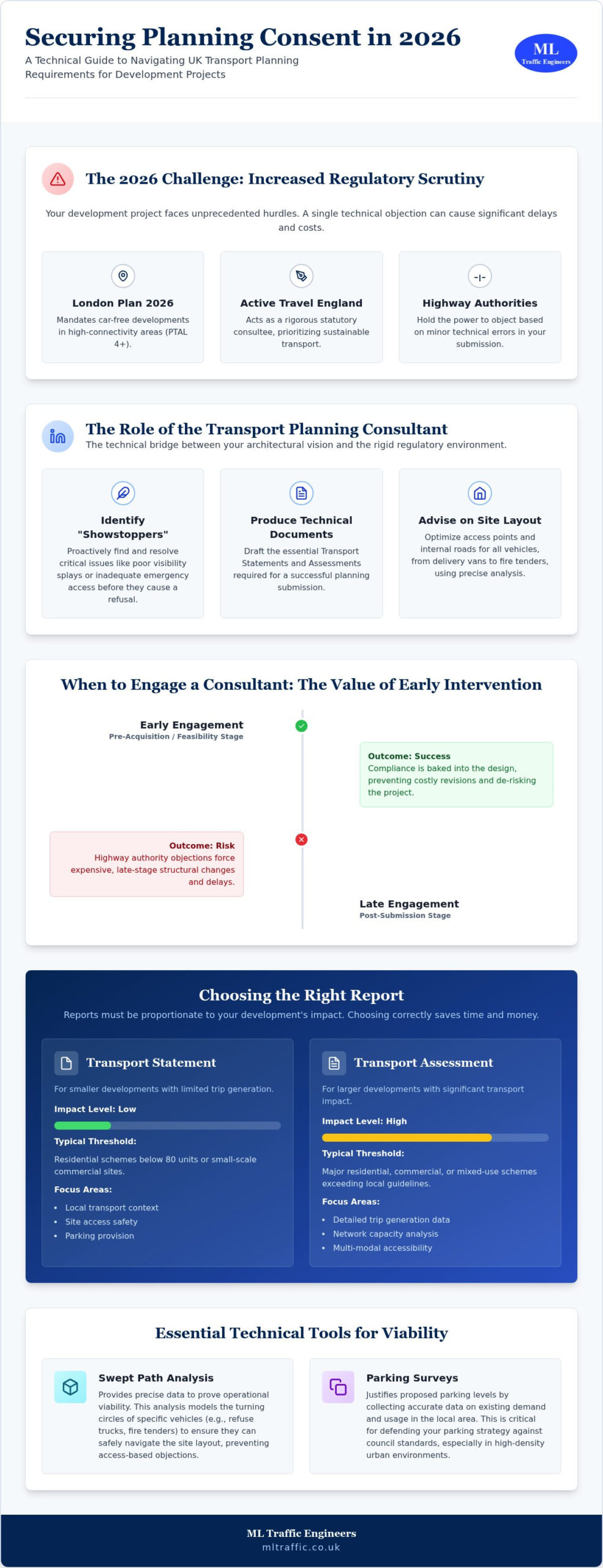
  • Garden Neighbourhood Transport & Placemaking

    Garden Neighbourhood Transport & Placemaking

    How do you secure planning approval for a high-density development when local authorities demand that 70% of all trips occur via sustainable modes? Achieving this target requires more than just drawing cycle lanes on a map; it demands a fundamental shift from traditional “predict and provide” models to a vision-led approach. Success hinges on a robust garden neighbourhood transport strategy and placemaking framework that prioritizes human movement over vehicle throughput. With 88% of English Local Highway Authorities now supporting 20mph design speeds for residential streets as of May 2026, the regulatory environment has moved firmly toward people-centric design.

    You likely recognize the complexity of balancing multi-modal transport assessments with the need for vibrant, walkable spaces. We’ve developed this guide to help you master the technical requirements and placemaking principles necessary to navigate these high-stakes regulatory hurdles. You’ll learn how to align your project with the April 2026 Local Transport Plan guidance and utilize data-driven strategies to reduce logistical pressures. This article previews the essential components of modern transport assessments and travel plans that turn strict sustainability targets into a functional advantage for your development.

    Key Takeaways

    • Understand how to leverage a garden neighbourhood transport strategy and placemaking framework to meet National Planning Policy Framework requirements and secure planning approval.
    • Identify the technical precision needed in Swept Path Analysis and Transport Assessments to validate your development’s internal permeability and safety standards.
    • Learn how to prioritize a hierarchy of movement that treats residential streets as vital social spaces rather than mere conduits for vehicle traffic.
    • Discover the critical role of Framework Travel Plans in facilitating the “step-change” toward sustainable, car-free residential environments.
    • Master the use of TRICS database projections to deliver realistic trip generation data that satisfies rigorous local authority scrutiny.

    What is a Garden Neighbourhood Transport Strategy?

    A garden neighbourhood transport strategy and placemaking framework serves as the technical blueprint for sustainable community growth. It’s far more than a simple mitigation plan; it aligns with the National Planning Policy Framework (NPPF) vision-led approach to prioritize people over cars. These modern communities draw inspiration from the historical Garden city movement, which emphasized self-contained towns with integrated green space and efficient transit. Unlike a standard Transport Statement, this strategy requires a comprehensive analysis of connectivity, internal permeability, and long-term sustainability goals.

    Local authorities now demand rigorous evidence that new developments won’t simply add to existing congestion. This requires a shift toward three core pillars: sustainability, connectivity, and internal permeability. A successful strategy demonstrates how residents will move within the site and how the site connects to the wider regional network. To better understand how these concepts bridge the gap between people and place, watch this helpful video:

    Active Travel England now plays a pivotal role in reviewing garden community proposals. They ensure projects meet the standards outlined in the Cycling and Walking Investment Strategy (CWIS3) for the 2025 to 2030 period. This scrutiny ensures that developers move beyond basic infrastructure to create environments that actively encourage walking and cycling for at least 55% of all short stages by 2035. Precision in these early stages reduces regulatory friction and speeds up the path to planning approval.

    The 20-Minute Neighbourhood Concept

    The 20-minute neighbourhood serves as the primary planning metric for 2026, requiring that residents can access all essential daily services within a 20-minute round trip by walking or cycling. This model relies on high-quality density and a diverse mix of uses to reduce the necessity of car ownership. By placing schools, shops, and health facilities within easy reach, we lower the demand for short vehicle journeys and improve public health outcomes across the development.

    Placemaking vs. Traffic Engineering

    Traditional traffic engineering often focuses on “predict and provide” models that prioritize vehicle flow. Modern garden neighbourhood transport strategy and placemaking uses a “vision and validate” approach instead. This means we design the desired social outcome first, then use technical data to validate the infrastructure needed to support it. The street’s design dictates the neighbourhood’s feel; narrow, winding paths with integrated greenery naturally slow traffic and create safer social spaces for residents. Balancing these aesthetic goals with statutory requirements is the key to a successful Transport Assessment.

    Integrating Placemaking with Sustainable Movement

    Streets in modern developments must function as more than asphalt conduits for private vehicles. A successful garden neighbourhood transport strategy and placemaking approach reconceptualises the street as a high-quality public realm where social interaction and safety take precedence. This requires strict adherence to the hierarchy of movement. Pedestrians and cyclists sit at the apex, followed by public transport, with private cars at the base. By prioritising active travel from the initial layout, developers create environments that naturally discourage vehicle use and promote healthier lifestyles.

    Filtered permeability is a critical tool in this transition. It involves designing the network to allow through-trips for walkers and cyclists while physically restricting through-traffic for motorised vehicles. This prevents “rat-running” and ensures residential zones remain quiet and safe. Integrating green infrastructure, such as rain gardens and tree canopies, within these corridors further reinforces the sense of place. These elements provide natural cooling and manage runoff while defining the aesthetic character of the transport route.

    Bridging the gap between these “soft” placemaking goals and “hard” engineering is where many planning applications fail. You must prove that your people-centric design remains functionally safe and accessible. Using Swept Path Analysis allows you to demonstrate to local authorities that while cars are de-prioritised, essential service and emergency vehicles can still navigate the tight, social streetscapes without difficulty. This technical precision provides the reassurance planning officers need to approve innovative layouts.

    Healthy Streets Principles in Practice

    Street design must meet specific qualitative criteria to be effective. This includes providing adequate shade, frequent places to stop, and maintaining low noise levels to encourage outdoor activity. Car park design is also a major factor. Instead of vast asphalt expanses, parking should be integrated discreetly into the landscape or tucked behind building lines to preserve the public realm. You can explore our Principles of Safe & Efficient Car Park Design to see how we balance these aesthetic and functional requirements.

    The 70% Modal Shift Target

    Securing approval for modern garden communities often hinges on achieving a 70% sustainable travel target. This is a massive step-change from conventional suburban developments. To convince planning officers, your strategy must include high-quality, segregated cycle networks that feel safe for all ages. It also requires passive provision for future technologies. We recommend including micro-mobility hubs that offer shared e-bikes or scooters to bridge the gap between the front door and public transport links. If you need help proving these shifts are viable, our team can provide the detailed Traffic Surveys and data needed to support your case.

    Technical Evidence: Transport Assessments and Swept Path Analysis

    Technical precision forms the bedrock of any successful garden neighbourhood transport strategy and placemaking proposal. While visionary design captures interest, empirical data secures the approval. Planning officers require more than just intent; they need rigorous evidence that your development will function safely without placing undue strain on existing infrastructure. We bridge the gap between creative masterplanning and statutory compliance by providing the hard data needed to satisfy Highway Officers and local stakeholders.

    We use the TRICS database to project realistic trip generation for modern garden communities. Standard suburban data often overestimates vehicle trips because it relies on car-centric developments. For your project, we select comparable sites that already feature high-quality sustainable travel infrastructure. This ensures your Transport Assessment reflects the actual behaviour of residents in a vision-led environment, preventing the need for unnecessary and costly road capacity upgrades.

    The most common objection to garden communities involves parking overspill. Local authorities often fear that reduced on-site parking will lead to congestion on surrounding residential roads. We counter this by conducting detailed Parking Surveys. These surveys provide a snapshot of current street capacity and resident behaviour, allowing us to justify lower parking ratios. By proving that existing streets can absorb any minor fluctuations, we help you maintain the high-density, people-focused layout essential for garden neighbourhood status.

    The Role of Swept Path Analysis (SPA)

    High-quality placemaking often involves tighter corner radii and narrower carriageways to naturally slow traffic. You must prove these designs don’t hinder emergency or service vehicles. Our Swept Path Analysis Services in London provide digital simulations that overlay vehicle movements onto your masterplan. We demonstrate that a 12m refuse vehicle or a fire tender can navigate your social streetscapes safely. This technical validation allows you to keep your pedestrian-friendly street widths while meeting all safety and accessibility benchmarks.

    Transport Statements for Smaller Garden Infill Projects

    Smaller garden infill projects may not require a full Assessment, but they still need a clear strategy. A Garden Neighbourhood-aligned Transport Statement ensures that even minor developments support the broader garden neighbourhood transport strategy and placemaking objectives of the region. We focus on proving compliance with local “Core Strategy” policies and demonstrating how your site connects to the wider sustainable network. This proactive approach reduces the risk of delays and ensures your project contributes to the local authority’s long-term environmental goals.

    Garden Neighbourhood Transport & Placemaking

    Achieving the “Step-Change”: Travel Plans and Car-Free Design

    Success in a garden neighbourhood transport strategy and placemaking framework requires moving beyond physical infrastructure to influence long-term resident behaviour. It’s not enough to build cycle paths; you must ensure people use them. This “step-change” involves a transition from car ownership to a “Mobility as a Service” (MaaS) model. By integrating car clubs and shared transport options from day one, you reduce the perceived need for private vehicles and lower the overall trip generation of the site.

    Large-scale garden communities require a Framework Travel Plan to manage this transition effectively. This document serves as a high-level strategy that coordinates individual travel plans across various phases of the development. We recommend moving parking from on-plot locations to peripheral parking hubs. This strategy removes cars from the immediate public realm, which frees up space for higher-quality social areas and creates safer environments for children. When residents park on the edge of the neighbourhood, the “last mile” of their journey becomes a walk through a landscaped environment, naturally reinforcing the hierarchy of movement.

    Strategic parking management is the technical key to unlocking car-free zones. By centralising vehicle storage, you can maintain the high-density requirements of garden communities without sacrificing green space. This approach requires careful coordination with local authorities to ensure that off-site parking doesn’t negatively impact existing residents. If you need a partner to develop these complex strategies, our Travel Plan Consultants provide the technical expertise required to secure local authority buy-in and satisfy Section 106 requirements.

    Developing an Actionable Travel Plan

    An effective plan must include SMART targets for modal shift over a 5 to 10 year period. These targets should be measurable and realistic, based on the specific demographics and location of your development. A dedicated Travel Plan Coordinator usually manages this process, acting as a liaison between residents and transport providers to ensure the community hits its sustainability goals. For a deeper look at the regulatory requirements for these documents, consult our London Travel Plans: The Essential Guide.

    Electric Vehicle (EV) Infrastructure Integration

    Future-proofing is a non-negotiable requirement for modern garden communities. With the UK target for 100% EV adoption by 2035, your strategy must account for comprehensive charging networks from the outset. This involves balancing high charging demand with existing grid capacity, which often requires innovative energy management systems. We help developers design efficient layouts for both on-street and off-street charging points. This ensures your neighbourhood remains functional and compliant with evolving legislative standards without compromising the aesthetic quality of the streetscape.

    Partnering with ML Traffic Engineers UK for Planning Success

    Securing planning approval for modern developments requires a partner who understands that a garden neighbourhood transport strategy and placemaking framework is a technical necessity; it’s not just a design preference. ML Traffic Engineers UK provides the specialized industry expertise needed to navigate the increasingly strict regulatory environments of England’s local authorities. Our team balances technical authority with a client-focused approach, aiming to reduce the logistical and regulatory pressures on your development team. By delivering precise, data-driven reports, we ensure your vision for a sustainable community meets every statutory benchmark.

    Our all-encompassing service model manages the full project lifecycle from inception to completion. We begin with comprehensive Traffic Surveys and Parking Surveys to establish an accurate baseline of existing conditions. This data informs the development of robust Transport Assessments and Travel Plans tailored to the specific requirements of your site. ML Traffic Engineers UK understands these intricate regional regulations so you don’t have to, positioning your project as a model of professional integrity and public safety.

    Why Technical Precision Matters in 2026

    Local councils have significantly increased their scrutiny of planning applications following the updated Local Transport Plan guidance in April 2026. Inaccurate data or poorly modeled vehicle movements can lead to costly design errors and lengthy delays in the planning queue. ML Traffic Engineers UK prevents these setbacks by utilizing advanced digital tools for Swept Path Analysis. This ensures that your pedestrian-friendly layouts remain functionally safe for essential services. Our commitment to precision reflects the high-stakes nature of the industry and provides the reassurance planning officers need to grant approval.

    Get Started with Your Transport Strategy

    Early engagement in the planning lifecycle is the most effective way to avoid regulatory friction. We recommend a comprehensive review of your car park and access layout during the initial design phase to identify potential issues before they become permanent obstacles. Whether you’re working on a large-scale community or a smaller infill project, we provide the technical evidence required to justify your design choices. You can contact ML Traffic Engineers UK for a professional Transport Statement or Assessment to ensure your garden neighbourhood transport strategy and placemaking objectives are both visionary and technically sound.

    Securing Future-Proof Planning Approval

    Mastering the balance between high-density placemaking and strict sustainable travel targets ensures your project withstands intense local authority scrutiny. You’ve seen how technical precision in Swept Path Analysis and vision-led transport assessments creates a functional foundation for modern, car-free environments. By prioritising the hierarchy of movement from the inception of your design, you turn complex regulatory hurdles into a distinct competitive advantage for your development. It’s the technical evidence that ultimately bridges the gap between a visionary masterplan and a successful planning outcome.

    A robust garden neighbourhood transport strategy and placemaking approach requires an all-encompassing partner who understands intricate UK statutory requirements. Founded in 2014, ML Traffic Engineers UK brings over a decade of planning success and reliability to your project team. We are proven specialists in Swept Path Analysis and Transport Statements, providing the expert knowledge necessary to navigate the rigorous 2026 planning landscape. Secure your development’s future with a professional Transport Strategy from ML Traffic Engineers UK. Our team is ready to help you transform your architectural vision into a technically sound and approved reality.

    Frequently Asked Questions

    What is the difference between a Transport Strategy and a Transport Assessment?

    A transport strategy provides the long-term vision and policy framework for movement across a development area, while a Transport Assessment is the site-specific technical document that evaluates the impact of a project on the local highway network. The strategy sets the high-level goals for sustainable travel and connectivity. In contrast, the assessment uses empirical data to prove those goals are both safe and achievable for a specific planning application.

    Is a 70% sustainable travel target mandatory for all garden communities?

    While not a statutory national requirement for every single development, many local authorities mandate a 70% sustainable travel target to grant official “Garden” status to a project. This high benchmark reflects the government’s CWIS3 goals for the 2025 to 2030 period. Meeting this target usually requires a comprehensive garden neighbourhood transport strategy and placemaking framework that prioritizes walking, cycling, and public transport over private vehicle use.

    How does Swept Path Analysis help with placemaking?

    Swept Path Analysis allows designers to create narrower, more social streetscapes by digitally proving that essential service and emergency vehicles can still navigate the layout safely. This technical validation gives planning officers the confidence to approve people-centric designs that deviate from traditional, car-heavy highway standards. It ensures that your aesthetic and social goals don’t compromise the functional safety or accessibility of the neighbourhood for refuse trucks or fire tenders.

    Can I still include car parking in a garden neighbourhood transport strategy?

    You can still include car parking, but modern strategies often shift away from traditional on-plot parking toward peripheral parking hubs or discreetly integrated spaces. This approach removes vehicles from the immediate public realm to enhance the social quality of the streets for residents. Strategic parking management, supported by detailed Parking Surveys, allows you to maintain necessary vehicle access while adhering to the core principles of garden community design.

    What is a “20-minute neighbourhood” in the context of UK planning?

    The 20-minute neighbourhood is a planning metric used in 2026 to ensure residents can access all daily essential services within a 20-minute round trip via active travel. This concept relies on high-density, mixed-use layouts to reduce car dependency for short journeys. It’s a key component of the vision-led approach now favored in Local Transport Plan guidance to create self-sustaining, healthier communities that reduce pressure on the wider road network.

    How do I prove my development meets Healthy Streets principles?

    You prove compliance by conducting a qualitative audit against the ten Healthy Streets indicators, which include factors like shade, air quality, and places to stop. This evidence is typically integrated into your Transport Assessment to demonstrate that the development supports public health and wellbeing. Providing specific data on noise levels and pedestrian comfort levels helps convince local authorities that your street design prioritizes the human experience over vehicle throughput.

    What role does the TRICS database play in garden neighbourhood planning?

    The TRICS database allows us to project realistic trip generation rates by comparing your project to similar, existing sustainable developments across the UK. Using accurate TRICS data prevents the over-estimation of vehicle traffic that often occurs with standard suburban models. This precision is vital for a garden neighbourhood transport strategy and placemaking plan, as it justifies reduced road capacity and supports your sustainability claims with empirical, site-specific evidence.

    Will a Travel Plan actually help me get planning permission?

    A Travel Plan is a statutory requirement for most significant developments and acts as a primary tool for mitigating the transport impacts of a project. It provides a structured roadmap for achieving behavioural change through measurable targets and long-term monitoring. By demonstrating a clear commitment to reducing car dependency, a robust Travel Plan reduces regulatory friction and significantly increases your chances of securing planning permission from the local authority.

    Michael Lee

    Article by

    Michael Lee

    Transport planner with over 35 years' experience.

    Disclaimer

    The content on mltraffic.co.uk, including all technical articles, guides, and resources, is provided for general informational and educational purposes only. It is not intended to constitute professional advice in traffic engineering, transportation planning, development approvals, or any other technical or legal field.
    While ML Traffic Engineers makes every reasonable effort to ensure the accuracy, completeness, and timeliness of the information published, we do not provide any warranties or representations (express or implied) regarding its reliability, suitability, or availability for any particular purpose. Any reliance you place on the content is strictly at your own risk.
    In no event shall ML Traffic Engineers, its directors, employees, authors, or affiliates be liable for any direct, indirect, incidental, special, consequential, or punitive damages (including, without limitation, loss of profits, data, or business opportunities) arising out of or in connection with the use of, or inability to use, any information provided on this website.
    The articles and guides on this site are not a substitute for engaging a qualified, professional traffic engineer to assess your specific project requirements. For tailored advice, compliance assessments, or traffic engineering services, please contact a competent professional.
    This disclaimer may be updated from time to time without notice. By accessing or using this website, you agree to be bound by the most current version of this disclaimer.

  • The Ultimate Guide to Transport Planning Consultants

    The Ultimate Guide to Transport Planning Consultants

    A single highway authority objection can stall a development project for months, inflating costs and jeopardising your entire investment. You likely know that navigating the labyrinth of local regulations, such as s278 agreements or the latest 2026 London Plan mandates, is a high-stakes challenge where precision is a functional necessity. It’s frustrating when generic advice leads to avoidable delays, but your planning submission doesn’t have to be a gamble.

    By partnering with specialized transport planning consultants, you can unlock a smooth planning process through expert guidance and rigorous technical reporting. This guide provides a comprehensive look at how data-driven site analysis, accurate Transport Assessments, and precise Swept Path Analysis reduce the risk of design errors. You’ll learn how to navigate complex highway regulations efficiently. We’ll show you how to ensure your submission is both cost-effective and fully compliant with the latest 2026 industry benchmarks, turning regulatory hurdles into a clear path for project completion.

    Key Takeaways

    • Understand how transport planning consultants navigate the latest 2026 national strategies to ensure your development meets rigorous regulatory standards.
    • Identify whether your project requires a Transport Statement or a full Transport Assessment based on current residential and commercial development thresholds.
    • Learn how Swept Path Analysis uses CAD simulations to provide technical proof of vehicle maneuverability and prevent costly design errors.
    • Discover the role of bespoke Traffic and Parking Surveys in providing the data-driven evidence needed to overcome highway authority objections.
    • Gain insights into managing the full project lifecycle from initial feasibility to final planning submission through expert technical reporting.

    The Role of Transport Planning Consultants in the UK Planning System (2026)

    Transport planning consultants are specialist advisors who manage the technical transport implications of new development projects. They act as the primary interface between developers and Local Highway Authorities (LHAs), ensuring that proposed infrastructure aligns with local and national safety standards. The field of transportation planning has evolved rapidly, moving beyond simple traffic counts to a holistic evaluation of sustainability, safety, and digital connectivity.

    As of June 2026, the UK planning system demands more robust transport evidence than ever before. This shift stems from the “Better Connected” national strategy published on April 2, 2026, and the updated Road Safety Strategy launched in January. These policies require developers to provide granular data on how their projects impact regional targets, such as the 65% reduction in road deaths aimed for by 2035. Consultants provide the data-driven defense needed to navigate these stricter thresholds, effectively mitigating the risk of expensive planning refusals.

    To better understand the daily impact of these professionals, watch this overview of the role:

    Consultants don’t just produce reports; they manage the entire lifecycle of the transport element. They translate the developer’s vision into the technical lexicon required by LHA engineers. This technical authority is vital when negotiating s278 and s38 agreements, where precision is a functional necessity to avoid costly delays. By taking a proactive approach, they ensure that transport considerations support the commercial viability of the site rather than hindering it.

    Supporting Planning Applications with Technical Evidence

    The role of transport planning consultants is to translate complex regulatory requirements into actionable design solutions that secure planning consent. Key responsibilities include:

    • Providing technical documentation required by the National Planning Policy Framework (NPPF) to prove a development’s sustainability.
    • Addressing highway safety and capacity concerns during the design phase to prevent later objections.
    • Developing mitigation strategies that satisfy LHA requirements while remaining cost-effective for the developer.

    Feasibility and Site Appraisals

    Effective site appraisals happen before land purchase to ensure a project is viable from the outset. Consultants evaluate site access and transport connectivity to identify “showstopper” issues, such as inadequate visibility splays or restricted vehicle maneuverability, that could derail a project. You can learn about our project types to see how early-stage analysis protects your investment from unforeseen regulatory hurdles.

    Essential Documentation: Transport Statements vs. Transport Assessments

    Determining whether your project requires a Transport Statement (TS) or a full Transport Assessment (TA) is a critical technical hurdle that impacts both your budget and your planning timeline. Experienced transport planning consultants use specific thresholds set by local authorities to advise on the appropriate level of reporting. The primary goal of both documents is to demonstrate “nil detriment.” This proves that the proposed development won’t negatively impact the safety or capacity of the existing highway network. Detailed guidance on Transport Assessments and Statements provided by the government sets the foundation for these technical requirements.

    The choice between a TS and a TA isn’t arbitrary. It’s dictated by the scale of the development and the potential volume of traffic it will generate. Getting this wrong leads to immediate objections from highway authorities, causing avoidable delays. Professional consultants ensure your submission is proportionate to the project’s impact, saving you from over-investing in unnecessary analysis while still meeting every regulatory benchmark.

    When Do You Need a Transport Statement?

    A Transport Statement is typically sufficient for smaller developments where the anticipated trip generation is relatively low. As of June 2026, for residential projects in London with fewer than 50 units or commercial spaces under 1,000 square meters, a TS is generally the standard requirement. This document focuses on the immediate site vicinity. It covers existing conditions, proposed access points, and options for sustainable travel. It’s a focused technical defense of your site’s accessibility. For specific regional requirements, you can refer to our London Transport Statements Guide to ensure your submission meets local expectations.

    The Depth of a Full Transport Assessment

    Larger developments trigger the need for a comprehensive Transport Assessment. In London, this requirement applies to residential schemes of 80 or more units or commercial developments exceeding 2,500 square meters. Unlike a statement, a TA involves rigorous junction modelling and capacity analysis. Consultants use the TRICS database to predict trip generation accurately based on comparable sites across the UK. This analysis evaluates the cumulative impact of your project alongside other committed developments in the area. It ensures that the wider network remains safe and functional, even during peak hours.

    Precision in these reports prevents costly design errors and highway authority objections. If you’re unsure which document your project requires, exploring our technical reporting services can provide the clarity needed to move forward with confidence. By addressing these requirements early, you reduce the risk of planning delays and ensure a more efficient path to approval.

    Technical Precision: Swept Path Analysis and Vehicle Maneuverability

    Swept Path Analysis (SPA) is the digital simulation of vehicle movements within a proposed site layout. It’s a non-negotiable requirement for modern planning applications. By using sophisticated CAD software, such as the 2026 versions of AutoTURN or Kobi Swept Path, transport planning consultants can map the exact path a vehicle’s body and wheels take during a turn. This technical precision provides the empirical evidence needed to satisfy highway authorities that a design is safe and functional. Adherence to the standards set by the Chartered Institution of Highways & Transportation ensures that these simulations reflect real-world operational requirements.

    Without SPA, developers risk significant post-construction errors that are both expensive and difficult to rectify. If a refuse truck cannot clear a corner or a fire tender cannot reach a building’s entrance, the development fails to meet basic safety and serviceability benchmarks. Consultants use standardized vehicle templates—ranging from 11.4m refuse collection vehicles to heavy articulated HGVs—to stress-test every junction and turning head before a single brick is laid. This proactive analysis transforms a conceptual drawing into a technically sound site plan.

    Demonstrating Access for Service and Emergency Vehicles

    Meeting the strict requirements of Building Regulations, specifically Approved Document B, is a primary concern for any new development. You must prove that emergency vehicles have unobstructed access to all parts of the site. Similarly, local authorities require evidence that refuse collection vehicles can enter, turn, and exit in a forward gear. Our Swept Path Analysis Services in London focus on these critical maneuvers to clear the way for planning approval. We ensure your layout accommodates these essential services without compromising on safety or regulatory compliance.

    Optimising Car Park and Access Layouts

    Precision in design doesn’t just ensure safety; it also protects your bottom line. By verifying that parking bays and access roads are functional for all users, transport planning consultants help you avoid over-engineered roads that waste valuable land. SPA justifies tight site designs to planners by providing mathematical certainty that the layout accommodates the largest anticipated vehicles without compromising safety. This allows you to reduce the footprint of infrastructure and maximize the developable area of your site. It’s a balance of technical authority and commercial awareness that ensures your project remains viable and efficient.

    The Ultimate Guide to Transport Planning Consultants

    Data-Driven Development: The Importance of Accurate Traffic and Parking Surveys

    Relying on generic or “off-the-shelf” data is a common mistake that leads to immediate planning refusals. Transport planning consultants provide the site-specific evidence needed to satisfy highway authorities and justify your development’s impact. Accurate data acts as a technical defense, ensuring that your proposals are grounded in reality rather than theoretical averages. Timing is also critical; surveys must avoid school holidays or atypical local events to ensure the data is representative and legally robust. Precision in data collection reduces the risk of highway authority objections and keeps your project moving forward.

    Parking Surveys and the Lambeth Methodology

    In urban environments, parking stress is a major concern for planners. The Lambeth Methodology has become the industry standard for measuring this stress, requiring surveys to be conducted during the early hours of the morning when residential parking demand is at its peak. This data is essential for justifying reduced parking provision, particularly in areas with a high Public Transport Accessibility Level (PTAL). Under the London Plan 2026, developments in areas with a PTAL score of 4 or higher must often be car-free. Accurate parking surveys prove that the surrounding streets can accommodate any small increase in demand without compromising safety or local amenity. This technical authority is vital for securing approval in high-density regions.

    Traffic Data Collection for Capacity Analysis

    Traffic surveys provide the foundation for junction modeling and capacity assessments. We use Automatic Traffic Counts (ATC) for long-term volume and speed data, while Manual Turning Counts (MTC) capture specific vehicle movements at junctions. This data calibrates software like Junctions 9, which includes ARCADY for roundabouts and PICADY for priority junctions. Without this calibration, your capacity models lack the precision required by Local Highway Authorities. Precise data ensures that your proposed junction designs are both safe and functional under peak load conditions.

    You can explore our data collection resources to understand how we gather the evidence required for successful submissions. If you need site-specific data to support your application, you can book a professional traffic survey today to ensure your project remains on track and compliant with the latest 2026 standards.

    Interaction with Local Highway Authorities (LHAs) is where technical data meets regulatory reality. ML Traffic Engineers UK provide the technical authority required to navigate these discussions with the urgency your project schedule demands. As transport planning consultants, we know that administrative delays directly impact construction financing and delivery windows. We manage the full project lifecycle, ensuring that every report anticipates and resolves potential regulatory hurdles before they become formal objections. This proactive stance ensures that your project maintains momentum from inception to approval.

    Our approach centers on constant availability and unwavering reliability. When an LHA engineer raises a technical concern regarding junction capacity or highway safety, we provide immediate, data-backed responses. This rapid response capability is a hallmark of our brand promise. By taking ownership of the technical dialogue, we reduce the logistical and regulatory pressures on your team. This allows you to focus on the broader aspects of development while we secure the necessary highway approvals.

    Why Precision Matters for s278 and s38 Agreements

    Section 278 and Section 38 agreements are the legal gateways to construction on the public highway. Precision during the initial design phase is a functional necessity to ensure works meet the exacting standards of the LHA. Our expertise in these negotiations reduces the risk of unforeseen costs and design changes during the construction phase. We ensure that all proposed highway works are technically sound and fully compliant with the latest 2026 industry benchmarks. For a deeper dive into these requirements, see our Highway Design S278 & S38 Guide.

    Comprehensive Support for Your Planning Submission

    Every site has unique constraints that require a tailored approach. We provide bespoke transport reporting that addresses site-specific issues, whether it involves a complex junction or restricted urban access. By maintaining a proactive dialogue with authority engineers, we resolve objections through technical evidence rather than costly compromise. This level of precision significantly reduces the need for expensive planning appeals. We take pride in our adherence to standards and our role as a vital guardian of public safety throughout the planning process.

    Securing professional guidance early in the project lifecycle is the most effective way to avoid regulatory friction. Contact ML Traffic Engineers UK for a project review to ensure your next planning submission is backed by technical authority and data-driven precision.

    Secure Your Planning Success with Expert Transport Guidance

    Achieving a successful planning submission in 2026 requires more than just standard reporting. It demands technical authority and a proactive approach to highway regulations. By integrating precise Swept Path Analysis and site-specific data from Parking Surveys, you eliminate the guesswork that often leads to highway authority objections. Professional transport planning consultants act as your technical defense; they ensure every aspect of your development’s infrastructure is safe, functional, and fully compliant with the latest national strategies.

    Founded in 2014, ML Traffic Engineers UK brings deep UK planning expertise to every project. We specialize in providing the technical evidence needed to navigate complex s278 and s38 agreements without the risk of design errors. Our safety-conscious approach to highway engineering prioritizes your project’s timeline and commercial viability. Don’t let regulatory hurdles stall your progress. You can get a quote for your Transport Statement or Assessment from ML Traffic Engineers UK today to ensure your site is ready for approval. We are ready to help you move your project forward with confidence.

    Frequently Asked Questions

    What do transport planning consultants actually do?

    Transport planning consultants manage the technical transport implications of new development projects to ensure safety and regulatory compliance. They act as a vital bridge between developers and Local Highway Authorities, producing essential documentation like Transport Assessments and Travel Plans. Their role involves using data-driven site analysis and technical modeling to prove that a proposed project won’t negatively impact the existing highway network or public safety.

    When is a Transport Statement required for a planning application?

    A Transport Statement is required for smaller developments that generate relatively low levels of traffic but still impact the local highway. As of June 2026, residential projects in London with fewer than 50 units generally trigger this requirement. It focuses on the immediate site vicinity, detailing proposed access points and sustainable travel options. It provides the technical evidence needed to satisfy planners that the development is accessible and safe.

    How much does a Transport Assessment cost in 2026?

    The cost of a Transport Assessment depends entirely on the scale and complexity of the proposed development. Factors such as the number of junctions requiring detailed modeling and the volume of traffic surveys needed will influence the final fee. Developers should request a tailored quote to ensure the reporting is proportionate to their project’s impact. This approach avoids over-investing in unnecessary analysis while meeting all local authority benchmarks.

    What is Swept Path Analysis and is it always necessary?

    Swept Path Analysis is a digital simulation used to prove that specific vehicles can maneuver safely within a site layout. It’s almost always necessary for developments that require access for service vehicles like refuse trucks or emergency fire tenders. Planners require this technical proof to ensure that the site design is functional and safe. It prevents costly design errors that might otherwise be discovered only after construction begins.

    Is a Travel Plan mandatory for residential developments?

    Travel Plans are mandatory for residential developments that exceed specific size thresholds set by the Local Highway Authority. These documents outline strategies to encourage sustainable travel, such as walking, cycling, or public transport use. In many urban areas, they are a standard requirement to mitigate the environmental impact of new housing. They help developers meet the sustainability targets mandated by the 2026 National Planning Policy Framework.

    How long does it take to complete a transport planning report?

    Completing a transport planning report typically takes between two to four weeks, depending on the complexity of the site and the data required. If new traffic or parking surveys are necessary, these must be scheduled during neutral periods to ensure the data is representative. Professional consultants prioritize technical rigor to ensure the final report withstands authority scrutiny. This timeline ensures a robust submission that reduces the risk of later delays.

    What is the difference between Section 278 and Section 38 agreements?

    Section 278 agreements cover works on the existing public highway, while Section 38 agreements involve the adoption of new roads by the local authority. Both require precise engineering drawings and technical approval from the highway authority. Consultants manage these negotiations to ensure all infrastructure meets the exacting safety standards required for legal adoption. This precision reduces the risk of unforeseen costs during the construction phase of a project.

    Can a transport consultant help if my application has already been objected to?

    Yes, transport planning consultants can review highway authority objections and provide the technical evidence needed to resolve them. This process often involves conducting bespoke parking surveys or refining a Swept Path Analysis to address specific safety concerns. A proactive technical defense can frequently overturn initial objections without the need for a full planning appeal. This expert intervention saves time and protects the commercial viability of your development project.

    Michael Lee

    Article by

    Michael Lee

    Transport planner with over 35 years' experience.

    Disclaimer

    The content on mltraffic.co.uk, including all technical articles, guides, and resources, is provided for general informational and educational purposes only. It is not intended to constitute professional advice in traffic engineering, transportation planning, development approvals, or any other technical or legal field.
    While ML Traffic Engineers makes every reasonable effort to ensure the accuracy, completeness, and timeliness of the information published, we do not provide any warranties or representations (express or implied) regarding its reliability, suitability, or availability for any particular purpose. Any reliance you place on the content is strictly at your own risk.
    In no event shall ML Traffic Engineers, its directors, employees, authors, or affiliates be liable for any direct, indirect, incidental, special, consequential, or punitive damages (including, without limitation, loss of profits, data, or business opportunities) arising out of or in connection with the use of, or inability to use, any information provided on this website.
    The articles and guides on this site are not a substitute for engaging a qualified, professional traffic engineer to assess your specific project requirements. For tailored advice, compliance assessments, or traffic engineering services, please contact a competent professional.
    This disclaimer may be updated from time to time without notice. By accessing or using this website, you agree to be bound by the most current version of this disclaimer.
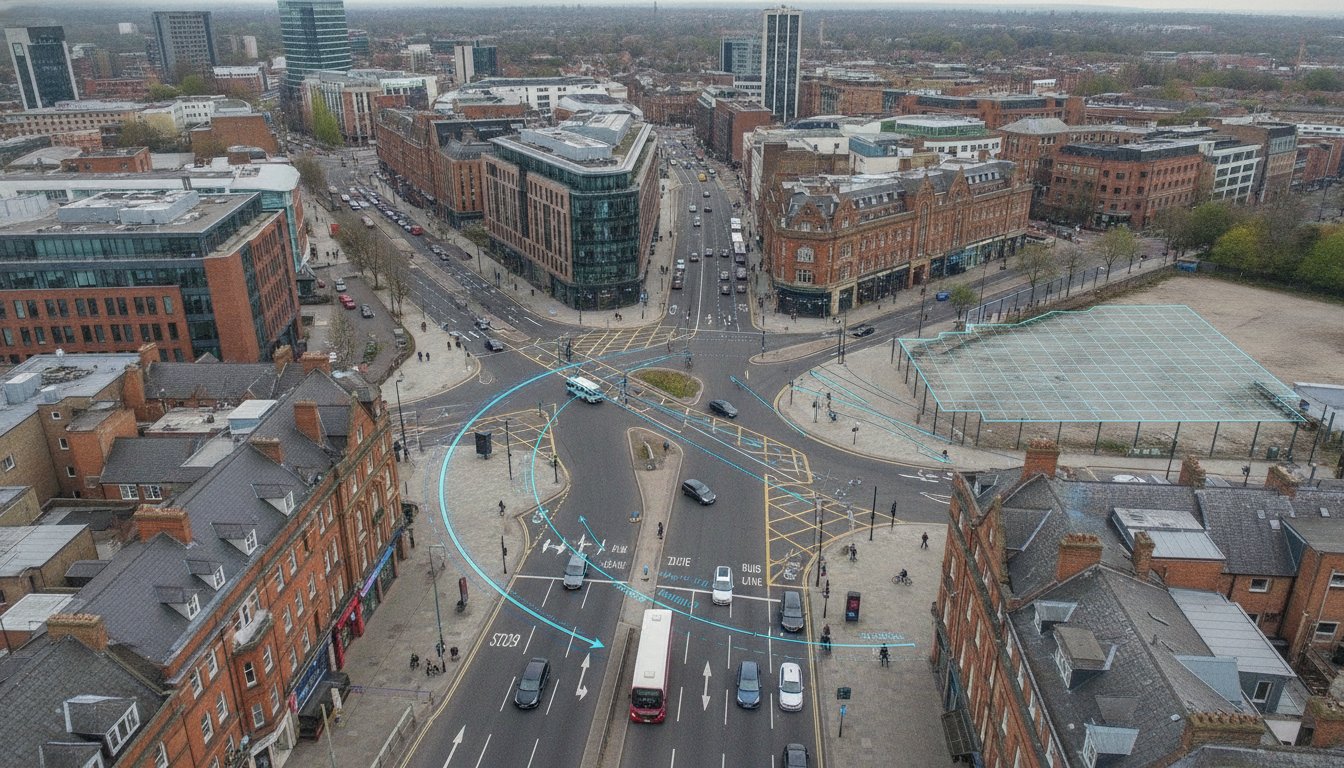
  • Complete Transport Engineering Projects: Guide for Success

    Complete Transport Engineering Projects: Guide for Success

    Failing to account for the latest 2026 regulatory shifts can turn a viable development into a costly stalemate overnight. With local authorities now empowered to charge up to £2,500 per day for road work delays, the margin for error in your transport engineering projects has vanished. It’s a high-stakes environment where a single oversight in a Transport Assessment or a miscalculation in vehicle tracking can result in months of planning delays and unexpected highway authority demands.

    You probably recognize that securing planning approval is becoming increasingly complex, especially with new mandates like the 10% Biodiversity Net Gain for major infrastructure and the car-free requirements of the London Plan 2026. This guide helps you master these technical and regulatory requirements to ensure your UK development moves forward without transport objections. We’ll provide a clear roadmap for optimizing site layouts for vehicle access, utilizing AutoTURN Pro 2026 standards, and understanding your S278 and S38 obligations. By prioritizing precision from the start, you can transform logistical pressures into a streamlined path toward successful project completion.

    Key Takeaways

    • Identify whether your development requires a Transport Statement or a full Transport Assessment to meet current UK planning thresholds.
    • Utilize Swept Path Analysis to verify site feasibility for fire tenders and refuse vehicles, ensuring your layout is optimized for safety and access.
    • Master the technical and regulatory requirements of transport engineering projects to secure planning approval without highway authority objections.
    • Gain a clear understanding of Section 278 and Section 38 obligations to manage infrastructure costs and legal handovers effectively.
    • Learn how PTAL ratings and modern parking standards dictate site design and public transport integration for commercial and residential developments.

    Defining Transport Engineering Projects for UK Property Development

    Professional transport engineering projects are the strategic bridge between an architectural concept and a functional, approved site. In the UK property market, these projects encompass the rigorous evaluation of traffic flow, pedestrian safety, and highway integration. By applying the core tenets of transportation engineering, consultants protect both the developer’s investment and the public’s well-being. This technical precision ensures that a site is accessible for everything from emergency fire tenders to standard delivery vans without compromising the local road network.

    A transport consultant’s role is defined by a commitment to infrastructure efficiency. They identify potential bottlenecks early in the design phase, mitigating risks related to highway capacity and road safety. Without this foresight, developers risk facing strict penalties. For instance, new 2026 regulations allow authorities to levy charges of up to £2,500 per day for disruptions caused by road works on busy routes. Avoiding these pitfalls requires a proactive approach to engineering design that prioritizes accuracy and regulatory compliance from day one.

    To better understand the different facets of these initiatives, watch this helpful video:

    The Scope of Professional Transport Consultancy

    Strategic consultancy goes far beyond basic traffic counts. It involves a deep understanding of the National Planning Policy Framework (NPPF) to ensure every development promotes sustainable travel and safe access. ML Traffic Engineers UK manages the full project lifecycle from the first site visit to the final planning committee hearing. Our team handles the intricate details of technical reporting and data collection, ensuring that the evidence used for your transport engineering projects is current and defensible. We act as a comprehensive partner, taking ownership of the regulatory burden so you can focus on the build.

    Why Developers Need Engineering Precision in 2026

    The complexity of highway authority requirements has reached a peak in 2026. In London and across England, latest mandates require developers to account for evolving environmental standards and car-free zones in well-connected areas. Professional technical reporting reduces the pressure on your team by delivering clear, evidence-based solutions. By providing accurate analysis from the start, we eliminate the uncertainty that often leads to planning delays. To see how we apply this expertise to real-world scenarios, visit our overview of what we do to learn more about our full range of engineering services.

    Strategic Reporting: Transport Statements and Assessments in 2026

    Securing planning approval requires more than just a site plan. It demands a rigorous defense of how your development interacts with the existing road network. Within the scope of professional transport engineering projects, technical reports serve as the primary evidence for local highway authorities. These documents justify the impact of your proposal, ensuring that traffic growth remains within manageable limits. To maintain consistency with national standards, consultants rely on the official transport analysis guidance provided by the Department for Transport. This framework ensures that every appraisal is robust and defensible during the planning process.

    Predicting future traffic flow is a science. We use the TRICS database to calculate trip generation based on comparable sites across the UK. This data allows us to model how many vehicles will enter and exit your site during peak hours. Alongside these figures, a Travel Plan is often necessary to promote sustainable transport modes. These plans are vital for demonstrating a commitment to “Active Travel,” which is a major focus for UK planning in 2026. By encouraging walking, cycling, and public transport use, you can often reduce the required number of parking spaces and overcome highway objections.

    Transport Statements for Small-to-Medium Developments

    A Transport Statement is typically required for smaller developments where the traffic impact is limited but still requires professional oversight. It focuses on existing site conditions, proposed access points, and the adequacy of parking provision. A Transport Statement is the primary tool for mitigating minor development impacts. If your project falls below the major development thresholds, this concise report is often enough to satisfy the local authority. If you’re unsure which report your site needs, reviewing our technical resources can help clarify the current standards for your region.

    Comprehensive Transport Assessments for Major Projects

    Major transport engineering projects require a full Transport Assessment. In London, as of 2026, this is mandatory for projects exceeding 80 residential units or 2,500 square meters of commercial space. These assessments involve complex junction capacity modeling and analysis of wider network implications. Early negotiation with highway authorities is essential to resolve potential objections before they cause delays. For those operating in the capital, our Transport Assessment London: The Developer’s 2026 Guide provides a detailed breakdown of these specific requirements.

    Technical Engineering Solutions: Swept Path Analysis and Site Design

    Precision in site design is not an aesthetic choice; it’s a functional requirement. Swept Path Analysis (SPA) has become the gold standard for verifying site feasibility within transport engineering projects. By using industry leading software like AutoTURN Pro 2026, we simulate the exact movement of vehicles through a proposed layout. This process accounts for both wheel paths and body overhangs, ensuring that vehicles don’t clip kerbs, buildings, or other infrastructure. It’s a vital preventative measure that stops costly design errors before a single brick is laid on site.

    Technical engineering solutions must prioritize the most demanding vehicles. In tight urban environments, ensuring fire tender access and refuse vehicle manoeuvrability is often the difference between a successful planning submission and a flat refusal. If a 12 metre refuse vehicle cannot safely navigate a turn or a fire appliance can’t reach a designated point, the entire site layout is compromised. We use these simulations to prove to highway authorities that your design is safe, efficient, and compliant with the latest standards.

    Critical Vehicle Templates for UK Developments

    Designing for the “worst-case scenario” protects the long-term viability of your development. We apply specific vehicle templates, such as the standard 12m refuse collector or large fire appliances, to stress-test your site access. This rigorous approach is also essential for coordinating the delivery of heavy equipment, where specialists like bewlake.com provide lorry-mounted and tracked cranes that require precise clearance for safe operation. Our goal is to find the perfect balance between maximizing the number of units and maintaining safe vehicle access. For developers working in high-density areas, our Swept Path Analysis Services in London provide the technical evidence needed to secure approval in 2026’s competitive landscape.

    Parking Surveys and Layout Optimisation

    Effective transport engineering projects also require a data driven approach to parking. We conduct parking stress surveys using the Lambeth Methodology to provide a clear picture of local parking capacity. This data informs the design of car park layouts that maximize every square metre while ensuring safety for pedestrians and drivers alike. With the London Plan 2026 now mandating that 100% of permitted parking spaces must have active electric vehicle (EV) charging points, your layout must account for the additional infrastructure and space these units require. We integrate these regulatory requirements into your site design from the earliest stages, reducing logistical pressures and ensuring your project remains net-zero ready.

    Complete Transport Engineering Projects: Guide for Success

    Compliance and Regulatory Frameworks for Infrastructure Projects

    Regulatory compliance is the final, non-negotiable hurdle for any infrastructure development. In the UK, transport engineering projects must strictly adhere to statutory frameworks to ensure that physical changes to the road network are safe and legally sound. Navigating these requirements involves early engagement with bodies like Transport for London (TfL) or local highway authorities to secure pre-application advice. This proactive approach identifies potential deal-breakers before they become embedded in your design, saving both time and capital. Expert coordination ensures that your project aligns with national standards and local policy from the outset.

    Understanding S278 and S38 Agreements

    Legal agreements are essential whenever a development impacts the public highway. A Section 278 (S278) agreement is required for works on existing roads, such as creating a new site entrance or modifying a junction. Conversely, a Section 38 (S38) agreement allows the local authority to adopt new roads constructed within a development for future public maintenance. Expert engineering design is the most effective way to speed up the technical approval process for these agreements, ensuring that the infrastructure discussed in previous sections meets the rigorous adoption standards of local councils. For a deeper look at these requirements, read our Highway Design S278 & S38: The London Developer’s Guide.

    PTAL Ratings and Sustainable Urban Planning

    Public Transport Accessibility Level (PTAL) ratings significantly dictate parking standards across London and other major UK cities. PTAL is a measure of proximity to the public transport network. Under the London Plan 2026, sites with high PTAL scores, typically 4 or higher, are often mandated to be car-free. In areas with lower accessibility, developers must rely on robust Travel Plans to offset car dependency and justify their parking provision. These plans demonstrate a commitment to sustainable transport, which is a core requirement for modern planning approval and helps mitigate the network impacts modeled in your Transport Assessment.

    The engineering lifecycle also relies on independent Road Safety Audits (RSA) at various stages of design and construction. These audits are a vital foundation for ensuring that new infrastructure doesn’t introduce safety hazards to the public or site users. Much like how PLM-Sme FZC enables industrial digitalization through advanced lifecycle solutions, integrating these compliance checks into your project timeline ensures that your development meets all legislative requirements without last-minute revisions. This comprehensive approach to transport engineering projects reduces logistical pressure and protects the long-term viability of your site.

    If you’re ready to secure technical approval for your site, contact ML Traffic Engineers UK to discuss your project requirements today.

    Delivering Successful Transport Engineering Projects with ML Traffic Engineers UK

    Success in UK development depends on more than just raw data; it requires a partner who can navigate the entire regulatory journey. Fragmented service providers often lead to communication gaps, resulting in costly delays and conflicting reports. By choosing ML Traffic Engineers UK, you gain access to an all-encompassing consultancy that manages transport engineering projects from initial site appraisal to final technical approval. Our tailored approach ensures that every report, from a Parking Survey to a full Transport Assessment, is integrated into a single, cohesive strategy for your site.

    We understand the high-stakes nature of the industry and the urgency of planning deadlines. Our team maintains a constant sense of readiness, offering the reliability and precision required to meet the strict demands of highway authorities across England. We reduce logistical pressures by acting as your technical advocate, ensuring that your vision isn’t stalled by transport objections. This commitment to formal excellence and safety-conscious design makes us a dependable partner for developers who can’t afford to leave their site feasibility to chance.

    Our Proven Process for Planning Success

    Our methodology is logical and sequential, designed to move your project through the planning system with maximum efficiency. We start with a thorough assessment of site feasibility and data collection, utilizing advanced Traffic Surveys to build a defensible evidence base. ML Traffic Engineers UK handles the complex technical lexicon and intricate regulatory compliance so you don’t have to. Our experts translate legislative requirements into actionable design solutions, ensuring your submission is robust from day one. You can explore our diverse range of project types to see our experience in action.

    Secure Your Planning Approval Today

    Professional integrity and civic responsibility are the foundations of our work. We view our role as vital guardians of both your project timeline and public safety. Precision in reporting is the ultimate protector of your development schedule, preventing the need for late-stage revisions that drain resources. Protecting your investment requires a partner who understands regional regulations and maintains constant accessibility throughout the project lifecycle. We deliver accurate, high-quality technical reporting that anticipates authority concerns and resolves them before they reach the committee stage.

    Don’t let transport objections derail your development. Contact ML Traffic Engineers UK today for a tailored quote and discover how our expertise in transport engineering projects can secure the planning approval your project deserves.

    Securing the Future of Your UK Development

    Successful property development in 2026 demands a meticulous approach to infrastructure. You’ve seen how integrating technical precision with regulatory foresight transforms a complex planning application into a straightforward approval. By prioritizing Swept Path Analysis and robust reporting from the outset, you eliminate the risk of transport objections and costly redesigns. These transport engineering projects are the foundation of a safe, accessible, and viable site.

    ML Traffic Engineers has been delivering planning success since 2014. With over a decade of experience navigating London Borough and National highway standards, we specialize in high-accuracy Swept Path Analysis and Transport Statements. Our team understands the urgency of your timeline and the necessity of precision. We take pride in being a dependable partner that manages the technical lexicon so you don’t have to. Our experts are ready to ensure your site meets every benchmark for safety and efficiency.

    Get a Professional Quote for Your Transport Engineering Project and let our expertise streamline your path to planning success. Your project’s feasibility is our priority, and we’re here to help you build with confidence.

    Frequently Asked Questions

    What is a transport engineering project in the context of planning?

    A transport engineering project in the planning context is the technical evaluation of how a new development affects the surrounding road and transport network. It involves detailed analysis of vehicle and pedestrian movements to ensure safety and infrastructure efficiency. These projects provide the evidence required by highway authorities to approve a planning application and ensure the site is accessible for all users.

    When do I need a Swept Path Analysis for my development?

    You need a Swept Path Analysis whenever a development requires access for large vehicles like fire tenders, refuse collectors, or delivery vans. Local authorities use these simulations to verify that vehicles can enter, turn, and exit the site safely without hitting kerbs or buildings. It’s especially critical for tight urban sites where every square metre must be optimized for safe manoeuvrability.

    How long does it take to complete a Transport Assessment?

    The timeline for a full Transport Assessment typically ranges from two to six weeks, depending on the complexity of the site and the required data. This period includes site visits, traffic counts, and junction modeling to ensure the report is robust and defensible. Starting this process early prevents logistical pressures during the statutory planning period and ensures all technical requirements are met.

    What is the difference between a Transport Statement and a Transport Assessment?

    The primary difference lies in the scale of the development and the expected traffic impact on the local network. A Transport Statement is a concise report for smaller sites with limited impact, while a Transport Assessment is a comprehensive study for major projects. Assessments involve more detailed modeling of junction capacity and wider network implications to satisfy highway authority standards.

    Do I need a Travel Plan for a small residential development?

    You may need a Travel Plan for a small development if the local authority requires a commitment to sustainable transport modes. While larger projects always require them, some councils mandate them for smaller sites to meet regional “Active Travel” targets. These plans encourage residents to use walking, cycling, and public transport, which can help justify lower parking provision on site.

    What are Section 278 agreements and why do they matter?

    Section 278 agreements are legal contracts between a developer and a local highway authority for works on the existing public highway. They are essential for creating new site access points or improving local junctions to accommodate development traffic safely. Without this agreement, you cannot legally modify public roads, making it a critical milestone for project completion and site adoption.

    How much does a transport planning consultant cost in the UK?

    The cost of a transport planning consultant varies depending on the scope of the report and the technical requirements of the project. Fees are generally determined by the complexity of the data collection and the level of modeling needed for the highway authority’s approval. It’s best to request a tailored quote to understand the specific investment required for your development’s unique constraints.

    Can a transport engineering project help if my site has limited access?

    Professional transport engineering projects are specifically designed to solve access challenges on constrained or difficult sites. Through technical solutions like Swept Path Analysis and layout optimization, consultants can prove to authorities that even tight spaces safely accommodate necessary vehicles. This technical evidence often unlocks the feasibility of urban developments that might otherwise face refusal due to access concerns.

    Michael Lee

    Article by

    Michael Lee

    Transport planner with over 35 years' experience.

    Disclaimer

    The content on mltraffic.co.uk, including all technical articles, guides, and resources, is provided for general informational and educational purposes only. It is not intended to constitute professional advice in traffic engineering, transportation planning, development approvals, or any other technical or legal field.
    While ML Traffic Engineers makes every reasonable effort to ensure the accuracy, completeness, and timeliness of the information published, we do not provide any warranties or representations (express or implied) regarding its reliability, suitability, or availability for any particular purpose. Any reliance you place on the content is strictly at your own risk.
    In no event shall ML Traffic Engineers, its directors, employees, authors, or affiliates be liable for any direct, indirect, incidental, special, consequential, or punitive damages (including, without limitation, loss of profits, data, or business opportunities) arising out of or in connection with the use of, or inability to use, any information provided on this website.
    The articles and guides on this site are not a substitute for engaging a qualified, professional traffic engineer to assess your specific project requirements. For tailored advice, compliance assessments, or traffic engineering services, please contact a competent professional.
    This disclaimer may be updated from time to time without notice. By accessing or using this website, you agree to be bound by the most current version of this disclaimer.
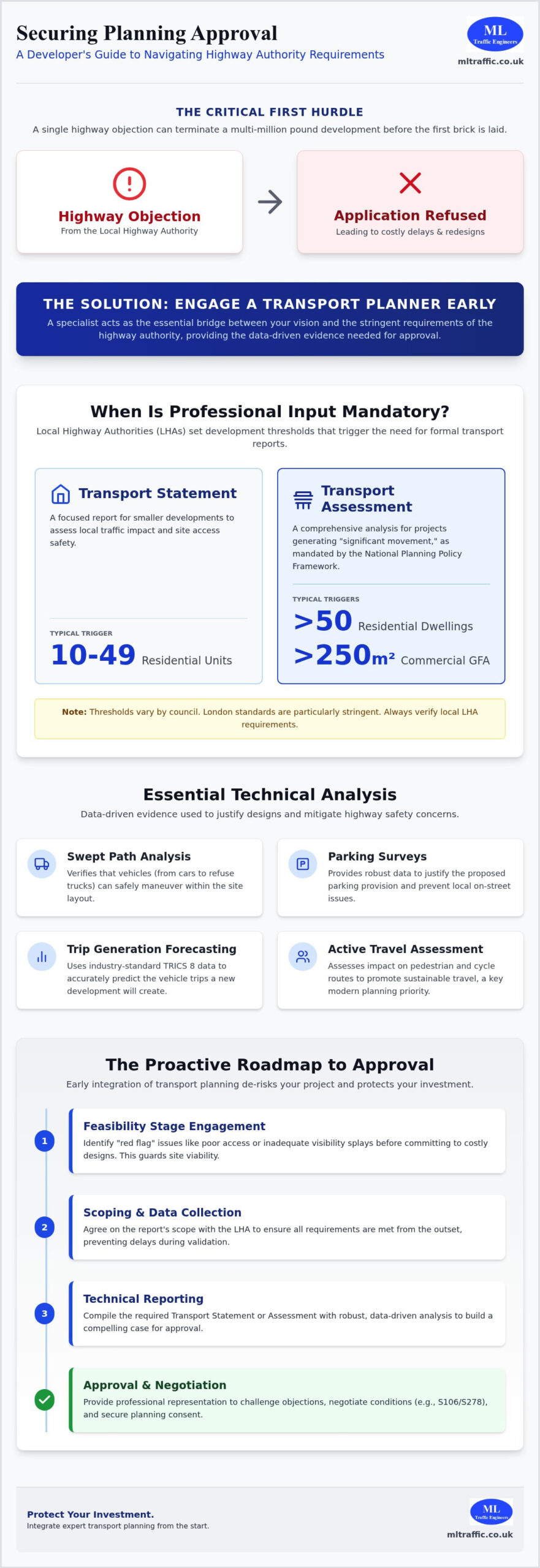
  • Transport Planning Guide for Success

    Transport Planning Guide for Success

    With planning fees in England having increased by 3.8% in April 2026, can your project afford a transport objection that forces a costly and time-consuming resubmission? It’s a common frustration for developers when transport planning becomes a barrier rather than a facilitator. The technical complexity of TRICS data and Swept Path Analysis often leads to regulatory delays, while unexpected highway authority requirements can quickly erode your project’s contingency budget. You need a strategy that prioritizes precision and compliance from the very first assessment.

    We recognize that navigating these logistical and regulatory pressures is a high-stakes task. This guide provides the technical authority you need to master the complexities of the planning system and secure your permission. We’ll deliver a clear roadmap of the required documentation, from Transport Statements to Travel Plans, ensuring your site layout is fully optimized for vehicle access. By the end of this article, you’ll understand how to align your submission with the Summer 2026 NPPF updates and eliminate the risk of transport-related objections.

    Key Takeaways

    • Understand how the National Planning Policy Framework influences local requirements to ensure your project aligns with national standards from the outset.
    • Learn the scale-based thresholds used to determine if you’ll require a Transport Statement or a full Transport Assessment.
    • Integrate technical tools like Swept Path Analysis during design. This creates robust applications that are difficult for authorities to challenge.
    • Identify the differences between Section 278 and Section 38 agreements to manage highway works and mandatory sustainability requirements effectively.
    • Choose a transport planning partner with local expertise to secure planning permission and avoid regulatory delays.

    What is Transport Planning in the Context of UK Development?

    Transport planning isn’t just about drawing lines on a map; it’s the critical technical integration of land use and physical infrastructure. In the UK, it serves as the functional blueprint for how people move between homes, workplaces, and essential services. A successful strategy ensures that a new development doesn’t exist in isolation. Instead, it must integrate seamlessly into the existing highway network while maintaining safety and efficiency for all users.

    National policy, specifically the National Planning Policy Framework (NPPF), sets the standard for these requirements. With a significant update to the NPPF expected in Summer 2026, the emphasis on connectivity-led planning is sharper than ever. Local authorities use these national guidelines to judge whether a project is sustainable. If your transport planning strategy fails to demonstrate safety or capacity, the application will likely face a refusal before other design elements are even considered. It’s your first line of defence against costly planning objections.

    To better understand the core principles of this process, watch this helpful overview:

    It’s vital to distinguish between strategic and development-led planning. Strategic planning is typically managed by government bodies to oversee regional infrastructure and long-term network growth. In contrast, development planning is a specialized consultancy service focused on securing permissions for specific sites. This is where precision becomes a functional necessity. We bridge the gap between your commercial goals and the strict regulatory requirements of the Local Highway Authority, ensuring every technical detail is addressed.

    The Core Objectives of a Transport Planning Consultant

    A consultant’s primary role is to protect the safety of the public and the viability of the project. We focus on three non-negotiable pillars to ensure a site is fit for purpose:

    • Safe Access: We design site entrances that provide clear visibility and safe turning movements for all vehicles, from cars to heavy goods vehicles.
    • Impact Mitigation: We use evidence-based data to prove that development-related traffic won’t cause gridlock or safety hazards on local roads.
    • Sustainability: We prioritize active travel modes like walking and cycling, alongside public transport links, to meet modern decarbonization targets.

    When Should You Engage a Transport Planner?

    Don’t wait until you’ve finalized your site layout to seek expert advice. Engaging a specialist during the pre-application stage allows us to identify “red flag” access issues before they become permanent obstacles. This proactive input informs the initial car park design and site access points. By resolving these technical challenges early, you avoid expensive late-stage design revisions and significantly reduce the risk of a highway authority objection. Early involvement is the most efficient way to manage your project’s long-term costs and timelines.

    Transport Statements vs. Transport Assessments: Which Do You Need?

    Determining whether your development requires a Transport Statement or a full Transport Assessment is a critical first step in the planning process. The decision is primarily based on the scale of the project and the volume of vehicular traffic it’s expected to generate. While national guidelines provide a framework, the Local Highway Authority (LHA) holds the final say on which report is necessary for your specific site. These documents provide the technical evidence base that planning officers use to recommend approval. Producing an accurate, data-driven report is essential for securing Transport for planning permission without facing costly delays or technical objections.

    The thresholds for these reports are often determined by the potential impact on the local road network. A common industry benchmark used by many LHAs suggests that a full assessment is required if a development generates more than 30 vehicle movements in the peak hour or 100 in a single day. However, these figures aren’t fixed. A small development in a sensitive or congested urban area might still trigger the need for a more detailed analysis. This technical nuance is why professional transport planning is a functional necessity for modern developers who want to avoid regulatory friction.

    Transport Statements: For Smaller Scale Developments

    Transport Statements are designed for projects with limited highway impact. Typical examples include small residential schemes, minor retail changes, or office refurbishments. These reports focus on three core areas: the existing site conditions, the safety of the proposed access, and a simplified prediction of trip generation. Even for smaller projects, the requirements can vary significantly by geography. For instance, a Transport Statement London must often adhere to stricter “Healthy Streets” principles compared to regional requirements. We ensure your report meets these specific local standards to streamline the approval process.

    Transport Assessments: For Major Development Projects

    Major developments require a comprehensive Transport Assessment. This is a deep technical analysis of significant traffic impacts and junction capacity across a wider area. We utilize the TRICS database to predict multi-modal trip generation, ensuring the data is robust enough to withstand scrutiny from highway officers. These assessments also address the cumulative impact of your project alongside other developments in the vicinity. Adhering to the professional standards set by the Chartered Institution of Highways and Transportation is essential to ensure your submission is respected by statutory consultees. If you’re unsure which report your project needs, we can help you identify the correct documentation during a pre-application review.

    Technical Analysis: The Foundation of Sound Transport Planning

    Data-driven evidence is the most effective way to overcome subjective objections from local authorities. When a submission relies on rigorous technical analysis, it shifts the conversation from opinion to objective fact. This level of precision is essential in modern transport planning, where every square metre of site layout must be technically justified. By providing quantifiable proof of safety and capacity, you create a robust application that’s far more resilient during the consultation phase. Local authorities are far less likely to challenge a proposal when it’s supported by verified data and industry-standard simulations.

    Our technical approach ensures that your site layout is optimized for both safety and commercial viability. We use evidence to prove the feasibility of essential services, such as fire tender and refuse vehicle access, which are often the first points of scrutiny for highway officers. By addressing these operational requirements through data, we reduce the risk of late-stage design changes that can compromise your project’s timeline or budget.

    Swept Path Analysis (SPA) and Vehicle Manoeuvrability

    We integrate Swept Path Analysis Services directly into the design phase to prevent costly design errors. Using specialized CAD software, we simulate the movement of specific vehicles to ensure they can navigate the proposed layout without incident. This is particularly vital for proving fire tender access and refuse vehicle manoeuvrability. Demonstrating that the largest expected vehicles can turn safely protects pedestrian zones and prevents structural damage to the built environment. It provides the highway authority with the absolute certainty they require regarding site safety and operational efficiency.

    Traffic and Parking Surveys: The Lambeth Methodology

    In high-density urban environments, parking stress is a frequent point of contention for residents and planners alike. We conduct detailed Parking Surveys to establish an accurate baseline of current demand within a 200m radius of your site. Our team utilizes the Lambeth Methodology, which remains the recognized gold standard for London-based surveys. This involves conducting “beat” surveys during peak stress times to measure exactly how much on-street space is available. This data is crucial for justifying parking-light or car-free developments, especially in areas with high Public Transport Accessibility Levels (PTAL). By proving that a development won’t overstrain local street capacity, we remove a major hurdle to your planning approval.

    Technical analysis isn’t just a box-ticking exercise; it’s a strategic tool that optimizes your site’s footprint while ensuring full compliance with safety standards. Whether you’re designing a complex urban infill or a large commercial hub, data-backed transport planning ensures your project is both viable and safe from day one.

    Transport Planning Guide for Success

    Statutory requirements are the legal framework that turns technical designs into physical infrastructure. This phase of transport planning is often where developers encounter the most significant financial and regulatory pressure. Highway officers may request extensive modifications or substantial financial contributions through Section 106 agreements. We help you manage these demands to ensure they remain proportionate to your development’s actual impact. Precision is a functional necessity here. Without a clear understanding of the legal landscape, you risk agreeing to highway works that can compromise your project’s bottom line.

    The most common developer objection we hear is that highway requirements are making a site unviable. This usually happens when authorities demand over-engineered road designs or excessive junction improvements. We counter this by using the precise data from your Transport Assessment to negotiate more cost-effective solutions. By applying the latest standards from the Manual for Streets or the Design Manual for Roads and Bridges, we ensure that every requested modification is technically justified and commercially realistic. If you are facing excessive highway demands, consult our team to review your statutory requirements and protect your site’s viability.

    Section 278 (S278) and Section 38 (S38) Agreements

    Section 278 and Section 38 agreements, governed by the Highways Act 1980, are the standard legal instruments for highway works. A Section 278 agreement is mandatory when you need to modify the existing public highway, such as creating a new site access or improving a nearby junction. Conversely, a Section 38 agreement allows the local highway authority to adopt new roads built within your development. This process ensures the roads are constructed to a specific standard before they become public property. For a comprehensive breakdown of these processes, see our guide on Highway Design S278 & S38.

    Travel Plans: Beyond the Planning Permission

    Travel Plans are critical for reducing the long-term carbon footprint of a development. They move beyond the initial planning submission to influence how residents and staff move daily. Depending on the scale and nature of your project, you may require a Framework, Full, or Workplace Travel Plans. These are living documents that include actionable strategies to promote walking, cycling, and public transport use. Monitoring and management are essential post-occupation. We ensure your plan remains effective and compliant with local targets, preventing future regulatory friction. Our approach focuses on creating realistic targets that genuinely promote sustainability without placing an undue burden on the developer.

    Choosing the Right Transport Planning Partner for Your Project

    Selecting a consultancy isn’t just about technical capability; it’s about finding a partner that understands the nuances of local government. Every Borough or Council has specific highway requirements that aren’t always found in national manuals. Local knowledge allows a consultant to anticipate these preferences, reducing the risk of a “back-to-the-drawing-board” scenario. A combined approach that integrates traffic engineering with transport planning is far more efficient than hiring separate specialists. It ensures that the technical data from your Swept Path Analysis informs the final Transport Statement without any loss of detail or delay.

    Precision is a functional necessity when your project’s timeline is at stake. A “right-first-time” technical report is the most effective way to avoid planning delays and keep your development on track. When local authorities receive a report that is professionally formatted and technically sound, it builds immediate trust. ML Traffic Engineers UK focuses on delivering high-quality documentation that streamlines the what we do process, allowing you to focus on the broader aspects of your development.

    What to Look for in a Transport Consultancy

    • Relevant Experience: Ensure the team has a proven track record with similar project types and scales. This experience is vital for navigating complex urban sites.
    • Responsiveness: You need a partner that can handle urgent pre-application queries and adapt to rapid design changes as they occur.
    • Accreditation: Professional membership in bodies like the Chartered Institution of Highways and Transportation (CIHT) or the Transport Planning Society (TPS) is a non-negotiable sign of quality and adherence to standards.

    How ML Traffic Engineers UK Delivers Planning Success

    We provide expert preparation of Transport Statements and Assessments for projects across England. Our in-house technical capabilities for Swept Path Analysis and Traffic Surveys mean we control the quality and speed of the data collection process. This integrated model allows us to produce safety-conscious reports that Local Authorities trust. We understand the high-stakes nature of infrastructure development and provide the unwavering reliability you need to secure your planning permission. By managing the full project lifecycle from inception to completion, we reduce the logistical and regulatory pressures on your team.

    If you’re ready to secure your site’s access and optimize your layout, contact ML Traffic Engineers UK for a project-specific quote today. Our team is ready to provide the technical authority your project requires.

    Secure Your Planning Approval with Technical Precision

    Effective transport planning transforms regulatory hurdles into strategic design advantages. By integrating data-driven technical analysis and navigating statutory requirements with precision, you eliminate the risk of costly objections. Whether your project requires a detailed Transport Statement or a comprehensive Swept Path Analysis, our team ensures every technical detail aligns with current UK and London-specific regulations. Mastery of these complexities is what separates a stalled application from a successful development.

    Founded in 2014, ML Traffic Engineers UK brings over a decade of planning success to your project. We’re specialists in Transport Statements and Swept Path Analysis, providing the technical authority needed to protect your site’s viability and safety. Our experts understand the intricacies of both UK-wide and London-specific highway regulations, ensuring your submission is robust and reliable from the start. Don’t let highway objections stall your progress when expert support is available.

    Request a Transport Planning Quote for Your Project

    We’re ready to help you secure your planning permission and optimize your site’s accessibility with confidence.

    Frequently Asked Questions

    Is a transport statement the same as a transport assessment?

    No. A Transport Statement is a simplified report for smaller developments with limited highway impact, while a Transport Assessment is a comprehensive technical study for major projects. Local authorities typically require the more detailed assessment if a site generates significant traffic, often over 30 two-way movements in peak hours. We help you identify which document is necessary based on your specific development scale and location.

    When is a swept path analysis required for a planning application?

    A swept path analysis is necessary when you must demonstrate that a specific vehicle can safely manoeuvre through your site or access point. It’s a functional requirement for proving fire tender access, refuse vehicle routing, and delivery bay viability. Planning officers use these simulations to ensure your layout doesn’t create safety hazards or structural damage risks. This analysis is especially critical for tight urban infill projects.

    How much does a transport planning consultant cost in 2026?

    Costs for these services vary based on the project’s technical complexity and the specific documentation required by the local authority. Factors that influence the total fee include the development’s scale, the need for specialized traffic surveys, and the depth of the required transport planning report. Because every site has unique highway constraints, we recommend requesting a project-specific quote to ensure all regulatory requirements are covered accurately.

    Do I need a travel plan for a small residential development?

    Requirements for a travel plan depend on the thresholds set by your Local Planning Authority. While very small schemes often avoid this requirement, many councils now request a “Travel Plan Statement” for minor developments to promote sustainable travel. These documents outline how residents will be encouraged to use cycling, walking, or public transport. We check your local policy during the pre-application stage to prevent unexpected delays.

    What is the TRICS database and how is it used in transport planning?

    TRICS is the industry-standard national system used to predict the number of trips a new development will generate. It contains thousands of survey records from existing sites across the UK. In transport planning, we use this data to provide an evidence-based forecast of how your project will affect the local road network. This objective data is harder for authorities to challenge than subjective estimates, making it vital for successful applications.

    Can a transport planner help with parking survey requirements in London?

    Yes, we specialize in conducting parking surveys using the Lambeth Methodology, which is the recognized standard for most London Boroughs. These surveys measure overnight parking stress within a 200m radius of your site. The results provide the technical evidence needed to justify parking-light or car-free developments. This is particularly important in high PTAL areas where local residents may have concerns about overspill parking on public streets.

    What happens if the Highway Authority objects to my planning application?

    An objection from the Highway Authority often leads to a refusal unless the technical concerns are resolved immediately. We act as your advocate, negotiating with highway officers to address their specific objections through design revisions or additional data. This process might involve providing a more detailed swept path analysis or a revised site access plan. Quick, evidence-based responses are essential to keep your application moving toward a positive recommendation.

    How long does it take to prepare a full Transport Assessment?

    Preparation usually takes between two and four weeks, though this depends on the availability of current traffic and parking data. If your project requires new on-site surveys, the timeline must account for the data collection period. We prioritize efficiency to meet your submission deadlines while ensuring every technical report meets the strict standards of the local authority. Early engagement allows us to identify and resolve potential issues before they impact your schedule.

    Michael Lee

    Article by

    Michael Lee

    Transport planner with over 35 years' experience.

    Disclaimer

    The content on mltraffic.co.uk, including all technical articles, guides, and resources, is provided for general informational and educational purposes only. It is not intended to constitute professional advice in traffic engineering, transportation planning, development approvals, or any other technical or legal field.
    While ML Traffic Engineers makes every reasonable effort to ensure the accuracy, completeness, and timeliness of the information published, we do not provide any warranties or representations (express or implied) regarding its reliability, suitability, or availability for any particular purpose. Any reliance you place on the content is strictly at your own risk.
    In no event shall ML Traffic Engineers, its directors, employees, authors, or affiliates be liable for any direct, indirect, incidental, special, consequential, or punitive damages (including, without limitation, loss of profits, data, or business opportunities) arising out of or in connection with the use of, or inability to use, any information provided on this website.
    The articles and guides on this site are not a substitute for engaging a qualified, professional traffic engineer to assess your specific project requirements. For tailored advice, compliance assessments, or traffic engineering services, please contact a competent professional.
    This disclaimer may be updated from time to time without notice. By accessing or using this website, you agree to be bound by the most current version of this disclaimer.

  • What is a Transport Consultant? A Guide for Developers

    What is a Transport Consultant? A Guide for Developers

    A single rejected transport statement can stall your development for 16 weeks, creating a costly bottleneck in your project timeline. For many developers, the Highway Authority’s requirements for Section 278 agreements or complex site access layouts feel like a high-stakes barrier to progress. It’s common to feel frustrated by technical jargon and the fear that a minor design error in your car park could trigger a full planning refusal. You need a partner who understands that precision is a functional necessity when dealing with modern infrastructure. Engaging a transport consultant ensures your application is built on a foundation of technical authority and regulatory compliance.

    This guide explains how a transport consultant acts as your strategic architect of approval. You’ll learn how they secure your planning permission through data-driven traffic surveys, swept path analysis, and expert negotiation with local authorities. We will outline the process of validating site access and optimizing layouts to ensure your project meets the latest 2026 regulatory standards without unnecessary delays. From Transport Assessments to detailed Travel Plans, we cover everything required to move your project from inception to completion with confidence. By the end of this article, you will understand how to turn highway constraints into technical justifications for your development.

    Key Takeaways

    • Understand the critical role of a transport consultant as the technical bridge between your development design and the Local Highway Authority.
    • Identify the specific reporting requirements for your site, including the differences between Transport Statements for minor works and comprehensive Transport Assessments for major developments.
    • Learn how to streamline the instruction process by defining project scope and requesting detailed fee proposals aligned with planning demands.
    • Gain insights into managing Section 278 agreements to ensure all works on the public highway comply with current safety benchmarks.
    • Discover how data-driven tools like Swept Path Analysis and professional Parking Surveys provide the technical justification needed to secure planning approval.

    What is a Transport Consultant in the Context of UK Planning?

    A transport consultant is a specialized technical expert who evaluates the impact of new developments on the existing transport network. They don’t just provide data; they act as the vital bridge between your architectural site design and the Local Highway Authority (LHA). Their primary role involves translating complex development goals into technical justifications that satisfy regulatory requirements. By integrating transportation planning principles with site-specific engineering, they ensure your project is both accessible and safe for the public. They manage the full lifecycle of transport requirements, from initial feasibility studies to final highway adoptions.

    To better understand this concept, watch this helpful video:

    The 2026 planning standards demand more robust data than ever before. With planning fees in England having increased by 3.8% as of April 1, 2026, the cost of a rejected application is higher than ever. Authorities now require granular evidence regarding vehicle movements and environmental impact. Within a consultancy, you’ll encounter two distinct roles. Transport planners focus on policy, sustainable travel strategies, and long-term network impact. Traffic engineers handle the technical design aspects, such as junction capacity and physical site access. Both roles are essential for a successful Transport Statement or Assessment.

    When Does a Developer Need to Instruct a Consultant?

    Precision starts at the pre-application stage. Instructing a consultant early allows you to identify ‘deal-breaker’ access issues before you’ve invested heavily in design. During formal submission, they provide the statutory Transport Statement or Assessment required by law. For residential developments of 10 to 49 units, a Statement is typically the baseline. If your project faces resistance, the consultant works post-submission to negotiate directly with council officers. This targeted advocacy helps clear transport objections that might otherwise stall your progress for 16 weeks or more.

    Key Regulatory Frameworks: NPPF and Local Plans

    The National Planning Policy Framework (NPPF) dictates the overarching transport requirements for all UK developments. However, local councils often impose stricter regional standards, such as the London Plan 2026 mandates for car-free developments in high PTAL areas. Your reports must align perfectly with these specific borough expectations to avoid immediate rejection. Under the 2026 NPPF update, sustainable transport is defined as an integrated network that prioritizes low-carbon mobility, active travel, and public transport accessibility to reduce reliance on private vehicles. Adhering to these benchmarks is a non-negotiable foundation for modern planning success.

    Technical Reports: Transport Statements, Assessments, and Travel Plans

    Technical reports serve as the objective evidence required to move a project through the planning system. A transport consultant uses these documents to demonstrate that a proposed development will not negatively impact highway safety or network capacity. Following official UK government guidance, these reports must be proportional to the scale of the development. They provide the technical justification that planning officers need to recommend an application for approval.

    Transport Statements are the baseline requirement for mid-sized schemes. In 2026, national guidelines indicate that residential projects between 10 and 49 units typically require a Statement. This report provides a streamlined overview of site access and local transport links. For larger developments, a full Transport Assessment is necessary. In London, the 2026 threshold for an Assessment is usually 80 residential units or commercial space exceeding 2,500 square meters. These assessments involve rigorous data modeling to predict how your site will interact with the wider road network over time.

    Travel Plans are strategic documents designed to encourage sustainable travel patterns. They are critical for meeting the 2026 National Planning Policy Framework (NPPF) requirements regarding decarbonisation. By promoting walking, cycling, and public transport use, these plans help developers meet TfL’s ambitious target of 80% sustainable trips by 2041. Without a robust Travel Plan, larger applications often face immediate objections from the Local Highway Authority. You can review our full range of technical reporting services to see how we support UK developers.

    Swept Path Analysis: Visualising Vehicle Maneuverability

    Designing a site layout without verifying vehicle movements is a high-risk strategy that often leads to planning refusal. We use CAD software to perform Swept Path Analysis Services in London, simulating the exact turning circles of refuse trucks, fire tenders, and delivery vans. This technical verification prevents costly site redesigns by proving access feasibility before a single brick is laid. If a fire engine cannot safely navigate your proposed access road, the Highway Authority will reject the layout. It’s a functional necessity that ensures your site is safe and operational from day one.

    Data Collection: Traffic and Parking Surveys

    Planning committees require objective data, not anecdotal evidence about parking availability. We utilize the Lambeth Methodology for parking surveys to establish precise demand and capacity in high-density areas. This data is essential for justifying parking provision in 2026, especially under the London Plan’s car-free mandates for areas with high PTAL scores. We also deploy Automatic Traffic Counters (ATC) to establish baseline traffic flows. This data-driven approach ensures your transport consultant can build a case grounded in reality, making your application ready for the highest levels of technical scrutiny.

    How to Instruct a Transport Consultant: A Step-by-Step Guide

    Instructing a transport consultant is a logical process that begins with project definition. To avoid technical delays, you must provide a clear brief that allows your partner to align their work with Local Highway Authority (LHA) expectations. Following a structured approach ensures that the resulting reports are robust enough to withstand the scrutiny of planning committees and statutory consultees.

    • Step 1: Define project scope. Identify which LHA oversees your site. Requirements in Worcestershire differ from those in West Sussex or London, so local context is vital.
    • Step 2: Request a fee proposal. Base this on specific planning needs. Ensure the proposal covers all necessary deliverables, such as Parking Surveys or Swept Path Analysis.
    • Step 3: Provide site plans. Submit accurate layouts and confirmed use classes. This data allows for precise trip generation analysis, which is the cornerstone of any Transport Assessment.
    • Step 4: Review the draft. Check the report for alignment with your commercial goals. Ensure the technical justifications maintain safety standards while supporting your site access strategy.
    • Step 5: Finalise for submission. Once approved, the consultant finalises the document for the planning portal, ready for formal consultation.

    Avoiding Common ‘Poor Service’ Pitfalls

    Technical accuracy depends on the quality of the tools used. Council officers will flag outdated data immediately, which leads to costly revisions. Ensure your consultant uses the latest TRICS database versions for trip rate analysis to maintain credibility. It’s also vital to verify that your partner holds adequate professional indemnity insurance and maintains membership with the Chartered Institution of Highways & Transportation. Selecting a low-cost report often creates a false economy. Low-quality submissions frequently trigger 16-week delays during the consultation period as authorities demand more detailed evidence.

    The Importance of Pre-Application Advice

    Early engagement with the LHA is a strategic necessity. By involving your transport consultant during the pre-application stage, you can secure early buy-in for your access strategy. This proactive approach identifies potential ‘deal-breakers’ before you commit to final designs. A well-negotiated pre-application response can significantly reduce the number of restrictive planning conditions attached to your final approval. You can learn more about how we manage these early-stage negotiations by reviewing what we do at ML Traffic. Reducing regulatory pressure through expert advocacy is the most efficient way to maintain your project timeline.

    What is a Transport Consultant? A Guide for Developers

    A Section 278 (S278) agreement is a legal requirement for any developer needing to carry out permanent alterations or improvements to the public highway. Whether you’re creating a new site access or improving a junction, the transport consultant acts as the technical lead during these negotiations. They ensure that your proposed highway works meet the exacting safety standards of the Local Highway Authority (LHA). Without a precise design, you risk facing the ‘Highway Objection’, which is the most common reason for planning delays in the UK. This objection can stall a project for months, directly impacting the commercial viability of your development.

    The financial stakes for these agreements are high. Medium-scale S278 schemes typically cost between £50,000 and £500,000, with utility diversions often accounting for 30% to 50% of the total budget. Regional fee structures also add to the complexity. For example, as of June 1, 2026, Worcestershire County Council requires an initial technical submission fee of £2,000. In West Sussex, the fee is 10% for schemes up to £1 million as of April 1, 2026. A skilled transport consultant manages these regulatory pressures, ensuring your design is approved without triggering excessive inspection fees or repeated submission costs.

    Car Park Layout and Access Review

    Precision in car park design is a functional necessity to avoid costly site redesigns after construction has begun. We focus on optimising parking spaces while maintaining safe visibility splays for both vehicles and pedestrians. Modern design also requires strict adherence to environmental mandates. The London Plan 2026 now mandates that 100% of all permitted parking spaces in new developments must have active electric vehicle charging points. Integrating these requirements early prevents logistical bottlenecks during the planning phase. For a deeper look at these requirements, read our Highway Design S278 & S38 Guide.

    Mitigating Traffic Impact Through Design

    Your transport consultant can often reduce the need for expensive ‘hard’ infrastructure changes by implementing ‘soft’ mitigation measures. These strategies are essential for negotiating Section 106 contributions and ensuring that pedestrian safety remains at the heart of your technical submission. By demonstrating a clear commitment to active travel and public transport accessibility, you can often secure approval for higher density sites even in constrained areas. If you need expert support with your highway design, contact ML Traffic Engineers UK to ensure your submission meets all current benchmarks.

    Why Partner with ML Traffic Engineers UK for Your Next Project?

    Choosing the right transport consultant is a strategic decision that directly impacts your project’s risk profile and delivery timeline. ML Traffic Engineers UK provides the technical authority required to manage the logistical and regulatory pressures of the UK planning system. We specialize in delivering high-precision Transport Statements and Assessments that meet the rigorous standards of 2026 legislation. Our team balances technical expertise with a client-focused approach, ensuring that your site design is both safe and commercially viable. By providing an all-encompassing, fully-managed service, we act as a vital guardian of your project’s progress from inception to final approval.

    Precision is a functional necessity in modern development. We utilize a data-driven approach to eliminate guesswork and prevent costly design errors. Our team performs detailed Swept Path Analysis to verify vehicle maneuverability and conducts professional Parking Surveys to establish robust baseline data. These technical deliverables are essential for overcoming the ‘Highway Objection’ and securing approval from the Local Highway Authority. We take immense pride in our adherence to industry benchmarks, ensuring every report we produce is ready for the highest levels of technical scrutiny.

    Our track record includes navigating complex planning applications across London and the wider English regions. We understand the specific nuances of the London Plan 2026, including car-free mandates and 100% EV charging requirements. We also manage the financial and technical complexities of Section 278 agreements, helping you avoid the pitfalls of repeated submissions and excessive inspection fees. Our readiness and urgency stem from a deep understanding of the fast-moving nature of the infrastructure sector. We ensure your application is built on a foundation of professional integrity and regulatory compliance.

    Our Comprehensive Approach to Transport Planning

    We manage the full project lifecycle, reducing the burden on your internal teams. Our consultants possess direct experience working with local highway authorities across the country, allowing us to anticipate potential obstacles before they cause delays. From initial feasibility assessments to final planning negotiations, we provide the unwavering reliability your development requires. You can explore our project types to see how we have successfully supported developers in residential, commercial, and mixed-use sectors.

    Get Started with Your Transport Planning Strategy

    Don’t let transport constraints stall your development progress. Our team is available to provide expert guidance tailored to the specific requirements of your site and the relevant local authority. We deliver the technical justifications needed to turn highway challenges into approved access solutions. Contact us today to ensure your planning application is supported by expert technical reporting and data-driven insights. You can request a transport planning quote from ML Traffic Engineers UK to begin your journey toward a successful planning outcome.

    Secure Your Planning Approval with Technical Precision

    Securing planning permission in the current regulatory environment requires more than just a basic site plan. It demands a rigorous technical foundation that addresses the specific concerns of Local Highway Authorities. By engaging an expert transport consultant, you ensure that every aspect of your site’s traffic impact is documented and justified. This process includes the production of data-led reports that align with the latest 2026 planning standards and the 2024 NPPF framework. Expert advocacy at the pre-application stage can prevent the 16-week delays that frequently stall projects during the consultation period.

    ML Traffic Engineers UK, founded in 2014, brings over a decade of technical expertise to your project. We specialize in precision tools like Swept Path Analysis and Lambeth Parking Surveys to validate your site’s functionality. Our team delivers comprehensive technical reports tailored to strict English planning standards, helping you navigate Section 278 agreements without unnecessary delays. Secure your planning approval with a professional Transport Statement from ML Traffic Engineers UK. Your project’s success depends on the technical authority we provide. We’re ready to help you move forward with confidence.

    Frequently Asked Questions

    What is the difference between a transport consultant and a traffic surveyor?

    A traffic surveyor focuses on the physical collection of raw data, such as manual vehicle counts or installing Automatic Traffic Counters (ATC). In contrast, a transport consultant takes this raw data and applies it to planning policy and engineering design. The consultant produces the technical reports and planning justifications required to secure approval from the Local Highway Authority. They act as the strategic lead for your application’s transport strategy.

    Do I need a transport consultant for a small residential development?

    Most developments with 10 or more units require professional technical input. National guidelines in 2026 state that residential projects between 10 and 49 units typically need a Transport Statement. Even for smaller sites, a consultant is often necessary to resolve complex visibility splays or site access issues. Engaging a professional early prevents design errors that could lead to a full planning refusal based on highway safety concerns.

    How much does it cost to hire a transport consultant for a planning application?

    Fees for consultancy services are determined by the specific technical requirements of your planning application. Factors that influence the final quote include the need for specialized Parking Surveys, junction modeling, or complex Swept Path Analysis. Developers should provide clear site plans and use classes to receive an accurate fee proposal. This ensures the technical support is proportional to the scale and potential traffic impact of the development.

    What is a Swept Path Analysis and why is it required by the council?

    Swept Path Analysis is a computer-aided simulation that tracks the physical path of a vehicle’s body and wheels during a maneuver. Councils require this to verify that large vehicles, such as refuse collectors or emergency fire tenders, can navigate the site safely. Proving that these vehicles won’t overrun footways or collide with structures is a functional necessity for securing approval of your proposed site layout.

    Can a transport consultant help if the council has already objected to my site access?

    A consultant is often the most effective partner for resolving existing highway objections. They review the council’s feedback and use data-driven evidence to challenge or mitigate the concerns raised. This might involve redesigning site access, providing more detailed traffic surveys, or negotiating soft mitigation measures through a Travel Plan. Their role is to find a technical solution that satisfies the authority while protecting your project’s viability.

    How long does it take to produce a Transport Statement for a planning submission?

    Producing a robust Transport Statement typically takes between two and four weeks. This timeline depends on whether baseline data is already available or if new Traffic Surveys are required. If field data collection is necessary, the process includes the time needed to deploy equipment and analyze the results. We prioritize efficiency to ensure your technical submission is ready for the planning portal without unnecessary delays.

    What data is required to start a Transport Assessment?

    You need to provide accurate site layouts, confirmed use classes, and total floor areas to begin the process. The consultant uses this information to calculate trip generation using the TRICS database. Additional requirements include details on existing parking provision and any proposed changes to the highway. This data allows for a comprehensive analysis of how the development will interact with the local transport network and public transport links.

    Do transport consultants handle Section 278 negotiations with the highway authority?

    Transport consultants manage the full technical negotiation of Section 278 agreements. They design the physical changes to the public highway and ensure these plans meet the strict safety benchmarks of the local authority. By managing the technical submission and liaison with highway officers, they help developers avoid the high costs associated with repeated design revisions or excessive inspection fees for defective works.

    Michael Lee

    Article by

    Michael Lee

    Transport planner with over 35 years' experience.

    Disclaimer

    The content on mltraffic.co.uk, including all technical articles, guides, and resources, is provided for general informational and educational purposes only. It is not intended to constitute professional advice in traffic engineering, transportation planning, development approvals, or any other technical or legal field.
    While ML Traffic Engineers makes every reasonable effort to ensure the accuracy, completeness, and timeliness of the information published, we do not provide any warranties or representations (express or implied) regarding its reliability, suitability, or availability for any particular purpose. Any reliance you place on the content is strictly at your own risk.
    In no event shall ML Traffic Engineers, its directors, employees, authors, or affiliates be liable for any direct, indirect, incidental, special, consequential, or punitive damages (including, without limitation, loss of profits, data, or business opportunities) arising out of or in connection with the use of, or inability to use, any information provided on this website.
    The articles and guides on this site are not a substitute for engaging a qualified, professional traffic engineer to assess your specific project requirements. For tailored advice, compliance assessments, or traffic engineering services, please contact a competent professional.
    This disclaimer may be updated from time to time without notice. By accessing or using this website, you agree to be bound by the most current version of this disclaimer.