Whether you’re submitting a planning application for ten houses or a regional distribution centre, your project’s movement, access and highway impact will be scrutinised. Traffic planning, often called transport planning, is the discipline that analyses, manages and mitigates how people and goods travel to, from and around a development site. Done well, it smooths your path to consent, reduces off-site infrastructure costs and supports healthier, lower-carbon travel choices. Done badly, it can delay or derail a scheme entirely. This guide explains what traffic planning involves, when a formal assessment is needed, what goes into a robust traffic plan, and how to work with specialists to navigate one of the most technical, but critical, aspects of the planning system.
Key Takeaways
- Traffic planning assesses and manages how people and goods travel to, from and around a development site, significantly influencing consent approval and reducing off-site infrastructure costs.
- Full Transport Assessments are typically required for larger schemes such as retail parks or housing estates above certain thresholds, whilst smaller proposals may only need a lighter-touch Transport Statement.
- Robust traffic plans must include baseline conditions, trip generation forecasts, junction capacity modelling, access design, and a mitigation package that demonstrates compliance with the National Planning Policy Framework.
- Early engagement with highway authorities during pre-application discussions clarifies required surveys and scope, preventing costly rework and application invalidation.
- Well-executed traffic planning supports sustainable travel choices through Travel Plans and improved cycling and pedestrian infrastructure, reducing carbon emissions and aligning with net-zero policy requirements.
- Engaging specialist transport consultants at the masterplanning stage enables feasibility checks on access and trip budgets before capital commitment, whilst helping navigate stakeholder negotiations throughout the planning process.
What Is Traffic Planning and Why Does It Matter?
Traffic planning is the systematic process of evaluating and managing the movement of people and freight across all transport modes, private vehicles, buses, trains, bicycles and on foot. It looks beyond counting cars: planners assess trip patterns, access arrangements, parking provision, public transport availability, walking and cycling infrastructure, and the capacity and safety of the surrounding road network.
It matters because developments generate trips, and those trips must be accommodated without compromising highway safety or network capacity. Poorly planned access can create queueing, accidents and community objection: robust transport planning demonstrates to local authorities and National Highways that your scheme is acceptable and deliverable. Beyond traffic flow, good planning supports sustainable travel, encouraging mode shift to public transport, walking and cycling, which in turn reduces carbon emissions, improves air quality and promotes healthier lifestyles. Transport planning also underpins wider spatial and infrastructure investment decisions, helping councils prioritise road improvements, bus routes and cycle networks. In short, it’s a technical discipline with real-world consequences for safety, environment, and whether your application wins planning permission.
When Is a Transport Assessment Required for Planning Applications?
In England, planning guidance distinguishes between Transport Assessments (TAs) and Transport Statements, depending on a development’s scale and likely impact. A full Transport Assessment is generally required for larger or traffic-intensive schemes, think retail parks, business estates, housing estates above a certain threshold, where trips could significantly affect local or strategic road networks. Smaller proposals may require only a Transport Statement, a lighter-touch document that still addresses access, trips and safety but with less modelling detail.
Thresholds vary by local planning authority and are often set out in validation checklists or supplementary planning documents. For instance, one council might trigger a TA at 50 dwellings, another at 80. The highway authority, and National Highways if a trunk road or motorway is nearby, will determine the scope during pre-application discussions. That early engagement is crucial: it clarifies what baseline surveys are needed, which junctions to model, and whether a Travel Plan or Construction Traffic Management Plan is expected. Submitting a TA when only a Statement was needed wastes time and money: submitting nothing when a TA was required will see your application invalidated or objected to. Always check local guidance and consult the highway authority before you commission work.
Key Components of a Professional Traffic Plan
A robust traffic plan, or Transport Assessment, typically comprises several interlocking elements. First, baseline conditions: existing traffic flows, collision records, public transport frequencies, pedestrian and cycle provision, and parking usage. Baseline data sets the scene and establishes whether the network already operates near capacity or suffers safety issues.
Next, trip generation and distribution forecasts. Planners use TRICS (the Trip Rate Information Computer System) or bespoke surveys to predict how many vehicle, cycle and pedestrian trips the development will generate, when those trips will occur, and where they’ll come from or go to. This feeds into junction capacity assessments, often modelled in software like PICADY, ARCADY or LinSig, and sometimes wider microsimulation or strategic modelling if impacts are complex.
The plan must also detail access and junction design: visibility splays, turning radii, swept paths for refuse vehicles, and compliance with design standards such as the Design Manual for Roads and Bridges or local highway authority guidance. Internal layout and parking strategy are equally important, ensuring cars, deliveries, cyclists and pedestrians can move safely within the site.
Finally, a mitigation package: off-site highway works (new roundabouts, pedestrian crossings, bus stops), a Travel Plan to encourage sustainable modes, and where relevant a Construction Traffic Management Plan to manage lorry routes, hours and road cleaning during the build phase. Every element must demonstrate compliance with national policy, particularly the National Planning Policy Framework, and local transport and design standards.
Traffic Impact Assessment and Modelling
The analytical heart of any TA is the Traffic Impact Assessment (TIA). This is where planners quantify development-related traffic and test its effects on junction capacity, link speeds, queueing, safety and sustainable modes. Traffic and transport models, ranging from simple priority junction models to complex microsimulation (VISSIM, Aimsun) or strategic demand models, allow you to test peak-hour scenarios, future-year growth, and the effectiveness of proposed mitigation.
Modelling isn’t just about proving capacity exists: it’s about demonstrating you’ve tested worst-case scenarios and designed proportionate, deliverable solutions. Highway authorities will interrogate your assumptions, baseline flows, growth rates, trip rates, so transparency and robust sensitivity testing are essential. Traffic impact assessments that skip this rigour risk objection and costly redesign.
How Traffic Planning Supports Successful Development Projects
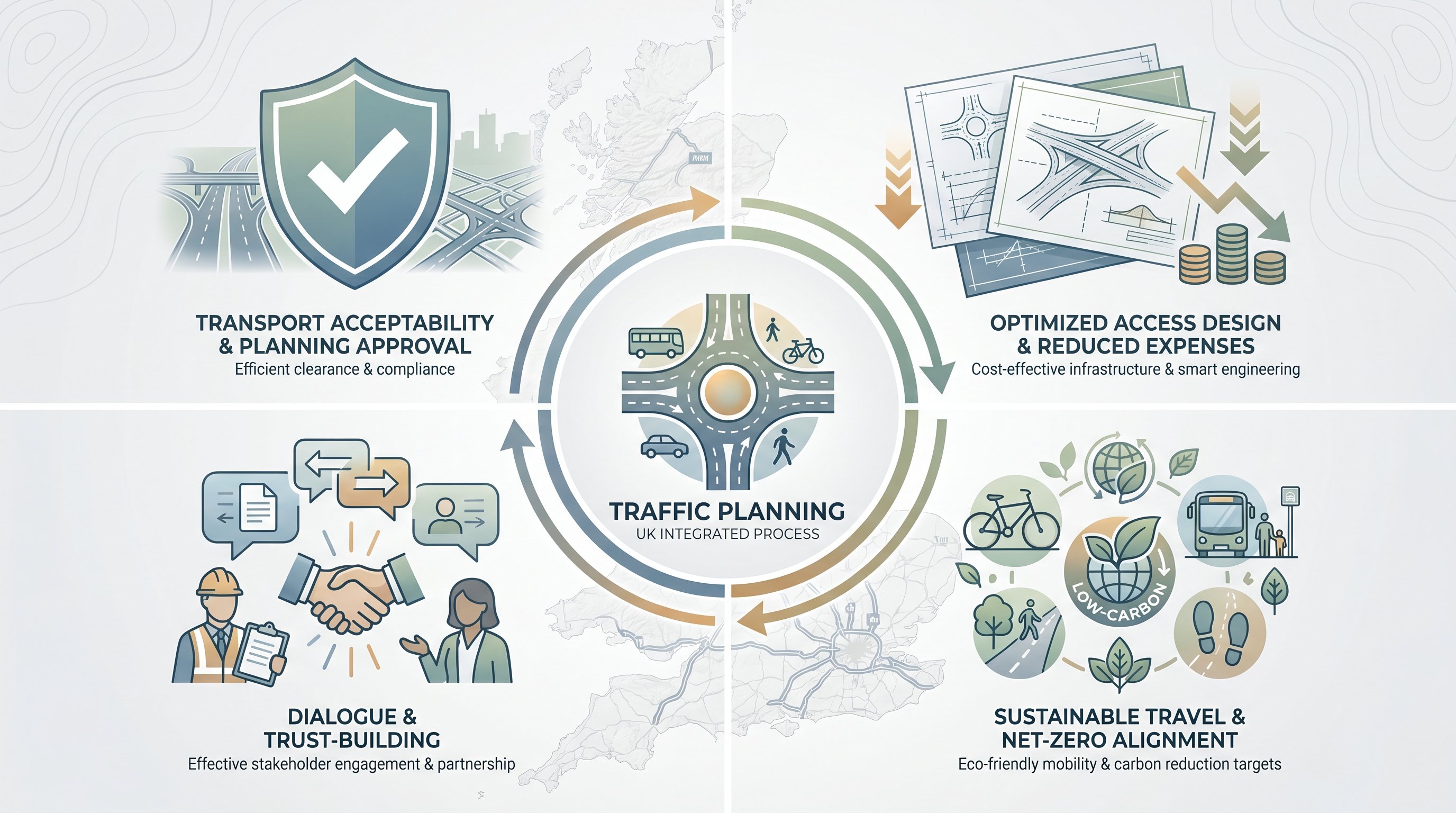
Well-executed traffic planning does more than satisfy a planning condition, it actively enhances the viability and quality of your scheme. First, it demonstrates transport acceptability, one of the material considerations highway authorities weigh when recommending approval or refusal. A clear, evidence-based TA reassures officers and members that safety and capacity concerns have been addressed, smoothing the path to consent.
Second, early traffic engineering input optimises access and layout, often reducing the need for expensive off-site works. By testing different access locations and junction types in the design phase, you can avoid over-engineering and negotiate pragmatic, cost-effective mitigation with the highway authority.
Third, traffic planning supports healthier, lower-carbon travel behaviour. Travel Plans, cycle parking, bus-stop improvements and pedestrian links encourage residents, employees and visitors to choose sustainable modes, cutting the development’s carbon footprint and aligning with net-zero and air-quality policies. This isn’t just good practice, it’s increasingly a policy requirement.
Finally, traffic planning facilitates constructive dialogue with statutory consultees. Highway authorities, National Highways, and sometimes local transport operators all have a say. Engaging them early, presenting robust evidence, and responding professionally to comments builds trust and avoids last-minute surprises that can delay determination or trigger appeals.
Common Challenges in Traffic Planning and How to Overcome Them
Even the best schemes encounter obstacles. Network capacity constraints are perhaps the most common: junctions already running over capacity in peak hours, or narrow rural roads with limited scope for widening. The solution lies in robust modelling and creative mitigation, phased development triggers, demand management (car clubs, travel plans), or off-peak delivery windows can all reduce peak pressure without major infrastructure spend.
Conflicting stakeholder objectives present another hurdle. A developer wants minimal off-site costs: the highway authority wants safe, future-proofed junctions: residents want minimal traffic increase: and National Highways has strict criteria for motorway junction impacts. Early, transparent engagement is the antidote. Pre-application meetings, scoping notes agreed in writing, and iterative design workshops align expectations and surface deal-breakers before applications are submitted.
Space limitations for access and parking, especially on tight urban infill sites, demand imaginative design. Shared-surface streets, on-street cycle parking, basement or stacked car parking, and stronger sustainable-transport packages can all unlock constrained sites. End-to-end transport planning ensures these solutions are coordinated, not bolted on.
Finally, policy and guidance evolve. LTN 1/20 (cycle infrastructure design), Gear Change, local design codes, and decarbonisation strategies all shape what authorities expect. Using consultants who stay current with Department for Transport, National Highways and local guidance ensures your assessment meets today’s standards, not yesterday’s.
Working with Transport Consultants: What to Expect
Specialist transport planning consultants bring technical expertise, local authority relationships and efficiency to the process. Engaging one early, ideally at site-acquisition or masterplanning stage, allows feasibility checks on access, trip budgets and likely mitigation costs before you commit capital.
A good consultant will scope the work in dialogue with the highway authority, commission baseline surveys (automatic traffic counts, manual turning counts, speed surveys, parking beats), and prepare the Transport Assessment or Statement to the agreed brief. They’ll also handle highway and junction design, pedestrian and cycle audits, public transport strategies, and any modelling the scheme requires. If your project needs a masterplan traffic strategy covering phasing and future growth, or a Construction Traffic Management Plan to manage HGV movements, your consultant will prepare those too.
Expect the consultant to act as your advocate in pre-application and post-submission negotiations, responding to highway authority and consultee comments with technical evidence and pragmatic solutions. They’ll work within your wider design team, architects, engineers, ecologists, to ensure transport considerations are integrated, not an afterthought. With over 30 years of experience, firms like ML Traffic deliver concise, accurate reports tailored to local thresholds and planning contexts, helping you navigate the technical requirements and secure the consents you need to build.
Frequently Asked Questions About Traffic Planning
What is traffic planning and why does it matter for development?
Traffic planning evaluates movement of people and goods across all transport modes to a development site. It matters because it ensures highway safety and capacity aren’t compromised, supports sustainable travel reducing carbon emissions, and demonstrates to authorities that your scheme is acceptable and deliverable.
When is a Transport Assessment required for a planning application?
A full Transport Assessment is generally required for larger or traffic-intensive schemes such as retail parks or housing estates above certain thresholds, where trips could significantly affect local or strategic road networks. Smaller proposals may only need a lighter-touch Transport Statement. Thresholds vary by local planning authority, so always consult the highway authority early.
What are the key components of a professional traffic plan?
A robust traffic plan includes baseline conditions (existing traffic, collisions, public transport), trip generation forecasts, access and junction design, internal layout and parking strategy, and a mitigation package such as highway works and travel plans. It must demonstrate compliance with national policy and local design standards.
How does traffic impact assessment and modelling improve planning outcomes?
Traffic impact assessments quantify development-related traffic effects on junction capacity, queueing and safety. Models test worst-case scenarios and mitigation effectiveness, providing robust evidence that demonstrates transport acceptability to highway authorities and strengthens your case for planning consent.
What common challenges arise in traffic planning and how can they be overcome?
Network capacity constraints, conflicting stakeholder objectives, space limitations and policy changes are frequent obstacles. Solutions include robust modelling, early engagement with authorities, creative design approaches like shared-surface streets, and working with consultants current with Department for Transport and local guidance.
What should I expect when working with traffic planning consultants?
Specialist traffic consultants provide early feasibility checks, baseline surveys, Transport Assessment preparation, highway design, pedestrian and cycle audits, modelling, and negotiation with authorities. They act as advocates throughout pre-application and post-submission stages, integrating transport considerations into your wider design team.