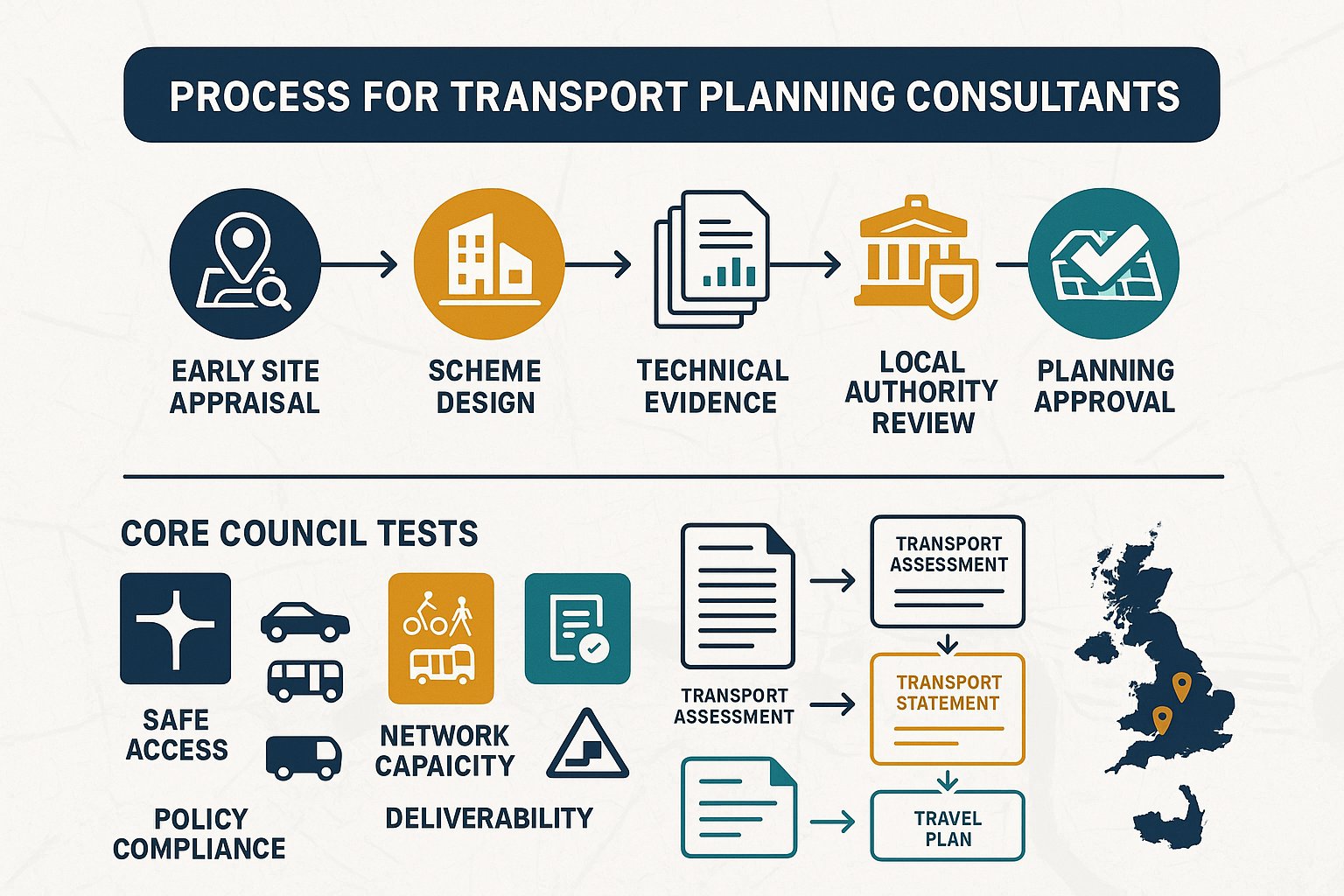
Planning applications rarely fail on design alone. Quite often, they unravel because movement, access, parking, servicing, or network impact hasn’t been thought through early enough. That is exactly where transport planning consultants come in.
For architects, developers, planners, surveyors and local authorities, transport is one of those disciplines that can look straightforward on the surface and become highly technical very quickly. A scheme may seem perfectly viable until a junction model shows queuing problems, a visibility splay doesn’t work, or the local highway authority asks for a Transport Assessment, Travel Plan, swept path review, and a stack of technical clarifications.
In practice, good transport advice is not just about writing reports. It is about shaping a project so it can move through planning with fewer surprises, fewer objections, and a stronger technical case. We use transport evidence to show that access is safe, impacts are acceptable, and sustainable travel has been properly considered in line with national and local policy.
In this guide, we’ll explain what transport planning consultants actually do, how their work fits into planning applications in 2026, which reports they prepare, when project teams should appoint one, and what councils usually expect to see. If you’re trying to secure planning consent without avoidable transport problems slowing everything down, this is the bit of the process worth getting right early.
What Transport Planning Consultants Do In The Planning Process
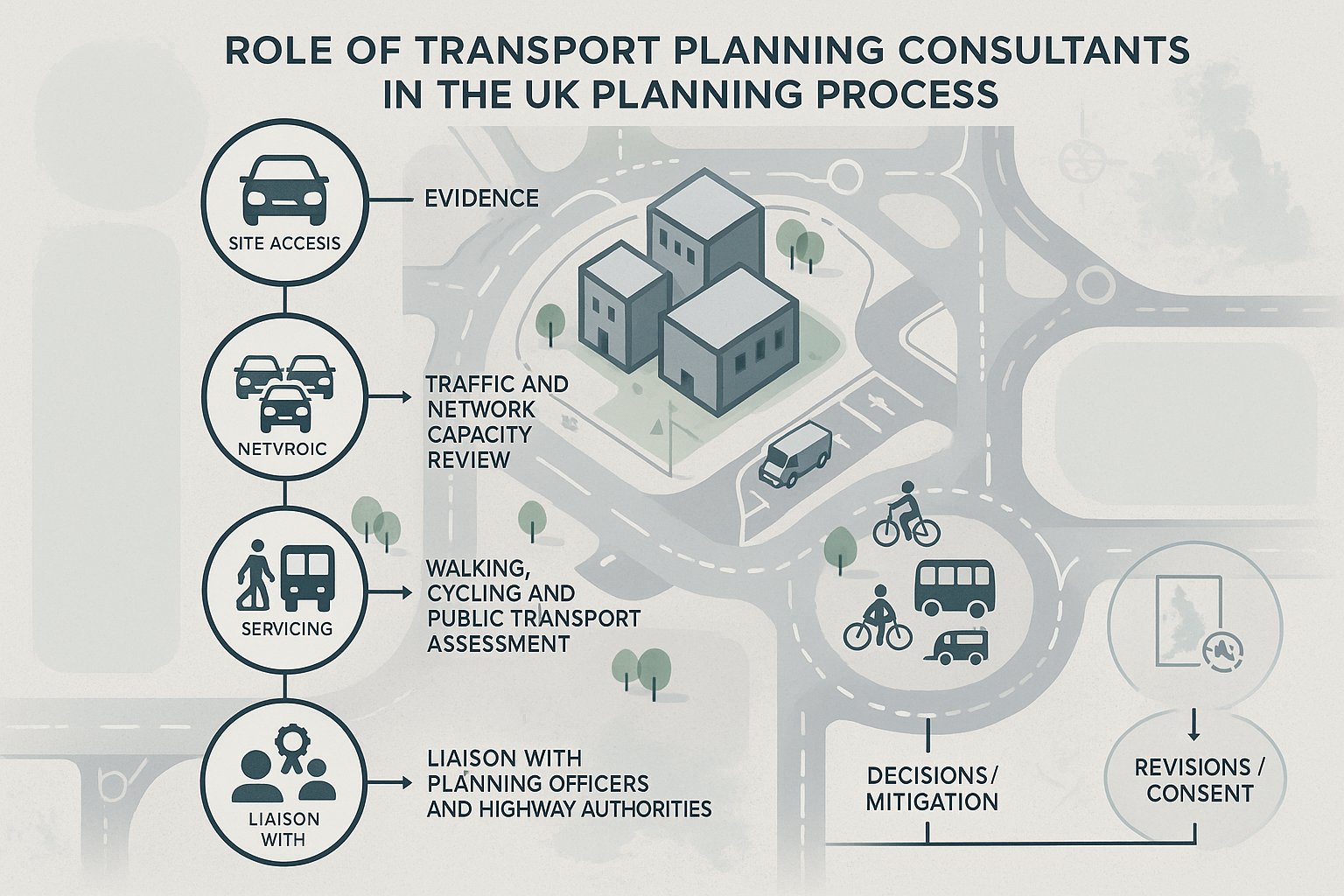
Transport planning consultants provide the transport and highways evidence that sits behind a robust planning application. In simple terms, we assess how people and vehicles will get to and from a site, whether the surrounding network can accommodate the development, and what changes or mitigation may be needed to make the proposal acceptable.
That sounds neat on paper. In reality, the role is broader.
We typically review trip generation, traffic distribution, access arrangements, parking demand, servicing, pedestrian and cycle movements, and public transport accessibility. We also look at whether the layout works in day-to-day use: can refuse vehicles turn safely, can delivery vehicles manoeuvre without conflict, is visibility adequate, do cyclists have a coherent route, and is the site practical for disabled users?
Just as importantly, transport planning consultants help teams interpret policy and local thresholds. A site in one authority may trigger a Transport Statement: in another, the same scale of development may need a full Transport Assessment and Travel Plan. Those local nuances matter.
We also liaise with planning officers and highway authorities, often through pre-application discussions, formal submissions, and responses to consultation comments. If objections arise, we prepare technical rebuttals and revise strategies where needed.
So the role is not limited to analysis. It is part technical author, part problem-solver, part negotiator. And when done well, it gives the wider design and planning team a much clearer path towards consent.
How Transport Planning Fits Into Planning Applications And Local Authority Requirements
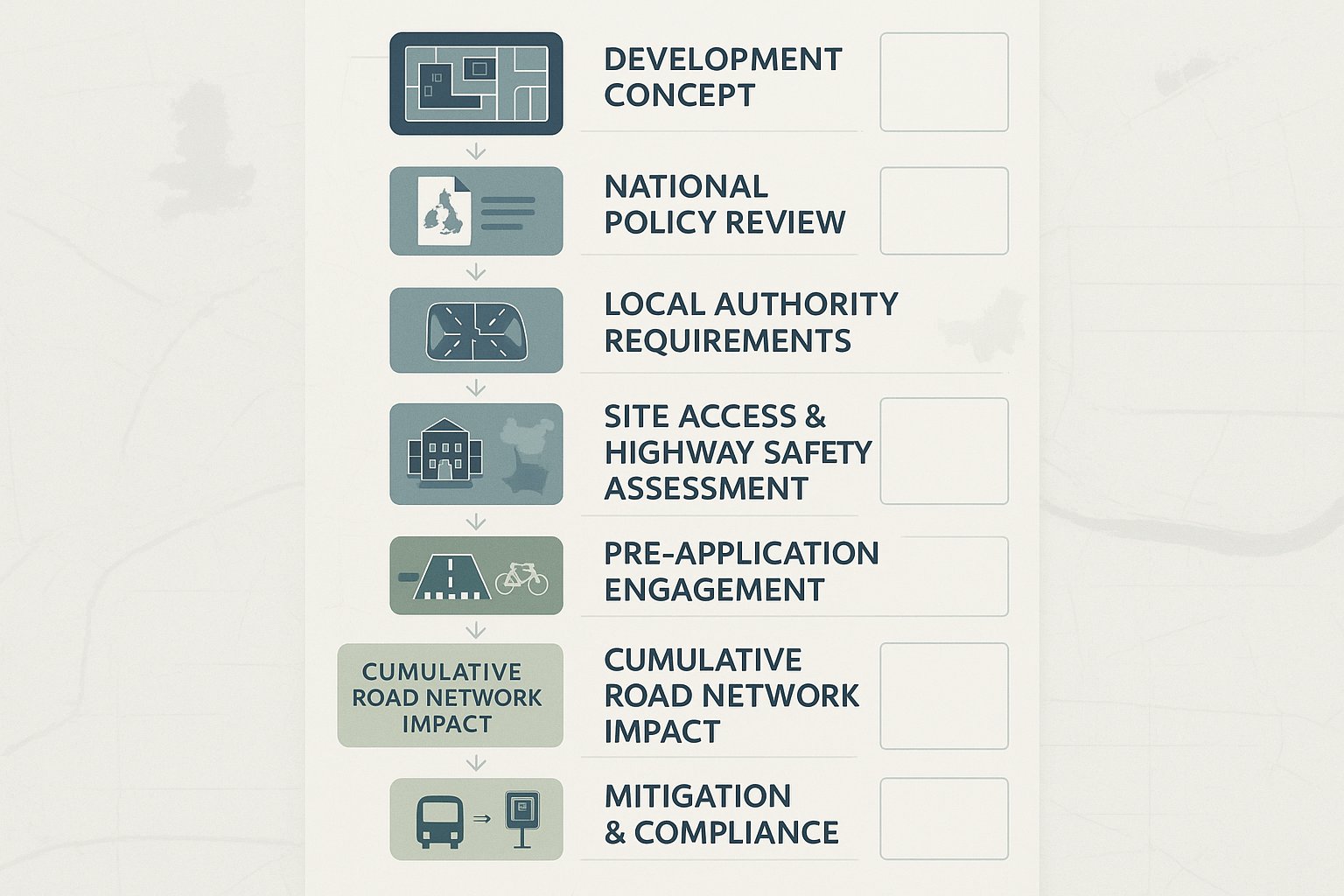
Transport planning sits at the intersection of planning policy, highway safety, and practical site delivery. A planning application is not simply judged on whether a development looks acceptable: it must also demonstrate that movement to and around the site has been properly considered.
In England, national policy remains central. The National Planning Policy Framework expects developments to provide safe and suitable access for all users and to ensure that any significant transport impacts can be addressed. Decision-makers are also concerned with whether residual cumulative impacts on the road network would be severe. That single test often becomes a focal point in objections and negotiations.
But national policy is only part of the picture. Local Plans, supplementary planning documents, parking standards, cycling policies, and Local Highway Authority guidance shape what is required in practice. Some councils are especially focused on active travel. Others scrutinise parking restraint, servicing, school travel patterns, or junction operation in more detail.
This is why transport planning consultants do more than produce generic reports. We tailor evidence to local authority expectations, local data, and the specific planning context. On sites with known constraints, that can include pre-application engagement to agree scope, modelling approach, survey extents, or mitigation principles.
Done properly, transport planning demonstrates policy compliance, addresses likely objections before they harden, and gives planning officers a defensible basis for recommending approval. Without that, even a strong scheme can feel under-evidenced.
The Main Reports And Studies A Consultant May Prepare
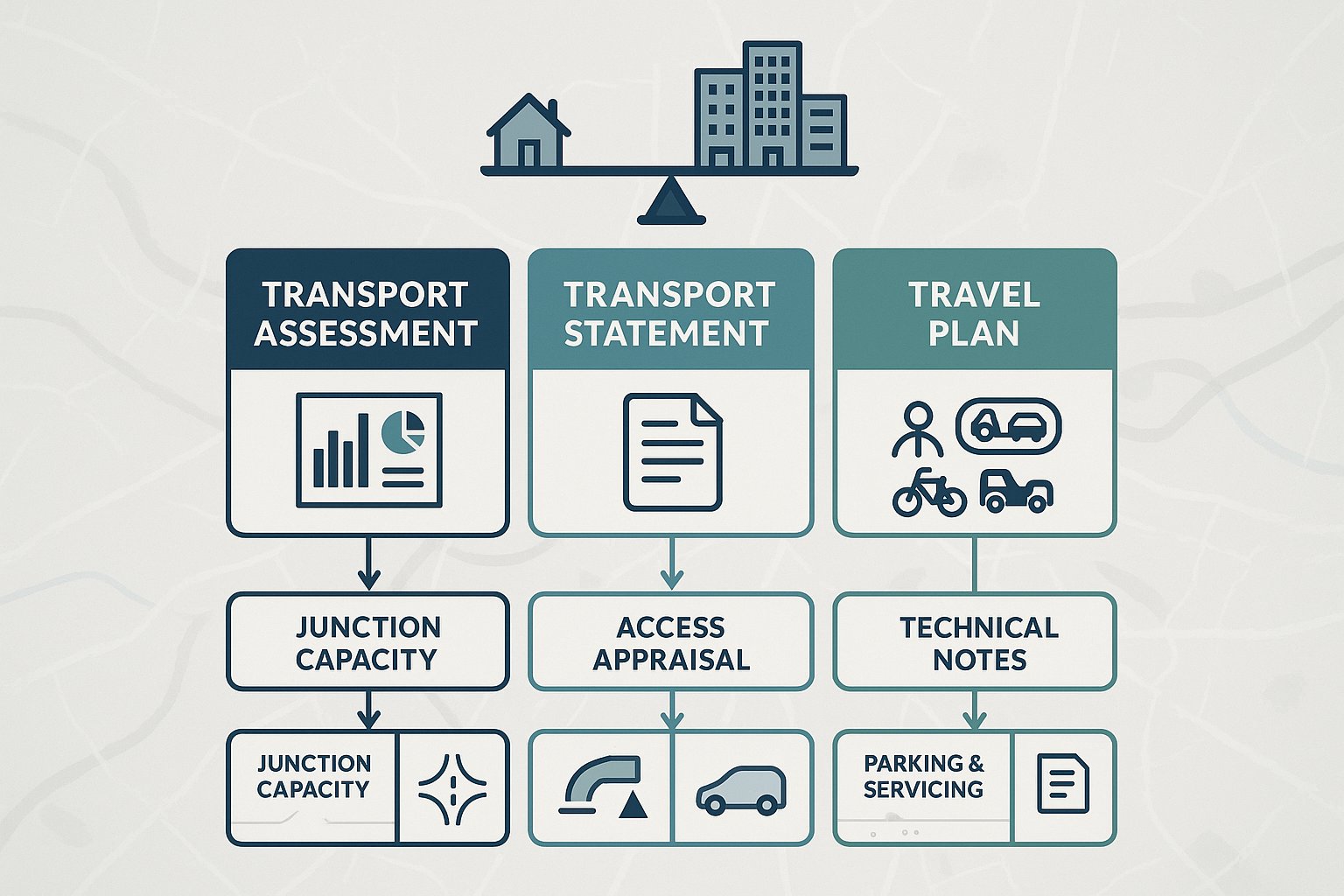
The exact package depends on the development, the location, and the authority’s validation requirements, but there are a handful of documents that appear again and again in UK planning work.
The best known are the Transport Assessment, Transport Statement, and Travel Plan. Alongside those, transport planning consultants often prepare junction capacity assessments, access appraisals, swept path analysis, parking and servicing strategies, construction traffic notes, and concise highways technical responses to consultation comments.
Some projects need only one focused document. Others need a coordinated suite of transport evidence. For example, a modest rural housing scheme might require an access review and Transport Statement, while a larger mixed-use proposal may need a full Transport Assessment, Travel Plan, capacity modelling, parking strategy, and a series of follow-up technical notes.
The key point is proportionality. Councils and highway authorities usually want evidence that matches the scale and likely impact of the scheme. Over-reporting can waste time and money: under-reporting is far riskier, because it leaves gaps that generate objections, delays, or validation problems.
That balance is where experience counts. Firms with a strong planning focus, including practices such as ML Traffic, are often brought in because they can identify what is genuinely required, prepare concise evidence quickly, and avoid turning a straightforward issue into a bloated technical exercise.
Transport Assessments Vs Transport Statements Vs Travel Plans
A Transport Assessment (TA) is the most detailed of the three. It is typically used for larger developments, sensitive sites, or proposals likely to create material traffic and movement impacts. A TA usually covers baseline conditions, trip generation, trip distribution, modal split, committed development, junction capacity, road safety context, accessibility, and mitigation. If a local highway authority wants robust proof that a scheme will not create severe impacts, this is often the principal document.
A Transport Statement (TS) is lighter touch. It is normally proportionate to smaller or less intensive schemes where impacts are expected to be limited. A TS still needs to be credible and evidence-based, but it is generally shorter and more focused than a full assessment.
A Travel Plan is different again. Rather than measuring traffic impact alone, it sets out how sustainable travel will be encouraged and managed. That can include cycle parking, pedestrian links, public transport information, car sharing measures, welcome packs, monitoring, and named responsibilities. Weak Travel Plans tend to get little traction. Practical, enforceable ones can help unlock approval.
Junction Capacity, Access, Parking, And Highway Technical Notes
Many schemes hinge on narrower technical questions, and that is where targeted studies come in.
Junction capacity assessments use recognised tools such as PICADY, ARCADY, LINSIG, and sometimes more detailed microsimulation like VISSIM, depending on complexity. These help test whether nearby junctions can operate acceptably with development traffic and whether mitigation is needed.
Access work often covers visibility splays, geometry, speed environment, pedestrian crossing points, internal tracking, and refuse or servicing movements. Sometimes the issue is not traffic volume at all: it is simply whether the access works safely and meets adoptable or acceptable standards.
Parking and servicing reviews examine parking accumulation, disabled bays, cycle provision, EV charging assumptions, car park management, and loading arrangements. Over-provision can be as problematic as under-provision if it conflicts with policy or encourages avoidable car dependence.
Then there are highways technical notes: concise responses to officer comments, revised trip-rate justifications, construction routing notes, or clarification on turning layouts. They are not glamorous documents, but they often keep an application moving when a single unresolved point threatens to stall determination.
When Developers, Architects, And Planning Teams Should Bring In A Consultant
The short answer: earlier than many teams do.
Ideally, transport planning consultants are appointed at site appraisal or concept stage, before the layout is fixed and before pre-application feedback is sought. That timing matters because transport constraints can shape the entire strategy of a scheme. If the access point is wrong, if visibility cannot be achieved, or if parking and servicing don’t fit the site properly, those are not issues we want to discover after the drawings are polished.
Early transport input is especially valuable for:
- sites with constrained or substandard access
- developments near sensitive junctions or schools
- schemes in town centres with parking restraint policies
- roadside commercial uses with servicing demands
- mixed-use projects where movement patterns overlap
- sites likely to trigger local concern about congestion or highway safety
Architects often benefit from early advice because it informs layout efficiency. Developers benefit because it reduces delivery risk and helps avoid late redesign. Planning consultants benefit because transport strategy can be aligned with the planning statement from the start, rather than patched in later.
And there is a practical point here. Surveys, junction modelling, design checks, and pre-application discussions all take time. Leaving transport work until just before submission can compress programmes badly. We’ve all seen applications delayed not by the main design team, but by the realisation that a junction model, speed survey, or swept path review is still outstanding.
How Early Transport Input Can Reduce Delays, Objections, And Redesign Costs
Early transport input saves time because it identifies what could go wrong while the scheme is still flexible.
At concept stage, we can test whether the proposed access is feasible, whether emergency and refuse vehicles can turn, whether likely trip rates look manageable, and whether parking levels align with policy. If there is a problem, the cost of changing the layout is relatively low. Once a planning pack is assembled and consultants across multiple disciplines have coordinated around it, even small changes become expensive.
This early-stage work also reduces the chance of avoidable objections. Highway authorities are more likely to push back when they feel a proposal has been engineered around planning aspirations rather than transport reality. By contrast, a scheme that already reflects sensible access design, sustainable travel measures, and proportionate evidence tends to attract more constructive engagement.
There is also a programme benefit. Good transport planning helps determine what surveys are needed, what can be scoped out, and what should be discussed with the council in advance. That means fewer surprises during validation or consultation.
Financially, this matters more than many teams expect. A redesign prompted by access geometry, parking layout, or servicing conflict can affect architecture, drainage, landscaping, and viability. One well-timed transport review can prevent that domino effect.
In our experience, the best results usually come when transport is treated as part of scheme design, not a report-writing exercise bolted on at the end.
What Local Councils And Highway Authorities Usually Look For
Local councils and highway authorities usually want confidence on four things: safety, capacity, policy compliance, and deliverability.
First, they look for safe and suitable access for all users. That means more than vehicle entry and exit. Officers will often examine pedestrian links, cycle access, crossing opportunities, visibility, gradient, inclusive access, and whether the internal layout works for day-to-day movement.
Second, they want to understand network impact. Will the development create unacceptable pressure on nearby junctions? Are there existing congestion issues? Has cumulative impact been considered with committed development? If mitigation is proposed, is it realistic and proportionate?
Third, they look for alignment with policy. Parking standards, sustainable travel expectations, school travel requirements, town centre accessibility, and active travel priorities all vary by authority. A report that ignores local policy usually gets found out quickly.
Fourth, they want robust evidence. That includes defensible survey data, accepted modelling methods, realistic assumptions, and clearly explained conclusions. Authorities may challenge unsupported trip rates or vague assertions, particularly on contentious schemes.
Well-prepared reports make an officer’s job easier. They set out the issue, the methodology, the evidence, and the conclusion without forcing the reader to guess. That matters because planning officers and highway engineers are often dealing with high caseloads. Clarity helps.
Key Issues That Commonly Affect Planning Outcomes
A few issues come up repeatedly in transport objections and refusals.
Inadequate access is one of the big ones. If visibility splays cannot be achieved, if vehicle tracking fails, or if pedestrians are forced into awkward conflict points, the scheme can struggle regardless of its wider merits.
Junction impact is another. A development does not need to flood an entire network to trigger concern: sometimes one already-stressed roundabout or signal junction is enough.
Parking is surprisingly polarising. Too little parking can lead to overspill concerns. Too much can conflict with policy, urban design goals, or sustainability principles. The right answer is often context-specific rather than formulaic.
Walking, cycling and public transport provision is increasingly scrutinised. A report that pays lip service to active travel but offers little practical analysis rarely lands well in 2026.
And then there are Travel Plans. If they are generic, unenforceable, or disconnected from the layout, officers notice. A useful Travel Plan is tailored, realistic, and linked to actual site opportunities and management arrangements.
How Transport Planning Consultants Support Different Project Types
Transport planning is never entirely one-size-fits-all. The same principles apply across sectors, but the issues that matter most change depending on what is being built and how the site will function.
For that reason, transport planning consultants adjust the scope, evidence base, and mitigation strategy to suit the project type. A school, a warehouse, a suburban housing site, and a town-centre mixed-use scheme may all require transport input, but the critical questions are quite different.
At one end of the spectrum, some projects hinge on basic access and parking. At the other, they involve multiple peak periods, competing user groups, servicing pressure, or active travel expectations that need careful balancing. The consultant’s job is to understand which transport questions actually matter to decision-makers and address those directly.
This sector-specific thinking is important for planning teams because it avoids generic reporting. It also improves the credibility of the submission. Highway officers can usually tell when a report has been adapted lazily from another job. Tailored evidence, by contrast, shows that the site and the authority’s concerns have been understood properly.
Residential, Commercial, Education, And Mixed-Use Schemes
For residential schemes, the recurring issues are access design, parking ratios, visitor parking, road safety, refuse tracking, and sustainable travel options. Family housing may trigger concerns about school-run traffic and local junction peaks. Flats in urban locations may be more focused on cycle parking, car-free or low-car policy, and accessibility to public transport.
For commercial and industrial development, servicing is often central. HGV routing, loading yard operation, swept paths, staff parking, shift change patterns, and impacts on nearby junctions can dominate the discussion. A site may look workable until articulated vehicle movements are tested properly.
For education projects, the peak-period profile is unique. Drop-off and pick-up activity, staff travel, pupil travel surveys, school Travel Plans, coach access, and safeguarding walking routes all matter. A technically small development can still be transport-sensitive if it intensifies movement at exactly the wrong time of day.
For mixed-use schemes, the challenge is integration. Shared parking, internal circulation, servicing strategy, public realm, pedestrian priority, and modal interchange all need coordination. Sometimes the opportunity is that land uses complement each other and reduce net peak impact. Sometimes they conflict. That is why mixed-use transport work tends to be as much about strategy as calculation.
How To Choose The Right Transport Planning Consultant For Your Project
Choosing the right consultant is not just about finding someone who can produce a report. It is about finding someone who can identify risk early, tailor evidence to the authority, and defend the scheme when questions come back.
We’d usually start with relevant experience. Has the consultant worked on similar development types and scales? Do they understand the policies and practical expectations of the local authority area? A technically capable team can still be the wrong fit if they are unfamiliar with local validation requirements or the highway authority’s usual concerns.
Professional credibility matters too. Chartered status, membership of relevant bodies, and a solid UK planning track record are useful signals. So is the ability to carry out or commission modelling properly where required.
Beyond credentials, ask sensible project questions:
- What reports do they think the scheme is likely to need?
- What surveys or modelling may be required?
- What are the key transport risks at this stage?
- Can they support pre-application discussions and responses to objections?
- How quickly can they deliver within the programme?
Good consultants explain things clearly. They do not hide behind jargon or recommend unnecessary work to inflate scope.
This is where a specialist planning-focused practice can be valuable. A firm like ML Traffic, with more than 30 years of experience and an emphasis on concise, accurate transport engineering reports, is a useful example of the type of support many project teams need: technically robust, commercially aware, and responsive to local authority thresholds.
Finally, ask for a clear fee proposal, scope, and timetable. Ambiguity at appointment stage usually turns into frustration later.
Conclusion
Transport issues can make or break a planning application long before committee papers are written. That is why appointing experienced transport planning consultants early is usually a strategic decision, not an administrative one.
The right advice helps shape access, parking, servicing, and sustainable travel from the outset. It also provides the technical evidence needed to satisfy local policy, respond to highway authority scrutiny, and demonstrate that a scheme’s impacts are acceptable and manageable.
For developers, architects, planners, surveyors, and councils, the value is straightforward: fewer surprises, fewer redesigns, and a better chance of securing consent without unnecessary delay.
In 2026, authorities expect transport evidence to be proportionate, locally informed, and technically robust. Projects that treat transport as an afterthought still run into the same old problems. Projects that address it early tend to move with much more confidence. And in planning, that often makes all the difference.
Frequently Asked Questions about Transport Planning Consultants
What role do transport planning consultants play in the planning application process?
Transport planning consultants assess how people and vehicles will move to and from a development site, ensure access is safe, mitigate network impacts, and provide technical evidence aligned with local policies to support planning applications effectively.
When is the best time to involve a transport planning consultant in a development project?
Engaging a transport planning consultant at the site selection or early concept stage is ideal to identify access constraints, shape layouts, and avoid costly redesigns or objections before pre-application submissions.
What are the differences between a Transport Assessment, Transport Statement, and Travel Plan?
A Transport Assessment is a detailed report for larger developments showing impacts and mitigation; a Transport Statement is a lighter, proportionate version for smaller schemes; whereas a Travel Plan outlines strategies to promote sustainable travel and manage car use on site.
How do transport planning consultants help comply with local and national planning policies?
They demonstrate safe and suitable access for all users, ensure transport impacts are not severe, support sustainable travel initiatives, and provide robust, locally tailored evidence meeting the National Planning Policy Framework and Local Highway Authority requirements.
What are common transport issues that can affect planning consent?
Planning can be delayed or refused due to inadequate or unsafe access, unacceptable traffic impact on junctions, under- or over-provision of parking, poor consideration of walking, cycling and public transport, and weak or unenforceable Travel Plans.
How should I choose the right transport planning consultant for my project?
Choose a consultant with relevant UK planning experience, chartered status, and expertise in your project type and local policies. Ensure they have modelling capabilities, can engage effectively with local authorities, provide clear fees, and deliver within required timescales.