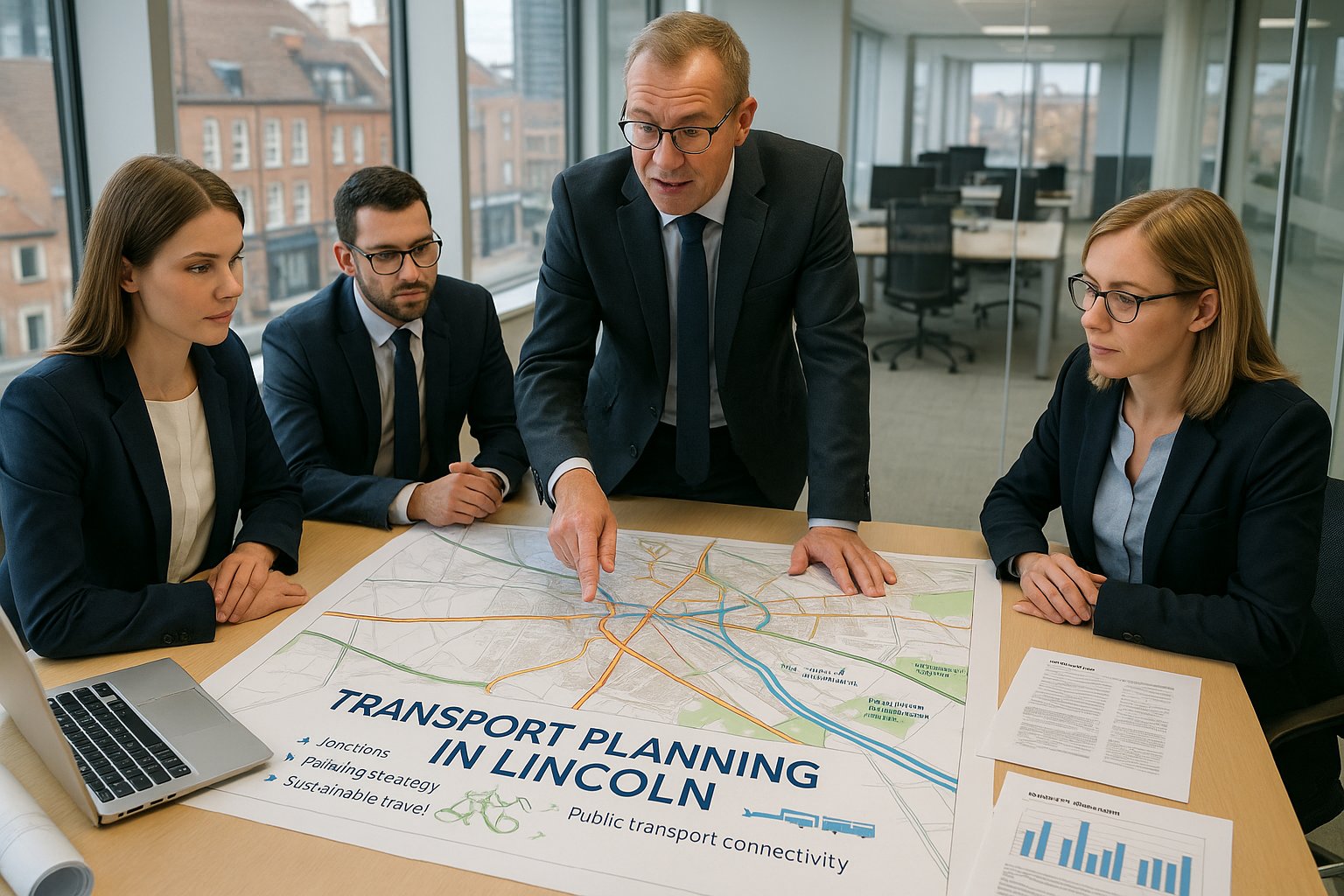
Planning in Lincoln rarely turns on land use alone. Access, traffic impact, sustainable travel, servicing, parking, and highway safety often become the issues that decide whether an application moves smoothly or stalls in consultation. That’s especially true in a city shaped by a historic core, tight streets, strategic radial routes, and clear policy pressure to reduce car dependence.
For developers, architects, planners, surveyors, and legal teams, that means one thing: transport evidence can’t be left until the end. A scheme that looks straightforward on a site plan may trigger detailed questions from both the local planning authority and highway authority once trip generation, junction capacity, pedestrian movement, or servicing are tested properly.
In our experience, good Transport Planning in Lincoln is less about producing a long report for its own sake and more about getting the right scope early, focusing on the junctions and access issues that matter locally, and aligning the development with the ambitions of the Central Lincolnshire Local Plan, the Lincolnshire Local Transport Plan, and the Lincoln Transport Strategy. If that work is done well, planning risk usually drops. If it’s done late, delay tends to creep in.
This guide sets out what developers need to know in 2026: when transport evidence is likely to be needed, which documents commonly support an application, the local constraints that shape assessments in Lincoln, and the practical steps that make approvals more achievable.
Why Transport Planning Matters In Lincoln’s Planning Landscape

Lincoln is not a place where transport can be treated as a standard planning checkbox. The city’s development pattern creates pressure points that are unusually visible in decision-making: a historic centre, constrained bridges and corridors, steep gradients, busy pedestrian areas, and a road network that channels strategic and local traffic through a limited number of critical routes.
That is why transport planning sits so firmly within the policy framework. The Central Lincolnshire Local Plan, the Lincolnshire Local Transport Plan, and the Lincoln Transport Strategy all push in a similar direction: support growth, but do it in a way that improves access to jobs, education, and services while reducing over-reliance on the private car. Walking, cycling, bus use, rail connectivity, and well-planned interchange are not side issues: they are central to whether a scheme is considered sustainable.
In practice, officers and consultees often look beyond the red line boundary very quickly. They want to know how a development connects to the surrounding movement network, whether it worsens pressure on already stressed junctions, and whether the layout genuinely supports non-car travel. In Lincoln, those questions can carry real weight because congestion, air quality, road safety, and public realm are closely tied together.
We also see another local reality: transport concerns are often intertwined with design and heritage. On constrained sites, access geometry, servicing movements, and parking provision can affect frontage design, active travel links, and the quality of the street scene. So transport planning in Lincoln is rarely just about vehicle counts. It is often about proving that a scheme can work in a sensitive urban setting without undermining the city’s wider transport and placemaking objectives.
When A Development In Lincoln Is Likely To Need Transport Evidence

Not every application needs a full Transport Assessment, but many more schemes need transport input than developers first assume. In Lincoln, evidence is typically required where a proposal is expected to create a material increase in trips, servicing activity, parking demand, or pressure on nearby junctions and streets.
The obvious cases are major residential, mixed-use, employment, education, healthcare, and retail schemes. But smaller developments can also trigger requests for transport evidence where the context is sensitive. A modest city-centre proposal, for example, may raise questions about servicing, delivery timing, pedestrian conflict, taxi activity, or displaced parking even if overall vehicle generation is not especially high.
Applications are also more likely to need transport evidence where they affect important parts of the network, including the A46 bypass, A15, A57, A1434, and key approaches into the city centre. If the development traffic routes through constrained junctions or onto roads already operating under pressure at peak times, the need for analysis increases quickly.
Sensitive uses matter too. Schools, student accommodation, care uses, healthcare facilities, and schemes with concentrated arrival and departure patterns can create transport issues out of proportion to their floorspace. Likewise, developments in highly walkable central locations may still need a strong transport case to justify reduced parking or a car-lite approach.
The safest position is usually to confirm requirements early through local validation guidance and pre-application discussion with City of Lincoln Council and Lincolnshire County Council. We’ve found that early agreement on scope often avoids a common problem: an application being submitted with too little evidence, only for the highway response to ask for more modelling, more surveys, or a revised travel strategy halfway through determination.
Common Transport Documents Required For Planning Applications
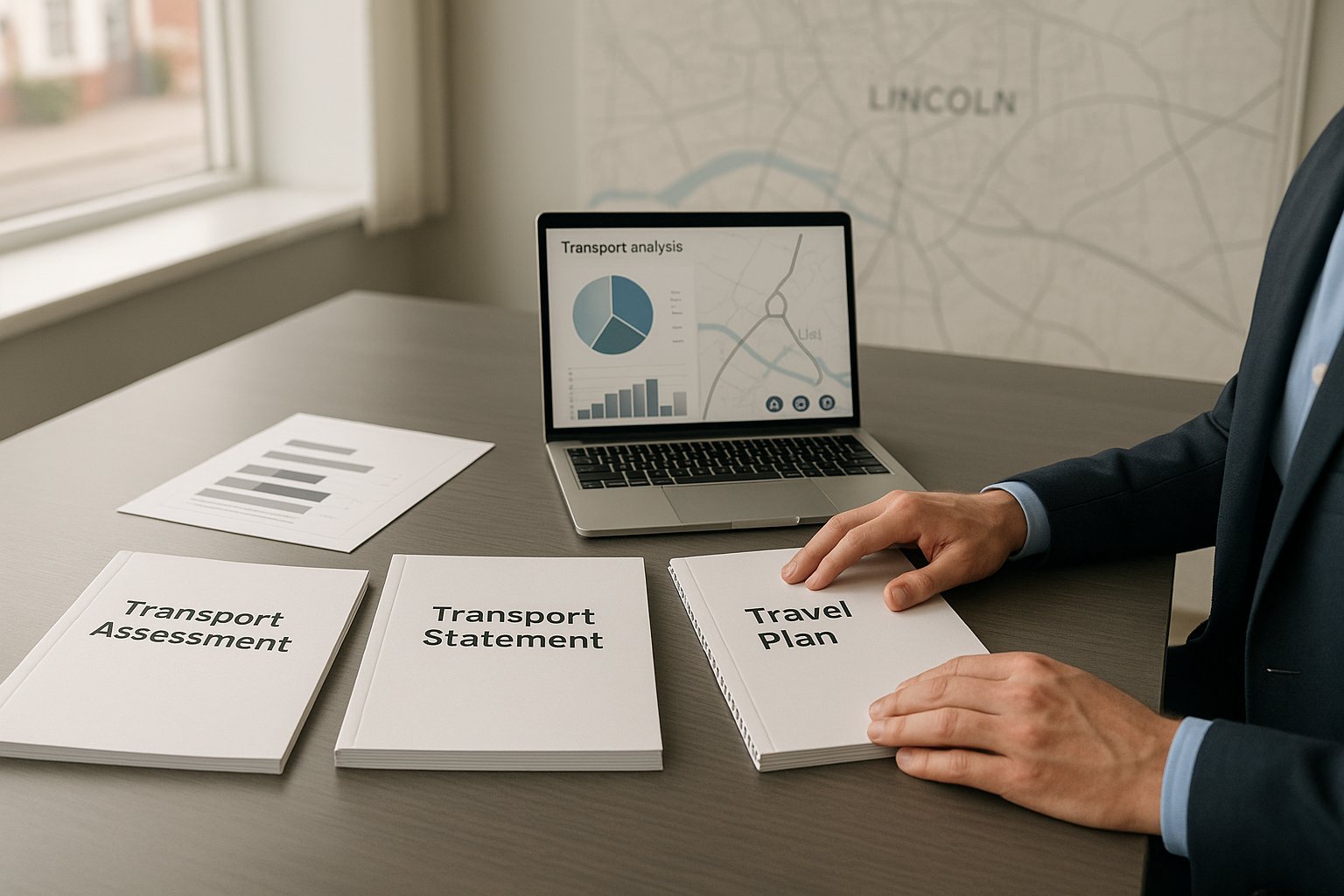
The documents required depend on scale, location, and likely impact, but there is a fairly familiar hierarchy in Lincoln planning work. At the core are Transport Assessments, Transport Statements, Travel Plans, and shorter Technical Notes prepared to answer specific points.
The important thing is proportionality. Decision-makers generally do not want unnecessary paperwork, but they do expect the right evidence in the right format. A well-scoped package should explain existing conditions, estimate demand credibly, test network effects where needed, and show how sustainable access and mitigation have been built into the scheme.
For developers, the practical distinction matters because the wrong document can create delay. A report that is too slight for the site may be challenged. Equally, an over-engineered report can waste time and budget without improving the planning outcome. Good transport planning is about matching evidence to risk.
Key Local Factors That Influence Transport Planning In Lincoln
Local context shapes almost every transport judgement in Lincoln. Two sites with similar floor area can require very different evidence depending on whether they sit in the historic core, on an edge-of-centre corridor, or near a strategic route.
That is why generic assumptions can be risky. A standard national assessment approach still matters, of course, but it has to be adapted to Lincoln’s geography, movement patterns, and policy priorities. The city’s topography, heritage assets, rail and river constraints, central interchange, and strategic road dependencies all influence how access and impact are assessed.
Understanding those local factors early helps in two ways. First, it improves the technical case by focusing surveys and modelling on the right issues. Second, it allows scheme teams to shape layout, servicing, parking, and travel plan measures before those choices harden into planning problems.
How A Lincoln Transport Planning Assessment Is Typically Prepared
A robust assessment usually starts with scoping. Before traffic counts are commissioned or trip rates discussed, it is sensible to agree the broad study area, likely assessment years, committed development assumptions, and the level of technical work expected by the highway authority. That early alignment is one of the biggest time-savers in practice.
Next comes the baseline picture. We typically assemble traffic counts, queue observations, speed and turning data, collision records, parking conditions, bus and rail information, and pedestrian/cycle movement data where relevant. In Lincoln, baseline quality really matters because local conditions can vary sharply between the historic centre, university areas, suburban corridors, and strategic approaches.
From there, the assessment moves to trip generation and distribution. That normally involves using comparable sites, census and travel datasets, local mode share evidence, and judgement about how the site’s location affects travel behaviour. A central, walkable site near Lincoln Transport Hub may justify a very different mode split from an edge location with weaker bus access.
The next stage is modelling and testing. Depending on the scheme, that may include junction capacity analysis, network modelling, parking stress review, swept path analysis, or walking and cycling accessibility work. Lincoln applications often need careful attention to peak conditions, committed growth, and the cumulative effect of nearby development.
Finally, the package is translated into deliverables: a TA or TS, site access drawings, a Travel Plan, and any supporting Technical Notes needed for planning submission or later discussion around section 106 and section 278 obligations. Firms such as ML Traffic position their value here by producing concise, locally tailored reports that match authority expectations rather than flooding the application with generic material.
Frequent Planning Risks And Reasons Applications Are Delayed
Most transport-related delays in Lincoln are not caused by exotic technical disputes. They usually come from preventable gaps in scope, evidence, or design.
A common issue is late engagement with Lincolnshire County Council as highway authority. If the study area, survey approach, or modelling method is not discussed early, there is a real chance the submitted work will miss a junction, scenario, or sensitivity test the authority expects. That can set off a frustrating cycle of review and revision.
Another frequent problem is underestimating the importance of strategic routes and peak-time operation. A development may appear acceptable at the site access itself but still draw concern because of impacts on nearby signals, roundabouts, or radial approaches. Where key links already experience pressure, officers will often want confidence that the proposal has considered cumulative effects properly.
Parking and servicing also cause trouble more often than developers expect. Too little parking can lead to overspill and local objection: too much can weaken the sustainability case. And badly resolved servicing can create conflict with pedestrians, cyclists, or heritage-sensitive streets. The same goes for cycle parking and active travel facilities: if they are tokenistic, the Travel Plan reads as wishful thinking.
Then there is the policy mismatch issue. Applications can struggle where the transport narrative leans too heavily on car use and does not convincingly support walking, cycling, bus, and rail access in line with local strategy. In central Lincoln especially, a weak sustainability case can be just as damaging as a weak junction model.
Finally, mitigation must be realistic. If highway works are conceptually vague, land control is uncertain, or Travel Plan measures lack delivery and monitoring detail, consultees may doubt whether the impacts have really been addressed.
How To Strengthen A Planning Application With Early Transport Input
The strongest applications usually treat transport as part of site strategy, not a report commissioned just before submission. That sounds obvious, but plenty of schemes still leave transport input until layouts, parking numbers, and access assumptions are already fixed.
A better approach is to bring transport planning into the design conversation at the site selection or concept stage. We can then test whether the access works, whether the parking level is defensible, how servicing should operate, which junctions may need modelling, and whether a lower-car solution is credible in that location. Those answers are far more useful when the scheme is still flexible.
Early pre-application discussions are equally valuable. Agreeing principles with planning and highway officers can de-risk the application materially, especially on sites with city-centre constraints, heritage sensitivities, or strategic route implications. It also helps the wider consultant team: architects can refine layouts, planning consultants can shape policy arguments, and lawyers can anticipate heads of terms.
The practical goal is alignment. Layouts should support realistic walking and cycling routes, convenient cycle storage, legible bus access, and sensible servicing. Parking strategy should reflect actual local conditions rather than default standards applied without context. Travel Plan measures should be built into the scheme from day one, not attached as a last-minute appendix.
Early modelling can also be powerful. Even a preliminary test can show whether a junction issue is manageable through design tweaks, signal optimisation, contributions, or a different trip distribution assumption. That is much cheaper to solve on a draft plan than after objections land.
In short, early transport input strengthens planning applications because it turns uncertainty into evidence. And in Lincoln, that often makes the difference between a scheme that feels prepared and one that feels hopeful.
Conclusion
In Lincoln, transport evidence is rarely a procedural extra. It is often a central part of whether development is judged acceptable, deliverable, and policy-compliant. The city’s historic centre, constrained streets, strategic road dependencies, and strong push toward sustainable travel mean access and movement issues can shape planning outcomes very quickly.
For developers and their teams, the lesson is straightforward: start early, scope properly, and tailor the evidence to Lincoln rather than relying on generic assumptions. A clear TA or TS, a realistic Travel Plan, sound modelling where needed, and a scheme design that genuinely supports walking, cycling, bus and rail access will usually travel much better through the planning process.
Done well, Transport Planning in Lincoln reduces avoidable risk. It can shorten consultation loops, support negotiations on mitigation, and improve confidence among officers, consultees, and stakeholders. And in a planning environment where delay is expensive, that is not a technical detail. It is a commercial advantage.
Transport Planning FAQs for Lincoln Developments
Why is transport planning particularly important in Lincoln?
Transport planning in Lincoln is vital due to the city’s historic core, narrow streets, steep topography, and strategic radial routes. These factors, combined with local policies prioritising sustainable travel, make access, traffic impact, and highway safety key to successful planning applications.
When is transport evidence required for a planning application in Lincoln?
Transport evidence is typically required when a development generates significant additional trips, affects key junctions or strategic routes like the A46 or A15, involves sensitive uses such as schools or healthcare, or is located in constrained areas like the city centre.
What types of transport documents support planning applications in Lincoln?
Common documents include Transport Assessments (full impact analysis), Transport Statements (for smaller schemes), Travel Plans promoting sustainable travel, and Technical Notes addressing specific issues like junction modelling or parking surveys, all tailored to local requirements.
How can early transport planning input strengthen a Lincoln planning application?
Engaging transport consultants early allows testing of access, parking, and mitigation options aligned with local strategies. Early discussions with planning authorities help agree scope, reduce risks of delays, and enable design adaptations that support walking, cycling, and public transport access.
What local factors must be considered in transport planning assessments in Lincoln?
Assessments must consider Lincoln’s historic streets and gradients, the role of Lincoln Transport Hub, sustainable transport priorities, key radial routes, junction capacity, pedestrian flows, and heritage sensitivities to ensure developments fit local context and policy ambitions.
How does Lincoln’s transport policy promote sustainable travel in development planning?
The Central Lincolnshire Local Plan and Lincoln Transport Strategy prioritise reducing car dependence by encouraging walking, cycling, bus, and rail use. Developments are expected to support accessible, low-car lifestyles with well-planned interchange and active travel facilities to improve air quality and reduce congestion.