
Planning applications rarely fail on design alone. More often, they slow down because a practical question hasn’t been answered well enough: how will people, vehicles, deliveries and parking actually work on the site? That’s where transport statement consultants come in.
For architects, planners, developers, solicitors and local authorities, a good Transport Statement can be the difference between a clean validation process and weeks of avoidable back-and-forth. It gives the planning authority a clear, evidence-based explanation of likely transport effects, usually for schemes where impacts are real but not significant enough to justify a full Transport Assessment. In other words, it fills the gap between “no transport input needed” and “this needs a major technical package”.
In our experience, the challenge isn’t simply producing a document. It’s producing the right document for the scheme, the site and the local authority involved. Thresholds vary. Expectations vary. Even small access or parking issues can become sticking points if they’re not handled properly at the outset.
In this guide, we’ll break down what transport statement consultants do, when you need one, how a Transport Statement fits into the planning process, and what to look for when appointing a consultant in 2026. If you need reports prepared quickly and accurately, tailored to local authority requirements, that early clarity matters more than ever.
What Transport Statement Consultants Do And When You Need One

A transport statement consultant assesses how a proposed development will interact with the surrounding transport network and presents that evidence in a concise technical report for planning. The work usually covers site access, parking, servicing, likely vehicle and person trips, and whether the proposal raises any highway safety or operational concerns.
The key point is proportionality. A Transport Statement is normally used where impacts are expected to be limited, but the local planning authority still needs formal transport evidence. That might be because the site has constrained access, parking is sensitive, deliveries need explanation, or the authority’s validation checklist asks for a transport submission above a certain threshold.
In practice, we’re often brought in when a project team wants to avoid two common mistakes: submitting no transport evidence when one is needed, or commissioning an overly complex package for a relatively modest scheme. Neither helps programme or budget.
You may need a consultant when:
- the council’s local validation list asks for a Transport Statement
- the proposal changes access, parking or servicing arrangements
- neighbouring roads are sensitive or already under pressure
- there are likely questions from highways officers
- a design team needs transport input before layouts are fixed
For many planning applications, the consultant’s value lies as much in judgement as in writing. A well-pitched report can reassure officers, address foreseeable objections early, and keep the application moving.
How A Transport Statement Supports The Planning Application Process

A Transport Statement supports planning by translating site and traffic issues into a form the local planning authority can assess. Planning officers, highways officers and sometimes elected members want to know whether the development can be safely and reasonably accommodated. The statement answers that question with evidence rather than assumption.
At validation stage, it can satisfy a formal requirement. If the council expects transport information and it isn’t provided, the application may not even be registered. That’s the blunt reality.
Beyond validation, the statement helps frame the conversation around the scheme. It explains existing conditions, summarises likely demand, reviews access and parking, and sets out why the proposal is acceptable in transport terms. Where needed, it can also recommend proportionate mitigation, such as visibility improvements, revised servicing arrangements, cycle parking, or modest layout changes.
A strong statement does three things well:
- It answers the right questions. Not every site needs junction modelling or extensive surveys.
- It reflects policy and local standards. That includes parking standards, access guidance and development plan policy.
- It anticipates officer concerns. Highway safety, overspill parking and servicing conflicts come up again and again.
When done properly, the report becomes a practical decision-making tool. It gives planners confidence that transport effects have been thought through, and that the scheme is credible on the ground, not just on a drawing.
Transport Statement Vs Transport Assessment Vs Travel Plan
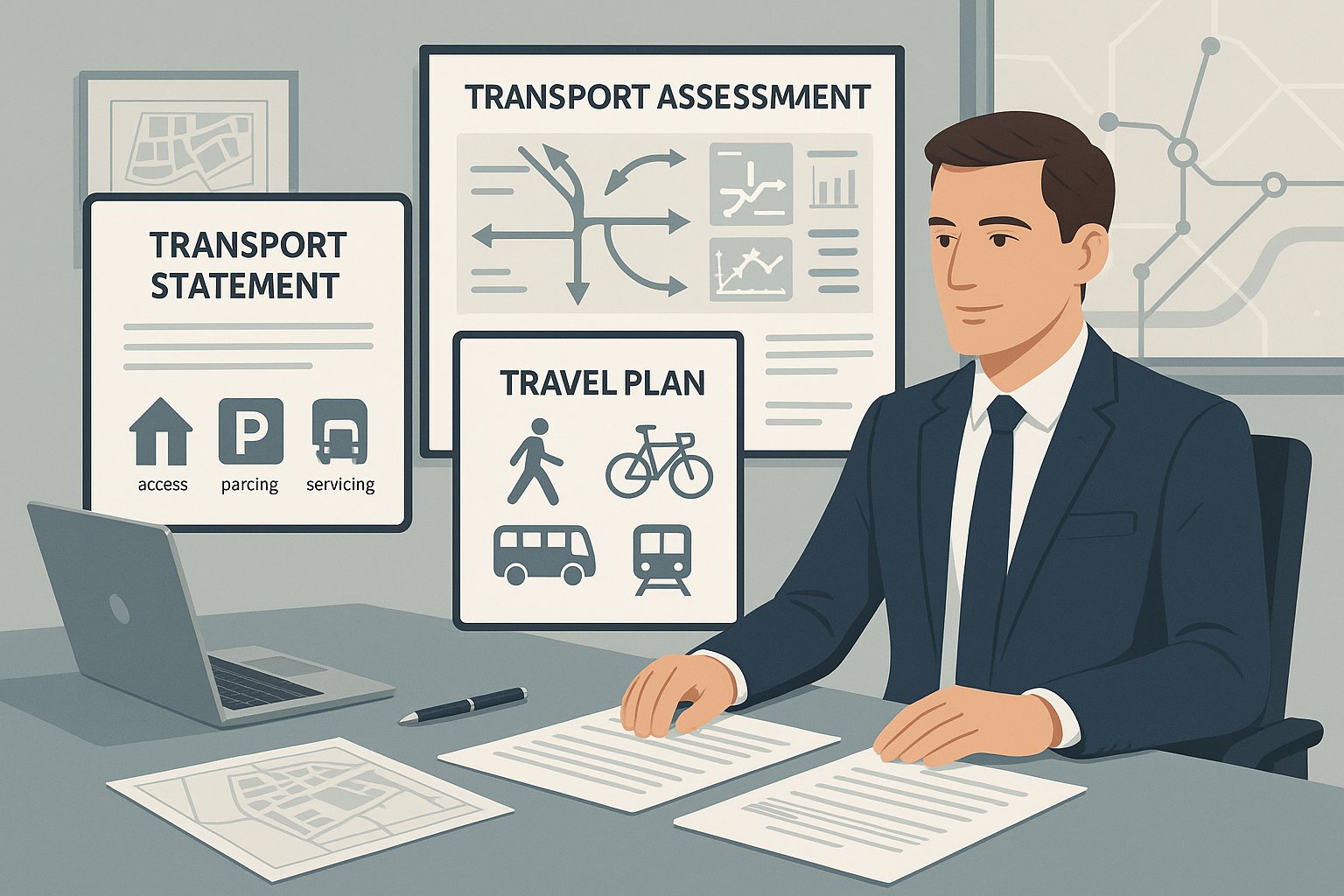
These documents are related, but they are not interchangeable.
A Transport Statement (TS) is generally the lighter-touch option. It’s used for schemes with relatively limited transport impacts, where the authority still needs technical evidence on access, parking, servicing and likely trip effects. It tends to be concise, focused and proportionate.
A Transport Assessment (TA) is more detailed. It is usually required where a development is larger, more complex, or more likely to create noticeable effects on the highway network. A TA may involve wider scoping, more extensive traffic data, junction capacity assessment, scenario testing, and a deeper look at cumulative impacts.
A Travel Plan is different again. Its purpose is behavioural rather than purely analytical. It sets out measures to encourage sustainable travel choices and reduce reliance on private car use. On some projects, a Travel Plan accompanies a TS or TA rather than replacing it.
A simple way to think about it:
- TS: explains limited transport impacts
- TA: analyses greater or more complex impacts in detail
- Travel Plan: manages future travel behaviour
The confusion usually starts when teams assume a smaller scheme can’t possibly need transport input. Sometimes it can. Equally, not every development needs the full weight of a Transport Assessment. Good consultants help define the right level of work early, which saves both time and money.
Typical Developments That Require A Transport Statement
Transport Statements crop up across a wide range of planning applications. The common thread is not simply land use: it’s whether the proposal changes how a site is accessed, parked, serviced or used in a way that needs formal explanation.
Smaller developments can still trigger transport concerns. A modest infill scheme on a tight urban site may raise more practical highway questions than a larger proposal on a well-served plot. That’s why relying on unit numbers alone can be risky.
We often see Transport Statements requested for proposals where:
- access is substandard or being altered
- parking provision is constrained or policy-sensitive
- servicing arrangements need to be demonstrated
- the surrounding highway network has known safety issues
- the site sits in a town centre, conservation area or dense residential area
The requirement may come from national guidance, local validation lists, discussions with the case officer, or pre-application advice. And sometimes the most sensible route is to prepare a statement voluntarily because it resolves likely objections before they gather momentum.
In short, a Transport Statement is not reserved for “big” development. It is reserved for development that needs proportionate transport evidence.
Residential, Mixed-Use, Commercial, And Change-Of-Use Schemes
Residential schemes are one of the most common triggers, especially where access geometry, parking stress, refuse vehicle movements or visibility splays need careful explanation. Even a relatively small housing proposal can prompt highways questions if it sits on a narrow road or introduces a new junction.
Mixed-use projects often need transport input because different uses create different movement patterns across the day. A scheme with flats above retail, for instance, may need a clear explanation of servicing, cycle parking, delivery activity and whether shared access arrangements are workable.
Commercial development can require a Transport Statement where staff travel, customer arrivals, servicing or parking demand need to be justified. This includes offices, light industrial units, roadside uses, nurseries, gyms and local retail proposals.
Change-of-use schemes are frequently underestimated. On paper, the building already exists. In reality, the use may generate very different traffic or parking effects. Converting a shop to a hot-food takeaway, a house to an HMO, or offices to a clinic can alter trip patterns significantly enough for the local authority to ask for transport evidence.
The lesson is simple: the planning transport question is usually about impact, not just floorspace.
Why Local Authority Thresholds And Validation Requirements Matter
Local authority thresholds matter because they shape both whether a Transport Statement is required and what it must contain. There is no single national trigger that works identically everywhere. Councils interpret policy through their own local validation lists, parking standards, design guides and highway priorities.
That means a proposal that passes cleanly in one borough may attract a transport request in another. Frustrating? Sometimes, yes. But entirely normal.
From a programme perspective, this matters at the very start. If the authority expects transport evidence and it is missing, validation can be delayed. If the wrong level of evidence is submitted, officers may ask for further information later, which can be just as disruptive.
Consultants with strong local authority knowledge tend to add value here. They understand not just the published thresholds, but the practical expectations of the highways team. Some authorities are particularly focused on parking stress. Others care deeply about access geometry, refuse tracking, or town-centre servicing.
At ML Traffic, this is where experience counts: matching the report to the relevant planning context instead of producing a generic document that could have been written for any site in any district.
Put plainly, thresholds are not box-ticking trivia. They set the rules of engagement for the application.
What A Consultant Will Usually Review Before Preparing The Report
Before drafting begins, a competent consultant will test the site and scheme from several angles. The aim is to identify what the authority is likely to ask, what evidence is needed, and whether any transport issues should be resolved in the design first.
That review usually starts with the red-line boundary, proposed use, scale of development, access arrangements, parking layout and servicing concept. Then it expands outward to the surrounding street network, nearby junctions, sustainable transport options, site constraints and planning policy.
This is also the point where missing information can derail progress. If vehicle swept paths haven’t been checked, if parking numbers don’t match the drawings, or if visibility splays are impossible within the applicant’s control, the report can’t convincingly paper over those issues. Better to spot them early.
Good consultants don’t just describe a scheme: they pressure-test it. We want to know whether the proposal works in real conditions, not only in planning language.
Trip Generation, Site Access, Parking, Servicing, And Highway Safety
Trip generation is a core part of the review. The consultant will consider how many movements the development is likely to create, when they occur, and whether those movements are materially different from the existing or fallback use. That comparison is often crucial, especially on change-of-use sites.
Site access comes next: geometry, visibility, junction form, pedestrian routes, conflict points and whether vehicles can enter and leave safely.
Parking is rarely just a numbers exercise. A sound review looks at policy standards, layout quality, disabled provision, cycle parking, likely overspill effects and the surrounding parking context.
Servicing also matters more than many applicants expect. Deliveries, refuse collection and occasional larger vehicles need a workable arrangement, particularly on constrained urban plots.
And then there’s highway safety. Accident history, road layout, speed environment and visibility constraints all influence whether the authority sees the proposal as acceptable. If a site has a sensitive frontage or awkward access, these issues need careful treatment, not optimistic wording.
Data Collection, Surveys, And Technical Evidence Behind The Statement
A credible Transport Statement stands on evidence. The exact evidence depends on the scheme, but most reports draw from a mix of desk-based review and site-specific observation.
That can include site visits, measured visibility checks, traffic counts, parking beat surveys, pedestrian environment review, collision data, public transport accessibility, and planning policy analysis. National datasets may help, but they rarely tell the whole story on their own. Local context usually decides whether a point is persuasive.
For example, if the key issue is on-street parking pressure, a generic statement that “parking is available nearby” won’t do much good. A properly timed parking survey, with photos and occupancy analysis, is far more useful. Likewise, if access safety is questioned, measured visibility and a clear review of actual road conditions carry weight.
The level of technical evidence should still remain proportionate. A Transport Statement is not meant to mimic a full Transport Assessment. But it does need enough substance to withstand scrutiny from highways officers and, if necessary, objectors.
Typical evidence inputs include:
- site appraisal and photographs
- local policy and validation review
- trip generation estimates or comparative use analysis
- parking accumulation or beat surveys
- servicing observations and swept path review
- collision record analysis
- walking, cycling and public transport context
Done properly, evidence gives the report confidence. Without it, conclusions can look thin very quickly.
Common Reasons Transport Statements Delay Or Undermine Applications
Most problematic Transport Statements fail for ordinary reasons, not exotic ones. They’re too generic, too thin, or too disconnected from the actual site.
One common issue is scoping the work badly. The report may ignore the concern the authority actually cares about, such as overspill parking, refuse access or unsafe egress. Another is relying on assertions without evidence. If a statement claims impacts are negligible but provides no survey work, no comparative analysis and no site-specific reasoning, officers are unlikely to be reassured.
We also see delays caused by mismatch between drawings and text. Parking spaces shown on one plan disappear on another. Servicing assumptions don’t reflect the architect’s layout. The report describes an access arrangement that highways drawings don’t support. These inconsistencies invite further queries.
Other recurring problems include:
- failing to address local validation requirements
- underestimating change-of-use impacts
- weak visibility or access analysis
- ignoring nearby constraints such as schools, controls or narrow streets
- omitting cycle parking or sustainable travel context
- submitting too late for design changes to be made efficiently
The biggest problem, though, is often trying to “write around” a genuine issue instead of solving it. If the parking is inadequate or the access is poor, the better approach is to revise the scheme and then report it clearly. Planning teams usually save time by confronting transport problems early, not by hoping they pass unnoticed.
How To Choose Transport Statement Consultants For Your Project
Choosing between transport statement consultants is partly about qualifications, but more about relevance, judgement and reliability. You need someone who can prepare a technically sound report, yes, but also someone who understands planning risk, local authority expectations and the realities of project timescales.
Start with direct experience in comparable schemes. A consultant who mainly handles strategic highway modelling may not be the best fit for a tight urban change-of-use application with parking and servicing sensitivities. Likewise, someone who only produces very small statements may struggle if a project sits on the border between TS and TA.
Look for evidence of practical planning support, not just report writing. Can they advise at pre-app stage? Can they review layouts before submission? Will they deal with officer queries after the application goes in?
In our view, the best appointments usually share a few traits:
- they scope work proportionately
- they understand local authority transport expectations
- they communicate clearly with architects and planners
- they flag risks early rather than burying them
- they can move quickly without becoming careless
That last point matters. Fast turnaround is valuable, but only if the report still feels tailored, accurate and defensible. In planning, speed without judgement tends to create work later.
Questions To Ask About Experience, Timescales, And Local Authority Knowledge
A short call with a prospective consultant can tell you a lot. We’d ask practical questions, not just generic ones.
For example:
- Have you worked in this local authority area before?
- What similar schemes have you recently supported?
- Do you think this project needs a TS, a TA, or something more limited?
- What surveys or site visits are likely to be required?
- What could delay the report or create planning risk?
- How long will the work take, including drawings review and revisions?
- Will you respond to highways officer comments after submission?
The answers should feel specific. If everything sounds interchangeable, that’s a warning sign. Good consultants usually have a clear initial view on likely issues, even before formal appointment.
It is also worth asking who will actually do the work. Senior oversight is useful, but the day-to-day author needs enough experience to spot problems and make sound judgement calls. A polished fee proposal means little if the final report reads like a template.
What To Expect On Fees, Programme, And Deliverables
Fees for Transport Statements vary with complexity. A straightforward scheme with an uncomplicated access arrangement and minimal survey needs will usually cost less than a constrained urban site requiring parking surveys, servicing analysis, design coordination and follow-up with the authority.
The main factors affecting cost are:
- scale and type of development
- local authority requirements
- need for surveys or measured site work
- complexity of access, parking or servicing issues
- whether drawings, swept paths or junction advice are needed
- likely rounds of revision or post-submission support
Programme is just as important as fee. Some reports can be turned around quickly, particularly where drawings are stable and evidence needs are light. Others take longer because survey windows, design coordination or authority-specific issues need more care. In practice, unrealistic promises on timing are often a red flag.
Deliverables commonly include the written Transport Statement itself, appendices with technical evidence, site location and access plans, parking or servicing analysis, and occasionally swept path material or supporting notes. For some applications, a concise technical package is enough. For others, there may be linked work such as a Framework Travel Plan or highway input to planning conditions.
A good proposal should set out scope, assumptions, exclusions, likely surveys, delivery timescales and whether responses to officer comments are included. Clarity here avoids disputes later.
And that’s really the point. The cheapest fee is rarely the cheapest outcome if the report causes delay, rework or refusal.
In 2026, choosing the right transport statement consultants is less about buying a document and more about securing planning-ready judgement. The right consultant will understand the scheme, the site and the local authority: identify risks early: gather proportionate evidence: and produce a report that planners and highways officers can actually rely on. For busy architects, developers, surveyors and councils, that combination saves time where it matters most: before avoidable transport issues start steering the application. If a project needs transport input, it pays to appoint someone who can do more than fill pages. They need to make the planning case stand up in the real world.
Frequently Asked Questions about Transport Statement Consultants
What do transport statement consultants do for a planning application?
Transport statement consultants assess a proposed development’s impact on site access, parking, servicing, trip generation, and highway safety. They prepare concise technical reports that provide evidence to the local planning authority for schemes with limited transport effects, helping to ensure smooth validation.
When is it necessary to appoint a transport statement consultant?
You typically need a transport statement consultant when the local authority’s validation checklist requires one, or if a development alters site access, parking, or servicing arrangements. They are essential where there are sensitive neighbouring roads or likely highways officer queries.
How is a Transport Statement different from a Transport Assessment or Travel Plan?
A Transport Statement is a proportionate, lighter-touch report for developments with limited transport impacts. Transport Assessments are more detailed analyses for larger schemes with significant effects, while Travel Plans focus on encouraging sustainable travel behaviours rather than technical impact assessments.
What types of developments commonly require a Transport Statement?
Developments such as residential projects, mixed-use schemes, commercial sites, and change-of-use proposals often need a Transport Statement if they affect access, parking, servicing, or trip generation, especially in sensitive or constrained locations.
Why do local authority thresholds and validation requirements matter for Transport Statements?
Local authority thresholds determine if and what type of transport evidence is required for validation. These vary by council, affecting when a Transport Statement is compulsory and what it must contain to avoid delays or refusals in the planning process.
How should I choose the right transport statement consultant for my project?
Select consultants with experience relevant to your scheme type and local authority area, who provide proportionate scoping, understand local transport policies, communicate clearly, offer realistic timescales, and handle post-submission queries effectively for smooth planning approval.