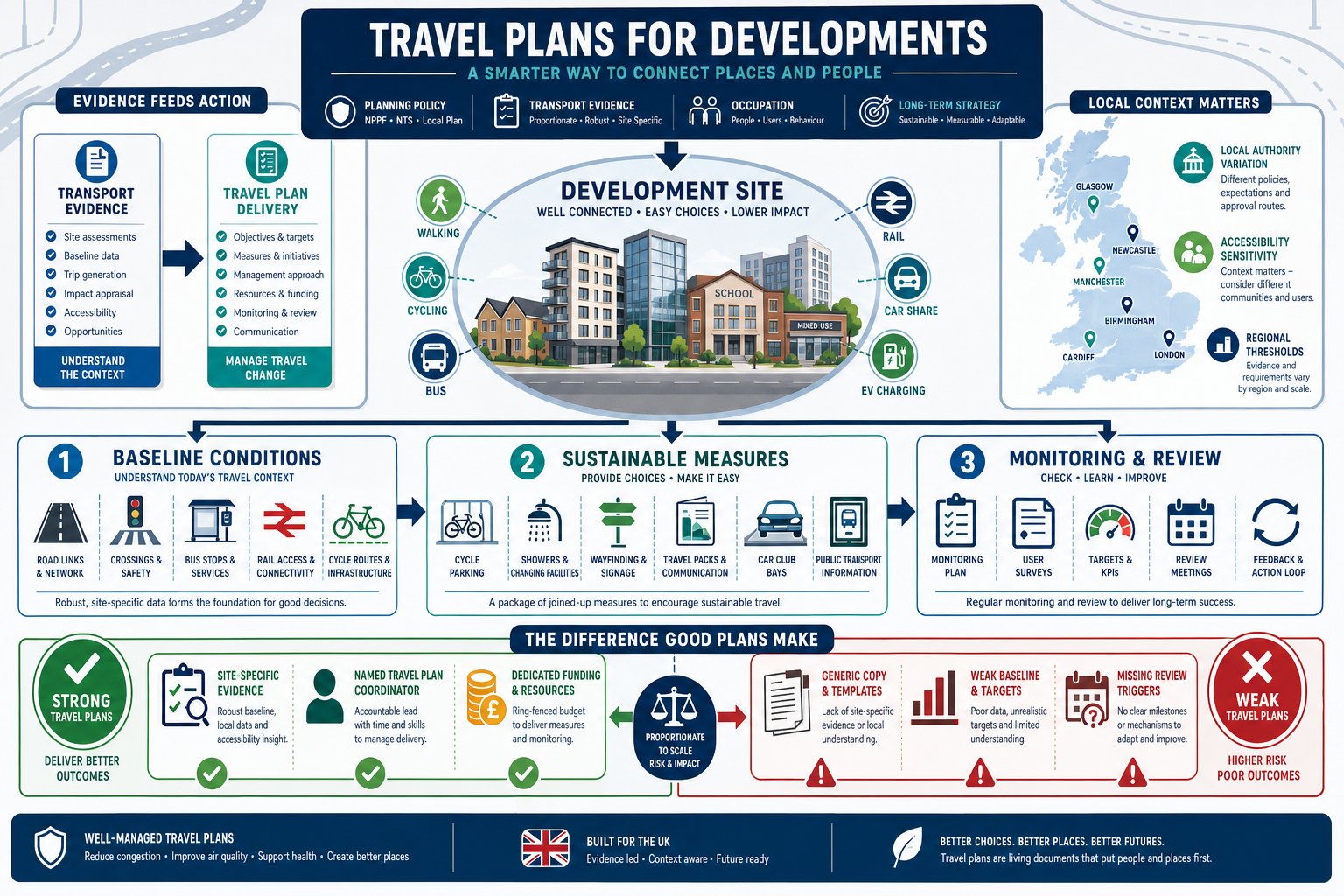
A weak Travel Plan can turn an otherwise well-designed scheme into a slow, expensive planning headache. A strong one does the opposite: it shows that a development can work in the real world, not just on a red line boundary plan. For architects, planners, developers, lawyers and local authorities, that matters more than ever in 2026, when planning scrutiny around accessibility, climate impact and highway pressure is only getting tighter.
In practice, travel plans for developments sit at the point where planning policy, transport evidence and day-to-day occupation all meet. They are not just paperwork added at the end of an application. They are the operational strategy for how people will actually reach a site, how reliance on private cars can be reduced, and how sustainable travel choices can be made realistic rather than aspirational.
We see this first-hand across residential, commercial, education and mixed-use schemes. The difference between a generic, copy-and-paste document and a site-specific, policy-aware Travel Plan is usually obvious to a case officer within minutes. And that difference can affect validation, negotiation, conditions and, eventually, whether a proposal feels deliverable.
This guide explains what a Travel Plan is, when it is needed, how it differs from a Transport Assessment or Transport Statement, what an effective plan includes, and where applications most often go wrong.
What A Travel Plan Is And Why It Matters For New Developments
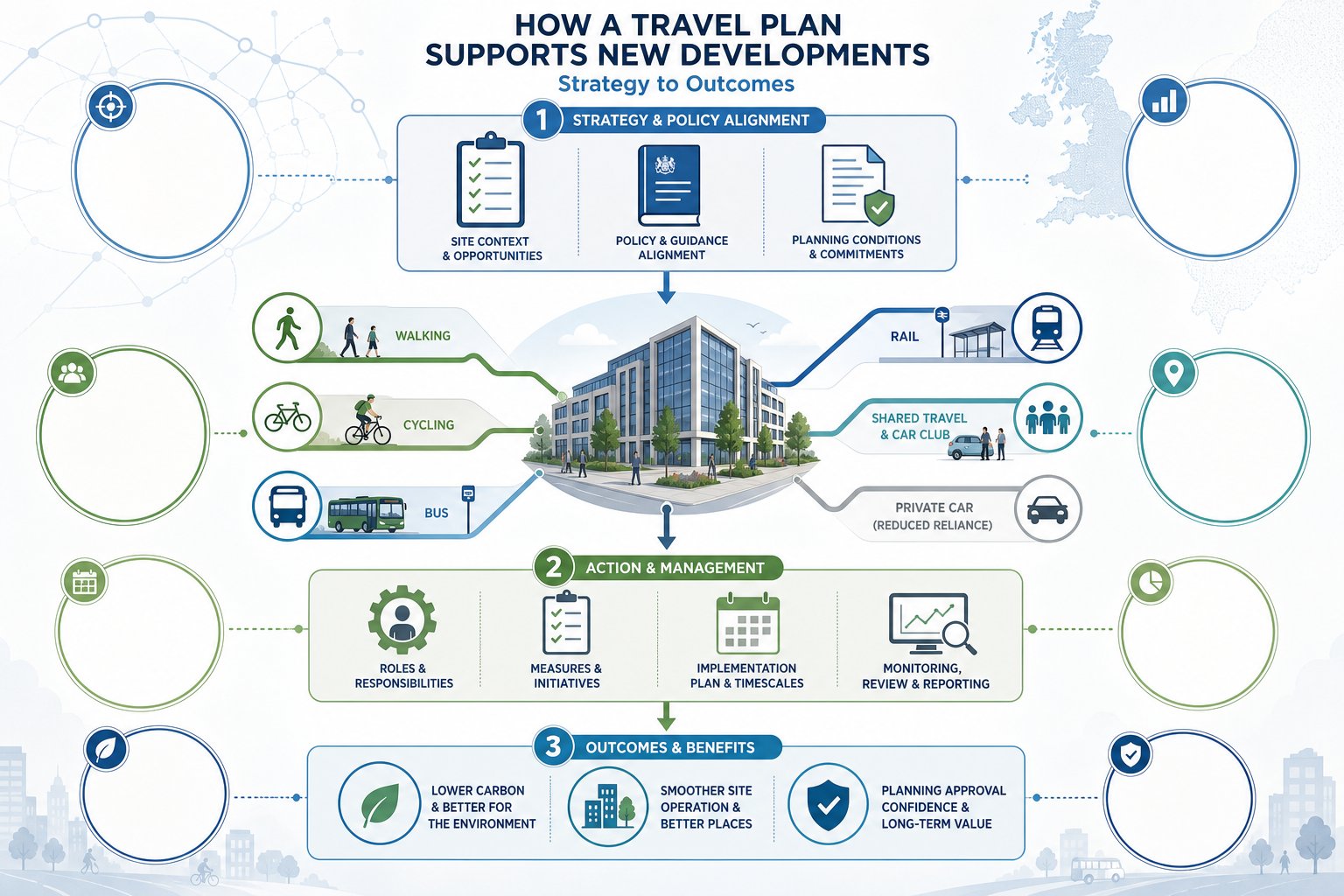
A Travel Plan is a long-term, site-specific strategy designed to manage travel demand and influence how people access a development over time. Its purpose is straightforward: reduce unnecessary car dependence, support walking, cycling, public transport and shared travel, and make sure the transport effects of a scheme are actively managed after permission is granted.
That last point is important. A Travel Plan is not just descriptive: it is meant to do something. It sets objectives, identifies practical measures, assigns responsibility, and creates a framework for monitoring whether the development is actually performing as intended.
For planning teams, the value is twofold. First, it helps demonstrate compliance with national and local policy that increasingly prioritises sustainable and active travel. Second, it gives local authorities confidence that the applicant has thought beyond vehicle access drawings and trip generation tables. A site may be technically accessible, but if occupiers are still likely to default to single-occupancy car trips, the planning risk remains.
In that sense, Travel Plans are often the behavioural counterpart to technical transport evidence. They bridge policy ambition and lived reality. On more complex schemes, they also sit alongside wider transport work such as a transport assessment for planning applications, helping turn identified issues into an ongoing management response.
Done properly, they support lower-carbon development, better site operation and more defensible planning submissions.
When A Travel Plan Is Required For A Planning Application
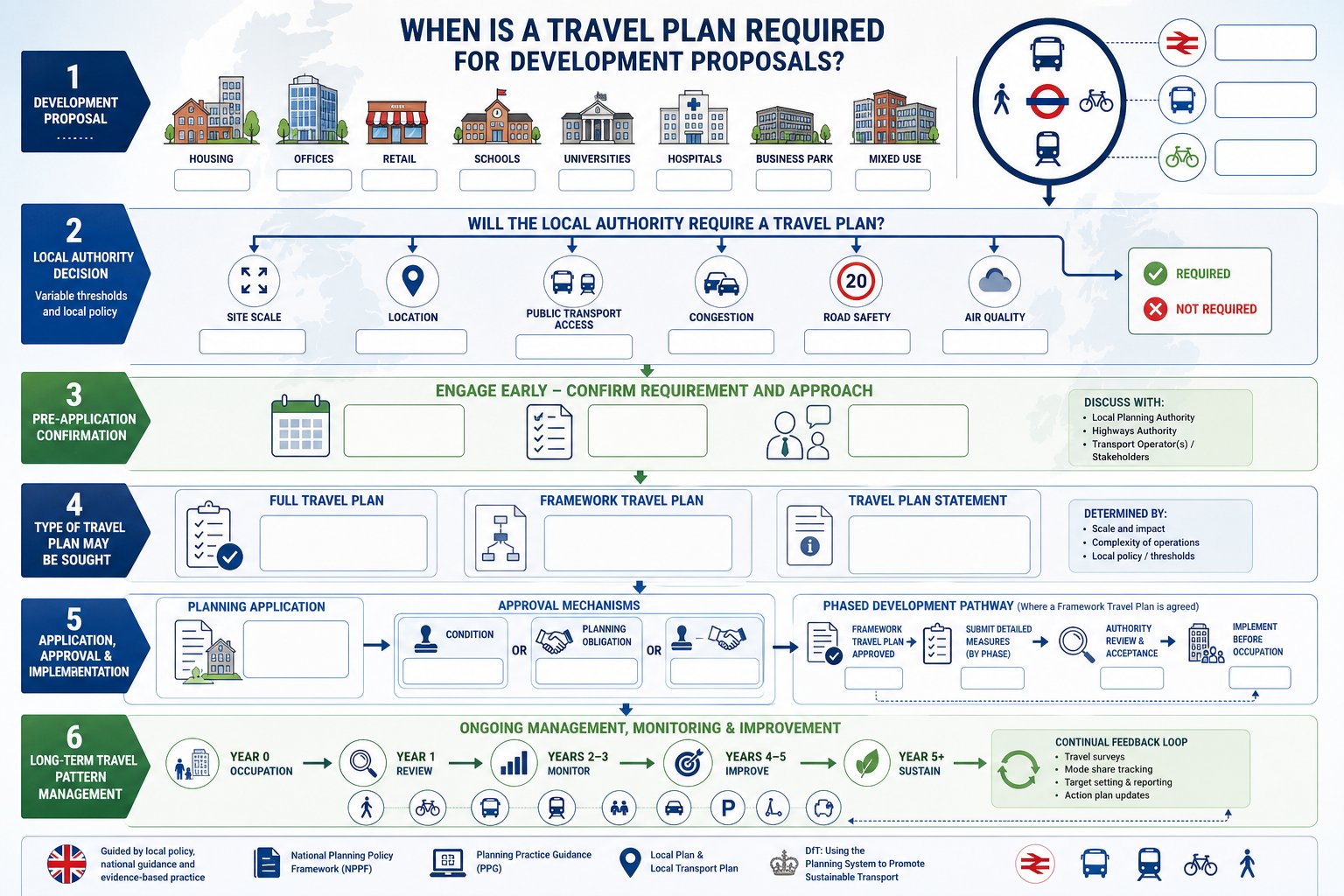
A Travel Plan is usually required when a proposal is likely to generate significant movement or where the site raises particular transport sensitivity, even if the scheme is not enormous in floor area or unit count. In the UK planning context, that commonly includes larger housing developments, offices, retail, schools, universities, healthcare facilities, business parks and mixed-use schemes.
There is no single national threshold that applies uniformly everywhere. Local planning authorities set their own validation requirements and development thresholds, often through local guidance, supplementary planning documents or county-wide transport notes. That means a Travel Plan requirement can vary not only by land use and scale, but also by site location, public transport accessibility, existing congestion, road safety issues and air quality concerns.
In practical terms, applicants should not leave this question until submission week. We usually advise confirming likely requirements at pre-application stage, especially where a full Travel Plan, an outline framework Travel Plan or a lighter-touch Travel Plan Statement may be acceptable. Early transport input often saves time later, particularly when coordinated with wider Private Sector Transport Planning for the scheme.
Most authorities expect the Travel Plan to be submitted with the planning application, then secured by condition, planning obligation or both. On phased developments, a framework version may be approved first, followed by more detailed travel planning before occupation.
The main point is simple: if a development will materially affect travel patterns, the authority will usually want a credible strategy for managing that impact over several years, not just at opening day.
How Travel Plans Differ From Transport Assessments And Transport Statements
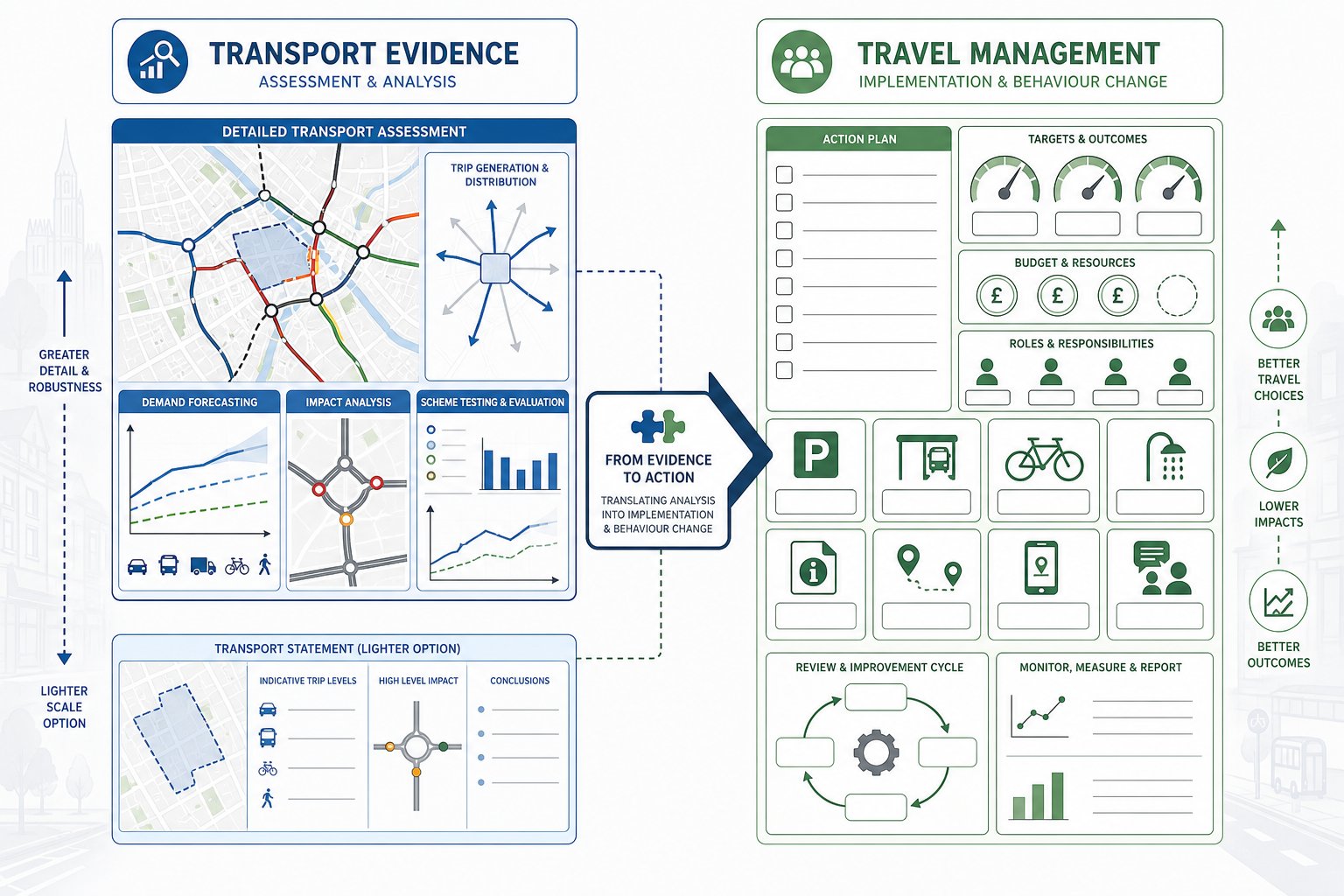
This distinction causes more confusion than it should. A Transport Assessment or Transport Statement evaluates the likely transport effects of a proposal. A Travel Plan sets out how those effects will be managed and how sustainable travel behaviour will be encouraged once the development is built and occupied.
So, the assessment asks: what trips will the scheme generate, on which modes, on which routes, and with what impact? The Travel Plan asks: what are we going to do about that in practice?
A full Transport Assessment is generally used for larger or more complex proposals where detailed forecasting, junction analysis, accessibility review and mitigation testing are needed. A Transport Statement is typically proportionate to smaller schemes with lower impacts. Either can inform a Travel Plan. The Travel Plan then takes the evidence base and translates it into measures, targets, responsibilities, budgets and review mechanisms.
For example, if the transport evidence shows good bus accessibility but weak cycling uptake, the Travel Plan might include secure cycle storage, shower provision, travel information packs, personalised journey advice and monitored mode-share targets. If parking demand risks undermining sustainable objectives, parking management becomes part of the strategy too, often aligning with a wider Parking Strategy For a site.
In short: the TA or TS is the evidence document: the Travel Plan is the management document. One explains likely impacts. The other commits the developer or occupier to a route for reducing them over time.
Core Elements Of An Effective Travel Plan
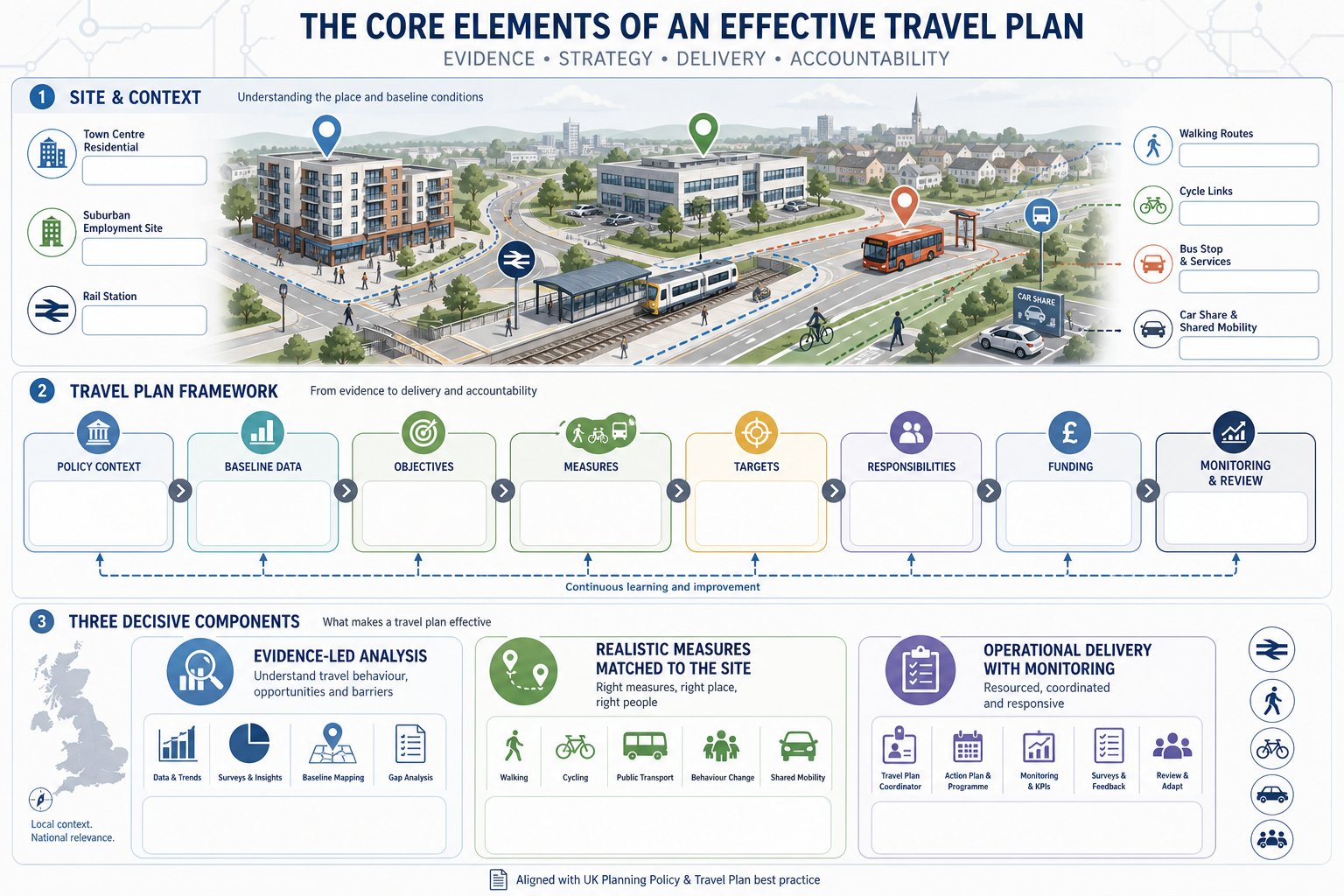
A good Travel Plan is specific, proportionate and usable. It should reflect the actual development, the actual place and the actual people likely to use it. Generic wording is the quickest way to weaken credibility.
Most effective plans share the same backbone: policy context, baseline conditions, clear objectives, a realistic package of measures, defined targets, named responsibilities, funding assumptions and a monitoring framework. But the quality lies in the detail. A suburban logistics-adjacent employment site will not need the same strategy as an infill town-centre residential scheme next to a rail station.
Authorities will also want to understand who owns delivery. Is there a Travel Plan Coordinator? When are surveys undertaken? What happens if targets are missed? How are residents, staff, pupils or visitors informed? If those questions are left hanging, the document can look more aspirational than operational.
At our end of the sector, we find the strongest plans are built from evidence up rather than policy down. They respond to the transport realities of the site and then tie those realities back to planning policy, rather than starting with a list of fashionable measures and hoping they fit.
The three components below tend to decide whether a Travel Plan feels robust or routine.
Baseline Travel Conditions And Site Accessibility
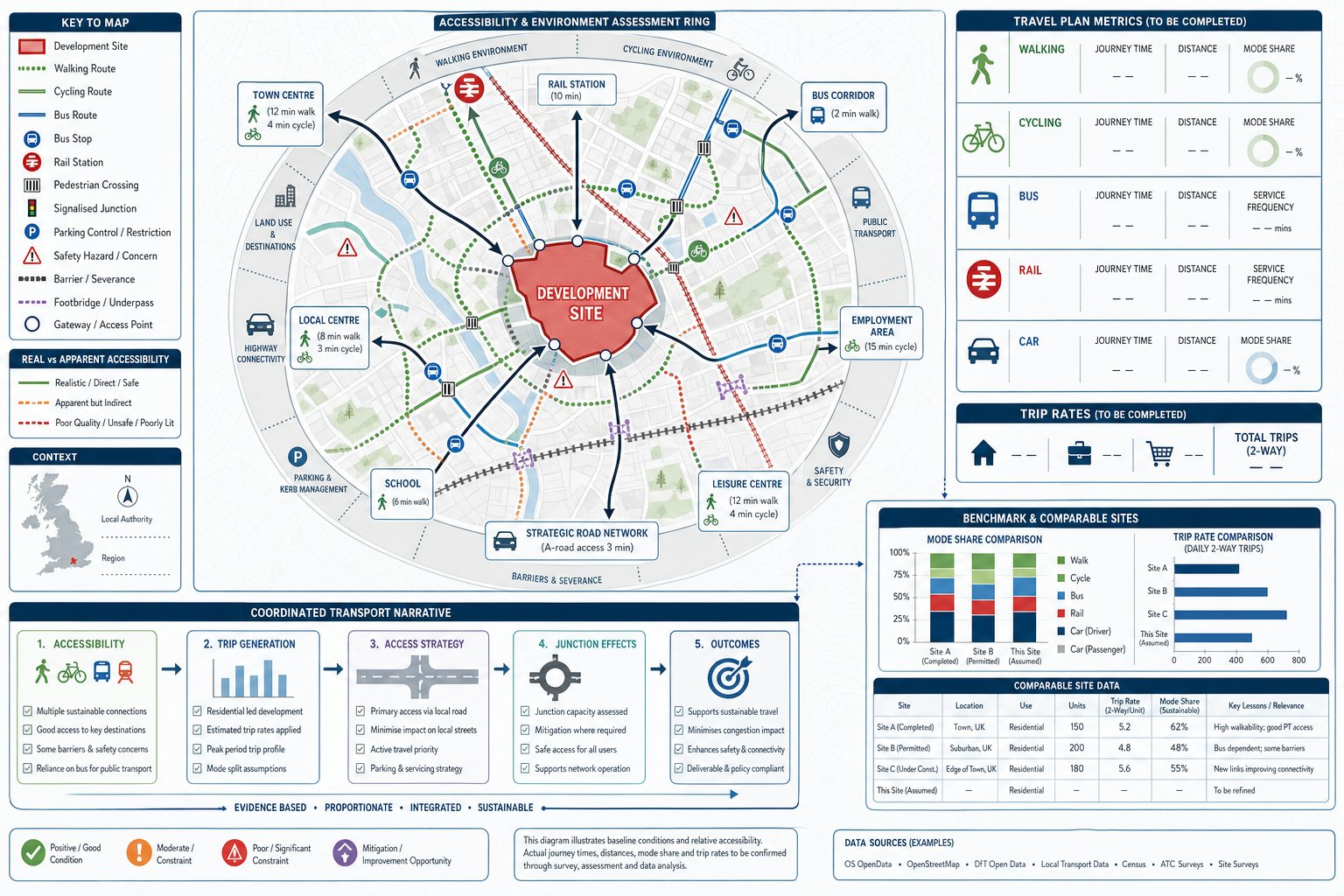
Baseline work is where the Travel Plan either earns trust or loses it. Before proposing measures, we need to understand existing and likely travel conditions in a way that is site-specific and defensible.
That usually means reviewing local highway context, walking and cycling links, bus and rail availability, service frequency, journey times, pedestrian crossing opportunities, parking controls, road safety issues and barriers to sustainable access. On occupied or comparable sites, surveys can help establish current mode share. For many developments, TRICS data and comparable site evidence are used to benchmark trip rates and likely travel patterns.
Accessibility analysis should be practical, not just cartographic. A bus stop within 400 metres may look good on a plan, but if the route is poorly lit, indirect or severed by a difficult crossing, its real value is lower. The same applies to cycle routes that technically exist but feel unsafe at peak periods.
Baseline evidence also needs to align with the broader technical transport case. If trip generation, access strategy and junction effects are being considered separately, the narrative should still be coherent. That is one reason developers often coordinate Travel Plans with wider Property Development Transport input, so the sustainable access story and the impact story do not drift apart.
Without a solid baseline, every later target and measure becomes harder to justify.
Measures To Encourage Sustainable Travel Choices
Measures should match the users of the site and the barriers identified in the baseline. That sounds obvious, but it is where many plans become vague. Effective measures are usually a mix of physical infrastructure, information, incentives and management controls.
For walking and cycling, common interventions include direct and legible pedestrian routes, secure and conveniently located cycle parking, showers and lockers for staff, improved crossings, signage and links into existing active travel networks. For public transport, measures may include upgraded stops, real-time information, journey planning packs, ticket discounts or travel vouchers during the first occupation phase.
Car-related measures matter too, especially when the aim is not to ban car use but to manage it sensibly. Reduced parking restraint without a workable alternative can backfire: equally, generous unregulated parking can undo the entire plan. Car-share spaces, car club provision, EV charging, priority bays for pooled trips and permit management can all play a role.
Behaviour-change measures are often undervalued. A clear site welcome pack, personalised travel planning, school travel initiatives, staff induction messaging and periodic promotional campaigns can shift habits, particularly in the first year of occupation. Where development impacts are more acute, these measures may complement findings from a traffic impact assessment, ensuring mitigation is both physical and behavioural.
The key is integration. Measures work best as a package, not as isolated bullet points.
Targets, Monitoring And Review Mechanisms
Targets turn a Travel Plan from a statement of intent into a management tool. Without them, there is no meaningful way to judge whether the strategy is succeeding.
Targets should be quantified, time-bound and proportionate to the scheme. They might relate to reductions in single-occupancy car commuting, increases in cycling mode share, uptake of public transport, or limits on total vehicular trip growth. On some developments, interim targets over one, three and five years are more realistic than a single long-range headline figure.
Monitoring then provides the evidence. Depending on the site, this may involve annual or biennial resident, staff or pupil travel surveys, parking beat surveys, cycle parking occupancy checks, visitor questionnaires or reviews of public transport ticket use. Reporting arrangements should be clearly stated, including when reports go to the local authority and who signs them off.
Review mechanisms are just as important. If targets are not being met, what happens next? A strong plan includes trigger points, corrective actions and a budget route for additional measures. Otherwise, monitoring becomes a box-ticking exercise with no consequence.
This is where governance matters. Named responsibility, realistic funding and authority engagement make a difference. In many cases, input from Transport Planning Consultants: What applicants need can help ensure the plan is enforceable, proportionate and credible rather than merely well-worded.
Types Of Development That Commonly Need Travel Plans
Not every planning application needs a full Travel Plan, but some categories of development attract them regularly because of the scale, intensity or pattern of trips involved. In broad terms, the more a scheme changes travel demand, the more likely it is that a Travel Plan will be expected.
Local authority thresholds vary, yet the same recurring development types appear across county guidance and validation lists. Residential expansion can alter peak movements and school-run patterns. Employment sites can generate concentrated commuter trips. Retail and leisure proposals often create weekend and evening peaks, with higher visitor variability. Public sector uses may involve a mix of staff, visitors, service vehicles and vulnerable users.
The right response is not always the same document. Some authorities will accept a framework or interim plan at outline stage: others will expect a fully formed Travel Plan with clear monitoring obligations from the outset. The form may differ, but the principle does not: where sustainable access needs active management, the authority will usually want that strategy on paper.
Below are the development types most commonly associated with Travel Plan requirements and the particular issues they tend to raise.
Residential, Mixed-Use And Commercial Schemes
Residential developments often need Travel Plans because they create long-term travel behaviour, not just construction traffic. Once patterns of school escorting, station access, food shopping and commuting settle in, they are hard to change. That is why authorities frequently want early occupation measures such as resident travel packs, cycle storage, pedestrian links, car club information and public transport incentives.
Mixed-use schemes add another layer. They may combine homes, retail, workspace and leisure in ways that can reduce external trips if planned well, or intensify local pressure if planned badly. The Travel Plan hence needs to address multiple user groups and different peaks across the day.
Commercial schemes, especially offices, industrial estates and business parks, often hinge on staff travel management. Shift patterns, parking supply, bus accessibility and active travel infrastructure all affect whether sustainable mode share targets are credible. Retail-led schemes can be trickier because visitor trips are less controllable than employee trips, so emphasis often falls on accessibility, signage, parking management and public transport integration.
In these sectors, the strongest submissions are usually the ones that align the Travel Plan with the access strategy, servicing assumptions and wider site operations from the start rather than treating it as the last transport appendix added before submission.
Schools, Healthcare, Leisure And Public Sector Sites
Schools are among the clearest examples of where a Travel Plan is not optional in any practical sense, even when local guidance leaves room for interpretation. Arrival and departure peaks are intense, parking stress is immediate, and road safety concerns around the school gate can dominate local objections. Effective school Travel Plans usually combine pupil and staff surveys, walking initiatives, cycle training, drop-off management and close monitoring after opening or expansion.
Healthcare sites have a different complexity. Hospitals, clinics and care settings operate across staggered shifts, emergency access constraints and a broad range of user needs, including patients with limited mobility. A workable Travel Plan must acknowledge those realities while still identifying where staff travel, visitor information and public transport access can be improved.
Leisure venues and public buildings also generate scrutiny because trip patterns can be concentrated, seasonal or event-driven. Stadium-adjacent sites, civic buildings, libraries, colleges and council offices often require plans that manage both regular and occasional demand.
For public sector clients in particular, the Travel Plan can become part planning document, part operational policy. That makes clarity on ownership, monitoring and communication especially important, because implementation usually spans several internal teams rather than a single occupier.
How Local Authorities Assess Travel Plans
Local authorities do not assess Travel Plans in isolation. They read them against planning policy, local transport objectives, site constraints, consultation responses and the accompanying transport evidence. A polished document will not carry much weight if the baseline is thin, the measures are generic or the targets bear little relation to the site.
In most cases, officers and highway advisors look first at policy fit. Does the plan support the National Planning Policy Framework and local plan objectives around sustainable transport, accessibility and healthy place-making? They then move to evidence: is the accessibility review sound, are assumptions transparent, and does the proposed strategy reflect the actual context of the development?
After that comes realism. Targets need to be ambitious enough to matter but not so optimistic that they look fictional. Measures need to be funded, deliverable and timed sensibly. Governance also matters more than many applicants expect. Authorities will want to know who is responsible for implementation, how long monitoring lasts, what reports are submitted, and what remedial steps can be taken if progress stalls.
Experience counts here. Teams producing transport submissions quickly and accurately, with awareness of local thresholds and authority preferences, tend to avoid unnecessary churn. That is one reason specialist consultants with strong regional planning experience are often brought in early, especially where a Travel Plan may be secured through condition wording or legal agreement that needs to be practical post-consent.
Common Mistakes That Delay Approval Or Weaken A Travel Plan
The most common problem is generic drafting. If the Travel Plan could be lifted from a city-centre office scheme and pasted into an edge-of-settlement care home application, it is not ready. Local authorities notice that immediately. Site-specificity is not a nice extra: it is the point of the document.
Weak baseline evidence is another recurring issue. Out-of-date public transport information, no meaningful walk/cycle appraisal, poor comparables, or a mismatch with the Transport Assessment can all undermine confidence. If the evidence base is shaky, the measures and targets built on top of it will be shaky too.
Targets are often either too vague or too bold. Saying the plan will “encourage sustainable travel” is not measurable. Promising a dramatic collapse in car use on a peripheral site with limited bus frequency is not credible. Both approaches cause trouble.
We also see plans with no clear implementation pathway: no coordinator, no budget, no survey timetable, no reporting route and no trigger for remedial action. At that stage, the Travel Plan becomes a planning ornament rather than a management strategy.
And finally, timing. Leaving the document until the end of the application process usually produces a rushed result. A better approach is to develop it alongside the rest of the transport evidence so access, impact, mitigation and behavioural measures all speak the same language. That is where concise, authority-aware reporting can save weeks rather than days.
Conclusion
Travel plans for developments are no longer peripheral planning documents. In 2026, they are part of the core case for why a scheme is accessible, policy-compliant and capable of operating sustainably after occupation. For planning teams, the real task is not simply producing one, but producing one that is site-specific, evidence-led and workable over time.
When the baseline is robust, the measures are realistic, and monitoring has teeth, a Travel Plan can strengthen negotiations and reduce post-submission friction. When it is generic or rushed, it tends to do the opposite.
For developers, designers, consultants and councils alike, the practical lesson is simple: start early, align the Travel Plan with the wider transport strategy, and treat it as a live management tool rather than a last-minute appendix. That is usually the difference between a document that helps secure planning approval and one that merely occupies pages in the application bundle.
Travel Plans for Developments: Frequently Asked Questions
What is a travel plan and why is it important for new developments?
A travel plan is a long-term, site-specific strategy designed to manage travel demand, reduce car dependency, and promote sustainable travel such as walking, cycling, and public transport. It is essential for ensuring developments operate sustainably and comply with planning policy.
When is a travel plan required for a planning application?
Travel plans are typically required for developments that generate significant vehicle trips, including larger housing, offices, retail, education, and healthcare projects. Requirements vary by local authority based on site location, transport impact, and sensitivity.
How does a travel plan differ from a transport assessment or transport statement?
A transport assessment or statement evaluates the transport impacts of a proposed development, while a travel plan outlines the management strategy and practical measures to mitigate those impacts and encourage sustainable travel behaviour over time.
What are the core elements of an effective travel plan for developments?
An effective travel plan includes a detailed baseline of travel conditions, clear objectives, a practical package of measures, defined targets with responsibilities, funding assumptions, and a monitoring and review framework to ensure ongoing deliverability.
Which types of developments commonly need travel plans?
Developments often needing travel plans include residential estates, mixed-use schemes, commercial offices, retail and leisure venues, schools, healthcare facilities, and public sector sites due to their significant and varied travel demands.
How can developers ensure their travel plan meets local authority expectations?
Developers should produce site-specific, evidence-based travel plans aligned with national and local policies. They must include robust baseline data, realistic targets, clear governance, sustainable measures, and a monitoring framework, often developed with specialist transport planning consultants.