
A planning inquiry can turn on one stubborn technical point. Not the glossy visuals, not the broad planning narrative, but the detail: whether a junction really works at peak hour, whether parking stress has been properly measured, whether the evidence is balanced enough for an Inspector to rely on it.
That’s where expert witness planning inquiries UK work becomes so important. In the UK appeals system, expert witnesses don’t simply back up a client’s position. Their job is to assist the Inspector with independent, professional opinion on matters that are genuinely technical or disputed. If the case involves transport, highways, heritage, noise, air quality, flood risk or another specialist issue, the quality of that evidence can shape the outcome.
For architects, planners, lawyers, surveyors, developers, local authorities and project teams, the practical challenge is knowing when expert evidence is needed and how to prepare it properly. Done well, it narrows the issues, strengthens credibility and helps the inquiry focus on what really matters. Done badly, it can unravel under cross-examination.
In this guide, we explain how planning inquiries fit into the wider UK appeals process, what an expert witness actually does, what documents need to be assembled, and how transport and highways evidence is prepared and tested. We also look at the common mistakes that weaken cases and how to choose the right expert first time.
What An Expert Witness Does In A Planning Inquiry
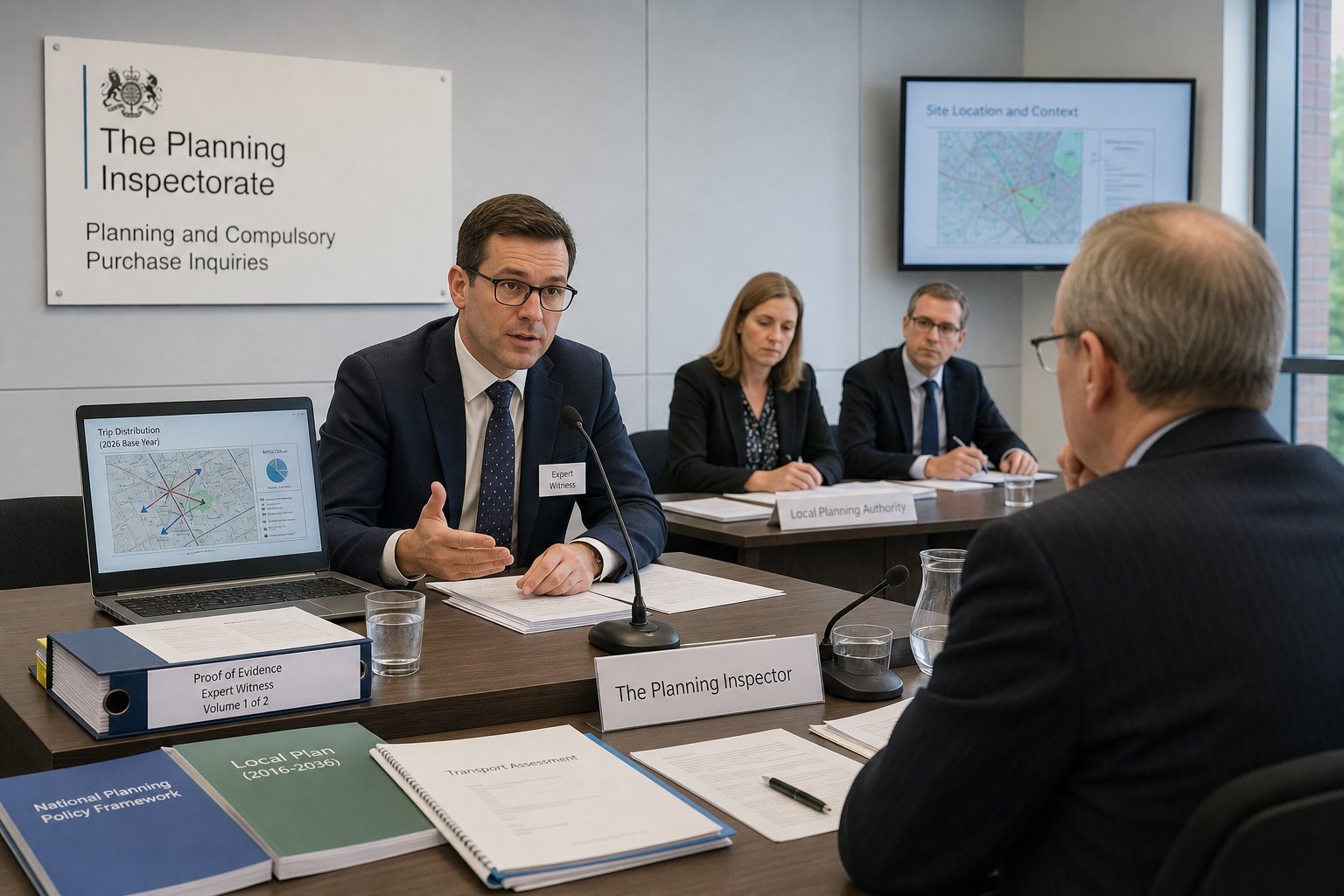
An expert witness in a planning inquiry gives independent opinion evidence within a defined professional discipline. That could be planning, transport, drainage, heritage, landscape, ecology, noise or another specialist field. The crucial point is that the witness is not there merely to argue for the appellant or the council. We should think of the role as assisting the Inspector to understand technical matters that are outside ordinary factual evidence.
In practice, that usually means the expert will:
- explain the methodology behind reports and assessments
- justify assumptions, data sources and modelling choices
- identify where impacts are likely to arise, and how severe they may be
- assess mitigation and whether it is realistic, deliverable and policy-compliant
- help narrow areas of disagreement through a Statement of Common Ground
At inquiry, the expert’s written proof of evidence is often taken as read, so their oral role becomes one of clarification and testing. Can they explain a junction model without jargon? Can they fairly acknowledge limitations in survey data? Can they distinguish between a likely effect and a speculative one?
That mix of technical authority and independence is what gives expert evidence its value. The strongest witnesses are not the loudest. They are the ones whose reasoning stays measured, transparent and defensible from first report to final questions from the Inspector.
How Planning Inquiries Fit Within The UK Appeals Process
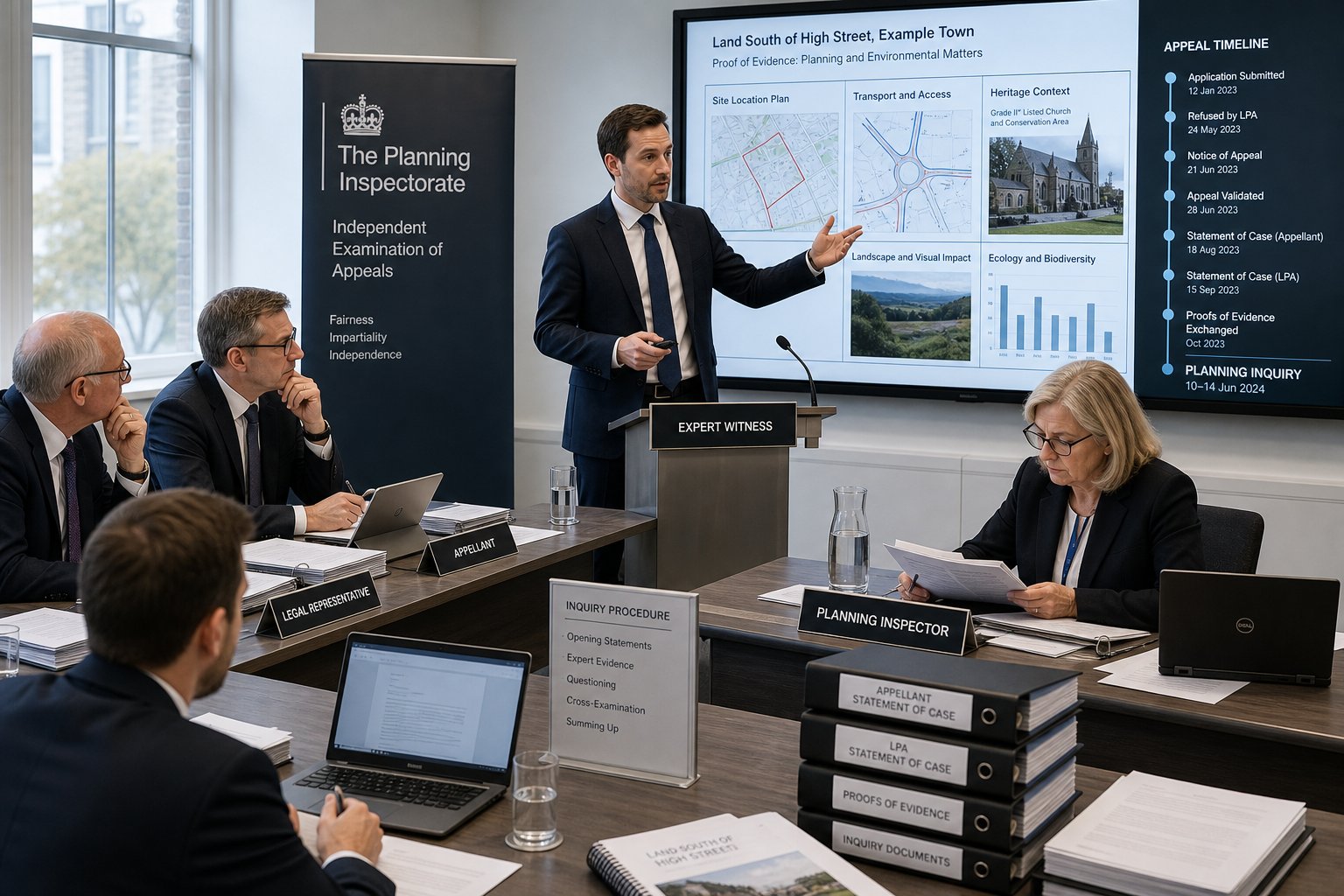
Planning inquiries are one of the procedures used by the Planning Inspectorate to determine appeals in England, with parallel arrangements in the devolved nations under their own systems. They sit alongside written representations and hearings, but are generally reserved for the more complex, technical or controversial cases.
Most often, we see inquiries in section 78 appeals following refusal of planning permission or non-determination. They also arise in called-in applications and, in related forms, within plan-making and examination processes where specialist evidence is heavily contested.
Why an inquiry rather than a hearing? Usually because the case needs formal testing of evidence. If there are substantial disputes on transport impact, heritage harm, viability, environmental effects or policy interpretation, the inquiry format allows witnesses to be cross-examined under a more structured process.
A typical route looks like this:
- planning application is refused, conditioned, or not determined
- an appeal is lodged
- the Inspectorate selects the procedure
- case management directions and timetables are issued
- Statements of Common Ground and proofs are exchanged
- the inquiry sits, evidence is heard, and a decision follows
So, in expert witness planning inquiries UK practice, the inquiry is not the whole appeals system. It is the point in that system where complex evidence is examined in depth, often with real scrutiny and very little room for vague assertions.
When Expert Evidence Is Needed In Planning Cases
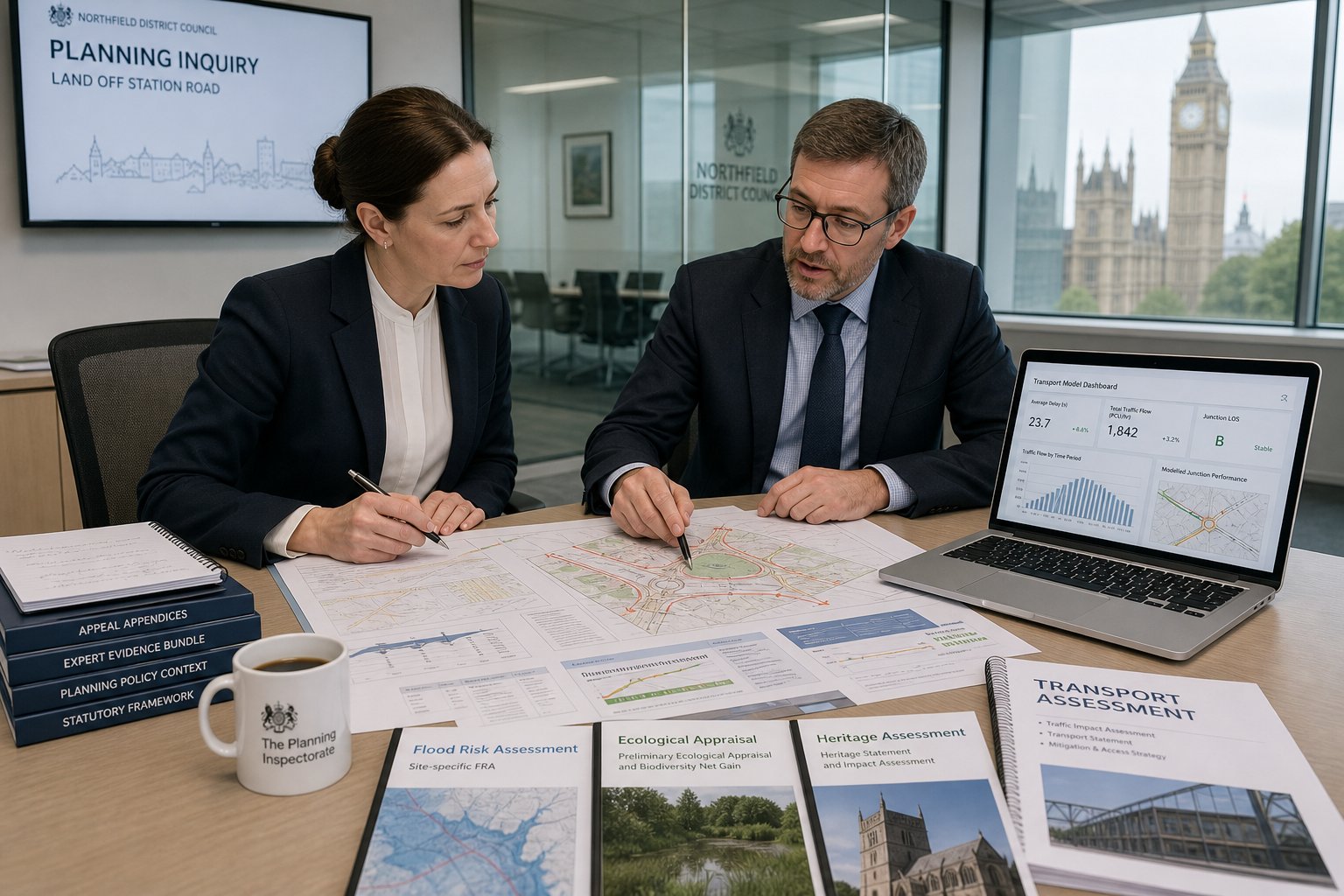
Not every planning appeal needs an expert witness. Some disputes are narrow enough to be dealt with through written submissions or planning judgment alone. But expert evidence becomes important when a case turns on technical matters that are either disputed, complex, or likely to carry significant weight in the decision.
Common triggers include:
- transport and highway impacts
- flood risk and drainage performance
- air quality or noise effects
- ecology and biodiversity issues
- heritage significance and setting
- landscape and visual effects
- viability or deliverability questions
We usually advise bringing in expert support early where the refusal reasons point to measurable impact. For example, if a council says a scheme would create unacceptable highway danger or severe traffic effects, that is not something to leave to broad planning rhetoric. It needs disciplined technical evidence.
The same is true where the other side already has specialist consultants. If one party submits detailed modelling and the other responds with general disagreement, the imbalance shows.
There is also a strategic point here. Early expert input can improve the appeal before the inquiry even starts. It may sharpen mitigation proposals, support a Statement of Common Ground, or expose weak assumptions in the opposing case. Sometimes the expert’s most useful contribution happens before anyone enters the inquiry room.
And yes, that applies especially in transport-led appeals, where small technical points can suddenly become the whole case.
Transport And Highways Evidence In Planning Inquiries
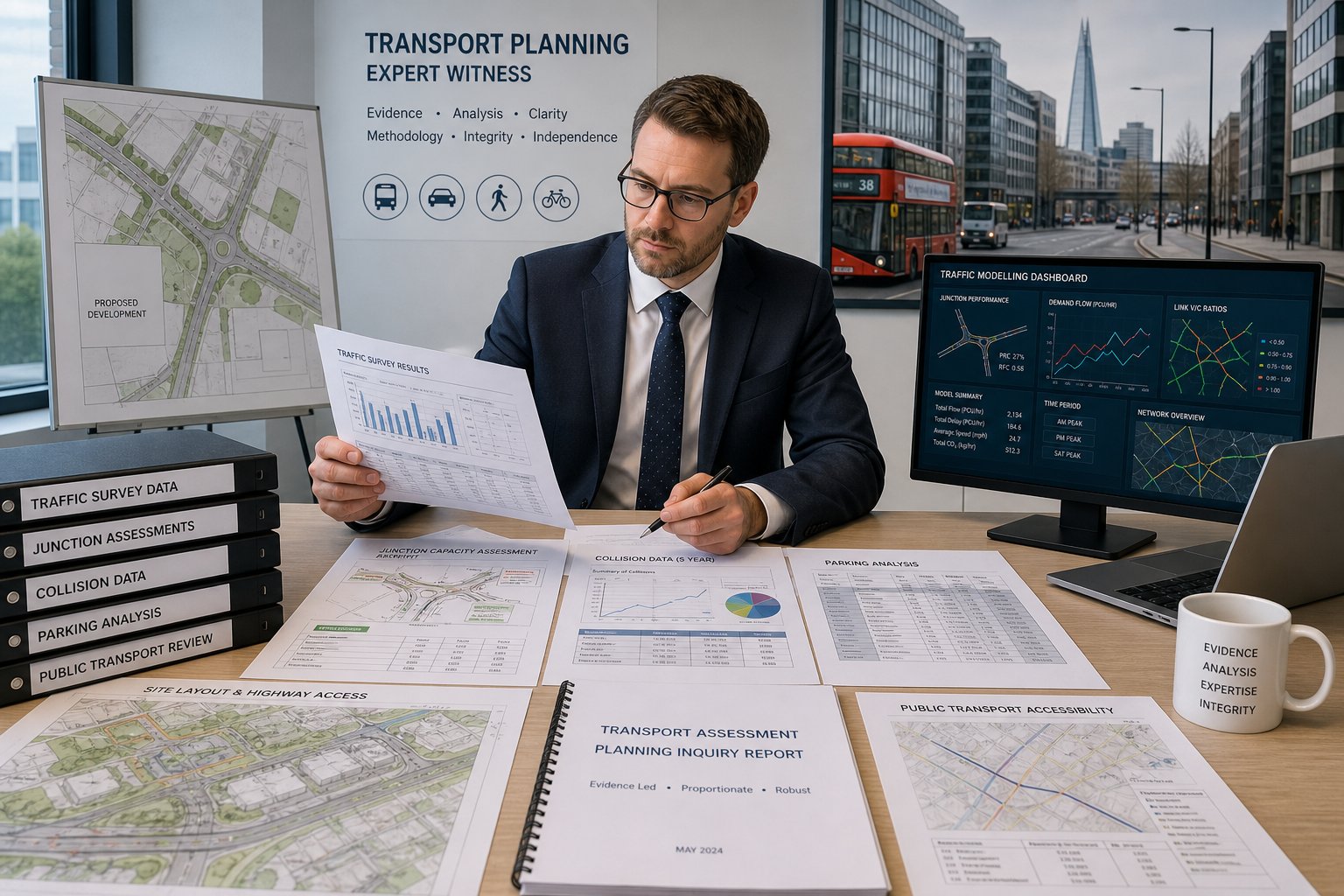
Transport and highways evidence is one of the most common and most heavily scrutinised forms of planning inquiry evidence. That’s because traffic impact is rarely abstract. It tends to involve numbers, modelling, observed conditions, design standards and policy tests that can be examined line by line.
A transport expert witness may be asked to address whether a development creates a severe residual cumulative impact under national policy, whether access is safe and suitable, whether parking provision is adequate, or whether sustainable travel options are realistic in that location.
Typical work includes reviewing traffic surveys, trip generation, distribution and assignment, junction capacity modelling, swept-path analysis, personal injury collision data, parking accumulation, accessibility audits and mitigation packages. On some schemes, the transport case is mainly about one priority junction. On others, it extends to wider network resilience, public transport links and Travel Plan effectiveness.
For project teams, this is where specialist support matters. Firms such as ML Traffic work in this space by preparing concise transport engineering reports aligned to local authority thresholds and planning contexts, which can make a real difference when an inquiry timetable is tight.
The key is not producing the thickest appendix bundle. It is producing evidence that is methodologically sound, transparent and easy for the Inspector to follow.
Who Can Act As An Expert Witness And What Independence Means
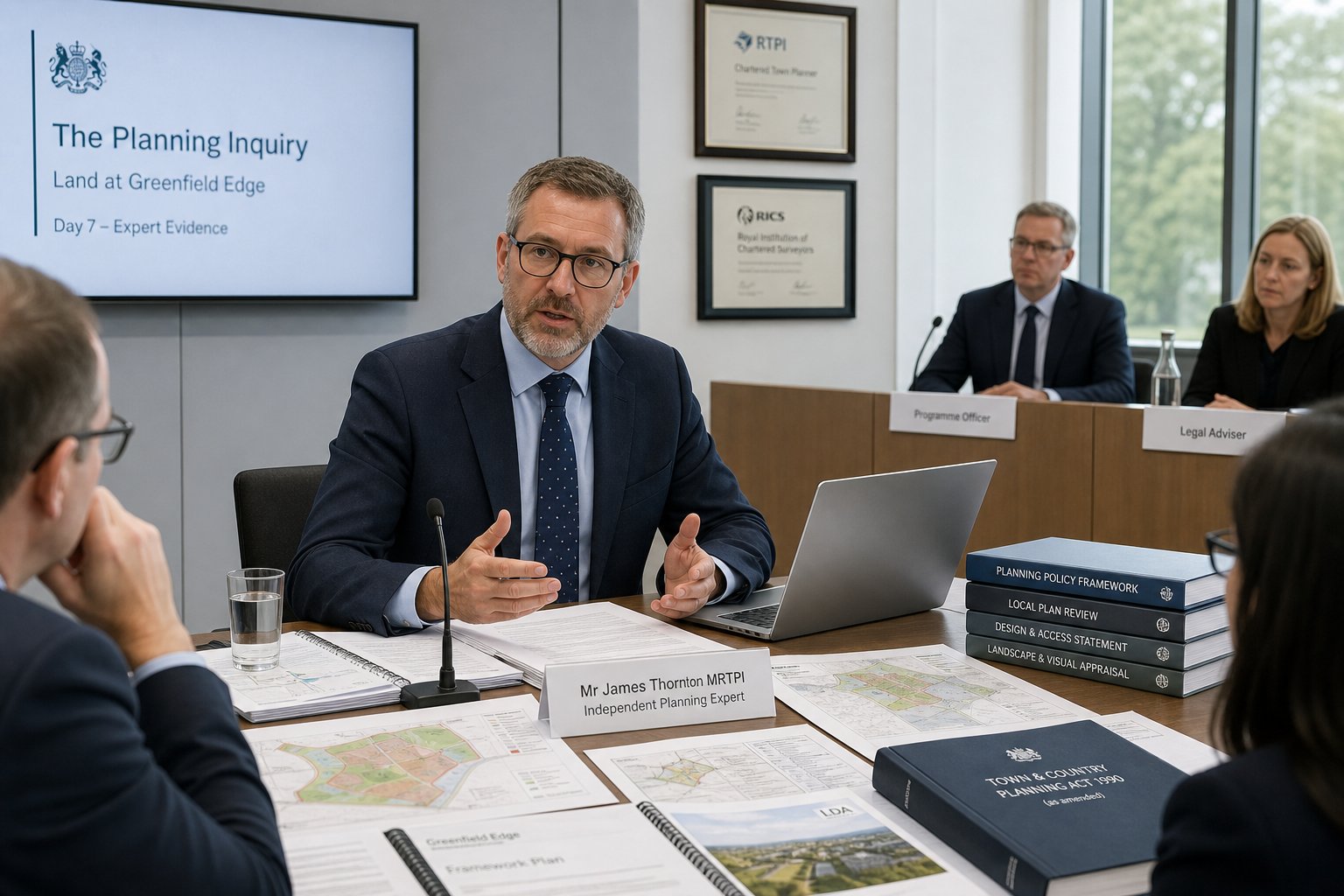
An expert witness must be suitably qualified by knowledge, experience and professional standing in the subject they are addressing. There is no single licence called “expert witness”, but in planning inquiries we would normally expect relevant degrees, substantial practice experience, and membership of appropriate professional bodies such as CIHT, CILT, RTPI or equivalent institutions depending on discipline.
But qualifications alone are not enough. Independence is the real dividing line.
An expert witness owes their primary duty to the Inspector, not to the party paying their fee. That duty requires objective, impartial opinion within the witness’s actual area of expertise. If the evidence starts to read like advocacy dressed up as technical analysis, credibility drops quickly.
In practical terms, independence means:
- acknowledging both strengths and weaknesses in the case
- staying within one’s discipline
- avoiding selective use of data
- making clear where judgment is involved
- changing position if new evidence genuinely justifies it
This can feel uncomfortable for clients who want certainty. But honest evidence is almost always stronger than over-claimed evidence. An Inspector is more likely to trust a witness who concedes a limited point than one who appears determined to defend every last corner of the case.
That’s why the best expert witness planning inquiries UK work is balanced. Firm, yes. Helpful to the client, ideally. But always rooted in professional independence.
Key Documents And Evidence Needed Before The Inquiry
Preparation for a planning inquiry is document-heavy, and for good reason. Expert opinion only carries weight if it is anchored to the right material and presented in an orderly way. Before the inquiry opens, the team should have a clear document structure covering both the appeal case and the technical evidence behind it.
Core documents usually include:
- the planning application and submitted drawings
- the local planning authority’s officer report and decision notice
- relevant development plan policies
- national policy and guidance relied on by either side
- appeal statement and statement of case
- technical reports and appendices
- Statements of Common Ground
- proofs of evidence and summaries
- agreed plans, photos and, where relevant, modelling outputs
For transport cases, the evidential base may also include traffic counts, TRICS analysis, junction models, collision records, accessibility mapping, tracking drawings, parking surveys, Travel Plans and correspondence on mitigation.
One common weakness is leaving technical documents in a half-finished state until too late. If survey notes are unclear, model files are incomplete, or appendices do not match the proof, those gaps become painfully visible under scrutiny.
We usually recommend building the inquiry bundle backwards from the likely disputed issues. What exactly will the Inspector need to understand and test that issue? If the answer is obvious from the document set, preparation is on the right track.
How Proofs Of Evidence, Statements, And Rebuttals Are Prepared
A proof of evidence is the expert witness’s formal written evidence for the inquiry. It is not just a recycled technical report. It should set out qualifications, instructions, the scope of evidence, the relevant facts and policy context, the professional methodology used, the witness’s opinion, and the conclusions reached. A summary is normally provided as well.
A statement is broader and may be used by planning witnesses or main parties to set out overall case themes, background and planning balance. Depending on the appeal, some evidence is better suited to a statement than a technical proof.
A rebuttal proof or rebuttal note is narrower. It responds to specific points raised in another party’s evidence after the main proofs have been exchanged. It should not become a second chance to rewrite the whole case.
Good preparation usually follows a sensible sequence:
- define the issues precisely
- review the agreed and disputed facts
- test the evidence base for gaps
- draft the proof in clear, numbered sections
- strip out advocacy and repetition
- prepare a concise summary for the inquiry
- draft rebuttal only where it adds real value
This is where experienced experts earn their keep. Strong proofs read clearly, cite the right documents, and lead the reader through the analysis without fuss. They feel calm on the page. Which is helpful, because the cross-examination may be less calm.
What To Expect At The Inquiry Hearing
For many clients, the inquiry itself feels formal at first, and it is. But the structure is usually more predictable than people expect. Once the timetable is set, the hearing tends to follow a disciplined sequence.
Typically, the inquiry will involve:
- appearances and preliminary matters
- opening submissions by the main parties
- discussion of agreed documents and Statements of Common Ground
- witness evidence, often taken as read from proofs
- cross-examination by the opposing side
- questions from the Inspector
- any re-examination on limited points
- closing submissions
- a site visit, either accompanied or unaccompanied
Expert witnesses normally give evidence on oath or affirmation. Their proof stands as their written evidence, so oral evidence often begins with confirmation of that proof and any necessary updates. The real focus then becomes questioning.
The atmosphere varies. Some inquiries are relatively measured and technical. Others become quite forensic, especially where refusal reasons are narrow and the case hinges on one disputed effect.
From a practical perspective, we prepare clients for two things. First, the inquiry is not a meeting: it is a formal decision-making process. Second, clarity matters more than theatrics. Inspectors are usually less impressed by flourish than by disciplined answers tied back to evidence, policy and professional judgment.
That sounds obvious, but in the room, under pressure, people do forget.
Cross-Examination And How Expert Witnesses Are Tested
Cross-examination is where expert evidence is pressure-tested. Counsel or the opposing advocate will usually probe the foundations of the witness’s opinion rather than merely disagreeing with the conclusion. The aim is to expose weak assumptions, inconsistent reasoning, overlooked evidence or positions that drift beyond the witness’s true expertise.
In planning inquiry terms, experts are often tested on:
- the reliability of the underlying data
- whether the survey period was representative
- assumptions used in forecasting or modelling
- consistency with policy wording and guidance
- whether mitigation is secured and deliverable
- treatment of worst-case scenarios
- differences between professional judgment and hard evidence
For transport witnesses, this can become very granular. One unanswered question about queue inputs, growth rates or committed development can consume far more time than anyone expected.
The best approach is straightforward: answer the question asked, stay within expertise, and concede what should be conceded. Trying to win every point is usually counterproductive. A witness who openly accepts a limited weakness often appears more reliable overall.
Preparation helps, of course. We would usually expect a witness to know the key documents cold, understand every material assumption in their own evidence, and have thought through the obvious lines of attack. Not scripted answers, that can sound brittle, but confident command of the case.
Cross-examination is not about sounding perfect. It is about remaining credible under strain.
Mistakes That Can Weaken Expert Planning Evidence
Weak expert evidence rarely fails because of one dramatic error. More often, it is eroded by a series of avoidable problems that make the witness appear partial, unclear or insufficiently prepared.
The most common mistakes include:
- acting as an advocate instead of an independent expert
- ignoring inconvenient data or acknowledged harm
- straying beyond the witness’s discipline
- relying on unexplained assumptions
- producing long, unfocused proofs with little analytical structure
- failing to engage meaningfully in Statements of Common Ground
- turning up without command of appendices, models or source data
Another recurring problem is overconfidence in technical material that has not been checked recently. We have seen cases where a model run, collision plan or parking survey looked sound when first prepared but was later challenged on a basic point because no one revisited it in the lead-up to inquiry.
There is also the presentation issue. Even strong analysis can be weakened if the proof is hard to navigate, inconsistent with other documents, or cluttered with unnecessary jargon. Inspectors do not award marks for sounding complicated.
A good internal question is this: if the opposing side put this paragraph on a screen and attacked it line by line, would it still hold up? If the answer is “probably, but…”, it needs more work.
That bit of discomfort before the inquiry is useful. Better then than under oath.
How To Choose The Right Expert For A Planning Inquiry
Choosing the right expert is partly about qualifications, but not only that. The real test is fit: fit for the issue, fit for the procedure, and fit for the pressure of inquiry work.
Start with discipline. If the key issue is highway safety, junction capacity, parking stress or accessibility, you need a transport and highways specialist with relevant inquiry experience. If the dispute is heritage, ecology or landscape-led, appoint accordingly. Sounds basic, yet mismatched appointments still happen.
Then look at four practical factors:
- case experience: have they worked on similar appeal types and scales of development?
- technical credibility: are they respected in their field, with appropriate memberships and track record?
- written clarity: can they produce concise, persuasive proofs rather than dense technical sprawl?
- oral performance: can they explain complex points calmly under cross-examination?
For transport matters, local planning context also matters more than many assume. Experts who understand authority thresholds, common refusal themes and how transport evidence is interpreted in practice often add value quickly. That is one reason specialist consultancies such as ML Traffic can be useful where concise, planning-focused transport evidence is needed fast.
Before appointment, we’d usually ask for examples of similar work, likely availability around the inquiry timetable, and a frank view on the strengths and weaknesses of the case. If the expert only tells you what you want to hear, that’s a warning sign, not reassurance.
Conclusion
Planning inquiries reward evidence that is clear, disciplined and genuinely independent. Whether the disputed issue is transport impact, highway safety, heritage, noise or another technical matter, an expert witness is there to assist the Inspector with professional opinion, not to provide polished advocacy in a different outfit.
For teams dealing with expert witness planning inquiries UK issues, the practical lesson is simple: prepare early, define the real points in dispute, assemble the right documents, and choose experts who can write well and withstand scrutiny. In transport-led appeals especially, the difference between a persuasive case and a fragile one often lies in the detail of surveys, assumptions, modelling and mitigation.
If we get those fundamentals right, the inquiry becomes far less mysterious. It is still demanding, of course. But it becomes a structured forum in which robust evidence can do the job it is supposed to do: help the decision-maker reach a sound planning judgment.
Frequently Asked Questions about Expert Witness Planning Inquiries in the UK
What role does an expert witness play in UK planning inquiries?
An expert witness provides independent, technical opinion within their professional field to assist the Inspector in understanding disputed or complex matters, such as transport or heritage. They explain methodologies, justify assumptions, and help narrow issues without advocating for any party.
When is expert witness evidence typically required in UK planning appeals?
Expert evidence is needed when disputes involve technical or complex impacts like transport, flood risk, air quality, or heritage. It is common in section 78 appeals following planning refusals, called-in applications, or when substantial technical disagreements exist.
How is transport and highways evidence presented in planning inquiries?
Transport experts provide evidence on traffic generation, junction capacity, safety, parking, and sustainable travel. Their proofs include traffic surveys, modelling, collision records, and mitigation proposals, focusing on clear, methodologically sound reports that meet local planning authority thresholds.
What qualifications and standards ensure an expert witness’s independence in planning inquiries?
Expert witnesses must have relevant qualifications, professional memberships (e.g., CIHT, RTPI), and substantial experience. Their primary duty is to the Inspector, requiring objective, impartial opinions within their expertise, acknowledging limitations and avoiding advocacy or selective data use.
What can I expect during the inquiry hearing involving expert witnesses?
The inquiry follows a structured timetable with opening submissions, evidence read from proofs, questioning by opposing counsel and the Inspector, cross-examination to test assumptions and methodology, re-examination on limited points, closing submissions, and often a site visit.
How should I select the right expert witness for a planning inquiry?
Choose an expert matching the technical discipline involved with proven inquiry experience, recognised professional standing, and strong written and oral communication skills. Familiarity with local planning context and ability to withstand cross-examination are essential for effective evidence.