
If you’ve ever watched a promising scheme stall over one transport objection, you’ll know this already: highways matters can make or break a planning application in Birmingham. A site might look straightforward on a layout drawing, but once questions start coming in about access, parking stress, junction impact, servicing, walking routes, or public transport connectivity, the process gets technical very quickly.
That’s where a Traffic Engineer in Birmingham becomes far more than a report writer. We help translate development proposals into transport evidence that Birmingham City Council, consultees, and project teams can actually work with. For architects, planners, solicitors, surveyors, developers, and local authorities, that usually means one thing, reducing uncertainty early, so an application has a better chance of moving forward without avoidable delays.
In practice, transport input in Birmingham has to respond to a very local set of pressures: busy corridors, constrained urban sites, active travel expectations, air quality concerns, public transport priorities, and a planning policy framework that expects development to be both accessible and realistic. A generic report won’t do much good.
In this guide, we set out what a traffic engineer does, when you need a Transport Assessment, Transport Statement or Travel Plan, how Birmingham’s local context affects advice, and what to look for when appointing the right consultant in 2026.
What A Traffic Engineer Does For Birmingham Planning Applications

A traffic engineer supporting a planning application does much more than comment on roads. We assess whether a development can function safely and efficiently within the surrounding network, and whether the transport case is strong enough to satisfy planning and highway officers.
For Birmingham applications, that often starts with the fundamentals: Can vehicles enter and leave safely? Is visibility acceptable? Can refuse vehicles, deliveries, emergency access and general servicing operate without conflict? Is the amount of parking justified? Are cycle facilities and pedestrian links adequate? Those questions sound simple, but each one can trigger technical scrutiny.
We typically advise at three stages.
First, pre-application. Here, we review the site, identify likely transport risks, and shape the design before fixed layouts create problems. This is usually the cheapest point to solve difficult issues.
Second, application submission. We prepare the relevant evidence, whether that’s a Transport Statement, full Transport Assessment, Travel Plan, technical note, junction review, swept path assessment, or parking justification, and coordinate with the wider planning team.
Third, post-submission and appeal. We respond to highway comments, clarify modelling assumptions, negotiate mitigation, and support statements of common ground or appeal evidence if needed.
In Birmingham, we also have to think locally. Birmingham City Council, and in some cases National Highways, will want transport evidence that reflects the site’s actual context rather than a standard template. That means understanding nearby constraints, local policy, public transport provision, congestion points, and the practical expectations of officers reviewing the application.
When You Need A Transport Assessment, Transport Statement, Or Travel Plan

One of the most common questions we hear is: which report do we actually need? The answer depends on scale, land use, location, and expected transport impact.
A Transport Assessment (TA) is usually required for larger or higher-impact developments. If a scheme is likely to generate notable vehicle trips, affect junction performance, alter travel patterns, or raise wider highway concerns, a TA is the usual route. Major residential sites, retail developments, larger employment schemes, logistics uses, and substantial mixed-use proposals often fall into this category.
A Transport Statement (TS) is generally more proportionate for smaller or medium-scale schemes with relatively limited effects. It still needs to be robust, but the scope is narrower. A TS may assess access, parking, servicing, sustainable travel opportunities, and likely trip impact without going into the same level of modelling detail as a full TA.
A Travel Plan (TP) focuses on how people will travel to and from the site and how more sustainable travel can be encouraged. These are often requested for major developments, education uses, office schemes, healthcare sites, and other staff-intensive or trip-sensitive developments. In some cases, the Travel Plan becomes a planning condition or forms part of a Section 106 obligation.
The key point is proportionality. Submitting a light-touch statement where a full assessment is needed can delay validation or trigger objections. But over-scoping a small scheme can waste time and budget. We usually advise clients to agree the likely transport scope early, ideally before the planning package is assembled.
How Birmingham’s Local Planning And Highway Context Shapes Transport Advice
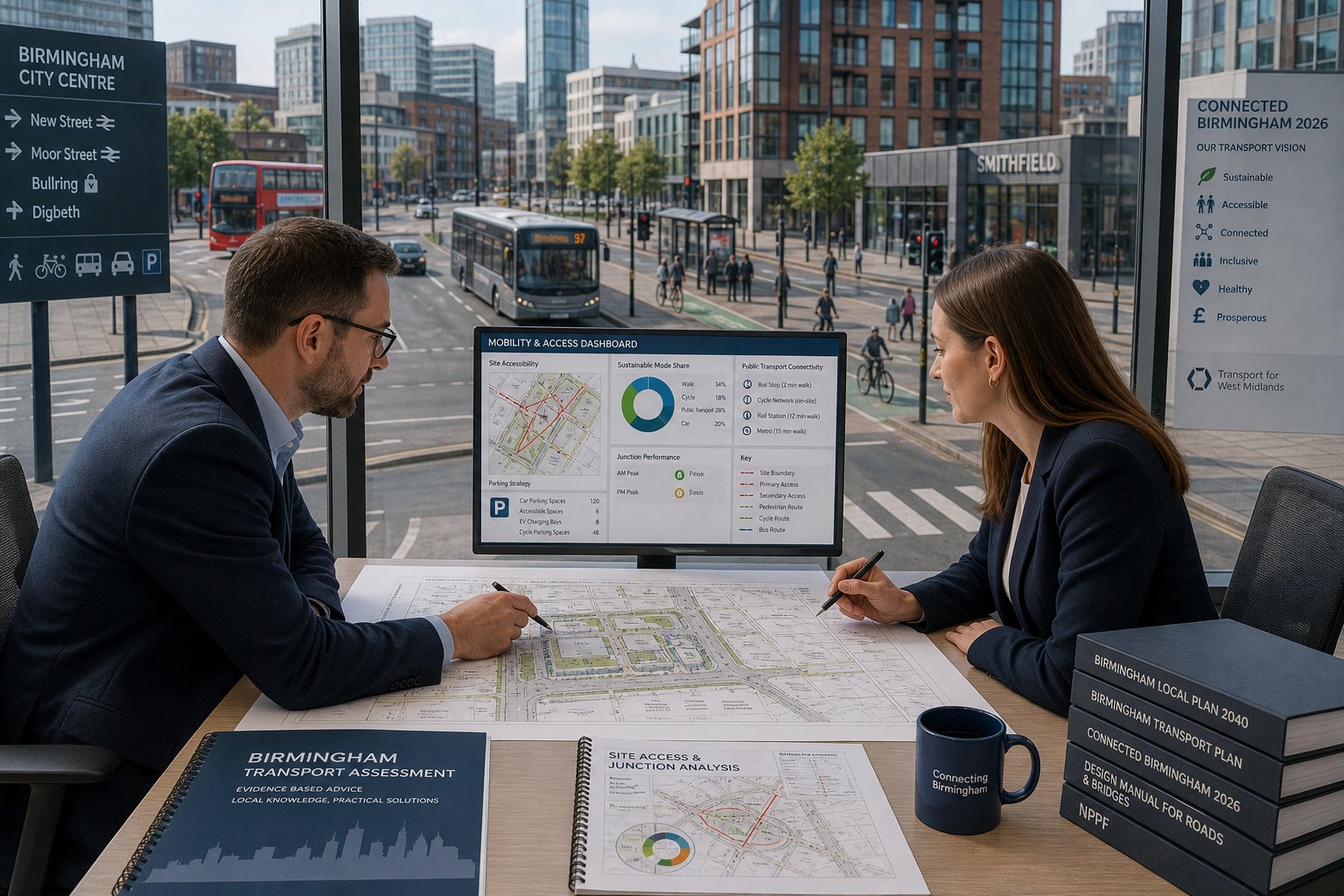
Transport advice in Birmingham is never just about national guidance. Local policy and local highway realities shape what is likely to be accepted, what needs evidence, and where objections are most likely to arise.
In broad terms, transport submissions should align with the Birmingham Development Plan, the Birmingham Transport Plan, and wider West Midlands policy priorities around mode shift, public transport accessibility, walking, cycling, network efficiency, and cleaner air. Those documents matter because they affect how development is judged. A proposal that relies heavily on car access in a highly accessible urban location, for example, may face stronger scrutiny than the same scheme in a less connected area.
Birmingham also has a network that is busy, varied, and often constrained. Conditions can change sharply from one corridor to the next. City-centre sites may raise questions about servicing strategy, cycle access, disabled parking, and interaction with public realm changes. Outer urban locations may be more focused on junction capacity, school-run pressures, or estate road geometry. Sites near strategic roads can introduce additional consultee requirements.
This is why local knowledge matters. We need to know not only the policy wording, but how those expectations are typically applied in practice, what officers tend to focus on, and where a scheme may need extra justification rather than generic reassurance.
Key Birmingham Considerations For Development Sites
For most Birmingham development sites, several recurring issues shape the transport strategy from day one.
Site access is usually first. That includes geometry, visibility splays, pedestrian crossing points, refuse access, and whether the access arrangement fits the road hierarchy around it.
Nearby junction and link impact comes next. Even modest developments can become contentious if they sit on already stressed corridors or close to sensitive junctions.
Parking, servicing, and EV charging are now examined more closely than many applicants expect. The numbers alone are not enough: layout functionality, disabled spaces, cycle parking quality, and servicing practicality all matter.
And then there’s sustainable accessibility. Birmingham increasingly expects development to show genuine opportunities for travel by walking, cycling and public transport. Distances to bus stops, quality of routes, crossing opportunities, and local connectivity all feed into the planning balance.
Put simply, a Birmingham site is rarely judged in isolation. It is judged in the context of its surrounding streets, policy priorities, and whether the development will work in the real world, not just on a drawing.
Typical Projects That Require Traffic Engineering Input

Traffic engineering input is relevant across a much wider range of schemes than many project teams assume. It is not just for major housing estates or retail parks. In Birmingham, even relatively modest proposals can trigger transport questions if the site is constrained, the location is sensitive, or the use is likely to change traffic patterns.
We’re often instructed on developments where transport is one part of a larger planning strategy but becomes disproportionately important because it is measurable, technical, and open to objection. That could be a small urban infill site with awkward access, a change of use with intensified servicing needs, or a redevelopment where parking demand and local street pressure become contentious.
The level of work varies. Some projects only need a concise technical note confirming that no severe impact would arise. Others need survey work, trip generation analysis, junction modelling, parking accumulation review, and a detailed Travel Plan.
What matters is not simply the scale of the project, but its relationship with the surrounding network and the concerns likely to be raised by Birmingham City Council, neighbours, or statutory consultees.
Residential, Commercial, Education, And Mixed-Use Schemes
Residential schemes range from single plots and apartment infill developments through to large suburban allocations. Key issues usually include access design, parking provision, refuse collection, visibility, and the effect of peak-hour trips on nearby junctions.
Commercial, office, industrial and logistics schemes often bring a different transport profile. Servicing, HGV tracking, shift patterns, staff parking, cycle facilities, and network resilience become central questions.
Education projects can be especially sensitive. Schools, colleges and universities can create concentrated peak movements, drop-off pressure, pedestrian safety concerns, and local resident objections.
Mixed-use and regeneration schemes are often the most nuanced. They may involve phased development, multi-modal access expectations, public realm changes, and competing demands between servicing, parking, and placemaking. In those cases, transport advice needs to support both technical compliance and the wider vision of the scheme.
The Core Transport Reports Used To Support An Application
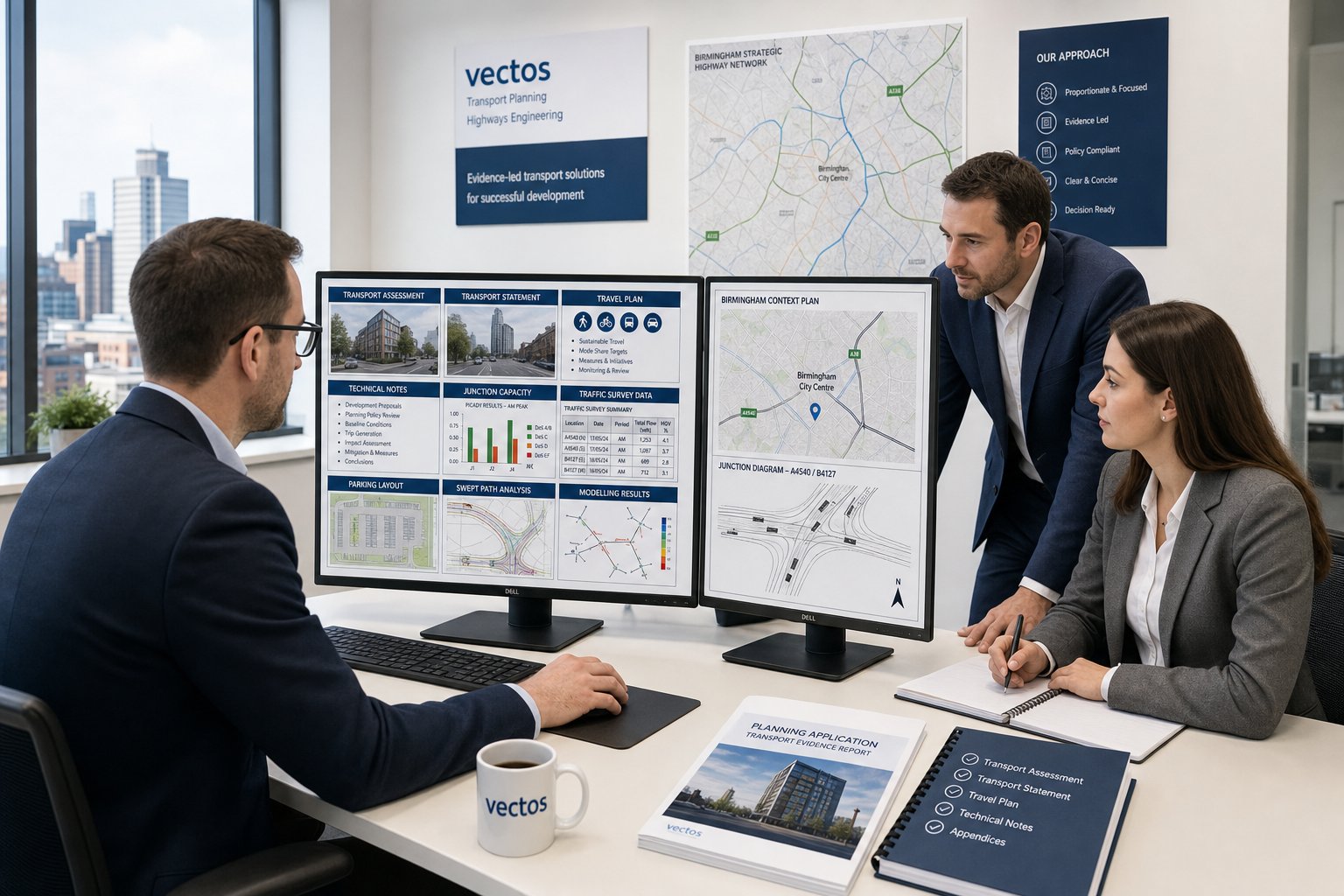
A planning application does not always need a thick transport document set. But it does need the right reports, properly scoped, evidence-led, and proportionate to the scheme.
The most common transport documents used in Birmingham are the Transport Assessment, Transport Statement, and Travel Plan. These are often supported by technical notes, access appraisals, collision analysis, swept path drawings, parking reviews, and junction modelling outputs where needed.
The best reporting approach is usually layered. We start with the planning questions the scheme needs to answer, then prepare the documents that answer them directly. That sounds obvious, but many delays happen because applications include generic transport text while missing the one piece of evidence officers actually need.
Concise reporting also matters. At ML Traffic, for example, the value is not in producing paperwork for its own sake: it is in preparing clear, accurate transport evidence tailored to local authority expectations and the specific planning context.
Transport Assessments, Statements, Technical Notes, And Junction Reviews
A Transport Assessment is the fuller evidence base. It may cover site context, accessibility, policy, traffic surveys, trip generation using tools such as TRICS, distribution and assignment, committed development, junction capacity, parking, servicing, road safety review, and mitigation.
A Transport Statement is shorter and more focused. It still needs proper analysis, but it is designed for developments with more limited impact.
A technical note or letter can be highly effective where a single issue needs to be addressed, say, parking stress, revised trip rates, delivery management, or a response to consultee comments.
Junction reviews and modelling are used where impact on the local network is a live issue. Depending on the junction type and complexity, that might involve PICADY, ARCADY, LINSIG or more detailed microsimulation methods. The right tool depends on the question being asked. Good judgement here saves time: bad scoping can create a lot of unnecessary modelling and not much useful planning progress.
How A Traffic Engineer Assesses Access, Safety, Capacity, And Parking
This is the technical heart of the job. When we assess a development, we are usually trying to answer four linked questions: Can people get in and out safely? Will the network continue to operate acceptably? Is the proposal safe in transport terms? And does the parking and servicing arrangement work in practice?
For access, we review the road hierarchy, visibility, geometry, pedestrian routes, cycle access, servicing needs, and whether vehicles can manoeuvre within the site without creating conflict. Swept path analysis is often part of that process, especially for refuse vehicles and larger service vehicles.
For safety, we may review available collision records, identify any local patterns, consider the relationship between the proposed access and nearby crossings or junctions, and coordinate with any Road Safety Audit process where physical highway works are proposed.
For capacity, we rely on traffic counts, turning counts, queue observations, and trip generation analysis. Trip rates may be drawn from TRICS or other evidence, then tested against local circumstances. If key junctions are sensitive, we use capacity modelling to understand likely effects on delay and queueing.
For parking, we go beyond a simple space count. We assess likely demand, disabled provision, cycle parking, EV charging expectations, servicing overlaps, and whether the layout actually functions day to day.
In Birmingham, these strands often interact. A site with acceptable trip generation might still fail if servicing blocks circulation. A parking layout that meets the numbers might still be resisted if it undermines pedestrian movement. That’s why transport engineering is as much about balanced judgement as it is about technical calculation.
The Value Of Early Transport Input Before Submission
Early transport input can save a surprising amount of time, redesign, and argument. We’ve seen projects where a short highways review at concept stage prevented months of avoidable back-and-forth later.
The main benefit is that we can identify likely objections before the scheme is fixed. If the access is too tight, visibility is compromised, servicing is unrealistic, or parking provision will be hard to justify, it is much easier to adapt the layout while the architect is still shaping the plan. Once the design has been coordinated across planning, architecture, cost, and viability, even small transport changes can become awkward and expensive.
Early input also helps with scope control. We can advise whether a Transport Statement is likely to be enough or whether a full Transport Assessment and junction modelling should be budgeted from the outset. That reduces uncertainty for the whole team.
Then there is the pre-application stage. Where appropriate, transport issues can be raised with Birmingham City Council early to test principles, narrow disagreement, or obtain informal feedback on the evidence expected at submission.
In practical terms, this means fewer surprises. And in planning, fewer surprises usually means faster progress. Not guaranteed approval, of course, no credible consultant should promise that, but a more robust, better prepared application with fewer obvious weaknesses for consultees to pick apart.
Common Reasons Transport Evidence Delays Birmingham Applications
Most transport delays are not caused by exotic technical disputes. They come from a handful of repeat issues.
One of the biggest is submitting the wrong level of assessment. If a scheme clearly needs a Transport Assessment but only includes a brief statement, officers may request additional work late in the process. That can disrupt programme and consultation timelines.
Another common problem is weak or outdated data. Traffic surveys need to be appropriate, recent enough to remain credible, and clearly explained. Modelling assumptions also need to be transparent. If the baseline is doubtful, everything built on it becomes vulnerable.
Applications are also frequently delayed by parking and servicing gaps. A development may meet broad planning objectives yet still attract objection because loading is impractical, turning is impossible, disabled parking is underprovided, or local parking standards have not been properly addressed.
A further issue is failure to deal convincingly with sustainable transport. Birmingham policy expectations around walking, cycling, public transport accessibility, and travel planning are not decorative extras. If they are treated as boilerplate, that tends to show.
Finally, some delays happen because the reporting is simply unclear. Long documents that never quite answer the key questions can be more frustrating than short ones. Clear evidence, scoped correctly and linked to the realities of the site, usually performs better than volume for volume’s sake.
How To Choose The Right Traffic Engineer In Birmingham
Not all transport consultants are the right fit for every Birmingham project. The best choice usually comes down to three things: local understanding, technical competence, and the ability to communicate clearly with the wider planning team.
First, look for proven Birmingham and West Midlands experience. A consultant who understands local policy, common officer concerns, highway standards, and the realities of the area’s network will generally spot risks earlier and frame evidence more effectively.
Second, check whether they have handled similar land uses and scales. A school travel strategy, an urban apartment scheme, a logistics yard, and a mixed-use regeneration proposal all raise very different transport issues.
Third, pay attention to clarity. Good transport advice should help architects, planners, lawyers, and clients make decisions. If a consultant cannot explain what is needed, why it is needed, and what the likely pressure points are, the project team may end up with technically dense output but poor strategic direction.
You should also ask practical questions: Will they advise at concept stage? Can they prepare concise reports quickly? Are they comfortable negotiating with the Local Highway Authority? Can they support post-submission queries or appeals?
For many clients, speed matters too. But speed only helps if the work is accurate and tailored. The strongest traffic engineer in Birmingham is usually the one who combines responsive delivery with local judgement, robust technical work, and reporting that officers can follow without wading through unnecessary jargon.
Conclusion
Transport is rarely the only issue in a planning application, but in Birmingham it is very often one of the issues that decides whether a scheme moves smoothly or starts to drift. Access, parking, servicing, junction impact, sustainable travel, local policy alignment, none of these can be treated as an afterthought.
A capable Traffic Engineer in Birmingham helps turn those risks into a structured, defensible planning case. That means understanding the site, the surrounding network, the likely concerns of Birmingham City Council, and the level of evidence needed to support the proposal without overcomplicating it.
For architects, planners, developers, legal teams and public-sector clients, the real value is early clarity. When transport advice is brought in at the right moment, designs improve, objections are easier to anticipate, and applications are usually in a much stronger position.
In 2026, with policy expectations and network pressures only becoming more demanding, informed local transport input is not a luxury. It is part of getting projects approved efficiently, and getting them built.
Frequently Asked Questions about Traffic Engineering in Birmingham
What role does a traffic engineer play in Birmingham planning applications?
A traffic engineer assesses development proposals for safe access, parking, servicing, and transport impact, preparing and negotiating transport evidence with Birmingham City Council and consultees to reduce uncertainty and support planning applications effectively.
When is a Transport Assessment required instead of a Transport Statement for Birmingham developments?
A Transport Assessment is needed for larger or high-impact schemes likely to generate significant vehicle trips or affect junction capacity, such as major residential, retail, or employment developments, whereas a Transport Statement suits smaller or less impactful schemes.
How do Birmingham’s local policies influence traffic engineering advice?
Traffic advice must align with the Birmingham Development Plan and Transport Plan, addressing busy corridors, air quality, public transport, walking and cycling priorities, ensuring developments meet local accessibility, parking standards, and network constraints unique to Birmingham.
What key transport issues do traffic engineers consider for development sites in Birmingham?
They evaluate site access safety and geometry, junction and corridor impact, parking and servicing arrangements including EV charging, and sustainable travel accessibility by public transport, walking, and cycling to ensure practical and policy-compliant development proposals.
Why is early traffic engineering input important before submitting a Birmingham planning application?
Early input helps identify and resolve potential highway objections, allowing site layout optimisation, appropriate transport evidence scoping, and pre-application engagement with authorities, reducing delays and increasing the chance of a smooth application process.
How do I choose the right traffic engineer in Birmingham for my project?
Select a consultant with proven local experience in Birmingham schemes, relevant expertise on similar land uses and development scales, and the ability to deliver clear, concise reports and effective negotiation support with local planning and highway authorities.