
Manchester development rarely fails on ambition. It more often stalls on detail: access geometry that doesn’t quite work, a junction that tips into stress at peak hour, parking numbers that don’t align with policy, or a planning submission that underestimates how closely highways issues will be reviewed. That is where a traffic engineer in Manchester becomes central, not peripheral.
We work with architects, planners, lawyers, surveyors, developers and councils to turn transport concerns into clear, defensible evidence. In practice, that means assessing how people and vehicles will reach a site, how a proposal fits local and national policy, and what needs to be designed or tested before an application goes in. In Greater Manchester, those questions are shaped by local authority requirements, TfGM strategy, active travel priorities, congestion hotspots and the realities of constrained urban sites.
A good transport submission is not just a report attached at the end. It is part of the planning strategy from the start. Done properly, it helps teams avoid redesign, answer likely objections early and move more confidently through validation, consultation and determination. The sections below explain what a traffic engineer in Manchester actually does, when transport assessments are needed, which services matter most on local schemes, and how early technical input can reduce planning risk in 2026.
What A Traffic Engineer In Manchester Does For Planning And Development

A traffic engineer in Manchester provides the transport and highways evidence that planning authorities expect to see before approving development. That starts with understanding a site in the real world, not just on a layout drawing. We review the surrounding highway network, nearby junctions, walking and cycling connections, public transport accessibility, parking conditions, collision history where relevant, and any operational constraints that could affect the proposal.
From there, we test how the development is likely to perform. For some sites, that means estimating trip generation and checking whether the traffic impact is modest. For others, it means modelling queues, delays and capacity at nearby junctions, then identifying practical mitigation. We also advise on access design, internal road layout, servicing arrangements, refuse collection movements, emergency access and visibility requirements.
The reporting side is equally important. Planning applications often need a Transport Assessment, Transport Statement or Travel Plan prepared in line with Department for Transport guidance, the National Planning Policy Framework and local validation requirements. In Manchester, that local layer matters a great deal. Council officers and consultees will want transport documents that are proportionate, technically robust and clearly tied to policy outcomes such as safety, sustainability and mode shift.
In short, our role is to help development teams answer a simple but critical question: can this scheme function safely and acceptably on the network, and can we prove it?
Why Manchester Projects Need Local Transport And Highways Expertise
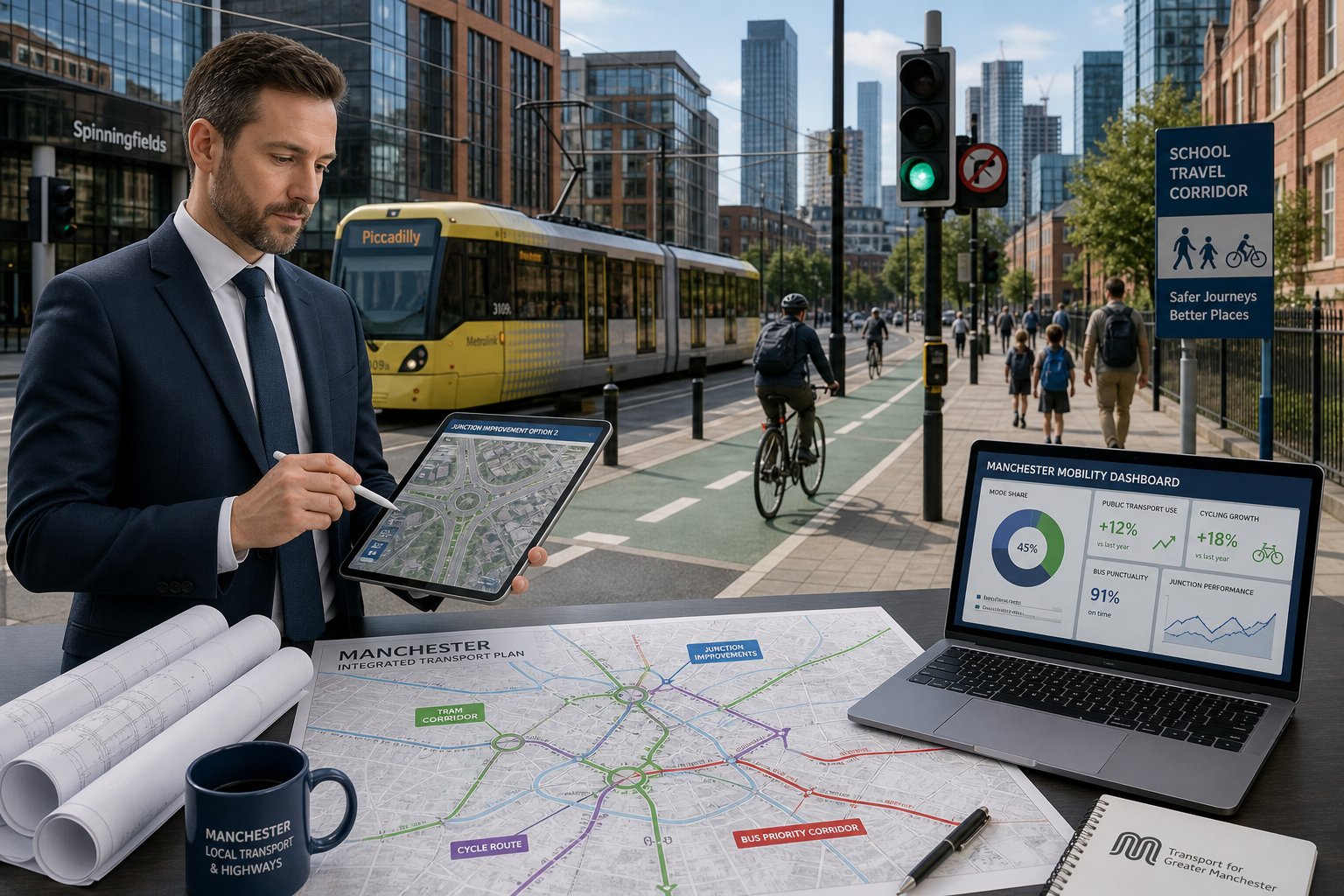
Manchester is not a place where generic transport advice goes very far. The city and wider conurbation operate within a layered planning and highways environment shaped by Manchester City Council, Transport for Greater Manchester, neighbouring boroughs, strategic corridors and fast-evolving active travel policy. A report that might feel acceptable elsewhere can quickly look thin if it misses local standards, known pressure points or authority expectations.
Local knowledge helps in obvious ways: understanding which junctions regularly attract scrutiny, where parking restraint is likely to be expected, how public transport accessibility should be presented, and what sort of mitigation is realistic in dense urban locations. It also helps in less obvious ones. A site near a bus priority route, Metrolink stop, school travel corridor or city-centre cycle intervention may need a more nuanced response than a template-led assessment can offer.
That is why experience across nearby authorities is useful too. Work on comparable schemes can sharpen judgement about thresholds, survey scope, validation expectations and officer concerns. On projects outside Manchester, for example, localised transport planning issues often differ in emphasis, as shown in our work as a regional transport consultant.
With more than 30 years of experience behind many specialist practices, including concise reporting tailored to authority requirements, the advantage is not just technical competence. It is knowing how to apply that competence in the exact planning context your scheme will face.
Planning Applications That Commonly Require Traffic Engineering Input

Not every planning application needs a lengthy transport report, but many need at least some highways input before submission. Residential development is a common example. Apartment schemes, housing estates, student accommodation and later-living proposals can all raise questions around trip rates, access design, parking provision, servicing, refuse collection and sustainable travel measures.
Commercial development is equally likely to require input. Offices, retail units, leisure uses, industrial schemes, logistics sites and mixed-use proposals often generate more complex travel patterns, with different peak periods and servicing demands. Schools, healthcare buildings, event venues and community facilities can also be highly sensitive because of concentrated arrival and departure periods, vulnerable users or constrained surrounding streets.
Location matters as much as land use. Even a relatively modest scheme may need traffic engineering input if the site sits on a congested corridor, near a problematic junction, within a dense urban centre, or where access visibility is restricted. Similarly, developments with unusual servicing needs, basement parking, shared surfaces, emergency access constraints or cross-boundary impacts often need a robust technical note or full supporting assessment.
In practice, the trigger is not simply size. It is whether the proposal could materially affect network operation, safety or policy compliance. We often advise teams at concept stage so they can decide whether a light-touch note will suffice or whether more formal evidence is needed, including support akin to our work on planning transport reports.
Transport Assessments, Transport Statements, And Travel Plans Explained
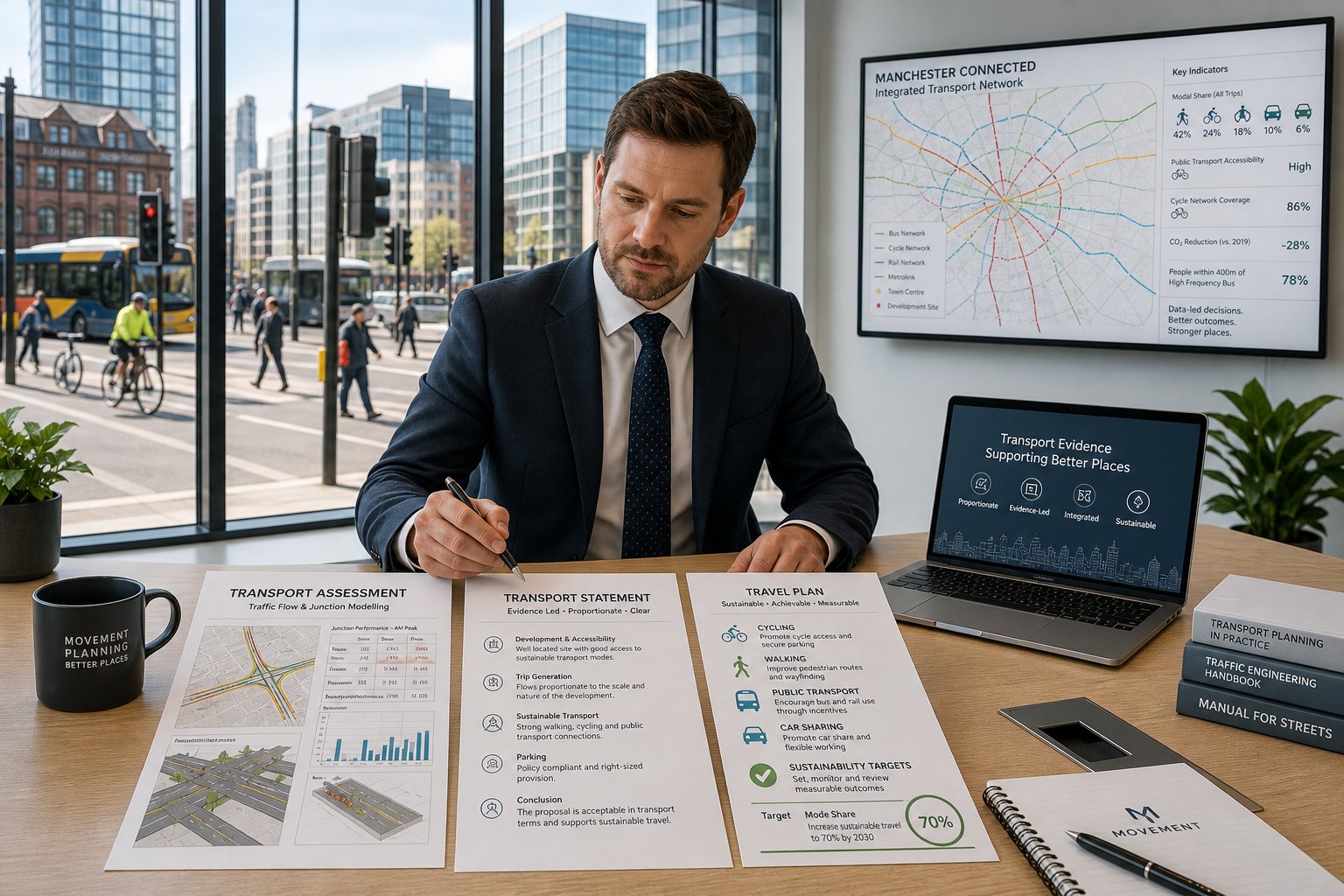
These three documents are often mentioned together, but they do different jobs.
A Transport Assessment (TA) is the most detailed of the three. It examines how a development affects all relevant modes of travel, including car trips, walking, cycling, public transport and servicing. A TA may include traffic surveys, trip generation, distribution and assignment, junction modelling, road safety review, parking analysis and a package of mitigation measures.
A Transport Statement (TS) is shorter and more proportionate. It is generally used where a scheme has more limited transport impacts that can be described and addressed without extensive modelling. It still needs to be evidence-led, but the scale of analysis is lighter.
A Travel Plan (TP) focuses on behaviour rather than pure capacity. It sets out measures to encourage sustainable travel, such as cycle parking, public transport information, car-share initiatives, welcome packs, monitoring and targets. In Greater Manchester, Travel Plans often matter because authorities want developments to support wider sustainability and mode-shift objectives.
The key is proportionality. Officers are rarely impressed by overblown reporting, and they are even less impressed by underpowered reporting. The right document is the one that matches the scale, context and likely impact of the scheme.
When A Full Transport Assessment Is Needed
A full Transport Assessment is usually required when a development is large enough, busy enough or sensitive enough that its effect on the surrounding network cannot be assumed away. That may be because local or national thresholds are exceeded, because the site sits on a strategic route, or because nearby junctions already operate under stress.
Typical examples include larger residential schemes, substantial employment uses, supermarkets, mixed-use developments with multiple access demands, and proposals in locations where cumulative impact is a live issue. If several developments are coming forward in the same area, authorities may expect junction modelling that tests combined effects rather than just the site in isolation.
A full TA is also common where there are known safety concerns, substandard access arrangements, interactions with buses or cyclists, or public objections that are likely to focus on traffic. In these cases, a concise but rigorous evidence base can be the difference between a manageable planning discussion and a prolonged challenge.
When A Transport Statement Or Travel Plan May Be More Appropriate
A Transport Statement is often more suitable for small to medium schemes where traffic effects are limited and straightforward to explain. A modest residential infill site, a small change of use, or a development in a highly accessible location with low predicted trip generation may not justify a full TA. What matters is showing, with evidence, that impacts are modest and any issues can be mitigated.
A Travel Plan may sit alongside either a TA or TS, and sometimes it is requested even when the traffic case is relatively light. Offices, schools, larger residential developments and employment uses are common candidates because authorities want a practical strategy to support walking, cycling, public transport and car sharing.
In Manchester, this is especially relevant where policy places emphasis on reducing car dependence. A Travel Plan is not meant to be a token add-on. If written properly, it demonstrates that the development team understands how travel behaviour can be shaped through design, management and monitoring over time.
Key Traffic Engineering Services For Manchester Developments

Traffic engineering support for planning is broader than many teams expect. Yes, reports are central, but good advice often starts before any report title is agreed. We commonly begin with a site review, policy check and scoping exercise to decide what the authority is likely to expect and what level of evidence is proportionate.
Core services usually include traffic surveys and baseline data review, trip generation using TRICS and comparable local evidence, trip distribution and assignment, junction capacity assessment, access feasibility, parking review, servicing strategy and Travel Plan preparation. Depending on the site, there may also be technical work on internal circulation, refuse tracking, coach or HGV access, or support with highways-related planning conditions.
For more contentious schemes, traffic engineers may contribute to pre-application discussions, respond to highways objections, prepare technical rebuttals, or assist at appeal. On some projects, particularly those with legal or strategic complexity, the value lies in joining up planning, design and highway negotiation so the technical case remains consistent throughout.
We also find that speed matters. Planning programmes can slip simply because survey windows are missed or the scope is agreed too late. That is why many clients look for teams that can produce transport planning support quickly without sacrificing accuracy.
Junction Capacity Modelling, Swept Path Analysis, And Access Design
These are among the most important technical services on development projects because they test whether a scheme can operate safely and efficiently in physical terms.
Junction capacity modelling uses recognised tools such as PICADY, ARCADY and LINSIG to compare existing and future network performance, with and without the development. The aim is not just to generate numbers. It is to understand where delay, queueing or reserve capacity might become problematic, and whether mitigation can address it.
Swept path analysis checks whether vehicles can actually manoeuvre within the site and at its access points. Refuse lorries, fire appliances, delivery vehicles and larger cars all have different tracking requirements. A layout that looks tidy on a concept drawing can fall apart once turning paths are tested properly.
Access design then pulls the evidence together. We review visibility splays, kerb radii, gradients, carriageway widths, pedestrian crossing arrangements and cycle conflict points so the proposed access is both policy-compliant and buildable.
Parking, Servicing, Delivery, And Visibility Reviews
Parking and servicing are where otherwise promising schemes often become awkward. In Manchester, parking provision is rarely just a numbers exercise. Officers may consider accessibility, city-centre restraint, disabled provision, cycle parking, electric vehicle charging and how the proposed mix aligns with local policy.
Servicing is just as important. A development can be acceptable in principle yet still attract concern if delivery vehicles stop on-street, reverse excessively, block footways or require unrealistic manoeuvres. We review loading needs, turning areas, refuse collection points and delivery timing assumptions so operational demands are clear from the outset.
Visibility reviews support both safety and design quality. At new or altered accesses, we assess whether drivers, cyclists and pedestrians can see and be seen within appropriate stopping distances and design parameters. On constrained urban sites, that sometimes means balancing ideal standards with practical context and identifying measures that make an access acceptable rather than perfect. That distinction matters in real planning work.
How A Traffic Engineer Helps Reduce Planning Risk And Delays
The biggest benefit of involving a traffic engineer early is usually not the report itself. It is the removal of uncertainty.
Planning delays often happen because transport issues are discovered too late: the access cannot accommodate a refuse vehicle, the parking ratio jars with policy, survey data is missing, or a junction impact that seemed minor suddenly requires modelling. Each of those problems can trigger redesign, extra consultation or a request for further information after submission.
We reduce that risk by identifying likely transport objections before they become formal objections. That might mean recommending a pre-application note, refining the layout, testing alternative access arrangements, agreeing survey scope with officers, or preparing mitigation in advance. For larger schemes, it can also mean supporting negotiations around Section 106 obligations, Section 278 works, phasing triggers and delivery responsibilities.
There is a legal and strategic angle too. Planners, solicitors and project managers need evidence that stands up under scrutiny, especially where neighbours object or committee members focus on congestion and parking. A weak transport case can expose a scheme to refusal or appeal risk. A strong one does not guarantee consent, of course, but it narrows the room for avoidable challenge.
And in a busy planning environment, that matters. Delay is expensive. Good traffic engineering often pays for itself simply by preventing one late-stage redesign.
Working With Manchester City Council, TfGM, And Other Local Authorities
Transport planning in Greater Manchester is rarely a one-authority exercise. Manchester City Council will often be central to the decision-making process, but TfGM may have a significant role where public transport, active travel, strategic movement or wider conurbation policy is engaged. On some sites, neighbouring authorities also matter because trip impacts do not stop neatly at administrative boundaries.
That means transport documents need to do more than satisfy a generic checklist. They should align with local validation requirements, reflect relevant policy wording, and address practical concerns in the way local officers tend to assess schemes. Pre-application engagement can be especially useful where the site is sensitive, the access is constrained, or the scale of development is likely to attract close review.
We often coordinate directly with planning teams, highways officers and wider design consultants so the transport strategy remains consistent through concept, application and condition stages. For example, if TfGM is likely to focus on bus accessibility, cycle provision or Travel Plan commitments, those points should be built into the submission rather than added reactively later.
Experience across authority boundaries helps here. Comparable work in other urban contexts, including schemes led by a traffic planning team, shows how early, well-framed dialogue can avoid months of unnecessary back-and-forth. Manchester is its own planning environment, but the principle is universal: authorities respond better when the transport case is locally aware, proportionate and complete.
What To Prepare Before Instructing A Traffic Engineer
Clients get better, faster advice when the starting information is organised. It does not need to be perfect, but it should be coherent.
At minimum, we would usually want a red line boundary plan, an initial site layout, a description of the proposed use, and a development schedule covering units, floor areas, parking numbers and any phasing. If there are draft plans from the architect, those help us test access, servicing and internal vehicle movement before the design hardens.
Planning history matters too. Previous applications, appeal decisions, council correspondence and any early highways comments can save a lot of duplicated effort. If the site has known constraints, such as restricted frontage, nearby schools, collision concerns, protected trees, neighbouring accesses or difficult level changes, flagging them early is invaluable.
Programme and budget are often overlooked, but they shape the advice. Survey lead-in times, school holidays, seasonal traffic variation and committee dates can all affect what is realistic. A team aiming for submission in six weeks may need a different approach from one with a three-month pre-application window.
One final point: be candid about uncertainty. If the use mix might change, if basement parking is still being debated, or if servicing assumptions are provisional, we would rather know that on day one. It is much easier to manage evolving inputs than to retrofit transport logic around late design shifts.
Conclusion
For development in Greater Manchester, transport evidence is not an afterthought. It is often one of the pieces that determines whether a planning application moves smoothly or runs into avoidable resistance.
A traffic engineer in Manchester brings the technical analysis, local policy awareness and practical design judgement needed to support planning applications properly in 2026. From deciding whether a Transport Assessment is required to testing junction impacts, refining access, shaping Travel Plans and dealing with local authority expectations, early input can improve both the scheme and its prospects.
For architects, planners, lawyers, surveyors, builders, developers and councils, the advantage is straightforward: clearer evidence, fewer surprises, and a better chance of securing timely approval with less redesign along the way.
Frequently Asked Questions About Traffic Engineers in Manchester
What does a traffic engineer in Manchester do for planning applications?
A traffic engineer in Manchester analyses traffic conditions, designs site access and internal roads, and prepares technical reports like Transport Assessments. They ensure developments comply with local and national policies, helping to prove that a scheme can operate safely and efficiently on the network.
When is a full Transport Assessment required for a Manchester development?
A full Transport Assessment is needed when a development exceeds local or national thresholds, is located on strategic or congested routes, or has known safety issues. Large residential schemes, supermarkets, or projects with cumulative impacts often require detailed junction modelling and mitigation proposals.
How do local transport policies in Manchester affect traffic engineering work?
Manchester’s planning environment involves specific standards from Manchester City Council and TfGM, including parking policies and active travel priorities. Traffic engineers must address local congestion hotspots and align with Greater Manchester’s sustainability goals to meet authority expectations effectively.
What types of developments commonly need traffic engineering input in Manchester?
Projects such as residential estates, student accommodations, retail units, offices, schools, and healthcare facilities often require traffic engineering. Any development with significant trip generation, constrained access, or sensitive locations in Manchester will likely need specialist transport input.
How can engaging a traffic engineer early reduce planning risks and delays in Manchester?
Early involvement helps identify transport issues before submission, enabling mitigation and design adjustments. This reduces objections, avoids late-stage redesign, and supports smoother validation and consultation. A strong transport case also lowers refusal or appeal risks and aligns with Manchester’s planning authorities.
What is the difference between a Transport Statement and a Travel Plan in Manchester developments?
A Transport Statement provides a proportionate, evidence-based overview for smaller schemes with limited impacts, while a Travel Plan focuses on encouraging sustainable travel behaviours through measures like cycle parking, public transport information, and monitoring, often required even for modest developments to support mode-shift policies.