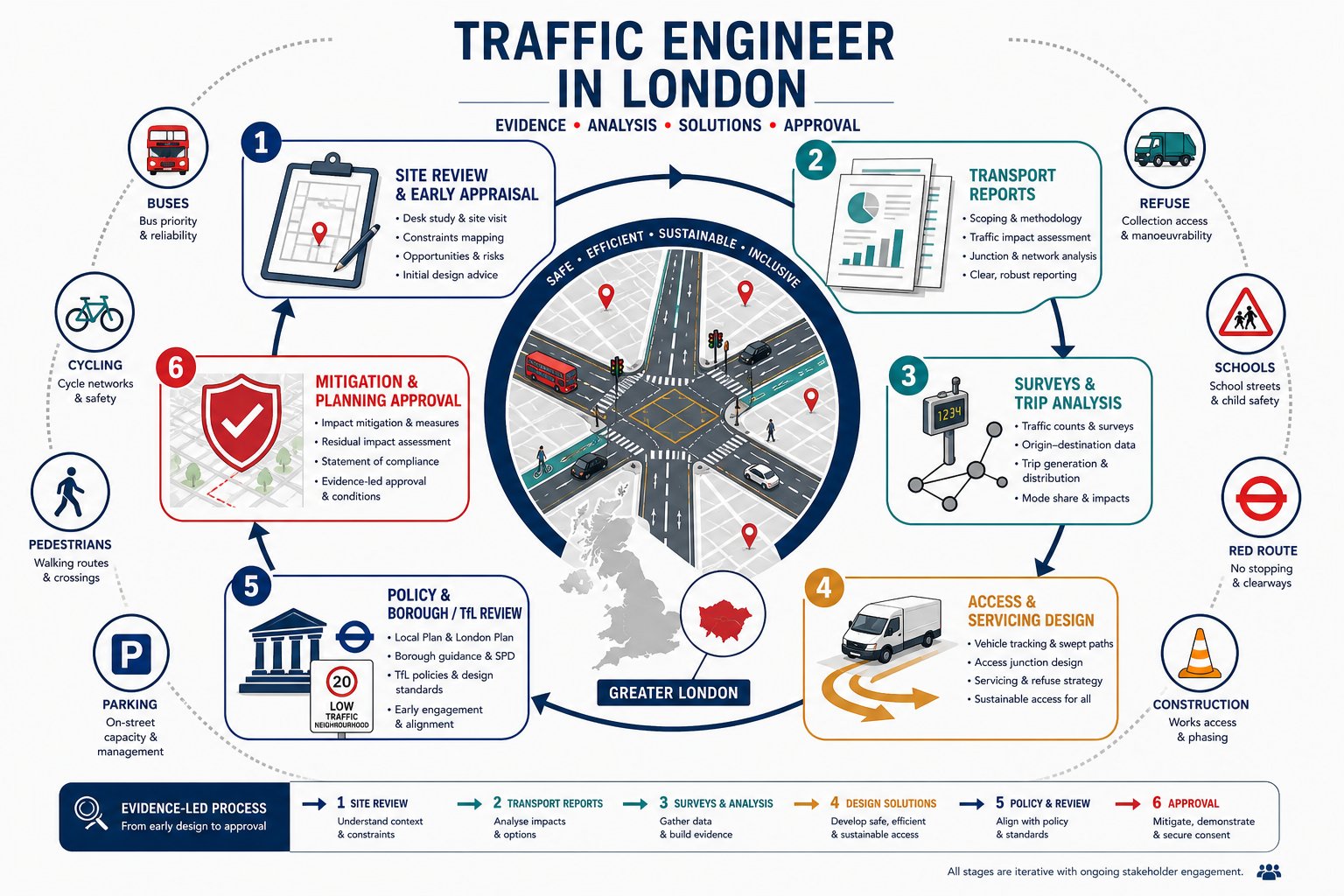
London development rarely gets a free pass on transport. Even modest schemes can trigger questions about access, servicing, parking stress, cycle provision, refuse collection, bus operations, or junction safety. On larger sites, the scrutiny goes up another level: borough highways teams, Transport for London, neighbours, and planning officers all want clear evidence that a proposal will work on a constrained network.
That is where a Traffic Engineer in London becomes central to the planning process. We help turn a transport concern into a structured, evidence-led response: what traffic a scheme is likely to generate, whether an access works safely, how deliveries will be managed, what level of parking is appropriate, and what mitigation is needed to support approval. In practice, that means combining technical analysis with local authority awareness. A report can be perfectly sound in theory and still fall flat if it ignores borough validation requirements or the practical realities of London streets.
For architects, planners, lawyers, surveyors, developers, builders, and local councils, the value is not just in producing a document. It is in producing the right document, at the right level of detail, early enough to influence design and robust enough to stand up during determination. In this guide, we set out what a traffic engineer does, when one is needed, which reports are commonly required, and how London-specific policy and site conditions shape the advice in 2026.
What A Traffic Engineer In London Does For Planning And Development
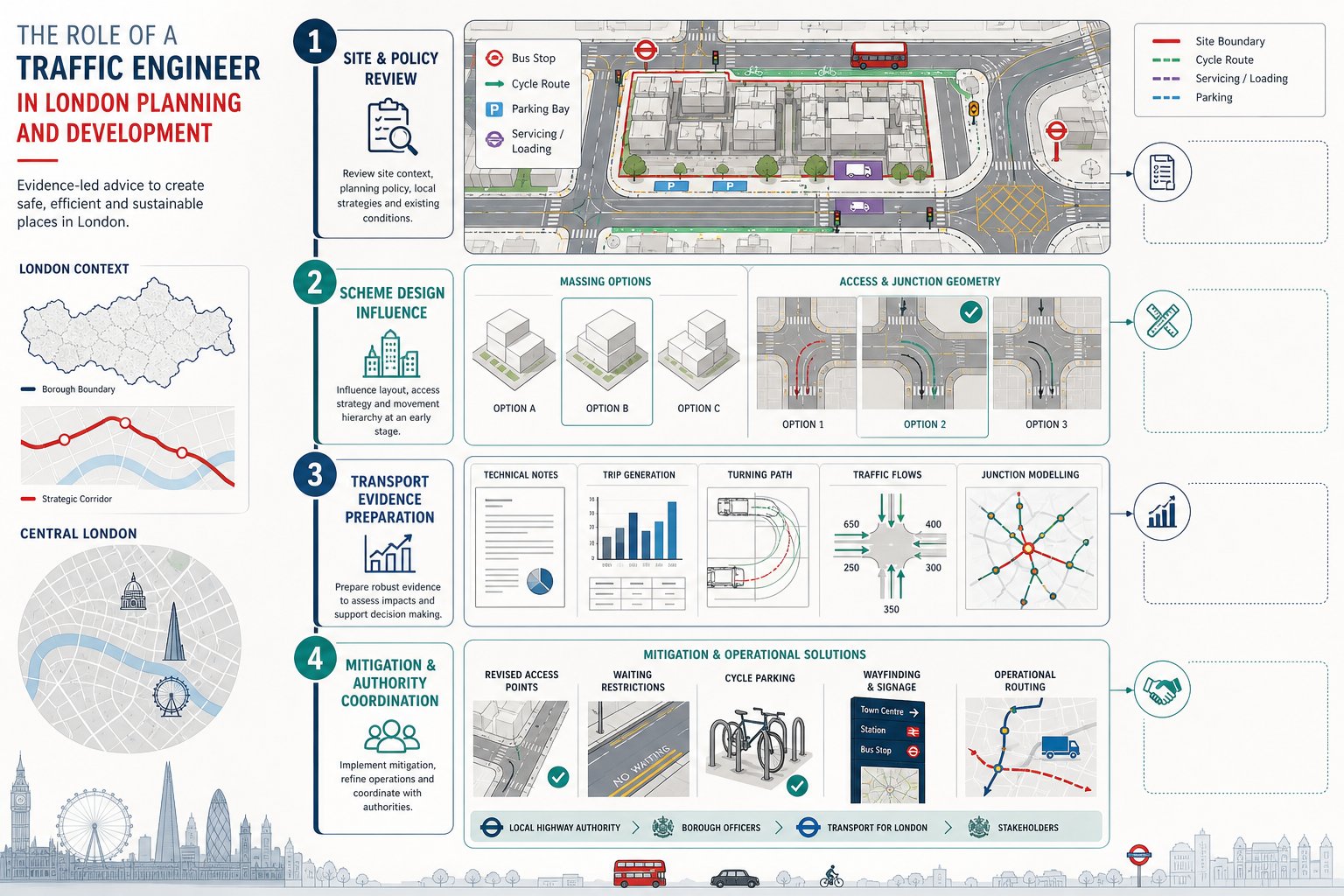
A traffic engineer working on London planning and development schemes sits at the point where design, policy, and network performance meet. Our role is to assess how a proposal interacts with the surrounding highway and transport system, then translate that into evidence that planners and highway authorities can actually use.
At the early stage, we usually review the site context, existing access arrangements, nearby junctions, public transport connections, walking and cycling links, parking pressure, servicing constraints, and relevant planning policy. That early view often shapes the scheme itself. A residential project may need a different access geometry: a commercial scheme may need servicing pulled off a busy frontage: a mixed-use development may need a more realistic parking and cycle strategy.
From there, we prepare transport evidence to support planning applications. That can include transport statements, transport assessments, travel plans, delivery and servicing strategies, construction logistics documents, swept path analysis, trip generation reviews, junction modelling, and technical responses to consultee comments. We also advise on mitigation, whether that is a revised access arrangement, waiting restrictions, wayfinding, cycle parking, or operational changes.
In London, this work is rarely generic. Borough expectations vary, and TfL involvement can change the level of analysis quickly, especially on or near strategic roads. That is why local experience matters. Firms with a broad planning background, including work beyond the capital such as regional transport support, often bring useful perspective, but London schemes still need advice grounded in borough practice and urban constraints.
When A Traffic Engineer Is Needed For A London Planning Application
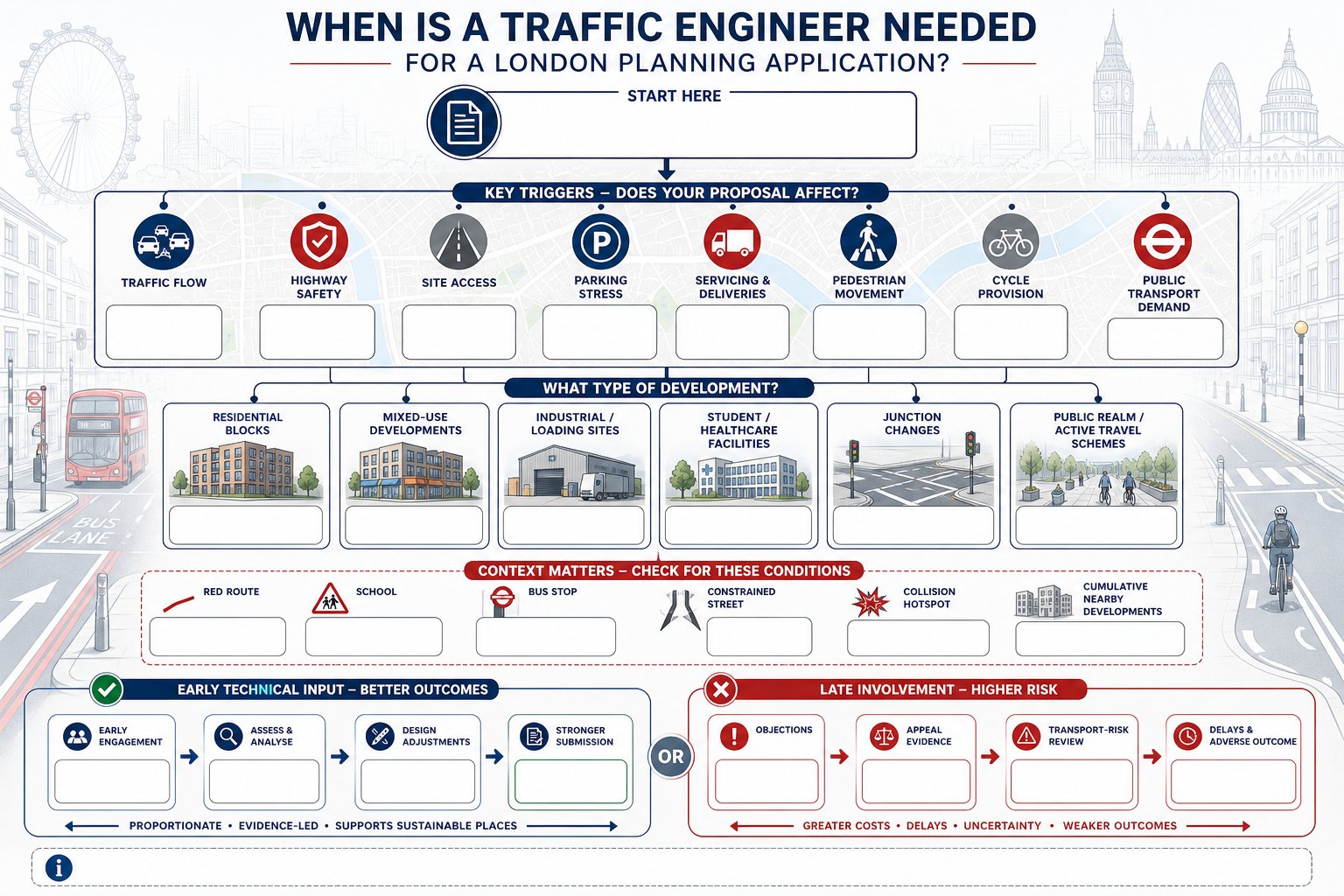
Not every planning application needs a full transport package, but many London schemes need at least some traffic engineering input far earlier than applicants expect. As a rule, we get involved whenever a proposal could materially affect traffic flow, highway safety, access, parking, servicing, pedestrian movement, cycle provision, or public transport demand.
That includes obvious cases such as major residential or commercial development, but also smaller schemes with awkward access conditions. A relatively modest infill project can trigger concerns if it sits on a red route, close to a school, beside a bus stop, or on a street already under parking pressure. Change-of-use schemes can be similar. The floorspace may not change much, yet the trip profile, delivery pattern, or peak-hour demand can change significantly.
Early appointment usually saves time. If transport issues are tested before a layout is fixed, we can often resolve them with design changes rather than reactive reporting after submission. That is especially important where a borough has strict validation requirements or where pre-application advice indicates concerns around servicing, refuse collection, or cycling provision.
We are also commonly instructed when an application has drawn objections, when a planning appeal needs technical evidence, or when legal teams need an expert view on transport risk. At that point, the question is no longer just whether a report is required, but whether the evidence is robust enough to defend the scheme.
Common Project Types That Require Traffic Engineering Input
Typical London project types include:
- residential developments, from small apartment blocks to estate regeneration
- mixed-use schemes with retail, leisure, office, or community space
- commercial and industrial sites with significant delivery activity
- student housing, hotels, healthcare, and education projects
- access changes, junction alterations, and traffic signal works
- public-sector highway, placemaking, and active travel schemes
Even where thresholds appear low, local context matters. A borough may ask for evidence because of constrained streets, known collision history, or cumulative development nearby. On complex schemes, applicants sometimes benchmark strategy against experience from other major cities, and that wider comparison can be useful where teams are familiar with planning reports in Birmingham. But in practice, London authorities will still expect a response tailored to local streets, local policy, and local operations.
Key Transport Reports Prepared For London Sites
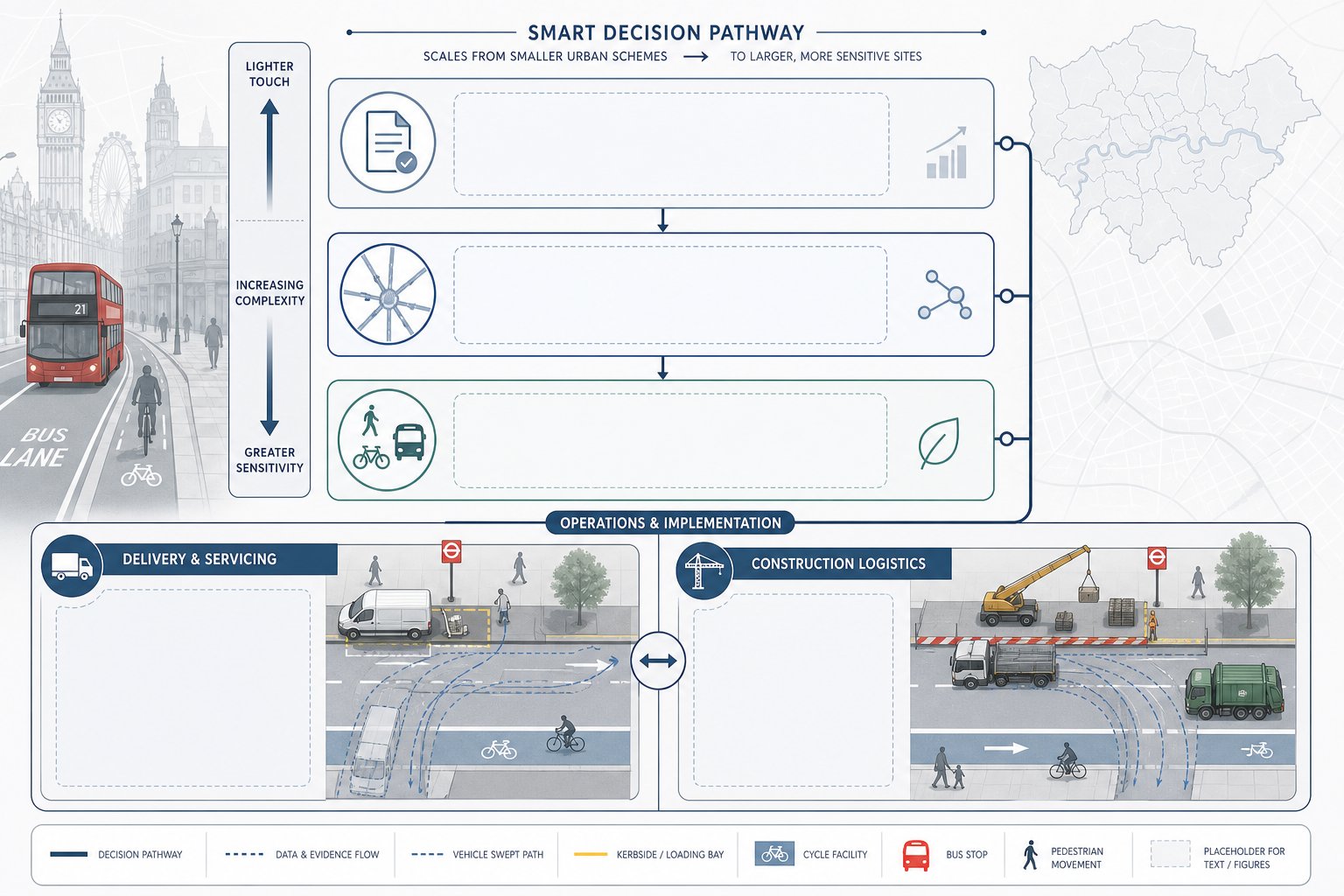
Transport reporting for London sites is not one-size-fits-all. The right package depends on scale, use class, location, borough requirements, and the sensitivity of the surrounding network. Our job is partly technical and partly strategic: we help decide what level of evidence is proportionate, then prepare documents that answer the real planning and highway questions.
For a smaller urban scheme, that may mean a focused transport statement with access review, parking rationale, cycle provision, servicing commentary, and a short travel plan. For a larger site, it could involve a full transport assessment supported by surveys, trip generation, junction modelling, road safety review, delivery and servicing analysis, and a construction logistics plan.
The best reports are not simply long. They are properly scoped. Borough officers tend to respond better to concise, relevant evidence than to a generic document loaded with unnecessary appendices. Equally, under-scoped work creates avoidable delays when consultees ask for more detail later.
Transport Statements, Transport Assessments, And Travel Plans
A Transport Statement is usually the lighter-touch option. We use it where the impact is expected to be limited but some transport evidence is still needed. It often covers the site context, policy background, sustainable transport accessibility, current and proposed access, parking, servicing, and a proportionate review of likely trip effects.
A Transport Assessment is more detailed and typically needed for larger or more sensitive proposals. It examines existing conditions, survey data, trip generation, trip distribution, modal split, junction impacts, highway safety, and mitigation. It is the document most often relied on where development scale or context makes transport effects a key planning issue.
A Travel Plan complements either document by setting out practical measures to reduce single-occupancy car use and support walking, cycling, public transport, car clubs, and cleaner travel behaviour. In London, travel plans are often expected even where traffic impacts are not severe, because mode shift is embedded in policy and development management practice.
Delivery, Servicing, And Construction Logistics Considerations
For London sites, deliveries and servicing can be as important as peak-hour traffic. A scheme may be acceptable in trip generation terms but still unacceptable if refuse vehicles cannot access the site safely, if vans would stop in the carriageway, or if servicing conflicts with cycling and pedestrian activity.
That is why we look closely at loading demand, vehicle types, frequency, dwell times, turning space, swept paths, and time-of-day effects. We also review how deliveries interact with kerbside controls, nearby crossings, bus stops, schools, and neighbouring uses. Retail, hotel, healthcare, and mixed-use schemes often need especially careful servicing strategies.
Construction creates another layer of risk. Boroughs and TfL increasingly expect applicants to explain how demolition and build phases will be managed, particularly on constrained streets. A Construction Logistics Plan may need to address routing, booking systems, holding areas, consolidation, temporary traffic management, workforce travel, and measures to reduce peak-hour conflicts. On many urban sites, construction access is the issue that determines whether a layout is genuinely deliverable, not just theoretically compliant.
How London Planning Policy And Borough Requirements Shape Transport Evidence
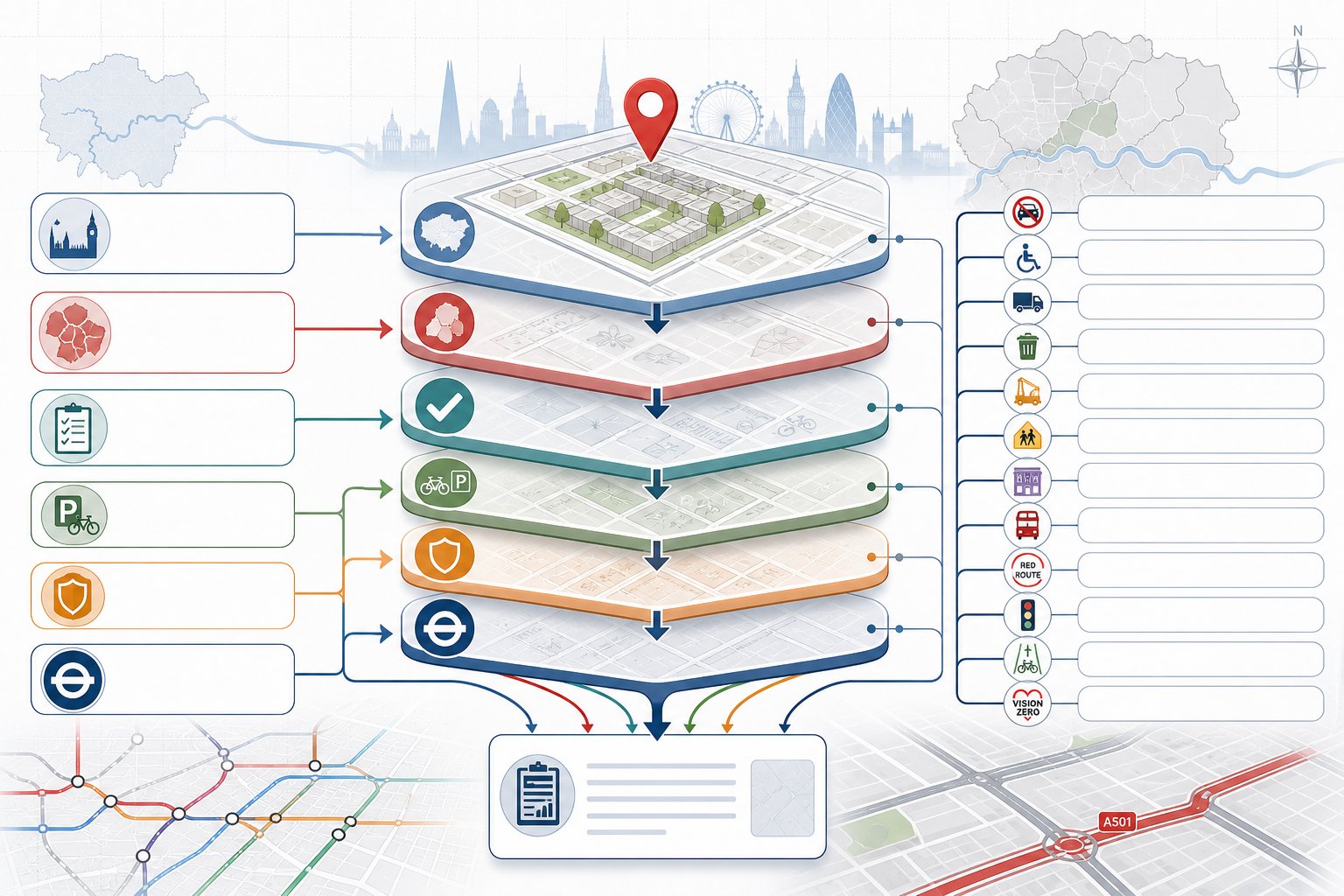
Transport evidence in London is heavily shaped by policy, but not by one policy source alone. We usually have to align a planning submission with the London Plan, borough development plan policies, local validation lists, parking standards, cycling standards, road safety expectations, and, where relevant, Transport for London guidance and network management priorities.
That layered policy context affects both scope and tone. One borough may accept a concise transport statement for a small residential scheme near a station: another may want more detailed servicing evidence because of local street constraints. Some authorities focus strongly on car-free compliance and disabled parking justification. Others will zero in on refuse collection, construction routing, school-street interactions, or impacts on a local high street.
TfL can also be a key stakeholder, especially where a site fronts a strategic road, affects bus operations, or sits within an area of wider network sensitivity. In those cases, issues such as signal staging, bus stop accessibility, red route controls, cycle corridor continuity, and Vision Zero principles can all become material.
This is why templated reporting often struggles in London. Technical correctness matters, but so does local fit. A report has to answer the questions the decision-makers are actually asking. That is one reason specialist teams such as transport planning consultants tend to spend time agreeing scope early. Good scoping reduces later objections, avoids over-reporting, and improves the chances of a smoother determination process.
Traffic Surveys, Trip Generation, And Junction Analysis Explained
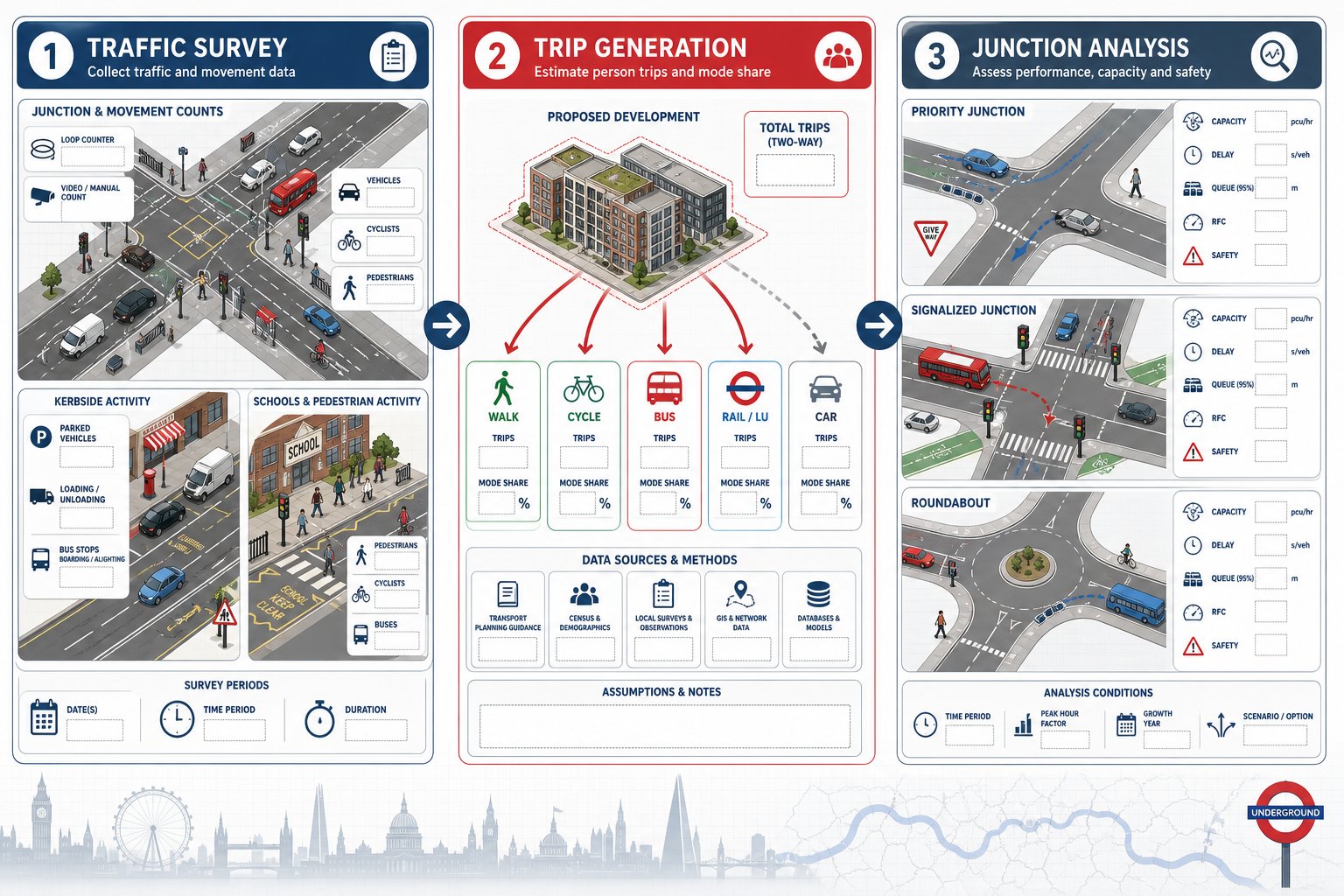
These are the technical building blocks behind most planning transport evidence. They sound dry on paper, but they answer the practical questions everyone cares about: how many trips a development will create, when those trips happen, where they go, and whether nearby streets and junctions can cope.
Traffic surveys establish existing conditions. Depending on the site, we may use turning counts at junctions, automatic traffic counts, queue surveys, parking beat surveys, pedestrian and cycle counts, or servicing observations. The right survey depends on the local issue. Around a school, timing is everything. Near a town centre, kerbside activity may matter more than raw flow.
Trip generation estimates how many arrivals and departures a development is likely to produce. We use standard databases, local census and mode share data, comparable sites, and professional judgment. In London, trip generation needs careful interpretation because public transport accessibility, controlled parking, and site context can materially suppress private car use while increasing walk, cycle, and bus demand.
Junction analysis tests whether key accesses and junctions operate safely and efficiently with the development in place. That may involve priority junction modelling, signal modelling, roundabout assessment, or microsimulation on more complex sites. Capacity is only part of the picture, though. We also consider queueing, road safety, pedestrian crossings, bus movement, and whether the model assumptions reflect how the street really works on a Tuesday morning rather than in an idealised spreadsheet.
Designing Access, Parking, Servicing, And Highway Improvements
Good traffic engineering is not just about identifying impacts. It is about designing solutions that make a scheme workable. In London, that often means finding a balance between tight physical constraints, planning policy, operational reality, and what can actually be delivered within highway land.
Access design is usually the starting point. We review visibility, geometry, gradients, pedestrian priority, cycle conflict, refuse vehicle tracking, emergency access, and how a crossover or bellmouth interacts with nearby features such as trees, parking bays, bus stops, and crossings. Sometimes the answer is to improve the access. Sometimes it is to move it entirely.
Parking strategy is similarly context-driven. Many London schemes aim for low-car or car-free outcomes, but that does not remove the need for analysis. We still need to justify disabled parking, cycle parking quality, visitor demand, car club provision, electric vehicle charging, and the relationship with local controlled parking zones.
Servicing design can be the hardest part. A loading bay that works neatly on a drawing may fail once you factor in turning paths, kerbside competition, delivery timing, and neighbour impacts. We test these details early because they are often decisive.
Where mitigation is needed, highway improvements might include waiting restrictions, footway changes, tactile paving, road markings, access protection, cycle facilities, signal amendments, or junction modifications. The strongest schemes treat transport design as part of placemaking rather than as a bolt-on fix after everything else is frozen.
Challenges Unique To Traffic Engineering In London
London is different from most UK development contexts because the network is busier, the street space is tighter, and the list of competing demands is much longer. A simple site access in a provincial town can become a multi-layered design and policy problem in the capital.
The first challenge is constrained street space. Many sites front roads that already need to accommodate buses, cyclists, pedestrians, loading, trees, utilities, crossings, parking controls, and sometimes street trading or school-street restrictions. There is very little spare width, and every kerbside metre tends to have several competing claims.
The second is intensity of movement. High pedestrian flows, frequent bus services, cycle corridors, and side-road turning activity mean even low-volume vehicle movements can create concern if they conflict with vulnerable road users. Safety is not judged solely by whether a vehicle can technically turn: it is judged by how comfortably and predictably the street operates.
Then there is consultation complexity. Borough highways officers, planning officers, TfL, urban designers, waste teams, and local stakeholders may all have a view. Their concerns overlap, but not always neatly. Construction logistics add another challenge: some sites are physically buildable only if deliveries are tightly managed, timed, and routed.
And finally, cumulative impact matters. A development might appear acceptable in isolation, yet become contentious because nearby schemes, temporary works, or policy changes are already reshaping the same network. That wider context is where London experience really earns its keep.
How To Choose The Right Traffic Engineer For A London Project
Choosing a traffic engineer is partly about technical skill and partly about planning judgment. In London, you need both. A consultant may be strong on modelling or highway design, but if they do not understand borough expectations, report scoping, and how to handle consultee concerns, the process can become slower and more expensive than it needs to be.
We would start with relevant experience. Have they supported planning applications in London boroughs similar to yours? Do they understand TfL interfaces, car-free policy, cycle standards, servicing constraints, and local validation requirements? Can they point to schemes involving similar land uses, scale, and urban conditions?
Reporting quality matters just as much. Planning transport documents need to be clear, proportionate, and defensible. Officers do not want a glossy document that avoids the hard questions. They want a report that identifies the real issues, uses credible evidence, and explains why the conclusions follow.
It is also worth checking whether the team can cover the full chain: surveys, trip generation, swept path work, junction modelling, access design, travel plans, and technical responses during determination. Quick turnaround is valuable, but only if the output is accurate. At ML Traffic, that balance between speed and precision is a big part of what clients typically need.
Finally, choose people who communicate plainly. Transport is collaborative. Architects, planners, lawyers, and developers need advice they can act on, not just a stack of technical appendices.
What To Prepare Before Instructing A Traffic Engineer
The fastest way to get useful transport advice is to provide a clear project brief from the start. We do not need every detail to be finalised, but we do need enough information to scope the likely issues properly and avoid guessing around key assumptions.
At minimum, it helps to provide:
- a site location plan and any existing or proposed drawings
- the proposed land use or land-use mix
- floorspace, unit numbers, or other scale metrics
- draft access proposals for vehicles, cycles, and pedestrians
- parking assumptions, including disabled spaces and cycle parking
- expected servicing arrangements, refuse strategy, and delivery patterns
- known planning history or pre-application comments
- target programme for submission and determination
If there are known constraints, flag them early. That could be a red route frontage, restricted construction access, nearby school, local parking stress, estate road adoption issue, or a neighbour likely to object on highway grounds. Those details often shape the scope more than the development size alone.
It is also useful to tell us what stage the design is at. Early concept advice is different from post-layout validation. If a planning appeal, due diligence exercise, or legal challenge is involved, the brief should say so.
When information arrives early and clearly, we can usually advise faster, identify whether a transport statement or fuller assessment is needed, and reduce the risk of avoidable redesign later in the process.
Conclusion
A Traffic Engineer in London does far more than calculate vehicle movements. We help shape development into something that can be approved, built, and operated on one of the most complex urban transport networks in the country. That means understanding policy, borough process, TfL expectations, street-level constraints, and the practical detail of access, servicing, parking, and mitigation.
For planning teams, the biggest gains usually come from getting transport advice early. A well-scoped piece of evidence can prevent redesign, reduce consultation friction, and give decision-makers confidence that transport impacts have been handled properly. A late or generic report tends to do the opposite.
If a scheme may affect traffic flow, highway safety, servicing, parking, or sustainable travel demand, transport input is not an administrative add-on. It is part of the planning strategy itself. In London, that distinction matters.
Frequently Asked Questions About Traffic Engineers in London
What does a Traffic Engineer in London do for planning and development?
A Traffic Engineer in London assesses how developments affect local transport, preparing evidence like transport assessments and statements. They advise on access, parking, servicing, and mitigation measures to ensure proposals work within London’s constrained network and meet borough policies.
When is it necessary to involve a Traffic Engineer for a London planning application?
Engaging a Traffic Engineer is essential when a development might impact traffic flow, highway safety, parking, servicing, access, or public transport demand. Even small schemes near sensitive areas, such as red routes or schools, often require their input early in the planning process.
What types of transport reports are commonly prepared by Traffic Engineers for London sites?
Common reports include Transport Statements for lighter impacts, detailed Transport Assessments for larger projects, Travel Plans promoting sustainable travel, delivery and servicing strategies, and Construction Logistics Plans to manage site access and vehicle movements during construction.
How do London-specific policies and borough requirements influence Traffic Engineering work?
London’s transport evidence must align with the London Plan, local borough policies, and Transport for London guidelines. This layered approach affects report scope and recommendations, as authorities may require tailored solutions addressing issues like car-free compliance, refuse collection, or cycle provision.
What challenges are unique to traffic engineering projects in London?
London presents unique challenges such as constrained street space crowded with buses, cyclists, and pedestrians; high movement intensity; complex stakeholder consultation; tight delivery and servicing schedules; and cumulative impacts from multiple developments, all requiring nuanced, locally tailored traffic engineering solutions.
How should one choose the right Traffic Engineer for a London project?
Choose a Traffic Engineer with proven London borough experience, familiarity with TfL processes, strong technical and reporting skills, and capability to handle surveys, modelling, and stakeholder consultation. Effective communication and understanding local policy requirements ensure smoother planning approvals.