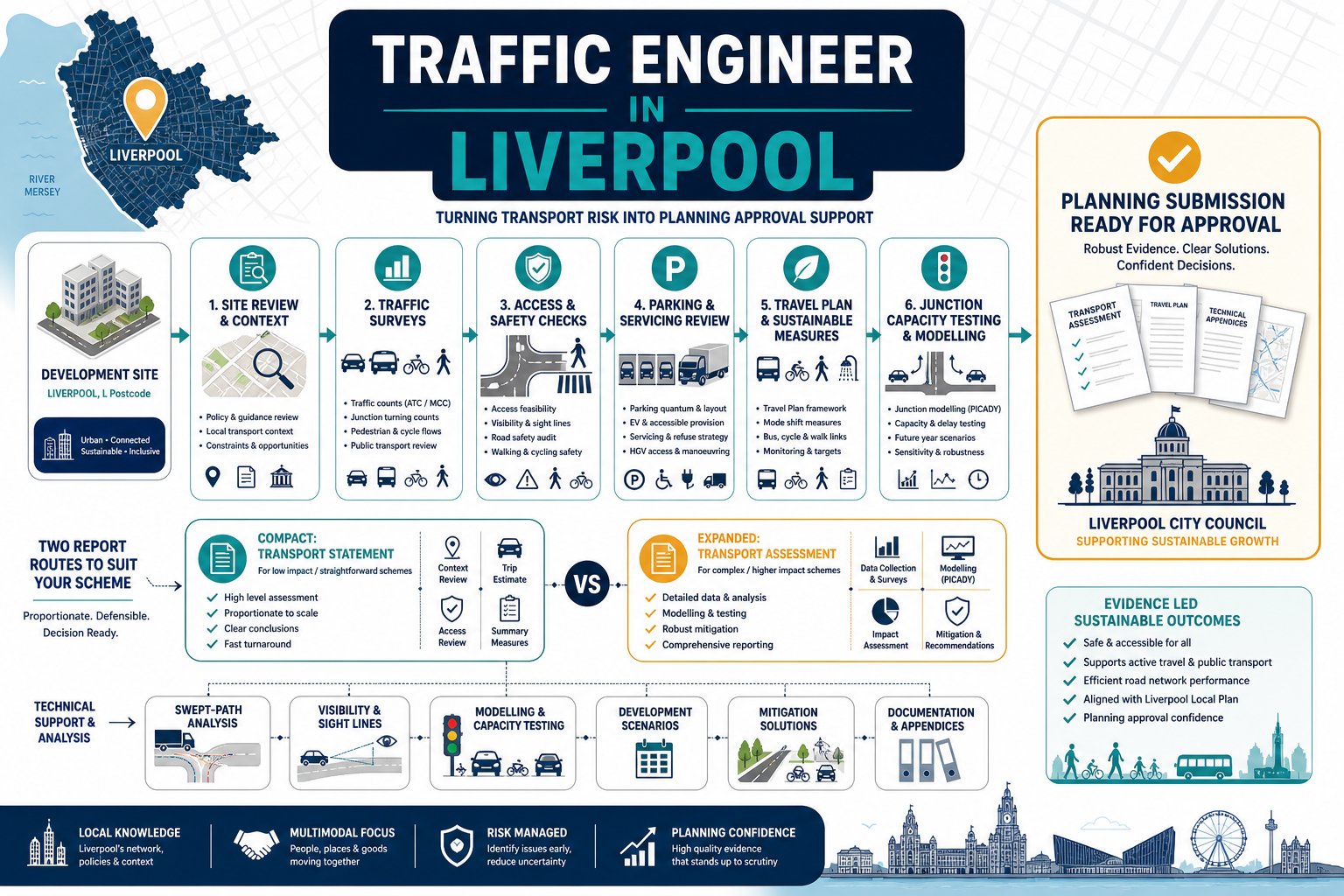
Liverpool development rarely moves in a straight line. A scheme can look commercially sound, architecturally well resolved, and perfectly suited to its site, then stall because access is constrained, junction pressure hasn’t been tested properly, or the local highway authority wants clearer evidence on parking, servicing, or sustainable travel. That is usually the point where a good traffic engineer becomes central rather than optional.
As a traffic engineer in Liverpool, we support planning applications by turning transport risk into something measurable, explainable, and, crucially, solvable. For architects, planners, lawyers, surveyors, developers and councils, that means proportionate advice at the right time: not pages of generic commentary, but transport input that reflects the site, the scale of development, and Liverpool’s local highway context.
In practice, that can involve anything from a concise Transport Statement for a modest urban scheme to a full Transport Assessment, Travel Plan, junction modelling package, parking review, swept-path analysis, or access strategy for a more sensitive proposal. The goal is consistent even when the reports differ: demonstrate safe and suitable access, show that the residual transport effects are acceptable, and help projects move through planning with fewer avoidable objections.
Below, we break down what a traffic engineer in Liverpool actually does, when transport input is needed, which reports are most often required, and how local knowledge can make the difference between a smooth submission and a long, expensive round of revisions.
What A Traffic Engineer In Liverpool Does For Planning And Development
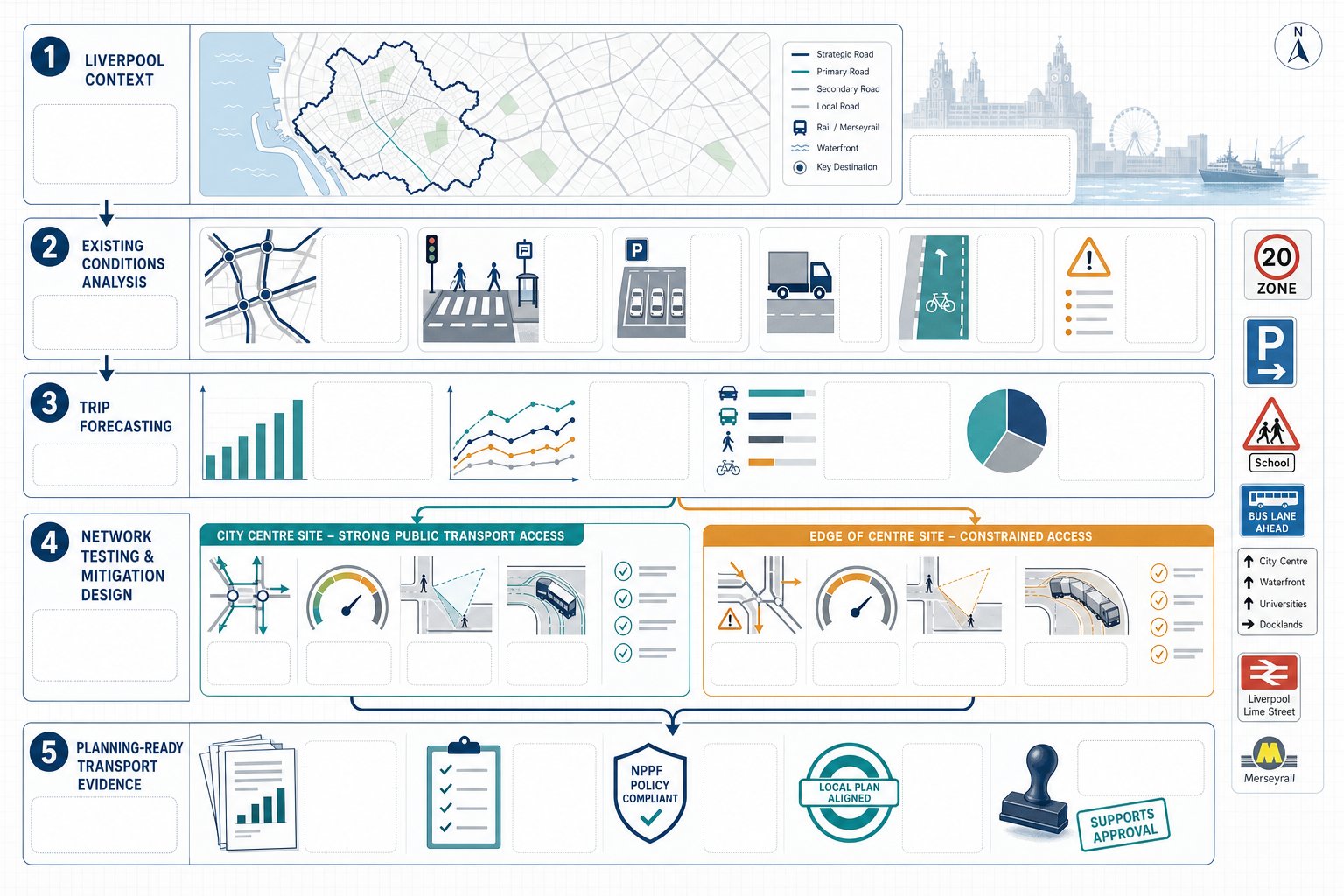
At planning stage, our job is to assess how a proposal will interact with the surrounding highway and transport network, then present that evidence in a form that Liverpool City Council and other stakeholders can rely on. That starts with understanding existing conditions: road hierarchy, nearby junction performance, pedestrian links, bus accessibility, parking stress, servicing patterns, cycle infrastructure, and any known safety concerns.
From there, we forecast how a development is likely to perform. We estimate trip generation, consider where those trips will come from and go to, and test whether the network can absorb them. If the answer is yes, we explain why. If not, we identify mitigation, access amendments, operational changes, parking refinements, servicing controls, junction improvements, or sustainable travel measures, to make the scheme acceptable in highway terms.
Traffic engineering for planning is partly technical and partly strategic. The technical side covers surveys, modelling, design checks, visibility splays, swept paths, capacity assessments, and standards compliance. The strategic side is knowing what level of reporting is proportionate and how local decision-makers are likely to view the proposal.
That local judgement matters. A city-centre infill site near strong public transport provision will be approached differently from an edge-of-centre commercial unit with constrained access and limited parking. In both cases, the role of a traffic engineer in Liverpool is to reduce uncertainty early and give the planning team a transport case that stands up under scrutiny.
Why Liverpool Projects Need Local Transport And Highway Expertise
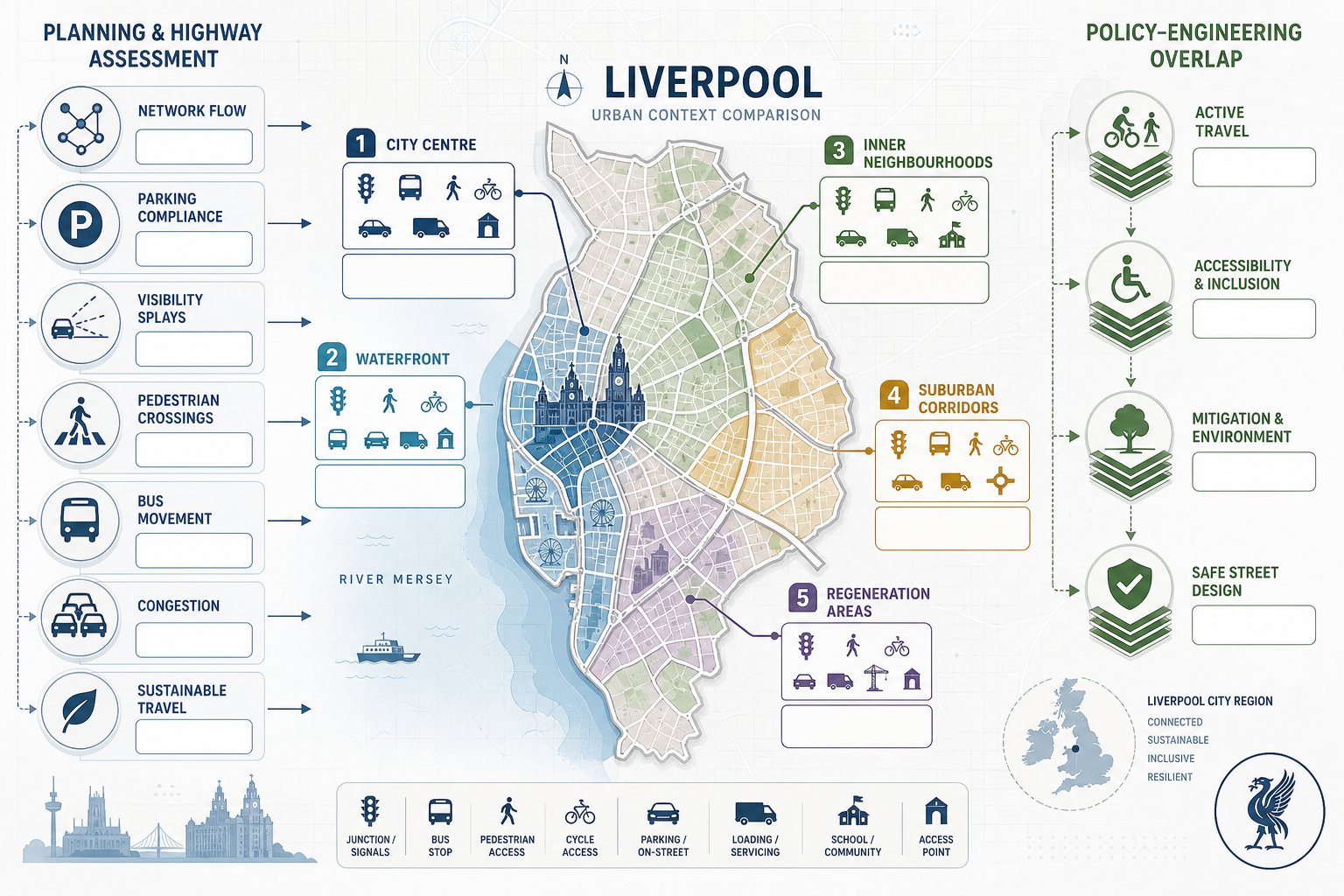
Liverpool is not a place where generic transport advice performs especially well. Street patterns vary sharply between the city centre, waterfront, inner urban neighbourhoods, suburban corridors, and regeneration areas. Some sites sit comfortably within walkable, multi-modal catchments. Others are heavily shaped by peak-time congestion, signal coordination, school traffic, servicing demands, or constrained frontage conditions.
That is why local transport and highway knowledge can save both time and cost. Liverpool City Council, as highway authority, will expect transport submissions to reflect the actual operating context of the surrounding network, not just broad assumptions lifted from another authority area. Junctions that appear manageable on a plan may already be sensitive in practice. Parking that looks generous on paper may conflict with local standards or nearby on-street demand. And a seemingly simple access point can become contentious if visibility, turning activity, pedestrian desire lines, or bus movement haven’t been addressed.
Local expertise also helps when policy and engineering overlap. The Liverpool City Region transport agenda places clear emphasis on sustainable travel, network efficiency, and safe street design. So a robust planning submission often needs more than traffic numbers: it needs a credible narrative on active travel, accessibility, and mitigation.
That broader perspective is useful across regions too. While local thresholds differ, many recurring planning issues are comparable to those we encounter on schemes such as transport planning work in Manchester and highway support in Birmingham. The principle is the same: context matters, and local highway judgement is rarely interchangeable.
Key Planning Reports Required For Liverpool Developments
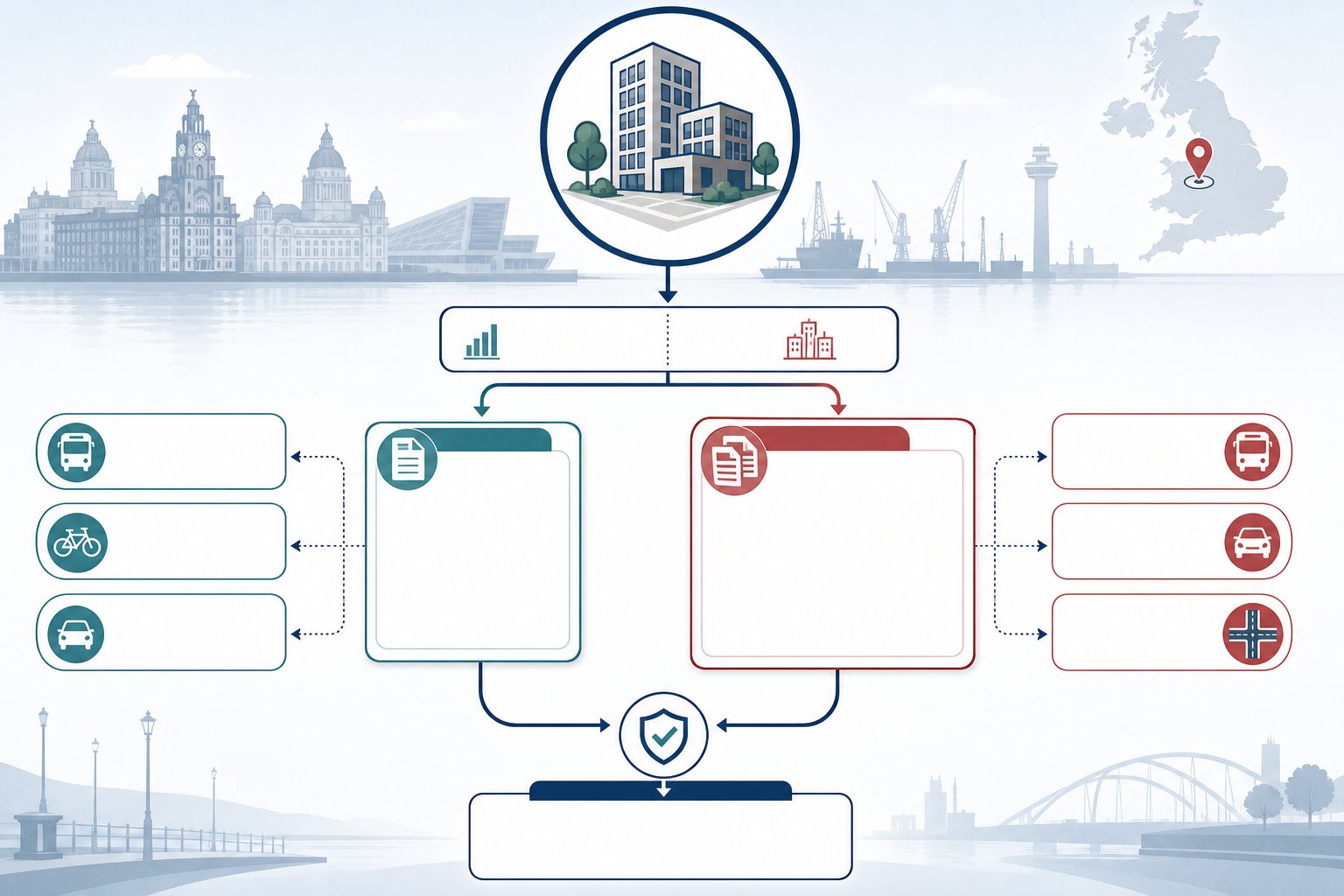
The right report depends on the scale, type, and location of the proposal, along with the level of transport impact likely to arise. In Liverpool, most planning schemes that trigger transport input will need either a Transport Assessment or a Transport Statement, often supported by more focused technical notes.
For smaller or less intensive developments, a concise report may be enough to explain access arrangements, parking, servicing, and expected trip effects. Larger schemes, or those on constrained urban sites, usually need a fuller evidence base. The important point is proportionality. Over-reporting can waste time and budget: under-reporting tends to lead to objections, validation issues, or requests for further information.
We also regularly prepare supporting documents where a full TA or TS is not the whole story. Travel Plans are commonly requested to demonstrate how sustainable travel will be encouraged and monitored. Parking reviews can be necessary where local stress is already high or where provision departs from expectation. Junction capacity studies may be needed when a development interacts with a sensitive priority, signalised, or roundabout arrangement.
Done properly, these reports do more than satisfy a checklist. They help the planning authority understand the scheme in operational terms, and they show that transport effects have been identified and managed before determination. That is often what separates a smoother planning pathway from months of back-and-forth.
Transport Assessments And Transport Statements
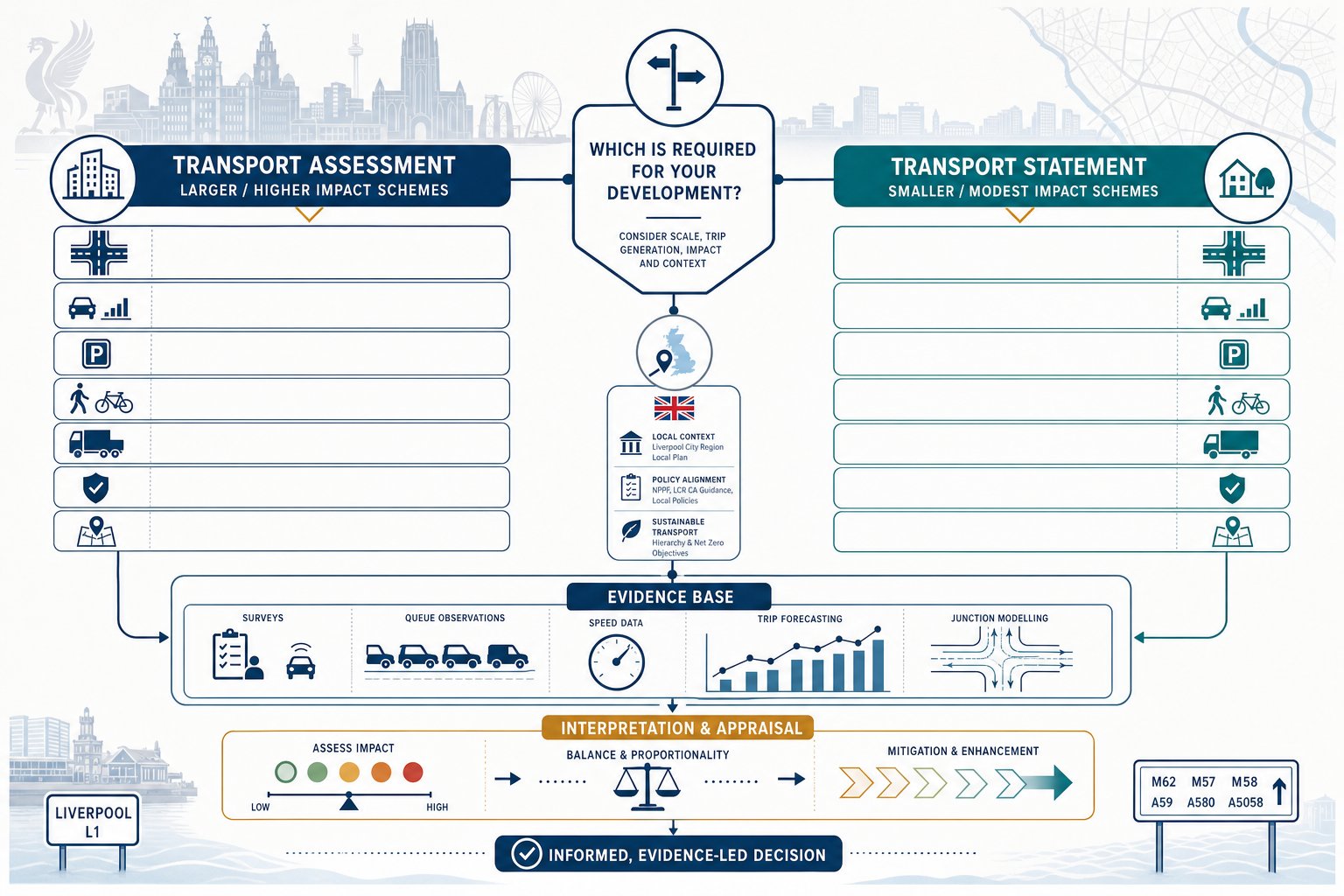
A Transport Assessment is the more comprehensive option and is generally prepared for larger developments or proposals with potentially material network effects. It quantifies existing conditions, projected trip generation, distribution and assignment, likely modal split, and the effect of those trips on surrounding junctions and links. Depending on the site, it may include accident data analysis, accessibility mapping, servicing strategy, parking appraisal, and mitigation design.
A Transport Statement is usually more proportionate for smaller schemes with modest impacts. It still needs to be robust. A concise report that clearly explains access, sustainable travel opportunities, parking provision, and expected trip activity is far more useful than a bloated document that avoids the actual planning issues.
Both documents rely on evidence. That may include traffic surveys, queue observations, speed data, TRICS-informed trip forecasting, and junction modelling using industry-standard tools. The outputs must then be interpreted sensibly. A model result on its own does not win support: it needs context, assumptions that reflect real site conditions, and a clear explanation of whether any impact is severe, negligible, or capable of mitigation.
In practice, one of the biggest advantages of involving us early is deciding whether a TA or TS is the right fit. That early call can prevent a planning submission from becoming either underpowered or unnecessarily complex.
Travel Plans, Parking Reviews, And Junction Capacity Studies
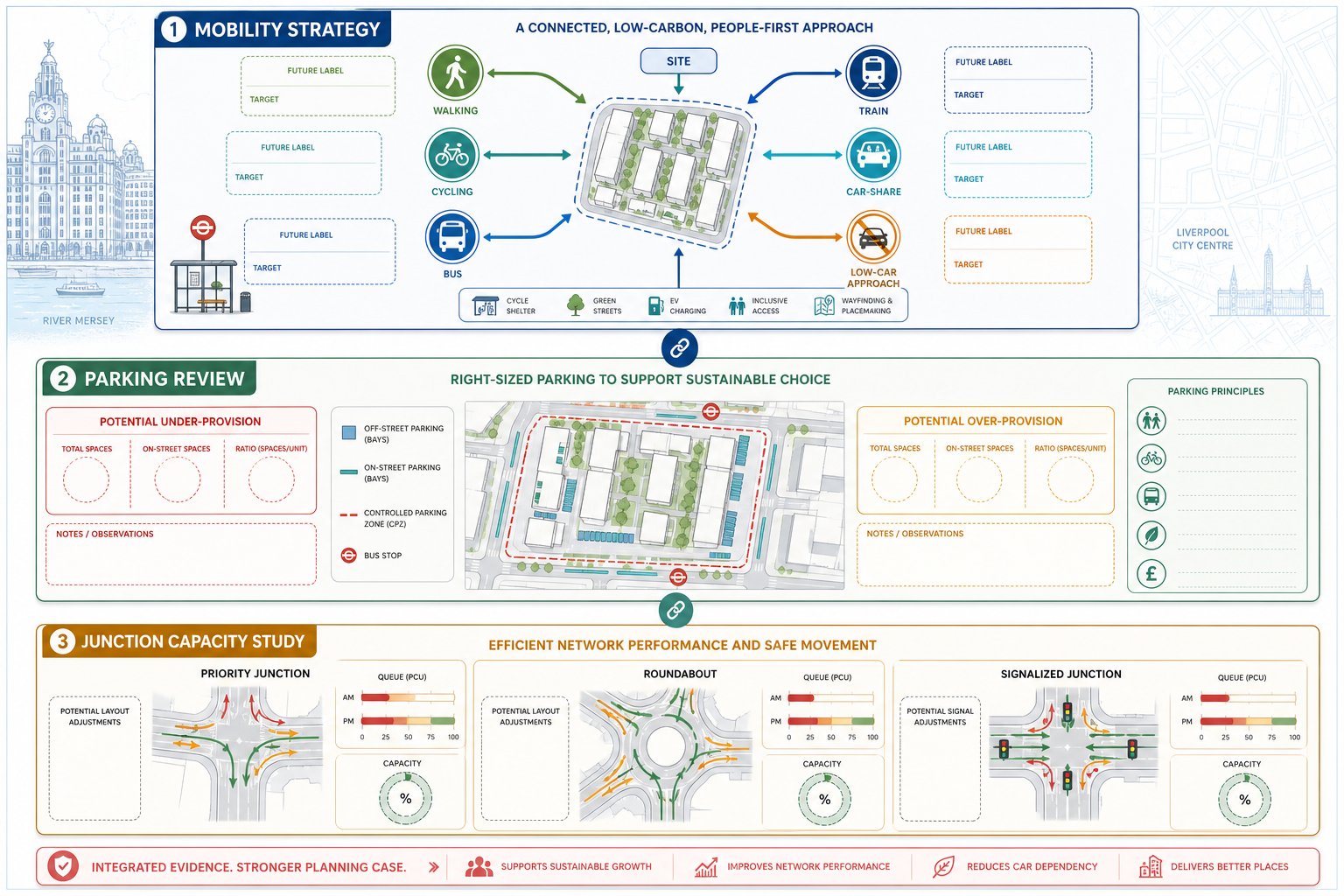
Travel Plans are often misunderstood as an afterthought. In reality, a good Travel Plan can be one of the most practical planning tools available, especially for sites where mode choice is flexible. It sets out realistic measures to encourage walking, cycling, public transport, car sharing, and lower single-occupancy car use, alongside monitoring arrangements and targets. For residential schemes, that might mean cycle storage, welcome packs, travel information and car club measures. For employment sites, it could extend to staff incentives, shower provision, public transport promotion, and site management commitments.
Parking reviews are equally important in Liverpool, particularly on compact urban sites. We assess proposed parking against likely demand, local standards, nearby controls, and existing on-street pressure. Sometimes the issue is under-provision. Sometimes it is over-provision that undermines sustainable travel objectives or compromises layout quality.
Junction capacity studies focus on whether nearby priority junctions, roundabouts, or signals can operate acceptably with development traffic. We look at ratio-to-capacity, delay, queue formation, reserve capacity, and whether any layout or signal changes may be needed. On more sensitive schemes, that can feed into wider discussions with the highway authority and design team.
When these supporting studies are integrated properly, they make the main planning case more persuasive, and much harder to challenge on detail.
When You Need A Traffic Engineer For A Planning Application
The short answer is earlier than most project teams expect. If a scheme creates a new access, intensifies an existing use, affects parking or servicing, or sits on a road where visibility, congestion, or safety are already live issues, transport input should usually begin before drawings are fixed.
A traffic engineer is commonly needed where the local validation requirements indicate a Transport Assessment, Transport Statement, or Travel Plan. But formal thresholds are only part of the picture. Plenty of applications run into trouble because the need for transport evidence was not obvious until late in the process. Change-of-use schemes are a classic example: on paper they can look minor, yet the shift in trip profile, peak timing, servicing demand, or parking intensity can be significant.
We also advise getting us involved early for sites fronting A-roads, busy distributors, signalised corridors, constrained side streets, or locations with limited visibility. The same applies where there is likely to be concern about cumulative impact, school-run traffic, HGV movement, or pedestrian conflict.
Early appointment usually improves options. If a layout needs to move slightly to secure visibility, if a service yard needs better turning geometry, or if cycle parking needs integrating before a design is locked, those are manageable changes at concept stage. They become expensive problems later.
For teams operating nationally, there is value in comparing how local expectations shift from city to city: workstreams similar to planning support in London often show just how much local authority context affects the scope of transport evidence.
Typical Liverpool Schemes That Require Transport Input
Not every project needs the same level of analysis, but certain development types in Liverpool repeatedly trigger transport and highway review. The common factor is not just traffic volume: it is whether the proposal changes how people, vehicles, and servicing activity interact with the site and the wider network.
Urban intensification, redevelopment of constrained plots, and schemes in areas with tight parking conditions often need support even when the gross floor area or unit count is not especially large. Equally, developments with strong sustainable transport credentials still need evidence. Good public transport accessibility does not remove the need to prove safe access, servicing practicality, and policy compliance.
We are typically brought in where planning teams need one or more of the following: a TA or TS, access strategy, swept-path analysis, parking and cycle review, Travel Plan, junction assessment, or technical response to highway comments. The detail varies by sector, but the planning risk is familiar, unresolved transport matters can delay otherwise viable schemes.
The two broad groups below account for a large share of requests we see in Liverpool, though there is often overlap between them on mixed or phased sites.
Residential, Mixed-Use, And Commercial Developments
Residential schemes generate a large proportion of planning-related traffic engineering work in Liverpool, from small apartment infill projects to major mixed-tenure or build-to-rent proposals. The key questions are usually access quality, parking provision, cycle storage, servicing, bin collection arrangements, and the effect of peak-hour trips on nearby junctions. City-centre and edge-of-centre schemes often require a more nuanced approach because car ownership assumptions, public transport access, and constrained loading conditions can differ substantially from suburban sites.
Mixed-use development adds another layer. Combining residential, retail, leisure, office, or hospitality uses can create complementary travel patterns, but it can also complicate servicing, drop-off, parking control, and cumulative peak effects. A good transport strategy needs to reflect how the place will actually operate, not just how each use performs in isolation.
Commercial schemes, including offices, gyms, drive-through elements, retail units, and leisure uses, frequently need parking reviews and junction assessments because trip timing can be sharp and locally concentrated. Even modest proposals can become contentious if they sit close to already stressed junctions or streets with limited kerbside capacity.
This is where evidence matters most. A planning authority may accept change when the transport consequences are clearly understood, proportionate, and mitigated. It is far less likely to be comfortable with assumptions that feel generic or optimistic.
Schools, Healthcare, Industrial, And Change-Of-Use Sites
Schools and education sites bring highly specific transport issues. Pick-up and drop-off patterns, crossing movements, coach activity, staff parking, and safeguarding for walking and cycling routes all need careful thought. A school can be well located and still create sharp local pressure during short peak windows. That is why School Travel Plans, parking management measures, and practical access reviews are often central to the application.
Healthcare uses can be similar. GP surgeries, clinics, and other medical premises tend to generate short-stay visits, accessibility needs, and parking demand that does not always fit neatly into standard assumptions. If ambulance access, patient drop-off, or limited frontage is involved, the transport case needs to be especially clear.
Industrial and logistics sites are a different discipline again. Here, HGV routing, yard design, turning space, gate operation, staff travel, and interaction with the wider freight network are often the deciding factors. Swept-path analysis and servicing strategy are usually as important as trip generation.
Change-of-use proposals can catch applicants off guard because the built form may remain largely unchanged while transport effects increase sharply. A move from office to restaurant, warehouse to trade counter, or residential to specialist supported use can alter parking demand, delivery patterns, and peak activity enough to justify technical evidence. Those are exactly the schemes where early traffic input prevents a “simple” application from becoming unexpectedly difficult.
How Traffic Engineers Assess Access, Safety, And Network Impact
The assessment process normally starts on site, not at a desk. We review the surrounding highway environment, observe how the street actually functions, note parking behaviour, pedestrian desire lines, servicing patterns, public transport access, crossing opportunities, and any physical constraints that do not show up well on plans. Then we combine that with survey data, traffic flows, queue lengths, speeds, turning counts, and sometimes parking beat surveys or classified movement data.
Access is then tested against the nature of the road and the expected vehicle types. We review geometry, visibility splays, pedestrian interaction, gradients, and whether vehicles can enter and leave in a safe and practical way. On some schemes, Manual for Streets principles will be most relevant: on others, more strategic design criteria and highway authority expectations carry greater weight.
Safety assessment usually includes collision record analysis, review of local conflict points, and a sense check on whether the development could worsen an existing problem. We also prepare swept-path drawings to confirm that refuse vehicles, delivery vehicles, or larger service vehicles can manoeuvre without unrealistic assumptions.
Finally, we test network impact. That may involve junction modelling, comparative scenario testing, and qualitative review of whether mitigation is needed. The best transport evidence is rarely just one spreadsheet or one model printout. It is the combination of field understanding, technical analysis, and planning judgement that makes the conclusions credible.
Working With Liverpool City Region Policies And Local Highway Standards
A technically competent report still needs to align with the policy framework. In Liverpool, that means understanding the local plan context, Liverpool City Region Combined Authority transport priorities, parking and cycle provision expectations, accessibility objectives, and the practical standards applied by the highway authority.
This matters because planning decisions are not based on capacity numbers alone. A scheme may have minimal junction impact but still attract concern if it underperforms on sustainable travel provision, creates awkward servicing on a busy street, or relies on a layout that is unlikely to be adopted or supported in highway terms. Equally, a site with some operational challenges may still be acceptable if the proposal is well connected, carefully mitigated, and policy compliant overall.
We hence treat policy and engineering as one conversation. Travel Plans need to be realistic and monitorable. Cycle parking needs to be functional, not tokenistic. Parking levels need to respond to place, use, and accessibility. Access layouts must work for the vehicles that will actually use them. And where signals or coordinated corridors are involved, the submission should respect how the wider urban traffic control environment operates.
That joined-up approach is part of why many clients use us repeatedly through different authorities. At ML Traffic, our emphasis is concise, accurate reporting shaped around local planning thresholds rather than off-the-shelf templates. That usually leads to fewer surprises after submission, and fewer rounds of avoidable clarification.
How To Choose The Right Traffic Engineer In Liverpool
If you are appointing a traffic engineer in Liverpool, start with relevance, not just availability. You need someone who understands UK planning transport work, can write clearly for planners and highway officers, and has experience with the kinds of schemes you are promoting. Degree-level transport or civil engineering credentials matter, but so does judgement. A technically correct report that misses the real planning issue is not much use.
Look for direct experience of Transport Assessments, Transport Statements, Travel Plans, junction capacity work, access design review, parking studies, and technical negotiation with local authorities. Ask whether the consultant has worked on comparable sites in Liverpool or the wider city region, particularly where constraints resemble your own, tight urban plots, mixed-use schemes, schools, healthcare, logistics, or access-sensitive redevelopment.
Software capability is important, but it should not be the headline act. Modelling tools are only useful when the engineer knows what assumptions are reasonable, what sensitivity testing is needed, and how the results will be interpreted by decision-makers.
Finally, consider how the advice is delivered. Planning teams usually need a consultant who is responsive, proportionate, and willing to engage early with architects, planning consultants, and design teams. Fast turnaround helps, of course. But faster only matters if the report is accurate, locally grounded, and capable of surviving scrutiny once it lands on a case officer’s desk.
Conclusion
In Liverpool, transport input is rarely just a technical add-on. It is often one of the key pieces of evidence that determines whether a scheme feels workable, safe, and policy compliant to the planning authority. For development teams, that means the right traffic engineer can do far more than produce a report, they can identify risk early, shape a better access strategy, and help avoid delays that come from underestimating local highway concerns.
Whether the requirement is a full Transport Assessment, a focused Transport Statement, a Travel Plan, a parking review, or junction modelling, the principle is the same: proportionate, site-specific evidence gives projects a much stronger planning position. And in a city as varied as Liverpool, local knowledge is not a luxury. It is part of what makes the advice effective.
For architects, planners, surveyors, lawyers, developers and councils, that is usually the difference between transport work that merely exists and transport work that genuinely helps unlock permission.
Frequently Asked Questions About Traffic Engineers in Liverpool
What does a traffic engineer in Liverpool do for planning and development?
A traffic engineer in Liverpool analyses existing and future traffic conditions for development proposals, designs site access and highway works, and advises on mitigation measures to ensure schemes are acceptable in highway terms, supporting smooth planning applications.
When is it necessary to hire a traffic engineer for a planning application in Liverpool?
In Liverpool, you need a traffic engineer early if your scheme creates or changes access to busy roads, affects parking or servicing, or faces visibility and safety issues. They are essential for applications requiring Transport Assessments, Statements, or Travel Plans according to local validation rules.
What are the key transport reports needed for developments in Liverpool?
Liverpool developments typically require either a Transport Assessment for larger projects or a proportionate Transport Statement for smaller schemes. Supporting documents often include Travel Plans to promote sustainable travel, parking reviews, and junction capacity studies to assess traffic impact.
How does local knowledge influence traffic engineering in Liverpool?
Local expertise is critical because Liverpool’s road patterns, traffic signals, and policies, including sustainable travel priorities, vary widely. Understanding these ensures transport reports reflect real conditions, helping avoid costly delays by meeting Liverpool City Council’s specific highway authority requirements.
What types of developments in Liverpool usually require traffic engineering input?
Residential, mixed-use, commercial, educational, healthcare, industrial, and change-of-use projects in Liverpool often need traffic engineering. These schemes influence access, parking, servicing, and local traffic flow, necessitating detailed assessments to meet planning and highway standards.
How can a Travel Plan benefit a Liverpool development project?
A Travel Plan in Liverpool manages travel behaviour by promoting walking, cycling, public transport, and car sharing. It sets realistic targets and monitoring measures, helping reduce vehicle trips, enhance sustainability, and satisfy local policy requirements, often improving planning outcomes.