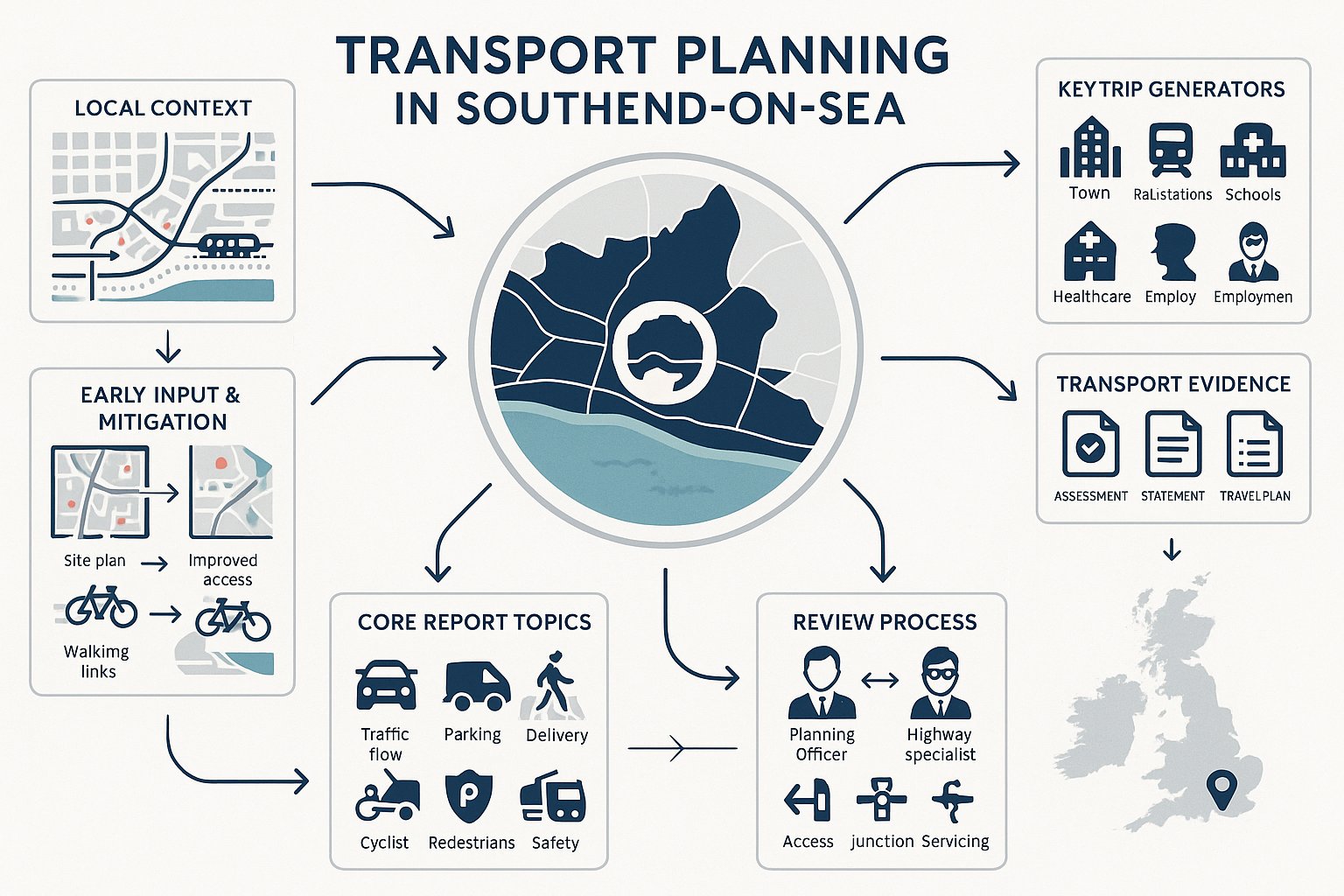
Planning development in a compact coastal city is rarely straightforward, and Southend-on-Sea proves the point. A scheme can look perfectly workable on paper, then run into immediate questions about peak-time congestion, seafront visitor traffic, parking pressure, rail accessibility, or whether a Travel Plan has any real substance behind it. That is why transport planning in Southend-on-Sea matters so much in 2026: it sits right between planning policy, highway capacity, regeneration ambition, and increasingly, climate expectations.
For architects, developers, planners, legal teams and local authorities, the practical challenge is not simply producing a transport document. It is producing the right evidence, at the right scale, in a form that responds to Southend’s local context. A modest infill residential scheme, a healthcare extension, and a town-centre mixed-use proposal may all require transport input, but not the same level of analysis or the same mitigation strategy.
In our experience, successful applications usually have one thing in common: transport is considered early, not bolted on at the end. With over 30 years of experience preparing concise, planning-ready reports through ML Traffic, we’ve seen how proportionate evidence, local knowledge, and clear engagement with policy can prevent avoidable delays. This guide explains what decision-makers typically look for, where applications often stumble, and how to build a transport case that stands up in Southend-on-Sea.
Why Transport Planning Matters In Southend-On-Sea
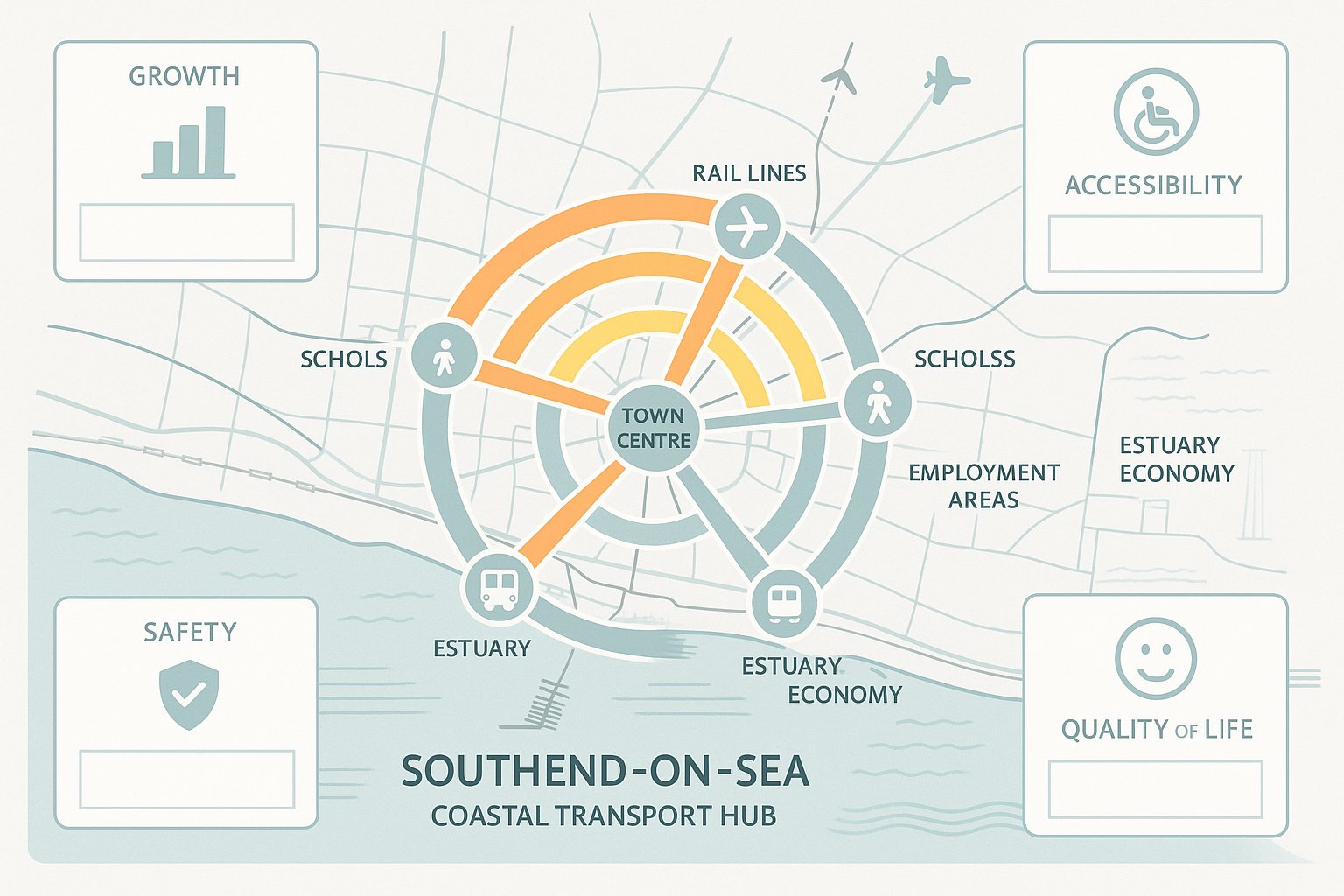
Southend-on-Sea has a transport story that is more complicated than its size might suggest. It is a dense coastal city, a visitor destination, a centre for employment and education, and part of the wider Thames Gateway regeneration area. That combination means transport planning is never just about vehicle access. It is about supporting growth without making existing network pressures worse.
The local economy depends heavily on movement. The town centre, seafront, rail corridors, airport-related activity and wider estuary economy all generate trips with different patterns across the day and year. Summer weekends can look very different from a standard weekday peak. So can school term conditions compared with holiday periods. Good transport planning recognises that Southend’s demand profile is not flat or predictable in the way a generic suburban authority might be.
There is also a policy reason transport planning carries weight here. The city’s transport strategy links economic growth with carbon reduction, safety, accessibility and quality of life. In plain terms, schemes are increasingly expected to do more than avoid severe traffic harm. They should also support walking, cycling, bus use, rail access and healthier travel behaviour where reasonable.
That matters for applicants because transport evidence often influences layout, parking, servicing, viability and eventually planning risk. Done well, it helps unlock consent. Done poorly, it can drag an application into rounds of queries, redesign and delay.
The Local Development Context Shaping Transport Decisions
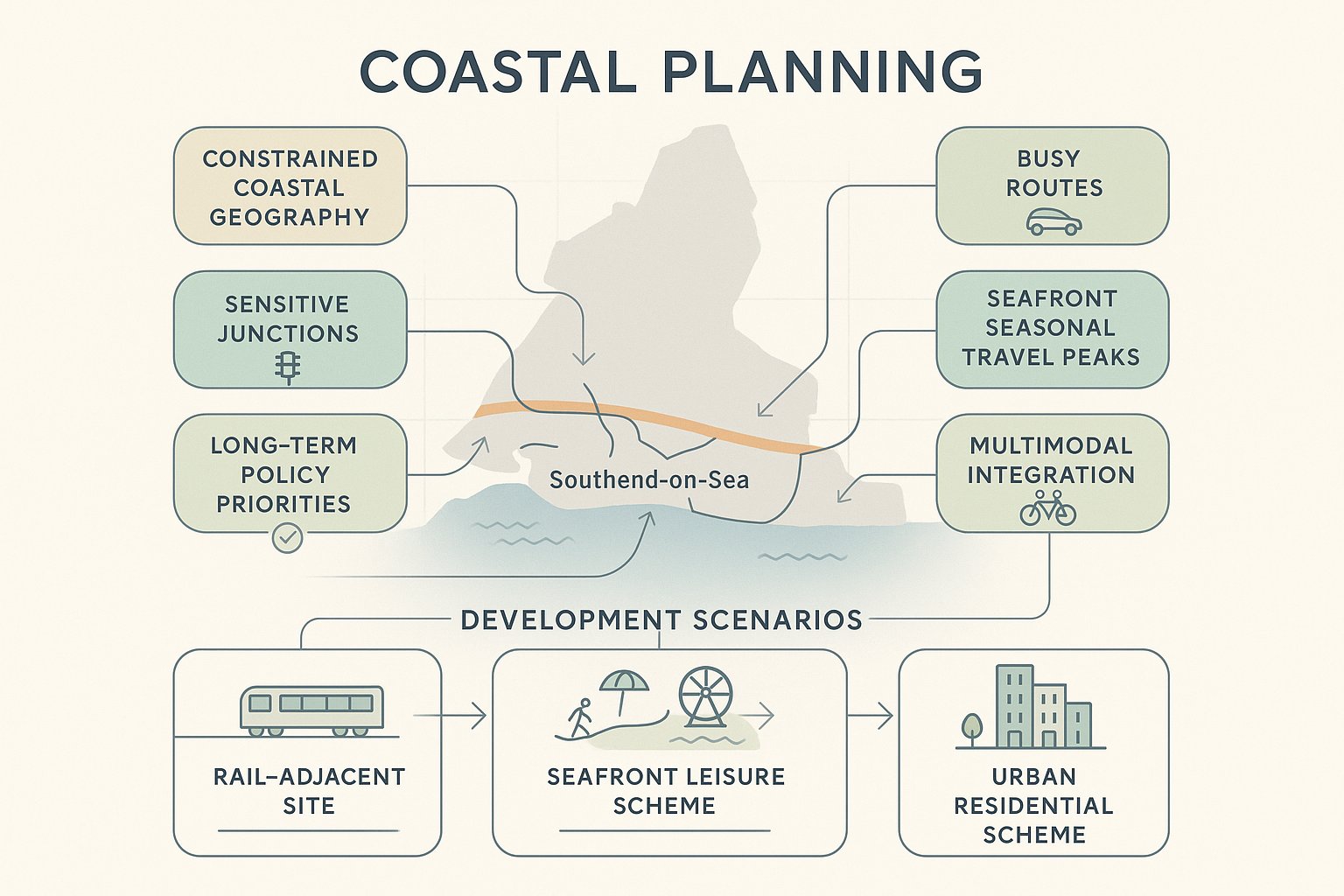
Southend’s development context shapes transport decisions in ways that are very local. Geography comes first. The city sits at the mouth of the Thames Estuary, with a constrained coastal form and strong east-west movement corridors. There are obvious attractions to developing in accessible urban locations, but there are also limits: some routes are already busy, some junctions are sensitive, and seafront-related travel can create sharp peaks.
Policy adds another layer. The Local Transport Plan 2011-2026 established long-term priorities around economic growth, reducing carbon emissions, equality of opportunity, safety and better quality of life. Although transport policy language evolves, those broad themes still frame how proposals are judged. Emerging strategies and interim work have pushed even harder on sustainable mobility, behaviour change and better integration between modes.
For applicants, this means Southend transport planning is not only a technical exercise. It is also a policy exercise. A report needs to show not just what traffic a proposal may generate, but how the development fits a wider vision for movement across the borough.
That often affects the emphasis within an assessment. A site near a rail station may need stronger discussion of mode share assumptions. A seafront or leisure-led scheme may need closer consideration of seasonal peaks. A residential proposal in an urban area may be judged partly on whether its parking strategy genuinely supports sustainable travel rather than simply displacing demand onto nearby streets.
Key Trip Generators And Network Pressures Across The Borough
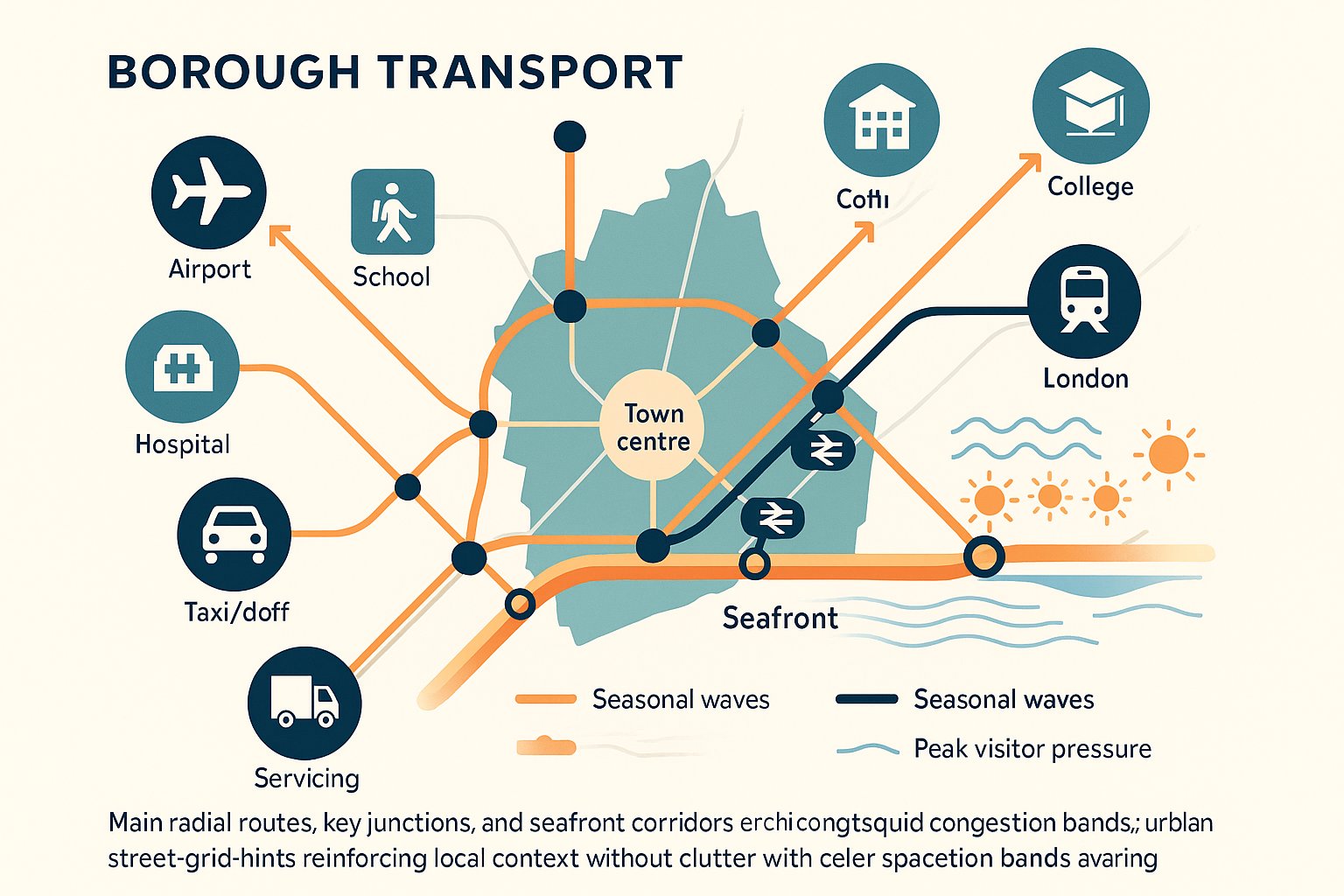
Several trip generators dominate transport planning in Southend-on-Sea, and understanding them is essential if we want to produce credible assessments.
The town centre remains a major attractor, combining retail, employment, civic uses and leisure. The seafront adds another very specific layer of demand, especially during warmer months, event days and school holidays. That is where generic weekday-only thinking can quickly fall apart. If a development is likely to interact with visitor traffic, the analysis needs to acknowledge it.
Rail is another defining feature. Southend benefits from two lines to London, which is a real strength for sustainable access and commuting patterns. But rail accessibility is not uniform across all sites, and proximity to a station does not automatically remove highway concerns. The quality of walking routes, bus interchange and actual service convenience all matter.
Southend Airport, schools, colleges and healthcare facilities also create concentrated travel demand. Education and healthcare uses, in particular, can produce sharp arrival and departure peaks, parking stress and sensitive pedestrian movements. Add in servicing activity, taxis, drop-off behaviour and occasional network incidents, and even modest development can have noticeable local effects.
Across the borough, pressure tends to be strongest on main radial routes, key junctions and seafront corridors. The practical lesson is simple: transport evidence should be based on how Southend actually functions, not how a spreadsheet says a place of similar size ought to function.
When A Planning Application Needs Transport Evidence
Not every planning application in Southend requires a full Transport Assessment, but many schemes do need some form of transport evidence. The threshold is usually not about a single magic number. It is about whether development is likely to generate significant trips, change travel patterns, affect access arrangements, or create impacts that planning officers and the highway authority need properly tested.
In practice, larger residential schemes, employment sites, education uses, healthcare development, retail proposals and leisure schemes are the most obvious candidates. But smaller applications can still trigger transport questions where the local highway context is constrained, where parking is already stressed, or where a site has awkward access or servicing conditions.
This is where early judgement matters. If an applicant under-scopes the transport requirement, the submission may look incomplete from day one. That tends to lead to requests for more data, further modelling, revised drawings or a belated Travel Plan. Time gets lost, and confidence in the application can slip.
We generally advise clients to treat transport evidence as a proportional exercise rather than a box-ticking one. The question should be: what does the authority need to understand to make a robust planning decision? In Southend-on-Sea, that often means linking trip impacts to local constraints, public transport opportunities, parking conditions and policy expectations around sustainable travel.
Transport Assessment Vs Transport Statement Vs Travel Plan
A Transport Assessment is the most detailed option. It is typically needed for larger or higher-impact schemes where trip generation, distribution, assignment, junction operation, access design and mitigation all require quantitative review. A good TA is evidence-led and site-specific, not just a template with traffic numbers dropped in.
A Transport Statement is lighter touch and usually suited to smaller schemes where impacts are expected to be limited. It still needs to be robust. Authorities will rightly push back if a TS is used to avoid proper analysis on a scheme that plainly needs more.
A Travel Plan is different again. It focuses on travel behaviour, setting out measures to encourage walking, cycling, public transport, car sharing or other alternatives to single-occupancy car use. In Southend, Travel Plans are often important because policy increasingly expects developments to contribute to sustainable mobility, not merely absorb traffic impacts. The best ones include targets, monitoring, responsibilities and realistic interventions rather than generic aspirations.
How Southend-On-Sea Highway And Planning Reviews Typically Work
Although each application has its quirks, the review process in Southend-on-Sea follows a familiar pattern. Planning officers assess the scheme against development plan policy, national guidance and material considerations, while the council’s highway or transport specialists review the technical transport evidence.
Their focus is usually practical. Is the access safe and suitable? Are trip rates credible? Has the applicant assessed the right junctions and time periods? Do parking and servicing arrangements work in real life, not just on a drawing? Are the sustainable travel claims backed by actual measures?
This is why a clear, proportionate report matters. Officers are not helped by overblown documents full of standard text but light on local explanation. Nor are they persuaded by selective analysis that avoids inconvenient issues. A submission tends to perform better when methodology is transparent, assumptions are explained, and any limitations are acknowledged honestly.
Southend reviews can also involve iterative discussion. Officers may ask for sensitivity testing, updated traffic data, refined tracking, amendments to cycle parking, changes to visibility splays, or stronger Travel Plan commitments. That is normal. The danger comes when the original submission leaves too much unresolved.
From our side, we see the best outcomes where transport strategy aligns with site design from the outset. If a layout creates poor servicing, awkward refuse collection, excessive parking dominance or weak pedestrian links, no amount of technical wording will fully rescue it. Review teams usually spot that quickly.
Core Topics A Robust Transport Report Should Cover
A robust transport report for Southend-on-Sea should give decision-makers confidence that the likely effects of a scheme have been properly understood and, where needed, mitigated. That starts with baseline conditions. We need to explain how the surrounding network currently operates for vehicles, buses, pedestrians and cyclists, and where existing sensitivities already sit.
From there, the report should cover trip generation, trip distribution and assignment using a methodology that fits the development type and the site context. For some schemes, that will also mean junction capacity modelling, queue analysis or link impact review. Parking demand, servicing, delivery arrangements and construction traffic should not be treated as afterthoughts either. In many urban Southend locations, those issues are where the real planning tension sits.
Road safety is another core topic. Collision data, site observations and design review help establish whether a proposal could worsen existing risks or whether mitigation is needed. And increasingly, sustainable travel measures need proper weight, not a token paragraph at the end.
The exact scope should always be proportionate. Still, even a smaller report should make it easy for the authority to answer the central planning question: would this development function acceptably on the transport network, and is the residual impact acceptable?
Access, Servicing, Parking, And Road Safety Considerations
Access design needs to work for everyone who will use the site: drivers, pedestrians, cyclists, deliveries, refuse vehicles and often emergency services. In Southend, where many sites are constrained, access is regularly one of the first points of challenge. Visibility, geometry, swept paths and relationship to nearby junctions all matter.
Servicing is often underestimated. A scheme may appear acceptable until someone asks where delivery vehicles will wait, turn or unload without obstructing traffic or footways. Town-centre, mixed-use and leisure schemes are especially exposed here.
Parking requires similar realism. The issue is not simply whether enough spaces are provided, but whether the proposed level reflects local standards, likely demand, nearby controls and the intended mode share. Too little parking can create overspill and neighbour objections. Too much can undermine sustainable travel objectives and weaken urban design.
Road safety should pull these strands together. We should test whether the proposal introduces conflict points, increases risk near schools or busy pedestrian routes, or interacts with known collision patterns. If it does, mitigation must be credible and specific.
Sustainable Travel, Public Transport, Walking, And Cycling
Southend’s policy direction is clear: new development should support more sustainable movement wherever feasible. That means a transport report should examine public transport accessibility, walkability, cycling links and the practical steps a scheme can take to improve travel choices.
This does not mean pretending every site can achieve city-centre London mode shares. Authorities respond better to realistic evidence than wishful thinking. But where bus routes, rail stations, local services or cycle corridors are available, the report should show how the development will connect to them.
Measures may include improved pedestrian routes, secure cycle parking, shower and locker provision for employees, travel information packs, bus ticket incentives, car club measures or phased Travel Plan monitoring. Schools, workplaces and larger residential schemes often benefit from tailored behaviour-change initiatives rather than generic promises.
In Southend, sustainable travel arguments are strongest when they relate directly to the site and to local opportunity. If we say residents will walk to rail, the route should actually feel walkable. If we expect staff to cycle, the parking and end-of-trip facilities should be meaningful. That level of practicality is what turns policy compliance into a convincing planning case.
Common Development Types And Their Transport Planning Issues
Different land uses create very different transport issues in Southend-on-Sea, so transport planning should never rely on a one-size-fits-all template.
For residential development, the recurring concerns are parking pressure, school-run traffic, accessibility to bus and rail, internal layout, refuse collection and cycle storage. Even small apartment schemes can become contentious where surrounding streets already operate under heavy parking stress.
For town centre mixed-use, retail and leisure schemes, servicing usually becomes critical. So do visitor peaks, taxi activity, pedestrian flows and interactions with car park management. On seafront-related schemes, seasonal demand can skew what looks acceptable in a normal weekday peak. That is exactly the kind of issue review officers notice when a report feels too generic.
For education and healthcare development, the challenge is often concentrated timing. Drop-off and pick-up activity, staff parking, patient access, blue badge provision, ambulance or servicing needs, and safe walking routes all deserve careful treatment. These uses can generate intense localised pressure even when daily trip totals do not look dramatic.
Employment and industrial uses bring their own issues, especially HGV routing, servicing yard operation, shift patterns and staff travel options.
What ties all of these together is proportionality. A robust Southend transport submission should respond to the actual operational characteristics of the proposed use, the surrounding network, and the way people are likely to travel in that part of the borough.
Frequent Reasons Transport Submissions Are Challenged Or Delayed
Most delayed transport submissions are not delayed because transport is unusually controversial. They are delayed because key questions were left half-answered.
One common problem is underestimated trip generation. That can happen when an applicant chooses low comparator sites, ignores mixed-use interactions, or forgets that Southend’s seasonal and visitor economy can materially affect demand. A weekday average is sometimes neat, but neat is not the same as convincing.
Another frequent issue is weak or outdated evidence. Old traffic counts, incomplete surveys, unrepresentative dates or limited local observations can quickly undermine confidence. The same applies to junction modelling that does not reflect the authority’s likely concerns.
We also see challenges where sustainable travel assumptions are overstated. Claiming major modal shift without reference to actual bus quality, walking conditions, cycle provision or Travel Plan delivery rarely lands well. Officers usually want to know what will change on the ground, who is responsible, and how success will be monitored.
Then there is non-compliance with local standards: substandard visibility, awkward access geometry, poorly resolved servicing, or parking layouts that do not function properly. These are often avoidable with earlier design input.
Finally, many Travel Plans are simply too generic. If targets are vague, measures unfunded and monitoring unclear, the document may satisfy nobody. A tailored, realistic submission is nearly always faster than a polished but hollow one.
How Early Transport Input Can Improve Planning Outcomes
Early transport input often saves far more time than it costs. That is especially true in Southend-on-Sea, where site constraints, parking sensitivity, visitor pressures and policy expectations around sustainable travel can all shape whether a scheme feels credible.
At concept stage, transport advice can influence the fundamentals: access position, internal circulation, bin and servicing strategy, parking quantum, cycle provision, visibility, and the relationship between buildings and movement routes. If these basics are wrong, later reporting becomes an exercise in justification rather than problem-solving.
Early input also helps us identify the likely evidence pathway. Does the scheme need a Transport Statement or a full Assessment? Will junction modelling be expected? Are there school-run sensitivities nearby? Could rail accessibility genuinely support lower parking? These are useful questions before drawings are fixed and committee deadlines loom.
There is a strategic benefit too. Pre-application engagement with the council and, where relevant, operators or other stakeholders can flush out concerns before they harden into objections. That often leads to more proportionate mitigation and fewer surprises during determination.
For clients using ML Traffic, the value is usually speed plus fit. We focus on concise, accurate reporting shaped to local authority thresholds and planning context, which means transport work supports the wider application rather than slowing it down. In practical terms, earlier transport planning usually means fewer redesigns, stronger evidence and a better chance of planning success.
Conclusion
In 2026, transport planning in Southend-on-Sea is not a peripheral planning exercise. It is central to how development is tested, shaped and, eventually, approved. The borough’s coastal geography, regeneration ambitions, constrained corridors, visitor economy and sustainable travel goals all mean transport evidence has to be both technically sound and locally aware.
For applicants, the lesson is straightforward: be proportionate, be realistic, and start early. A strong submission should explain existing conditions clearly, assess likely effects honestly, and set out mitigation that can actually be delivered. It should also reflect Southend’s policy direction, where growth is expected to sit alongside safer streets, healthier travel and better network efficiency.
When transport is handled early and well, it reduces friction across the whole planning process. And that is usually what clients, consultants and authorities all want: clearer decisions, fewer surprises, and development that works in practice as well as on paper.
Frequently Asked Questions about Transport Planning in Southend-on-Sea
Why is transport planning important in Southend-on-Sea?
Transport planning supports Southend-on-Sea’s economic growth, manages congestion on constrained corridors, and helps meet climate, air quality, and health targets by promoting sustainable travel modes across the coastal city.
When does a planning application in Southend-on-Sea require transport evidence?
Applications likely to generate significant trips or change travel patterns, such as larger residential, employment, education, healthcare, retail, or leisure schemes, generally need Transport Assessments, Statements, or Travel Plans in Southend-on-Sea.
What are the key topics a robust transport report should cover for developments in Southend-on-Sea?
A thorough transport report should detail baseline conditions, trip generation, junction capacity, parking and servicing strategies, road safety analysis, and sustainable transport measures relevant to the site’s local context.
How do Transport Assessments, Transport Statements, and Travel Plans differ?
Transport Assessments are detailed quantitative analyses for larger developments; Transport Statements are lighter reviews suitable for smaller schemes; Travel Plans focus on managing travel behaviour to encourage walking, cycling, and public transport use.
What common transport issues arise with residential developments in Southend-on-Sea?
Residential schemes often face challenges with parking pressure, school-run traffic, accessibility to buses and trains, internal layouts, refuse collection, and provision for cycling.
How can early transport planning input benefit a development project in Southend-on-Sea?
Early transport involvement helps align site design with access, parking, and public transport realities, facilitates engagement with local authorities, reduces redesigns and objections, and increases the likelihood of swift planning approval.