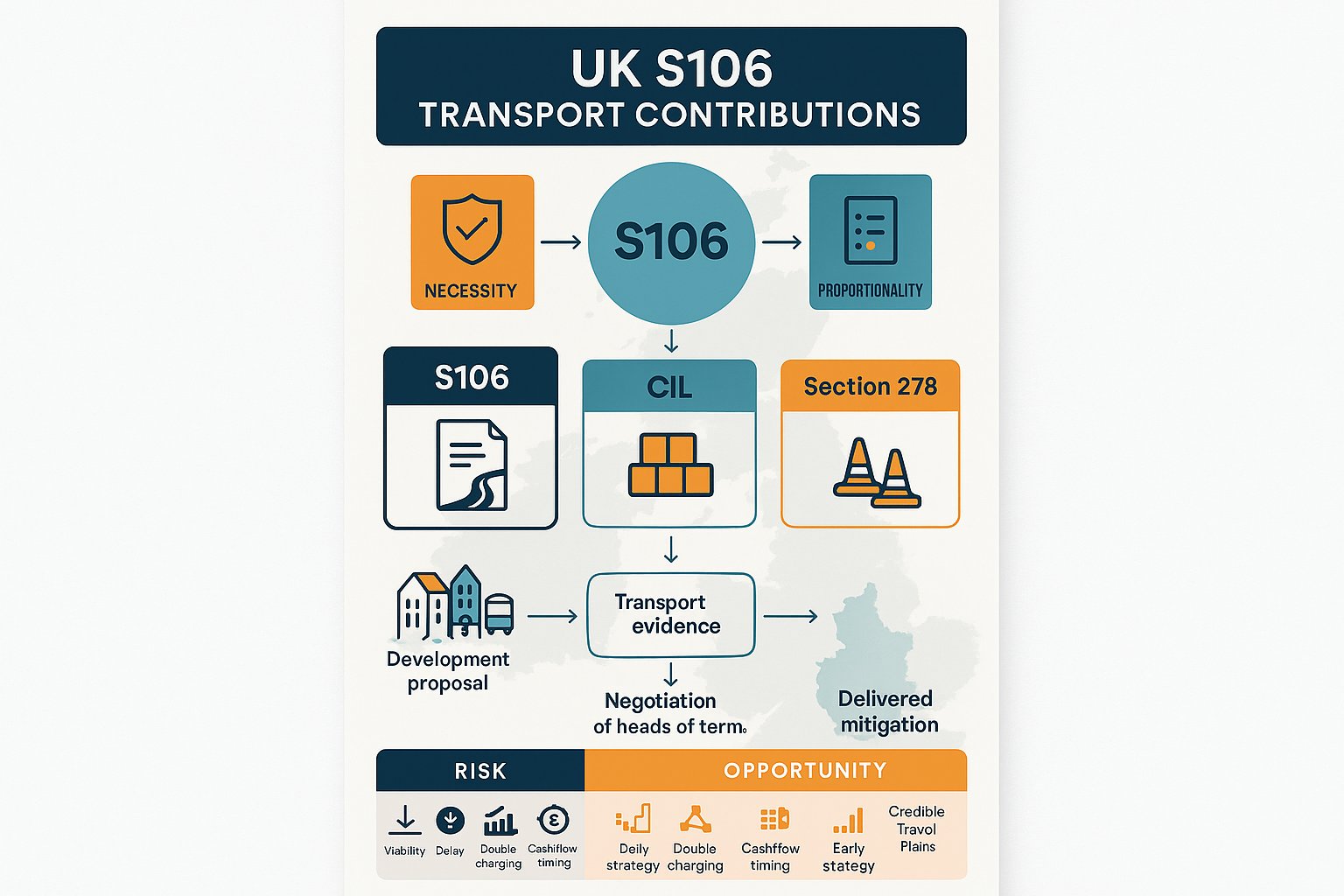
If you’ve worked on a planning application of any scale in England or Wales, you’ll know the transport discussion rarely stops at vehicle trip rates and a junction model. Sooner or later, the conversation turns to mitigation, delivery, and cost. That’s where S106 transport contributions come in.
These obligations can shape whether a scheme is acceptable, viable, or stuck in negotiation for months. For developers, they affect land value, cashflow, and programme. For planning officers, highway authorities, architects, and legal teams, they’re one of the main tools for making sure growth doesn’t create unsafe access, overloaded junctions, or car-dependent layouts that fail policy tests.
In practice, the challenge isn’t just knowing that a contribution may be requested. It’s understanding why, when, how much, and whether the request is actually justified. Too many projects still reach committee stage with transport evidence that’s either too thin, too late, or disconnected from the wording eventually drafted into the planning obligation.
We see this regularly in our work at ML Traffic: the strongest outcomes usually come from getting the transport strategy, assessment scope, and negotiation position aligned early. Done properly, S106 can be precise and proportionate. Done badly, it becomes a vague catch-all for costs that should have been challenged, refined, or structured differently.
This guide explains what planning teams need to know in 2026.
What S106 Transport Contributions Are And Why They Matter
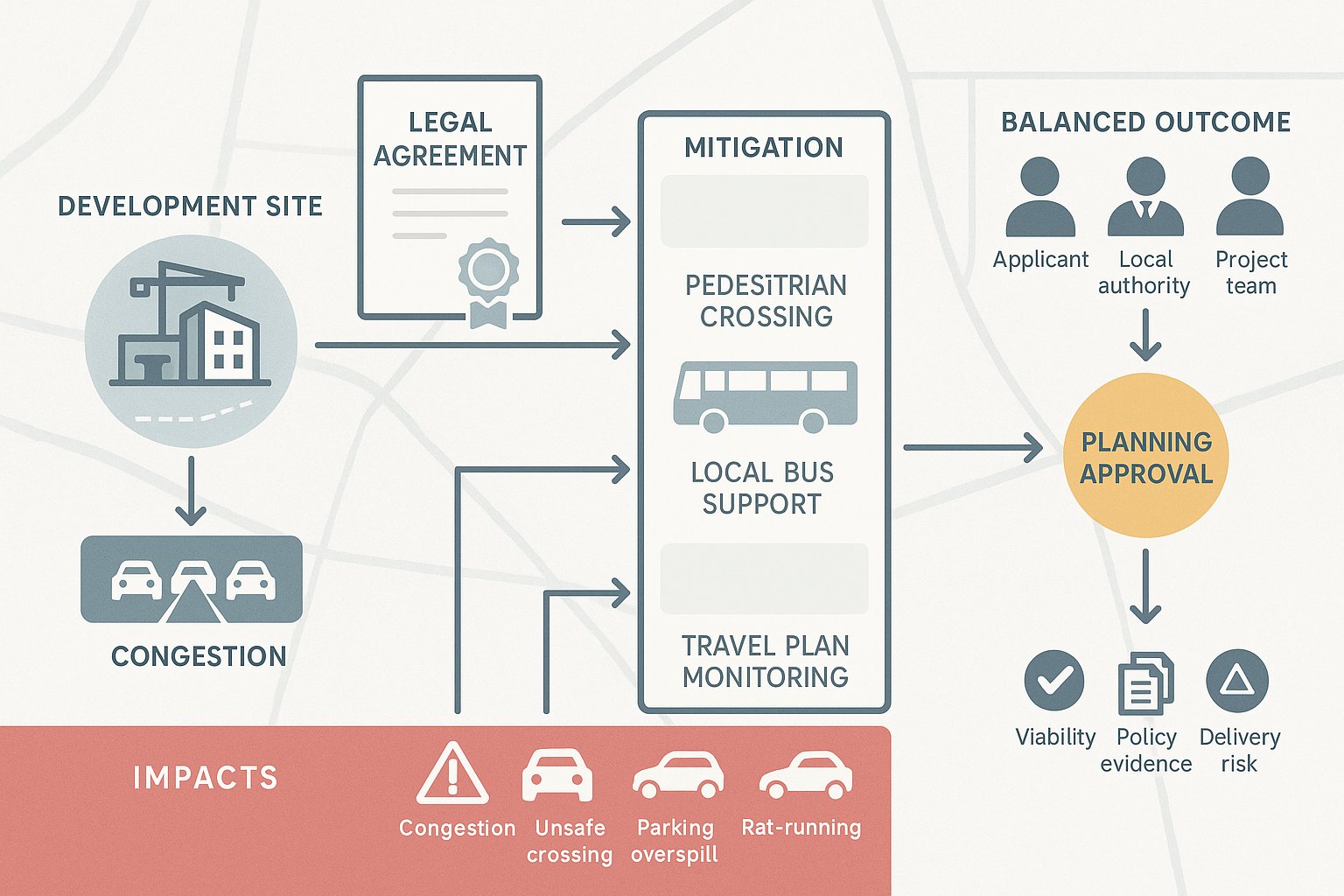
A Section 106 agreement is a legally binding planning obligation made under section 106 of the Town and Country Planning Act 1990. In transport terms, it is used to secure payments, works, or actions needed to mitigate the specific impacts of a development.
That site-specific link is the key point. These are not general taxes on development. They are intended to make a proposal acceptable in planning terms where, without mitigation, the transport effects would be problematic. Depending on the scheme, that might mean funding a junction improvement, delivering a pedestrian crossing, supporting a bus service, or securing travel plan measures and monitoring.
Why does this matter so much? Because transport impacts are often among the most visible and politically sensitive effects of development. Residents notice congestion, unsafe crossings, parking overspill, and rat-running almost immediately. Planning committees do too.
For applicants, S106 transport contributions can be material enough to affect viability and land negotiations. For authorities, they are one of the few practical mechanisms available to secure targeted mitigation that cannot simply be conditioned. And for project teams, they sit at the intersection of planning policy, transport evidence, legal drafting, and delivery risk.
In other words, this isn’t just a legal appendix. It’s part of the scheme strategy. If the contribution is well evidenced and proportionate, it helps unlock consent. If it’s vague or overstated, it can derail a perfectly workable proposal.
How Section 106 Differs From CIL And Section 278
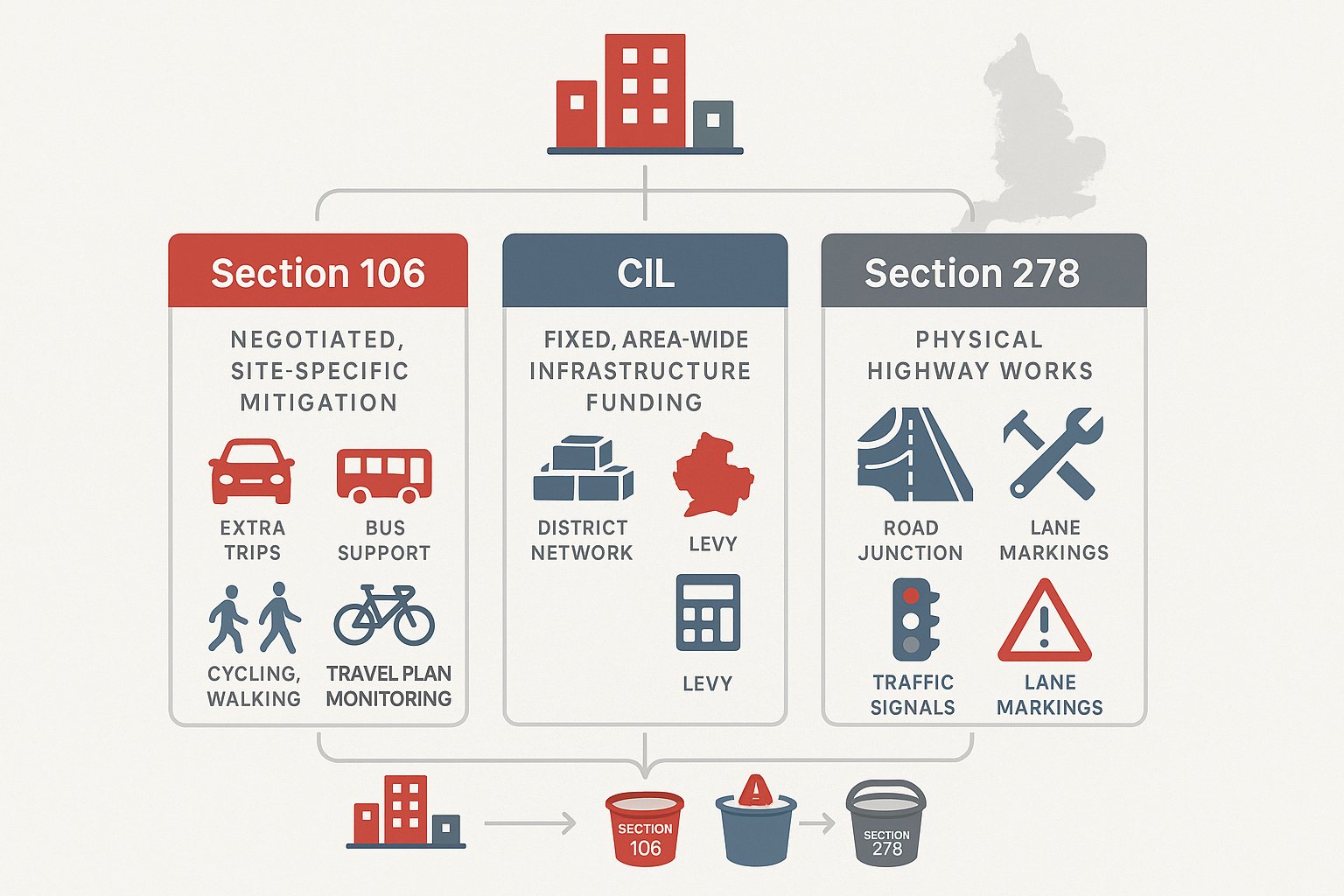
These three mechanisms are often mentioned together, but they do different jobs.
Section 106 is negotiated and site-specific. It addresses impacts arising from the particular development. In transport, that usually means obligations tied directly to additional trips, altered travel patterns, or a need for sustainable transport measures linked to the scheme.
Community Infrastructure Levy (CIL) is different. It is generally a fixed charge, usually based on floorspace, set by the charging authority through a published schedule. The purpose is broader: funding infrastructure needed to support growth across an area, rather than mitigating one development’s specific impacts. So if a council seeks money through CIL for strategic infrastructure, it should not then seek the same item again through S106.
Section 278, under the Highways Act 1980, is about works on the public highway. If a development needs a new access, amended kerbs, signal upgrades, road widening, or other physical works within highway land, those works are often delivered through a s278 agreement with the highway authority.
In real schemes, the lines can overlap operationally. A development might have:
- a S106 contribution for bus service support and travel plan monitoring,
- a CIL liability for wider infrastructure, and
- a s278 agreement for the off-site junction works themselves.
That’s normal. The trick is making sure each item sits in the correct bucket and that no one is paying twice for the same mitigation.
When A Transport Contribution Is Likely To Be Requested
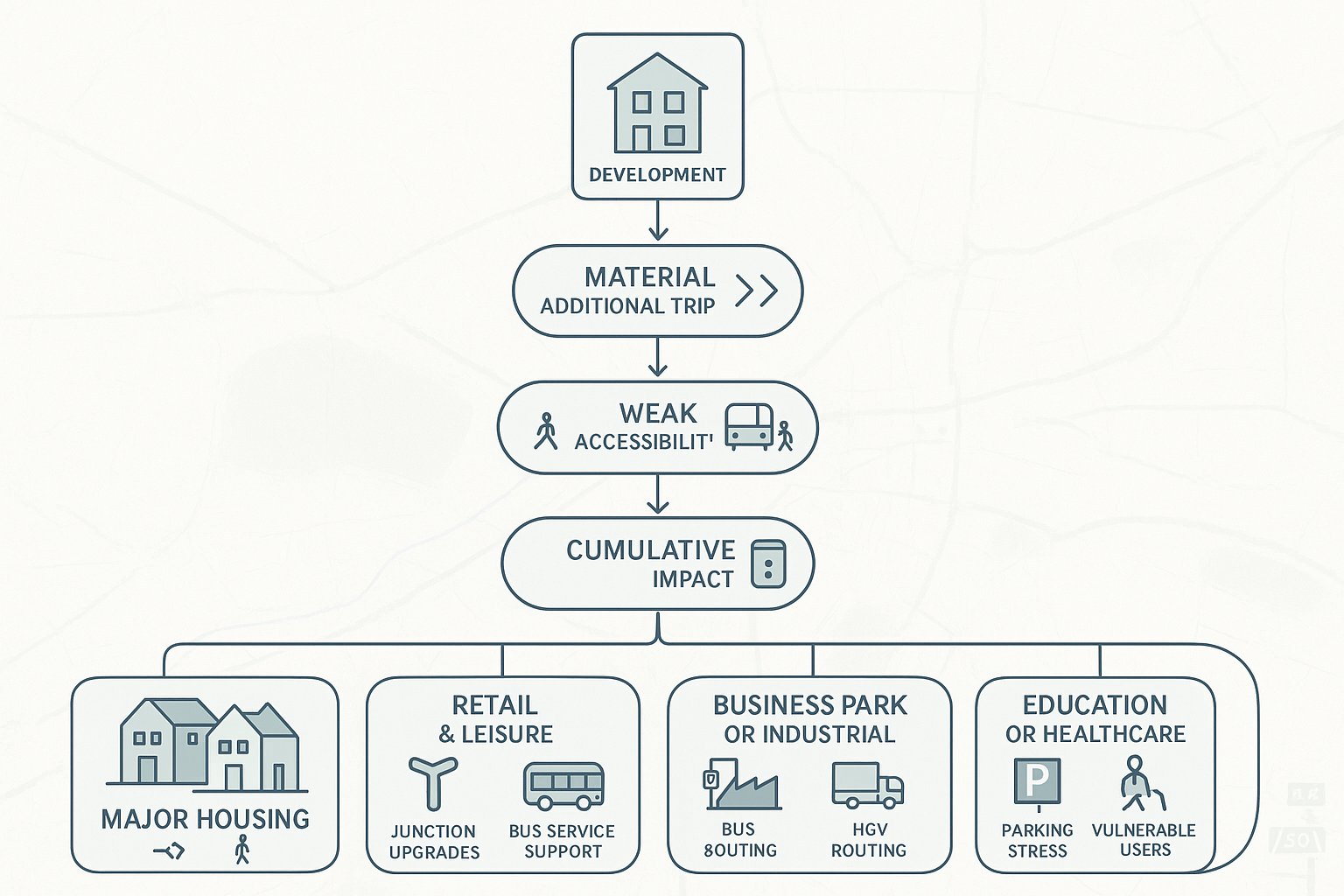
A transport contribution is most likely to be requested where a development creates material additional demand on the local network or where existing accessibility is weak enough that mitigation is needed to make the scheme policy-compliant.
The phrase “material additional trips” matters. Authorities are not supposed to ask for contributions simply because a development exists. They need a rational connection between the proposal and the measure being sought. That usually emerges through the Transport Assessment, local policy, site context, and comments from the highway authority.
Larger schemes naturally attract more scrutiny: residential-led developments, employment sites, retail parks, mixed-use allocations, logistics uses, student housing, roadside foodstores, and leisure schemes can all trigger requests. But smaller developments can also do so in constrained locations, especially where there are known safety issues, narrow footways, poor crossing opportunities, school-related parking stress, or junctions already operating close to capacity.
Another common trigger is a mismatch between the scale of development and the quality of sustainable transport access. If a site is heavily car-oriented and the proposal does little to improve walking, cycling, or bus access, authorities may seek contributions to address that gap.
And sometimes the issue is cumulative impact. A single development may not justify a full intervention on its own, but it may still be expected to contribute a fair share toward a package of local transport measures identified through policy or infrastructure planning.
Typical Development Scenarios That Trigger Contributions
Some patterns come up again and again.
Major housing schemes often trigger requests for bus service pump-priming, pedestrian and cycle links, traffic calming, crossings, and junction upgrades. On urban extensions, contributions can be substantial because the transport package is usually multi-layered and phased over time.
Retail and leisure schemes can prompt contributions where they generate high car trip rates, weekend peaks, servicing pressure, or parking effects on nearby streets. In town centre locations, the focus may be more on pedestrian access, servicing management, and public transport integration.
Business parks and industrial developments commonly raise questions around HGV routing, access geometry, queueing at site entrances, employee travel options, and shift-time public transport provision. If the nearest bus stop is a muddy pole on the verge half a mile away, the authority will notice.
We also see requests on education, healthcare, and roadside developments, particularly where vulnerable users, school-run traffic, or strategic road interfaces are involved.
The Policy And Legal Tests Contributions Must Meet
This is where negotiation stops being just commercial and becomes legal.
Under Regulation 122 of the Community Infrastructure Levy Regulations 2010, a planning obligation must meet three core tests. It has to be:
- Necessary to make the development acceptable in planning terms
- Directly related to the development
- Fairly and reasonably related in scale and kind to the development
Those tests are not optional. If a requested transport contribution fails them, it should not be imposed simply because it appears on a wish list or because “similar schemes paid before”.
In practice, the first test asks whether the mitigation is genuinely needed. The second asks whether there is a clear connection between the development and the item. The third is about proportionality: the scale of the contribution must reflect the development’s actual impact.
This is especially important where authorities seek pooled or strategic contributions. They need to show how the scheme contributes to the need for the measure and how the share requested has been calculated. A vague statement that a junction upgrade is “in the area” is not enough.
National policy supports this approach by requiring planning obligations to be justified and relevant. For transport professionals, that means the evidence base matters. A robust assessment can show whether a requested measure is truly necessary, whether a cheaper alternative would work, or whether the authority’s proposed package goes too far.
Good negotiations usually turn on evidence, not volume. The better the evidence, the cleaner the legal justification.
How Local Planning Authorities Calculate Transport Contributions
There is no single national formula for calculating transport contributions. Methods vary by authority, by development type, and by the maturity of local planning guidance.
Some councils use Supplementary Planning Documents (SPDs) or similar guidance that set out contribution rates or methodologies. These may include cost-per-dwelling figures, cost-per-trip calculations, zone-based formulas, or standard charges for defined sustainable transport improvements. Others rely more heavily on bespoke negotiation informed by the Transport Assessment and local infrastructure evidence.
A typical calculation starts with the transport evidence:
- forecast trip generation,
- distribution and assignment,
- expected mode share,
- network impacts,
- road safety considerations, and
- accessibility gaps.
From there, the authority may identify a package of measures needed to mitigate those impacts. If the package serves several developments, costs may be apportioned according to trip share, dwelling numbers, floorspace, or another defensible metric.
For example, if a bus corridor improvement package costs a defined sum and several allocated sites feed into the same corridor, each scheme may be asked to fund a proportion. Equally, if a site-specific crossing or footway link is needed solely because of one development, the full cost may sit with that scheme.
This is why early review of local policy documents, Infrastructure Delivery Plans, and previous committee reports is useful. They often reveal the authority’s preferred logic before formal negotiations begin.
We usually advise clients not to focus only on the headline number. Just as important is how that number has been derived, what infrastructure item it relates to, whether the cost basis is current, and whether the scheme is already funding overlapping measures elsewhere.
Common Types Of Transport Measures Funded Through S106
The menu is broader than many people expect, though every item still needs to satisfy the legal tests.
Common examples include pedestrian and cycle infrastructure: new footways, widened links, dropped kerbs, controlled crossings, shared-use routes, lighting, wayfinding, and local permeability improvements. These are often crucial where a development claims good sustainable access but the route to the nearest school, stop, or centre is plainly poor.
Public transport measures are another frequent category. Contributions may support new bus stops, shelter upgrades, raised kerbs, real-time information, service pump-priming, or timetable enhancements. On larger sites, obligations can include travel vouchers, resident bus passes, or support for demand-responsive services in early phases.
Then there are highway-related measures, such as junction improvements, local capacity works, traffic management, waiting restrictions, speed reduction features, or safety interventions. Some physical works may instead be delivered through s278, but S106 can still secure related funding or linked measures.
Authorities also use S106 to secure travel plan measures: monitoring fees, travel plan coordinators, cycle parking, car-club support, welcome packs, cycle vouchers, and behavioural incentives aimed at reducing car dependency.
In some locations, contributions may also go toward rail station access, interchange upgrades, or first/last-mile improvements, provided the direct relationship to the development is clear.
The strongest mitigation packages are usually mixed. A scheme that combines access design, walk-cycle links, public transport support, and realistic travel plan measures will often negotiate more effectively than one relying on highway capacity works alone.
The Role Of Transport Assessments And Travel Plans In Negotiations
This is the heart of the discussion. If the Transport Assessment is weak, the negotiation position is weak. Simple as that.
A Transport Assessment (TA) provides the technical case on trip generation, distribution, junction performance, access design, sustainable travel opportunities, and sometimes road safety. It tells the authority what the likely effects of the development are and what mitigation is needed. Or, just as importantly, what mitigation is not needed.
A solid TA can narrow the S106 ask by showing that:
- impacts are lower than assumed,
- certain mitigation is unnecessary,
- an alternative intervention would work better,
- or sustainable mode opportunities reduce pressure on the highway network.
The Travel Plan plays a different but connected role. It sets out how the development will encourage non-car travel through practical measures, targets, incentives, and monitoring. When prepared properly, it becomes a negotiation tool rather than an afterthought.
For instance, if a residential or employment scheme includes credible travel plan funding, cycle facilities, bus incentives, appointment of a coordinator, and meaningful monitoring, the authority may be more willing to moderate a broader contribution request. Not always, but often.
Poorly timed documents create problems. We’ve seen schemes where the TA is submitted late, key assumptions are untested, and the Travel Plan is generic boilerplate. At that point, the authority has little confidence and tends to reach for broader, more conservative obligations.
That’s why we push for early scoping, authority engagement, and locally grounded evidence. A TA and Travel Plan should not just support the application: they should actively shape the legal and financial outcome.
How Heads Of Terms And Planning Obligations Are Structured
By the time an application is heading toward committee, the transport debate usually needs to be distilled into a form lawyers and decision-makers can work with. That is where heads of terms come in.
Heads of terms are a summary of the principal planning obligations proposed or agreed in principle. They are often referenced in officer reports or in the resolution to grant planning permission subject to completion of a S106 agreement.
For transport items, the heads of terms should be specific enough to avoid drift later. Typically, each obligation should identify:
- the purpose of the contribution or works,
- the amount payable or scope of works,
- the trigger for payment or delivery,
- any indexation mechanism,
- monitoring fees,
- time limits for spending,
- and repayment or clawback provisions where relevant.
The final S106 agreement then turns that summary into binding legal wording. It will also address who is bound, mortgagee exclusions, notice provisions, interest on late payments, dispute clauses, and obligations that pass to successors in title.
Details matter more than they first appear. A contribution payable “before first occupation” is very different in cashflow terms from one split across phases or linked to occupation thresholds. Likewise, a vague contribution toward “sustainable transport improvements in the vicinity” is far less satisfactory than a clearly defined item or package.
From a project perspective, the structure should reflect how the scheme will actually be funded, phased, sold, and built. If it doesn’t, a seemingly acceptable obligation can become a delivery headache later.
Key Risks For Developers, Landowners, And Project Teams
The first obvious risk is viability. Transport obligations can become significant, especially where they stack alongside affordable housing, education, public open space, nutrient mitigation, and other policy requirements. If transport costs are uncertain at option stage, they can distort land deals from day one.
Second is delay. Applications often stall because the principle of mitigation is accepted but the quantum, wording, or trigger points are not. A technically minor transport item can still hold up committee, decision issue, funding drawdown, or start on site.
Then there is scope creep. This happens when obligations start drifting beyond development-specific mitigation into wider aspiration. It can also happen when authorities seek transport contributions without clearly separating them from CIL-funded infrastructure. If no one challenges the overlap, double-charging risk creeps in quietly.
A more technical but very real issue is future disposal and phasing risk. Because S106 obligations bind the land, badly structured provisions can complicate phased implementation, parcel sales, refinancing, or reserved matters strategy. That’s especially relevant on strategic sites with multiple land interests.
Finally, there is non-spend risk. If contributions are not spent within a defined period and there is no repayment mechanism, developers may fund mitigation that never materialises. Clawback provisions do not solve everything, but they matter.
For consultants and legal teams, the practical lesson is clear: the risk is rarely just the amount. It is the amount, timing, wording, evidence base, and deliverability of the obligation taken together.
How To Challenge, Reduce, Or Refine A Proposed Contribution
Challenging a transport contribution does not mean refusing mitigation outright. Usually, the better approach is to test, refine, and evidence.
Start with the three legal tests. Is the contribution genuinely necessary? Is it directly related to the development? Is it fair and proportionate in scale and kind? Those questions sound basic, but they cut through a lot of noise.
Next, go back to the transport evidence. A robust TA may show lower trip generation, different distribution patterns, or a reduced need for a particular intervention. Alternative mitigation can also be persuasive. For example, a stronger package of travel plan measures, on-site accessibility improvements, or a more targeted off-site works package may address the issue more efficiently than a broad cash contribution.
If viability is genuinely strained, bring evidence rather than assertion. Authorities may not accept every argument, but a transparent viability position can support rebalancing or phasing of obligations, especially where cumulative asks threaten deliverability.
Watch carefully for double-charging. If the same transport infrastructure is already intended to be funded through CIL, it should not simply reappear under S106 without a clear and lawful basis.
Then negotiate the drafting:
- cap contribution amounts where possible,
- tie payments to sensible triggers,
- define the funded measure clearly,
- include time limits for spend,
- and secure clawback for unspent sums where appropriate.
In our experience, the most successful challenges are measured, evidence-led, and practical. Not combative for the sake of it, just precise.
Practical Steps To Prepare For S106 Transport Discussions Early
The best time to think about S106 is before anyone has drafted heads of terms.
Start at pre-application stage with transport planners or highway consultants who understand local authority thresholds, validation expectations, and the transport policy context. Agreeing the scope of the TA early can avoid a lot of circular debate later.
Review the local Local Plan, transport SPD, parking standards, committee history, and any Infrastructure Delivery Plan relevant to the site. These documents often signal likely asks long before they appear in formal consultee comments.
Build an access and movement strategy that prioritises sustainable travel from the outset. If the scheme layout makes walking, cycling, and public transport use realistic, the mitigation conversation usually becomes more focused and defensible.
Prepare an outline Travel Plan early, with costed measures rather than generic aspirations. That gives the project team something positive to negotiate around, instead of reacting to requests late in the process.
Model phasing and cashflow. A contribution that looks manageable in total can still be painful if triggered too early. Understanding payment timing against occupations, sales, and infrastructure delivery is essential.
Finally, keep an audit trail. Record the basis of assumptions, authority feedback, mitigation options considered, and reasons for any challenge. When negotiations tighten, as they often do, that record becomes invaluable.
This is also where experienced support helps. At ML Traffic, we focus on concise, authority-aware transport evidence that gives teams a clearer basis for those discussions, not just a report to upload and hope for the best.
Conclusion
S106 transport contributions are a core part of modern development management, not a side issue to be dealt with after the application is submitted. They sit at the point where transport evidence, planning policy, legal drafting, and scheme viability all meet.
The fundamentals are straightforward enough: the obligation must be site-specific, justified, and proportionate. But the real-world detail is where projects either move smoothly or get bogged down. The amount requested, the infrastructure item, the delivery route, the trigger points, and the wording of the agreement all matter.
For developers, landowners, architects, planners, lawyers, and councils, the best results usually come from early preparation and disciplined evidence. A well-scoped Transport Assessment, a credible Travel Plan, and a clear understanding of local policy put everyone in a stronger position to agree mitigation that is lawful, practical, and deliverable.
In 2026, that early clarity is still the difference between a negotiated solution and an expensive surprise.
Frequently Asked Questions about S106 Transport Contributions
What are Section 106 transport contributions and why are they important?
Section 106 transport contributions are site-specific payments or works secured through a legal planning agreement to mitigate the transport impacts of a development. They ensure developments do not cause unsafe conditions, congestion, or unsustainable travel patterns, making proposals acceptable in planning terms.
How do Section 106 transport contributions differ from CIL and Section 278 agreements?
S106 contributions are negotiated obligations specific to a development’s impacts, particularly transport. Community Infrastructure Levy (CIL) is a fixed charge used for broader area-wide infrastructure. Section 278 agreements fund or deliver works on the public highway, such as new accesses or junction improvements, often complementing S106.
When is a transport contribution likely to be requested by local authorities?
Transport contributions are typically requested when a development generates material additional trips or alters travel patterns requiring mitigation. This often applies to medium to large residential, employment, retail, or mixed-use schemes, and smaller developments in sensitive locations with constrained transport capacity.
What types of transport measures can be funded through S106 agreements?
Common measures include off-site junction improvements, bus service enhancements, cycleways and footpaths, pedestrian crossings, traffic calming, travel plan initiatives like cycle parking and car club bays, and sometimes rail station access improvements, provided they are directly related to the development.
How do Transport Assessments and Travel Plans influence S106 transport negotiations?
A robust Transport Assessment provides evidence of trip generation, network impacts, and required mitigation, forming the basis for negotiated contributions. A well-prepared Travel Plan shows measures to reduce car use and encourage sustainable travel, potentially reducing broader contribution requests through effective mitigation.
What steps can developers take to challenge or reduce a proposed S106 transport contribution?
Developers should test contributions against legal tests of necessity, direct relation, and proportionality. Using detailed Transport Assessment evidence, proposing alternative mitigation like enhanced Travel Plans, providing viability evidence, checking for double-charging with CIL, and negotiating clear wording with payment caps and clawback provisions can help refine obligations.