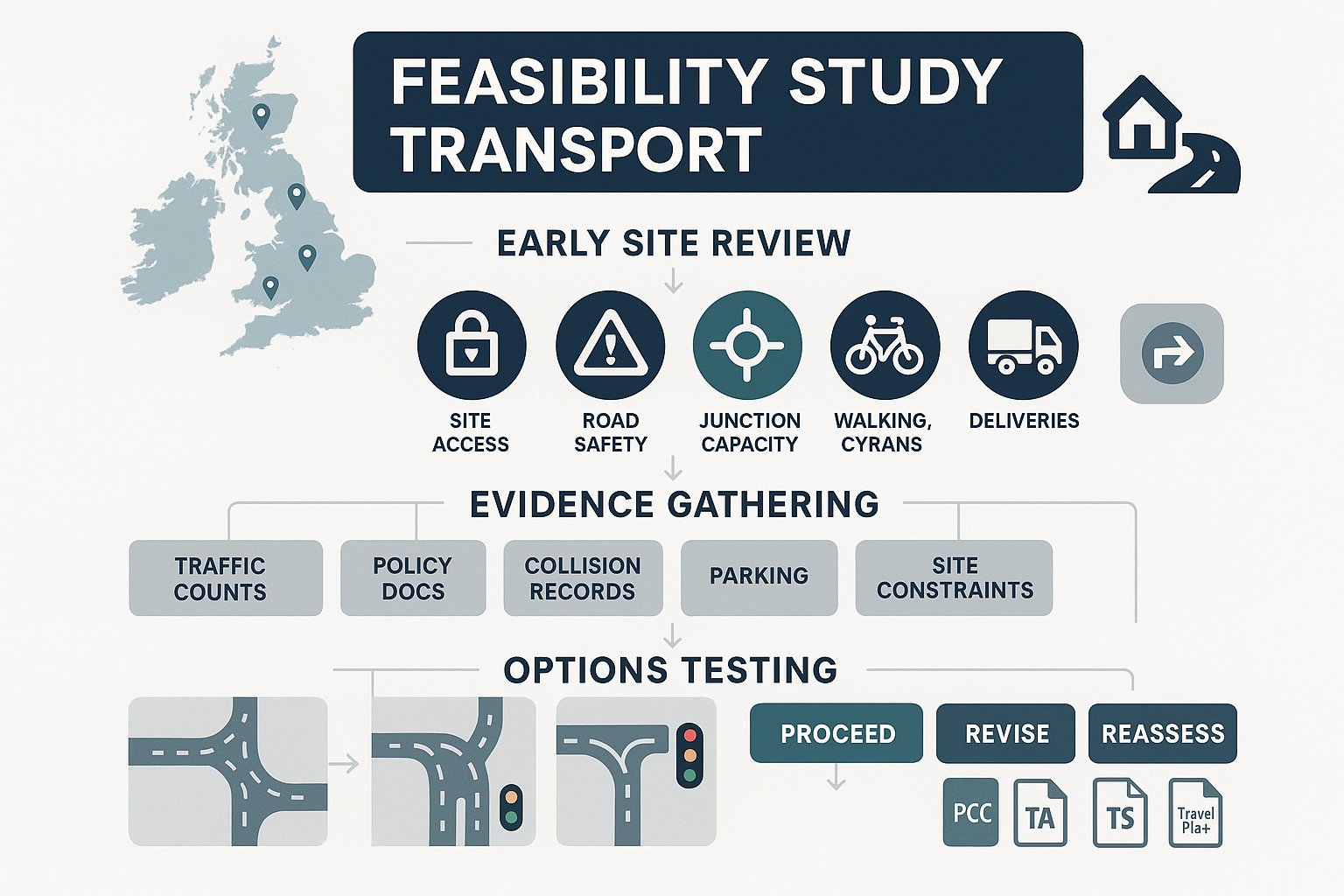
A feasibility study transport review can save a project from heading too far down the wrong road. We’ve seen it happen more than once: a site looks promising on paper, the layout starts taking shape, legal and design costs mount, and only then does a highways issue surface that should have been spotted at week one. By that stage, changing access, reducing unit numbers, or reworking servicing can be expensive and politically awkward.
That is exactly why transport feasibility work matters. At the earliest planning stage, it helps us test whether a development can be accessed safely, whether the local highway network is likely to cope, and whether the proposal has a realistic chance of satisfying local policy and highway authority expectations. It is not the same as a full Transport Assessment, and it is not meant to be. Its value lies in clarity, speed, and risk reduction.
For architects, planners, lawyers, surveyors, developers, builders, and council teams, the goal is straightforward: understand the transport position before major commitments are made. A good study gives us a practical view of access constraints, likely mitigation, sustainable travel prospects, and the level of transport reporting the planning application will eventually need.
In this guide, we explain what a transport feasibility study covers, when it is needed, what evidence sits behind it, and what local planning authorities usually expect to see in 2026.
What A Transport Feasibility Study Is And When It Is Needed
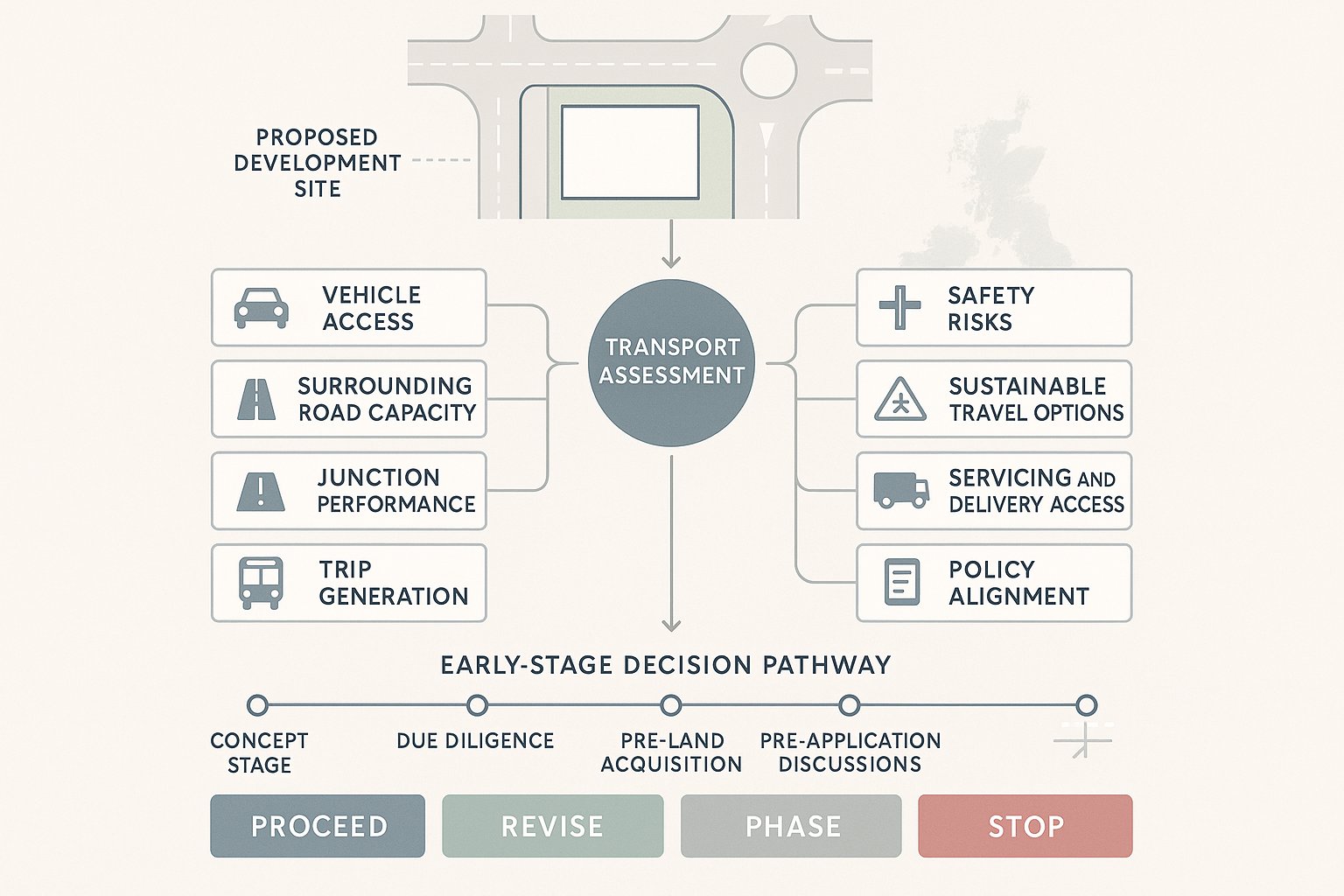
A transport feasibility study is an early-stage appraisal of whether a development or infrastructure proposal is broadly workable in highways and transport terms. In simple language, it asks: can the site be acceptably accessed, can the surrounding network support the proposal, and are there any obvious transport risks that could delay, weaken, or stop the scheme?
That early wording matters. This is usually not a final design document. It is a structured pre-application assessment used before substantial design fees, land costs, or planning commitments are locked in. We use it to look at likely trip generation, site access options, nearby junction conditions, safety concerns, sustainable travel opportunities, servicing needs, and headline policy fit.
It is particularly useful where a site is constrained, where access is not straightforward, where local roads are already busy, or where the development could be politically sensitive. Larger residential sites, mixed-use regeneration schemes, roadside commercial plots, schools, healthcare uses, and sites near contested junctions are obvious candidates.
In practice, it is usually commissioned at concept stage, during site due diligence, before land acquisition completes, or alongside pre-application discussions. Done properly, it gives the wider consultant team something extremely valuable: a realistic basis for deciding whether to proceed, revise, phase, or walk away.
How It Differs From A Transport Assessment, Transport Statement, And Travel Plan
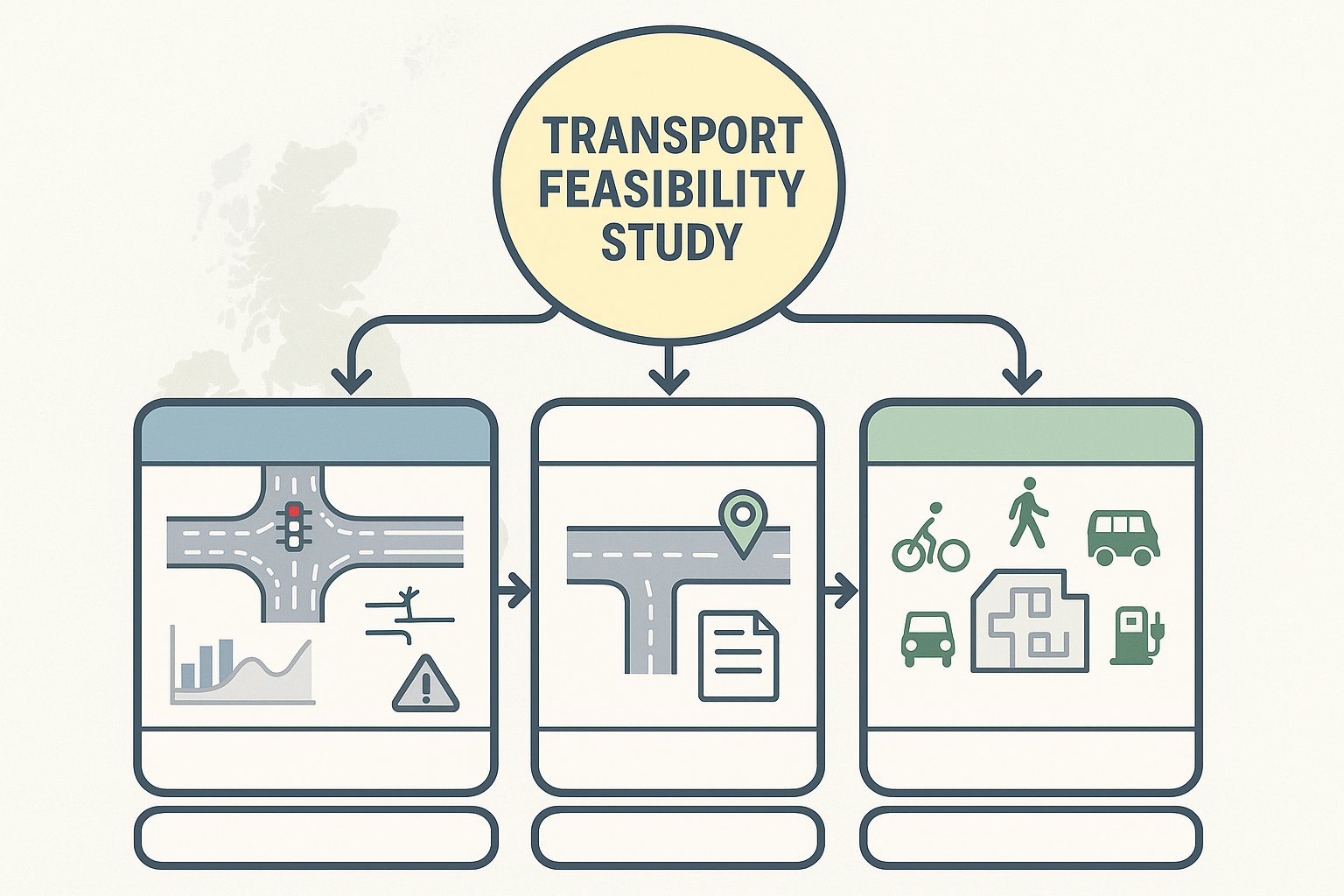
This is where confusion often creeps in, because the documents sit close together but serve different purposes.
A Transport Assessment (TA) is the more detailed, formal technical submission that usually supports a planning application for developments with material transport effects. It normally includes robust trip generation, distribution, assignment, junction modelling, impact assessment, mitigation design, and a reasoned conclusion on acceptability.
A Transport Statement (TS) is a lighter-touch version used for smaller schemes where impacts are expected to be limited. It still needs evidence and professional judgement, but it is narrower in scope than a TA.
A Travel Plan (TP) is different again. It focuses on behaviour and operation after occupation: how we encourage walking, cycling, public transport use, car sharing, electric vehicle provision, and reduced single-occupancy car trips.
A transport feasibility study sits before all of these. It is the gateway piece. It helps us decide whether the scheme is broadly deliverable, what access strategy may work, what the likely pain points are, whether mitigation appears feasible, and whether the planning application is likely to need a TA, TS, Travel Plan, or all three.
That sequencing is why early feasibility work is so commercially useful. It doesn’t replace formal planning-stage transport reporting: it makes that later reporting smarter and less risky.
Why Feasibility Work Matters At The Earliest Planning Stage
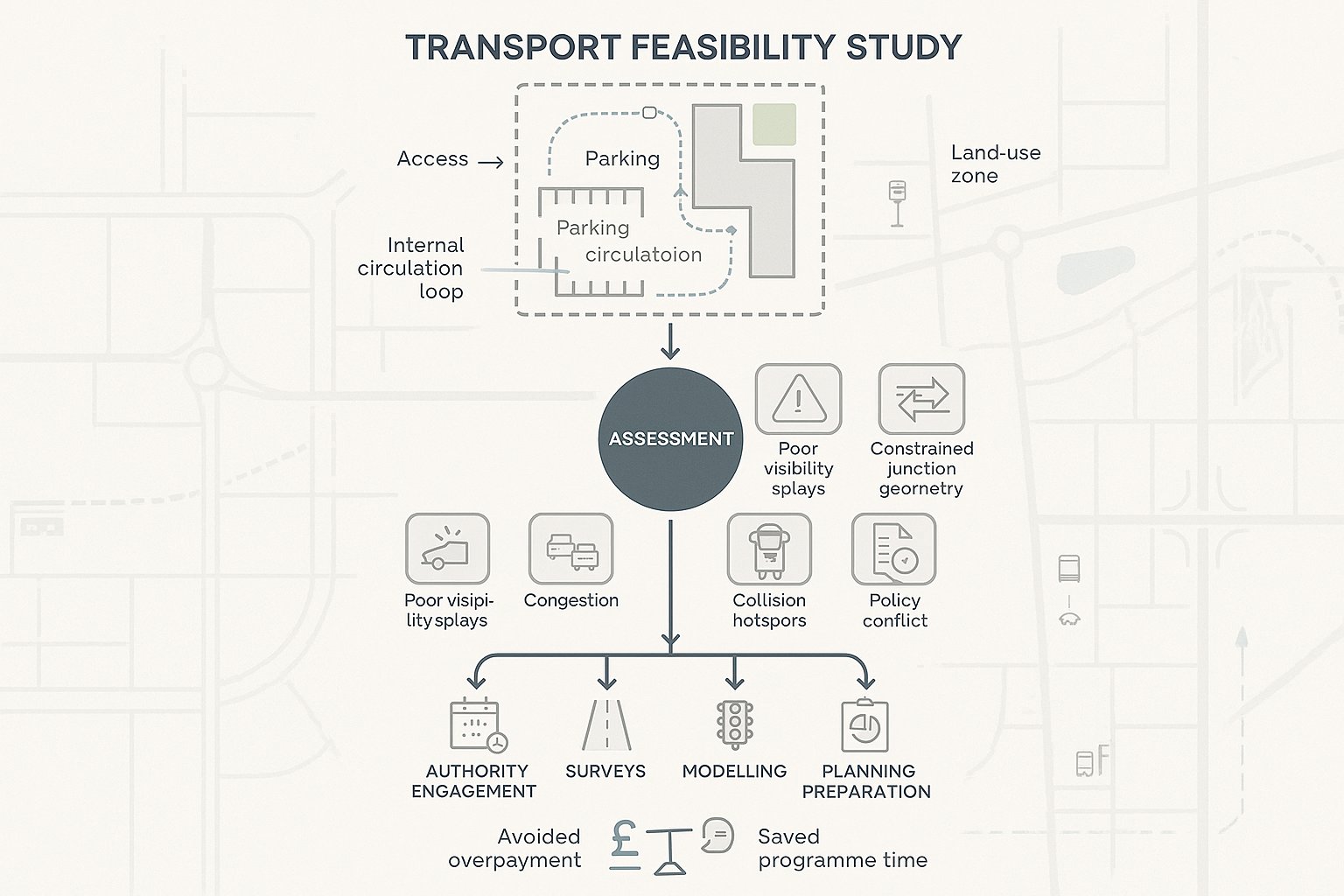
Transport issues are far easier to solve when a scheme is still flexible. At concept stage, we can still move an access point, alter development quantum, shift parking, improve internal circulation, or rethink the land use mix. Once the architecture is fixed, legal agreements are advanced, and the acquisition price assumes a certain yield, those same changes can become painful.
Early feasibility work helps us identify what developers sometimes call the quiet killers: poor visibility splays, awkward frontage width, constrained junction geometry, severe existing congestion, collision clusters, weak bus accessibility, or direct policy conflict on sustainable travel and parking. None of these always kills a scheme outright, but each can reshape it.
There is also a programme advantage. A targeted early review can tell us whether to begin pre-application engagement with the local planning authority or highway authority, whether additional surveys are needed, and whether more detailed modelling should be commissioned before the planning package is assembled. That reduces late surprises.
Commercially, this is one of the highest-value pieces of transport advice a project team can buy. It can stop overpaying for a constrained site, help a planning consultant frame a realistic strategy, and give architects a more honest design brief. On sites with obvious uncertainty, concise early reporting from experienced transport engineers, such as the approach often expected from specialist practices like ML Traffic, can save months rather than days.
Common Development Scenarios That Trigger A Transport Feasibility Review
Not every proposal needs the same level of pre-application transport work, but certain scenarios almost always benefit from a feasibility review.
The first is where the site access is unknown or disputed. If there are questions over whether vehicles can enter safely, whether visibility can be achieved, or whether a junction form is acceptable, we should test that early.
The second is where the surrounding network is already under pressure. A development next to a congested roundabout, a school peak-time bottleneck, or a town centre corridor with queueing issues may still be deliverable, but only if the transport evidence is thought through from the outset.
The third is where planning policy places strong emphasis on sustainable travel. Urban intensification sites, edge-of-settlement housing, and car-light proposals often need an early reality check on walking catchments, cycle links, bus services, and parking standards.
Feasibility studies are also common where there is land promotion, option agreements, bid-stage due diligence, public sector funding, or committee sensitivity. In those situations, the question is not just whether transport impacts exist: it is whether the project team understands them before committing.
And sometimes the trigger is simple: the site looks fine, but everyone in the room suspects transport may be the issue that decides it.
Residential, Mixed-Use, Commercial, And Public Sector Schemes
Different land uses create different transport risks, so a good feasibility review adjusts its focus accordingly.
For residential schemes, the usual questions are whether the access works safely, whether the local roads can absorb peak trips, how parking should be handled, and whether schools, shops, bus stops, and walking routes make the location policy-compliant. On strategic housing sites, the issue may extend to phasing and wider junction mitigation.
For mixed-use schemes, complexity rises quickly. We often need to test how uses interact across the day, whether internal circulation is coherent, whether servicing clashes with pedestrians, and whether multi-access strategies or travel planning measures can reduce pressure on a single junction.
For commercial development such as offices, retail, roadside uses, warehouses, or leisure schemes, trip patterns and servicing become critical. A site may look acceptable for staff travel but fail on delivery access, swept paths, or weekend peak operation.
For public sector schemes including schools, hospitals, civic buildings, transport interchanges, and highway upgrades, the assessment often has a sharper political edge. Drop-off behaviour, emergency access, vulnerable users, public scrutiny, and network resilience all matter.
The broad principle is the same across each type: we are testing practical transport deliverability early enough to influence the scheme, not merely documenting problems after the design is settled.
Key Questions A Good Study Should Answer
A useful transport feasibility study does more than say a proposal is possible or difficult. It should answer the practical questions decision-makers actually need.
Can we create a safe and suitable access for all users? Will the likely traffic levels be acceptable on the surrounding network? Are there visible highway safety concerns that will attract objection? What level of transport evidence is likely to be needed later? And what changes would materially improve the planning position?
The strongest studies also separate fixed constraints from manageable ones. A mature tree affecting visibility, for example, may be resolvable. A severely constrained frontage beside a fast road and protected boundary may not be. That distinction matters because it shapes commercial strategy.
We should also expect a feasibility review to comment on reasonable mitigation. Not full detailed design, but enough to tell us whether access changes, junction improvements, parking revisions, sustainable transport measures, or phasing could turn a weak scheme into a credible one.
If the report leaves the team with only broad reassurance, it has probably missed the point. The real value lies in answering the right questions early, with enough clarity that architects, planners, solicitors, land teams, and clients can make informed decisions rather than hopeful assumptions.
Site Access, Highway Safety, Capacity, Sustainable Travel, And Servicing
These five themes sit at the heart of most transport feasibility work.
Site access
We need to know whether vehicles, pedestrians, and cyclists can enter and leave the site safely and logically. That includes visibility splays, geometry, gradients, frontage constraints, proximity to nearby junctions, and whether the access arrangement suits the proposed use.
Highway safety
Collision history, recorded incidents, speed environment, crossing points, and conflict with existing users all need scrutiny. A site beside a road with poor alignment or a known accident cluster deserves a harder look than a quiet urban street.
Capacity
This is the classic question: can the network cope? At feasibility stage, this may involve high-level trip estimates and initial junction checks rather than full modelling. But the objective is clear enough, to identify whether congestion is likely to become a major planning issue.
Sustainable travel
In 2026, this is no longer a side note. We need a credible view on walking routes, cycle links, bus provision, rail access where relevant, and the realistic mode share the site can support. Policy often turns on this point.
Servicing
Refuse collection, delivery vehicles, emergency access, and internal turning are frequently overlooked early on. Yet servicing failures can sink otherwise promising layouts. A good study flags those issues before the drawings become too precious.
The Core Evidence And Data Required
Transport feasibility work is early-stage, but it still needs evidence. A report built on guesswork is just optimism in a PDF.
The exact data set depends on the size and complexity of the proposal, though most studies draw from a common core: existing traffic conditions, junction performance, road safety records, local policy, parking standards, active travel opportunities, public transport provision, site constraints, and preliminary trip expectations.
The aim is not to build an oversized planning submission before the planning submission exists. The aim is to gather enough reliable evidence to make sensible strategic decisions. That usually means combining desk-based review with a site visit and, where warranted, targeted traffic or movement surveys.
We also need the right context. A site may appear unconstrained from a pure engineering standpoint but still face policy tension if it sits in an area where authorities expect a stronger shift to non-car modes. Equally, a constrained access may still be acceptable if development quantum is reduced and servicing is tightly managed.
Good evidence allows us to draw those distinctions. It also gives confidence when speaking to clients, planning teams, landowners, and authorities, because the conclusions are rooted in observed conditions rather than broad assumptions.
Traffic Counts, Baseline Conditions, Policy Review, And Site Constraints
Traffic counts
Traffic counts remain one of the most useful building blocks. Depending on the site, we may need automatic traffic counts, turning counts at nearby junctions, queue surveys, pedestrian and cycle counts, or speed data. The point is to understand actual movement patterns rather than rely on instinct. A junction that feels busy at 8.30am may behave quite differently across the wider peak period.
Baseline conditions
Existing conditions should be described properly: traffic flows, delay, queueing, parking stress, nearby schools, bus stop quality, walking routes, collision records, and known operational pressure points. This gives the development impact somewhere real to sit.
Policy review
A feasibility study should also review the relevant planning and transport framework, including the National Planning Policy Framework, local plan policies, parking standards, design guidance, and authority-specific thresholds. Transport objections are often rooted as much in policy conflict as in engineering detail.
Site constraints
Finally, the site itself needs honest appraisal. Frontage width, levels, visibility, neighbouring accesses, rights of way, trees, drainage features, retaining structures, and available land for turning all matter. Plenty of schemes look efficient on a red-line plan but become awkward the moment we stand at the kerb and measure what is really there.
How The Feasibility Process Typically Works
Most transport feasibility studies follow a fairly consistent process, even though the depth varies by project.
We usually begin with a desk-based appraisal and a site visit. That means reviewing available drawings, local policy, aerial imagery, collision data, previous planning history, mapping, and any existing transport reports. The site visit then tests whether the paperwork matches reality. Quite often, it doesn’t entirely.
Next comes targeted evidence gathering. If the risks appear low, the study may rely mainly on existing information and professional judgement. If the site sits beside a pressured junction or the access arrangement is questionable, traffic counts, speed data, or pedestrian surveys may be needed.
From there, we move into high-level analysis. That can include preliminary trip generation, broad traffic distribution assumptions, simple capacity checks, visibility review, swept path considerations, and sustainable travel appraisal. We are not yet producing the full planning-stage technical case: we are testing whether one is likely to stand up.
Then come options. Different access forms, altered unit numbers, revised parking levels, servicing changes, or phasing scenarios may be compared. Finally, the report draws everything together into a practical recommendation: proceed, proceed with changes, engage the authority first, or reconsider the scheme basis entirely.
From Initial Appraisal And Surveys To Modelling And Reporting
A well-run process tends to move through five steps.
Initial appraisal
We start with the fundamentals: site location, proposed use, likely scale, planning context, known constraints, and nearby network conditions. This stage often reveals whether the proposal is straightforward or whether transport is likely to become a defining issue.
Surveys
Where needed, surveys are commissioned to fill evidence gaps. These might include junction turning counts, classified traffic counts, speed surveys, parking beat surveys, or pedestrian and cycle observations. The trick is to commission only what adds decision-making value.
Modelling and capacity checks
At feasibility stage, this is usually proportionate. We may test a priority junction, mini-roundabout, or signalised node at a high level, using realistic assumptions rather than over-engineering the exercise. The goal is to identify likely stress points and broad mitigation requirements.
Options testing
This is where the study becomes genuinely useful. We compare layouts, access strategies, development quanta, servicing solutions, and parking approaches. A scheme that fails in one form can become workable in another.
Reporting
The final report should be concise, evidence-led, and usable. Many teams find a red-amber-green style summary helpful, alongside clear next steps toward a TA, TS, or Travel Plan where appropriate.
Common Risks, Red Flags, And How To Strengthen A Scheme Before Submission
The most common red flags are familiar, but they still catch projects out. Substandard visibility, poor access geometry, difficult right-turn movements, severe local congestion, collision history, overspill parking risk, weak bus accessibility, and conflict with local design standards all appear regularly.
Some risks are physical. If the site frontage is too narrow for a compliant access and there is no land to widen it, the issue may be fundamental. Some are operational. A commercial yard may technically fit but create reversing or servicing conflicts that a highway authority will not accept. Others are strategic. A car-dependent scheme in a policy area pushing active travel may face resistance even where the engineering works.
The way to strengthen a scheme is usually not mysterious, just sometimes inconvenient. Reduce development quantum. Rebalance the land use mix. Move the access. Improve internal layout. Create proper turning space. Tighten parking strategy. Introduce walking and cycling connections. Strengthen public transport links where feasible. Consider phasing or trigger-based mitigation if full works are not needed on day one.
Early engagement can help too. A focused conversation with the local highway authority or planning authority, backed by credible evidence, is often more productive than submitting an overconfident scheme and arguing later. The strongest projects are rarely the ones with zero transport issues: they are the ones that identified issues early and responded intelligently.
What Local Planning Authorities Usually Expect To See
Local planning authorities do not usually expect a transport feasibility study to read like a full Transport Assessment, but they do expect it to be clear, proportionate, and grounded in evidence.
At minimum, we should expect the study to explain the proposal, define the scope of review, identify the surrounding highway and transport context, and show the proposed access and internal circulation principles. Authorities will also want a concise policy summary, baseline conditions, and an explanation of the main constraints and opportunities.
They will usually expect some commentary on likely trip generation and where those trips would go, even if only at a high level. If nearby junctions, schools, town centre links, or servicing arrangements are likely to be sensitive, the study should say so directly rather than glossing over them.
Crucially, authorities tend to look for professional judgement on mitigation and next steps. Does the scheme appear capable of progressing? What revisions are needed? Will a Transport Assessment be required, or is a Transport Statement likely to be sufficient? Is an outline Travel Plan needed? What further surveys or modelling should follow?
The best feasibility studies answer those questions in plain English. They do not pretend uncertainty does not exist. They frame it, quantify it where possible, and give the planning team a credible route forward.
A strong transport feasibility study is not just an early technical note: it is a decision tool. Used well, it helps us protect budgets, shape better layouts, reduce planning risk, and enter the application stage with a far clearer sense of what the highway and planning authorities are likely to say.
Transport Feasibility Study FAQs
What is a transport feasibility study and when should it be conducted?
A transport feasibility study is an early-stage assessment to determine if a development can be safely accessed and supported by the local transport network. It is typically carried out at the concept or pre-application stage, before major design or land commitments are made.
How does a transport feasibility study differ from a Transport Assessment or Travel Plan?
Unlike a full Transport Assessment, which provides detailed traffic modelling and mitigation for planning applications, a transport feasibility study is a high-level appraisal done earlier to test the broad deliverability of a scheme. It also differs from a Travel Plan, which focuses on managing travel behaviour post-occupation.
Why is early transport feasibility work important for development projects?
Early feasibility work identifies key transport risks like safety issues, access constraints, and network capacity before costly design or land purchase decisions. This helps shape the project layout, access strategy, and travel measures to reduce planning risks and align with local policies.
Which types of developments typically require a transport feasibility study?
Transport feasibility studies are most needed for residential housing, mixed-use or commercial projects, and public sector schemes such as schools, hospitals, or transport interchanges—especially where access or local network pressures exist.
What key topics should a good transport feasibility study address?
A strong study evaluates safe and suitable site access for all users, highway safety concerns, local network capacity, realistic sustainable travel potential, servicing requirements, and possible mitigation to improve scheme deliverability.
What evidence and data support an effective transport feasibility study?
Core evidence includes traffic and turning counts, baseline traffic flows, collision records, local policy and parking standards, site constraints like visibility and frontage width, plus a site visit to confirm conditions. This ensures the study’s conclusions are evidence-based and credible.