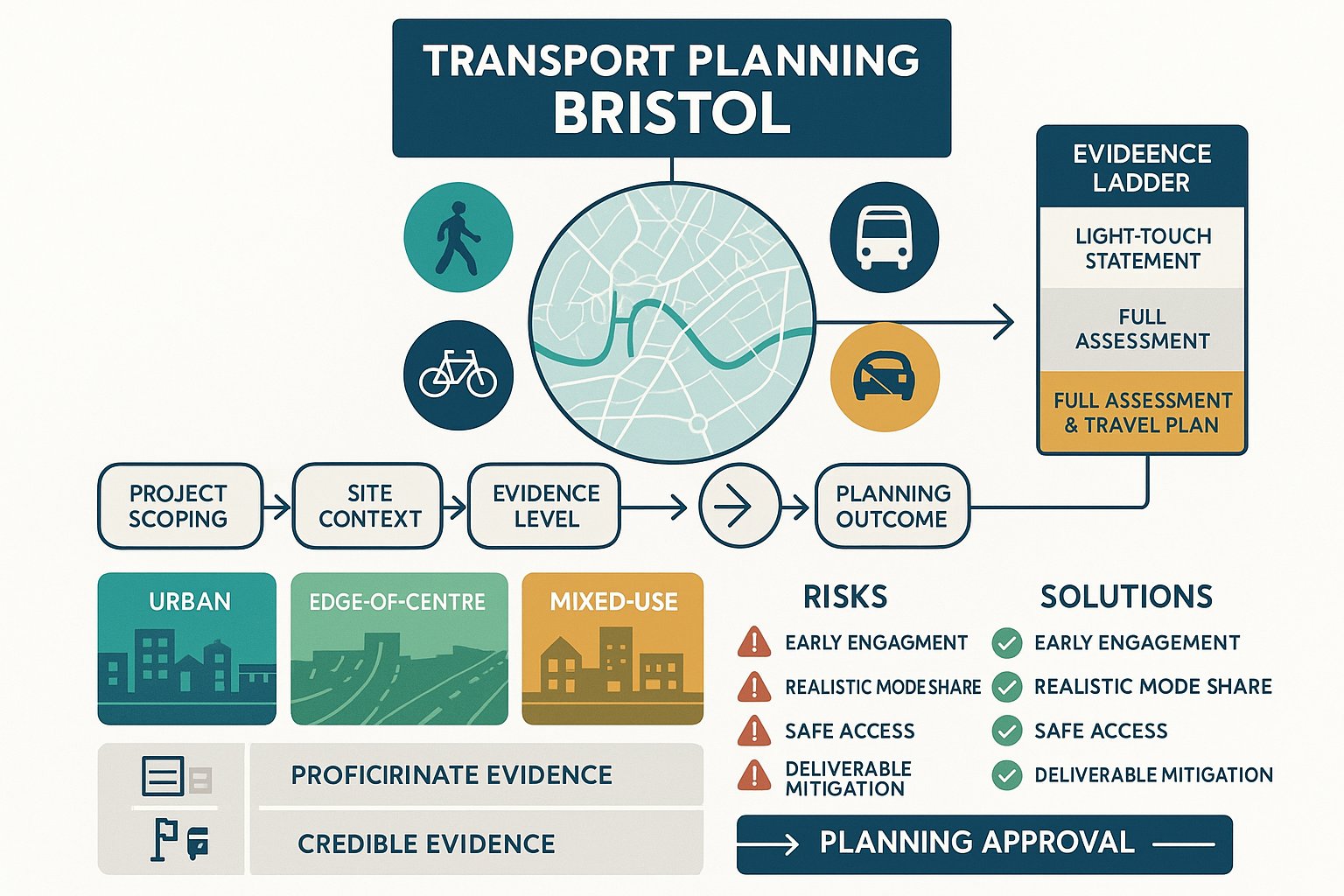
If you work on development in Bristol, you’ll already know this: transport is rarely a side note. It can be the issue that unlocks a planning permission smoothly, or the reason an otherwise well-designed scheme stalls, gets queried, or is refused.
That’s because transport planning Bristol is tied closely to how the city wants to grow. Bristol City Council is pushing hard on healthier streets, better public transport, safer walking and cycling routes, and lower car dependence. In practice, that means planning applications are judged not just on whether vehicles can get in and out, but on whether a proposal supports wider place-making, climate and accessibility goals.
For architects, developers, planners, lawyers and local authorities, the challenge is usually not whether transport evidence is needed, but how much is needed, when to scope it, and what Bristol’s Transport Development Management team is likely to expect. A light-touch statement may be enough for one site. Another will need a full Transport Assessment, Travel Plan, junction modelling, servicing strategy and targeted mitigation package.
In this guide, we set out what a robust Bristol submission typically involves in 2026, where applications commonly run into trouble, and how early, well-scoped advice can strengthen the planning case. Drawing on the kind of practical approach we use at ML Traffic, the aim here is simple: help teams submit transport evidence that is proportionate, credible and far easier for decision-makers to support.
Why Transport Planning Matters For Development In Bristol
In Bristol, transport planning is not a technical appendix bolted onto the back of an application. It sits near the centre of decision-making because the city’s growth strategy depends on moving more people sustainably, safely and efficiently.
Bristol City Council’s direction of travel is clear: prioritise walking, cycling and public transport: reduce congestion and pollution: improve health outcomes: and make streets function better as places, not just as corridors for traffic. So when a new residential, commercial, education or mixed-use scheme comes forward, the transport question is broader than highway capacity alone. The real test is whether the development helps deliver that wider vision, or cuts across it.
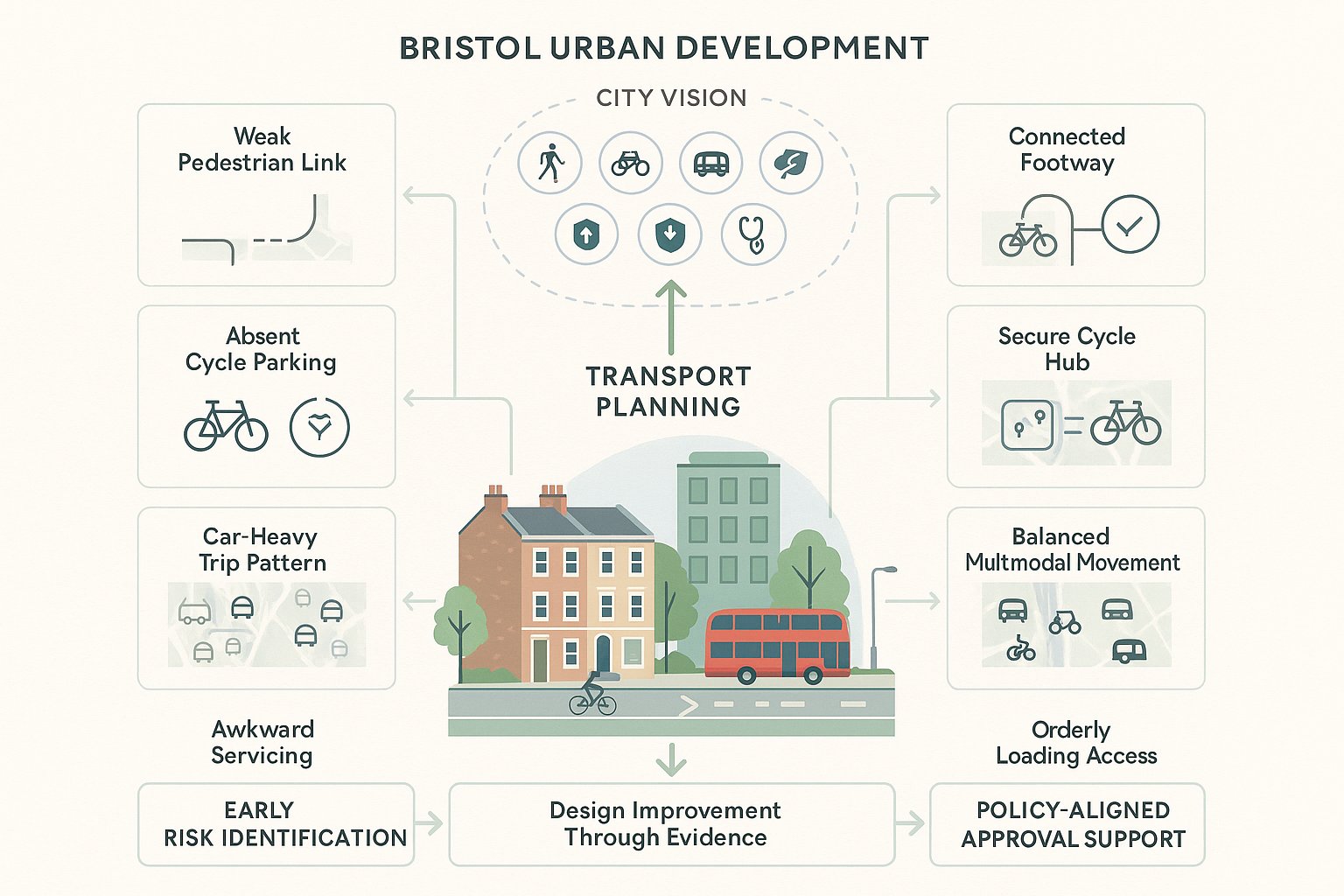
That matters for applicants in very practical ways. A site with weak pedestrian links, over-reliance on private car trips, poor cycle provision or awkward servicing can quickly attract objections or requests for further work. On the other hand, a scheme that demonstrates realistic mode share, safe access, policy alignment and proportionate mitigation has a much stronger platform.
We’ve found that good transport planning in Bristol does three jobs at once. First, it identifies risk early. Second, it gives the design team evidence to improve the scheme before submission. Third, it helps planning officers and consultees see a coherent story: this development can work on the network, and it supports the city’s transport priorities rather than undermining them.
How Bristol’s Planning Context Shapes Transport Requirements
Bristol has a distinct planning and transport context, and it shapes both the type of evidence required and the standard that evidence must meet. The city’s Transport Development Management (TDM) team acts as highway authority consultee on planning proposals, applying national policy alongside local plan and transport priorities.
That means requirements are not determined by floor area or dwelling numbers alone. Context matters. A modest scheme in a constrained inner-urban location may generate detailed scrutiny if access, servicing, pedestrian movement or cycle connections are sensitive. Equally, a larger scheme in a well-connected location might be acceptable if the transport strategy is genuinely sustainable and well evidenced.
Bristol also tends to look carefully at whether development contributes to healthy and sustainable transport infrastructure. In other words, applicants are not just asked to avoid severe residual impacts. They are often expected to show how the proposal supports walking, cycling, public transport and public realm improvements in a meaningful way.
For project teams, that changes the mindset. We’re not simply producing a TA or TS to satisfy a validation requirement. We’re building a planning case within a city that is actively trying to shift travel behaviour. If the submission doesn’t reflect that local reality, it can feel generic, and generic reports rarely do well in Bristol.
Key Local Policy And Decision-Making Factors To Consider
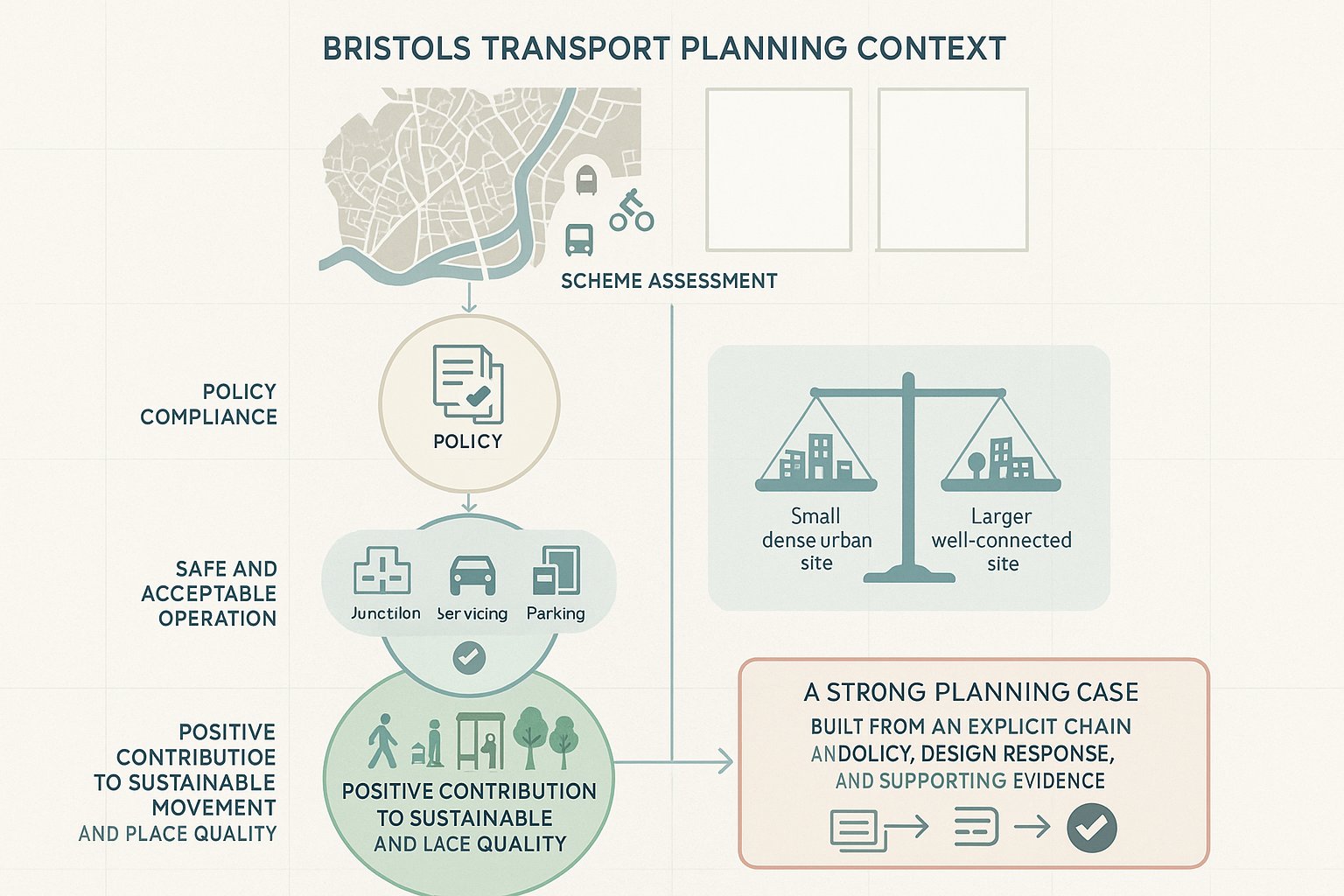
At local level, Bristol’s decision-making tends to focus on three linked questions.
Does the scheme comply with relevant planning and transport policy? That includes the local plan framework, sustainable travel priorities, street design expectations and any site-specific allocation considerations.
Will the development operate safely and acceptably? This covers access design, visibility, servicing, parking, internal layout, pedestrian conflict points, cycle safety and the performance of nearby links and junctions.
Does it contribute positively to sustainable movement and place quality? This is often the decisive point. Financial contributions, physical improvements, better crossings, cycle links, bus stop enhancements or public realm measures can all matter.
The strongest submissions deal with these issues directly rather than leaving officers to infer the answer. We usually recommend making the policy-to-design-to-impact chain very explicit: here is what policy seeks, here is how the scheme responds, and here is the evidence that the result is acceptable.
When A Transport Assessment, Transport Statement, Or Travel Plan Is Needed
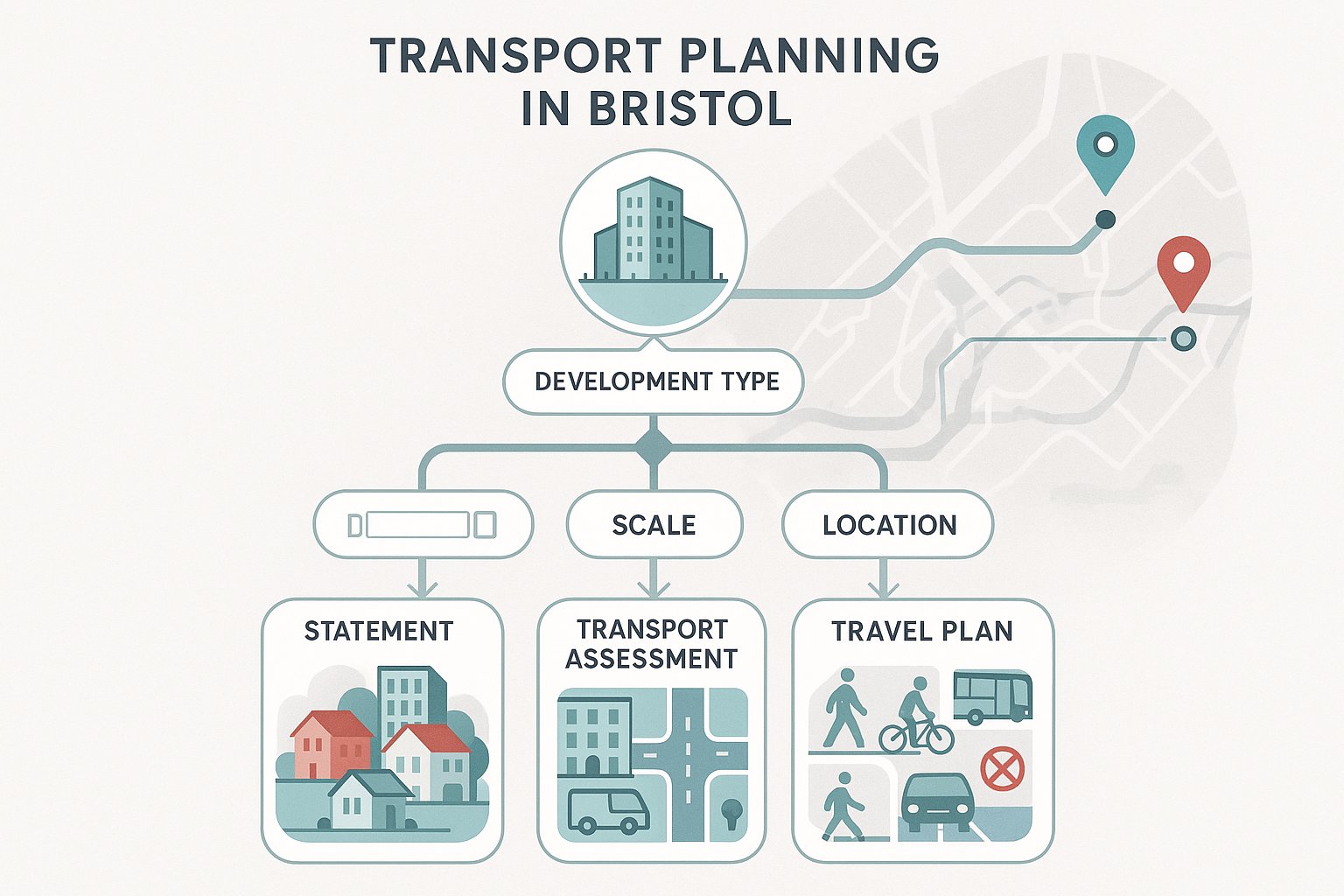
One of the most common early questions is whether a proposal needs a full Transport Assessment (TA), a lighter Transport Statement (TS), a Travel Plan, or some combination of the three. In Bristol, the answer is normally shaped through proportionate scoping with the Council’s TDM team rather than by relying on crude national thresholds alone.
Broadly speaking, a Transport Statement suits smaller-scale proposals where impacts are likely to be limited and can be explained without detailed modelling. A Transport Assessment is usually needed where a scheme is larger, more intensive, potentially traffic-generating, or located where the surrounding network and street environment are sensitive. A Travel Plan becomes important where mode shift is expected to form part of the mitigation strategy or where the development has the scale and occupation profile to support active travel measures, monitoring and management.
What matters in Bristol is proportionality backed by logic. If an application proposes a use that could materially alter travel demand, parking pressure, servicing patterns or junction performance, the Council will usually want robust evidence. And if the scheme’s acceptability depends on people choosing to walk, cycle or use public transport, then those assumptions need proper support rather than optimistic aspiration.
This is why pre-application discussion is so valuable. Early scoping can save weeks of redesign and avoid the classic problem of submitting too little, then being asked for more once the application clock is already running.
How Development Type, Scale, And Location Affect Submission Requirements
Different schemes trigger different levels of transport work.
A central Bristol infill residential scheme near strong bus corridors and local services may need detailed accessibility analysis, cycle parking and servicing strategy, but limited highway modelling. An edge-of-centre retail or roadside format, by contrast, can draw close scrutiny because of likely car trips and the risk of undermining sustainable travel patterns.
Likewise, mixed-use sites often require more rounded evidence because trip patterns vary by time of day and by land use. Office arrivals, residential departures, servicing windows, school-run peaks and weekend activity can all overlap in awkward ways.
Location is often the decisive variable. Sites in highly accessible urban areas can support lower parking levels and stronger non-car mode share, provided the walking and cycling environment is genuinely usable. Edge or strategic sites usually need more evidence on connections to centres, bus services, crossing points, route quality and off-site improvements.
In short: the less inherently sustainable the location or format, the more robust the transport justification usually needs to be.
What A Bristol Transport Planning Assessment Typically Covers
A well-prepared Bristol transport planning assessment should tell a clear story from site context to likely impact to mitigation. The exact contents vary, but most robust submissions cover the same core ground: policy context, existing conditions, accessibility, trip generation, distribution, junction effects, access design, servicing, parking, active travel, public transport, road safety and, where relevant, construction impacts.
The key is that these elements need to connect. Too many reports read like separate technical notes stitched together at the last minute. Bristol officers and consultees are much more likely to engage positively where the document explains how the location, land use and design strategy produce a coherent movement pattern.
For example, if a low-car residential scheme is proposed, the report should not merely list nearby bus stops and cycle routes. It should explain walking distances, route quality, crossing opportunities, cycle storage standards, likely trip patterns, servicing arrangements and how residents are expected to make real day-to-day journeys without defaulting to the private car.
It’s also important to be honest about constraints. A site may have awkward servicing geometry, peak-hour sensitivity at a nearby junction, or gaps in cycle comfort. Identifying those issues early and proposing sensible mitigation is usually better than glossing over them. In our experience, Bristol responds better to transparent assessment than to over-optimistic reporting.
Trip Generation, Distribution, And Junction Impact
Trip generation is still fundamental, even in highly sustainable locations. Decision-makers want to understand how many person trips and vehicle trips a development is likely to produce, when they occur, and where they go.
This usually involves drawing from national databases such as TRICS, local survey evidence where available, census and travel behaviour data, and professional judgement. But Bristol schemes often need more than a standard suburban car-trip estimate. We need to reflect the actual urban context: constrained parking, strong public transport corridors, walkable catchments, cycling potential and mixed land-use surroundings.
Once trips are estimated, they are distributed across the network to test likely effects on nearby links and junctions. Depending on the scale and sensitivity of the proposal, that might involve simple flow analysis, capacity assessments, or more detailed modelling of queueing and delay.
The quality of judgement here matters a lot. Unrealistic internalisation assumptions, weak distribution logic or vague peak-hour analysis are common reasons for challenge. A credible Bristol assessment should show not only the numbers, but why those numbers make sense for this site, this use and this part of the city.
Active Travel, Public Transport, Servicing, And Accessibility
In Bristol, active travel and accessibility are not side issues. They are often central to whether the application aligns with policy at all.
A strong submission should assess walking and cycling routes in practical terms: directness, safety, crossing quality, gradients, personal security, wayfinding and connection to strategic routes. Public transport analysis should go beyond stop locations and timetables to consider service usefulness, destination coverage and the pedestrian experience of getting there.
Servicing is another point where otherwise good schemes can stumble. Bristol will want confidence that deliveries, refuse collection and operational movements can take place safely, without unacceptable conflict with pedestrians and cyclists or excessive reliance on awkward reversing. For constrained urban sites, swept path work and time-specific management arrangements are often crucial.
Accessibility should then pull these threads together. We typically ask: can future users of this site realistically make common journeys by non-car modes? If the answer is yes, the report should prove it. If the answer is not yet, then mitigation needs to bridge the gap, whether through crossings, cycle links, bus stop improvements, travel plan measures or changes to the site layout itself.
Common Transport Planning Issues That Delay Bristol Applications
Most delayed applications do not fail because transport is impossibly complex. They fail because the transport work starts too late, is scoped too narrowly, or doesn’t align with Bristol’s priorities.
A very common issue is late engagement with the TDM team. By the time transport consultants are instructed, the layout may already be fixed, parking ratios agreed internally, and access points assumed. If those assumptions turn out to be weak, redesign becomes slow and expensive.
Another frequent problem is under-scoping. Applicants submit a brief TS where a fuller TA was always likely to be needed, or rely on generic trip rates with no sensitivity testing, no realistic active travel review and no robust servicing detail. That often leads to a further information request, which can be more disruptive than doing the work properly at the outset.
Poor-quality baseline data is another culprit. Out-of-date traffic counts, weak survey periods, limited accident review, or unrepresentative mode share assumptions can undermine the credibility of the whole report. And then there is mitigation: sometimes promised, but not designed: referenced, but not costed: desirable, but not actually deliverable.
Bristol also tends to look critically at schemes that talk about sustainability while retaining fundamentally car-led layouts. If the street hierarchy, parking strategy and access design point one way, and the narrative points another, consultees will spot the disconnect very quickly.
The practical lesson is simple enough: start early, scope carefully, and make sure the evidence, layout and policy case all say the same thing.
Preparing Evidence For Urban, Edge-Of-Centre, And Mixed-Use Sites
Different Bristol sites need different forms of transport evidence. The strongest reports respond to the grain of the location rather than applying a one-size-fits-all template.
For urban sites, the emphasis is often on accessibility, mode shift realism, servicing and the relationship between movement and placemaking. Inner-city proposals are rarely judged only by whether they add traffic. Officers will also look at pavement quality, cycle permeability, loading strategy, short-stay parking pressure, bus access and how the scheme fits into a dense street environment. Here, evidence should be detailed and place-sensitive.
For edge-of-centre sites, the challenge is often credibility. It is easy to claim a site is “walkable” or “well connected” in broad terms: it is harder to demonstrate that people will genuinely choose non-car travel for regular journeys. These schemes usually need stronger analysis of route quality, crossing points, severance, bus frequency, cycle comfort and links to key destinations. If the design still feels car-dominant, that weakness tends to come out quickly.
For mixed-use sites, transport evidence has to deal with interaction. Uses may complement one another through linked trips and internal capture, but they can also stack peaks in difficult ways. Residential, retail, workspace and leisure components each behave differently. Good assessments show where internalisation is realistic, where servicing demands overlap, and how the site will function across a full day rather than only in a weekday AM peak.
Across all three site types, Bristol tends to respond well to evidence that is specific, visual where helpful, and grounded in how people actually move.
How Transport Planners Support Planning Applications From Early Feasibility To Decision
Transport planners add most value when they’re involved before key design decisions harden. At feasibility stage, we can test whether access is likely to be acceptable, what level of assessment the scheme may trigger, whether parking assumptions are realistic, and where off-site improvements might be needed.
That early input matters because transport issues ripple through the whole planning package. A revised access point can alter landscape design. A servicing constraint can affect floorplate efficiency. A stronger walking route can improve both policy compliance and marketability. When transport advice comes in early enough, it informs the scheme. When it comes in late, it often just documents problems.
Through pre-application engagement, transport planners can help scope work with Bristol’s TDM team, agree survey requirements, frame the likely TA or TS content, and identify whether a Travel Plan, construction logistics material or junction modelling is likely to be expected.
From there, the role usually expands to preparing technical assessments, reviewing design drawings, coordinating with architects and planning consultants, responding to consultee comments, negotiating mitigation, and helping discharge transport-related conditions after consent. If a scheme goes to appeal, the same evidence base often underpins proof writing and expert support.
That end-to-end support is where experienced local judgement really counts. At ML Traffic, for example, the focus is on concise, accurate reporting tailored to local authority thresholds and planning contexts, which is exactly what Bristol applications tend to need: not more paper, just better-targeted evidence.
What Local Authorities And Consultees Look For In A Robust Submission
A robust submission usually feels clear before it feels technical. Planning officers, highway consultees and statutory bodies want to understand the proposal, the likely transport effects, and the logic behind the conclusions without having to excavate the answer from appendices.
In Bristol, that generally means a few things.
First, the submission should be policy-led. Not overloaded with policy quotations, but clearly anchored in the local and national framework that matters to the site. Officers want to see how the proposal supports healthy, sustainable movement rather than merely avoiding obvious harm.
Second, the evidence needs to be transparent and proportionate. Data sources, assumptions, survey dates, trip rates, growth factors and modelling scenarios should be visible and capable of challenge. If professional judgement has been applied, and it always is, the report should explain why.
Third, the design response must be practical. Safe access, realistic servicing, suitable cycle parking, pedestrian priority where appropriate, workable refuse strategy, and mitigation that can actually be delivered are far more persuasive than broad statements of intent.
And finally, consultees look for internal consistency. If the Travel Plan assumes strong bus use, the accessibility analysis and parking strategy should support that. If active travel is central to the planning case, the route review and site design need to show that users can move safely and directly.
The best transport planning Bristol submissions do not just answer technical questions. They make it easier for decision-makers to say yes.
Conclusion
Strong transport evidence can do more than satisfy a planning requirement in Bristol. It can sharpen the design, reduce risk, and help a proposal speak the same language as the city’s wider goals for healthier, lower-carbon movement.
The common thread in successful applications is usually early, realistic and policy-aware work: scoping the right level of assessment, understanding the site’s true accessibility, testing impacts honestly, and putting forward mitigation that is proportionate and deliverable. Bristol’s expectations are not mysterious, but they are exacting. Generic reports and last-minute fixes rarely hold up well.
For architects, developers, planners and councils, the practical takeaway is straightforward: treat transport as part of the scheme strategy from the start, not as a late compliance task. That is the best route to a smoother application, stronger consultee engagement and a more defensible planning outcome.
If needed, experienced consultants with local authority awareness can make that process much easier, especially where the brief is to move quickly without losing technical rigour.
Frequently Asked Questions about Transport Planning in Bristol
Why is transport planning crucial for development projects in Bristol?
Transport planning in Bristol plays a key role in ensuring developments support the city’s goals for healthier streets, reduced car use, and better public transport, which helps secure smoother planning approvals.
When is a full Transport Assessment required for a Bristol development application?
A full Transport Assessment is generally needed for larger, more intensive uses or developments in less accessible locations to provide robust evidence on traffic impacts and mitigation aligned with Bristol’s sustainable transport policies.
How does Bristol’s Transport Development Management team influence transport planning requirements?
The TDM team reviews planning proposals to ensure compliance with national and local policies, focusing on safety, accessibility, and positive contributions to sustainable transport infrastructure.
What factors affect the transport evidence needed for different types of developments in Bristol?
Development scale, location, and use influence the transport assessment level; urban sites focus on accessibility and active travel, while edge or larger sites require detailed analysis of connections, servicing, and likely travel patterns.
How can early engagement with transport planners improve Bristol planning applications?
Early involvement helps scope appropriate assessments, identify access or parking issues, and align designs with Bristol’s transport priorities, reducing delays and strengthening the planning case.
What are common mistakes that delay transport-related planning approvals in Bristol?
Delays often stem from late consultation with TDM, insufficient transport evidence, poor data quality, inadequate mitigation designs, or inconsistencies between sustainability claims and car-centric layouts.