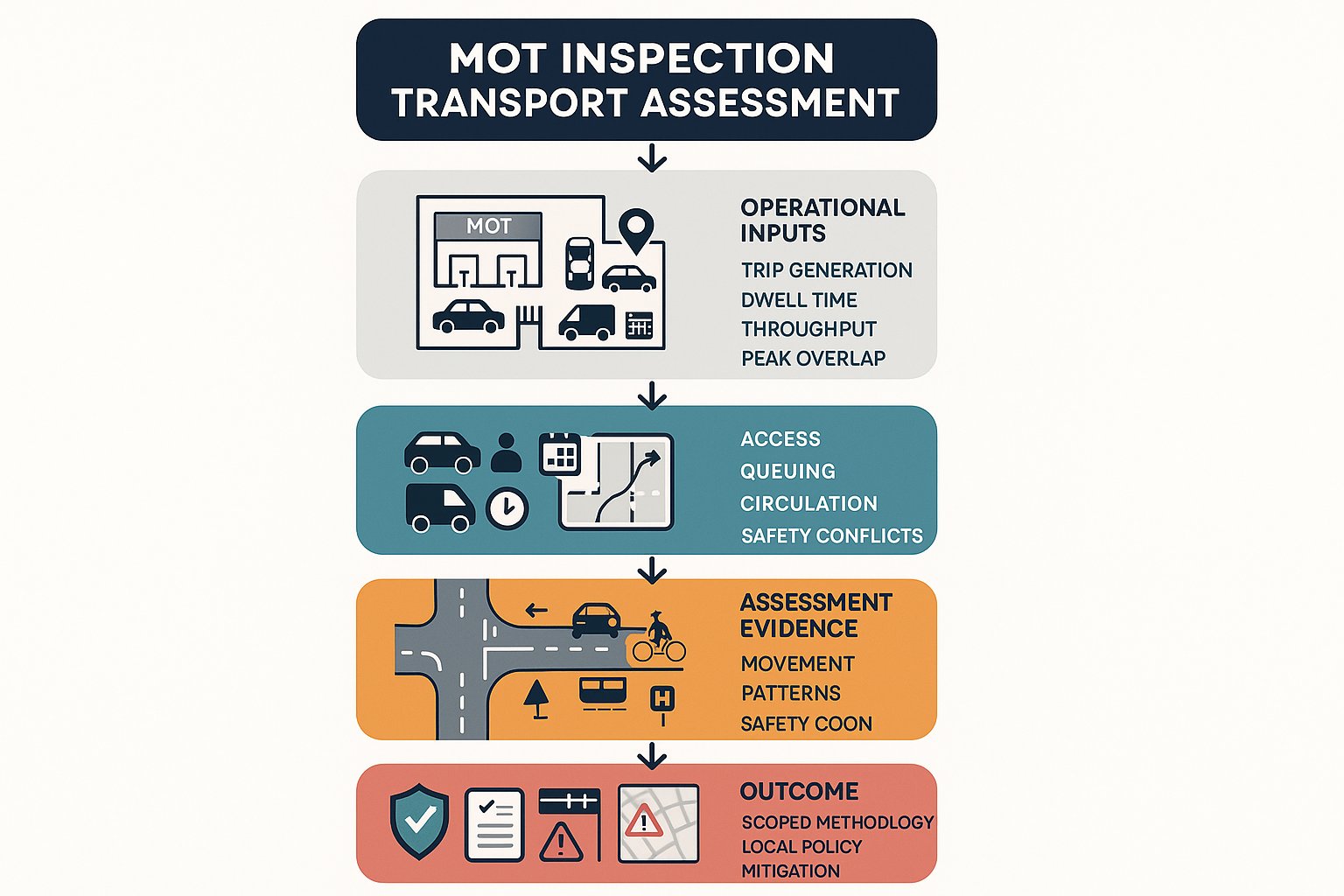
Planning applications for garages and vehicle testing sites rarely fail because the use itself is controversial. More often, they stall because the transport case is thin, generic, or clearly borrowed from a completely different scheme. That is especially true for an MOT inspection transport assessment, where planning officers and highway authorities want far more than a basic traffic estimate.
In 2026, expectations are sharper. Authorities are looking closely at whether an MOT proposal will create short-stay traffic peaks, awkward turning movements, queuing at the site entrance, overspill parking, or conflicts with people walking and cycling nearby. A scheme that looks modest on paper can still trigger concern if the access is constrained, the yard is tight, or the surrounding road network is already sensitive.
For architects, planners, lawyers, surveyors, developers, and local authorities, the challenge is to present a report that is technically sound but also grounded in how MOT centres actually operate day to day. That means connecting layout, throughput, trip generation, safety, and policy into one coherent planning narrative.
In this guide, we set out what planning authorities usually expect from an MOT inspection transport assessment, when a full Transport Assessment is likely to be needed, where applications commonly come unstuck, and how to scope a submission so it stands up first time. Drawing on the kind of approach we use at ML Traffic, the emphasis throughout is practical: clear evidence, realistic assumptions, and a report aligned to local planning context rather than boilerplate text.
What An MOT Inspection Transport Assessment Is And When It Is Needed
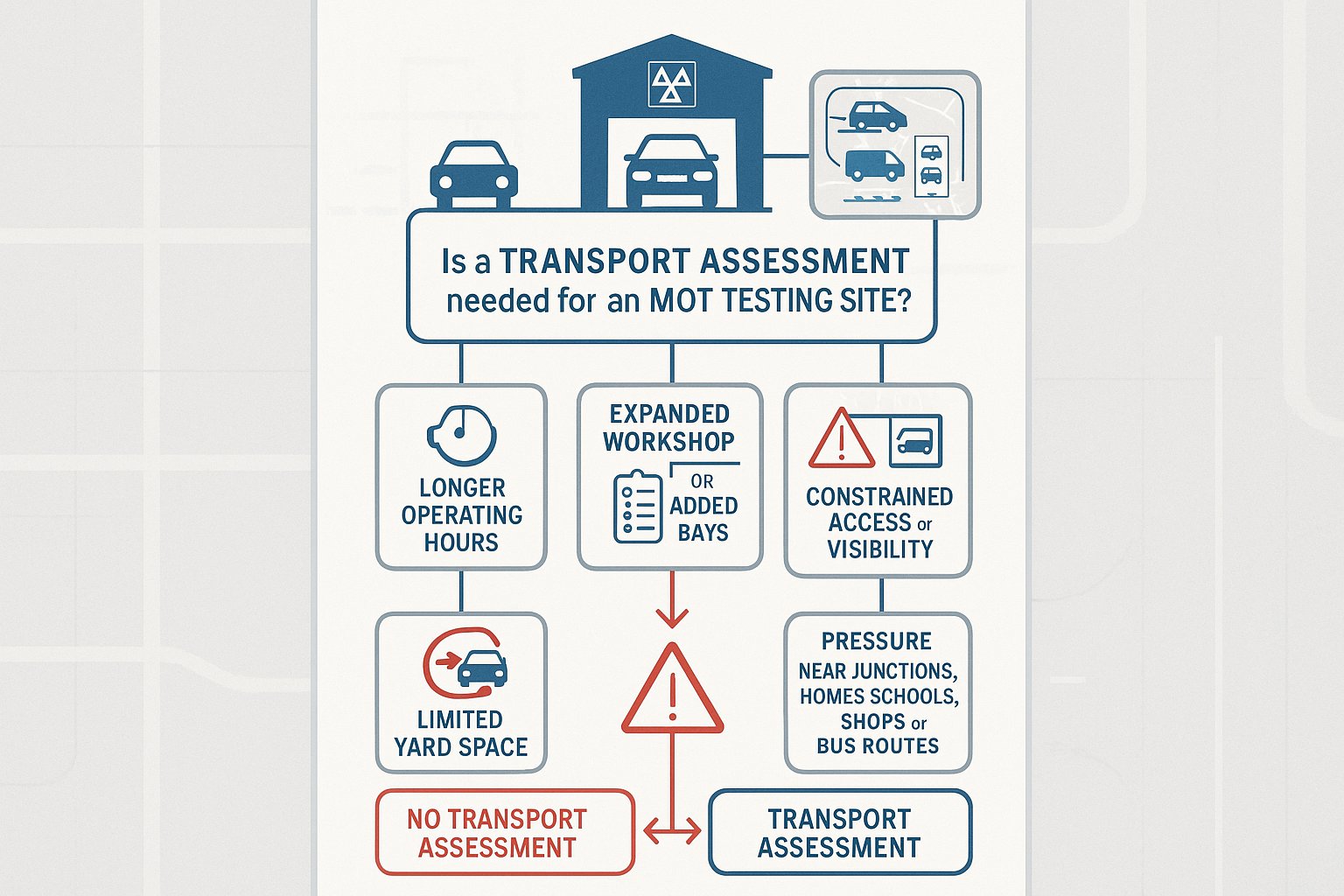
An MOT inspection transport assessment is a transport and highways report prepared to support a planning application for a new MOT testing centre, an expanded workshop, or an intensified vehicle inspection use. Its job is straightforward in principle: to show how the proposal will affect the highway network, site access, parking, servicing, circulation, and road safety, and whether those effects are acceptable in planning terms.
In practice, it sits somewhere between a conventional employment-use assessment and a more operationally detailed workshop appraisal. MOT premises generate repeated short visits, tightly timed appointments, occasional no-shows, customer waiting, staff arrivals, and sometimes recovery or trade vehicle activity. Those patterns matter because they shape when vehicles arrive, how long they stay, and whether queues remain on site.
A local authority may ask for this assessment when:
- a new MOT centre is proposed
- an existing garage adds MOT bays or increases throughput
- hours of operation are extended
- a change of use introduces a more intensive automotive function
- the site has constrained access, poor visibility, or limited yard space
- nearby junctions, homes, schools, shops, or bus routes are already under pressure
Not every scheme needs a full Transport Assessment. Some smaller proposals can be dealt with through a Transport Statement. But if the development is likely to generate notable vehicle movements, raise safety questions, or require careful layout testing, authorities typically expect something more robust. And where the planning history is sensitive, a light-touch note often just invites further queries.
How MOT Testing Centres Create Distinct Transport And Planning Issues
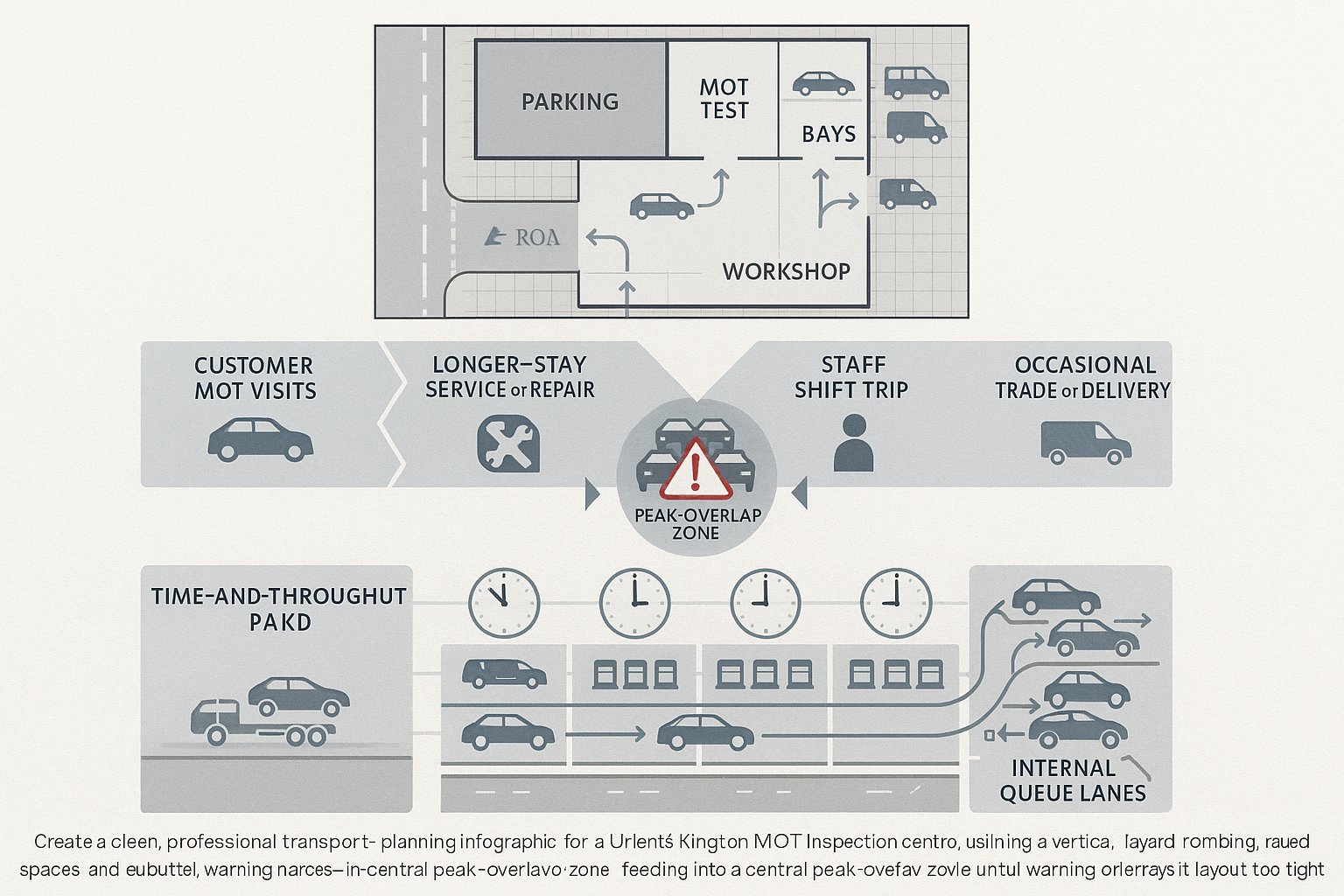
MOT uses are deceptively specialised. On the surface, they resemble ordinary garages. But from a transport planning perspective, they create a different pattern of movements and operational constraints that planning authorities increasingly recognise.
Unlike a standard industrial unit with predictable staff-led traffic, an MOT centre often combines booked customer arrivals, waiting vehicles, handovers, workshop circulation, and collection trips in a compressed footprint. If that footprint is poorly designed, small operational problems quickly become planning problems.
Vehicle Trip Generation For MOT Inspection Uses
Trip generation for MOT inspection uses should not be lifted lazily from broad land-use categories. The more defensible approach is to estimate movements by reference to test bays, likely throughput, hours of operation, staffing, and local evidence from comparable sites.
We normally separate out at least four components:
- customer arrival and departure trips for MOT-only visits
- longer-stay visits where MOTs are combined with servicing or repairs
- staff trips by shift or opening pattern
- occasional trade, delivery, recovery, or light goods vehicle movements
That matters because the headline daily trip total rarely tells the full story. Authorities are often more concerned with peak-hour overlap. For example, a site may have modest total movements across the day but still create pressure around 8am to 10am, lunchtime handovers, or late afternoon collection periods.
Weekday and Saturday profiles can differ too. Saturday demand is often important for customer-facing automotive uses, even where the surrounding road network behaves differently from a commuter weekday. A credible assessment will hence test typical weekday conditions, network peak hours, and any Saturday pattern that could affect nearby shopping streets or residential roads.
Customer Dwell Time, Queuing, And Workshop Throughput
This is where many weak reports unravel. Dwell time and throughput drive how many vehicles are on site at the same moment, and that is usually the crux of an MOT scheme.
A basic MOT-only appointment may keep a vehicle on site for roughly 45 to 90 minutes, depending on check-in, waiting, retests, and operational slack. Add servicing or repair work, and dwell times lengthen substantially. Then factor in staff vehicles, customer early arrivals, delayed collections, and vehicles awaiting parts. Suddenly, a yard that looked adequate on the drawing starts to feel tight.
Planning authorities want to know:
- how many tests each bay can realistically process per day
- what the maximum concurrent vehicle accumulation could be
- whether vehicles can queue internally without blocking access
- whether workshop operations spill into customer parking areas
- whether any waiting occurs on the public highway
If the proposal relies on perfect booking discipline to function, officers may be sceptical. Real sites run a little messily. People arrive early. Someone turns up without an appointment. A van stays longer than expected. A strong assessment acknowledges that reality and tests layouts against realistic, slightly robust operating scenarios rather than best-case assumptions.
Planning Policy And Local Authority Thresholds That Shape The Assessment
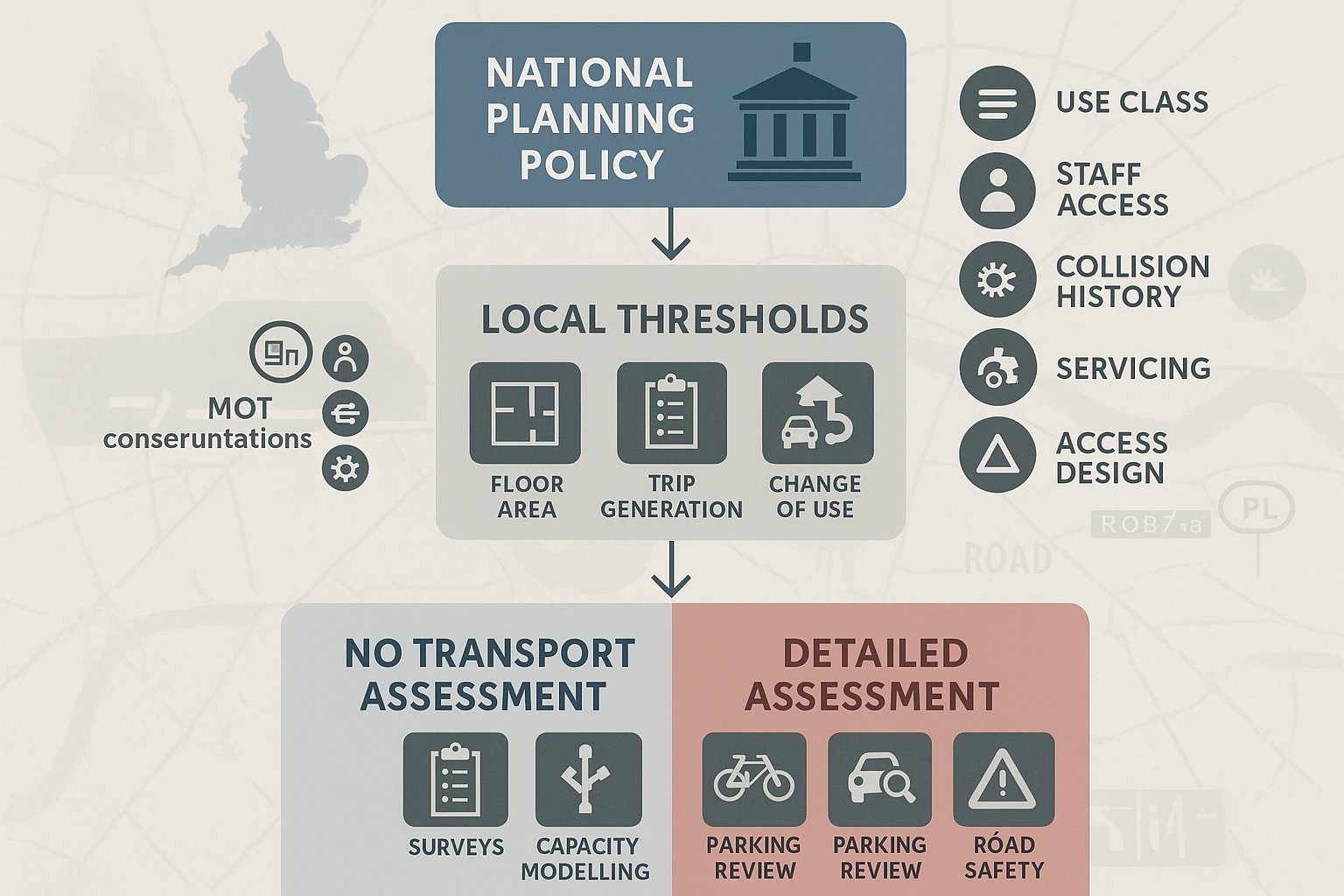
The policy framework behind an MOT inspection transport assessment is familiar, but the detail is local, and that local detail often decides whether an application moves smoothly or becomes bogged down.
At national level in England, the National Planning Policy Framework expects developments that generate significant amounts of movement to be supported by a Transport Statement or Transport Assessment. The accompanying planning practice guidance reinforces the idea that the level of assessment should be proportionate to the scale and likely impact of the proposal.
That sounds simple. It isn’t always. Local plans, validation checklists, parking standards, and supplementary planning documents usually provide the real thresholds and practical expectations. Some councils set floor-area triggers. Others focus on expected trip generation, change of use, or highway sensitivity. A small MOT proposal in one borough might pass with a concise statement, while a similarly sized scheme elsewhere may need surveys, capacity modelling, and a detailed parking review because the access sits on a constrained urban street.
For MOT uses specifically, authorities may look closely at:
- whether the use is treated as B2, sui generis, or a mixed automotive operation
- local car and cycle parking standards
- servicing expectations for light goods vehicles
- design standards for access width, gradients, and visibility
- collision history and road safety priorities
- sustainable transport expectations for staff access
This is why generic reports cause trouble. A robust assessment should reference the relevant local development plan documents and highway guidance directly, then explain how the proposal aligns with them. We find that tailoring the report to the authority’s actual validation and policy framework usually saves time later, especially where officers need confidence that the scope is proportionate and policy-led rather than template-driven.
Core Elements Of An MOT Transport Assessment
A sound MOT transport assessment should read as a joined-up technical case, not a stack of disconnected appendices. The exact scope varies by authority and site complexity, but most robust submissions include the same core ingredients: site context, planning history, policy review, baseline traffic and parking conditions, trip generation, trip distribution and assignment, access review, safety appraisal, and any mitigation.
For MOT proposals, but, the strongest reports go one step further. They explain how the site will actually operate. That means linking the layout to throughput assumptions, linking throughput to trip estimates, and linking both to access and circulation. If those strands do not line up, consultees notice.
Site Access, Visibility, And Junction Operation
Access is usually the first pressure point. An MOT site may generate relatively low-speed traffic, but the frequency of turning movements, confined geometry, and customer unfamiliarity with the premises can create risk if the entrance is poorly designed.
The assessment should review:
- access width and whether two-way movement is realistic
- kerb radii and suitability for cars and light goods vehicles
- gradients near the highway boundary
- gate positions and whether vehicles can wait clear of the carriageway
- visibility splays based on measured or policy-appropriate speeds
- potential conflict with bus stops, crossings, loading bays, or nearby junctions
Where movements are material, junction operation should also be examined. Sometimes this requires capacity modelling at the site access or a nearby junction, especially if the surrounding network is already close to saturation. But not every scheme needs a complex model. The important point is proportionality backed by evidence.
Authorities also like to see that vehicles can enter and leave in forward gear where possible. A layout that depends on awkward reversing near the highway boundary often attracts concern very quickly.
Parking, Servicing, Circulation, And Turning For Cars And Light Goods Vehicles
Parking is not just about meeting a nominal standard. For an MOT site, the central question is whether there is enough functional space for the operation being proposed.
A proper review should identify demand from:
- customer parking
- staff parking
- waiting vehicles before test
- vehicles under test
- vehicles awaiting collection
- any courtesy or trade vehicles
- deliveries and occasional recovery visits
This is where accumulation analysis and layout testing matter. A site may technically show the right number of marked spaces, yet still fail operationally because circulation routes are pinched or turning requires multiple shunts. If customer spaces are routinely blocked by workshop activity, planning officers may reasonably assume overspill will end up on street.
Swept path analysis is often critical, particularly where light goods vehicles, vans, or recovery trucks are expected even occasionally. The assessment should demonstrate that the largest anticipated vehicle can manoeuvre safely within the site, use turning areas properly, and leave without relying on the public highway for reversing or repositioning.
One-way systems, clearly separated customer and workshop areas, and simple circulation patterns can make a dramatic difference. A good report does not just say the layout works: it shows, in a way a case officer and highway engineer can trust.
Road Safety, Walking, Cycling, And Public Transport Considerations
Even though customers typically arrive by car, an MOT inspection transport assessment cannot ignore sustainable transport or road safety. Planning authorities increasingly expect both to be addressed, and not as a token paragraph near the back of the report.
The road safety review should start with baseline evidence: the character of the surrounding streets, traffic speeds, visibility, crossing points, frontage activity, and any recorded collision history over an appropriate study period. The aim is not merely to state that accidents are low or high. It is to identify whether there is any pattern that the proposal could worsen, particularly involving turning traffic, manoeuvring, or vulnerable road users.
For walking, basic points matter a great deal:
- Is there a continuous footway to the site?
- Can customers walk safely from parking to reception?
- Are dropped kerbs, lighting, and surfacing adequate?
- Will waiting or parked vehicles obstruct pedestrian movement?
Cycling is often more relevant for staff than for customers, but that does not make it optional. Local standards may require secure cycle parking, showers in larger employment schemes, or clear cycle access from the highway. If the site has no realistic provision, officers may question whether the design has been properly considered.
Public transport should be covered pragmatically. For most MOT customers, bus or rail is not the main mode. For staff, though, it may be. A concise audit of nearby bus stops, service frequency, walking routes, and any nearby station helps demonstrate that the proposal is not wholly car-dependent for employment access.
The best assessments strike the right tone here: realistic, evidence-based, and not over-claiming. Authorities are usually receptive to that.
How To Scope The Assessment For A Planning Application
Scoping can save weeks, sometimes months. If there is one practical lesson we return to again and again, it is that many disputes over an MOT inspection transport assessment begin long before the report is written.
The sensible route is early pre-application engagement with both the local planning authority and, where relevant, the highway authority. That discussion should pin down what level of report is needed, which junctions fall within the study area, what survey days and time periods are expected, and whether the authority wants a Transport Statement, full Transport Assessment, Travel Plan, swept path package, or all of the above.
A written scope note is especially valuable. It can cover:
- the nature of the proposed MOT use and expected throughput
- opening hours and staffing assumptions
- the surrounding highway context and sensitive receptors
- proposed survey locations and survey periods
- methodology for trip generation and comparable site selection
- approach to queueing, accumulation, and internal layout testing
- whether capacity modelling is proposed and for which junctions
- road safety review parameters
Getting written agreement does not eliminate all later comments, but it narrows the room for disagreement. It also shows that the applicant has approached the process transparently.
At this stage, we also advise coordinating transport input with the architect and planning team, not treating it as a bolt-on. If the access geometry, parking arrangement, and workshop layout are still changing, the transport scope should reflect that. There is little value in agreeing a methodology for a layout that will be materially different two weeks later.
In short: scope early, scope in writing, and scope against the real operation of the site, not an idealised version.
Common Reasons MOT Transport Assessments Are Challenged Or Delayed
Most challenged submissions are not fatally flawed. They are just unconvincing. And in planning, that is often enough to trigger a holding objection or a request for more information.
One common weakness is generic trip generation. If the report relies on broad garage or industrial rates without explaining how MOT activity differs, consultees may question the entire evidence base. The same applies where daily movements are presented but there is no serious analysis of peak-hour overlap, queueing, or on-site accumulation.
Parking shortfalls are another recurring issue. Sometimes the numerical standard is met, yet the plan clearly shows that some spaces are blocked by manoeuvring routes or workshop doors. Officers notice that quickly. So do neighbours, especially where on-street parking is already contentious.
Other regular causes of delay include:
- no swept path analysis for vans or recovery vehicles
- inconsistency between the TA, the application form, and the site layout plans
- failure to address existing congestion at nearby junctions
- weak visibility evidence or no speed-based justification
- little or no discussion of pedestrian safety
- unsupported assumptions about staff travel behaviour
- a mitigation package that is vague, undeliverable, or absent
There is also a softer problem: reports that feel copied. Planning officers read a lot of transport documents. They can usually tell when a submission has been produced from a standard template with the names changed. If the text does not reflect the actual site, the authority may assume the analysis is equally generic.
That is why clarity matters as much as technical content. A concise, tailored report with coherent plans often performs better than a bulky document full of standard wording and thin evidence.
Practical Steps To Prepare A Robust Submission
A robust submission usually starts with better inputs, not better spin. If the underlying evidence is site-specific and the design team works iteratively, the transport report is far easier to defend.
The first step is to gather realistic operational data. Comparable MOT centre surveys can be extremely useful, especially where they capture arrival patterns, dwell time, staff parking, and the number of vehicles on site at different times of day. Local evidence is nearly always more persuasive than national assumptions used in isolation.
Next, align the layout and assessment together. We often see the best results when the transport engineer, architect, and planner test options early rather than waiting for a near-final layout. Small changes to gate position, circulation direction, or waiting-space allocation can remove the very issues that would otherwise generate objections.
A strong submission will usually include:
- a clear site description and planning context
- policy references specific to the authority
- surveyed baseline conditions where proportionate
- transparent trip generation and accumulation calculations
- swept path drawings for relevant vehicles
- plans showing parking, servicing, circulation, and visibility splays
- road safety and sustainable transport commentary
- mitigation measures where needed
- a concise non-technical summary for decision-makers
It also helps to address local concerns before they harden into objections. If nearby residents are likely to worry about queueing, noise, or parking overspill, the report should tackle those matters directly. Not defensively, just clearly.
For applicants working to tight planning timescales, speed matters too. But speed should come from experience and good scoping, not from cutting corners. That is exactly where specialist input can make a difference: producing concise, accurate reporting quickly while still tailoring the assessment to the authority’s thresholds and the scheme’s real transport effects.
Conclusion
An MOT inspection transport assessment is not just a box-ticking transport note for a garage application. It is a focused planning document that needs to explain how an MOT site will genuinely function: how vehicles arrive, where they wait, how they turn, whether they queue, and what that means for the surrounding highway network and nearby users.
In 2026, planning authorities are expecting sharper evidence, tighter alignment between layout and operation, and a more credible response to parking, safety, and sustainable access. The schemes that progress most smoothly are usually the ones that scope the work early, use realistic MOT-specific assumptions, and present the findings in a way that is technically sound and easy to follow.
For architects, planners, developers, and councils, the takeaway is simple. Treat the transport assessment as part of the design and planning strategy from the outset, not as an afterthought. When that happens, the report becomes far more than supporting paperwork: it becomes part of the reason the application succeeds.
Frequently Asked Questions about MOT Inspection Transport Assessments
What is an MOT inspection transport assessment and when is it required?
An MOT inspection transport assessment is a specialised transport report required to support planning applications for new or expanded MOT testing centres. It assesses traffic impacts, site access, parking, and safety to ensure compliance with local and national planning policies, typically needed when use intensifies or if the site is near sensitive junctions.
How do MOT testing centres differ from other vehicle repair uses in transport assessments?
MOT centres generate distinct traffic patterns with short, appointment-based visits causing peak arrival times and potential on-street queuing. They involve low-speed manoeuvres, a mix of cars and light goods vehicles, and can impact nearby residential or retail areas through congestion, parking overspill, and safety concerns.
What factors influence vehicle trip generation estimates for MOT inspection uses?
Trip generation depends on the number of test bays, operating hours, staffing levels, and local evidence. Assessments differentiate customer trips, staff trips, and occasional trade or recovery vehicles, and consider weekday, network peak hours, and Saturday demand to reflect realistic traffic profiles.
Why is it important to assess customer dwell time, queuing, and workshop throughput in the transport assessment?
Dwell time and throughput determine the maximum number of vehicles onsite and potential queuing. Since MOT visits can last 45–90 minutes or longer with additional servicing, assessments must ensure that vehicle queues remain within the site and do not block access or extend onto public roads, addressing real-world operational variability.
How should parking and site circulation be managed in an MOT inspection transport assessment?
Assessments must demonstrate adequate parking for customers, staff, waiting vehicles, and servicing, with clear circulation routes. Swept path analysis for cars and light goods vehicles ensures safe manoeuvring without reliance on public highways. Layouts often include one-way systems and separation between customer and workshop areas to minimise conflicts.
What are best practices for scoping an MOT inspection transport assessment for planning?
Early pre-application engagement with planning and highway authorities is key to agree reporting scope, survey requirements, and methodology. A written scope note reduces later disputes. Coordinating transport input with architects and planners ensures that access, parking, and throughput assumptions align with site design from the outset, avoiding delays.