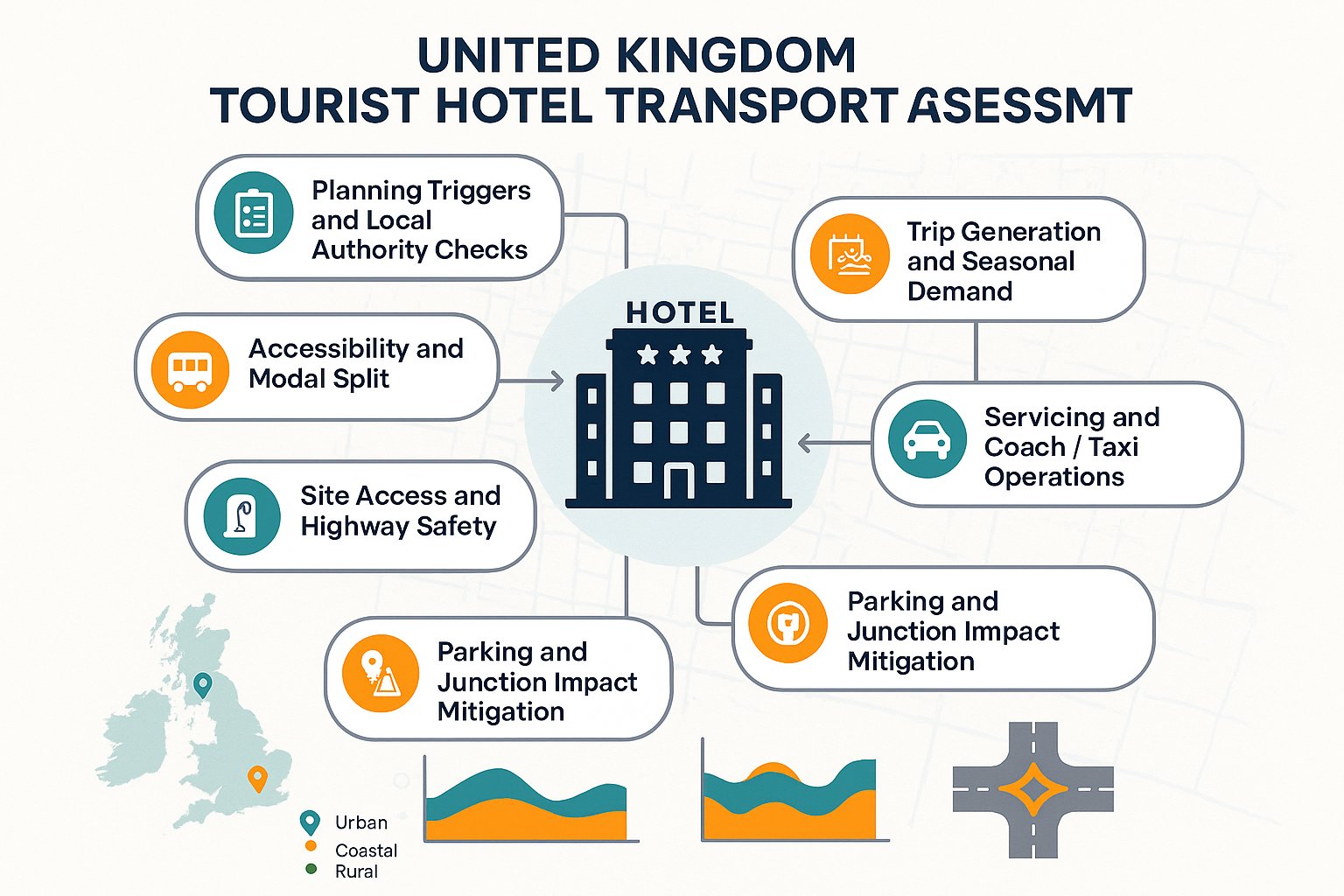
A hotel planning application can look straightforward on paper: a site, a bedroom number, a parking layout, a new access. But anyone who has worked on tourist-led development knows the transport picture is rarely simple. Hotels do not behave like standard housing, offices or even many other commercial uses. They operate all day and all night. Demand shifts by season. Arrival patterns can bunch around check-in, breakfast, events and weekend turnover. And in the wrong location, even a moderate scheme can create awkward pressure on nearby junctions, kerbside activity and pedestrian routes.
That is exactly why a tourist hotel transport assessment matters. In UK planning terms, it is the document that shows whether the transport effects of a hotel development have been properly understood, tested and, where necessary, mitigated. For architects, planners, developers, solicitors, surveyors and local authorities, the quality of that assessment often shapes whether an application moves smoothly or stalls in validation, consultation or determination.
In 2026, expectations are sharper than they were a few years ago. Local validation lists are more specific. Highway authorities are looking harder at sustainable travel, servicing, pick-up activity, EV provision and realistic seasonal demand. In this guide, we set out what a hotel transport assessment needs to cover, where schemes commonly run into trouble, and what we need to get right if we want a planning submission to stand up to scrutiny.
What A Tourist Hotel Transport Assessment Is And When It Is Required
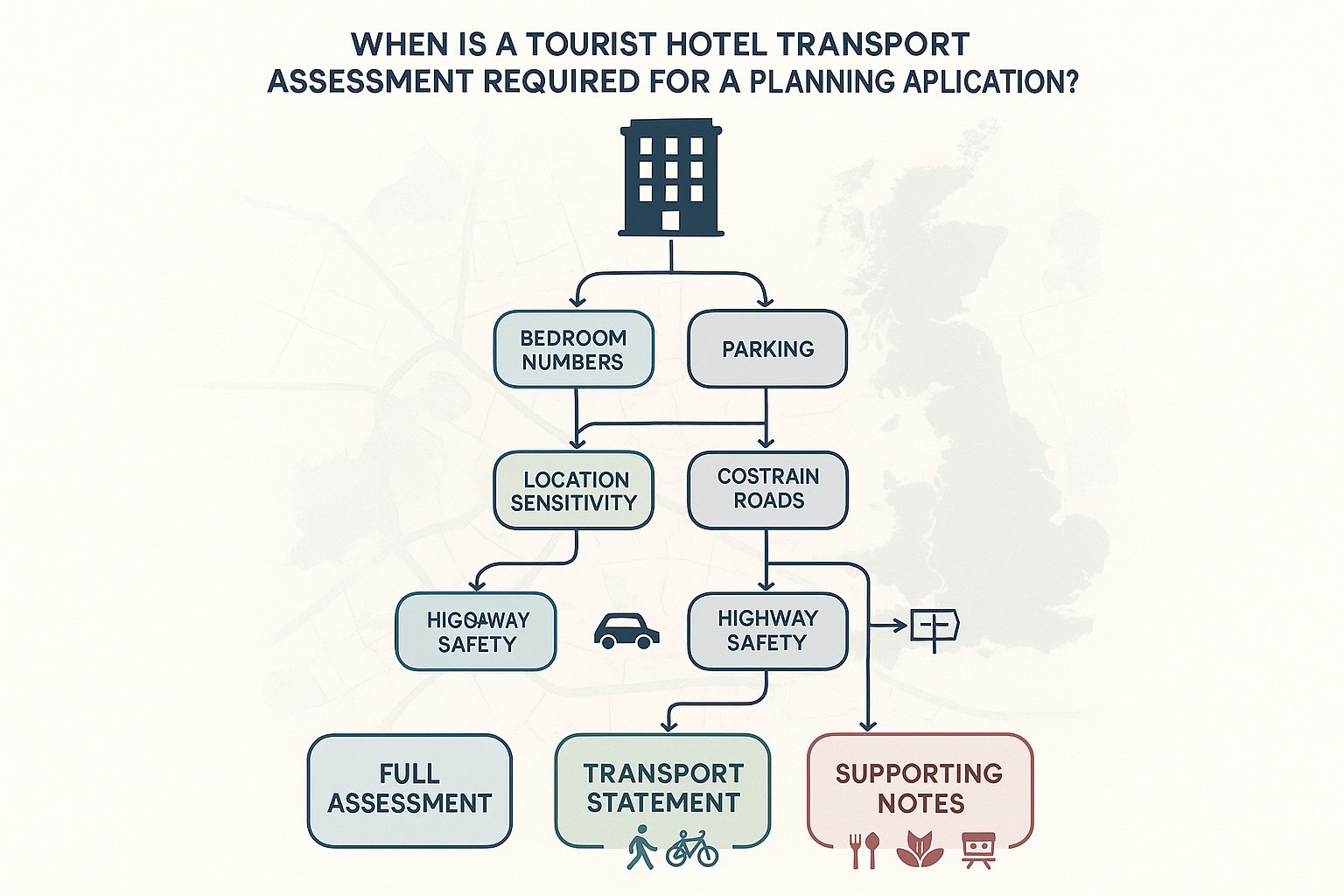
A tourist hotel transport assessment is a formal transport study submitted with a planning application to identify, quantify and manage the likely travel and traffic effects of a proposed hotel. In practice, it sits between policy, design and evidence. We use it to explain how people and vehicles will reach the site, what demand the hotel will generate, how the surrounding network will perform, and whether mitigation is needed.
Under UK planning guidance, a transport assessment is generally required where development is likely to create significant transport implications. That principle sounds simple, but the real trigger usually comes from local validation requirements and site-specific judgement. Some councils set indicative thresholds based on bedroom numbers, gross floor area, parking spaces or proximity to constrained roads. Others focus more on context: town-centre sensitivity, tourism pressure, highway safety history, or whether the site sits close to a strategic route or fragile local junction.
For hotel schemes, requirement is often driven by more than scale alone. A 60-bedroom hotel in a tightly constrained coastal town may need a fuller assessment than a larger scheme in a highly accessible city-centre location. Add a restaurant, spa, function suite or conference space, and the transport case becomes broader again.
So the key point is this: we should not treat requirement as a box-ticking exercise. Early review of the local authority checklist, local plan policies and likely highway authority concerns usually tells us whether a full assessment, a lighter transport statement, or supporting technical notes will be expected.
How Hotel Developments Create Distinct Transport And Traffic Impacts
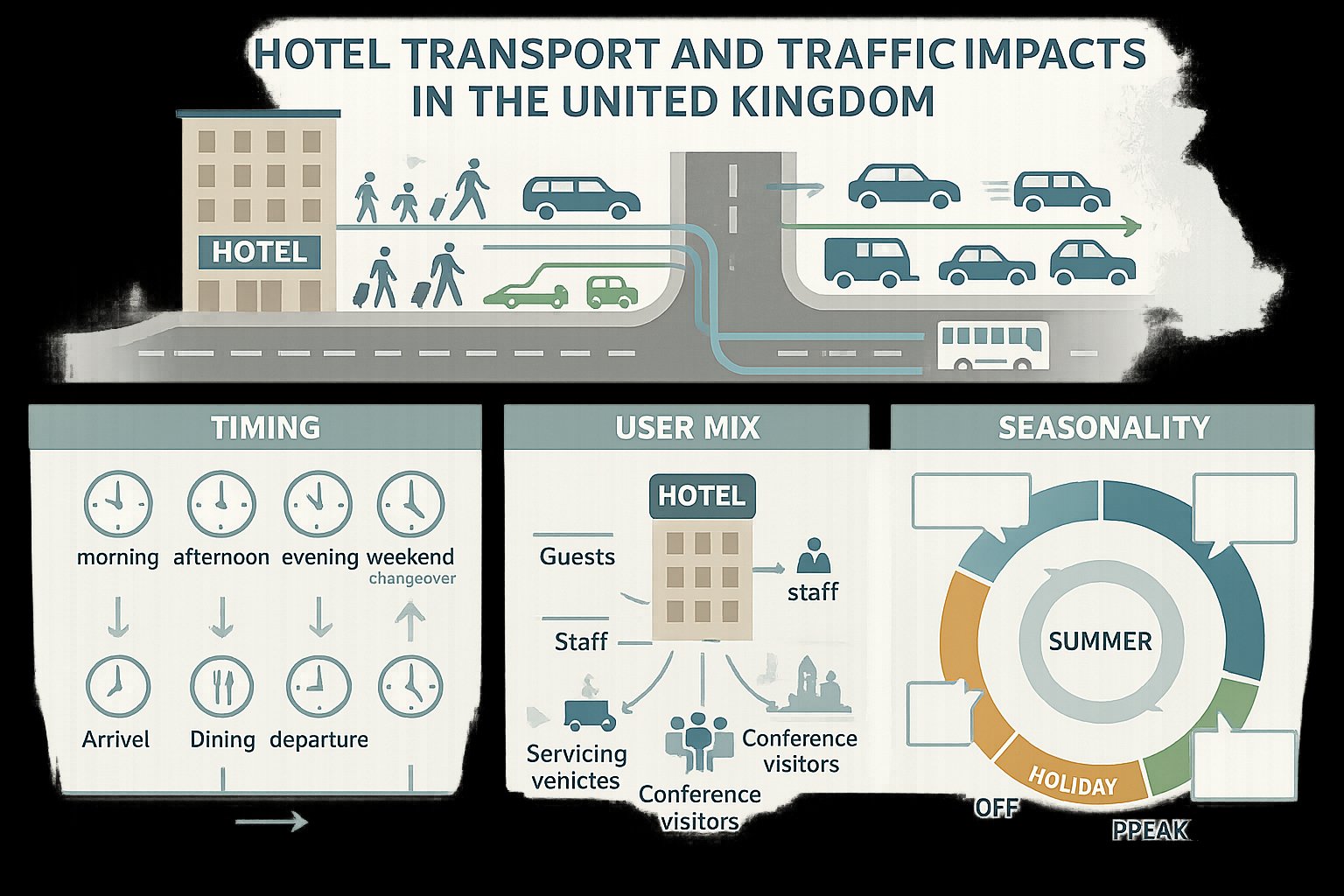
Hotels produce a transport profile that is different from most mainstream land uses, and that difference matters when we forecast impact. Unlike offices, hotels are not driven by a single AM and PM commuter rhythm. Unlike residential, they do not simply generate home-based trips spread through the day. They are operational businesses with guest turnover, staffing patterns, deliveries and visitor movement layered on top of one another.
The first distinctive feature is timing. Check-in and check-out periods can create short bursts of activity, particularly on Fridays, Sundays and holiday changeover days. Breakfast periods generate internal and external movement. Evening arrivals often overlap with restaurant demand, taxis and app-based pick-ups. If the hotel includes events or conferencing, those patterns can become more pronounced and more irregular.
The second is user mix. A hotel does not only generate guest cars. It may attract rail arrivals transferring by taxi, airport-linked coach activity, tourists unfamiliar with the network, shift staff arriving outside normal peak periods, and servicing vehicles for food, linen, waste and maintenance. That means kerbside behaviour, loading demand and turning movements can be just as important as total trip numbers.
The third is seasonality. Tourist accommodation in seaside towns, heritage centres, resort locations and event-led destinations can vary sharply through the year. Summer weekends may bear little resemblance to a wet Tuesday in November. A robust assessment recognises those swings rather than relying on generic average-day assumptions.
Key Planning Triggers, Local Policy Thresholds, And Validation Expectations
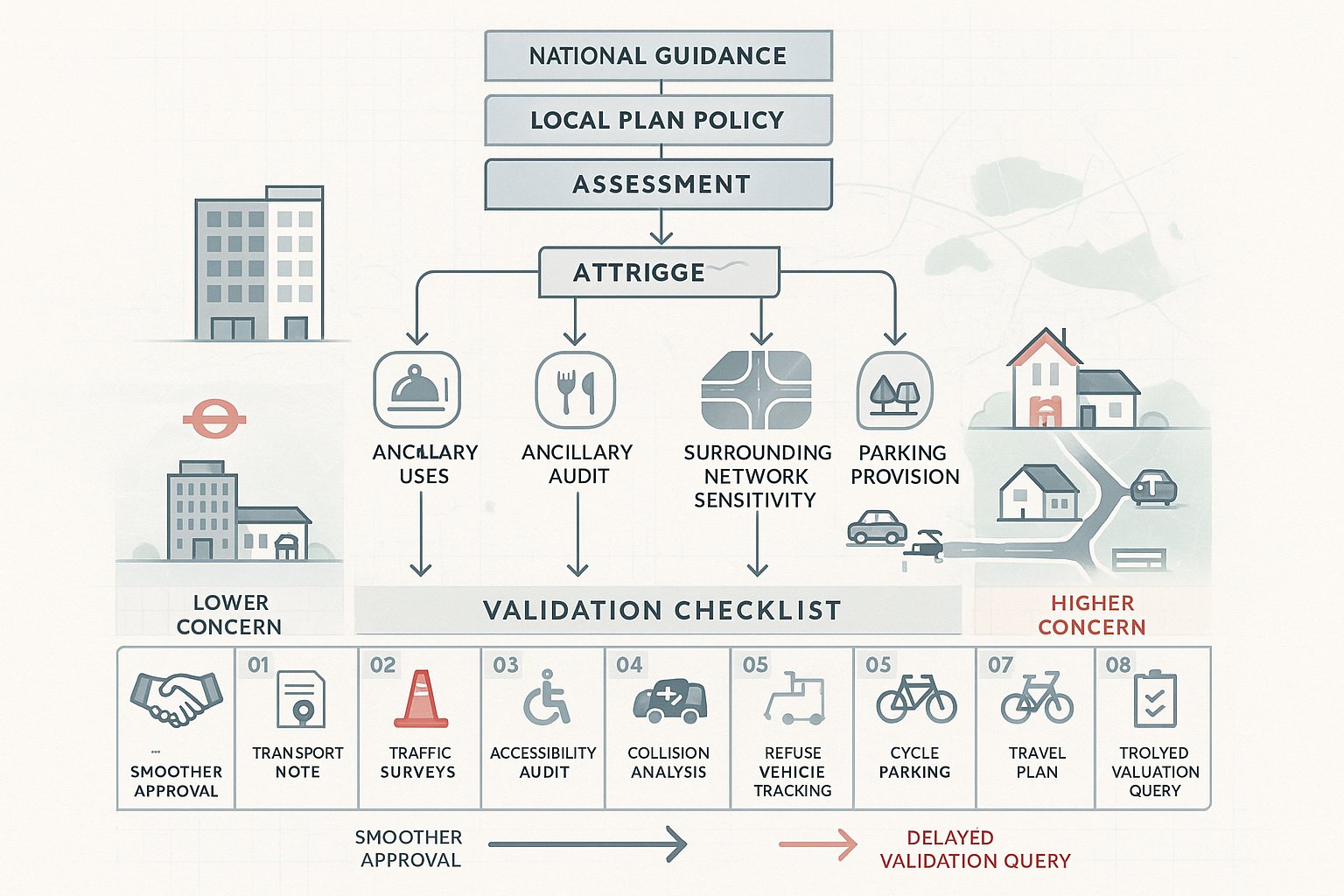
In hotel planning work, transport requirements are often determined by a combination of national guidance, development plan policy and local validation practice. We need all three in view. National policy provides the broad test around whether a development creates significant transport impacts. Local plans and supplementary guidance then shape what “significant” means in that authority area.
Common triggers include the scale of the proposed hotel, the inclusion of ancillary uses, and the sensitivity of the surrounding network. Bedroom numbers are an obvious indicator, but they are not the only one. A 100-bedroom budget hotel next to a rail station may raise fewer transport concerns than a 40-bedroom rural hotel with a wedding venue accessed from a substandard junction.
Parking can also trigger scrutiny. Where proposed provision materially departs from local standards, or where low parking levels rely on strong sustainable transport credentials, councils will expect clear evidence. Equally, oversized parking can conflict with town-centre first principles, mode shift policy and placemaking objectives.
Validation expectations have become more exact in recent years. Many local authorities now want a transport note even before they ask for a full assessment. They may expect traffic surveys, accessibility audits, collision analysis, swept paths, refuse tracking, cycle parking details and a framework travel plan at submission stage.
This is where early scoping is invaluable. On projects we prepare for planning, aligning scope with the authority before submission usually saves time, reduces rework and avoids the familiar frustration of a validation query landing when the design team thought transport was already settled.
Core Scope Of A Hotel Transport Assessment
A hotel transport assessment should explain the transport case from first principles through to mitigation. That normally includes the site context, baseline conditions, committed development, trip generation, distribution and assignment, capacity testing, access arrangements, parking, servicing, sustainable travel opportunities and any mitigation package. The exact depth depends on the site and the authority, but the structure needs to be coherent and transparent.
At minimum, we should be able to answer a few practical questions. How accessible is the hotel by foot, cycle and public transport? How many person trips and vehicle trips will it generate in realistic peak periods? Where will those trips come from and go to? Will nearby junctions still operate acceptably? Is the access safe? Can deliveries, taxis and coaches operate without conflict? And does the parking strategy support both policy and real-world demand?
A good assessment also distinguishes between total movement and critical movement. A scheme may not add large traffic volumes overall, yet still cause a local problem through poor pick-up arrangements, reversing delivery vehicles or pedestrian conflict at the entrance.
Below are three of the most important technical components for tourist accommodation in particular.
Trip Generation And Seasonal Demand Forecasting For Tourist Accommodation
Trip generation for hotels needs more care than many applicants assume. Standard database references can help, but they rarely tell the full story on their own. We typically start with recognised survey sources and then sense-check them against comparable hotel types, room occupancy assumptions, day-of-week effects and local tourism patterns.
Seasonality is where assessments often become thin. A tourist hotel in Cornwall, the Lake District or a major festival city can perform very differently in August than it does in February. If we only assess an average neutral month, we may miss the period that actually worries the highway authority. That is why scenario testing matters. Peak tourist season, major events, school holidays and changeover weekends can all justify sensitivity testing.
Occupancy assumptions also need to be explicit. A report that quietly assumes moderate occupancy when the operator’s business case depends on stronger year-round trade will not inspire confidence. Better to set out a central case and a robust sensitivity case, then explain the basis clearly.
Another useful distinction is between person trips and vehicle trips. Hotels may generate healthy visitor numbers without equivalent car growth if they sit near rail, coach, park-and-ride or strong walking routes. But we should prove that through evidence, not optimism.
Modal Split, Accessibility, And Sustainable Travel Considerations
Accessibility is not a decorative chapter in a hotel transport assessment: it is often central to the planning balance. If a development proposes restrained parking, relies on town-centre policy support, or claims limited highway impact, we need a credible explanation of how guests and staff can travel without depending entirely on the private car.
That starts with an accessibility audit. We should review footway continuity, crossing opportunities, gradients, lighting, wayfinding, bus stop quality, rail links, cycle routes and realistic walking distances to local attractions and services. Staff access is especially important. A hotel may be attractive for car-free visitors while still being awkward for early-morning or late-night employees.
Modal split assumptions should follow from that evidence. If the site sits a short walk from a railway station and frequent bus services, lower car driver mode share may be justified. If it is remote, hilly and poorly served, sustainable mode claims must be more modest.
Travel plans remain useful here, but only when they are practical. Discounted bus information, staff cycle facilities, secure cycle parking, EV charging, taxi booking protocols and clear guest arrival information can all help. What authorities increasingly resist is the vague promise of “encouraging sustainable travel” without defined measures, management responsibility or monitoring.
Servicing, Coach Activity, And Hotel Operational Movements
Operational movement is one of the most underestimated parts of hotel assessment work. Guests are visible, so they get attention. Linen vans, refuse vehicles, catering deliveries, maintenance contractors, taxis and occasional coaches are less glamorous, but they often drive the hardest design and management questions.
We need to understand the hotel’s operating model early. Will refuse be stored internally and collected kerbside? Are deliveries booked or ad hoc? Is there a dedicated loading bay? Are coaches expected for group tourism or events? Can a large vehicle enter, turn and leave in forward gear? If not, what management controls are proposed?
Coach activity deserves special mention near tourist destinations. Even a small number of arrivals can create disproportionate effects where streets are narrow or heavily trafficked by pedestrians. Swept-path analysis, dwell time assumptions and boarding location management are essential.
Taxi and private hire activity also needs realistic treatment. Many urban hotels rely heavily on them, particularly in the evening and for station transfers. If there is no formal pick-up area, kerbside stopping can quickly become a safety and amenity issue.
The strongest reports do not treat operations as an afterthought. They show how the building, the forecourt and day-to-day management will actually function together.
Site Access, Internal Layout, And Highway Safety Appraisal
A sound access strategy is about more than checking visibility splays and moving on. For hotels, the access point often has to accommodate a wider range of manoeuvres and behaviours than a conventional development. Guests may arrive unfamiliar with the area, stop suddenly, hesitate at the entrance or rely on sat-nav instructions that are technically correct but operationally clumsy.
We hence need to assess the access in context: road hierarchy, speed environment, nearby junction spacing, crossing desire lines, frontage activity and existing collision history. Where the surrounding network already shows a pattern of turning, shunt or pedestrian incidents, a safety appraisal becomes more than a routine annex.
Internal layout matters just as much. Can vehicles circulate without conflict between drop-off activity, parking searches and servicing? Are pedestrian routes legible from the car park to reception? Is there enough space for Blue Badge users and step-free access? Can emergency and refuse vehicles operate safely?
Design should be checked against current standards, but standards alone are not the whole story. A technically compliant layout can still work badly if it creates awkward reversing, hidden pedestrian pinch points or overspill waiting on the public highway.
In practical terms, this section should combine geometry, tracking, safety evidence and operational realism. When those pieces align, objections tend to reduce. When they do not, access becomes the issue everyone remembers from the consultation responses.
Parking Strategy For Guests, Staff, Blue Badge Users, And Pick-Up Activity
Parking is where planning policy, commercial expectations and day-to-day hotel operations often collide. There is rarely a one-size-fits-all answer. Some authorities support restrained provision in centres with strong public transport. Others expect a higher level of on-site parking where overspill would affect nearby residents or tourism streets.
A robust strategy begins by separating user groups. Guest parking, staff parking, Blue Badge spaces, EV charging, cycle parking, taxi waiting and short-stay pick-up/drop-off do not perform the same role, so they should not be lumped together in a single total. Blue Badge provision and accessible routes need particular care, especially where level changes or remote parking are involved.
Pick-up activity has become more important with the growth of ride-hailing and app-based travel. Hotels that provide no obvious space for stopping often push activity onto the carriageway, nearby bays or private land not designed for frequent turnover. That can create exactly the sort of localised friction highway officers pick up on during a site visit.
Demand management may be part of the solution: pre-booked parking, staff permit controls, valet arrangements, EV charging strategy, coach booking windows or guest information that directs arrivals clearly. But management proposals need teeth. If a parking strategy only works when everyone behaves perfectly, it probably does not work.
The aim is balance: enough provision and control to avoid harm, without undermining sustainable transport policy or overdeveloping the site around cars.
Assessing Junction Capacity And Network Effects Near Tourist Destinations
Junction assessment remains a core part of many hotel transport submissions, particularly where the site sits near a constrained priority junction, signalised node, roundabout or town-centre corridor already affected by visitor demand. The key is to test what matters, not simply to run a model because one is expected.
We usually begin with observed traffic conditions: turning counts, queue surveys where needed, journey patterns, committed development and existing stress points. From there, future-year scenarios can be developed using agreed growth factors and development traffic assumptions. The assessment year, design year and sensitivity scenarios should all be clear.
Tourist locations add nuance. Peak impacts may occur during holiday periods, weekends or event days rather than standard commuter peaks. If the surrounding area is known to experience sharp seasonal pressure, we should discuss with the local highway authority whether neutral weekday counts alone are sufficient. Often they are not.
Model choice matters too. Simple priority modelling may be enough for some sites. Elsewhere, linked junctions, signal operation or heavy pedestrian demand may require broader analysis. But models are only as good as the assumptions inside them.
Where impacts are identified, mitigation should be proportionate and deliverable: revised access geometry, signal tweaks, kerbside controls, crossing upgrades, travel plan measures or operational management. The best assessments are honest about residual impacts and clear about how they can be managed.
Common Issues Raised By Local Highway Authorities And How To Address Them
Local highway authorities tend to raise similar concerns on hotel schemes, and most of them are avoidable with better preparation. One common issue is underplayed trip generation. Reports sometimes rely on generic rates without explaining why they suit the specific hotel type, location or seasonal pattern. The remedy is straightforward: use defensible comparators, show assumptions openly and test sensitivity cases.
Another recurring issue is weak sustainable transport evidence. Applicants may claim low car dependency while providing little detail on walking routes, staff access or public transport quality. A proper accessibility review, linked to realistic mode share assumptions and practical travel plan measures, usually strengthens the case considerably.
Access and layout problems are also common. Highway officers will quickly focus on pinch points, poor visibility, inadequate turning, conflict between taxis and service vehicles, or parking layouts that appear unmanageable. Revised tracking, amended geometry and clearer operational plans often resolve these points better than lengthy narrative.
Authorities also challenge missing safety evidence. If there is a collision pattern nearby, we should analyse it. If coaches are expected, we should track them. If kerbside pick-up is likely, we should show how it will work.
And then there is presentation. A technically sound report can still attract queries if the logic is buried. Clear figures, readable plans, transparent assumptions and a simple explanation of mitigation go a long way. Sometimes the problem is not the conclusion: it is that no one can see how we got there.
Preparing A Robust Hotel Transport Assessment For A Planning Application
The strongest hotel transport assessments are usually shaped before drafting begins. Early scoping with the design team and local highway authority helps us agree what needs to be assessed, what survey work is required, which peak periods matter and what level of modelling is proportionate. That early alignment can save weeks later on.
A robust submission should be methodical. We need a clear description of the proposal, including ancillary uses and operational assumptions. Baseline conditions should be current and relevant. Survey dates should be explained, especially if they sit outside the obvious tourist peak. Forecasting assumptions should be transparent. And every conclusion should trace back to evidence rather than aspiration.
It also helps to think like a case officer reading under time pressure. Can they see, quickly, what the site does well and where mitigation is proposed? Are the drawings consistent with the text? Does the parking strategy line up with the travel plan and access layout? Do the swept paths reflect actual vehicle types?
For applicants, speed matters too. That is one reason specialist support can make a difference. Teams such as ML Traffic focus on concise, planning-ready transport reports aligned to local authority thresholds and the realities of the development programme. In our experience, concise is not the opposite of robust: done properly, it is what robust looks like.
Eventually, a planning-ready assessment is one that answers likely objections before they are formally raised.
Conclusion
A well-prepared tourist hotel transport assessment does more than satisfy a validation checklist. It gives planners, developers and councils a credible basis for deciding whether a hotel can operate safely, sustainably and without unacceptable pressure on the surrounding network.
In 2026, the difference between a weak report and a strong one usually comes down to realism. Realistic trip rates. Realistic seasonal testing. Realistic servicing assumptions. Realistic parking and pick-up management. Hotels are operationally complex, and the assessment has to reflect that.
If we scope the work early, align it with local policy, and test the issues that genuinely matter to the site, the transport case becomes much easier to defend. And if we ignore those details, even a good development can lose time in avoidable objections.
For teams preparing a planning application, that is the real goal: not a longer report, but a sharper one that helps the right decision get made.
Tourist Hotel Transport Assessment FAQs
What is a tourist hotel transport assessment and when is it required?
A tourist hotel transport assessment is a formal study submitted with planning applications to evaluate the transport and traffic impacts of a hotel. It is generally required under UK planning guidance when developments generate significant travel demand, often based on local thresholds like bedroom numbers or site sensitivity.
How do tourist hotel transport impacts differ from other developments?
Hotels have unique transport patterns including 24-hour operation with peaks at check-in/check-out times, mixed user types such as guests, staff, taxis, and coaches, plus strong seasonal demand variations, which differ from typical residential or office traffic profiles.
What key elements should a hotel transport assessment cover?
It should include baseline transport conditions, trip generation with seasonal forecasts, junction capacity tests, access and parking design, servicing and operational movements, sustainable travel opportunities, and mitigation proposals tailored to local policy and site specifics.
Why is seasonal demand forecasting important in hotel transport assessments?
Seasonality affects tourist hotel traffic significantly. Peak tourist seasons, events, and holiday changeovers create fluctuations in demand that must be scenario-tested to ensure the assessment reflects realistic trip generation and local highway pressures.
How are sustainable travel and accessibility addressed in these assessments?
Assessments audit walking, cycling, and public transport access, evaluate modal splits, and propose practical travel plans. This supports reduced car dependency aligned with local sustainable transport policies and helps justify restrained parking strategies.
What common issues do local highway authorities raise regarding hotel transport assessments?
Frequent concerns include underestimating trip rates, insufficient seasonal or sustainable transport analysis, constrained access or parking designs, and lack of safety evidence. These are addressed through additional surveys, clear assumptions, improved modelling, and operational management plans.