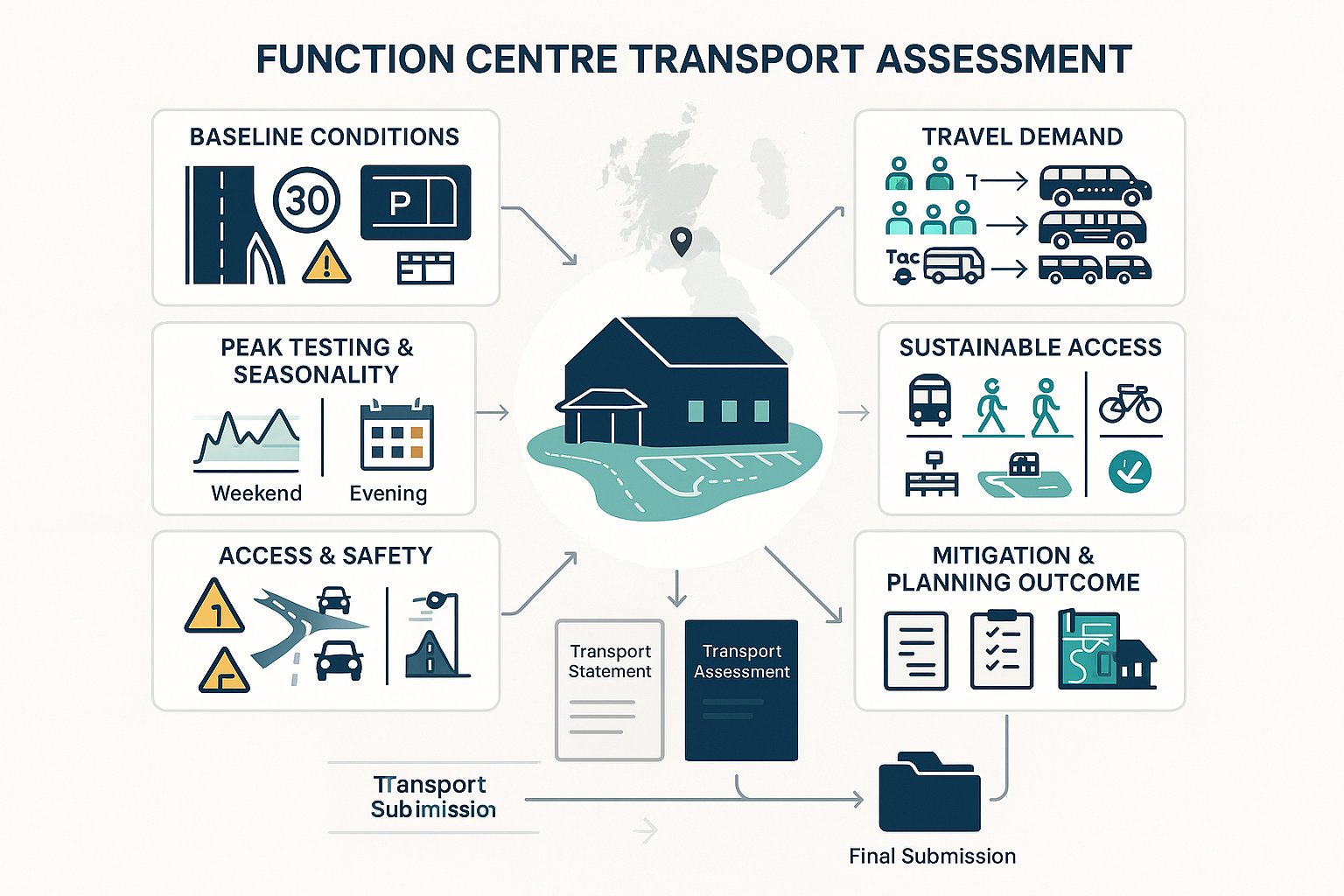
Planning authorities rarely object to a well-run function centre in principle. What tends to cause delay is uncertainty: how guests will arrive, whether parking will overflow onto nearby streets, whether a rural access is safe after dark, and whether coaches, taxis, staff and suppliers can all use the site without conflict. That’s where a function centre transport assessment becomes critical.
In 2026, expectations are a little sharper than they were a few years ago. Highway officers want evidence, not broad assumptions. They expect clear trip generation logic, realistic peak event testing, proper parking accumulation, and a genuine look at walking, cycling and public transport rather than a token paragraph. For architects, planners, lawyers, developers and local authorities, the transport piece often becomes one of the decisive parts of a planning submission.
We see this regularly in practice at ML Traffic, where concise, authority-focused reporting matters just as much as technical accuracy. A strong assessment does two jobs at once: it identifies whether there is a transport problem, and it shows how that problem can be resolved before the application stalls.
This guide explains what a function centre transport assessment usually covers, when a Transport Assessment or Transport Statement is likely to be needed, and the specific issues planning authorities are now looking for when reviewing proposals for new or expanded function centres.
What A Function Centre Transport Assessment Covers
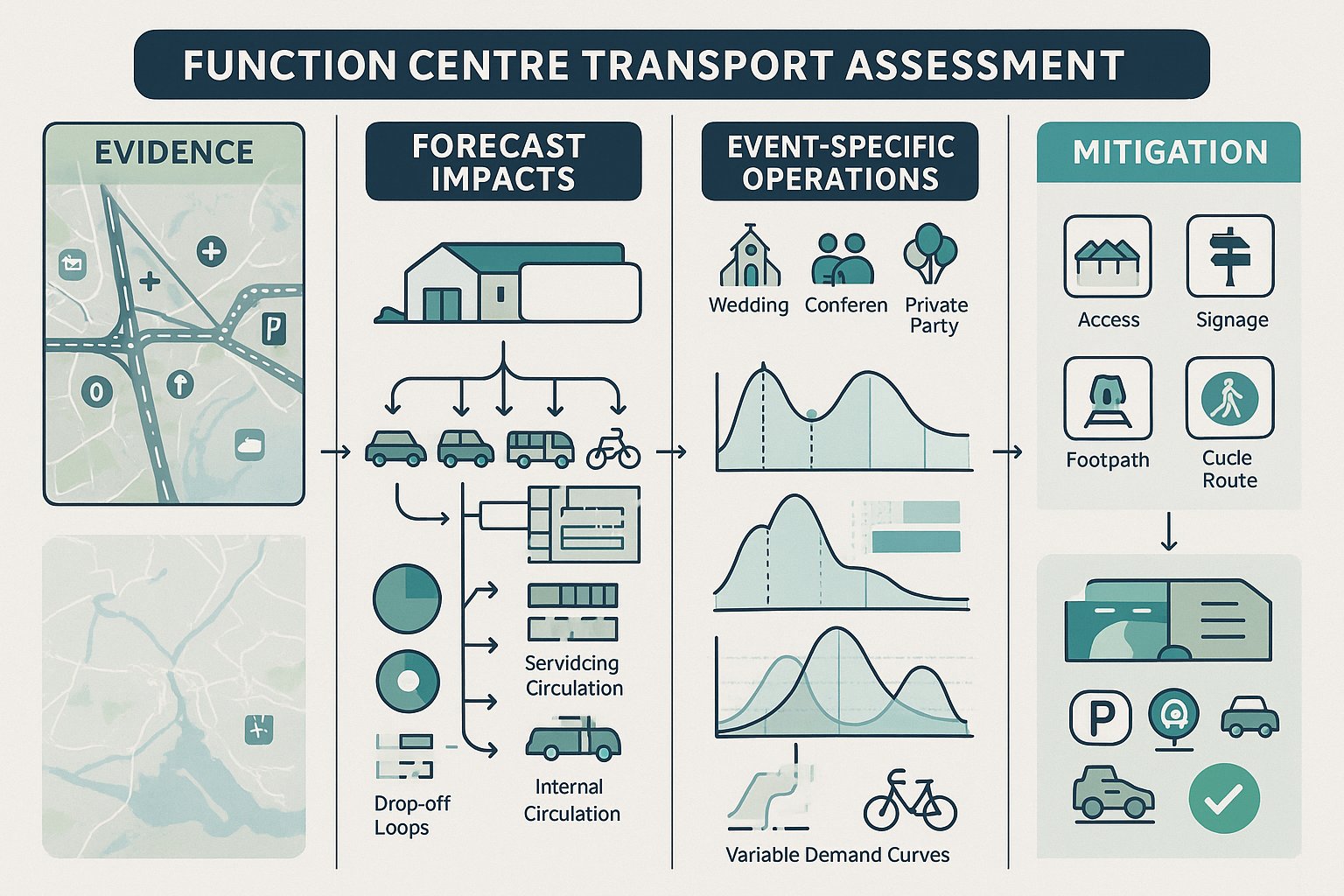
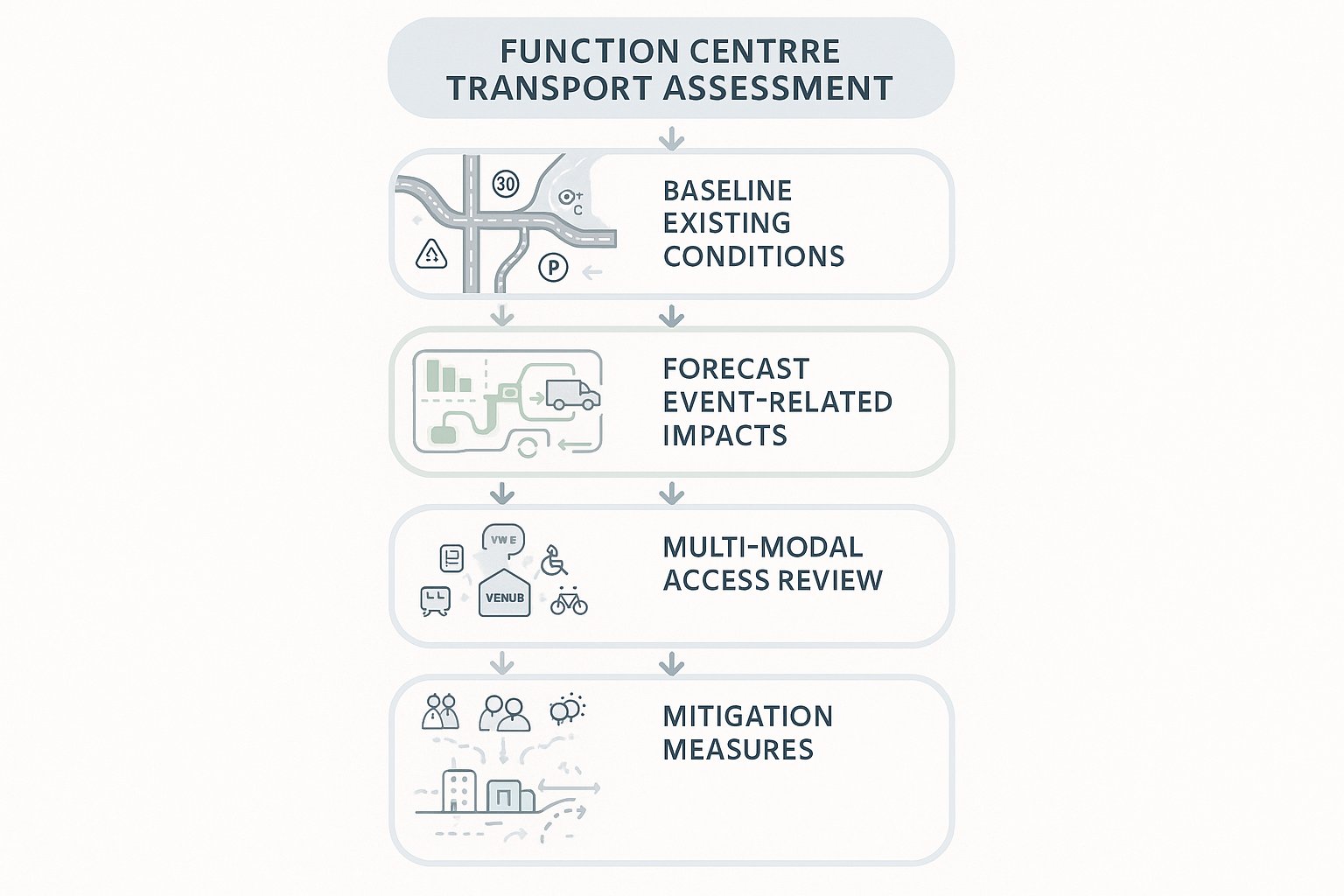
A function centre transport assessment is a formal study prepared to quantify and test the transport effects of a proposed venue, whether that is a new build, a change of use, or an expansion of an existing operation. In simple terms, it tells the planning authority how the site will work in the real world.
A robust assessment normally starts with existing conditions. That includes the surrounding highway network, current traffic flows, access arrangements, nearby junction performance, speed environment, collision history, parking controls, and the availability of sustainable transport. Without that baseline, later conclusions are weak.
It then moves to forecast impacts. We would typically assess trip generation, modal split, traffic distribution, junction capacity, parking demand, drop-off activity, servicing, and internal circulation. For a function centre, this has to reflect the way events actually operate rather than relying on generic daytime assumptions.
The scope usually extends beyond cars. Planning authorities increasingly expect comment on buses, rail access where relevant, pedestrian routes, cycling links, taxi activity, coach movements and accessibility for disabled users. If the venue hosts weddings, conferences, private parties or seasonal events, those operational differences should be reflected too.
Finally, the assessment should set out any mitigation measures needed to make the development acceptable. That might include access improvements, signage, travel planning, parking management, or servicing controls. The point is not just to describe impacts, but to demonstrate that they are understood and manageable.
When A Transport Assessment Or Transport Statement Is Needed
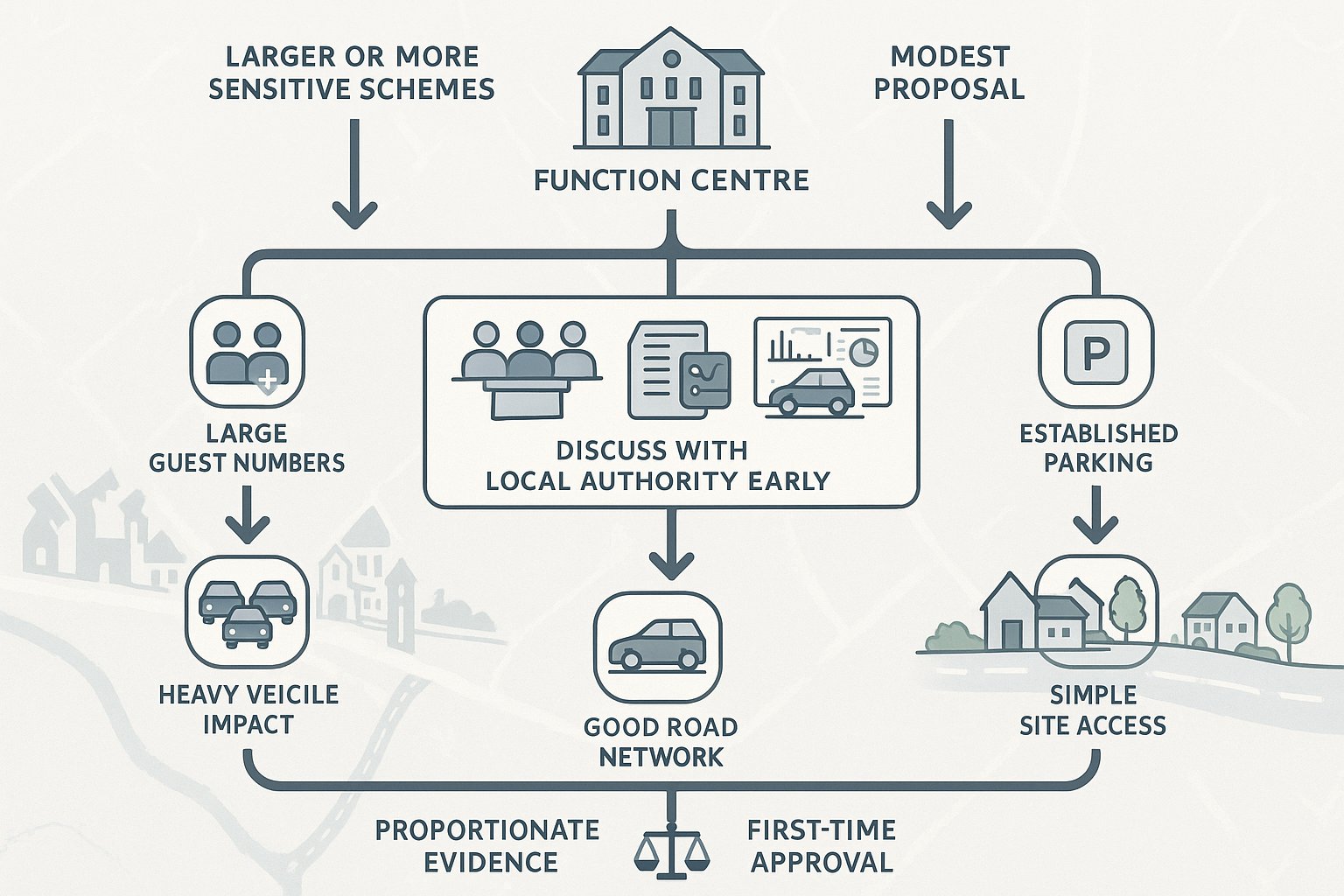
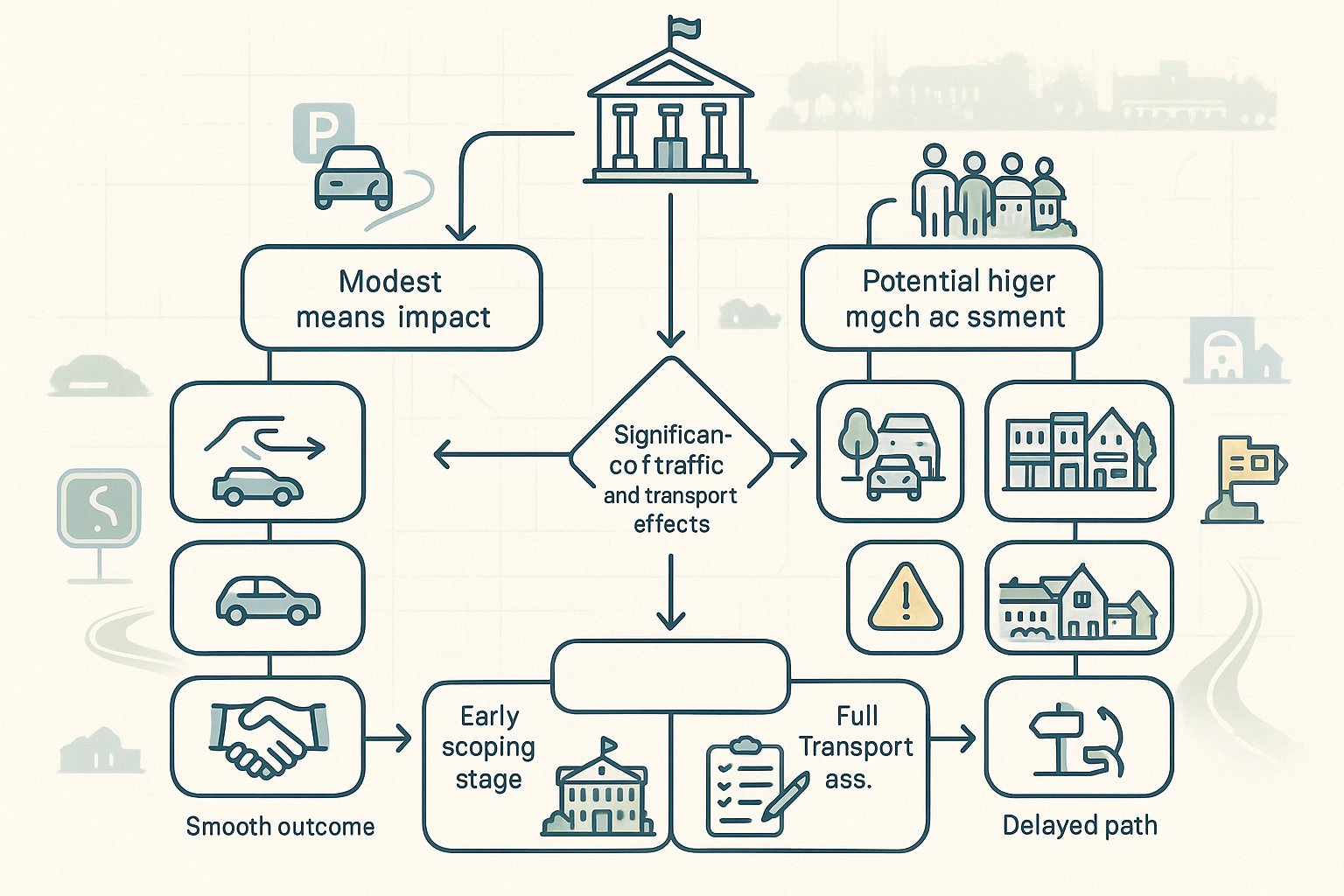
Not every proposal needs a full Transport Assessment. In many cases, a smaller scheme with limited impact can be supported by a Transport Statement, which is shorter and more proportionate. The distinction usually turns on whether the development is expected to create significant traffic and transport effects.
A full TA is more likely where a function centre has substantial guest capacity, sits on a constrained road network, relies heavily on private car travel, or may affect a sensitive junction, village centre, or residential street pattern. Extensions to existing venues can also trigger the need for a TA if intensification materially changes how the site operates.
A TS may be enough where the proposal is modest, parking and access are already established, and the local highway authority is unlikely to need detailed modelling. But there is no universal threshold that applies everywhere in exactly the same way. Local planning and highway authorities set expectations case by case, often informed by the scale of the venue, local policy, and network sensitivity.
That is why early scoping matters. We generally recommend agreeing the extent of the work with the authority before surveys begin, especially for event venues. A short pre-application discussion can avoid the classic problem: an applicant submits a light-touch statement, the authority asks for a full TA, and weeks are lost while new surveys and modelling are commissioned.
In practice, proportionate evidence wins. The right question is not “how little can we submit?” but “what level of transport evidence will satisfy the authority first time?”
How Function Centres Generate Travel Demand
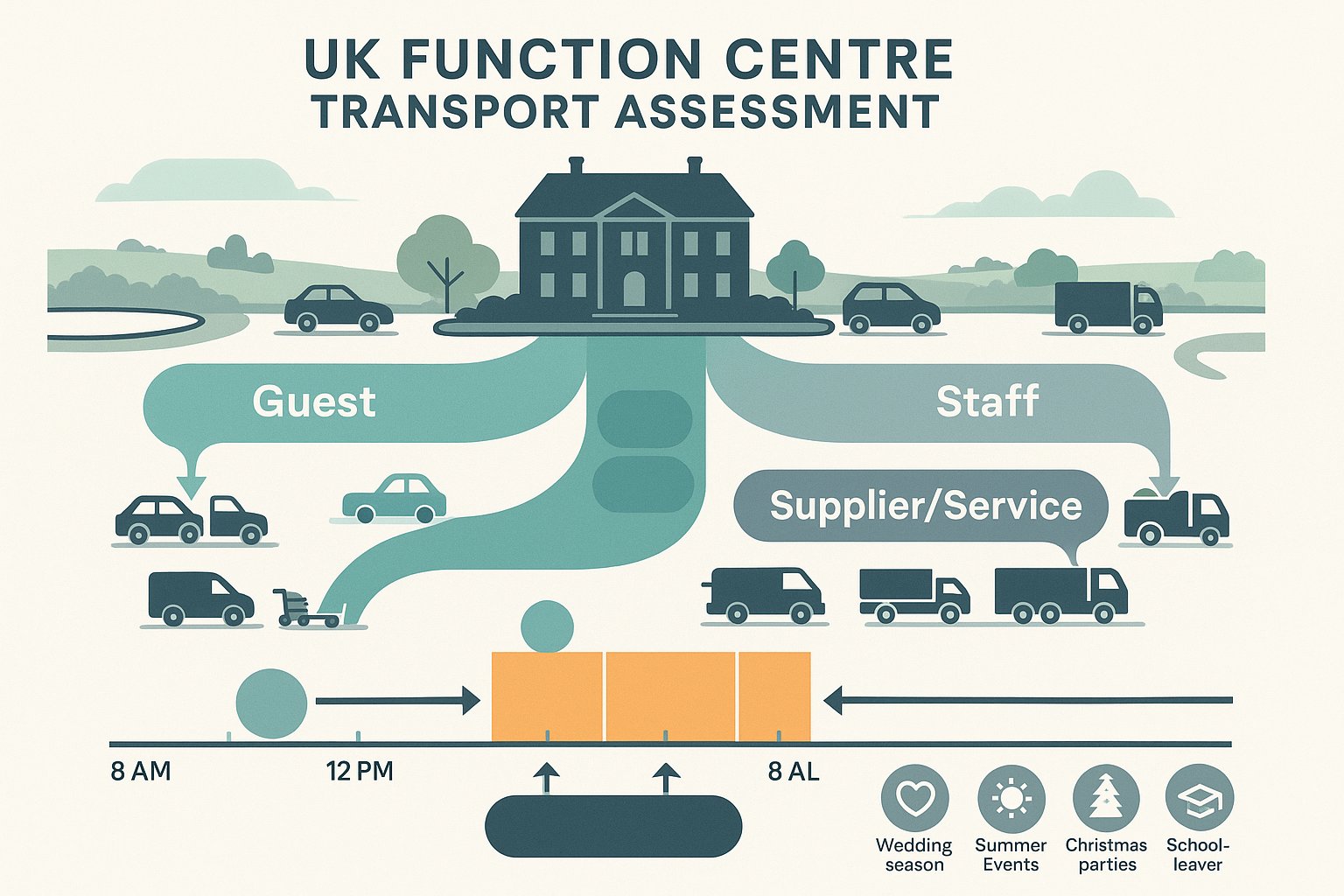
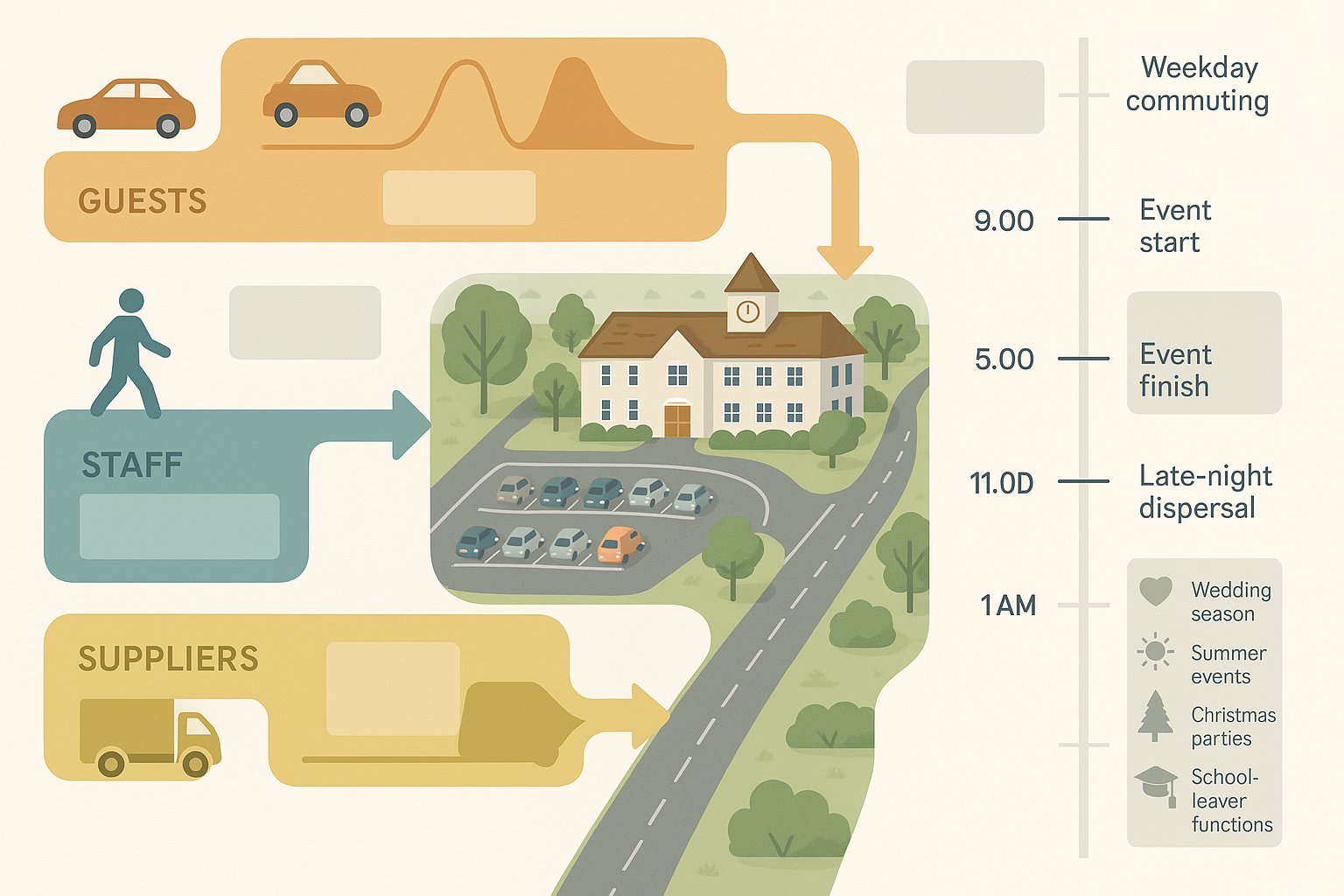
Function centres do not behave like standard offices, retail units or industrial sites. Their travel demand is shaped by event schedules, booking patterns, seasonality and operational logistics. That makes them a slightly awkward land use from a transport planning perspective, but not an impossible one.
The primary demand driver is obvious: guests. A wedding venue may be quiet for most of the day and then receive a surge of arrivals over a 60 to 90 minute period. A conference facility may see stronger morning arrivals and late afternoon departures. A multi-room venue may host overlapping events, which is where parking and circulation issues can become more pronounced.
The second demand stream is staff. Front-of-house teams, catering staff, management, cleaners and security often work shifts that start before guests arrive and finish after the venue closes. Those trips can either smooth demand across the day or, if poorly managed, add to peak site activity.
Then there are suppliers and servicing movements: food deliveries, florists, entertainment equipment, waste collection, laundry, maintenance contractors and occasional larger vehicles. Individually these may not dominate the traffic picture, but they can create manoeuvring, access and conflict issues on constrained sites.
A credible function centre transport assessment needs to separate these trip types and test how they interact. If all users are simply lumped together into one headline number, the assessment usually misses the operational reality that planning authorities care about most.
Peak Event Timing And Seasonal Variations
For function centres, timing is everything. Planning authorities will usually want to understand not only the classic weekday AM and PM highway peaks, but also the event peaks that the venue itself creates.
That matters because a site can appear harmless in standard commuter periods yet still generate local stress when 150 guests arrive within an hour on a Saturday afternoon or when multiple evening events finish at roughly the same time. In rural or edge-of-settlement locations, darkness, narrow lanes and limited passing opportunities can make those peaks more sensitive.
Seasonality matters too. Wedding season, Christmas parties, summer corporate events and school-leaver functions can all alter demand. If a venue’s busiest months are materially different from its annual average, a planning authority may expect those conditions to be tested. The same applies where a proposed extension is specifically intended to capture more peak-season trade.
We generally advise taking a realistic view rather than relying on annualised averages that dilute the worst case. Authorities tend to respond better when the assessment openly identifies the busiest likely operating scenarios and explains why they remain acceptable.
Guest Arrival Patterns, Staff Movements, And Supplier Trips
Guest arrivals are often highly concentrated. People don’t drift into a wedding venue evenly across four hours: they typically arrive in a fairly compressed window before the ceremony or reception starts. Departures can be even more peaked, particularly where taxis are booked for similar times or where an event has a defined finish.
Staff patterns are different. Setup crews, caterers and management may arrive well in advance, while bar staff, cleaners or security may leave later than guests. That can be useful operationally, because it reduces direct overlap, but only if the site has enough space for staggered parking and circulation.
Supplier trips usually occur earlier in the day and can often be scheduled away from guest peaks. Planning authorities like to see that thought through. A simple operational commitment, such as avoiding routine deliveries during arrival and dispersal periods, can make a noticeable difference to perceived impact.
The key point is this: transport effects are not driven only by how many trips are made, but by when, how, and in what combination those trips occur. Good assessments reflect that nuance.
Trip Generation, Modal Split, And Traffic Distribution
Trip generation is where many assessments either gain credibility or lose it. Planning authorities expect the trip rate assumptions for a function centre to be grounded in evidence, usually through TRICS comparisons, local survey data, observed operation at similar venues, or a reasoned combination of those sources.
For event venues, selecting comparable sites is especially important. Capacity, location, parking supply, rural or urban context, and event type all influence travel behaviour. A town-centre banqueting venue near a rail station is rarely a good comparator for a countryside function barn accessed from minor roads. If the comparator set is poor, every number that follows becomes vulnerable.
Modal split should also be site-specific. In many locations, private car travel will dominate, and pretending otherwise tends to weaken the report. But authorities still want an honest assessment of bus use, rail access, walking, cycling, shared travel, taxi use and coach potential where relevant. Census journey-to-work data, local accessibility mapping and site surveys can all help build a realistic mode share picture.
Traffic distribution then assigns those trips onto the surrounding road network. That is usually informed by local journey patterns, census origins, route logic, and existing turning movements. Once assigned, the forecast flows can be tested through junction modelling where needed.
Done properly, this section answers a practical planning question: where will the vehicles come from, where will they go, and can the surrounding network cope? That is the heart of transport acceptability.
Car Parking, Drop-Off Areas, And On-Site Circulation
Parking is often the make-or-break issue for function centre proposals. Even where the strategic highway impact is modest, local concern tends to focus on overspill parking, awkward reversing, blocked accesses and late-night disturbance on surrounding roads.
A good assessment should test parking demand against supply using realistic accumulation analysis. That means considering event overlap, staff parking, disabled bays, VIP or wedding party demand, and whether taxis or private hire vehicles reduce or increase space pressure at key times. It should not rely on a simple ratio and stop there.
Drop-off and pick-up areas deserve specific attention. If guests are expected to arrive dressed for a formal event, often in poor weather, a usable drop-off space near the entrance becomes more than a nice extra. Without it, vehicles may stop on the access road or highway verge, creating conflict and delay.
Internal circulation matters just as much. Can cars pass each other? Is there room to turn without long reversing movements? Do pedestrian routes cross manoeuvring areas safely? Can a full car park still function late in the evening when visibility is lower and driver behaviour is less orderly than on a plan drawing?
Planning authorities usually respond well to clear diagrams and parking accumulation tables. They want confidence that the site can operate on its own land, without exporting operational problems to neighbours or the public highway.
Access Design, Visibility, And Highway Safety Considerations
No matter how attractive the venue, planning consent becomes difficult if the access is unsafe. For function centres, this is especially important because arrivals often include unfamiliar drivers, evening travel, occasional alcohol-related taxi activity, and in some cases rural roads with limited lighting.
Access assessment usually covers junction geometry, entry width, radii, gradient, gate setback, and the ability of vehicles to enter and leave without conflict. Visibility splays are a core consideration. They need to reflect measured vehicle speeds, not optimistic assumptions, and they must be achievable within land under the applicant’s control or via deliverable highway works.
Highway safety is broader than visibility alone. We would normally review personal injury collision data for the surrounding network, consider whether there are existing patterns of turning conflict or shunt risk, and assess interaction with walking and cycling routes. If the access crosses a footway or shared route, that interface matters.
Swept path analysis can also be crucial, particularly where coaches, refuse vehicles or delivery vehicles need to use the access. Authorities will want reassurance that larger vehicles can manoeuvre without overrunning verges, blocking opposing traffic, or creating unsafe reversing movements.
Where shortcomings exist, the assessment should confront them directly and propose mitigation. That may include widening, localised carriageway works, improved signing, speed management, passing provision, or operational controls. A candid, solution-led approach is usually more persuasive than trying to downplay an obvious constraint.
Public Transport, Walking, And Cycling Accessibility
Even when a function centre is expected to be car-led, planning authorities still want to see a proper assessment of sustainable travel options. In 2026, a token sentence saying “the site is accessible by non-car modes” will not do much heavy lifting.
The assessment should map nearby bus stops, rail stations where relevant, service frequencies, operating hours, walking routes, crossing points, gradients, lighting and footway quality. For cycling, the local network, route directness, traffic conditions, and on-site cycle parking all matter. If staff are likely to travel differently from guests, that distinction should be made.
The point is not to force unrealistic mode share claims. A rural wedding venue with infrequent evening buses is unlikely to achieve a high public transport share, and authorities know that. But they still expect the report to identify opportunities to reduce car dependence at the margin. Sometimes that means staff travel planning, better cycle storage, links to local taxi operators, shuttle arrangements from rail stations, or wayfinding information in booking materials.
For urban venues, the bar is higher. Authorities may expect stronger sustainable travel measures, especially where local policy prioritises mode shift. A framework travel plan can help, setting out actions, monitoring and management responsibilities.
In short, this section should show that sustainable access has been genuinely examined, not treated as an afterthought because the car park looked easier.
Servicing, Coaches, Taxis, And Large Vehicle Management
Function centres often operate with a wider mix of vehicles than applicants first assume. It is not just cars. There may be minibuses, coaches, rigid delivery vehicles, refuse lorries, wedding transport, private hire vehicles, and the occasional rather ambitious florist van trying to arrive at the same time as everyone else.
That is why servicing and large vehicle management should be addressed explicitly in the assessment. A planning authority will usually want to know where deliveries occur, whether vehicles can enter and leave in forward gear, how loading activity is separated from guests, and whether there is enough turning space on site.
Coaches can be particularly sensitive. They may be occasional, but when they do attend, their space requirements are substantial. If a venue markets itself for larger parties or corporate functions, coach management should not be brushed aside as hypothetical. Swept path drawings, waiting arrangements and set-down locations are often needed.
Taxis and private hire activity also deserve more attention than they sometimes get. Evening peaks can create clusters of pick-ups, with vehicles arriving early and waiting informally. If there is no designated area, the consequence is usually congestion at the entrance or on the public highway.
Simple management measures can solve a lot: timed deliveries, marked loading space, coach booking protocols, designated taxi bays, and stewarding during major events. Planning officers like to see that the site can be run actively, not merely hoped into compliance.
How Transport Assessments Support Planning Applications For Function Centres
A transport assessment is not just a technical appendix. Done properly, it becomes one of the most useful pieces of evidence in the planning application, because it addresses a question that sits near the centre of decision-making: can the development operate safely and acceptably in transport terms?
For function centres, that evidence can be decisive. Local planning authorities and highway officers want confidence that the proposal will not create severe traffic impact, dangerous access conditions, unacceptable parking stress, or unresolved servicing problems. A clear assessment gives them a structured basis for saying yes.
It also helps the wider consultant team. Architects can use it to refine layout, entrance positioning and parking design. Planning consultants can align it with policy arguments. Lawyers can rely on it when conditions or obligations are being drafted. Developers gain a clearer picture of likely mitigation cost early enough to make informed decisions.
Just as importantly, a good TA can narrow disagreement. If impacts are identified honestly and mitigation is credible, discussions with the authority become more focused. Instead of arguing about whether a problem exists, the conversation shifts to what solution is proportionate.
That is often the difference between a smooth determination and a prolonged cycle of objections, revisions and deferred committee dates. In planning, certainty has real value. A well-prepared function centre transport assessment provides some of that certainty.
Common Planning Issues And How To Address Them Early
Most transport objections to function centres are not especially surprising. They tend to revolve around a familiar set of issues: inadequate parking, poor access visibility, pressure on nearby junctions, overspill parking on residential streets, weak sustainable travel credentials, and servicing arrangements that do not work once the venue is busy.
What does cause trouble is when those issues are discovered too late. A layout is fixed, the planning statement is drafted, public consultation has started, and only then does the transport evidence reveal that the access is substandard or the car park cannot cope with overlapping events. At that point, options narrow quickly.
Early review is the best defence. Pre-application engagement with the local highway authority can clarify whether a TA or TS is needed, what survey periods should be used, whether junction modelling is likely, and which local sensitivities need particular attention. That early steer can save a surprising amount of time.
It also helps to be realistic about assumptions. Understated trip rates and heroic modal split claims may look attractive on paper, but they are exactly the kind of thing an experienced case officer will challenge. A robust assessment usually performs better than an optimistic one, because it is easier to trust.
Where concerns are foreseeable, address them before submission: refine the site layout, improve access geometry, increase parking provision, formalise drop-off areas, schedule servicing off-peak, and include a practical travel plan. Prevention is cheaper than redesign under pressure.
The Evidence Typically Included In A Robust Assessment
Planning authorities generally expect a function centre transport assessment to be evidence-led from start to finish. The exact scope varies by site, but a robust submission will usually include a core set of technical materials.
First, there is the baseline survey package: traffic counts, turning counts at key junctions, queue observations where relevant, parking beat surveys, speed surveys if visibility is an issue, and site observations of pedestrian, cycle and servicing activity. For an existing venue, operational surveys during representative events can be very persuasive.
Second comes the analytical evidence: trip generation using TRICS or equivalent comparative data, modal split assessment, traffic distribution, and junction capacity modelling where impact may be material. Parking accumulation analysis is often essential for function centres because event overlap and departure peaks can be more revealing than average demand.
Third is the safety and accessibility evidence. That typically includes collision records, access review drawings, visibility assessment, swept path analysis, and mapping of public transport, walking and cycling opportunities.
Finally, the assessment should set out mitigation and management measures clearly. These may include highway works, revised layouts, signage, parking controls, servicing protocols, and often a Framework Travel Plan with monitoring commitments.
The strongest reports do not just contain data. They explain why the data matters, how the conclusions have been reached, and why the authority can rely on them.
A robust function centre transport assessment should leave very few loose ends. If the evidence is proportionate, transparent and tied closely to how the venue will actually operate, the planning process is usually much smoother. And that, frankly, is what most project teams want: fewer surprises, clearer technical answers, and a planning submission that stands up to scrutiny in 2026.
Function Centre Transport Assessment FAQs
What is a function centre transport assessment and why is it important?
A function centre transport assessment is a formal study that evaluates the traffic and transport impacts of a proposed or expanded function centre. It helps planning authorities ensure the venue operates safely and manages traffic, parking, and access without negative effects on the local area.
When is a full Transport Assessment required instead of a Transport Statement for a function centre?
A full Transport Assessment is needed when the function centre is expected to generate significant traffic, has a large guest capacity, sits on a constrained network, or may impact sensitive junctions or local streets. Smaller schemes with limited impact may only require a shorter Transport Statement.
How does a function centre generate travel demand throughout an event day?
Travel demand comes from guests who often arrive and depart in concentrated peaks around event start and finish times, staff working shifts that may smooth demand, and suppliers or service vehicles that typically schedule trips outside peak guest times.
What transport factors are typically covered in a function centre transport assessment?
Assessments cover existing road conditions, trip generation and distribution, parking and internal circulation, access design and safety, public transport and sustainable travel options, and servicing and large vehicle management, along with any mitigation measures needed.
How can transport assessments help improve planning applications for function centres?
They provide clear, evidence-based analysis showing the venue can operate safely with manageable traffic impacts. This supports planning authorities’ decisions, helps align design and policy, and promotes early resolution of issues to avoid delays in approval.
What measures can be proposed to manage parking and vehicle circulation at function centres?
Mitigation may include realistic parking demand analysis, designated drop-off and taxi areas, improved signage, internal circulation layouts allowing vehicles to pass safely, and managing event timing or servicing schedules to reduce congestion and overspill parking.