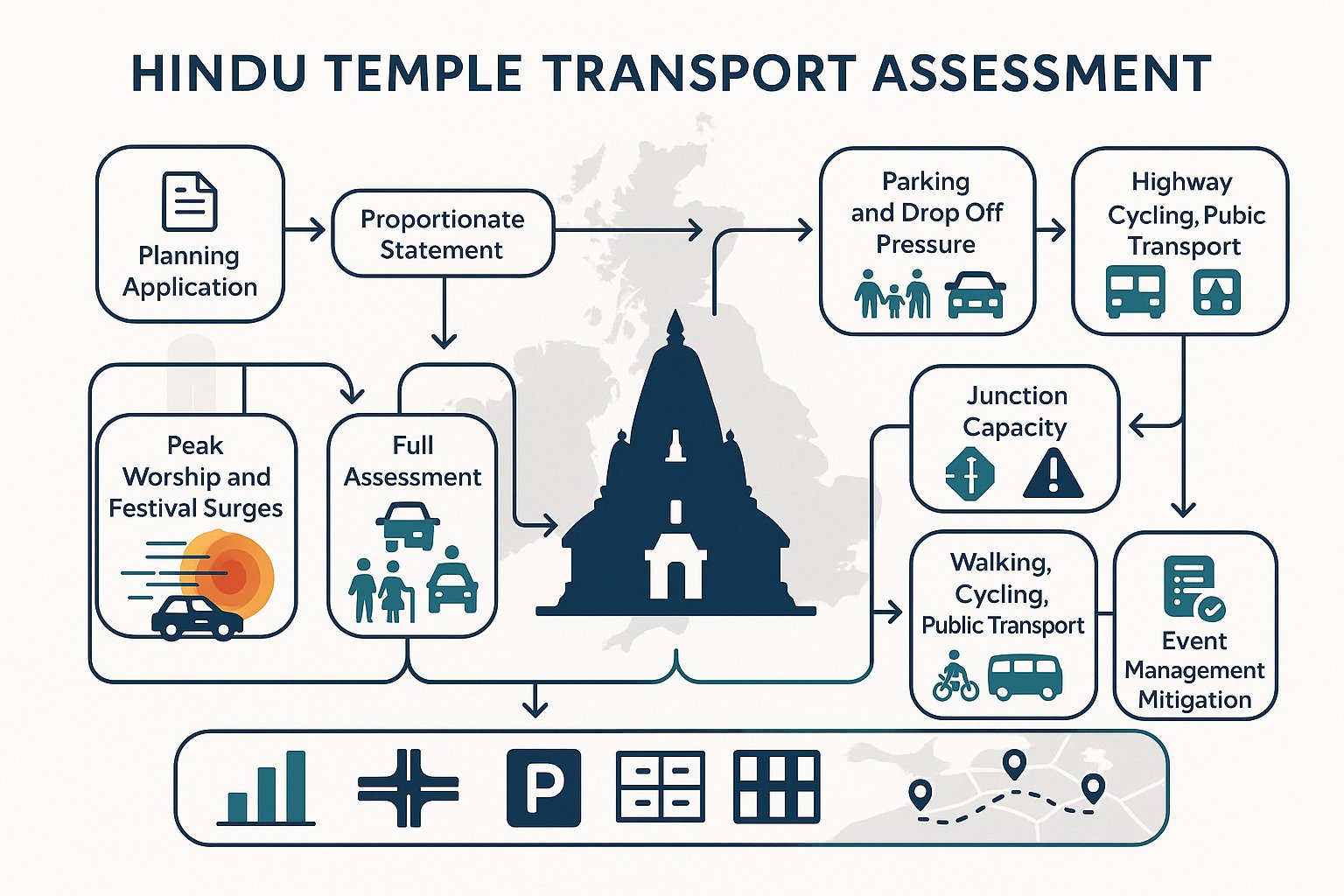
Planning applications for places of worship rarely succeed on good intentions alone. When a proposed mandir is likely to attract regular congregations, festival peaks, community classes, weddings, volunteer activity, and visitors from a wide catchment, transport becomes one of the first issues that planning officers, highway authorities, and neighbours examine. That is exactly where a well-prepared hindu temple transport assessment earns its place.
In practice, this document does much more than count cars. It explains how people will arrive, when demand will peak, where vehicles will park, whether local junctions can cope, and what management measures are needed to keep the site operating safely. For Hindu temple developments, those questions are rarely straightforward. Travel demand can be highly peaky, family-based, event-led, and very different from a typical community hall or assembly use.
In this guide, we set out how we approach a temple transport assessment in the UK planning system for 2026 applications. We focus on the evidence local authorities usually expect, the transport characteristics that make temple schemes distinctive, and the practical steps that help strengthen a planning submission. Drawing on the sort of concise, authority-aware reporting used across transport engineering practice, including our work at ML Traffic, we aim to give architects, planners, lawyers, surveyors, developers, and councils a clear framework they can actually use.
Why A Hindu Temple Transport Assessment Matters In The Planning Process
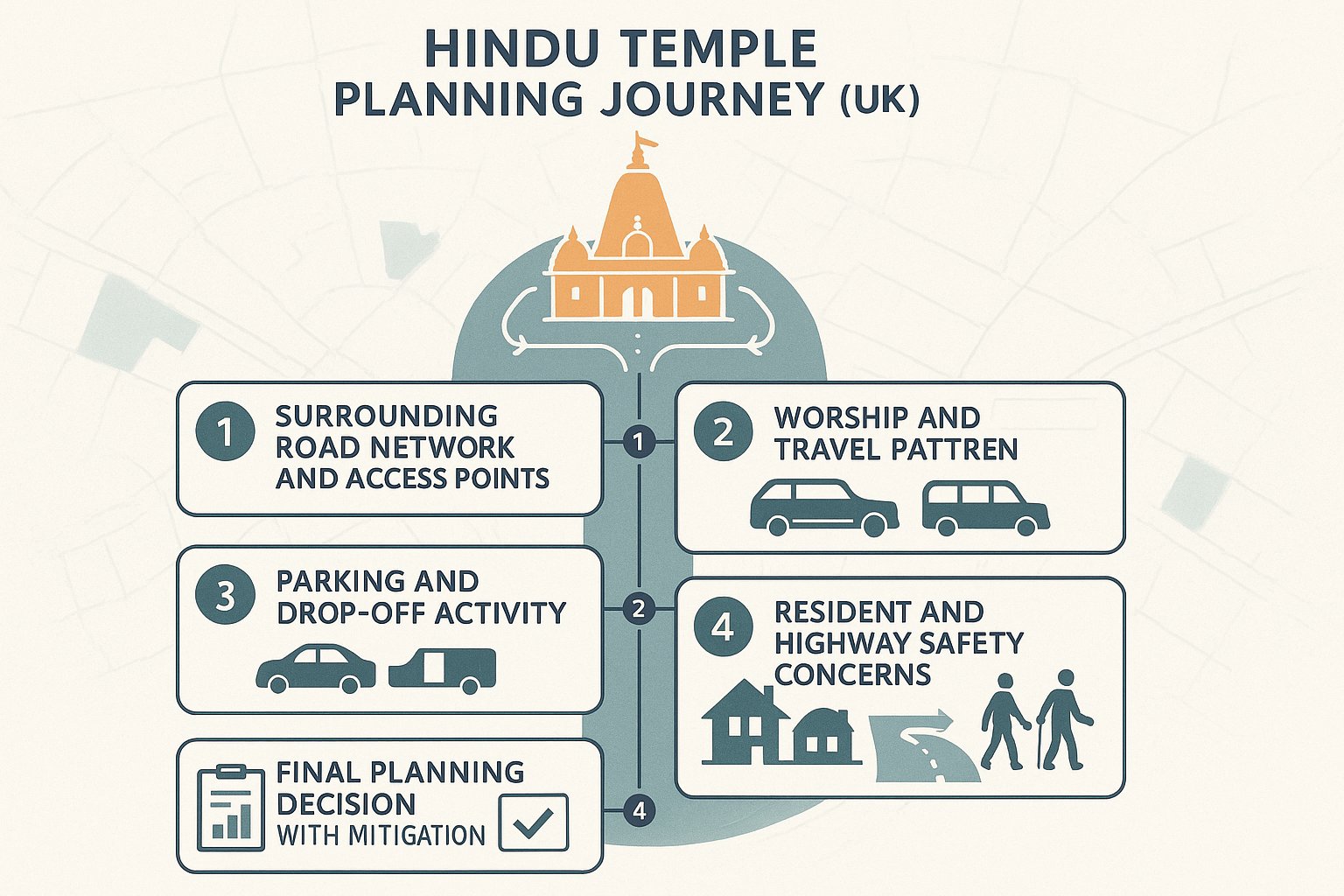
A Hindu temple transport assessment matters because it translates a sensitive planning issue into evidence. Without it, concerns about traffic, overspill parking, drop-off activity, coach movements, and highway safety tend to remain speculative. With it, those same issues can be tested, quantified, and managed.
For planning officers, the assessment helps answer a basic question: can the development operate safely and acceptably on the surrounding transport network? That means understanding not just daily worship activity, but also major festivals, overlapping community uses, volunteer arrivals, and family-based travel patterns. A standard assumption borrowed from another land use often misses the real picture.
For applicants, the document is equally valuable. It supports site layout decisions, informs access design, shapes parking provision, and often identifies mitigation early enough to avoid expensive redesign later. We’ve seen many schemes improve materially once transport evidence is brought into the design process rather than left until the end.
It also helps with objections. Residents commonly worry about congestion, noise from late departures, indiscriminate parking, and conflict with children or elderly visitors crossing the road. A robust submission does not dismiss those concerns: it responds to them with survey data, realistic event assumptions, and workable management commitments.
In short, the assessment is not a formality. It is often one of the central documents that determines whether permission can be granted, and on what conditions.
When A Temple Development Is Likely To Need A Transport Assessment Or Transport Statement
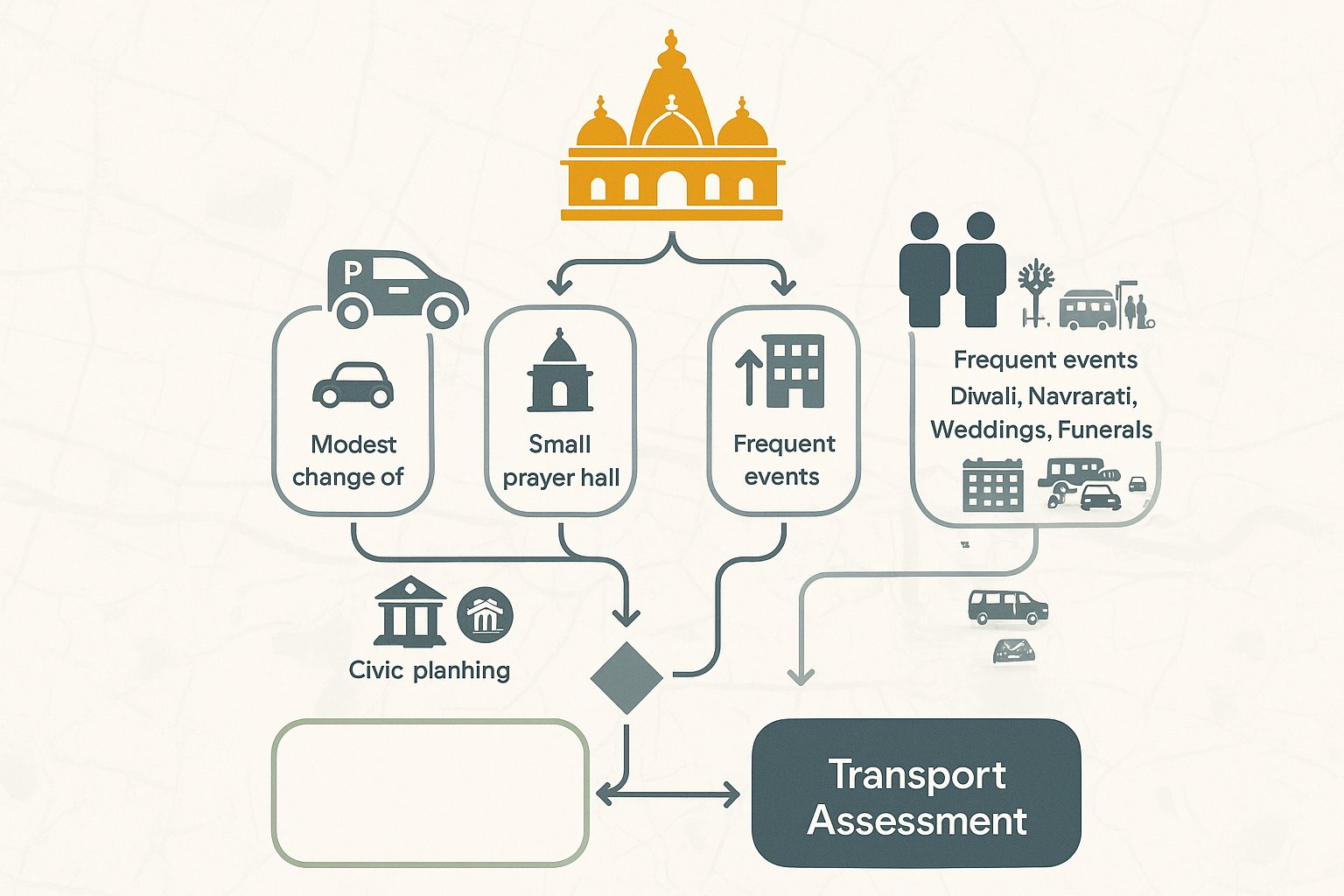
Not every temple proposal needs a full Transport Assessment, but many will need at least a Transport Statement. The dividing line is usually whether the development is likely to create significant transport implications in its local context.
A smaller change of use, modest prayer hall, or low-intensity extension may be capable of being assessed proportionately through a Transport Statement. In those cases, the focus is often on access, parking, local road conditions, and a reasoned review of likely trip levels. But once a scheme involves larger congregations, frequent events, material intensification of an existing site, or a location with constrained highways, a fuller assessment is often justified.
Temple developments deserve particular care because average daily activity can understate the real transport effect. A site that appears manageable on a typical weekday may still generate sharp pressure during Friday evenings, weekends, Navratri, Diwali, Janmashtami, weddings, funerals, or large cultural gatherings. Local authorities know this. So do local residents.
Thresholds vary. Some councils set local plan triggers based on floorspace, parking demand, or expected trip generation, while highway authorities may ask for additional evidence where the road network is already sensitive. That is why early scoping matters. We generally recommend confirming expectations with the planning and highway authority at pre-application stage, especially where peak events are central to the proposal.
A proportionate approach is fine. An under-scoped one usually isn’t.
Key Factors That Make Hindu Temple Travel Demand Different From Standard Community Uses
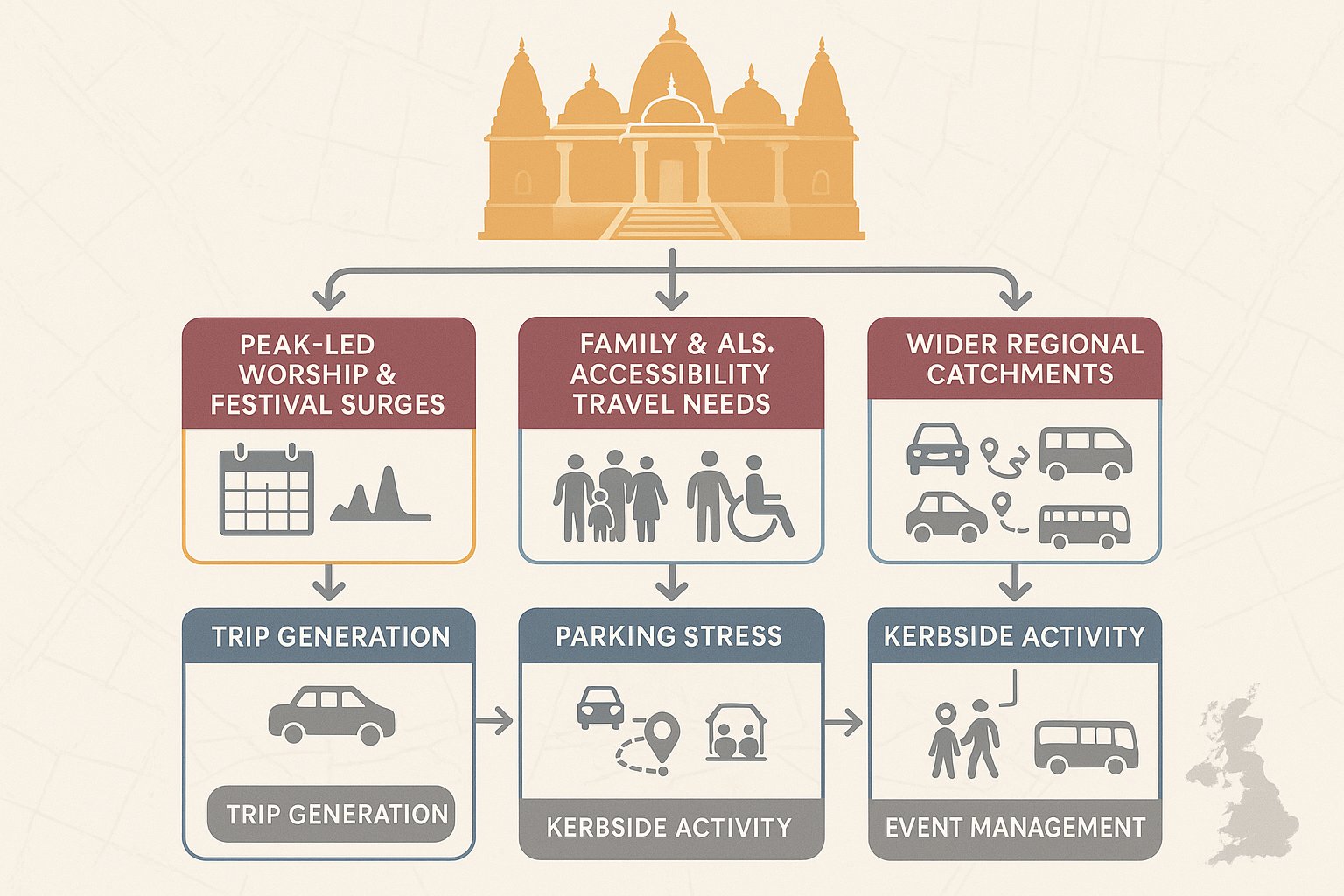
Treating a mandir like a generic community hall is one of the quickest ways to weaken a planning case. Hindu temple travel demand has distinctive characteristics, and a credible assessment needs to recognise them clearly from the outset.
First, demand is often event- and peak-led rather than evenly spread. Second, activities are usually multi-layered: worship may sit alongside classes, charitable work, celebrations, food preparation, and cultural programmes. Third, catchments can be wider than those associated with neighbourhood community uses, which changes both mode choice and arrival patterns.
There is also a strong family dimension. Higher car occupancies, elderly passengers, children, and shared rides are common. Volunteers may arrive early for set-up and stay late for cleaning or lock-up. On major festival days, some visitors may come by coach or organised group transport from outside the immediate area.
Those differences are not just interesting background. They affect trip generation, parking stress, drop-off design, accessible provision, event management, and the credibility of mitigation. If the assessment does not capture them, the authority may reasonably conclude that the impacts have been understated.
Regular Worship, Festival Peaks, And Multi-Use Activities
A sound assessment distinguishes between normal operation and exceptional peaks. That usually means separating typical weekday worship, weekend worship, educational or community sessions, and major annual festivals or life events such as weddings.
Why does this matter? Because the transport profile can change dramatically. A regular prayer session may create moderate arrivals over a contained period. A festival can produce a compressed surge of arrivals, heavier parking demand, more walking from remote parking locations, and greater reliance on stewards or temporary controls.
Multi-use activity adds another layer. If worship overlaps with language classes, music tuition, community meetings, or catering activity, the combined demand may be more material than any one element in isolation. We hence prefer to identify the worst realistic combinations, rather than simply describing each use separately.
For larger schemes, surveys of comparable temples or existing on-site counts are often the strongest evidence. They give decision-makers something far more reliable than generic trip rates.
Volunteer, Visitor, And Family Travel Patterns
A temple is not used by one homogenous group. Devotees, volunteers, visitors, celebrants, caterers, and occasional service providers can all have different travel behaviours.
Volunteers often arrive before the main congregation and may leave after it, which affects parking duration and internal circulation. Families may travel together, increasing car occupancy but also creating short dwell drop-off movements, buggy access needs, and demands for safer crossing points. Elderly worshippers may depend on being dropped close to the entrance, with step-free routes and accessible bays genuinely essential rather than merely desirable.
Then there is the wider catchment issue. For major events, attendees may come from neighbouring towns with limited direct public transport links. That can increase shared car trips, taxis, minibuses, and coaches. If we ignore those patterns, we risk underestimating kerbside activity or overestimating how much standard parking alone can solve.
A stronger assessment maps these user groups explicitly and shows how each has been considered in the transport strategy.
Core Transport Data Needed To Assess A Hindu Temple Proposal
A persuasive transport submission is built on the right data, not just a neat narrative. For a Hindu temple proposal, the core dataset usually needs to cover the highway network, parking conditions, travel choices, and safety context around the site.
At minimum, we would expect to review existing traffic flows on surrounding roads, turning movements at key junctions, observed queueing, and local speeds where they affect access safety. If the proposal could materially influence nearby junctions, the baseline has to be robust enough to support later capacity testing.
Parking evidence is just as important. On-street parking stress surveys within a sensible walking catchment can show whether surrounding roads have genuine spare capacity or are already under pressure. This is often one of the most contested parts of a temple application, so timing surveys carefully around likely stress periods matters.
Collision data should also be examined, typically using recorded personal injury collision history over the relevant study period. If there is an existing pattern involving turning conflicts, pedestrian vulnerability, or visibility issues, the design response needs to show that the proposal will not worsen it.
We also need a clear picture of public transport accessibility, footway continuity, crossing opportunities, lighting, cycle routes, and access constraints such as narrow frontages or difficult visibility splays. In many cases, the quality of this baseline determines whether mitigation appears proportionate and credible later in the planning process.
How Trip Generation Is Estimated For Daily Use And Major Religious Events
Trip generation for a temple cannot be lifted blindly from a generic database. The better approach is usually to combine several evidence sources and show the logic transparently.
Comparable survey data is often the starting point. If there are similar Hindu temples with known attendance patterns, parking behaviour, and event profiles, those observations can provide a grounded basis for estimating arrivals and departures. Where an existing temple is being extended, relocated, or intensified, on-site counts and attendance records become even more valuable.
The key is to separate people from vehicles. Attendance should first be estimated by activity type: regular worship, community use, classes, weddings, and major festivals. Those attendance figures can then be converted into vehicle trips using realistic car occupancy assumptions, with separate allowance for taxis, minibuses, and coaches where relevant.
Time profiling is crucial. A daily total tells us very little about operational impact if arrivals are concentrated within a 15- or 30-minute window. For that reason, we normally build arrival and departure profiles across the peak periods for both normal days and festival scenarios.
Sensitivity testing is often where weak submissions get exposed. Authorities will want to know not only the expected case, but also what happens if attendance is higher than forecast, if overlapping activities occur, or if weather reduces walking and public transport mode share. Honest, well-reasoned sensitivity cases usually strengthen credibility rather than weaken it.
Assessing Parking Demand, Drop-Off Activity, And Coach Provision
Parking for a temple scheme is rarely just a question of counting bays against floorspace. What matters is whether the site can accommodate the pattern of demand generated by regular worship, overlapping activities, and major events without causing harmful overspill on nearby streets.
We usually assess parking demand across more than one scenario: a typical regular session, a weekend peak, a combined use scenario, and the highest-demand festival or ceremonial event that could reasonably occur. This avoids the common mistake of designing only for an average day and then relying on hope for everything else.
Drop-off is often underestimated. Elderly worshippers, children attending classes, and families arriving together can create intense but short-duration kerbside activity near the entrance. A properly designed drop-off loop or lay-by arrangement can reduce conflict, but only if it is sized, signed, and managed realistically.
Coach provision is another issue that can make or break a submission. If major festivals are likely to attract organised group travel, the assessment should identify whether coaches will park on site, lay over elsewhere, or operate on a managed pick-up and set-down basis. Vague wording here tends to invite planning conditions at best and objections at worst.
And if overspill risk remains, it should be faced directly. Resident parking controls, overflow agreements, stewarding, and attendance management may all have a role. The strongest reports acknowledge operational reality and plan for it.
Highway Safety, Access Design, And Local Junction Impacts
Even where trip numbers are acceptable, a temple proposal can still fail on safety or access design. That is why this part of the assessment needs to be precise.
The first test is whether the site can be entered and exited safely by the vehicles likely to use it. That includes private cars, taxis, minibuses, service vehicles, refuse collection, and emergency access. Visibility splays, gate set-backs, turning space, width constraints, and pedestrian interaction all need to be checked against the character of the road and the level of activity.
Internal circulation matters more than applicants sometimes expect. If vehicles have to reverse awkwardly, if drop-off activity blocks access, or if pedestrians are funnelled across manoeuvring areas, the design will attract legitimate concern. We prefer to show clearly how circulation works at the moments of greatest pressure, not just in a quiet midday snapshot.
Where temple traffic would materially affect nearby junctions, capacity assessment may be required. That could involve priority junction analysis, signal modelling, or practical review of right-turning effects, queue interaction, and blocking back. In some cases, mitigation such as a ghost island right-turn lane, altered access arrangement, or local signal changes may be justified.
Collision history should also be reviewed carefully. If there is an existing record of turning shunts, pedestrian incidents, or speed-related problems nearby, the design response must show why the proposal will not intensify that pattern.
Walking, Cycling, Public Transport, And Inclusive Access Considerations
A temple transport assessment should never read as though everyone will arrive by car, even where car use is expected to dominate. Planning policy generally requires us to consider sustainable travel and inclusive access in a serious, site-specific way.
That starts with walking routes. Are footways continuous? Are crossings available where people actually want to cross? Is lighting adequate for evening worship? Can families, elderly people, and children move safely between the site and nearby parking or bus stops? Small missing links can matter a lot when arrivals occur after dark or in poor weather.
Cycling can also be part of the picture, especially for volunteers, staff, and local worshippers. Secure, convenient cycle parking should be proportionate but properly located, not hidden in a corner that nobody will use.
Public transport analysis needs more than a list of bus stops. We should understand service frequency, evening and weekend availability, rail connections where relevant, and whether major event timing aligns with the network. For larger festivals, shuttle buses or coordinated off-site parking may be more realistic than expecting scheduled services to absorb demand.
Inclusive access is fundamental. Step-free routes, Blue Badge bays, dropped kerbs, manageable walking distances, and safe internal pedestrian paths all need to be integrated into the layout. For temple uses, where elderly worshippers often form a significant part of the user profile, this is not a compliance footnote. It is central to whether the site works in practice.
Travel Plans, Event Management, And Mitigation Measures For Planning Approval
Where impacts cannot be designed out entirely, they often need to be managed. That is where Travel Plans, Event Management Plans, and targeted mitigation become essential parts of a temple planning package.
A Travel Plan should set out practical measures to reduce single-occupancy car trips and encourage more sustainable choices. Depending on the site, that may include car-sharing promotion, volunteer ride coordination, clear public transport information, cycle provision, and communication with worshippers about preferred arrival routes and parking behaviour. To carry weight, the plan should include monitoring and realistic targets rather than vague aspirations.
For many temple schemes, an Event Management Plan is just as important. Major festivals and weddings can create transport conditions very different from normal operation, so the authority will want confidence that these peaks can be handled. Measures may include timed admissions, advance booking, overflow parking arrangements, stewarding, shuttle buses, temporary signage, police liaison where necessary, and staggered start or finish times.
Physical mitigation may also be required. That could mean footway widening, new crossing points, revised access geometry, parking controls, or minor junction works. The key is proportionality: mitigation should respond to identified impacts, not be added as decorative padding.
In our experience, planning submissions are strongest when the operational measures are specific, enforceable, and aligned with how the temple will genuinely function on busy days.
Common Planning Concerns And How To Strengthen A Temple Transport Submission
Most objections to temple schemes are predictable. That is not necessarily a problem. Predictable concerns can be addressed if the submission is honest, detailed, and technically sound.
Traffic congestion is usually first. Authorities and residents will ask whether arrival peaks will overload local junctions or create queues at the site entrance. The answer needs to come from observed data, defensible trip generation, and, where necessary, capacity testing. Hand-waving about staggered arrivals is rarely enough on its own.
Parking overspill is often the most emotive issue. If neighbours believe worshippers will occupy residential streets, the assessment must show existing parking stress, realistic event demand, and the management measures proposed to prevent unacceptable displacement. Drawings, survey plans, and operational commitments matter here.
Highway safety is another recurring concern, especially where children and elderly visitors are expected. Access geometry, pedestrian routes, crossing points, visibility, and internal circulation all need to be shown clearly and in a standards-aware way.
So how do we strengthen a submission? By being transparent. Use robust survey evidence. Test realistic festival scenarios, not just average days. Show standards-compliant layouts. Commit to a meaningful Travel Plan and Event Management Plan. And where appropriate, engage early with neighbours, emergency services, and the highway authority.
A submission becomes far more persuasive when it demonstrates not only that impacts have been assessed, but that they can be managed in the real world, on the busiest day of the year as well as the quietest.
Conclusion
A hindu temple transport assessment is not a generic planning appendix. It is a tailored evidence base for a land use whose impacts are often shaped by festivals, family travel, volunteer activity, and sharp peak periods rather than flat daily averages.
That is why the strongest submissions distinguish regular worship from exceptional events, ground trip generation in real evidence, test parking and junction effects honestly, and deal properly with walking, public transport, accessibility, and event management. When those elements come together, planning discussions become clearer and more constructive.
For architects, planners, lawyers, developers, and councils, the takeaway is simple: treat temple transport as a specialist exercise, not a templated one. A proportionate but rigorous assessment can reduce objections, inform better design, and improve the prospects of planning permission.
And for projects needing concise, locally aware transport input, that practical mindset matters. Good transport reporting does not just defend a proposal on paper: it helps make the finished development safer, more workable, and easier for authorities to support.
Hindu Temple Transport Assessment FAQs
What is a Hindu temple transport assessment and why is it important?
A Hindu temple transport assessment predicts and manages travel, parking, and highway impacts of a proposed temple, ensuring it operates safely without adverse effects on the local transport network. It provides evidence for planning decisions, addresses community concerns, and supports safer site design and management.
When is a transport assessment required for a Hindu temple development?
A transport assessment or statement is needed when a temple development is likely to create significant transport implications, such as large congregations, frequent events, or site intensification. Smaller prayer halls or modest changes may only require a simpler transport statement, subject to local authority thresholds.
How does travel demand for a Hindu temple differ from typical community uses?
Hindu temple travel demand is peak- and event-led, with multi-use activities like worship, classes, festivals, and weddings. Visitors often come from wide areas via cars, shared rides, and coaches, with higher family car occupancy and volunteer movements, differing markedly from standard community centres.
What core data is needed to accurately assess transport impacts for a Hindu temple?
Assessment requires data on local traffic flows, junction turning movements, parking occupancy and stress, collision history, public transport accessibility, and site access features. This evidence ensures credible trip generation estimates and demonstrates safe access and management measures.
How are parking and drop-off needs evaluated in a Hindu temple transport assessment?
Parking demand is assessed for regular worship, overlapping activities, and peak festivals or life events. Drop-off zones are designed for families and elderly visitors, and coach parking or managed lay-over plans are considered. Overspill risks are evaluated with mitigation such as parking controls or stewarding.
What mitigation and management measures support planning approval for Hindu temples?
Measures include Travel Plans promoting sustainable travel, Event Management Plans for peak festivals detailing stewarding, timed admissions, shuttle buses, and parking arrangements. Physical mitigation like pedestrian crossings, footway widening, and junction improvements may also be implemented to reduce impacts.