Did you know that 42% of minor development applications in London face immediate delays at the validation stage because of insufficient highway data? In a borough like Islington, where narrow Victorian road networks meet the UK’s strictest car-free mandates, securing planning permission is no longer a simple administrative task. You’re likely already feeling the pressure of 2026’s updated requirements, including new weight-based parking surcharges and the mandatory Healthy Streets approach that prioritizes pedestrians over vehicle capacity. It’s a high-stakes environment where a single technical error can lead to a costly refusal.
Partnering with a specialist Islington transport planning consultant ensures your project moves from inception to approval with technical precision. We provide the data-driven Transport Statements and Swept Path Analysis needed to justify site viability even on the tightest urban plots. This article outlines how to navigate the latest London Plan mandates, utilize the Lambeth Methodology for parking surveys, and minimize Section 106 and 278 costs through expert negotiation. You’ll learn how to optimize your site layout for vehicle access while satisfying every regulatory benchmark on your first attempt.
Key Takeaways
- Understand how the 2026 Islington Transport Strategy and net-zero targets act as a critical gatekeeper for all new development approvals.
- Identify the specific thresholds that determine whether your project requires a standard Transport Statement or a comprehensive Transport Assessment.
- Learn why technical precision in Swept Path Analysis and Lambeth Methodology parking surveys is essential for navigating Islington’s narrow Victorian road network.
- Discover how early engagement with Transport for London and proactive S278 negotiation can prevent costly delays on major red route developments.
- Gain insights into how a specialist islington transport planning consultant provides a fully-managed service to secure planning approval on the first attempt.
The 2026 Islington Transport Planning Landscape
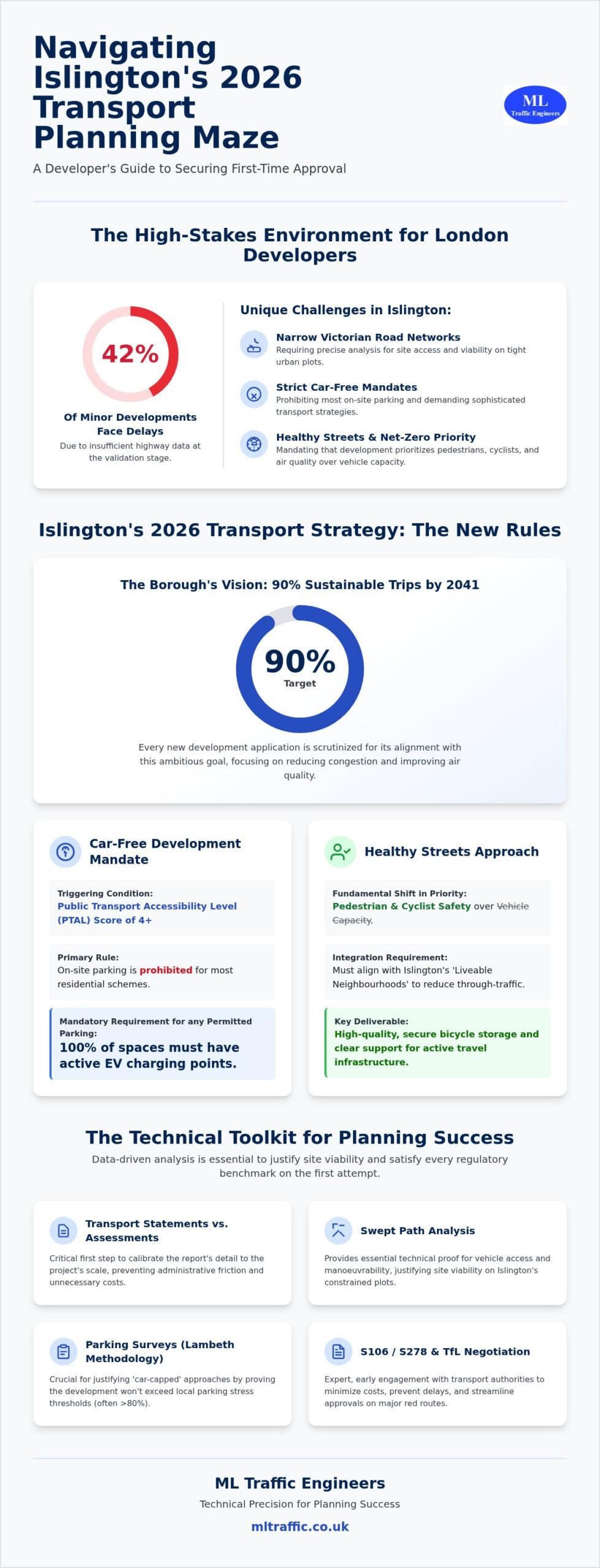
Transport planning isn’t just a secondary box to check in the planning process; it’s the primary gatekeeper for site viability in North London. In a borough defined by its narrow Victorian streets and ambitious net-zero targets, the 2026 regulatory framework is exceptionally tight. Islington’s Transport Strategy aims for 90% of all trips to be made via sustainable modes of travel by 2041. For developers, this means that every application is scrutinized for its impact on local congestion and air quality. Partnering with an expert islington transport planning consultant is essential to navigate these high-stakes requirements and avoid the 42% of minor applications that face delays due to insufficient data.
Effective transportation planning now requires a sophisticated blend of technical data and policy alignment. It’s about proving that a development can thrive without adding pressure to an already saturated road network. Without a robust strategy, even the most architecturally sound projects risk refusal at the validation stage. We manage the full project lifecycle, ensuring your transport reports meet every local and regional benchmark.
To better understand the strategic importance of these frameworks, watch this helpful video:
Islington’s Car-Free Mandate in 2026
The Islington Local Plan enforces a strict car-free mandate for any development in areas with a Public Transport Accessibility Level (PTAL) score of 4 or higher. For most residential schemes, this means on-site parking is prohibited. Exceptions are generally limited to Blue Badge holders and essential service vehicles. Furthermore, the London Plan 2026 mandates that 100% of any permitted parking spaces must include active electric vehicle charging points. If your site is in a lower PTAL area, you may need to justify a ‘car-capped’ approach using a detailed Transport Statement. This document must prove that the development won’t exacerbate local parking stress, which is often a tipping point for planning officers when levels exceed 80%.
The Shift Toward Active Travel and Sustainable Transport
The 2026 landscape prioritizes the ‘Healthy Streets’ approach, placing pedestrian and cyclist safety above vehicle capacity. Your transport strategy must integrate seamlessly with Islington’s Liveable Neighbourhoods, which focus on reducing through-traffic and improving air quality. Compliance requires more than just a passing mention of cycling; it demands high-quality, secure storage and clear evidence of how the site supports active travel infrastructure. We help you optimize your site layout to meet these standards, ensuring your project contributes to the borough’s safety and sustainability goals while remaining commercially viable. Our team provides the technical authority needed to manage these complex negotiations with the local highway authority.
Transport Statements vs. Assessments in Islington
Determining whether your development requires a simple statement or a full assessment is a critical first step in the planning lifecycle. ML Traffic Engineers UK specializes in identifying these thresholds early to prevent administrative friction. An expert islington transport planning consultant ensures that the level of detail in your report is perfectly calibrated to the scale of your project. This strategic approach prevents over-spending on unnecessary data while ensuring every mandatory technical requirement is met. We manage the technical narrative so you can focus on the broader development goals.
Highways officers in Islington demand reports that are both technically precise and aligned with the borough’s strict safety standards. ML Traffic Engineers UK tailors every document to address these specific local concerns. We understand that a well-prepared report acts as a reassuring foundation for planning committees, reducing the logistical and regulatory pressure on your team. Our technical authority allows us to manage the full project lifecycle from inception to final approval.
Transport Statements for Small to Medium Schemes
For residential schemes below 80 units, a Transport Statement is the standard requirement. This document focuses on trip generation and the immediate operational impact on the local highway. We utilize the TRICS database to provide precise forecasts of vehicle movements, justifying the car-free status required in high PTAL areas. By analyzing existing public transport capacity, we prove that your development won’t place undue stress on Islington’s infrastructure. This data is essential for justifying ‘car-capped’ developments in areas where public transport links are less dense.
Major Transport Assessments for Large Scale Developments
Major developments, particularly those exceeding 80 units or 2,500 square meters, demand a comprehensive Transport Assessment. These reports require sophisticated impact modelling to evaluate the cumulative effect of your project alongside other nearby schemes. We integrate these assessments with detailed Travel Plans to outline sustainable transport strategies that mitigate long-term traffic growth. This level of technical authority is essential for projects that trigger a Mayoral referral or impact the Transport for London Road Network. We ensure that every mitigation measure is commercially viable and technically sound.
As your islington transport planning consultant, we manage the entire technical process, from initial data gathering to final negotiation with the council. We ensure every technical benchmark is met so your project stays on schedule. If you’re unsure which report your site requires, consult our technical team to see how we can support your application with precision and reliability.
Technical Precision: Swept Path Analysis and Parking Surveys
Technical precision is the baseline for any successful planning application in North London. Islington’s road network, built largely in the Victorian era, wasn’t designed for modern HGVs or 12.5-metre refuse vehicles. As an islington transport planning consultant, we provide the technical evidence required to prove that your site can safely accommodate these essential services. Proving fire tender and refuse vehicle access is a non-negotiable requirement for securing planning approval in 2026. Without this data, applications are frequently rejected for failing to meet basic safety and operational standards.
We manage the full lifecycle of technical reporting, ensuring every simulation and survey meets the council’s rigorous benchmarks. Our team acts as a guardian of public and worker safety by ensuring that vehicle movements don’t create hazards for pedestrians or other road users. This level of detail reduces the regulatory pressure on developers and provides a clear path to approval.
Manoeuvrability in Tight Urban Spaces
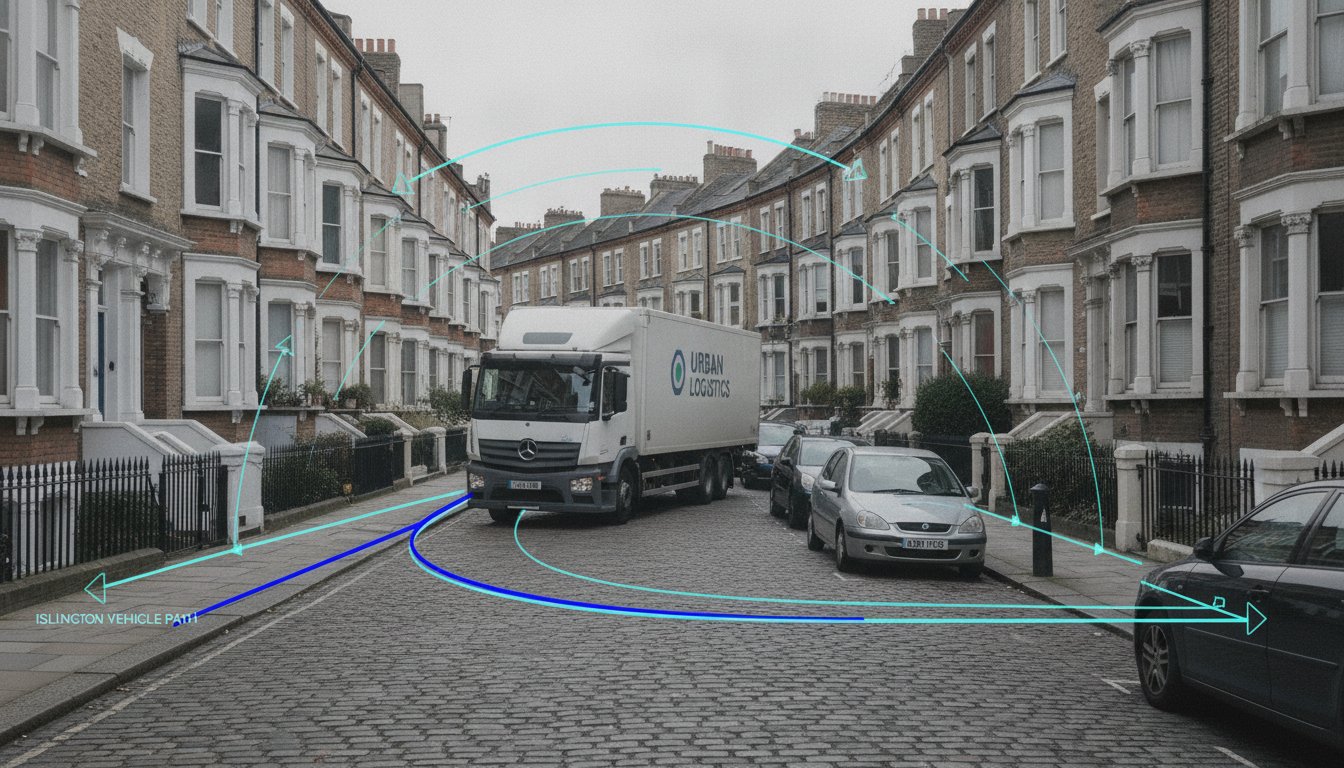
We utilize advanced Swept Path Analysis Services in London to simulate vehicle movements with millimetre accuracy. This is critical for developments located in Islington’s narrow mews or backstreets, where ‘tight corner’ challenges are a daily reality. Our simulations use specific vehicle templates mandated by the council, including the latest fire tender dimensions and specialized urban delivery vans. Proving safe ingress and egress isn’t just about clearance; it’s a fundamental safety requirement. We ensure that delivery and service vehicles can enter and exit your site in a forward gear, which is a key priority for Islington Highways Officers.
Parking Stress Tests and PTAL Ratings
Public Transport Accessibility Level (PTAL) ratings are the primary driver of parking policy. In 2026, a high PTAL score often necessitates a car-free development, but proving this won’t negatively impact surrounding streets requires a rigorous parking survey. We follow the industry-standard Lambeth Methodology, conducting surveys within a 200-metre radius of the development site. These surveys take place between 1:00 AM and 5:30 AM over two consecutive weekday nights to capture peak residential parking demand. This data is vital when navigating Islington’s strict parking permit restrictions for new residents. If local parking stress exceeds the 80% critical tipping point, your islington transport planning consultant must provide a robust justification to prevent planning refusal. We offer the technical authority needed to negotiate these complex data points with confidence.
Navigating S278 Agreements and TfL Engagement
S278 agreements are the legal mechanism for making permanent alterations to the public highway. In a dense borough like Islington, these works often involve complex interactions with existing infrastructure and strict safety standards. An experienced islington transport planning consultant manages these negotiations to ensure that developer-funded improvements are both technically sound and cost-effective. We also work to minimize Section 106 transport contributions by providing data-driven evidence of a project’s actual impact. This proactive approach reduces the financial burden on the developer while meeting the council’s high standards for public safety. It’s about balancing the commercial needs of the site with the borough’s requirement for a safe, accessible highway network.
The S278 Process in the Borough of Islington
Securing approval for highway alterations involves a rigorous timeline and a multi-stage review process. You must submit detailed technical drawings and legal documentation before any physical work begins. Common pitfalls include incomplete swept path data or failure to account for existing underground utilities, which can lead to significant delays. We act as the primary liaison between the developer and Islington Council, managing the technical submission to ensure it meets every benchmark. Islington’s Local Highway Authority often requires an initial upfront fee of £3,000 to £5,000 to cover design review and implementation costs. We ensure your submission is right the first time to avoid wasting these resources. For a deeper look at these requirements, see our Highway Design S278 & S38 Guide.
Coordinating with TfL for Major Infrastructure Sites
Developments adjacent to the Transport for London Road Network (TLRN), or ‘red routes’, require early engagement with TfL. These sites face additional scrutiny regarding their impact on bus routes, cycle lanes, and pedestrian crossings. Securing pre-application advice is the best way to de-risk major planning submissions. We manage this process, ensuring that your site’s access strategy doesn’t conflict with TfL’s strategic goals for the capital’s transport network. This includes addressing the cumulative impact on the ‘Healthy Streets’ framework mentioned earlier. Our team coordinates directly with TfL officers to secure the necessary approvals for major infrastructure projects, ensuring that your development supports rather than hinders the flow of public transport.
Our technical authority allows us to navigate these regulatory environments with speed and precision. We take the logistical pressure off your shoulders by managing full project lifecycles from inception to completion. If you’re planning a project on a red route or require technical support for highway alterations, contact our expert consultants today for a comprehensive assessment.
Why Partner with ML Traffic Engineers UK for Your Islington Project?
Selecting an islington transport planning consultant involves more than just commissioning a technical report. You need a partner that understands the borough’s unique constraints and the rigorous 2026 regulatory environment. ML Traffic Engineers UK offers specialized knowledge of Islington’s local implementation plans and net-zero targets. We provide a Total Managed Solution that covers every stage of the transport planning process. This approach ensures that technical precision remains consistent from the initial survey to the final planning approval. Our team acts as a guardian of public safety, ensuring every vehicle movement and parking strategy meets the highest industry standards. We manage the intricate regional regulations so you don’t have to, allowing you to focus on the commercial delivery of your site.
We understand the fast-moving and often unpredictable nature of infrastructure development. Our round-the-clock readiness allows us to meet urgent planning deadlines without compromising on technical quality. We take immense pride in our adherence to standards, positioning ourselves as a reliable partner that values your time. By providing an all-encompassing service, we reduce the logistical pressure on your project team and ensure a logical progression from initial assessment to execution. This rhythmic efficiency is a hallmark of our brand promise, ensuring unwavering reliability throughout the project lifecycle.
Our Technical Expertise and Precision
Our technical authority is built on the expert preparation of Transport Statements, Assessments, and Travel Plans. We don’t just deliver data; we provide strategic guidance that justifies site viability in even the most challenging urban environments. Our focus remains on safety-conscious and reassuring technical reporting that gives planning officers confidence in your application. Our core service offerings include:
- Advanced Swept Path Analysis using the latest council-mandated vehicle templates for tight urban access.
- Comprehensive Parking Surveys and Traffic Surveys that provide the data-driven foundation for your scheme.
- Detailed Transport Assessments that model cumulative impacts on the local road network.
- Strategic Travel Plans designed to support Islington’s sustainable transport and active travel targets.
For a deeper understanding of how we manage complex submissions, consult our Transport Assessment London Guide. We ensure every report is tailored to meet the specific technical benchmarks required for success in the borough.
Securing Your Development’s Future
ML Traffic Engineers UK has a proven track record of navigating Islington’s tight Victorian road network and strict car-free mandates. Our role is to de-risk your development by identifying potential highway issues early and providing technical solutions before they cause costly delays. We manage the full project lifecycle, including all necessary liaison with Islington Highways and Transport for London. This proactive approach ensures that your project stays on schedule and avoids the common pitfalls that lead to planning refusal. If you’re ready to secure your planning permission with technical precision, Contact ML Traffic Engineers UK for an Islington Project Quote. We’re ready to provide the professional excellence and unwavering reliability your project demands.
Securing Your Site’s Viability in 2026 and Beyond
Navigating Islington’s transport landscape in 2026 requires more than just policy awareness; it demands a strategic alignment with the borough’s vision for a safer, more sustainable urban environment. By integrating the Healthy Streets approach and prioritizing active travel infrastructure from the outset, you can transform regulatory hurdles into site advantages. Utilizing technical precision in every report ensures that your project remains a viable contributor to North London’s infrastructure goals. It’s about proving that your development can thrive within a high-stakes, car-free framework while satisfying every planning officer’s requirement for safety and accessibility.
ML Traffic Engineers UK provides the technical authority and professional excellence required to manage these complex submissions. As your dedicated islington transport planning consultant, we offer a fully-managed service that handles every regulatory detail on your behalf. Our specialized expertise in Swept Path Analysis and rigorous parking surveys ensures your project meets all industry benchmarks while maintaining public safety. We’re ready to provide the unwavering reliability and rapid response capabilities your development demands to move from inception to completion without delay.
Request a Transport Planning Quote for Your Islington Project
We’re here to help you secure planning approval on your first attempt with data-driven precision.
Frequently Asked Questions
Do I need a Transport Statement or a Transport Assessment for an Islington project?
Residential developments with fewer than 80 units typically require a Transport Statement. Larger schemes or commercial spaces exceeding 2,500 square meters necessitate a full Transport Assessment. Your islington transport planning consultant evaluates these thresholds against current 2026 London Plan mandates to ensure your application meets validation requirements. Technical precision at this stage prevents the 42% delay rate common in minor London applications.
What are Islington Council’s current car-free development policies in 2026?
Islington Council mandates car-free developments in areas with a PTAL score of 4 or higher. Any permitted parking must include 100% active electric vehicle charging points according to 2026 standards. These policies aim for 90% sustainable travel by 2041. Developers must prove that their site can operate safely without on-site vehicle storage, typically by providing robust technical data on local public transport links.
How much does a professional transport planning consultant cost in London?
Professional fees for transport planning depend on the technical complexity of the site and the specific reports required. While industry averages for reports exist, costs are influenced by the need for Swept Path Analysis or overnight parking surveys. We provide tailored quotes that reflect the all-encompassing, fully-managed nature of our service, ensuring every regulatory benchmark is met without hidden expenses or unexpected delays.
What is Swept Path Analysis and why does Islington Council require it?
Swept Path Analysis is a software-based simulation used to prove that vehicles can maneuver safely within a site’s constraints. Islington Council requires this because of the borough’s narrow Victorian road network. You must demonstrate that fire tenders and refuse vehicles can enter and exit in a forward gear. Our technical reporting ensures these simulations meet the council’s rigorous safety and operational standards.
How do PTAL ratings affect my planning application in the Borough of Islington?
PTAL ratings measure the density of the public transport network at a specific location. In Islington, a high PTAL rating of 4 or above usually triggers a mandatory car-free requirement for new developments. If your site has a lower rating, you may be permitted a car-capped approach, but this requires substantial evidence from a specialist islington transport planning consultant to justify the impact on the local highway.
Can a Travel Plan help secure planning permission for a car-capped site?
What is the typical timeline for a transport-related planning approval in Islington?
Standard planning applications in Islington usually follow an 8 to 13-week timeline for a decision. However, technical errors in transport reporting are a leading cause of delays at the validation stage. We prioritize readiness and technical precision to ensure your application moves through the process as efficiently as possible. Early engagement with highway officers and TfL is the best way to de-risk your project’s timeline.
Do you provide traffic surveys and parking stress tests in-house?
We manage the entire data collection process in-house, including specialized Traffic Surveys and Parking Surveys. Our team utilizes the Lambeth Methodology for parking stress tests, conducting observations between 1:00 AM and 5:30 AM to capture peak residential demand. This all-encompassing service ensures that the data used in your Transport Statement or Assessment is accurate, current, and fully compliant with Islington’s technical requirements.

Disclaimer
The content on mltraffic.co.uk, including all technical articles, guides, and resources, is provided for general informational and educational purposes only. It is not intended to constitute professional advice in traffic engineering, transportation planning, development approvals, or any other technical or legal field.
While ML Traffic Engineers makes every reasonable effort to ensure the accuracy, completeness, and timeliness of the information published, we do not provide any warranties or representations (express or implied) regarding its reliability, suitability, or availability for any particular purpose. Any reliance you place on the content is strictly at your own risk.
In no event shall ML Traffic Engineers, its directors, employees, authors, or affiliates be liable for any direct, indirect, incidental, special, consequential, or punitive damages (including, without limitation, loss of profits, data, or business opportunities) arising out of or in connection with the use of, or inability to use, any information provided on this website.
The articles and guides on this site are not a substitute for engaging a qualified, professional traffic engineer to assess your specific project requirements. For tailored advice, compliance assessments, or traffic engineering services, please contact a competent professional.
This disclaimer may be updated from time to time without notice. By accessing or using this website, you agree to be bound by the most current version of this disclaimer.