A TfL objection is a transport issue to investigate, not necessarily a verdict on your planning application. If you’re searching for how to challenge TfL transport assessment feedback, start by identifying what each comment asks you to clarify, revise or evidence. This is a planning discussion, not the formal process for challenging a penalty charge notice. A clear, proportionate response can help the planning authority understand your position and keep the application moving.
Unresolved comments can affect how the planning authority considers an application, particularly when TfL’s technical wording does not make the next action clear. A wholesale rewrite or defensive argument is rarely the best starting point. Instead, address the specific concern with relevant evidence and explain how it relates to the proposed development and planning context.
This guide explains how to interpret TfL’s feedback, prepare an evidence-led response and coordinate revisions with the local planning authority and project team. It also shows how a transport consultant can review comments against your submitted Transport Assessment or Transport Statement and supporting traffic data, so you can focus on the issues that matter.
Key Takeaways
- Use a comment log to pinpoint each issue and distinguish factual errors from disagreements about assumptions, methods or impacts.
- Choose a proportionate response: correct the record, clarify the evidence, carry out further analysis or explain a reasoned disagreement.
- Learn how to challenge TfL transport assessment feedback with a response schedule linking each comment to evidence, report revisions and drawings.
- Coordinate response owners and timing with the planning agent and project team so technical changes stay consistent across the application.
- See when specialist transport planning support can help review complex comments and prepare Transport Assessment material for planning applications.
What does TfL transport assessment feedback mean for your planning application?
TfL feedback is a planning and technical response to evidence submitted about a proposed development. It may identify missing information, question an assumption or request further analysis of transport effects. It is not automatically a refusal, and it does not determine the planning application by itself. The local planning authority makes the decision, considering consultation responses alongside the application as a whole.
Transport for London (TfL) has responsibilities across London’s transport network and may be consulted where a proposal could affect transport matters within its remit. The focus of its involvement depends on the application and the issues raised. Comments may address effects on traffic, public transport, walking and cycling, and whether the evidence relates to relevant London planning policies and transport objectives. For context on evidence commonly included in a report, see this guide to a Transport Assessment for London developments.
The video below concerns a separate TfL assessment dispute. It is not guidance on responding to planning consultation comments.
What might TfL be asking the applicant to clarify?
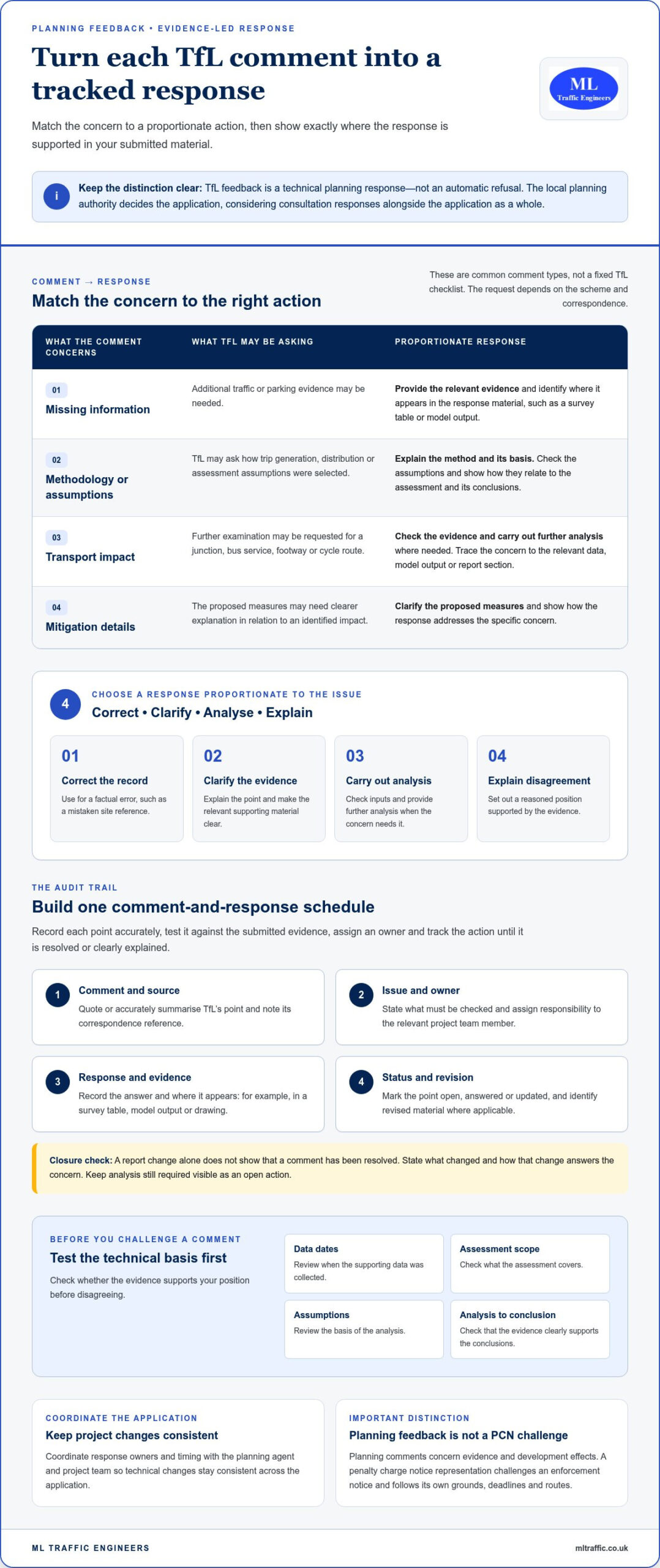
Treat each comment as a request to resolve a defined uncertainty, rather than as a general objection. It may ask for:
- More information: for example, additional traffic or parking evidence.
- Methodology clarification: an explanation of how trip generation, distribution or assessment assumptions were selected.
- Impact analysis: further examination of effects on a junction, bus service, footway or cycle route.
- Mitigation details: clearer information about measures proposed to address an identified impact.
These are common categories, not a fixed TfL checklist. The request depends on the scheme and consultation correspondence. Trace each comment to the relevant report section, drawing, dataset or assumption. A question about a junction forecast, for example, could relate to the survey date, model inputs or presentation of the forecast. Pinpointing the reference helps the project team address the actual concern instead of revising unrelated material.
Why a planning comment is not a TfL penalty challenge
Planning feedback concerns the evidence and effects of a proposed development; a PCN representation challenges an enforcement notice. TfL’s PCN processes can cover matters such as road-user charging or HGV permits. Those procedures have their own grounds, deadlines and representation routes. They do not apply automatically to planning consultation comments. If you’re considering how to challenge TfL transport assessment feedback, work from the application correspondence and relevant planning process, and agree project-specific next steps with the planning agent or local planning authority.
How to analyse TfL comments against your Transport Assessment
A useful response starts with a clear audit trail. For each TfL comment, record the point raised, identify the technical issue, test it against the submitted evidence, agree an action and track that action until it is resolved or clearly explained. This turns a consultation response into a manageable task list instead of a general instruction to revise the report.
Separate factual corrections from disagreements about assumptions, methodology, impacts or mitigation. A mistaken site reference may need a simple correction; a concern about forecast traffic may require checking inputs and explaining the method. The GOV.UK guidance on Transport Assessments provides context on the purpose and scope of transport evidence. Read it alongside the project’s submitted documents and consultation correspondence.
Build a comment-and-response schedule
Create one schedule that links every comment to its source and response. Record TfL’s wording accurately, note any reference to a report section or drawing, assign an owner and track the status. Then add the applicant’s answer, the evidence location and any document revision. Keep open actions visible, distinguishing work that still needs analysis from a point answered through explanation.
- Comment: quote or accurately summarise TfL’s point, with its correspondence reference.
- Issue and owner: state what must be checked and assign responsibility to the relevant project team member.
- Response and evidence: note the answer and where it appears, such as a survey table, model output or drawing.
- Status and revision: mark the point as open, answered or updated, and identify revised material where applicable.
For example, if a comment refers to a junction forecast, identify the relevant model output and the assumptions behind it. Do not mark the point closed just because the report has changed. Show what changed and how it answers the concern.
Test the technical basis before disagreeing
Before challenging a comment, check whether the evidence supports your position. Review the data dates, assessment scope, assumptions and the link between the analysis and its conclusions. Consider whether the requested work relates to the development’s likely transport effects and whether the current material addresses those effects clearly. A technical disagreement is more persuasive when it identifies the evidence and explains the reasoning, rather than relying on assertion.
- Check that survey data, drawings and modelling outputs relate to the proposal being assessed.
- Confirm that assumptions are stated and applied consistently throughout the report.
- Identify whether updated evidence or further analysis is needed before responding.
Rule of thumb: respond to the substance of each comment and show exactly where the evidence addresses it. If the original assessment does not resolve the issue, record what additional work is needed instead of assuming the existing report is sufficient. This comment-by-comment method is a practical starting point for how to challenge TfL transport assessment feedback. ML Traffic Engineers UK can review the assessment and connect report revisions to project evidence. Explore transport planning support for planning applications.
When should you revise, explain or challenge TfL’s transport feedback?
Choose your response according to what TfL has identified and what the project evidence shows. A comment may point to a straightforward error, a gap in explanation, a transport effect needing more analysis or a conclusion the applicant reasonably disputes. Each calls for a different response. Disagreement alone is not enough: set out the technical basis and show how the relevant evidence supports your position.
Use this comparison to decide what to do next:
- Correct an error: amend a demonstrable inconsistency in a figure, drawing, assumption or report reference, then identify the correction.
- Provide clarification: explain the method or reasoning where the submitted material is unclear, without changing a conclusion the evidence still supports.
- Undertake further analysis: fill an evidence gap or test an impact more fully if the existing assessment cannot answer the point raised.
- Explain a reasoned disagreement: state why you consider the comment’s interpretation or conclusion unsupported by the available evidence, and show the relevant analysis.
Match the response to both the substance of the comment and the strength of the evidence. If analysis identifies an adverse effect, a correction or further explanation may not resolve it. The project team may need to consider proportionate mitigation or a design change, then assess whether it addresses the issue. Do not promise that a proposed measure will resolve TfL’s concern before examining its effect.
When a correction or further explanation may resolve a comment
Correct facts that can be checked directly, such as a mismatched figure, outdated drawing reference or inconsistency between a stated assumption and the analysis. If the underlying method is sound but poorly explained, make the steps and rationale explicit. Add information only when it answers the question TfL actually raised. Extra material that misses the concern can obscure the response rather than strengthen it.
How to present a reasoned technical disagreement
Start by acknowledging the specific concern, then define the point you dispute. Set out the relevant data, assumptions and reasoning in a measured way. For example, if TfL questions a forecast conclusion, explain which inputs and outputs support the applicant’s interpretation and where they appear in the assessment. Do not present uncertain evidence as conclusive. If a point remains unresolved, record the limitation and agree the next step with the planning team.
A disciplined approach is central to how to challenge TfL transport assessment feedback: respond to the issue, not the tone of the comment. A clear correction, targeted clarification, additional analysis or evidence-led disagreement gives the local planning authority a traceable basis for understanding the applicant’s position. It also makes remaining actions visible, helping the project team decide whether to revise the assessment, explore mitigation or continue technical discussion.
How to prepare a clear, evidence-led response to TfL
A strong response needs coordination as well as sound analysis. Agree with the planning agent who will lead the reply, who will provide technical input and how the team will manage timing. Check the latest application correspondence for the intended recipient, submission route and any requested response date. Do not assume that a route or deadline from another TfL process applies to your planning consultation.
General guidance, not a universal TfL procedure: confirm the correspondence and response arrangements, assign each comment to an owner, gather the relevant evidence, agree any project changes, then issue a coordinated response with traceable document references.
Coordinate evidence, report revisions and project decisions
Bring transport analysis together with the site design, access information and any proposed mitigation. A change to access or layout, for example, may affect both the drawings and the assumptions in the Transport Assessment. Ask the relevant team members to check those links before finalising the response. Refer decisions affecting the assessment’s scope, design or planning strategy to the planning agent and applicant.
Use one controlled set of documents. Make sure the response schedule, revised report material and supporting drawings describe the same proposal. Identify each revision clearly, and ensure that every explanation points to the matching evidence. If new analysis changes a conclusion, check whether related sections or drawings also need updating. A coordinated review reduces the risk of sending inconsistent information to the planning team.
Keep the response precise and auditable
Answer each comment directly before adding technical context. Name the document, section, drawing or dataset that supports the answer, and include revision details where material has changed. Label actions accurately: distinguish completed work, proposed changes and outstanding matters. Do not describe a proposal as agreed unless the correspondence confirms agreement.
For example, if a response refers to an updated access drawing, give its title and revision reference, then explain which part addresses the comment. If an analysis is still in progress, say so and identify the next action instead of presenting an incomplete answer as resolved. This gives the planning agent and project team a clear view of the evidence and outstanding decisions.
Before issuing the response, check that the schedule and attachments match, each answer addresses the point raised and the documents use consistent project details. This final quality check matters when several contributors have revised different parts of the application. Keep a record of what was sent and which document versions were included, so later correspondence can be compared against the same set.
ML Traffic Engineers prepares Transport Assessments and Transport Statements for planning applications and can help audit TfL comments, coordinate technical revisions and prepare supporting material. The consultancy also provides traffic and parking surveys and Swept Path Analysis. Its work supports development projects in Greater London, Manchester, Birmingham, the West Midlands, Liverpool, Surrey, East Sussex, West Sussex, Hampshire, Berkshire and Buckinghamshire. For support with a project response, discuss your transport assessment requirements.
When transport planning support can strengthen a TfL feedback response
Technical support is particularly useful when TfL’s comments involve complex transport effects, contested assumptions, further analysis or revisions that must stay consistent across several documents. A transport consultant can review the feedback alongside the submitted evidence, identify what needs attention and prepare proportionate Transport Assessment material for the planning application. This can make the technical response clearer, but cannot guarantee TfL’s agreement or a planning decision.
Consider specialist review if a comment concerns modelling inputs, survey evidence or the link between analysis and a report conclusion. Support can also help when a potential design change affects access, trip assumptions or the assessment’s scope. In these situations, an evidence-focused review can help the project team understand the implications of the feedback before revising documents or taking a position.
What a focused technical review can address
A review should connect each comment to the evidence it concerns, rather than treating the Transport Assessment as a standalone document. This helps distinguish information that is already present but needs clearer signposting from a genuine gap requiring further work. ML Traffic Engineers can:
- Map feedback to relevant assessment sections, traffic surveys, modelling outputs, drawings or policy considerations.
- Identify inconsistent assumptions, missing evidence or report sections that may need clarification.
- Assess whether further analysis or revised material is proportionate to the issue raised.
- Prepare a technical response that reflects the development proposal and supports coordination with the planning team.
For broader context on how assessment evidence supports development proposals, the Transport Assessment London guide explains key considerations for planning applications. The appropriate assessment and response depend on the scheme, submitted evidence and specific consultation comments.
Connect feedback to the wider application evidence
A Transport Assessment forms part of the application’s transport evidence. Changes made in response to feedback should be checked against related drawings, surveys and conclusions, not inserted in isolation. For example, if a revised access layout affects an assumption in the assessment, the response and supporting material should make that relationship clear. The Transport Assessment service overview provides further context on assessment preparation for planning applications.
Keep the project response coordinated. Record which revisions are agreed, which issues remain outstanding and who is responsible for the next action. This gives the planning agent and project team a shared view of the evidence and decisions, without implying that an unresolved point has been accepted or closed.
ML Traffic Engineers provides Transport Assessments, Transport Statements, Travel Plans, traffic and parking surveys, and Swept Path Analysis for development projects. If you need a structured technical review or support preparing assessment material in response to TfL comments, discuss your transport planning requirements. A clear, evidence-led approach can help address the feedback while keeping the wider planning application consistent.
Move your application forward with a clear technical plan
Turn TfL’s feedback into project decisions. Agree which issues need a technical answer, which could affect the design and which require further discussion with the planning team. Keep the evidence trail alongside those decisions so later revisions remain connected to the proposal being assessed.
Understanding how to challenge TfL transport assessment feedback means making a precise, proportionate case supported by project evidence, not simply opposing a comment. If further work is needed, focused transport planning input can help clarify the technical position and prepare the supporting material. ML Traffic Engineers prepares Transport Assessments and Transport Statements for planning applications, supported by traffic data and technical analysis.
Discuss transport planning support for your application and take the next step with a considered response. A clear plan helps your team address the issues methodically and manage the application with confidence.
Frequently Asked Questions
Can you formally appeal TfL feedback on a Transport Assessment?
There is not usually a separate formal appeal against TfL’s consultation comments themselves. During the application, the applicant can respond through the planning process by explaining or revising the transport evidence. If the local planning authority refuses the application, a planning appeal may be available under the applicable process. Read the decision notice and discuss options with the planning agent. Understanding how to challenge TfL transport assessment feedback means addressing the consultation evidence, not using a PCN appeal route.
Is TfL’s feedback the same as a planning refusal?
No. TfL’s response is a consultee’s view on transport matters; the local planning authority determines the application. A critical comment may influence the authority’s assessment, but it is not itself a refusal. The authority may consider TfL’s concern alongside the applicant’s response, other consultation responses and planning considerations before deciding. Read the formal decision notice to establish whether the application has been refused and what reasons the authority gives.
Does TfL transport assessment feedback have a fixed response deadline?
Do not assume there is one fixed deadline for every response to TfL feedback. Check the consultation correspondence and any timetable set by the local planning authority or agreed with the planning agent. If no date is clear, ask the planning agent to confirm the appropriate timing and submission arrangements with the authority. Keep the response plan aligned with the live application, since timing can affect how the authority considers further material.
What evidence should I provide when responding to TfL’s comments?
Provide evidence that directly answers the point, rather than sending a large bundle without explanation. Depending on the issue, this could include a corrected calculation, a relevant traffic survey extract, a modelling output, an annotated drawing or a revised report passage. State the document title and version, explain what it demonstrates and flag any assumptions that affect interpretation. For a London proposal, make sure the evidence relates to the submitted scheme and its stated transport effects.
Can a Transport Assessment be revised after TfL has commented?
Yes, an applicant can prepare revised assessment material after receiving comments. First agree with the planning agent how revised documents should be provided to the local planning authority and whether related drawings or supporting material also need updating. Mark revisions clearly and explain what has changed. A submitted revision does not automatically mean TfL or the authority agrees with it, so keep any remaining questions visible in the project record.
What happens if TfL and the applicant still disagree?
The local planning authority considers the application and relevant evidence, including TfL’s views and the applicant’s response. The disagreement may be discussed further through the planning process or remain a matter for the authority to weigh when determining the application. Keep the technical basis for the applicant’s position clear and record any unresolved points. If a decision is issued, use its formal reasons to understand the authority’s conclusions and discuss subsequent options with the planning agent.
Should I use TfL’s PCN challenge process to respond to planning comments?
No. A PCN challenge concerns an enforcement matter, such as a penalty linked to road-user charging or an HGV permit. It is not the route for responding to comments on a development application’s Transport Assessment. Follow the application correspondence and planning process instead. Using the wrong route could leave the technical feedback unanswered, so keep planning consultation documents separate from any enforcement notice and its specific representation instructions.

Disclaimer
The content on mltraffic.co.uk, including all technical articles, guides, and resources, is provided for general informational and educational purposes only. It is not intended to constitute professional advice in traffic engineering, transportation planning, development approvals, or any other technical or legal field.
While ML Traffic Engineers makes every reasonable effort to ensure the accuracy, completeness, and timeliness of the information published, we do not provide any warranties or representations (express or implied) regarding its reliability, suitability, or availability for any particular purpose. Any reliance you place on the content is strictly at your own risk.
In no event shall ML Traffic Engineers, its directors, employees, authors, or affiliates be liable for any direct, indirect, incidental, special, consequential, or punitive damages (including, without limitation, loss of profits, data, or business opportunities) arising out of or in connection with the use of, or inability to use, any information provided on this website.
The articles and guides on this site are not a substitute for engaging a qualified, professional traffic engineer to assess your specific project requirements. For tailored advice, compliance assessments, or traffic engineering services, please contact a competent professional.
This disclaimer may be updated from time to time without notice. By accessing or using this website, you agree to be bound by the most current version of this disclaimer.