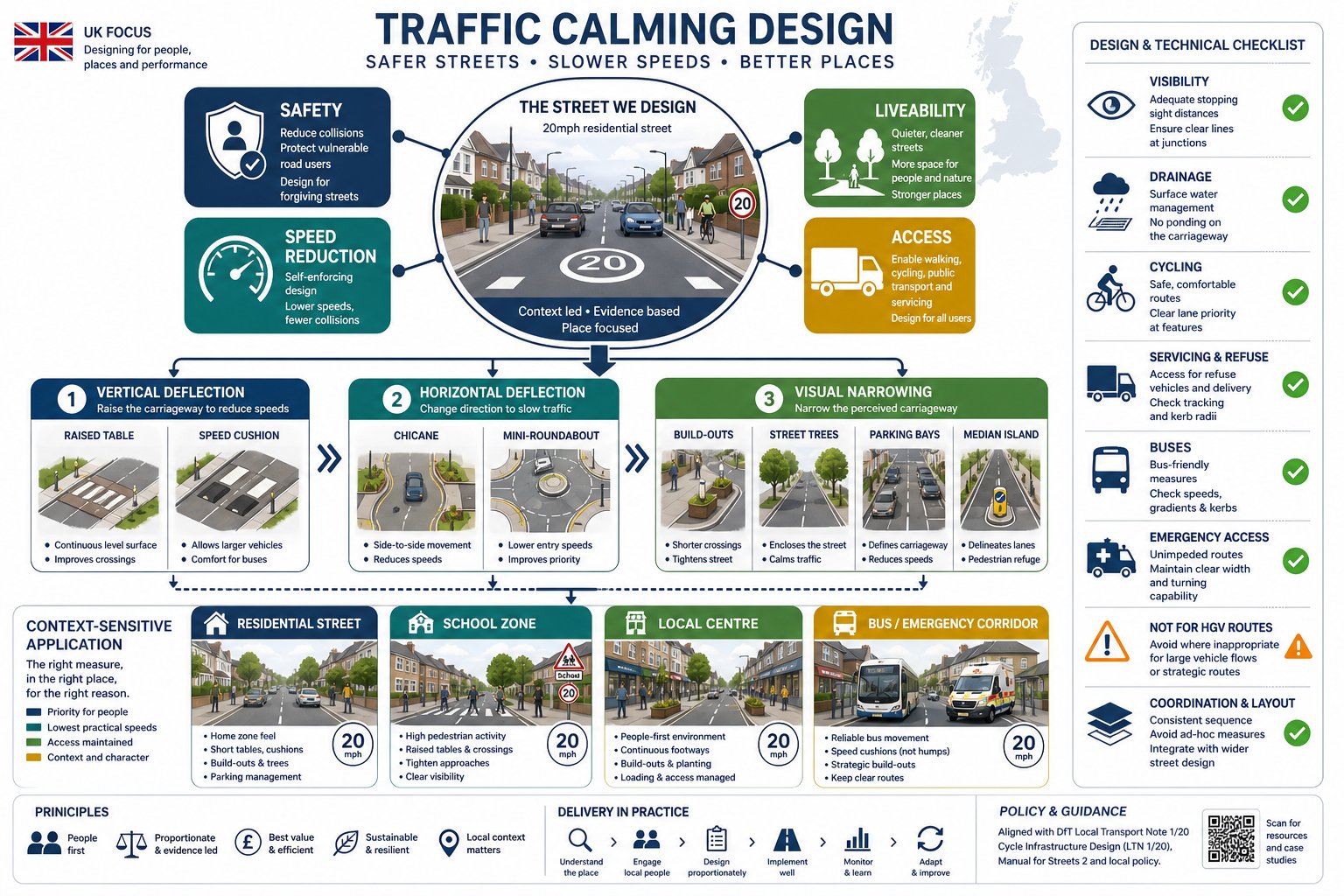
A traffic calming scheme can look deceptively simple. A raised table here, a build-out there, a couple of signs at the entrance to a residential street, and on paper it all seems straightforward. In practice, though, traffic calming design sits right at the junction of safety, place-making, highway engineering and planning risk. Get it right and speeds fall, crossings feel shorter, streets become more usable, and planning officers are far more comfortable that a scheme will work in the real world. Get it wrong and the result is often patchy compliance, drainage complaints, objections from bus operators, and features drivers simply ignore.
For architects, planning consultants, developers, surveyors and local authorities, that distinction matters. We’re rarely designing in a vacuum. We’re working within adopted standards, constrained corridors, forecast traffic growth, emergency access requirements, active travel expectations and local political realities. And in 2026, expectations are higher: schemes need to be self-enforcing, proportionate and defensible in planning terms.
In this guide, we set out what traffic calming design actually involves, the principles behind effective schemes, the measures that tend to work best in different contexts, and the design checks that are too often left until late in the process. We’ll also look at how traffic calming should be handled within transport assessments and planning applications, where poorly justified proposals can easily stall otherwise viable development.
What Traffic Calming Design Is And Why It Matters
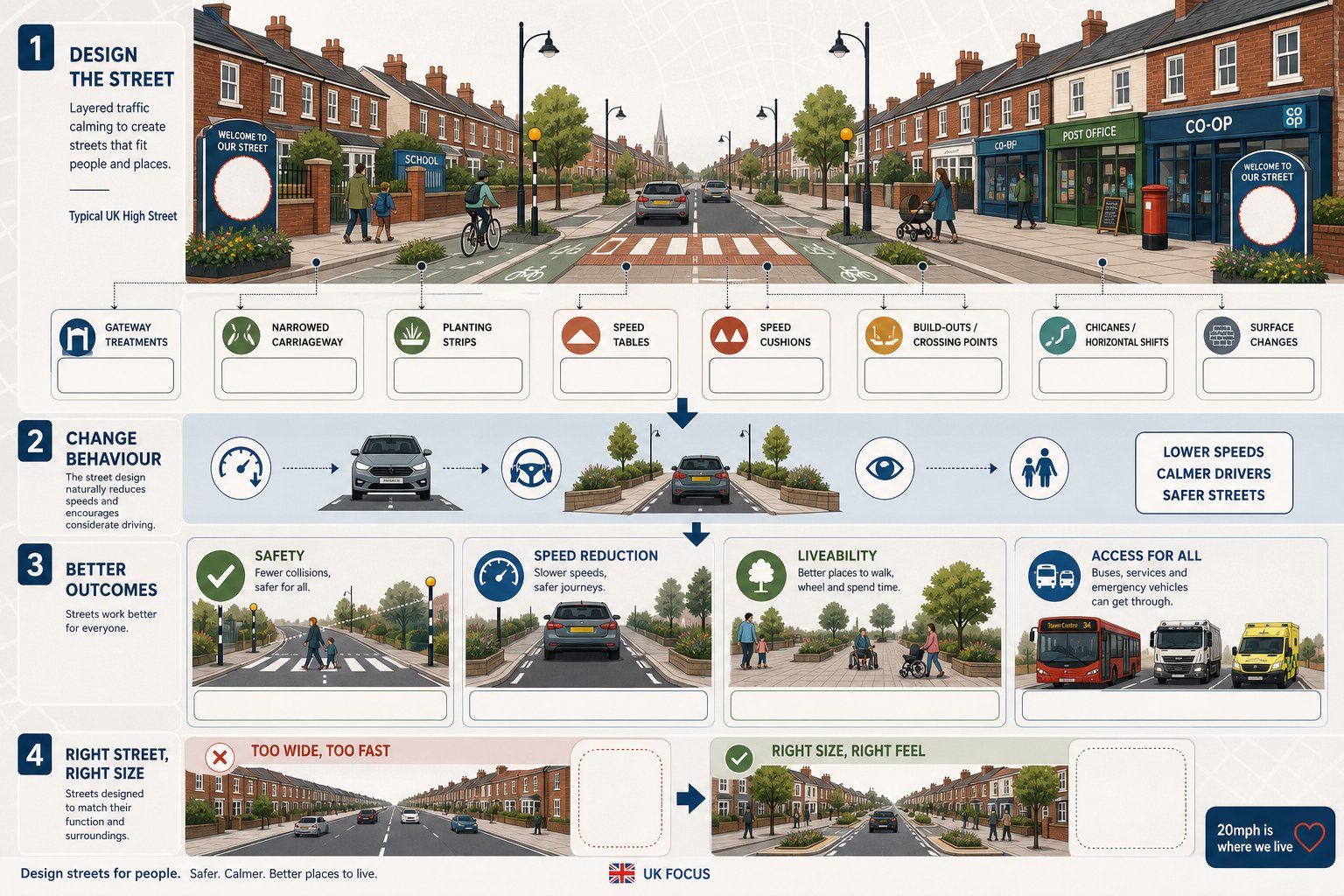
Traffic calming design is the use of physical and perceptual street features to reduce vehicle speeds, influence driver behaviour, manage traffic volumes and improve conditions for people using the street. That can include vertical features such as speed tables and cushions, horizontal changes such as chicanes or build-outs, and visual cues such as planting, narrower carriageways, surfacing changes, markings and gateway treatments.
The point is not simply to slow vehicles for its own sake. Good traffic calming aligns traffic speed with street purpose. A street serving homes, schools, local shops or walking routes should not feel or operate like a distributor road. That sounds obvious, but many planning disputes begin because the geometry sends one message while the land use sends another.
The evidence base is one reason the subject matters so much. Lower speeds generally mean fewer collisions and, crucially, less severe outcomes where collisions still occur. That is particularly important in mixed-use environments and on residential streets where people walking, cycling, wheeling or crossing informally are part of normal daily movement.
It also matters because traffic calming increasingly supports broader planning objectives. In many schemes, it is not just a highways add-on: it helps deliver public realm quality, safer active travel connections, and a more credible 20 mph environment. In that sense, traffic calming sits within wider Traffic Engineering: Your decisions about how movement and place should coexist.
Core Objectives: Safety, Speed Reduction, Liveability And Access
At scheme level, four objectives usually sit at the centre.
Safety comes first. We want fewer collisions, and where conflicts do occur, we want lower impact speeds and better visibility. Geometry that naturally reduces turning speeds or shortens crossing distances is often more valuable than signage alone.
Speed reduction is the most obvious aim, but it needs to be tied to a realistic target speed consistent with the road’s function. On many UK residential streets that means creating a genuinely self-enforcing 20 mph character, not just applying a limit and hoping compliance follows.
Liveability is where traffic calming moves beyond engineering. Quieter streets, easier crossings, more pleasant frontages and better conditions for walking and cycling all feed into placemaking. Parents judge streets this way. So do planning committees.
Access keeps the design grounded. Residents, refuse vehicles, servicing, buses and emergency services still need to get through. Effective traffic calming design is hence about balance: slowing what should slow down, while preserving the level of access the street genuinely needs.
Key Principles Of Effective Traffic Calming Design
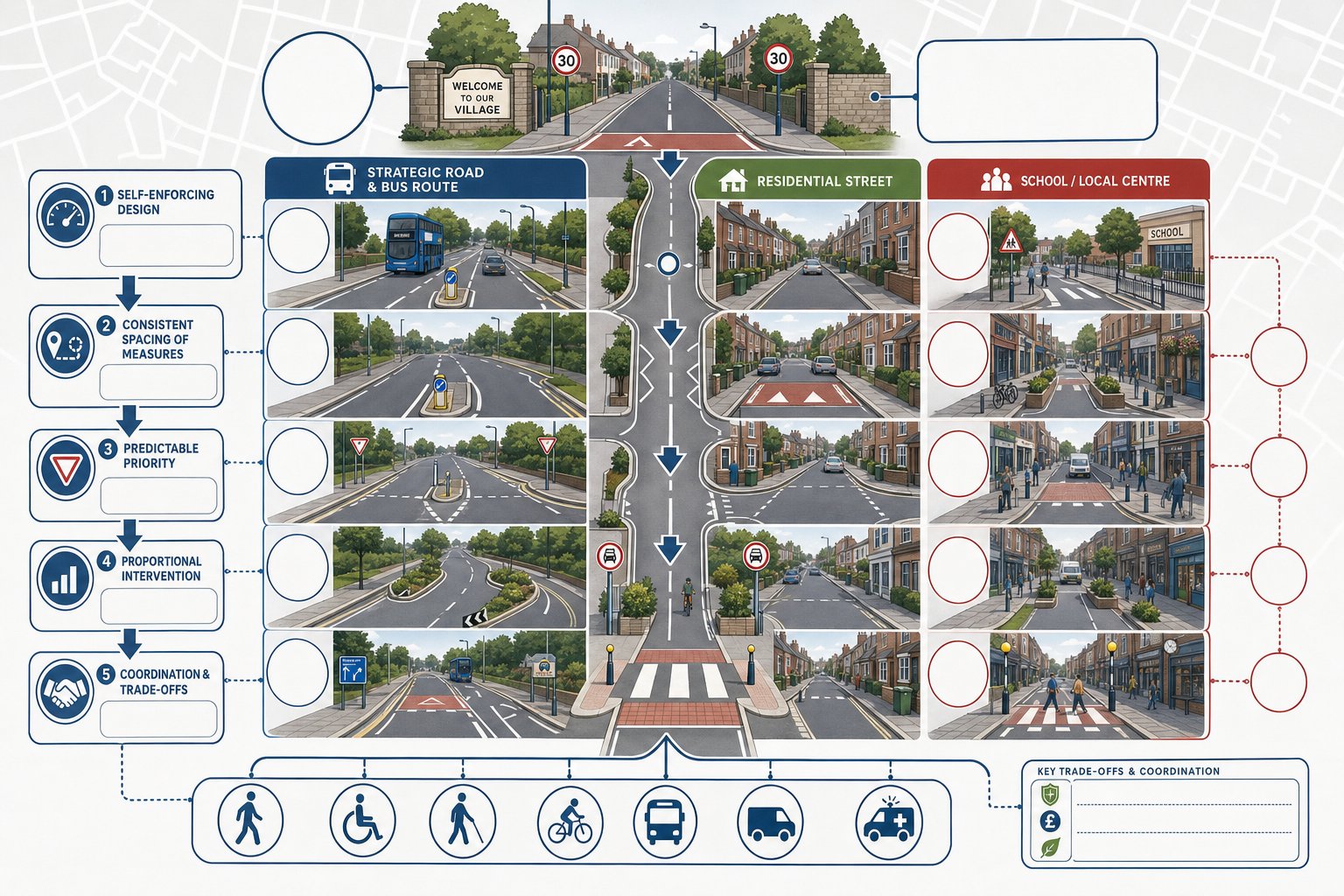
The best schemes are self-enforcing. That principle is worth dwelling on because it separates effective design from cosmetic intervention. If a driver can comfortably accelerate between isolated features, or if the geometry feels overly generous even though the signs, the scheme will underperform.
Self-enforcing design relies on consistency. Measures need to be spaced and composed so that drivers read the street as a low-speed environment from entry to exit. One speed table outside a school gate can be helpful, but if the rest of the corridor remains wide, straight and forgiving, average speeds often rebound quickly.
Predictability matters too. Drivers should understand where they are expected to yield, slow, turn or align. Pedestrians and cyclists should be able to read crossings and priority with equal clarity. Confusing layouts do not create calm: they create hesitation and occasional conflict.
Another principle is proportionality. We should match the degree of intervention to the street’s role. A residential loop road can usually accommodate stronger vertical features than a bus corridor or emergency response route. Likewise, a village gateway or local centre may benefit more from surface character, tighter geometry and visual friction than from repeated humps.
Good schemes also account for all users, including people with mobility impairments, visually impaired pedestrians, cyclists using standard carriageways, bus passengers and delivery drivers. That means traffic calming is not just about reducing speed, it is about shaping a street that still functions well.
Where developments need a broader package of intervention, traffic calming often sits alongside wider mitigation measures traffic: proposals, especially when local authorities want evidence that impacts are being managed in a coherent way.
How Street Function, Context And User Needs Shape The Design
Street context should decide the toolkit.
On strategic roads, bus routes and streets carrying regular servicing movements, harsh vertical deflection is often the wrong first answer. In these locations, we typically look harder at horizontal alignment, lane discipline, gateway treatment, reduced effective width, signal coordination or selective road diet measures. The aim is to moderate speed without undermining route resilience.
On local residential streets, the palette is wider. Speed humps, cushions, raised tables, modal filters, tighter junction radii and narrowed entries can all be appropriate where through-traffic should feel secondary to neighbourhood function.
Near schools, local centres and places with heavy pedestrian activity, crossing quality becomes central. Raised crossings, side-road tables, build-outs and strong entry treatments often do more than a standard hump sequence because they directly reinforce pedestrian priority.
User needs can alter apparently sensible proposals. A cushion layout that suits cars may create discomfort for cyclists if bypass width is poor. A chicane can reduce speed but create pinch conflict unless cycle movement is designed in. And a landscaped narrowing may look excellent at concept stage yet fail if refuse tracking or disabled parking demand has not been tested. This is why early coordination with access design highway work is so important on live planning projects.
Common Traffic Calming Measures And Where They Fit Best
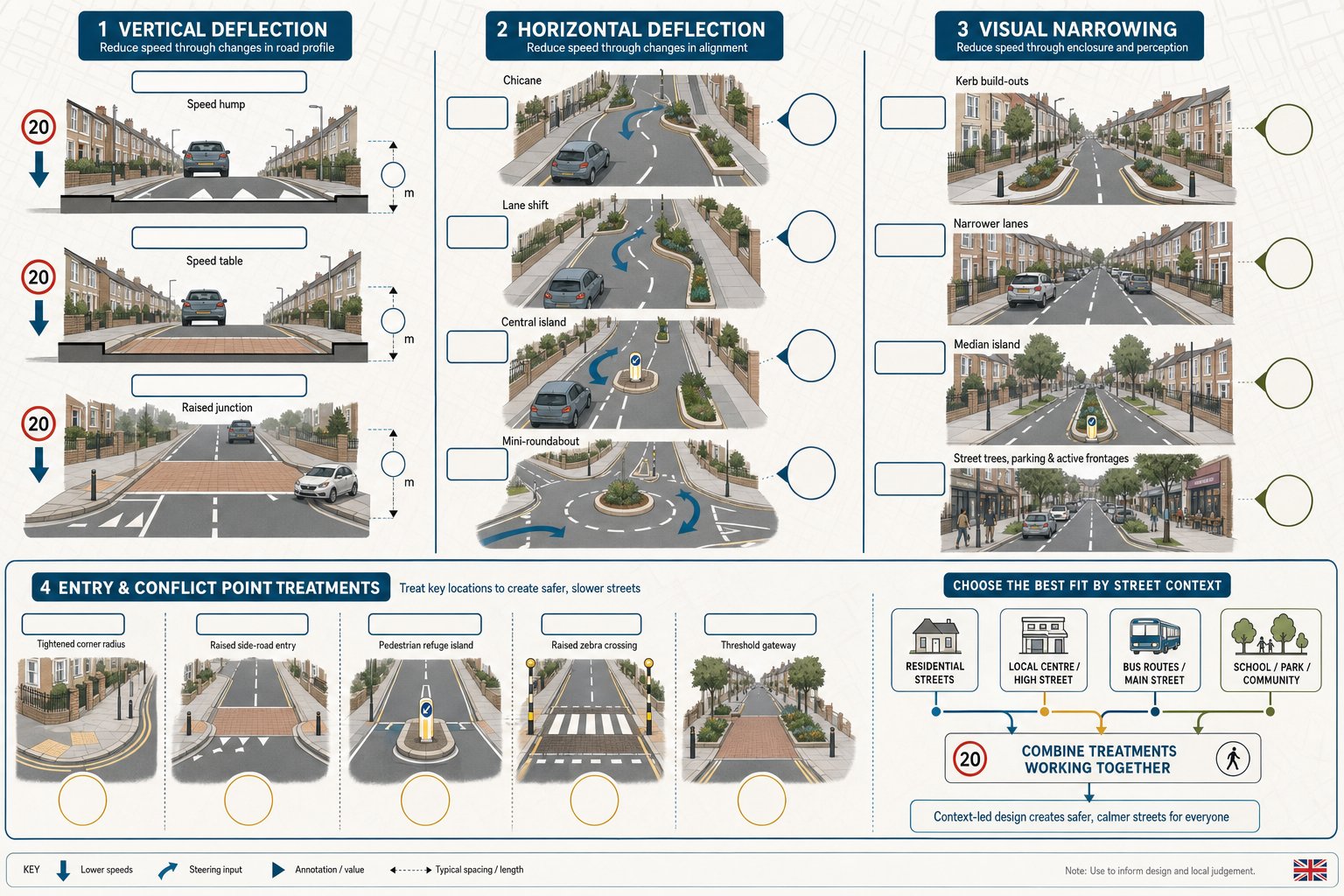
There is no universal best measure. The right choice depends on target speed, traffic composition, frontage activity, route function, maintenance implications and what behaviour we are trying to change.
Vertical deflection remains one of the strongest tools where clear speed reduction is required on local streets. Speed humps, sinusoidal profiles, speed tables and raised junctions can all produce meaningful reductions when properly spaced. They tend to work best where low to moderate traffic volumes, residential character and limited bus sensitivity align.
Horizontal deflection is often better suited to routes where speed needs to come down but ride quality and operational continuity still matter. Chicanes, lane shifts, central islands and mini-roundabouts encourage slower approach speeds without the same level of vertical discomfort.
Visual narrowing sits somewhere between geometry and psychology. Build-outs, narrower lanes, tree planting, median islands, strong frontage enclosure, on-street parking and changes in material can all make a street feel less like a through-route and more like a place. These are particularly useful where we want lower speeds with less harsh intervention.
There are also volume-management measures such as modal filters, turn restrictions and closures. Strictly speaking, these can go beyond classic speed control, but they are often part of the same strategy where rat-running or inappropriate through-movement is the underlying problem.
In planning-led schemes, the measure should also fit the delivery route. Some features are straightforward within on-site highway layouts: others may depend on off-site works, land take, drainage alterations or adoption negotiations. That is where highway infrastructure design thinking has to join the conversation early.
Vertical Deflection, Horizontal Deflection And Visual Narrowing
Vertical deflection includes humps, cushions, tables and raised intersections. These are effective because they physically force lower speeds. But they come with trade-offs. Buses, ambulances, fire appliances and some delivery fleets may object to repeated severe profiles. Poorly detailed features can also create noise, discomfort and drainage problems. Cushions can soften impacts for larger vehicles able to straddle them, though their effect depends heavily on lane positioning and actual vehicle mix.
Horizontal deflection includes chicanes, lane shifts, mini-roundabouts and junction realignment. Done well, these lower speed through steering input rather than impact. They are often useful on busier streets, but they need enough visual clarity and deflection angle to work. Token offsets rarely change behaviour.
Visual narrowing is subtler but often powerful. Narrowed lanes, kerb build-outs, medians, street trees, frontage activity and parking bays can all reduce the perceived operating envelope of the carriageway. Drivers tend to moderate speed when a street feels enclosed and socially active. In many modern schemes, the strongest results come from combining light physical measures with visual friction rather than relying on one dramatic feature.
For development-led streets, we often test these options alongside Speed Reduction Measures decisions so the eventual geometry supports both policy compliance and day-to-day usability.
Junction Treatments, Crossings And Gateway Features
Junctions are often where traffic calming produces the greatest return because they are already points of conflict, decision and speed change. Tightened corner radii, raised side-road entries, compact junction tables and mini-roundabouts can all reduce turning speed while making pedestrian movement more legible.
Crossings deserve more attention than they sometimes get in transport reports. A refuge island, raised zebra, parallel crossing or simple build-out can materially shorten crossing distance and improve intervisibility. Near schools or neighbourhood centres, these interventions often shape public perception of safety more than a mid-link hump ever will.
Gateway features are also crucial, especially where drivers are entering a lower-speed environment from a faster road. Effective gateways usually combine more than one cue: signing, carriageway narrowing, surfacing change, planting, village-style edge treatment, lighting character or a raised feature at the threshold. The goal is to create a transition that feels unmistakable.
What tends not to work is the weak gateway, a pair of signs on a wide, forgiving road with no accompanying geometric message. Drivers read shape faster than words. So when a 20 mph zone or residential street begins, the carriageway should say so immediately.
Design Standards, Visibility And Drainage Considerations
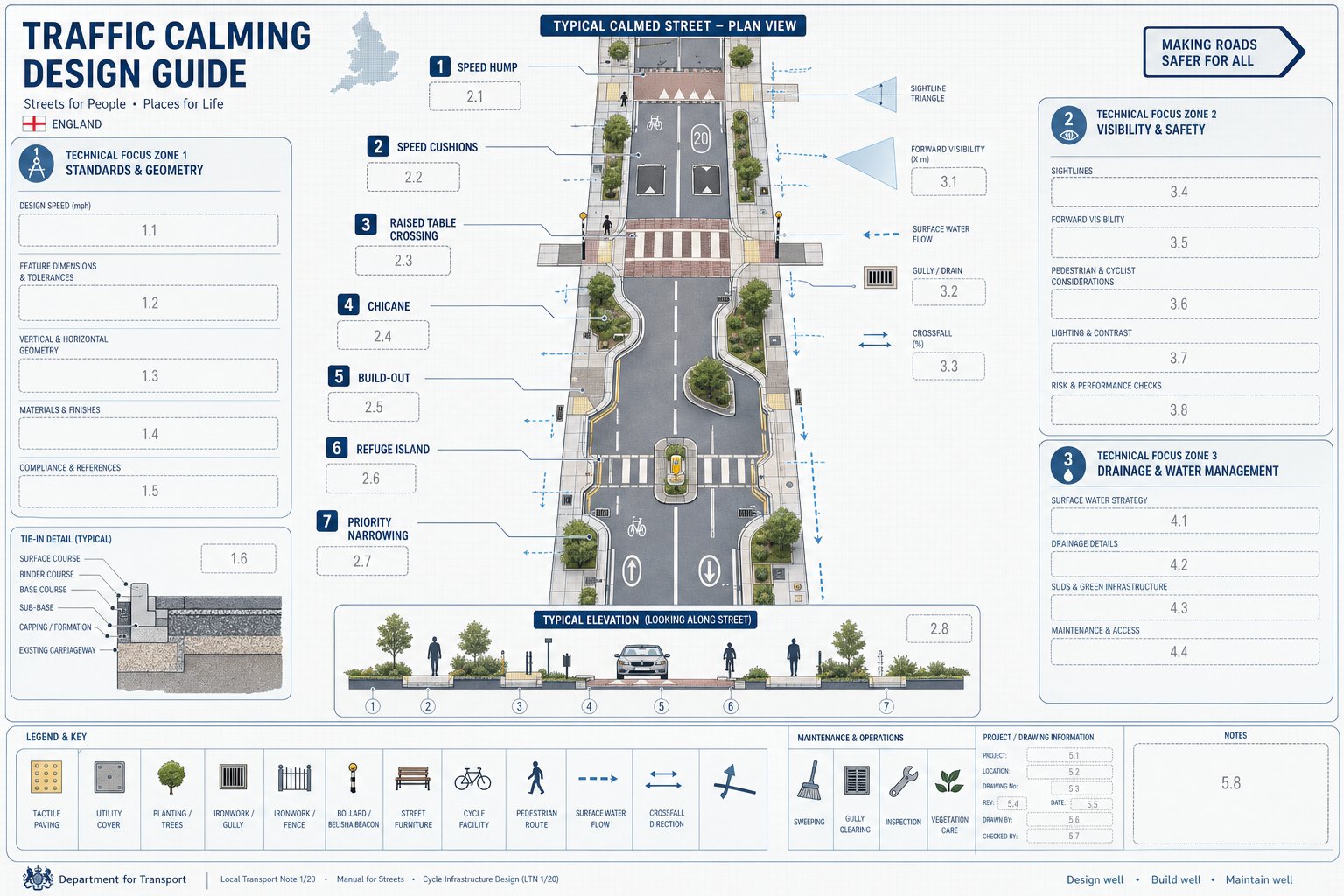
Traffic calming design needs more than a good concept sketch. It must also stand up technically. In England, Local Transport Note 1/07 remains a key reference point for traffic calming design and installation, and local highway authorities will often supplement it with their own standards, standard details and adoption preferences. In 2026, Active Travel England expectations also matter more than they once did, particularly where measures affect walking and cycling quality.
Visibility is one of the first checks we make. Forward visibility has to remain adequate on approaches to humps, cushions, chicanes, crossings and priority narrowings. Features that depend on opposing traffic behaviour must be readable in enough time for drivers to react smoothly. At junctions, reduced corner radii and raised entries should calm speeds without compromising intervisibility or creating blind conflict with cyclists.
Drainage is another area where weak detailing can quietly undermine an otherwise sound design. Build-outs can interrupt gutter flow. Raised tables can trap water if tie-ins are poor. Narrowings and islands can create ponding where crossfall and gully placement are not coordinated. And once standing water appears, user complaints follow quickly, especially if crossings are involved.
We also need to think about constructability and maintenance. Surface treatments that look persuasive on a visualisation may weather badly. Planting can improve enclosure but only if maintenance responsibilities are realistic. Kerb lines, tactile paving, ironwork adjustments and utility covers all need to be coordinated in detail design, not left to chance.
On planning projects, these checks often sit naturally beside a traffic impact assessment because authorities want confidence that proposed calming measures are both effective and buildable, rather than simply illustrative.
How Traffic Calming Affects Capacity, Servicing And Emergency Access
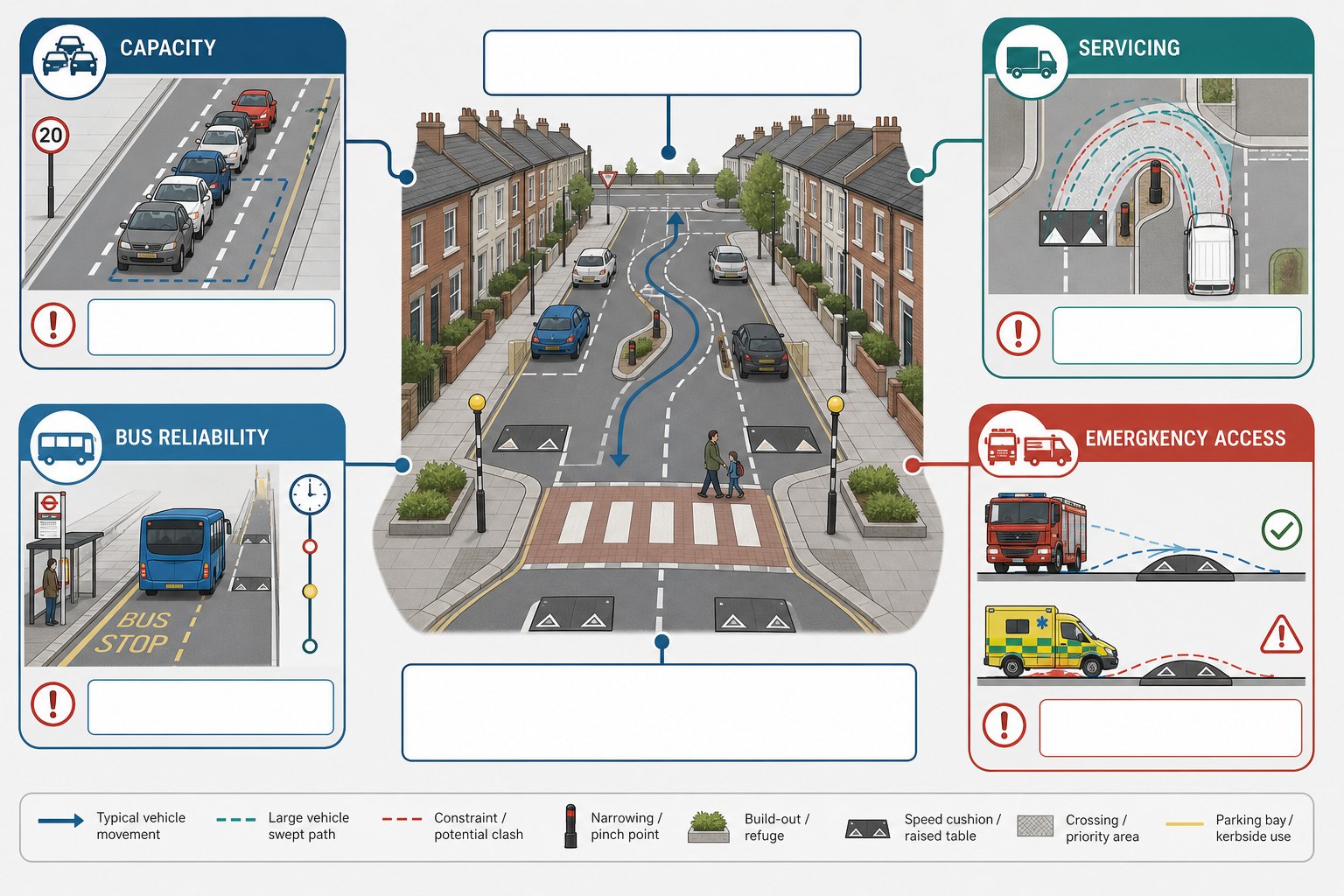
Traffic calming almost always changes operational performance. Sometimes that is the point. Lower speeds can discourage unsuitable through-traffic and reinforce use of more appropriate routes. But those benefits need to be weighed against effects on capacity, servicing efficiency, bus reliability and emergency response.
On lightly trafficked residential streets, reduced capacity may be acceptable or even desirable. On streets with frequent servicing, bus penetration or strategic diversion roles, the same intervention may create unintended friction. Repeated vertical features can add delay, increase vehicle wear complaints and reduce passenger comfort. That does not mean such measures are never appropriate, only that they should be selected and spaced with route function in mind.
Emergency access deserves direct consultation, not assumptions. Fire and ambulance services may accept some features, object to others, or request modified profiles and alignments. Cushions are often proposed as a compromise because wider-track emergency vehicles may straddle them, but that benefit depends on exact dimensions and approach position.
Servicing is similar. Swept path analysis should test whether delivery vehicles can pass narrowings, negotiate deflections and still operate safely near crossing points or parking bays. If the street also relies on kerbside activity, there may be interaction with a wider parking strategy traffic approach.
The practical lesson is simple: traffic calming should not be assessed as an isolated safety feature. It affects how the street works day to day, and local authorities will usually expect evidence that these operational impacts have been understood rather than discovered after implementation.
Traffic Calming Design In Planning Applications And Transport Assessments
In planning work, traffic calming is often proposed for one of three reasons: to make an internal site layout self-enforcing, to mitigate the effects of development traffic on nearby streets, or to support a policy case around safety, active travel and placemaking. Sometimes it does all three.
Within a Transport Assessment or Transport Statement, the design case should be clear. We need to explain the existing problem or future need, identify the target operating environment, show why the selected measures are appropriate to the road function, and demonstrate that the proposal remains workable in terms of visibility, swept paths, drainage, accessibility and safety. A vague promise of “traffic calming if required” rarely carries much weight.
This is particularly true where off-site works are involved. If a development relies on speed reduction measures, crossing improvements or junction tables beyond the red line boundary, the likely delivery route should be acknowledged early, often through Section 278 works, and sometimes with linked Section 106 obligations where wider mitigation is necessary.
Planning officers and highway authorities also tend to respond better when traffic calming is framed as part of a coherent network strategy, not a bolt-on. If pedestrian desire lines point one way, cycle connections another, and the carriageway geometry another, objections are more likely.
For housing-led schemes, this often overlaps with a residential traffic impact review of forecast flows, junction effects and local street suitability. And where rapid reporting is needed, a concise evidence-led approach, something we prioritise in our own transport work at ML Traffic, can make a real difference to keeping planning programmes on track.
The best submissions show not just that a measure can be drawn, but that it has been thought through in the context of local authority thresholds, design codes and real user behaviour.
Mistakes To Avoid When Specifying Traffic Calming Measures
The most common mistake is relying on isolated features. A single hump, one refuge island or a token gateway on its own often produces a localised dip in speed followed by quick acceleration. Drivers respond to a sequence and a street character, not to a one-off interruption.
Another frequent error is over-reliance on signs and markings without enough geometric support. Markings can reinforce a low-speed environment, but they rarely create one by themselves. If the carriageway still feels wide, straight and forgiving, compliance will often be weak.
We also see schemes that overlook cyclists, disabled users or pedestrian comfort. A pinchpoint without cycling provision, tactile paving that does not align with desire lines, or vertical features that create unnecessary discomfort can turn a nominal safety intervention into a source of friction.
Drainage is regularly underestimated. Minor level differences around tables, build-outs and side-road entries can lead to ponding, splash and maintenance problems that erode confidence in the whole scheme. So can poor materials selection or details that are difficult to construct accurately.
Finally, there is the route hierarchy mistake: applying severe vertical measures on important bus or emergency corridors without proper consultation and then being surprised by objections. Context should always drive choice.
A good rule of thumb is this: if a proposed measure solves one problem but creates two more, capacity, servicing, accessibility, drainage or political acceptability, it probably needs redesign, not better wording in the report.
Conclusion
Traffic calming design works best when we treat it as part engineering, part behavioural design, and part placemaking. The strongest schemes do not simply tell drivers to slow down: they make lower speeds feel natural, expected and appropriate to the street.
For planning teams, that means choosing measures that suit the road’s function, testing them properly against visibility, drainage and operational needs, and presenting them clearly in transport evidence. It also means resisting the temptation to specify features in isolation or too late in the design process.
In 2026, local authorities are looking for schemes that are safer, self-enforcing and policy-aligned, while still practical for residents, buses, servicing and emergency access. When those strands come together, traffic calming stops being a checkbox and becomes a credible part of delivering streets that actually work.
Frequently Asked Questions about Traffic Calming Design
What is traffic calming design and why is it important?
Traffic calming design uses physical and visual features like humps, narrowings and crossings to reduce vehicle speeds, manage traffic flow and improve safety and liveability for all street users. It lowers collision rates, supports walking and cycling, and enhances the public realm.
How do the core objectives of traffic calming design balance safety and access?
The core aims are to reduce collision frequency and speed, improve street liveability, and maintain reasonable access for residents, buses, servicing and emergency vehicles. Effective design slows traffic where appropriate while ensuring essential movement is not compromised.
Which traffic calming measures are best suited for residential streets versus busier routes?
Local residential streets benefit from vertical deflection measures like speed humps, cushions and narrowed junctions. Busier or strategic routes often require horizontal deflection such as chicanes, lane shifts, or visual narrowing to moderate speeds without disrupting buses and emergency vehicles.
Why is self-enforcing design crucial in traffic calming schemes?
Self-enforcing design means the street geometry manages speeds naturally without relying on signage or enforcement. Consistent spacing and predictable layouts ensure drivers perceive and maintain lower speeds throughout the zone, improving compliance and safety.
How do traffic calming schemes affect emergency vehicle access and local servicing?
While calming measures reduce speeds, designs like cushions can allow wide-track emergency vehicles to straddle them, mitigating delays. Swept path analysis ensures delivery vehicles and buses can navigate safely, balancing traffic calming with operational needs.
What should be included in planning applications regarding traffic calming to ensure successful approval?
Applications must clearly justify the need, demonstrate appropriate measure selection aligned to road function, and show the scheme’s impact on safety, visibility, drainage, accessibility and capacity. Early inclusion in transport assessments and alignment with design codes increases approval likelihood.