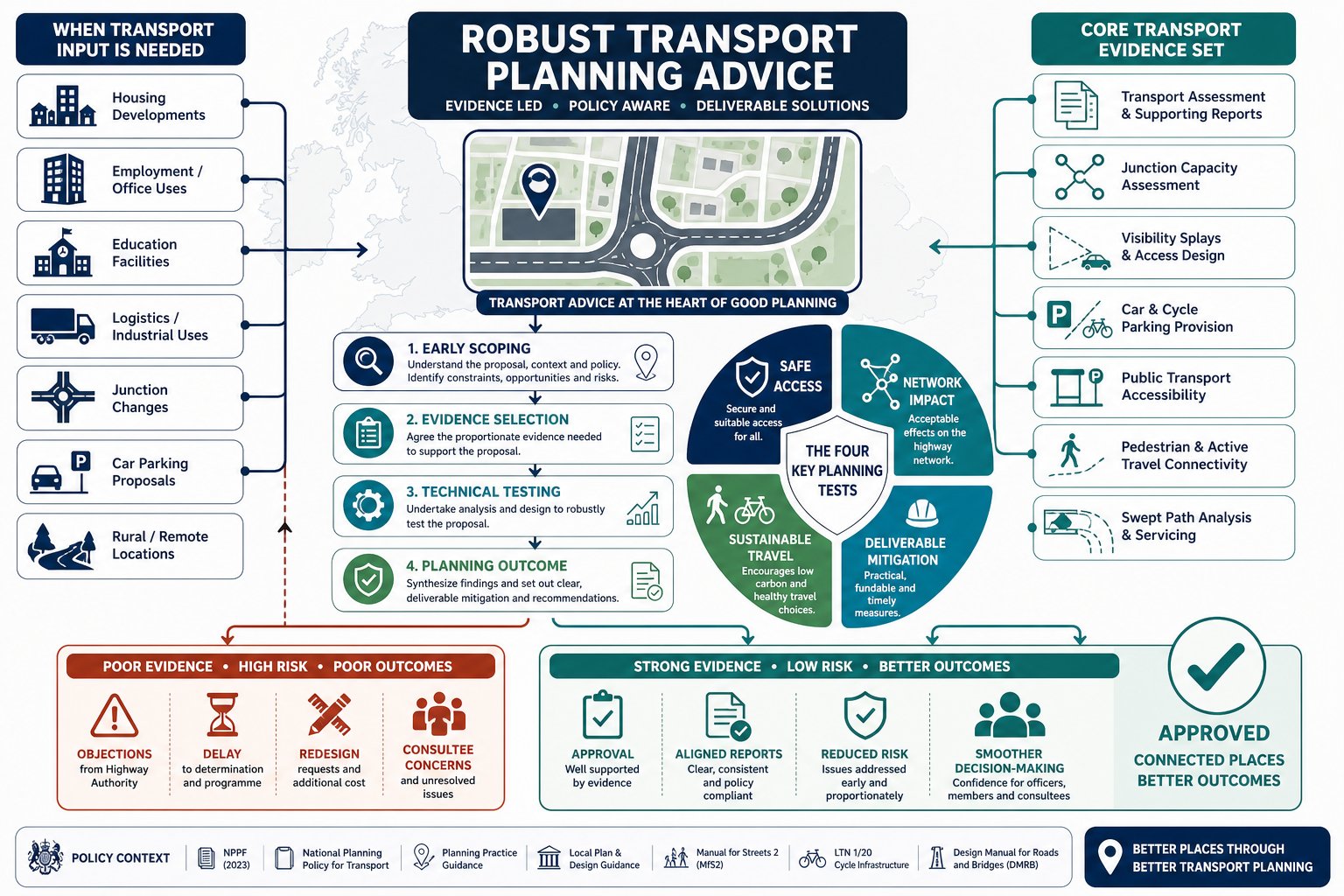
A planning application can be well designed, policy-aware and commercially sensible, yet still run into trouble for one stubborn reason: transport hasn’t been dealt with properly. We see it often. A scheme reaches validation or consultation stage, and suddenly questions appear about access geometry, trip impact, parking stress, servicing, walking links, visibility splays, or whether the wrong report has been submitted altogether.
That’s why robust transport planning advice matters. In practical UK planning terms, it means proportionate, evidence-led work that shows a development is safe, acceptable on the network, aligned with policy, and realistically deliverable. Not padded reporting. Not over-engineering for the sake of it. Just the right level of transport evidence, prepared early enough to influence the scheme rather than defend mistakes after the fact.
For architects, planners, developers, surveyors, solicitors, builders and local authorities, the real value is risk reduction. Strong transport input can support validation, narrow highways concerns, improve negotiation with officers, and avoid late redesign that burns time and budget. It also helps create a planning narrative that stands up when a proposal is scrutinised.
In this guide, we set out what robust transport planning advice looks like in 2026, when transport input is usually required, which reports do the heavy lifting, and how to build a defensible case that reduces delay rather than inviting it.
What Robust Transport Planning Advice Means In The Planning Process
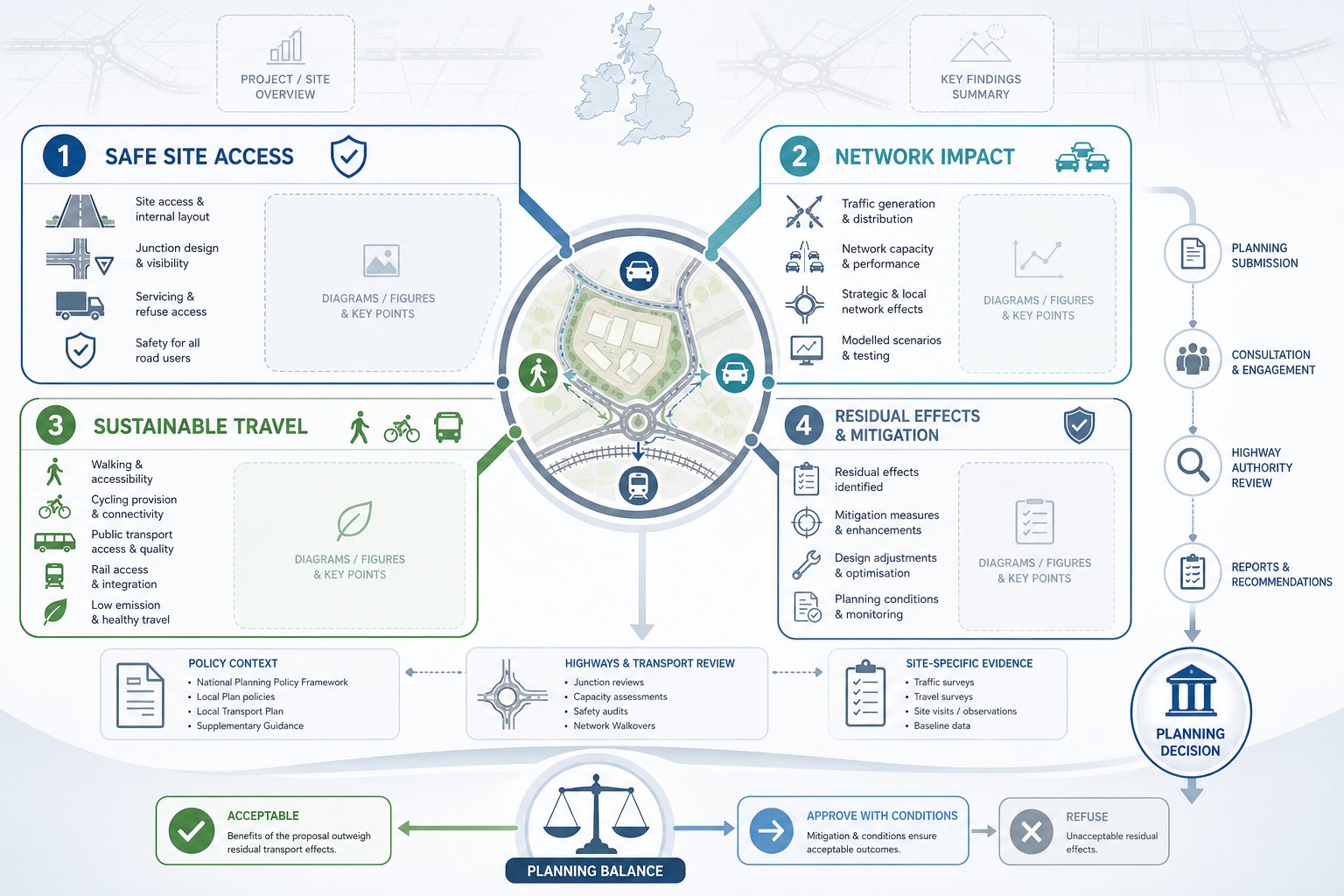
Robust transport planning advice is not simply a report attached to an application because a validation list says so. It is the disciplined process of testing whether a proposal works in movement terms and then presenting that case in a form decision-makers can rely on. In UK planning practice, that usually means combining local and national policy, site-specific evidence, highways review, and realistic mitigation into one coherent position.
At its best, transport advice helps answer four planning questions. Is the site safely accessible? Will the development create material harm on the surrounding network? Does it support sustainable travel in a credible way? And can any residual effects be managed through design, conditions, or proportionate mitigation?
That is why robust advice sits inside the planning balance rather than outside it. Officers, members and appeal inspectors are rarely persuaded by vague assurances. They want defensible numbers, clear drawings, and a straightforward explanation of why the proposal is acceptable. Good transport work does exactly that.
In practice, the strongest applications treat transport as part of the development strategy from the start. That is the difference between a document produced to fill a gap and a genuine piece of robust transport planning advice that supports the whole scheme.
When A Development Needs Transport Input
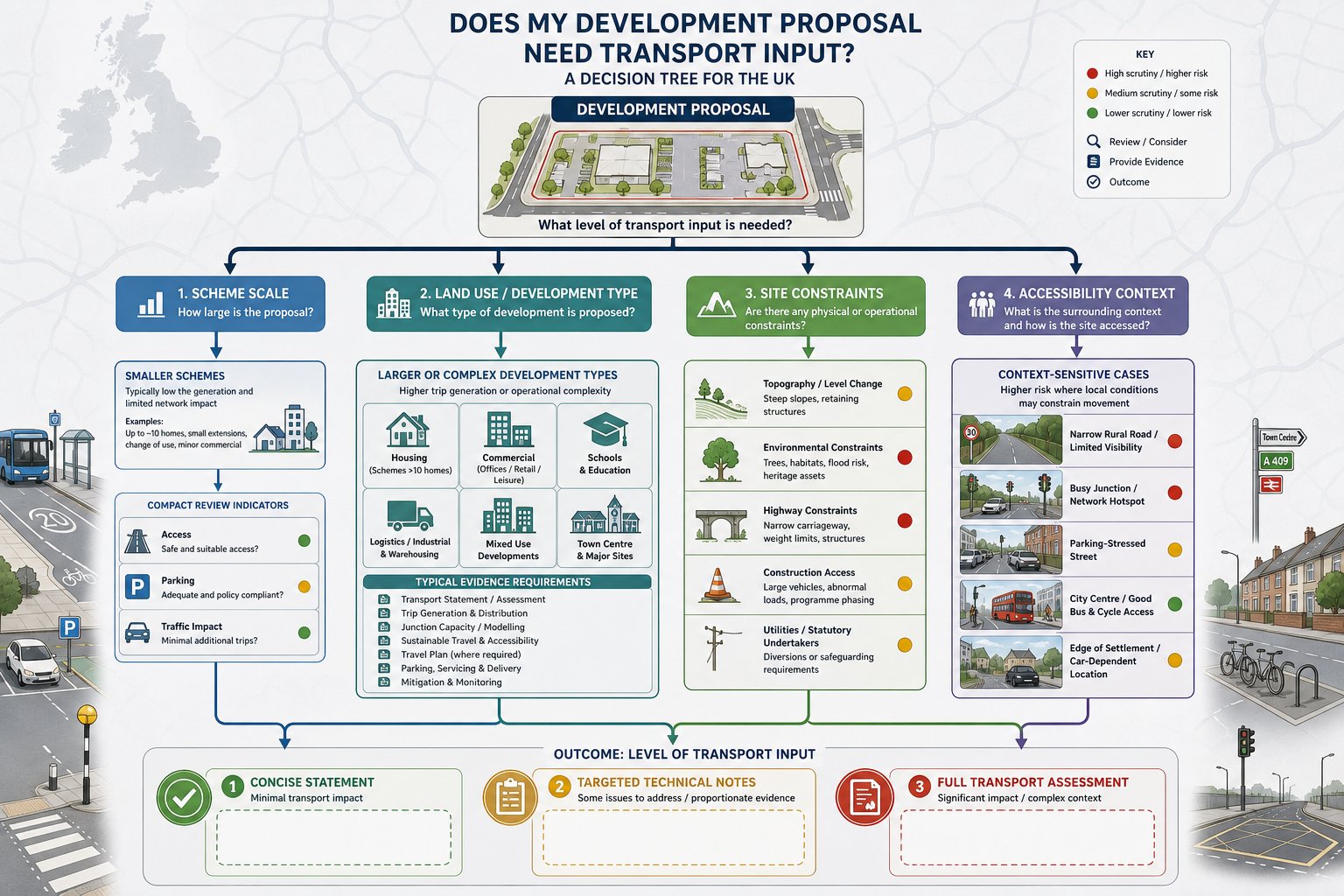
Most non-householder development needs some degree of transport input, even where the transport effects appear modest at first glance. The key test is usually whether the proposal could materially alter access, parking, trip generation, servicing, road safety, or sustainable travel patterns around the site.
For smaller schemes, that may only require a concise review confirming that existing access works, parking is policy-compliant, and traffic effects are limited. For larger or more complex proposals, the expected evidence increases quickly. Residential development, commercial space, schools, roadside uses, logistics premises, mixed-use schemes and town-centre sites often trigger more detailed analysis because their travel characteristics can be sensitive to peak-hour network conditions.
We also need to look beyond scale alone. A relatively small proposal on a constrained rural road, near a busy junction, or in an area with local parking stress can attract transport scrutiny out of all proportion to its floorspace. Equally, a city-centre development with excellent active travel and bus access may justify a more proportionate evidence base than a car-dependent edge-of-settlement site.
This is where early scoping helps. A short review against local thresholds, site conditions and planning policy usually reveals whether the right route is a Transport Statement, a full assessment, or targeted technical notes supported by Transport Assessment Consultants: focused on planning risk rather than paperwork.
Typical Triggers From Local Authority Validation Requirements
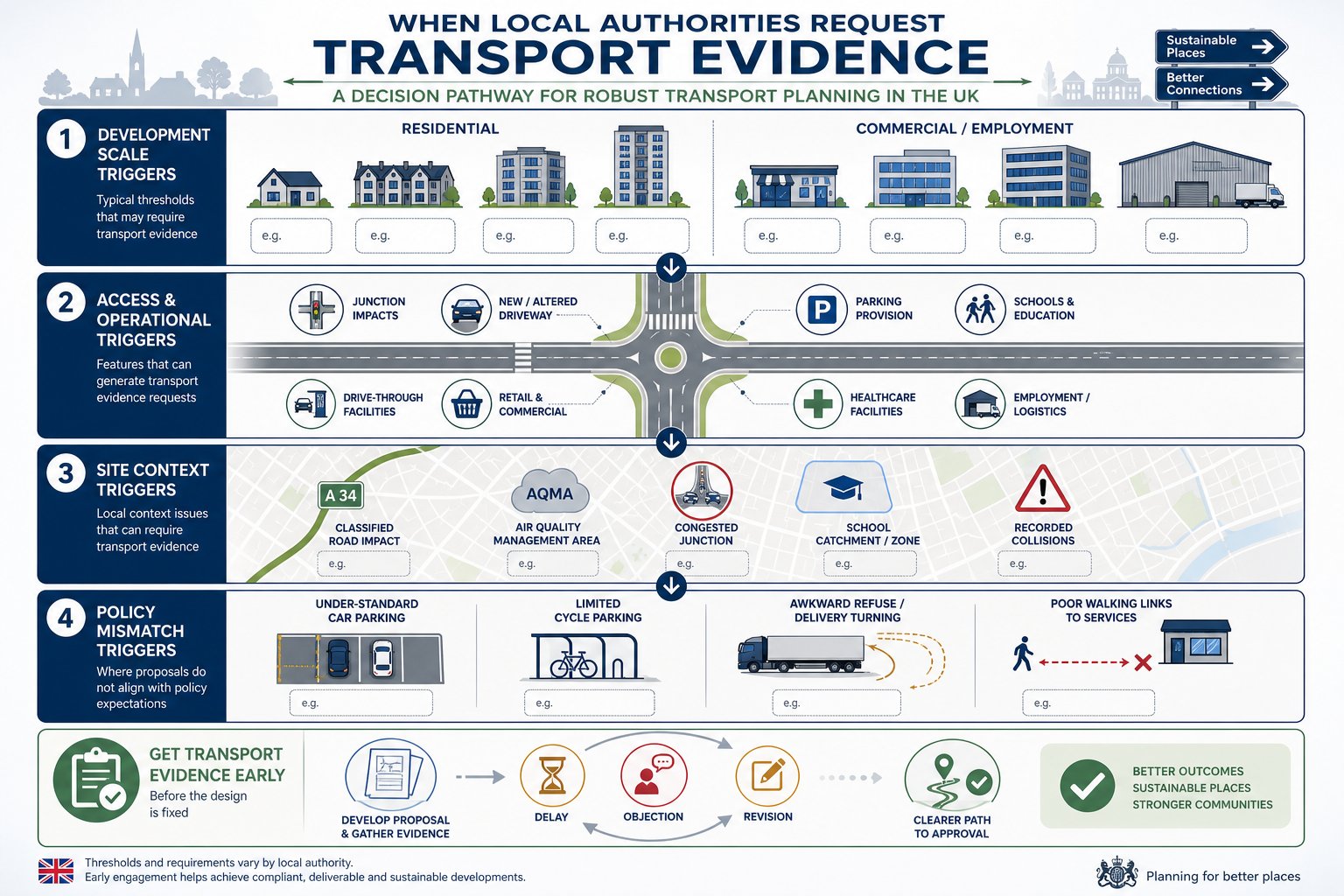
Validation requirements vary by authority, but the recurring triggers are familiar. Housing numbers and commercial floorspace thresholds are the obvious starting point. So are proposals involving a new access, a materially altered access, changes to parking provision, or uses with sharp peak-hour demand such as schools, drive-throughs, food retail, healthcare, and distribution.
Authorities also pay close attention to context. Sites on classified roads, within Air Quality Management Areas, near congested junctions, close to schools, or in locations with known collision history may need transport evidence even where a scheme sits below generic thresholds. Some councils are explicit about this in local validation checklists: others rely on judgement during validation or consultation. Either way, assuming that a small scheme will avoid transport scrutiny is a gamble.
Another trigger is a mismatch between the proposal and the local policy framework. If parking is below standards, if cycle provision is limited, if refuse or delivery vehicles appear awkward to accommodate, or if walking links to nearby services are weak, transport questions arrive quickly.
A useful discipline is to test the proposal against local validation guidance before design is fixed. That kind of end to end transport thinking can prevent a frustrating cycle of validation delays, consultee objections and drawing revisions.
How Early Transport Advice Reduces Planning Risk
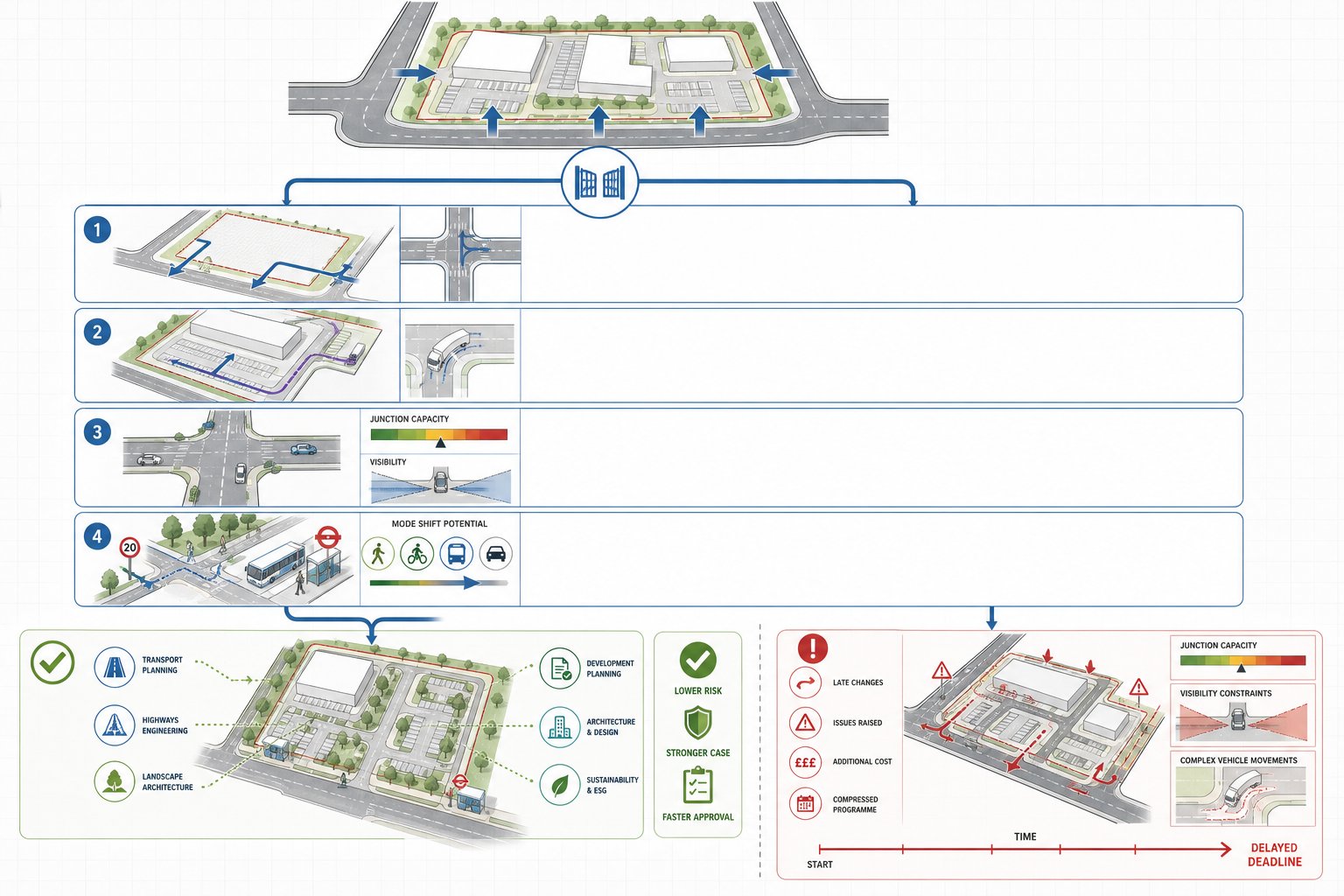
The earlier transport advice enters the project, the more valuable it becomes. Once a layout is fixed and an application deadline is looming, transport work often turns defensive. We are no longer shaping the proposal: we are trying to explain away weaknesses that could have been designed out in week one.
Early input reduces planning risk in several ways. First, it tests site access options before teams become attached to a poor arrangement. Second, it helps calibrate parking, servicing and internal circulation to the likely expectations of the local highway authority. Third, it identifies whether the proposed scale of development is realistic against junction capacity, visibility constraints, sustainable connectivity and local policy. Those are big issues. Catching them late is expensive.
It also sharpens strategy. If a development is likely to be judged on walkability, public transport access or mode shift, we can gather evidence early and make design choices that support that case. If highway capacity is sensitive, we can agree survey scope, modelling assumptions and mitigation principles before positions harden.
For development teams, this usually means fewer surprises and better coordination between disciplines. It is one reason clients increasingly favour Private Sector Transport Planning that is embedded at concept stage rather than commissioned as a late validation exercise.
Core Reports That Support A Planning Application
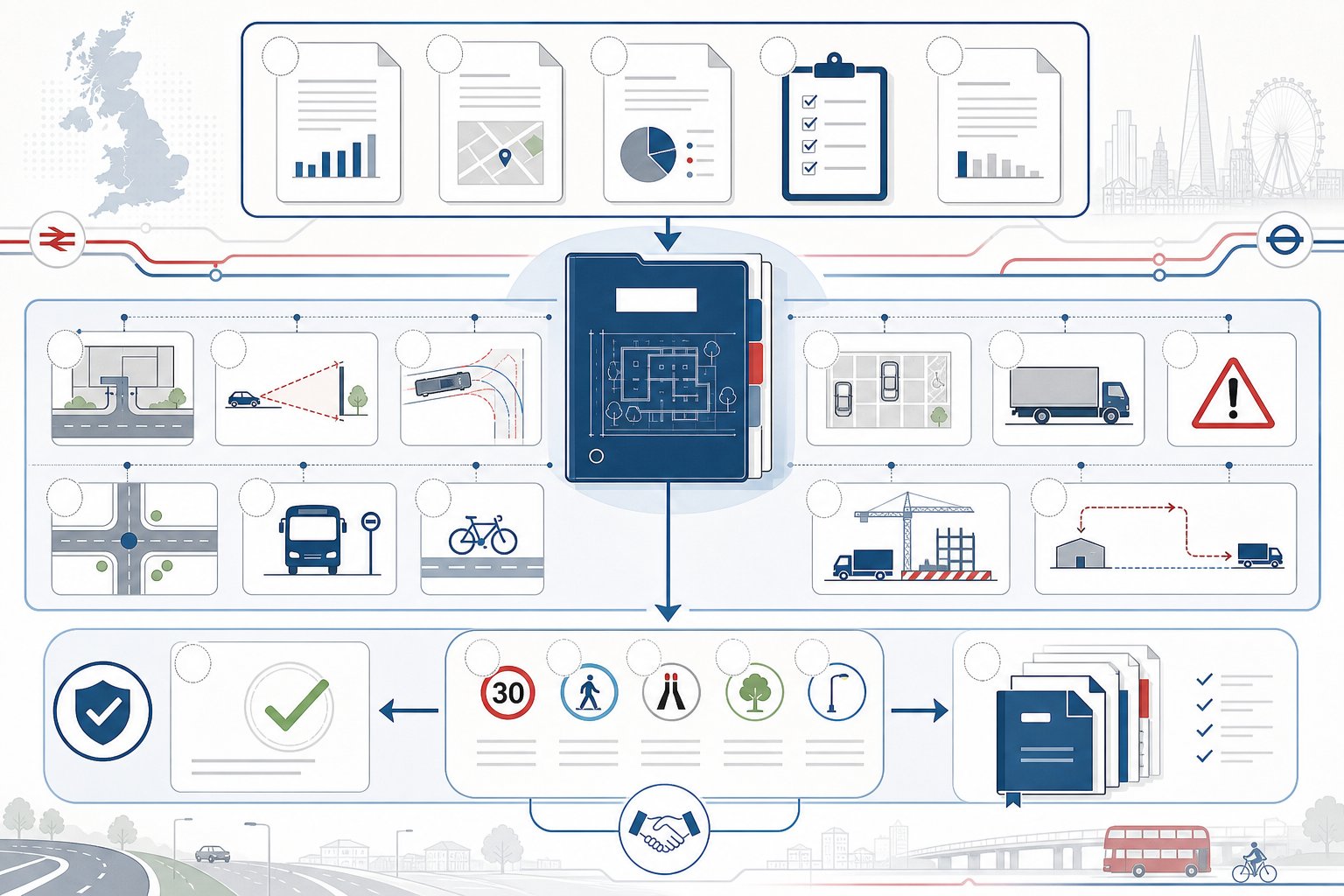
Transport evidence should match the likely effect of the development. That sounds obvious, but plenty of applications still fail because the report package is either too thin to answer basic concerns or so overblown that it obscures the real issues.
The core suite usually starts with a Transport Statement or Transport Assessment, sometimes accompanied by a Travel Plan. Depending on the site, that may be supported by access drawings, visibility plans, swept-path analysis, parking accumulation evidence, servicing strategy, road safety review, and junction modelling. On more constrained schemes, we may also need delivery management measures, construction access commentary, public transport assessment, or active travel audit work.
The point is not to throw every technical appendix at an application. It is to provide enough reliable evidence for officers and highway consultees to conclude that the scheme is acceptable, and to understand any mitigation required.
Clear report structure matters too. A well-prepared application shows how the transport evidence relates to the plans, the design and access statement, and the planning case. Where those threads line up, consultees tend to spend less time trying to work out what the development is actually proposing. That alone can save weeks.
Transport Statements, Transport Assessments, And Travel Plans
These are the documents most planning teams talk about first, and with good reason. They are the standard framework used across the UK to explain transport effects.
A Transport Statement is generally suited to lower-impact development. It describes the site, existing conditions, access arrangements, parking, sustainable travel opportunities and expected trip effects in a concise format. It still needs evidence, but the emphasis is proportionate explanation rather than extensive modelling.
A Transport Assessment is the heavier-duty document for schemes with material transport implications. It usually covers baseline conditions, trip generation, trip distribution, assignment, junction capacity, road safety, accessibility, servicing, parking, and mitigation in much greater depth. If a proposal is likely to prompt serious scrutiny from the highway authority, the TA is often where the argument is won or lost.
A Travel Plan focuses on behaviour and management. It sets out measures to reduce reliance on the private car and increase walking, cycling, car sharing and public transport use. For many employment, education and larger residential schemes, it is a practical part of the planning package rather than a box-ticking appendix.
Teams needing a sharper read on scope often benefit from comparing the demands of a formal TA with a narrower transport assessment for schemes where impacts are present but still manageable through proportionate evidence.
Junction Reviews, Access Appraisals, And Parking Evidence
This is the material that often decides whether a consultee is comfortable with the proposal. A planning statement may say the scheme is sustainable: a junction review or access appraisal shows whether that claim survives technical scrutiny.
Junction reviews test the effect of development traffic on surrounding nodes, usually with observed operation, queue review and, where needed, capacity modelling. The key is realism. Over-optimistic assumptions or opaque distribution patterns are quickly challenged.
Access appraisals examine the practical safety and functionality of getting in and out of the site. That includes geometry, visibility splays, speed environment, pedestrian crossing routes, cycle access, gradients and interaction with nearby frontages or junctions. On awkward sites, a small design adjustment can make a remarkable difference.
Parking evidence should do more than count bays. It needs to show that provision is policy-aware and workable for the land use, location and user profile. For many schemes, that means demonstrating how parking demand, disabled provision, cycle parking, electric vehicle charging and servicing arrangements have been considered together.
Where public transport or active travel is central to the strategy, adjoining evidence from Public Transport Strategy or local sustainable movement work can strengthen the overall case, provided it is tied back to the actual site and occupier pattern.
The Key Evidence Needed To Build A Defensible Case
A defensible case is one that can withstand normal planning scrutiny without collapsing into assertion. In transport terms, that usually rests on five pillars.
First, credible trip generation. The data source must fit the proposed land use, location and likely mode share. Weak comparator selection is a common point of attack.
Second, transparent trip distribution and assignment. Officers and highway authorities need to understand where traffic is expected to travel and why. If the logic is unclear, confidence falls quickly.
Third, capacity and operational analysis where material impacts are possible. This does not always mean complex modelling, but it does mean using the right tool for the right issue and explaining assumptions clearly.
Fourth, road safety and access evidence. Collision records, visibility, turning paths, pedestrian movement and servicing all matter because safety concerns remain among the fastest ways for objections to gain traction.
Fifth, policy compliance and sustainable access. A strong application shows not only that impacts are acceptable, but that the site provides genuine opportunities for walking, cycling and public transport use, or that mitigation can improve them.
In our experience, the strongest submissions combine those elements with clear drawings and concise reporting. Increasingly, teams also pair conventional analysis with Sustainable Transport Consultants input where mode shift and future-proofing are central to the planning narrative.
Common Reasons Transport Objections Arise
Transport objections rarely appear out of nowhere. Most can be traced to a predictable gap in evidence, design or strategy.
One common problem is using the wrong level of assessment. If a scheme with genuine peak-hour implications is supported by a lightweight statement, consultees often conclude that impacts have been understated. The opposite can also create trouble: an overcomplicated report full of unnecessary technical material can distract from the actual planning issues and invite challenge on minor points.
Another frequent cause is inconsistency. Drawings, parking schedules, swept paths, red-line boundaries and report assumptions must align. If they do not, the authority may question the reliability of the whole package.
Timing is another issue. Late transport input tends to preserve flawed layouts rather than improve them. By then, the design team may be defending a suboptimal access point, awkward servicing route or unsupported parking ratio simply because the programme has moved on.
And then there is presentation. Dense, jargon-heavy reports can make a reasonable scheme look uncertain. Clear evidence, explained plainly, is usually far more persuasive.
For many developer-led schemes, that is why Private Sector Transport advice works best when it is integrated with planning and design decisions rather than left to tidy up at the end.
Highways Safety, Capacity, Sustainability, And Servicing Issues
If we strip transport objections down to their essentials, four themes recur.
Highways safety concerns usually relate to access visibility, vehicle conflict, unsuitable geometry, pedestrian risk, or a poor response to the surrounding speed environment. Even where traffic growth is modest, authorities may resist a proposal if the site access feels awkward or unsafe.
Capacity objections focus on whether development traffic would cause severe impact at nearby junctions or worsen existing congestion in a material way. This is where realistic baseline review and proportionate modelling matter. A bad forecast can haunt an application.
Sustainability concerns arise where the location or design appears overly car-dependent. Weak walking links, poor cycle parking, limited bus access, or the absence of practical mode-shift measures can undermine a scheme even if highway capacity is technically manageable.
Servicing is often underestimated. Refuse collection, deliveries, emergency access and larger vehicle manoeuvring all need to work cleanly. If a servicing plan relies on heroic assumptions, consultees notice.
The good news is that these issues are usually identifiable early. Once recognised, they can often be addressed through layout changes, revised management measures, or targeted evidence rather than wholesale redesign.
How To Align Transport Advice With Design Teams And Planning Strategy
Transport planning works best as a live conversation, not a final-stage commission. Architects, planners, highways specialists, landscape teams and clients are often solving the same problem from different angles: how to make the scheme both attractive and approvable. If transport advice is isolated, conflicts emerge quickly.
We find alignment usually depends on three habits. First, agree the transport strategy early: access principles, likely report scope, parking philosophy, servicing approach and sustainability goals. Second, test those principles against evolving layouts rather than waiting for a supposedly final plan. Third, keep the planning narrative consistent across all documents.
That consistency matters more than many teams realise. If the planning statement argues that a scheme is sustainably located, the transport evidence should demonstrate walkable catchments, bus accessibility and cycle provision. If the design and access statement celebrates placemaking, the transport work should not quietly rely on vehicle movements that compromise it.
It also helps to define what success looks like with the highway authority. Is the aim to demonstrate negligible impact, acceptable residual impact with mitigation, or policy compliance through a balanced package of measures? Different schemes need different answers.
Done well, transport input supports design quality instead of limiting it. Done badly, it becomes an expensive argument over problems that could have been coordinated away.
Choosing Practical, Proportionate Advice For Different Development Types
Not every site needs a full technical arsenal. The right approach depends on risk, context and likely policy sensitivity.
For small infill residential schemes, a concise Transport Statement, access review, parking assessment and perhaps a simple swept-path check may be enough. The objective is to demonstrate limited impact and workable site operation without creating unnecessary technical bulk.
For larger residential development, the emphasis often expands to trip generation, distribution, junction analysis, travel planning, internal street function and sometimes school-run sensitivity. Mixed-tenure or phased schemes may also need a more careful management narrative.
For commercial and employment sites, servicing, staff travel patterns, parking accumulation and peak-hour traffic interaction are usually central. Warehouse and logistics uses can require particularly careful review of HGV routing and yard operation.
For town-centre, education, healthcare and mixed-use schemes, sustainable transport, footfall patterns, public transport accessibility and operational timing often carry significant weight alongside traffic impacts.
The principle is simple: scale the evidence to the real planning issues. Too little invites objection. Too much can waste budget and muddy the message. Proportionate scoping, grounded in local thresholds and site realities, is what turns transport advice from a compliance exercise into a practical tool for securing permission.
Conclusion
Robust transport planning advice is really about judgement. The best work is proportionate, evidence-led and closely tied to the design and planning strategy behind the application. It anticipates the questions a highway authority will ask, answers them clearly, and avoids dressing uncertainty up as certainty.
In 2026, that matters more than ever. Validation requirements remain detailed, highway authorities are under pressure, and development teams cannot afford preventable redesign or avoidable refusals. Whether a project needs a concise Transport Statement or a fuller package of assessment, travel planning, access and parking evidence, the aim is the same: build a credible transport case early enough to influence outcomes.
For architects, planners, developers, solicitors and councils, the practical takeaway is straightforward. Treat transport as a core planning discipline from the outset. When the evidence is aligned with policy, design and delivery, applications tend to move more smoothly, objections narrow, and decisions become easier to justify.
Frequently Asked Questions About Robust Transport Planning Advice
What does robust transport planning advice involve in the UK planning process?
Robust transport planning advice involves proportionate, evidence-led analysis demonstrating a development is safe, policy-compliant, and deliverable. It supports decision-makers by addressing access, movement, safety, and sustainability within the planning balance, ensuring clear and defensible transport evidence early on.
When is transport input typically required for a development project?
Transport input is generally required for most non-householder developments and larger householder schemes where changes in trip generation, parking, access, or safety could materially affect local conditions. Smaller schemes still need review if they alter access or parking or affect sensitive sites.
How can early transport advice reduce planning risks for developers?
Early transport advice helps shape access, parking, and trip strategies from concept stage, avoiding costly redesign and supporting viability against local policy and network constraints. It allows for clear alignment with highway authorities, reducing surprises, objections, and delays.
What are the core reports used to support a planning application?
Core reports include a Transport Statement (TS) for lower-impact schemes, a Transport Assessment (TA) for larger developments with material impacts, and a Travel Plan to manage travel behaviour. These may be complemented by access appraisals, swept-path analysis, and parking and servicing strategies.
Why do transport objections commonly arise in planning applications?
Objections often stem from insufficient or inconsistent evidence, safety concerns such as poor access visibility, severe traffic capacity impacts, inadequate parking or servicing provisions, and lack of sustainable travel options. Timing and clarity of reporting also influence objections.
How should transport planning advice be coordinated with design teams and planning strategies?
Transport planners should work collaboratively with architects and planners from the start, agreeing on access, parking, servicing, and sustainability goals. Iterative testing of transport principles against evolving designs ensures a consistent planning narrative aligning transport evidence with policy and strategy.