
Planning risk rarely starts with a dramatic refusal notice. More often, it starts quietly: a site access that looked fine on a concept sketch but fails a visibility check: a residential layout that works architecturally but not for refuse tracking: a retail proposal that underestimates Saturday peak trips: a planning officer who is broadly supportive, while the highway authority remains unconvinced. That gap between “good development idea” and “consent-ready scheme” is exactly where private sector transport planning matters.
In practice, private sector transport planning helps developers, architects, planners, surveyors, lawyers and councils turn transport and highways issues into evidence-led solutions. We use it to test whether a site can be accessed safely, whether the surrounding network can absorb demand, what mitigation is proportionate, and how a scheme can align with local and national policy on sustainable travel. Done early, it protects viability and saves redesign. Done late, it often becomes expensive catch-up.
In 2026, that early input matters even more. Authorities are looking closely at safe access, active travel, servicing, parking restraint, and cumulative impacts from nearby committed development. So the goal is no longer just producing a report to satisfy validation. It is producing the right transport evidence, at the right level, at the right time, so planning applications move with fewer surprises and stronger prospects of approval.
What Private Sector Transport Planning Covers And Why It Matters

Private sector transport planning covers the transport, access and highways work needed to support development in the real world. That includes early feasibility, access strategy, trip generation, junction capacity analysis, walking and cycling connectivity, parking design, servicing, Travel Plans, construction logistics, and negotiations with planning and highway authorities.
For most project teams, the value is practical rather than theoretical. A transport planner tells us whether a proposed access can work before a layout hardens. We can identify whether the site is likely to need a Transport Statement or a full TA, whether visibility splays depend on third-party land, whether swept path problems will affect unit size or yard depth, and whether local parking standards are likely to become a planning flashpoint.
It also matters because transport is one of the few disciplines that cuts across design, policy, engineering, legal agreement and politics. A scheme may be excellent in land-use terms, but if the authority believes it creates unsafe access or severe network effects, permission can still fall away. Good private sector transport planning reduces that risk by translating policy tests into evidence and workable mitigation.
On more complex sites, transport planning also protects development value. A better access arrangement, more efficient internal geometry, or a proportionate mitigation package can preserve net developable area and avoid over-engineering. That is why experienced teams treat transport planning as part of scheme formation, not just a late planning appendix.
How Transport Planning Supports Planning Applications And Development Viability

Transport planning supports planning applications by showing that a development can be accessed safely and that its traffic effects are acceptable, or can be made acceptable through mitigation. In England, that usually means addressing familiar policy tests: safe and suitable access for all users, and residual cumulative impacts on the road network that would not be severe.
That sounds simple. It rarely is. The transport case for a scheme often sits on several moving parts at once: predicted trip generation, peak-hour distributions, base traffic assumptions, committed developments, local junction sensitivity, parking standards, servicing arrangements and sustainable travel opportunities. A robust assessment brings those strands together and explains why the proposal should be acceptable in highway terms.
Viability is where transport planning becomes especially valuable. The right strategy can avoid abortive redesign, prevent unnecessary highway works, and help teams target mitigation where it will actually change decision-making. We often find that a relatively modest intervention, such as a revised ghost island layout, improved pedestrian links, a delivery strategy, or an agreed Travel Plan package, does more for consent prospects than a broad but unfocused list of transport promises.
There is also a direct relationship between transport efficiency and commercial return. Parking, servicing and access geometry affect floorspace, unit mix and operational performance. On many schemes, especially housing and logistics, end to end transport input helps teams strike the right balance between compliance, cost and net developable value.
For larger or more sensitive sites, transport planning may also feed into EIA work, section 106 negotiations, section 278 delivery, and planning appeals. In other words, it is not just there to support submission day. It shapes the whole route to consent.
When A Development Needs Transport Input
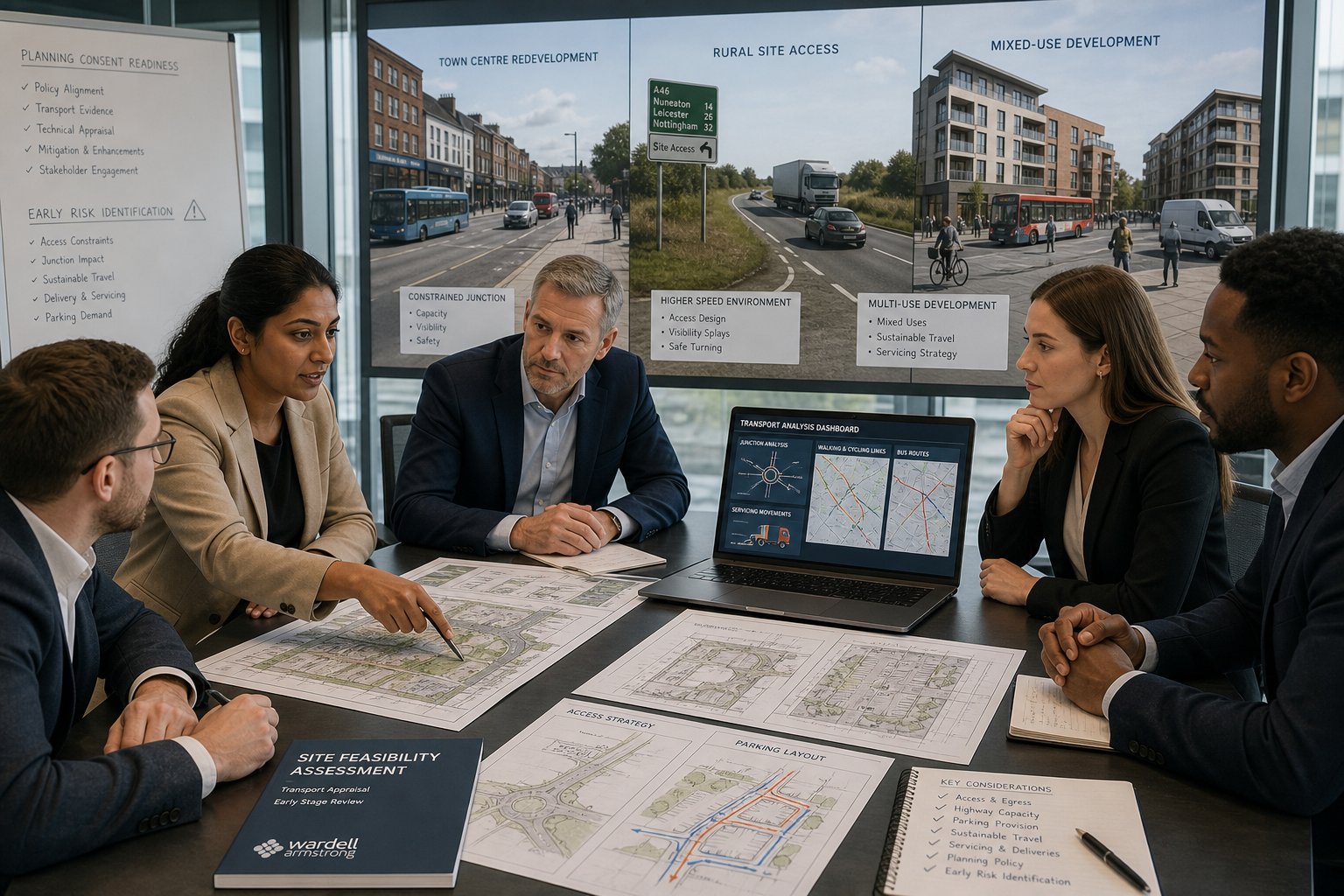
Most schemes benefit from transport input earlier than clients first assume. The common trigger is a local validation requirement for a Transport Statement, Transport Assessment or Travel Plan above certain thresholds. But formal thresholds are only part of the picture.
A development usually needs transport input when it changes trip patterns, introduces a new access, intensifies an existing use, depends on constrained on-street conditions, or sits in a location where walking, cycling and public transport links are weak. Even a modest proposal can become transport-sensitive if the nearby junctions are already stressed or if the site relies on awkward servicing.
Another point worth stressing: the need for transport planning is not limited to large urban schemes. Rural sites often present access visibility issues, speed environment concerns, or sustainability questions. Town-centre proposals may involve loading constraints, pedestrian conflict, parking stress and servicing windows. Education, healthcare and logistics uses create their own peaks and operational nuances.
That is why early feasibility is usually money well spent. A short review can identify whether the transport issue is likely to be strategic, technical, political, or all three.
Typical Trigger Points For Different Land Uses
Thresholds vary by authority, so there is no single national number we can safely apply to every application. Still, some patterns are predictable.
Residential schemes commonly trigger a TS or TA once unit numbers reach the point where peak-hour traffic, parking demand, or local concern becomes material. Larger housing sites frequently need Travel Plans as well, particularly where active travel and bus accessibility are central policy themes. Detailed guidance in a Residential Development Transport context often turns on local threshold tables, site context and cumulative growth nearby.
Retail, foodstore and leisure proposals tend to trigger transport work at lower floorspace levels because they attract comparatively high trip rates and can create pronounced weekend and inter-peak effects. Employment and logistics uses are often judged less by gross floor area alone and more by HGV activity, shift patterns, yard operation and servicing demands.
Schools, colleges, clinics and care facilities also draw close scrutiny. Their impact may be tied to sharp arrival and departure peaks, pick-up activity, or vulnerable road user movements rather than total daily volume.
Early Warning Signs That Transport Risks Could Delay Consent
Some warning signs appear very early, if we are paying attention. Access on a bend, near a busy junction, or onto a higher-speed road is an obvious one. So is any arrangement that depends on third-party land for visibility splays, widening, footway links or tracking.
Parking is another classic pressure point. Too little parking can trigger overspill concerns. Too much can conflict with policy or undermine a sustainability narrative. Neither is automatically fatal, but both need a reasoned position.
We also watch for weak walking and cycling connections, poor bus accessibility, steep topography, constrained frontage, and layouts where refuse or servicing vehicles can only operate through awkward manoeuvres. If highway officers start asking for extra modelling, stage 1 road safety concerns, or more detailed tracking before validation or soon after submission, that is usually a sign the file may not move quickly.
In many cases, the delay is not caused by one fatal flaw. It is caused by several manageable issues arriving too late and all at once.
Core Transport Planning Documents Explained
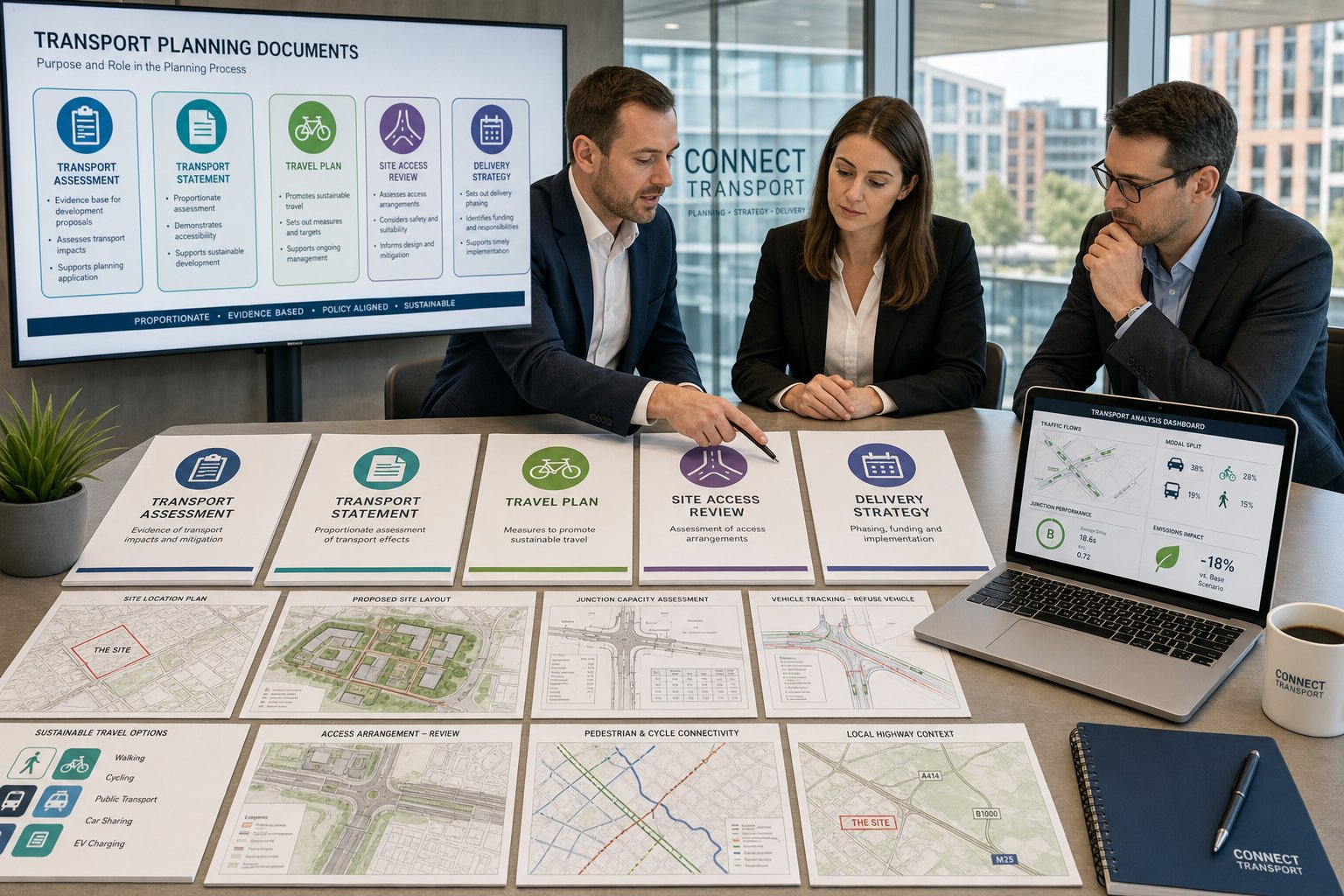
Transport planning reports are not interchangeable. Each document has a distinct purpose, level of technical depth and planning role. Choosing the right one matters because authorities tend to react badly to overblown submissions just as they do to thin, under-scoped ones.
At the broadest level, the document set may include a Transport Assessment, Transport Statement, Travel Plan, technical note, site access review, Construction Traffic Management Plan, Delivery and Servicing Management Plan, and in some cases junction modelling files, road safety analysis or transport chapters for EIA. The art is proportion.
A small urban infill scheme with established access and limited traffic impact may only need a concise statement plus tracking and cycle parking detail. A larger mixed-use or edge-of-settlement development may require a full suite of reports, modelling and mitigation design.
For planning teams, the key is to understand what each document is intended to prove. One report might demonstrate network impact. Another might explain operational freight management. Another might secure policy support around sustainable travel behaviour. When those roles blur, the submission tends to become harder to review and easier to challenge.
Transport Assessments, Statements, And Travel Plans
A Transport Assessment is the fuller, more analytical document, usually used where traffic impacts are material or the authority expects detailed evidence on trip generation, distribution, assignment, junction performance, road safety and mitigation. A Transport Statement is shorter and more proportionate, suited to smaller developments where impacts are limited but still need structured explanation.
Both are typically shaped by local policy, validation requirements and accepted professional guidance. They often include baseline conditions, accessible mode review, parking review, trip rates, operational assessment and recommendations. Where the scheme is larger or more sensitive, the technical standard rises quickly. That is where experience in transport assessment for development proposals becomes important, because assumptions around surveys, committed development and model scenarios can materially alter conclusions.
Travel Plans sit alongside those reports. Their job is not to pretend cars disappear. It is to set out practical measures, welcome packs, cycle facilities, public transport information, car club provision, monitoring, coordinator roles, targets and reviews, that help reduce single-occupancy vehicle reliance over time. Authorities increasingly expect them to be specific, deliverable and monitored, not generic policy cut-and-paste.
Technical Notes, Site Access Reviews, And Delivery Strategies
Technical notes are targeted documents used to address one issue clearly and quickly. That might be visibility splays, parking accumulation, speed survey interpretation, refuse tracking, or a response to highway comments. On many applications they are the quiet workhorses that keep the process moving.
Site access reviews are usually commissioned early. They test whether the site can be served safely by all relevant users and whether design assumptions stack up. We look at geometry, visibility, gradient, frontage constraints, conflict points, nearby junction influence, and whether the access can be delivered within land control. Those reviews often save weeks of redesign later.
Delivery strategies, including DSMPs and construction plans, are particularly important for constrained urban sites, logistics uses and mixed-use schemes. They explain what vehicle types will arrive, when they will arrive, where they will turn, where they will wait, and how conflict with residents, pedestrians and cyclists will be controlled. Strong Traffic Engineering and input is often what turns a servicing concern from a likely objection into a managed operational condition.
Key Issues Reviewed By Local Planning And Highway Authorities

Local planning and highway authorities generally review the same broad themes, though the weight given to each will vary by site and politics as much as by policy. First is safe access: can vehicles, pedestrians and cyclists enter and leave the site in a way that is legible, policy-compliant and genuinely safe rather than merely technically arguable?
Then comes network effect. Officers will look at how many trips the scheme adds, when they occur, how they distribute, whether nearby junctions have realistic reserve capacity, and whether queues or turning movements create knock-on safety or amenity problems. If an authority is already worried about cumulative growth in the area, committed development assumptions become especially important.
Parking and servicing are reviewed closely too. Is parking provision consistent with local standards and context? Are disabled bays, cycle stores and EV spaces sensibly integrated? Can deliveries, refuse collection and emergency access operate without blocking the highway or creating awkward reversing?
Sustainable travel is no longer an afterthought. Authorities increasingly ask whether walking, wheeling, cycling and bus access are genuinely attractive, not just theoretically available. On some schemes, input from Sustainable Transport Consultants can strengthen that part of the case where mode shift expectations are high.
Finally, they assess credibility. Are the survey dates sensible? Do the assumptions feel transparent? Does the mitigation match the identified problem? A technically polished report can still attract resistance if it appears to underplay obvious local concerns.
The Private Sector Transport Planning Process From Feasibility To Decision
The process usually starts with feasibility and due diligence. Before a design team gets too far, we test access options, visibility, likely report requirements, broad trip levels, and whether there are obvious showstoppers. At this stage, the best advice is often brutally concise: yes, but only with redesign: yes, if mitigation is accepted: or no, not without significant planning risk.
Next comes pre-application scoping. This is where we engage with the local authority, and sometimes the highway authority separately, to agree what level of assessment is proportionate. If that discussion goes well, it can save a lot of wasted modelling and argument later. If it is skipped, teams can end up writing to the wrong scope and spending twice.
Detailed assessment follows. That may involve traffic surveys, TRICS-based trip generation, distribution and assignment, junction modelling, swept path analysis, accessibility audits, Travel Plan drafting and preparation of construction or servicing documents. On more involved projects, Transport Planning Consultants: support is most valuable here because the process becomes iterative, design changes affect transport, and transport findings affect design.
Then comes submission and negotiation. Highway comments arrive, often in waves. Clarifications are issued, technical notes are prepared, mitigation is revised, and legal agreement heads of terms may start to emerge.
After decision, the work often continues: discharging conditions, detailed section 278 design, Travel Plan monitoring, Construction Traffic Management Plan updates, and occasionally appeal or expert witness support. That is why the strongest teams think in programme terms, not just report terms.
Common Transport Planning Problems And How To Avoid Them
The most common problem is timing. Transport planners are often brought in after the red lines are fixed, unit numbers are tested, and the access has been sketched into a layout that nobody wants to change. At that point, even minor transport constraints can force painful redesign.
The second problem is under-scoping. Teams assume a short statement will do, only to discover the authority wants junction modelling, speed surveys, a Travel Plan and delivery strategy. That creates delay, not because the scheme is impossible, but because the evidence arrives in fragments.
Data quality is another recurring issue. Poor survey timing, weak assumptions on committed development, unrealistic modal share claims, or selective use of trip rates can all undermine credibility. Authorities may forgive an honest technical disagreement: they are less forgiving when a report feels slanted.
We also see projects stumble on parking and servicing. Car parking levels are argued without a clear local evidence base. Cycle parking is treated as a schedule item rather than a usability issue. Deliveries are left vague even when the site is constrained. A lot of that can be avoided through early operational thinking and, where needed, advice from Transport Assessment Consultants: teams with relevant sector experience.
The simplest ways to avoid problems are consistent: appoint early, agree scope, be transparent with assumptions, stress-test access before the layout settles, and respond to authority concerns with evidence rather than irritation. It sounds obvious. It is still where many applications go wrong.
How To Choose A Transport Planning Consultant For Your Project
Not every consultant is right for every scheme. The best choice depends on project type, authority area, programme pressure and how much strategic judgment you need, not just who can produce a report quickest.
First, look for relevant sector experience. Residential, roadside retail, urban mixed-use, schools, logistics and rural employment schemes all raise different transport issues. A consultant who understands the development type will spot the likely objections early and know which matters genuinely influence determination.
Second, ask how they approach scope and risk. A good consultant should be able to explain, in plain terms, what documents are likely to be needed, what the authority may challenge, what surveys are required, and where the programme pinch points sit. Vague reassurance is not enough.
Third, consider local authority familiarity. We do not mean cosy relationships: we mean practical knowledge of threshold tables, parking expectations, modelling preferences and common review themes in that area. Firms with long experience, ML Traffic, for example, positions its offer around concise, accurate reporting and understanding local authority thresholds, often add value here because speed without local judgement is not especially helpful.
Finally, test communication. Will they engage well with architects, planners, lawyers and highways officers? Can they defend a position firmly without becoming combative? Strong private sector transport planning is as much about judgement and negotiation as it is about software outputs.
In short, choose the team that can reduce risk across the whole planning journey, not just deliver a PDF.
Conclusion
Private sector transport planning is not a bolt-on technical exercise. It is part of how good schemes become consentable schemes. When we bring transport input in early, the benefits are usually tangible: safer access, better layouts, clearer mitigation, more credible planning evidence and fewer delays caused by avoidable surprises.
For architects, planners, lawyers, surveyors, developers and councils, the practical lesson is straightforward. Treat transport as a strategic workstream from feasibility onward, then scale the evidence to the real level of impact. Some projects need a concise statement and a couple of focused notes. Others need modelling, Travel Plans, servicing strategy and sustained negotiation. The trick is knowing which is which early enough to act on it.
In 2026, with authorities paying closer attention to safety, sustainability and cumulative impact, well-judged transport planning is one of the clearest ways to improve planning confidence without wasting time or overcomplicating the case.
Private Sector Transport Planning – Frequently Asked Questions
What is private sector transport planning and why is it important?
Private sector transport planning applies transport expertise to help developers design safe, efficient, and sustainable access, supporting planning permissions. It matters because it reduces risks like unsafe layouts or congestion, improves scheme viability, and aligns with policy on sustainable travel in 2026 and beyond.
How does private sector transport planning support planning applications and development viability?
It demonstrates safe and suitable access and that residual traffic impacts are not severe, helping to secure approvals. Transport planning also identifies targeted mitigation, optimises parking and access design, and can enhance financial returns by maximising developable space while complying with standards.
When is transport planning input required for a development?
Transport input is typically needed when developments exceed local thresholds for traffic impact or trip generation, introduce new or intensified access, occur in constrained or sensitive locations, or where walking, cycling, and public transport links are weak. Even modest schemes may require input if nearby junctions are already stressed.
What are the typical transport planning documents involved in supporting developments?
Common documents include Transport Assessments (full, detailed reports for larger impacts), Transport Statements (lighter reports for smaller schemes), Travel Plans to reduce car use, Construction Traffic Management Plans, and Delivery and Servicing Management Plans. Each has a distinct role in demonstrating compliance and managing impacts.
What early warning signs indicate that transport risks might delay planning consent?
Signs include site access near busy or constrained junctions, reliance on third-party land for visibility, parking levels significantly above or below standards, poor public transport or active travel links, and early requests from highway authorities for additional modelling or safety analysis. Addressing these early can prevent delays.
How should developers choose a transport planning consultant?
Choose consultants with relevant sector experience, local authority knowledge, and a track record in negotiation and risk management. They should provide clear scope advice and communicate well with teams and authorities. The right partner supports the whole process from feasibility to post-consent, not just report writing.