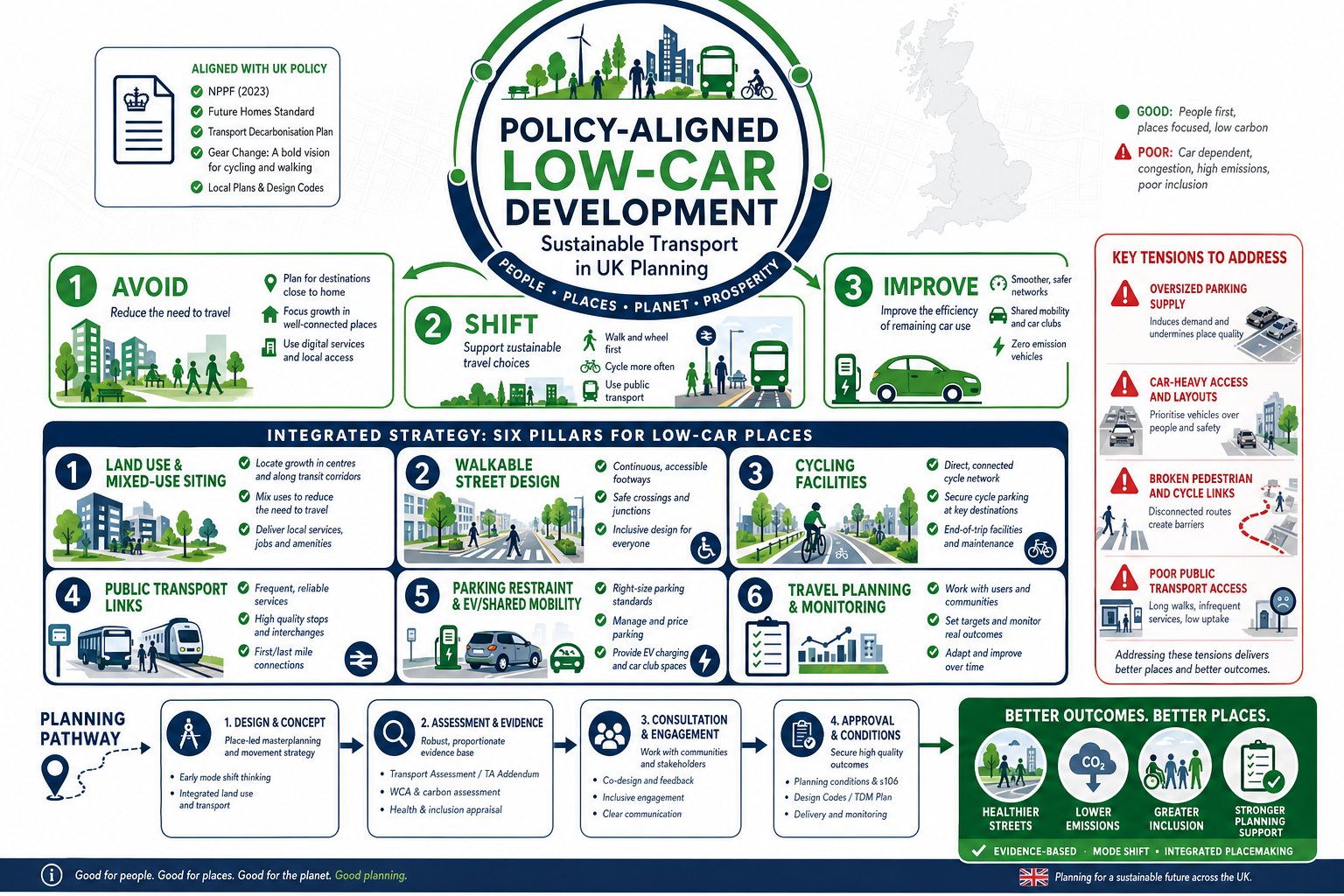
A planning application can still look technically competent on paper and yet run into predictable resistance because the transport story is too car-led, too thin on evidence, or simply out of step with current policy. That gap matters more in 2026 than it did even a few years ago. Local authorities, consultees and appeal decisions are increasingly testing whether development genuinely supports lower-carbon, healthier and more inclusive movement patterns.
When we talk about sustainable transport initiatives, we’re not talking about a token cycle stand near reception or a Travel Plan appended at the last minute. We mean a coordinated package of land-use choices, street design, access arrangements, parking controls, public transport integration and behaviour-change measures that reduces car dependence in a credible way.
For architects, planners, lawyers, surveyors, developers and councils, the challenge is practical: what does a policy-aligned scheme actually need to show? Not just in principle, but in a Transport Statement, a full Transport Assessment, a Design and Access Statement, committee reporting, and sometimes at appeal.
In this text, we set out what sustainable transport means in a development context, why it now sits near the centre of planning decisions, which policy pressures are driving requirements, and how to build measures that stand up to scrutiny. The aim is simple: help project teams prepare smarter submissions that are easier to defend and more likely to secure support.
What Sustainable Transport Initiatives Mean In A Planning And Development Context
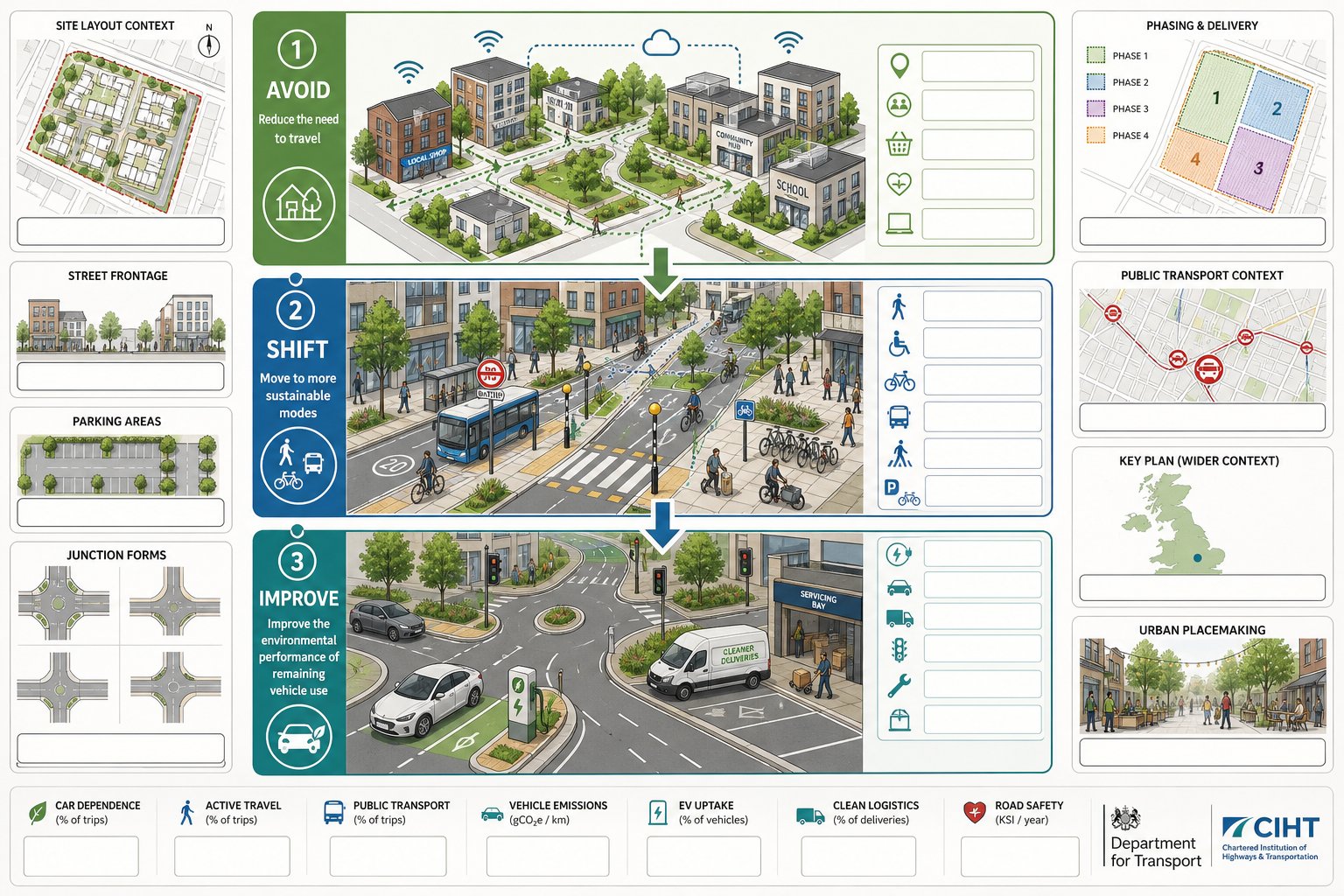
In planning terms, sustainable transport initiatives are the measures built into a scheme to reduce the need to travel by private car, support mode shift, and improve the environmental and social performance of movement. The best way to understand them is through the familiar avoid-shift-improve hierarchy.
First, we avoid unnecessary travel by locating development where trips can be shorter and more easily combined. Mixed-use layouts, proximity to shops and services, good digital connectivity and sensible site planning all matter here. Then we shift trips towards walking, wheeling, cycling and public transport through direct routes, safe crossings, bus accessibility, cycle parking and realistic mobility choices. Finally, we improve what remains, through cleaner fleets, EV charging, servicing strategies and more efficient network operation.
In practice, this means sustainable transport is not a bolt-on. It affects site layout, frontage design, junction form, permeability, servicing, parking ratios and phasing. On many schemes, the transport strategy is now inseparable from placemaking.
That is one reason early specialist input helps. A well-scoped approach to end to end transport can align access, movement and policy from the outset, rather than trying to retrofit mitigation after design decisions have already narrowed the options.
Why Sustainable Transport Is Now Central To Planning Decisions
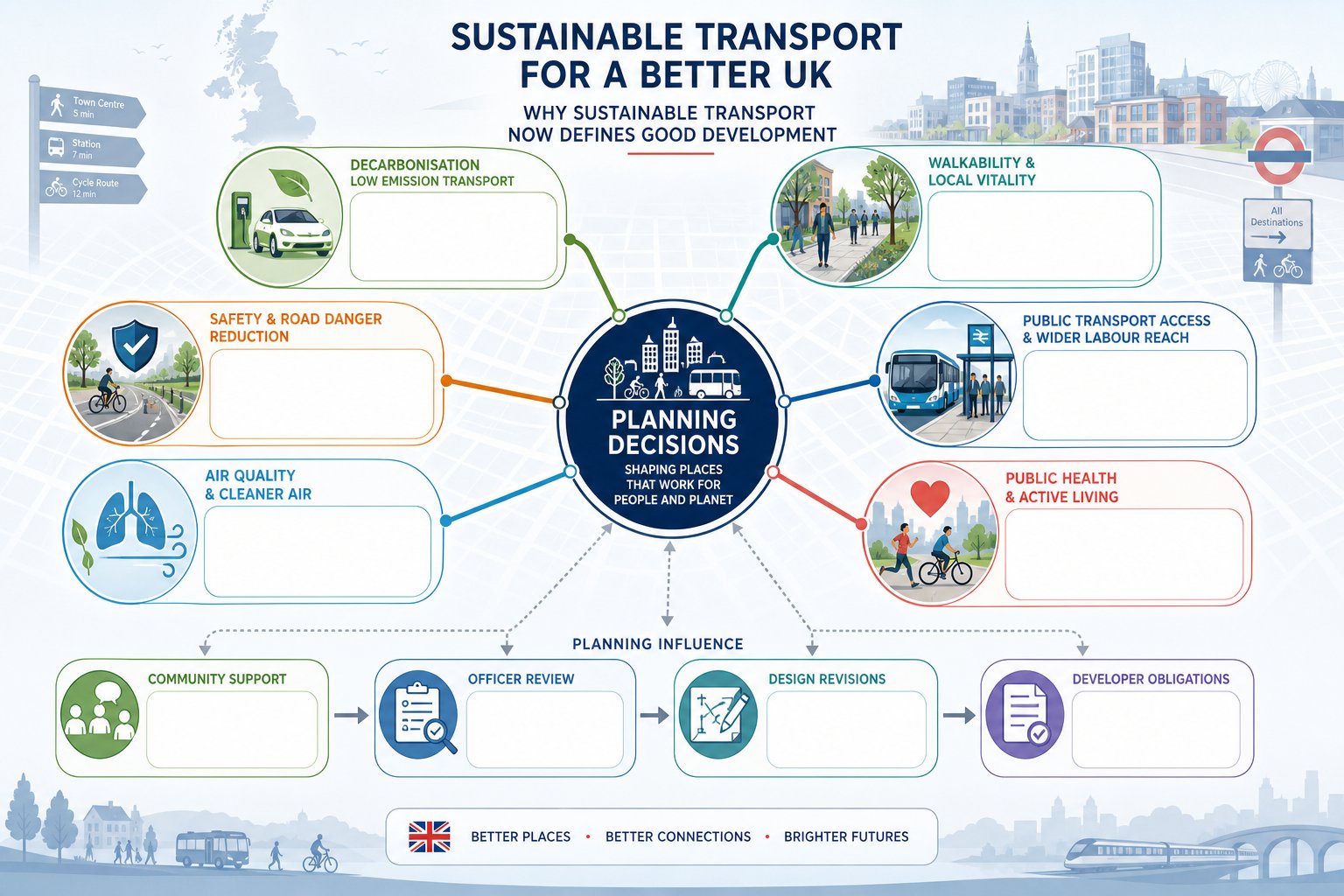
Transport remains one of the hardest sectors to decarbonise, and in the UK it continues to account for a substantial share of territorial greenhouse gas emissions. That fact alone has changed the tone of planning. Authorities are no longer satisfied with a scheme that merely avoids severe highway impact. They increasingly want to know whether the proposal actively supports lower-carbon travel patterns.
But carbon is only one part of the picture. Sustainable transport also touches air quality, road danger reduction, public health, social inclusion and the commercial success of places. A walkable street network can support footfall and local vitality. Reliable public transport access can widen labour catchments. Inclusive design can determine whether older people, children and disabled users can move through a site safely and independently.
This is why transport evidence now carries more strategic weight across the planning process. It influences local support, officer recommendations, section 106 discussions and design revisions. Strong public consultation transport work often reveals the same theme: communities are far more likely to back growth when they can see safer streets, better walking routes and realistic alternatives to extra traffic.
In short, sustainable transport is central because it has become central to what “good development” means.
Policy Drivers Shaping Sustainable Transport Requirements
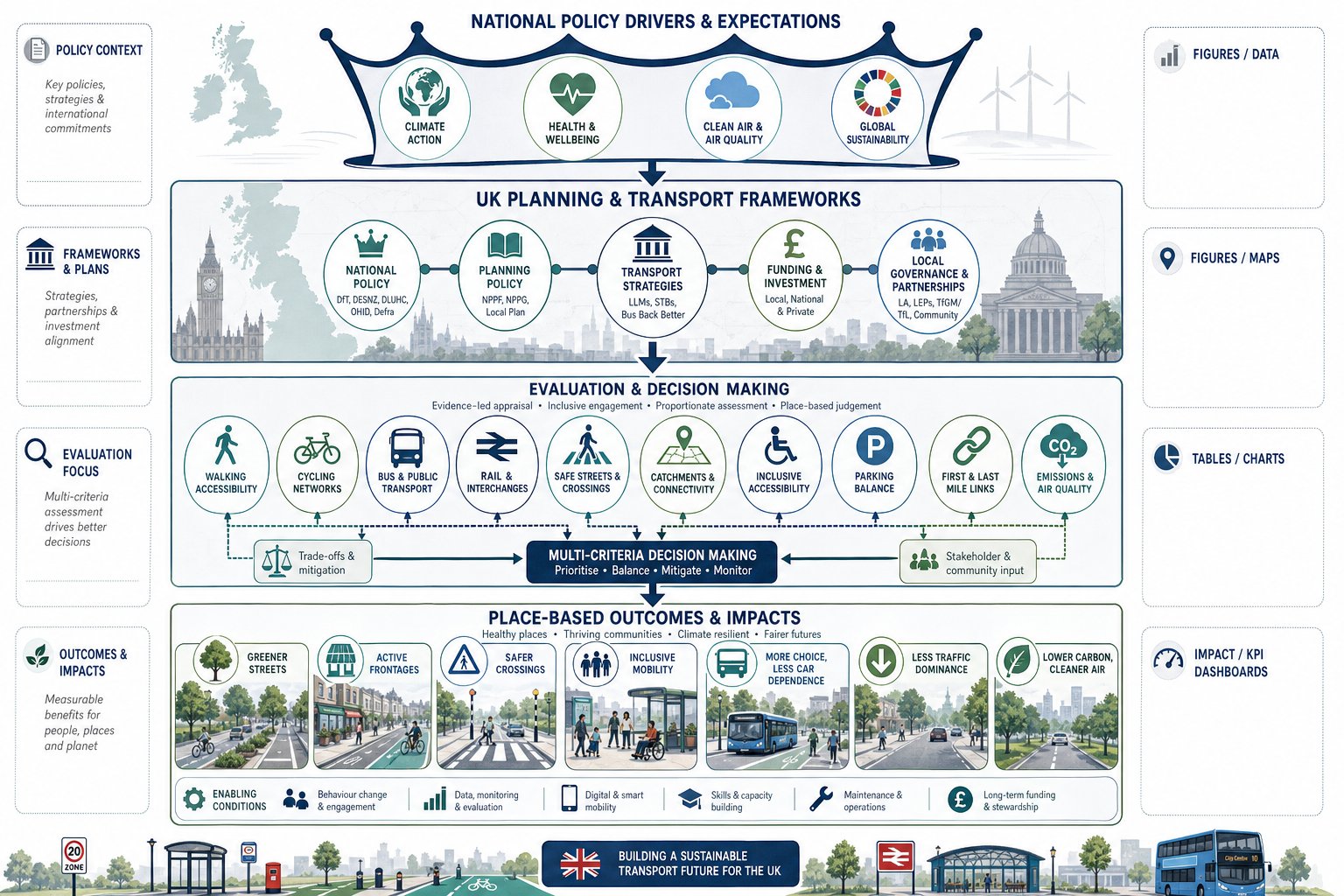
The policy backdrop is now broad, layered and difficult to ignore. At the highest level sit climate commitments, the UN Sustainable Development Goals, public health priorities and air-quality obligations. At national and local level, those themes are translated into planning policy, design codes, transport strategies and net-zero plans.
For applicants, the implication is straightforward: transport submissions must do more than quantify traffic. They need to show how the scheme responds to policy expectations on mode shift, accessibility and emissions, and how the proposed measures will actually work in place-specific terms.
National Policy, Local Plans, And Mode Shift Expectations
National policy and guidance increasingly favour development that prioritises active travel and public transport, particularly in accessible locations. Local Plans then sharpen those expectations through parking standards, cycling requirements, accessibility benchmarks, Healthy Streets policies, low-traffic ambitions or corridor-specific movement strategies.
This is where generic wording causes problems. A statement that a site is “sustainable” is not enough. We need to test catchments, route quality, crossing opportunities, bus frequency, first-and-last-mile barriers, and likely behaviour. On larger or more complex schemes, regional transport planning considerations can also become important, especially where growth areas, strategic road constraints or rail investment programmes shape what local authorities expect.
Applicants are also being pushed towards realistic mode share forecasts. If a scheme promises strong active travel uptake while retaining abundant free parking and poor pedestrian links, decision-makers will spot the contradiction quickly.
Carbon Reduction, Healthy Streets, And Place-Making Goals
Carbon reduction is now a transport issue and a development issue at the same time. Authorities increasingly expect transport measures to support local climate objectives, even where there is no formal standalone carbon threshold in validation requirements.
Healthy Streets thinking has also widened the lens. The question is no longer only whether people can technically walk somewhere, but whether they would sensibly choose to. Are routes direct, overlooked and attractive? Are crossings convenient? Is traffic speed controlled? Are disabled users, schoolchildren and less confident cyclists genuinely catered for?
And then there is placemaking. Streets dominated by vehicle movement, turning radii and surface parking rarely deliver the quality of environment promoted in design narratives. By contrast, sustainable transport initiatives can reinforce active frontages, stronger public realm, social inclusion and economic resilience. The transport strategy is often one of the clearest tests of whether a development vision is real or just well-rendered.
The Core Types Of Sustainable Transport Initiatives Used In New Developments
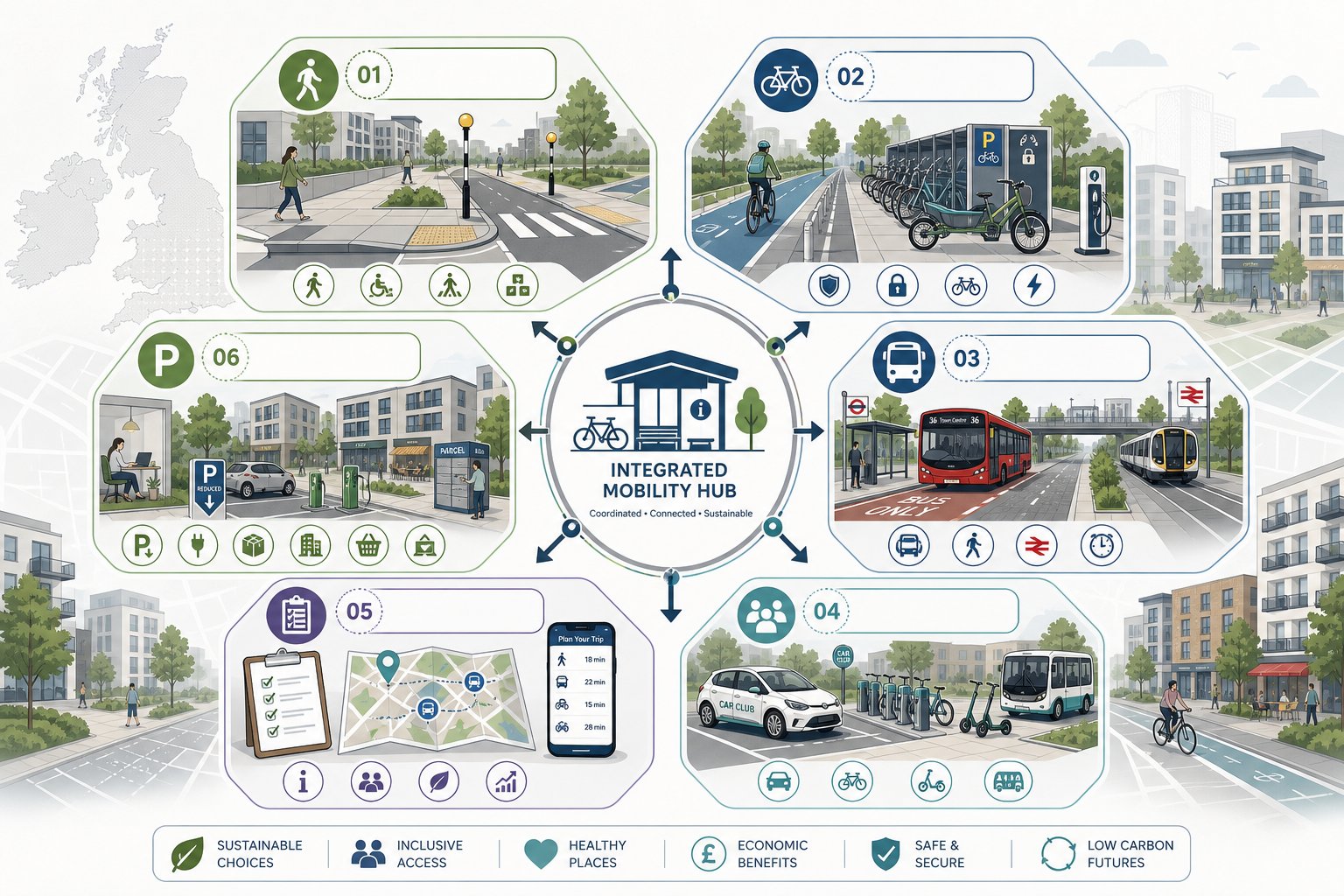
Most successful schemes do not rely on one intervention. They use a package of measures that works together: physical infrastructure, operational controls and behavioural tools. The exact mix depends on scale, location and land use, but there are recurring components that planning authorities expect to see.
Walking, Cycling, Public Transport, And Shared Mobility Measures
For walking, the basics still decide whether a scheme succeeds: direct footways, safe crossings, active frontages, manageable block lengths, step-free routes and clear connections to surrounding streets. Small design choices matter. A missing dropped kerb or an inconvenient crossing can undo a lot of policy language.
Cycling measures need to go beyond minimum standards. Secure and convenient parking, visitor spaces, larger provision for non-standard cycles, e-bike charging, links to existing or planned routes, and junction designs that do not force riders into hostile conditions are all increasingly important.
Public transport integration is equally critical. That may involve upgraded stops, new pedestrian links to stations, contribution mechanisms, travel information, bus priority support, or service discussions during pre-application stages. A mixed use masterplan in particular needs these elements embedded early, because trip chaining and internal capture are central to its transport case.
Shared mobility can add flexibility where private car ownership is being restrained. Car clubs, cycle hire, e-bike schemes and demand-responsive shuttles are not universal answers, but in the right location they can strengthen mode shift credibility.
Travel Planning, Parking Management, And Demand Reduction Tools
Travel Plans still matter, but only when they are specific, funded and monitored. Personalised travel planning, welcome packs, cycle training, promotional campaigns, subsidised public transport offers and targets for review can all support behaviour change. Vague aspiration won’t.
Parking management is often the sharper lever. Reduced car parking provision, active management of unallocated spaces, permit controls, workplace parking discipline, motorcycle provision, cycle-first design and EV charging all shape how people travel. Importantly, parking strategy must align with the narrative on sustainability. A low-car scheme with oversized parking courts sends mixed signals.
Demand reduction is sometimes overlooked because it does not always look like “transport”. Yet mixed-use development, local service provision, remote-working support, parcel locker strategies and on-site facilities can cut trip generation significantly. This is where vision led transport thinking tends to outperform reactive modelling: it starts with how a place should function, then builds the movement strategy around that outcome.
How Sustainable Transport Initiatives Are Assessed In Transport Statements And Assessments
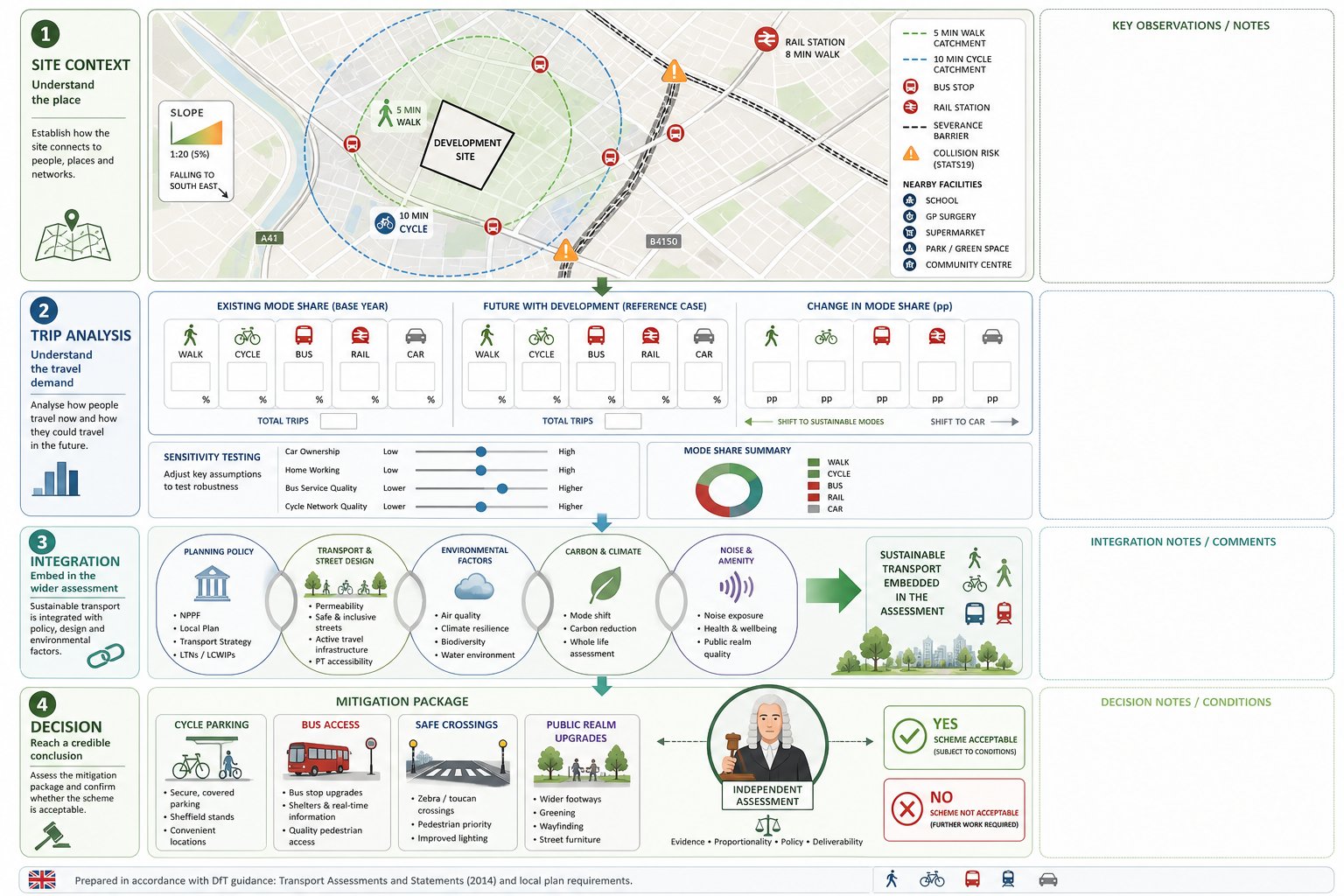
Transport Statements and Transport Assessments remain the main technical vehicles for showing whether sustainable transport initiatives are credible. At a minimum, they should explain baseline accessibility, likely trip generation, mode split, network effects and the mitigation package. But the stronger submissions go further: they connect those findings directly to policy and design.
A robust assessment usually starts by establishing the site context properly. That means not just plotting bus stops and stations on a plan, but reviewing service quality, route comfort, severance, topography, local collision history, nearby facilities and the realism of walking and cycling catchments. Accessibility mapping can be helpful, but only if it reflects actual conditions rather than idealised distances.
Trip generation and mode split then need careful handling. Comparable sites should be genuinely comparable. Census and survey data should be interpreted cautiously, particularly where local travel behaviour is changing. Sensitivity testing is often valuable. If a claimed uplift in cycling is essential to make parking or junction impacts acceptable, we should be able to explain why that uplift is achievable.
Authorities also increasingly expect sustainable transport to be integrated into the wider transport assessment for the scheme, not treated as a separate aspiration. In some cases, parallel work on environmental impact assessment issues such as air quality, carbon and noise can reinforce the planning case for stronger mode shift measures.
The practical question behind every assessment is simple enough: would a decision-maker believe this package will change how people travel?
Design Principles That Make Sustainable Transport Measures More Effective
The most effective measures are not the most numerous. They are the ones that are coherent, legible and rooted in how people actually behave.
Integration comes first. Land use and transport should support each other, with everyday destinations placed within reasonable walking distance and movement corridors designed as part of the masterplan rather than squeezed into left-over space. Directness matters more than many teams admit. People do not choose convoluted routes because a plan legend colours them green.
Safety is equally fundamental. That includes traffic speed management, passive surveillance, forgiving junction design, crossing convenience and cycle infrastructure that works for ordinary users, not just the highly confident. If users feel exposed, mode shift assumptions start to unravel.
Inclusion should be treated as a core design principle, not a compliance note. Step-free movement, resting places, tactile information, lighting, manageable gradients, clear wayfinding and provision for adapted cycles can determine whether the site works for a very wide range of people.
And there is a resilience angle too. Trees, shade, drainage, durable materials and climate-adapted public realm all affect route comfort and reliability. Sustainable transport initiatives succeed when they support everyday convenience in all weather, not just on a presentation board. That is why teams often benefit from bringing in Sustainable Transport Consultants early enough to influence layout, servicing and parking before those decisions harden.
Common Risks That Lead To Objections Or Weak Planning Submissions
The first recurring risk is over-reliance on car access. That usually shows up as generous parking, weak internal walkability, poor bus integration and a mitigation package that assumes travel behaviour will somehow become sustainable later. It rarely convinces.
Second, there is the evidence problem. We still see submissions using optimistic mode split assumptions with very little local justification, or citing nearby facilities without acknowledging hostile crossings, indirect routes or steep gradients. Decision-makers are increasingly alert to these gaps.
Third, design contradictions can be fatal. A scheme may talk about active travel while placing cycle parking in obscure corners, routing pedestrians through service yards, or prioritising turning geometry over street quality. Those mismatches are easy for officers and local stakeholders to spot.
Fourth, policy alignment is often thinner than applicants think. If local plan policies, area action plans, net-zero strategies or Healthy Streets objectives are not clearly addressed, objections become more likely and negotiation becomes more expensive. Stronger sustainable transport initiatives are usually less about adding one more feature and more about removing inconsistency between the transport evidence, the site design and the policy framework.
Finally, there is timing. If sustainable transport is only considered after access and parking are fixed, the planning submission often ends up defending compromises rather than presenting a credible strategy.
How To Build A Robust Sustainable Transport Strategy For A Planning Application
A robust strategy starts earlier than the Transport Statement. We should begin with policy review, site constraints and the intended development vision, then work through the avoid-shift-improve hierarchy before access details become locked in. That sounds obvious, but it is still where many schemes slip.
First, define the policy case clearly. Which national provisions, local plan policies, parking standards, active travel expectations and area-specific objectives are relevant? Which outcomes must the scheme demonstrate: lower car mode share, reduced emissions, healthier streets, better inclusion, less network stress? Framing the strategy around those requirements keeps the work purposeful.
Second, build the evidence base. Understand current travel behaviour, nearby destinations, route quality, public transport performance, collision data, servicing needs and demand patterns. For larger schemes, engagement with highway officers, public transport operators and design teams can save months later.
Third, assemble a coherent package rather than isolated measures. That normally includes site layout choices, active travel links, cycle parking, public transport improvements, shared mobility options, parking restraint, delivery management and a funded Travel Plan with triggers and monitoring.
Fourth, quantify where possible. Mode share forecasts, sensitivity tests, parking stress considerations, carbon implications and monitoring indicators all help turn aspiration into a defensible planning position. This is where experienced teams such as ML Traffic, with long-standing work on locally tailored reporting and authority thresholds, can add real value: concise evidence often carries further than bulky generic narrative.
Finally, keep the strategy alive through design development, consultation and determination. Sustainable transport works best when it is treated as part of the scheme’s identity, not just part of its validation pack.
Conclusion
In 2026, sustainable transport initiatives are no longer an optional extra attached to major schemes for appearance’s sake. They are a core test of whether development is policy-aligned, deliverable and suited to the kind of places authorities say they want to approve.
For planning teams, the implication is clear enough: start early, ground decisions in evidence, align the transport strategy with the design vision, and make sure every claimed mode shift outcome is backed by infrastructure, management and realistic assumptions. Good submissions do not simply promise fewer car trips. They show, in practical and measurable terms, why people would choose to travel differently.
That shift in approach tends to produce better planning outcomes anyway. Schemes become easier to explain, easier to defend and, frankly, better places to use. Which is usually the point.
Sustainable Transport Initiatives: Frequently Asked Questions
What are sustainable transport initiatives in the context of planning and development?
Sustainable transport initiatives are coordinated measures embedded in development to reduce private car use, promote walking, cycling, and public transport, and support lower-carbon, healthier, and inclusive movement patterns through land-use design, infrastructure, and behaviour change.
Why have sustainable transport initiatives become central to planning decisions in the UK?
They address transport’s significant greenhouse gas emissions, air quality, road safety, and social inclusion by promoting mode shift away from cars, helping meet climate targets, public health goals, and local policies on healthy streets and liveable neighbourhoods.
How do national and local policies influence sustainable transport requirements in developments?
National policies encourage active travel and public transport prioritisation with compact mixed-use layouts, while local plans specify parking controls, cycling benchmarks, and movement strategies, requiring realistic mode share forecasts aligned with these expectations.
What are the core types of sustainable transport measures used in new developments?
They include high-quality walking routes, segregated cycling infrastructure with secure parking, enhanced public transport access, shared mobility options like car clubs, active travel-focused Travel Plans, parking management, and trip demand reduction through mixed-use and digital connectivity.
How should sustainable transport initiatives be demonstrated in Transport Statements and Assessments?
Submissions must quantify trip generation, mode splits, network impacts, and show how measures meet policy targets on mode shift and safety, with evidence-based forecasts and context-sensitive analysis connecting transport strategy to design and local conditions.
What design principles improve the effectiveness of sustainable transport initiatives?
Effective initiatives are integrated with land-use, prioritise direct and safe routes, ensure inclusivity for all users, implement traffic calming and clear wayfinding, and incorporate resilient infrastructure to support reliable, comfortable active and public travel in varied conditions.