
A traffic case can look straightforward until the detail starts to matter. A few metres of missing visibility, a signal phase that doesn’t match the as-built drawings, a queue model that quietly understates peak-hour stress, those are the kinds of details that can change liability, alter a planning outcome, or undermine a development proposal entirely.
That is where expert witness traffic engineering becomes decisive. In legal disputes, planning appeals, and local authority matters, the question usually isn’t whether traffic is relevant. It’s whether the technical evidence is robust enough to stand up under scrutiny. For architects, planners, solicitors, surveyors, developers, and councils, that distinction matters more than ever in 2026, when transport evidence is expected to be transparent, standards-led, and defensible.
We’ve seen this repeatedly across highway liability claims, access disputes, development objections, and appeal work: good technical evidence clarifies issues early: weak evidence creates noise, delay, and cost. An expert witness in traffic engineering doesn’t simply produce a report. We analyse what happened, test competing explanations, apply the right guidance, and present an independent opinion that can survive cross-examination.
In this text, we set out what a traffic engineering expert witness actually does, where their evidence is most valuable, what they review, and what makes that evidence credible in court and at appeal.
What An Expert Witness In Traffic Engineering Does
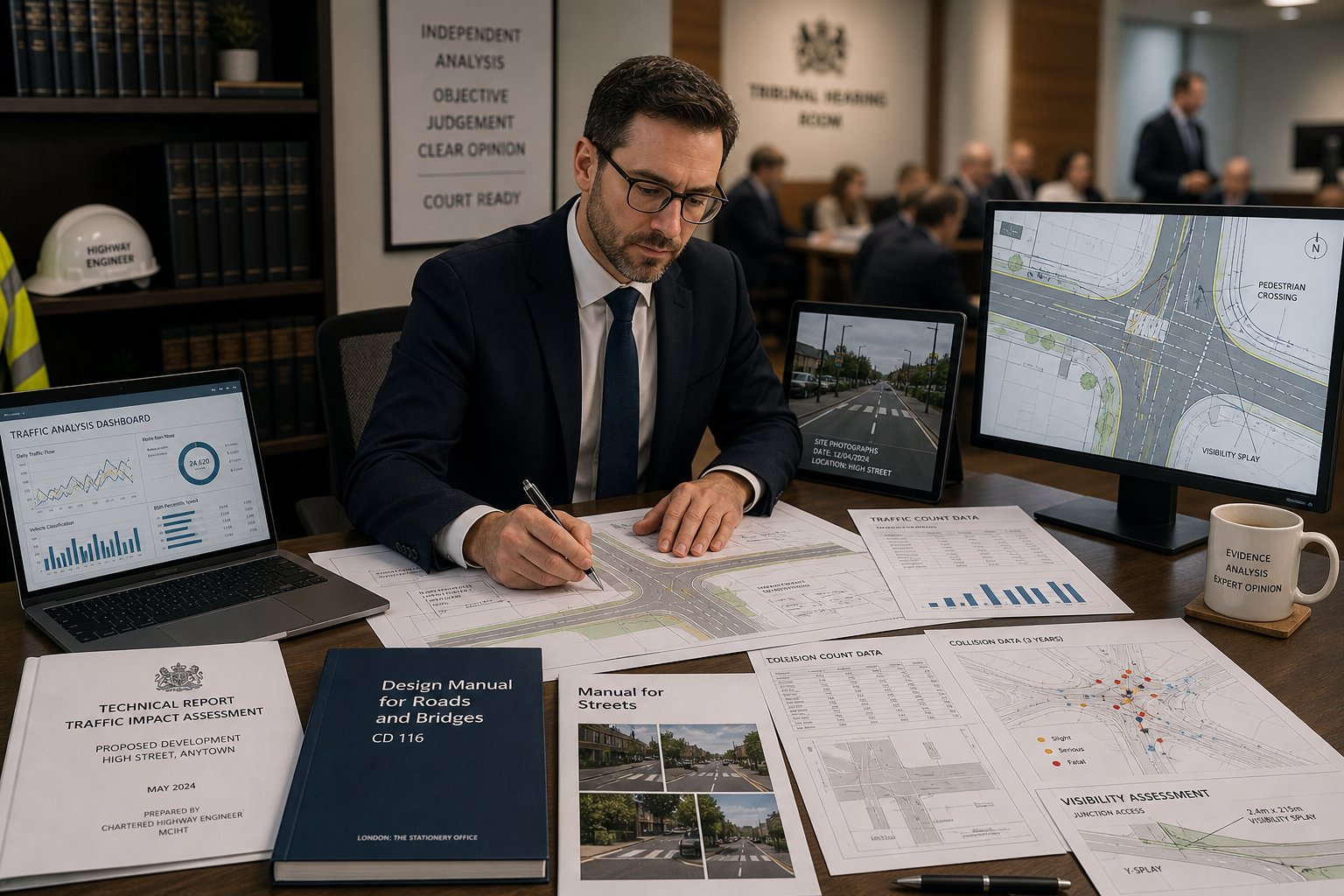
An expert witness in traffic engineering is usually a qualified traffic or highway engineer asked to provide an independent technical opinion on matters involving road design, traffic operation, capacity, visibility, signing, safety, or compliance with accepted standards. Independence is the key word. Unlike a general project adviser, the expert’s duty is not to argue whatever best suits the client: it is to assist the court, tribunal, inspector, or inquiry with honest professional evidence.
In practice, that work often begins with a structured review of the available material: drawings, traffic counts, collision data, police records, witness statements, highway maintenance logs, safety audits, modelling outputs, photographs, and site videos. We then compare the physical and operational conditions against the relevant standards and guidance in force at the material time. That might include DMRB, Manual for Streets, TSRGD, local design standards, or authority-specific guidance.
The role also extends well beyond paperwork. Site inspections matter because roads rarely behave exactly as plans suggest. A junction may technically comply on paper but still create poor driver expectancy, hidden conflicts, or uncomfortable pedestrian crossings in the real world. In broader Traffic Engineering: Your practice, that gap between design intent and operational reality shows up again and again.
Finally, the expert prepares a formal report and, where needed, gives oral evidence. That means explaining technical conclusions clearly enough for non-engineers to follow, while also being precise enough to withstand detailed challenge.
How Traffic Engineering Evidence Supports Legal And Planning Cases
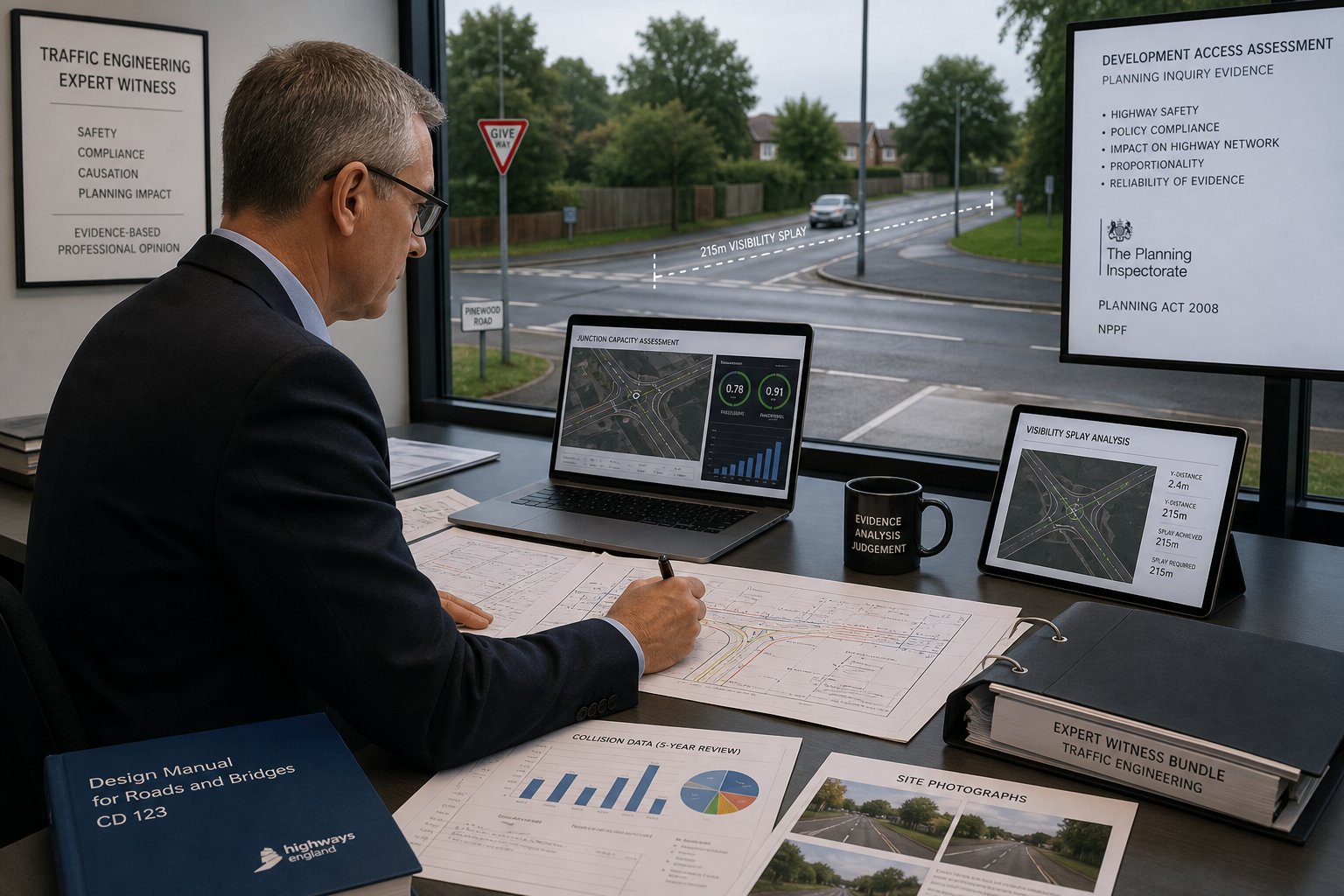
Traffic engineering evidence supports cases by turning technical uncertainty into something testable. Courts and inspectors are often dealing with competing narratives: a claimant says poor visibility caused the collision: a highway authority says the road was compliant: an objector says a development will overload a junction: a developer says the impact is negligible. Engineering evidence helps decide which account is actually supported by data, standards, and observed conditions.
In legal cases, the expert commonly addresses compliance and causation. Was the road layout reasonably safe? Were signs and markings adequate? Did surface condition, alignment, speed environment, or maintenance contribute materially to the incident? These are not abstract questions. They go to breach, foreseeability, and whether an alleged defect made any practical difference.
In planning matters, the emphasis often shifts to capacity, access, safety, and policy compliance. A robust expert opinion can test whether a proposed access works, whether trip generation assumptions are realistic, and whether mitigation is proportionate. That is especially important when evidence moves beyond a routine planning submission and into appeal territory, where the scrutiny becomes more forensic. In that context, work connected to expert witness planning inquiries often requires a different level of rigour than a standard application-stage report.
Good evidence doesn’t just support a case at hearing. Often, it narrows the dispute beforehand by identifying what is genuinely in issue and what simply isn’t.
Common Case Types That Need Traffic Engineering Expert Evidence
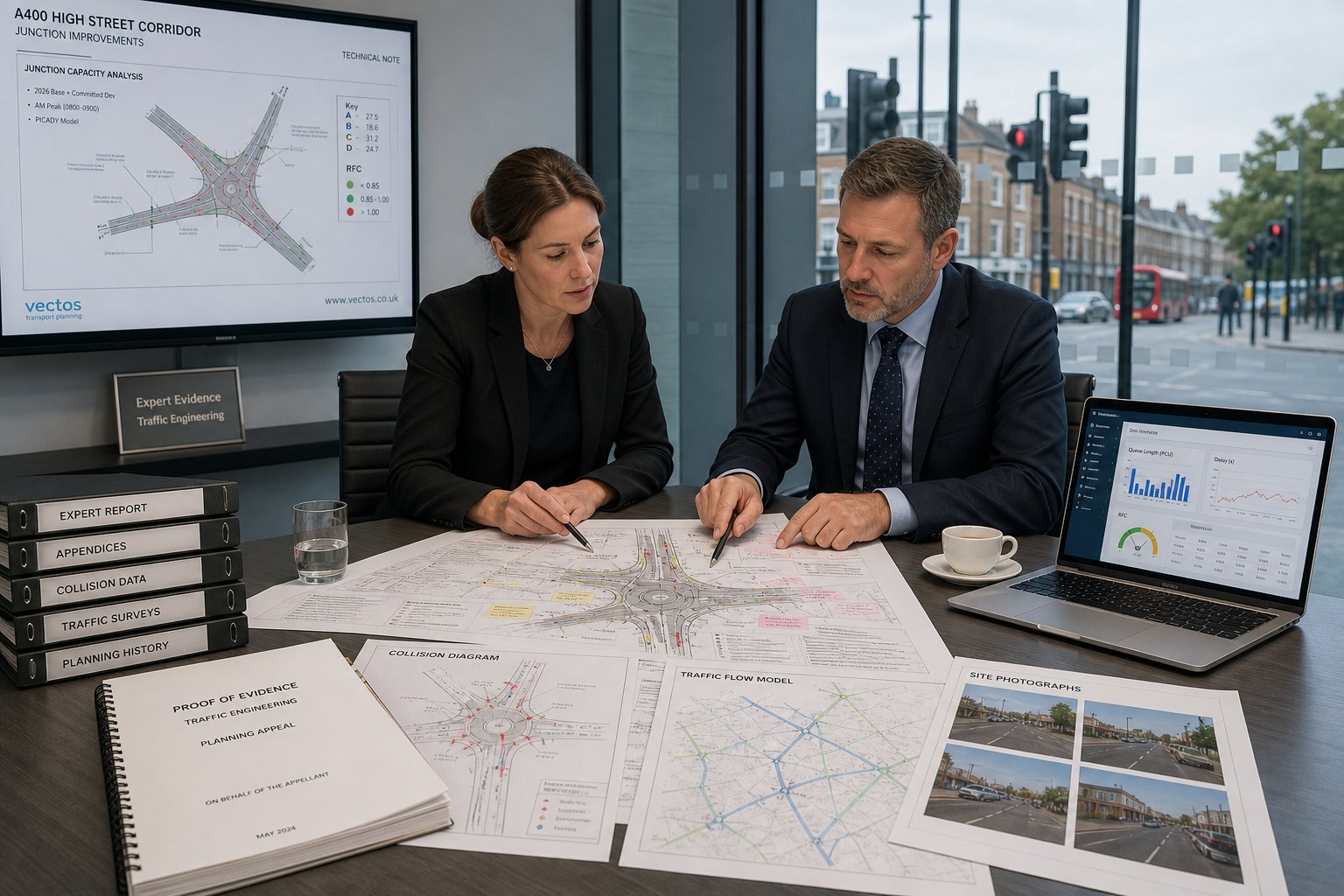
Some disputes obviously call for traffic engineering expertise: others only reveal that need once the documents are opened and the assumptions start to wobble. Broadly, the most common cases fall into collision and liability work, planning and development disputes, and local authority or network management matters.
The common thread is that each involves technical questions that a judge, inspector, or legal team cannot safely answer from lay evidence alone. Drawings need interpretation. Modelling assumptions need testing. Site behaviour needs explaining. And, importantly, standards need to be applied in context rather than quoted as if they answer every problem by themselves.
For project teams already using specialist advisers, there is often a close overlap between advisory work and contentious work. A consultant involved in early-stage access strategy, for instance, may identify concerns that later become material in an objection or appeal. That is one reason firms providing Traffic Engineering Consultants: support are often asked to move from planning advice into more formal expert review when a scheme becomes disputed.
Below are the case types where expert witness traffic engineering most commonly proves decisive.
Road Traffic Collisions And Highway Liability
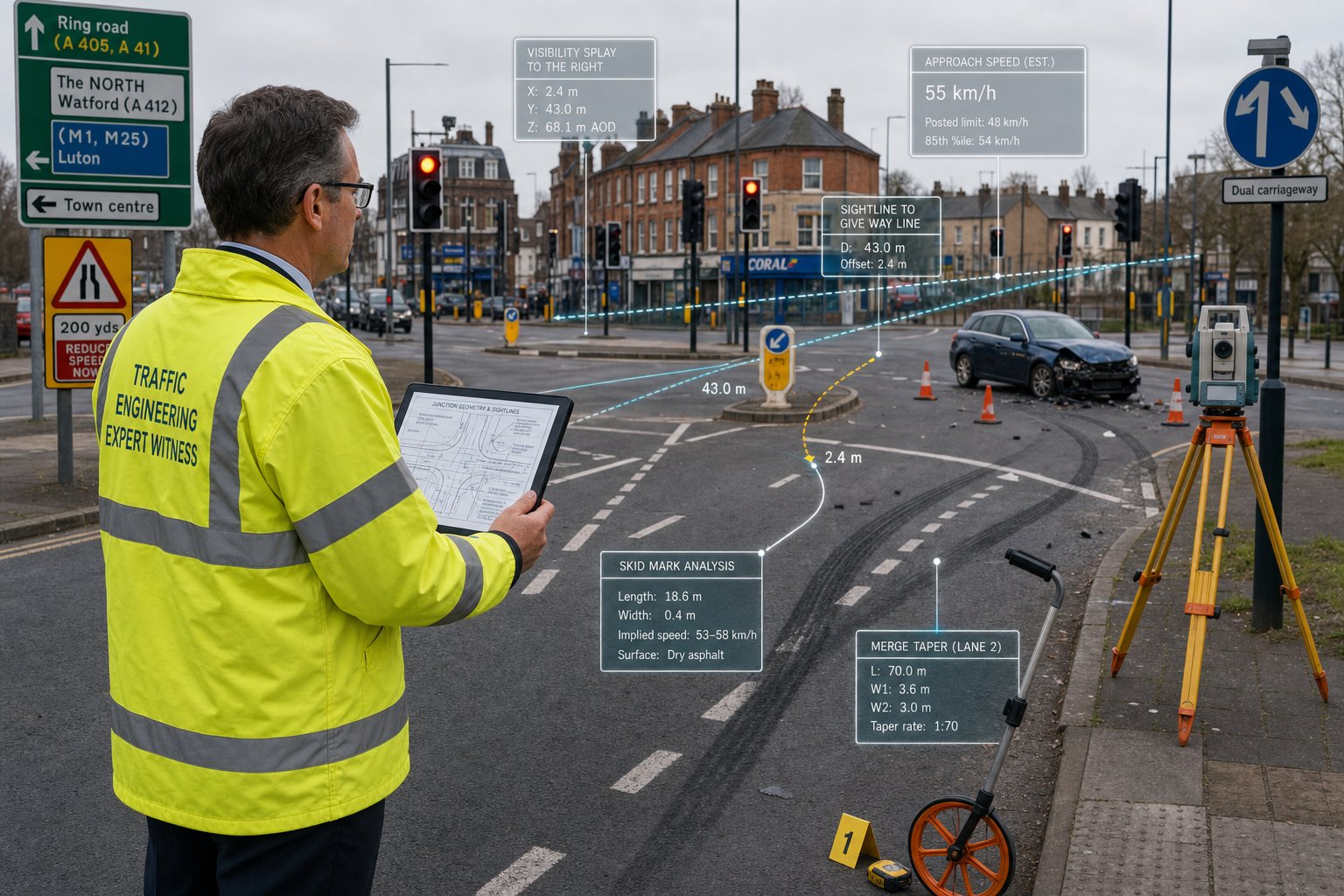
Collision cases often turn on a deceptively simple issue: what actually caused the event? The answer may involve vehicle speeds, sightlines, skid resistance, signing, lining, signal timings, junction geometry, road surface condition, or the interaction of several factors at once.
In highway liability matters, the expert may be asked whether the authority inspected and maintained the road adequately, whether a defect was present long enough to be actionable, or whether the layout created an unreasonable risk. A poor merge taper, inadequate advance warning, obscured signs, worn markings, or substandard visibility splays can all become central points.
But we have to be careful. Not every non-compliance causes a collision, and not every collision implies defective design. Credible expert analysis distinguishes between technical imperfection and meaningful causal contribution. That distinction is often where cases are won or lost.
Detailed site review, contemporaneous records, and measured geometry are crucial here. So is understanding how drivers, cyclists, and pedestrians behave in the actual speed environment rather than the one assumed by the drawing set.
Planning Appeals, Development Disputes, And Local Authority Matters
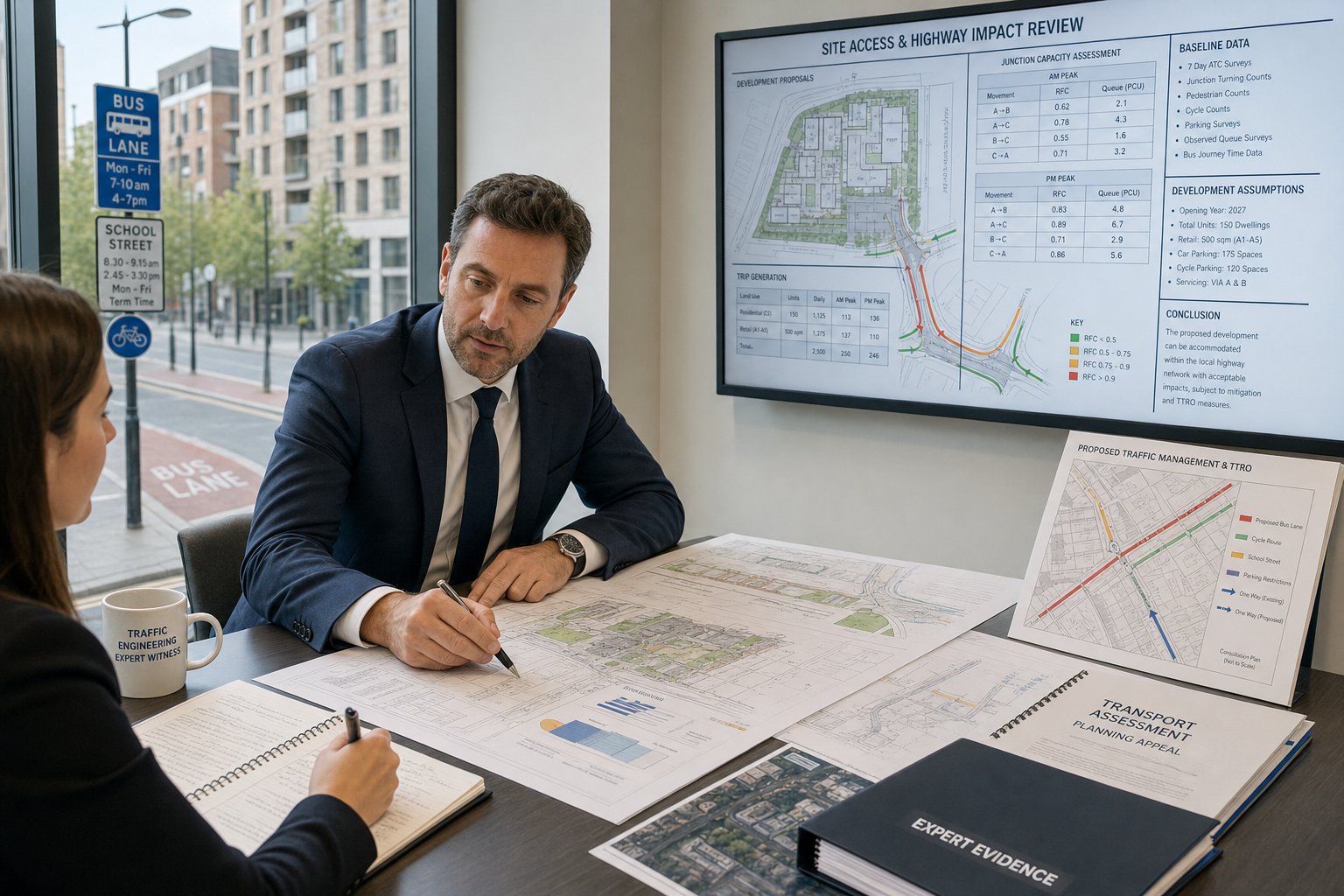
Planning appeals and development disputes usually focus on whether a proposal creates an unacceptable impact on highway safety or the residual cumulative effect on the network. That can cover access arrangement, parking strategy, trip generation, servicing, queueing, pedestrian provision, and off-site mitigation.
A small disagreement over assumptions can have large consequences. If baseline counts were taken in an unusual period, if growth factors are inflated or suppressed, or if committed development is treated inconsistently, the apparent acceptability of a scheme can shift quite a bit. We often find the real issue is not the software output but the judgement embedded inside the inputs.
Local authority matters add another layer. School streets, TROs, bus priority, cycle schemes, and speed limit changes can generate disputes about consultation, network displacement, safety consequences, and proportionality. In urban settings, local conditions matter enormously: a city-centre bus corridor behaves very differently from an edge-of-town access road. That’s why location-specific experience, including work akin to a Traffic Engineer In London: setting or a Traffic Engineer In Liverpool: context, can sharpen the evidence considerably.
What A Traffic Engineering Expert Reviews Before Giving An Opinion
Before offering any opinion, we need the factual platform to be solid. That usually means assembling documents from multiple sources and checking whether they actually relate to the same time period, road layout, and operational conditions. It sounds obvious, but cases regularly contain mixed drawing revisions, outdated speed data, incomplete maintenance records, or photos taken after a layout has changed.
A proper review commonly includes accident reports, police files, witness statements, dashcam or CCTV footage, and medical or vehicle evidence where collision mechanics matter. On the highway side, we look at design drawings, general arrangement plans, traffic signal staging, safety audits, maintenance logs, inspection records, TRO schedules, and any departure from standards documentation.
Traffic data is another core layer: turning counts, classified flows, queue surveys, journey times, speed surveys, pedestrian counts, and sometimes mobile or video-based observations. For development cases, trip generation sources, distribution assumptions, committed development schedules, and modelling files are all essential. Work linked to traffic impact assessment often provides the starting dataset, but expert witness review goes further by stress-testing what was submitted.
Then there’s the site visit. We use it to verify dimensions, observe driver behaviour, assess conspicuity, understand gradients and alignment, and spot practical issues that never make it into a PDF bundle.
Key Areas Of Analysis In Expert Witness Traffic Engineering
Traffic engineering evidence can range from a single visibility calculation to a full reconstruction of network performance and road user interaction. The exact scope depends on the dispute, but the strongest reports usually combine quantitative testing with practical engineering judgement.
That balance matters. A model can be technically correct and still misleading if it reflects the wrong scenario. Equally, a site impression without proper measurement is rarely enough. Good expert witness traffic engineering brings both strands together: what the data says, and what the road is actually doing.
Two broad areas come up most often: operational performance and road safety condition. The first asks whether the network can accommodate movements and development demand. The second asks whether the environment, layout, and control measures are reasonably safe and understandable for users.
Below are the issues we most often analyse in detail.
Junction Capacity, Trip Generation, And Network Impact
In planning and development disputes, junction performance is often the first battleground. We assess baseline demand, likely development trips, assignment patterns, and how those flows affect capacity, queueing, and delay. That may involve PICADY, ARCADY, LINSIG, LinSig-style signal analysis, or microsimulation where the network interaction is more complex.
But software outputs are only as good as the assumptions behind them. We test whether the selected survey dates were representative, whether seasonality matters, whether queue calibration reflects observed conditions, and whether committed developments or background growth have been applied consistently. Trip generation also needs care. TRICS-based estimates can vary significantly depending on filtering, land-use match, location type, and whether a site is genuinely comparable.
For architects and developers, this is often where an ordinary planning issue turns contentious. A routine assessment may satisfy validation, but once objections land, the modelling may need to be recast to withstand challenge. Specialist input from teams experienced in Traffic Modelling Consultants: work can be particularly valuable when queue interaction or signal coordination becomes central.
We also look beyond the modelled junction itself. Re-routing, rat-running, blocked back movements, and stress transferred onto nearby links can matter just as much as the headline RFC or degree of saturation.
Visibility, Road Layout, Speed, Signing, And Road Safety
Safety analysis is where field judgement really earns its keep. We assess stopping sight distance, visibility splays, forward visibility on bends and crests, crossing intervisibility, lane discipline, conspicuity of hazards, and whether signs and markings communicate clearly enough in the prevailing speed environment.
A road can comply geometrically and still perform poorly if users are overloaded or misled. For example, cluttered signing near a priority junction may reduce comprehension at the very moment drivers need to process a turn conflict. Likewise, a nominal speed limit tells only part of the story: the self-explaining character of the road, alignment, width, frontage activity, and enforcement reality often matter more to actual operating speed.
In collision work, we review whether the physical environment likely increased conflict risk for pedestrians, cyclists, or turning traffic. We also consider collision history and patterning, while being realistic about what that data can and cannot prove. A low recorded collision count does not automatically mean a layout is safe if exposure is low or reporting incomplete.
Where local context is important, practical knowledge from places with very different street conditions, including a Traffic Engineer In Manchester: environment, can help frame what is typical, what is marginal, and what is plainly problematic.
The Difference Between An Expert Witness Report And A Standard Transport Assessment
This distinction is one many clients underestimate at first. A standard transport assessment is usually prepared to support a planning application. Its job is to explain the proposal, quantify impact, address policy and guidance, and identify mitigation where needed. It is prepared for a client’s scheme and, naturally, aims to help that scheme move forward.
An expert witness report is different in purpose, audience, and duty. It is written for a court, inquiry, tribunal, or appeal process where the expert must be independent. That means the report has to set out methodology, source material, assumptions, limitations, and reasoning in a much more explicit way. It must also distinguish clearly between facts, assumptions, and opinion.
The practical difference is easy to spot. A transport assessment may say a junction operates within capacity and impacts are acceptable. An expert witness report will often go further: were the surveys representative, was the model validated, were sensitivity tests appropriate, what standards applied at the time, and do alternative interpretations materially change the conclusion?
So while the underlying subject matter may overlap, the mindset is not the same. One document supports an application. The other assists a decision-maker by independently testing the technical case, including weaknesses that the instructing party may not especially enjoy hearing.
How To Instruct A Traffic Engineering Expert Effectively
A good instruction saves time, reduces cost, and usually improves the quality of the final evidence. The best starting point is clarity: what are the issues, what legal or planning tests apply, what timetable matters, and what question do you actually need answered? “Please review traffic issues” is not a useful instruction. “Please advise whether the access arrangement meets accepted standards and whether any shortfall is likely to have contributed materially to the collision” is far better.
Full disclosure matters just as much. We need the complete bundle, not the flattering parts. Missing drawings, undisclosed revisions, absent maintenance records, or selective traffic data nearly always come back to cause trouble later. If there are awkward documents, it is better that we address them early.
It is also essential to confirm independence and conflicts. If the proposed expert has been deeply involved in promoting the scheme design, they may not be the right person to act as expert witness. In some situations a separate reviewer is the safer route, particularly when a case may proceed to hearing or inquiry.
Finally, build in realistic timescales for site work, data checking, and response to opposing evidence. Technical credibility rarely survives being rushed, especially when the dispute turns on fine margins.
What Makes Traffic Engineering Evidence Credible In Court And At Appeal
Credible evidence rests on three things: expertise, method, and independence. Qualifications and experience matter, of course. A relevant engineering background, professional registration, and substantial practical work in highways, traffic, and transport planning all strengthen confidence. But credentials alone do not carry a case.
Method is usually what persuades. The court or inspector needs to see a transparent route from source material to conclusion. That means measured dimensions are identified, assumptions are stated, alternative explanations are considered, and calculations are replicable. If a conclusion depends on a judgement call, the report should say so plainly and explain why that judgement is reasonable.
Independence is the third pillar. Overstated advocacy is surprisingly easy to spot. Reports that ignore inconvenient data, stretch standards beyond their purpose, or pretend uncertainty does not exist tend to unravel under questioning. By contrast, an expert who acknowledges limits, accepts fair points, and remains consistent is usually more persuasive.
For organisations needing concise and defensible reporting, that combination of speed, clarity, and local-authority awareness is exactly why specialist practices such as ML Traffic are often brought in when technical evidence has to stand up, not just read well.
And one final point: credible evidence is understandable evidence. If the decision-maker cannot follow the engineering logic, even a technically correct report may fail to do its job.
Conclusion
When a dispute turns on road design, traffic operation, safety, or development impact, technical evidence is rarely a side issue. It is often the issue. That is why expert witness traffic engineering matters so much in 2026: decision-makers expect more than broad opinion and software printouts. They expect clear reasoning, sound data, proper standards application, and an expert who understands the difference between supporting a case and serving the tribunal.
For planners, lawyers, developers, architects, surveyors, and councils, the practical lesson is simple. Bring in the right specialist early, define the issues properly, and treat the evidence as something that must withstand challenge from day one. Done well, expert traffic evidence narrows disputes, clarifies risk, and gives courts or inspectors something they can rely on with confidence. Done badly, it does the opposite, and that can be expensive.
Frequently Asked Questions on Expert Witness Traffic Engineering
What is the role of an expert witness in traffic engineering?
An expert witness in traffic engineering is an independent, qualified engineer who analyses road design, traffic operations, and safety to provide technical evidence in court or planning inquiries, assisting decision-makers with clear, unbiased professional opinions.
How does expert witness traffic engineering support legal and planning cases?
Expert traffic engineering evidence clarifies whether road layouts or junctions meet standards, assesses collision causation, and evaluates development impacts on traffic, helping courts and planners resolve disputes with factual, data-driven insights.
What are common case types requiring expert witness traffic engineering?
Typical cases include road traffic collisions and highway liability involving design defects or safety issues, planning appeals disputing development impacts on traffic, and local authority matters like traffic calming and speed limit changes.
What distinguishes an expert witness report from a standard transport assessment?
Unlike transport assessments that support planning applications and advocate for a client, expert witness reports are independent, thoroughly explaining methodology and assumptions, addressing specific legal questions, and providing impartial opinions for courts or inquiries.
How do traffic engineering experts evaluate junction capacity and network impact?
They use traffic data and modelling tools like PICADY, ARCADY, or LINSIG to assess baseline flows, development trip generation, and network stresses, verifying if survey assumptions and growth forecasts are accurate to predict operational performance.
Why is site inspection important for expert witness traffic engineering?
Site inspections reveal real-world conditions affecting driver behaviour, visibility, and safety that plans or models might miss, ensuring technical evidence reflects actual road use and hazards for more credible, practical analysis.