
A planning application can look well prepared on paper and still unravel the moment transport questions land. Will the junction cope? Is access safe? Are parking levels defendable? Has anyone actually agreed the scope with the local highway authority? Those are the points that slow schemes down, trigger objections, or lead to costly redesign late in the process.
That is where transport assessment consultants matter. For architects, planners, developers, surveyors, lawyers and councils, the right consultant does far more than produce a report to tick a box. We help translate a development proposal into transport evidence that a case officer and highway officer can scrutinise, challenge and, ideally, accept. Done properly, that evidence can de-risk a scheme, support negotiations, and make planning submissions much more resilient.
In 2026, expectations are not getting lighter. Local planning authorities want proportionate but robust analysis, sustainable travel measures, credible modelling assumptions and reports aligned with local standards. And because every authority applies policy through its own lens, speed comes from getting the approach right early, not from rushing a weak document out the door.
In this guide, we set out what transport assessment consultants do, when you need one, what a strong assessment should contain, and how to choose a planning partner who can move quickly without cutting corners.
What Transport Assessment Consultants Do And When You Need One

Transport assessment consultants are specialist transport planners and traffic engineers who examine how a proposed development will interact with the surrounding network. In practical terms, we assess likely trip generation, test junction performance, review access arrangements, consider parking demand, check servicing movements and examine safety issues such as visibility, collision history and conflict points.
But the job is broader than analysis. We also shape mitigation. That may include revised access geometry, off-site highway works, parking strategy changes, servicing controls, pedestrian links, cycle facilities or a travel plan package aimed at reducing car dependence. A good consultant is not simply identifying problems: we are building a planning case around workable solutions.
You usually need one when a scheme is likely to create significant vehicle movements or where transport is clearly sensitive, even if the development is not huge. That can mean a busy urban infill site, constrained access onto a classified road, a school near peak-time congestion, or a town-centre regeneration site where mode share and servicing are under close scrutiny.
For planning teams, the real value is early judgement. On many schemes, a proportionate strategy starts with deciding whether a full TA is necessary or whether a lighter study will satisfy the authority. A useful overview of that wider role sits in Transport Planning Consultants: What, particularly for multidisciplinary teams trying to align planning, design and highways inputs from the outset.
How Transport Assessments Support Planning Applications

A transport assessment supports a planning application by turning transport risk into evidence. It explains whether the site is accessible by different modes, whether the development’s traffic effects are acceptable, and whether mitigation is needed to keep impacts within policy and operational limits.
For applicants, that matters because transport objections tend to be highly technical and, once raised, can be hard to neutralise quickly. An unsupported claim that “the network will cope” is not enough. Highway authorities normally want to understand baseline conditions, forecast trips, assignment assumptions, peak-hour effects, parking logic, servicing operation and any mitigation relied upon. The TA becomes the structured answer to those questions.
It also supports design choices. Access widths, internal layout, parking quantum, cycle parking, refuse collection routes and emergency access often need transport input before the final drawing set is fixed. If we leave those questions too late, the report ends up trying to defend a layout that was never transport-tested in the first place.
For larger or more sensitive sites, the TA often sits alongside a wider transport assessment for strategy covering phasing, mitigation and negotiation points. That is especially helpful where planning officers, highway officers and applicants all need a common evidence base for conditions, obligations or amendments.
Transport Assessment Vs Transport Statement Vs Travel Plan
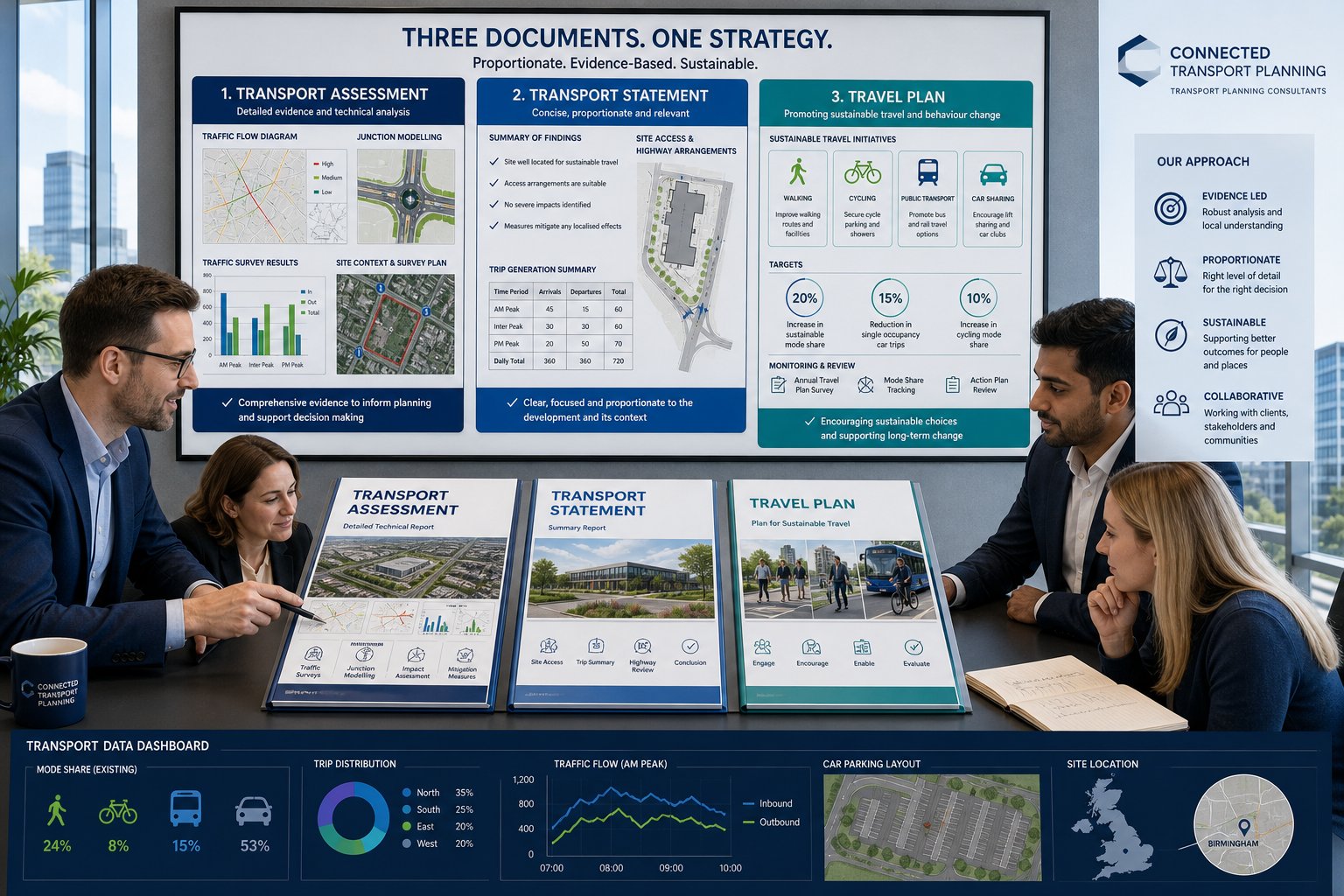
These documents are related, but they are not interchangeable.
A Transport Assessment (TA) is the fullest option. It is normally used for larger or higher-impact schemes, or where the site context is sensitive enough to justify detailed evidence. A TA usually includes surveys, forecast trip generation, distribution and assignment, capacity testing, sustainable travel review, parking and servicing analysis, and mitigation proposals.
A Transport Statement (TS) is shorter and more proportionate. It is typically prepared where impacts are expected to be limited and a full modelling exercise would be excessive. A TS may still include traffic surveys, policy review, access analysis and parking review, but the level of detail is scaled to the development.
A Travel Plan (TP) is different again. It focuses on influencing how people travel to and from a site. That means targets, measures, incentives, monitoring and review mechanisms intended to encourage walking, cycling, public transport, car sharing or staggered travel behaviour.
In many real projects, the correct answer is not one or the other but a combination: a TS with a Travel Plan, or a TA supported by a Framework Travel Plan. Teams working on more scheme-specific impacts sometimes also compare this work with a traffic impact assessment, especially where the authority’s terminology varies.
What Triggers The Need For A Transport Assessment

The trigger for a transport assessment is rarely just one number. Yes, many local authorities use floor area, unit count or use-class thresholds, and national guidance still points decision-makers toward developments that are likely to generate significant movement. But in practice, context often drives the requirement as much as scale.
A modest scheme can still need a TA if it sits on a constrained access, near a poor accident record, beside a saturated junction, or within an area where parking stress is politically and operationally sensitive. Equally, a larger scheme in a highly accessible location may still require detailed evidence, but the emphasis may shift toward sustainable mode share, trip suppression and servicing management rather than pure highway capacity.
We usually advise clients to ask three early questions:
- Is the development likely to generate noticeable peak-hour demand?
- Is the site in a location where highway or access conditions are already delicate?
- Does the local authority have explicit validation or threshold guidance that points toward a TA or TS?
If the answer to any of those is yes, bringing in transport assessment consultants early is sensible. Local knowledge matters too. A city-centre authority may focus heavily on mode split and servicing, while a suburban or edge-of-settlement authority may focus on junction operation, visibility and school-run effects.
Typical Development Types And Planning Scenarios
Typical schemes that trigger a TA include residential estates, apartment developments, supermarkets, retail parks, logistics units, offices, hospitals, schools, colleges, universities and mixed-use regeneration proposals. Urban extensions are another obvious category because they can affect multiple junctions, internal streets and phased delivery of sustainable transport infrastructure.
Some sectors are especially transport-sensitive. Schools can generate short, intense peaks and difficult kerbside conditions. Logistics sites raise HGV routing, servicing and access geometry questions. Retail schemes often face scrutiny on parking turnover and weekend peaks. Residential proposals may look straightforward, yet access visibility, parking stress and cumulative traffic growth frequently become the main battleground.
For housing-led schemes, a Residential Development Transport Assessment: framework is often useful because the arguments around trip rates, internal layout, active travel links and parking standards tend to repeat across authorities, albeit with local nuance.
How Consultants Scope A Transport Assessment

Scoping is where strong transport work begins. Before surveys are commissioned or models are built, we need agreement on the fundamentals: what development is being tested, which years are relevant, what study area applies, which junctions need assessment, what baseline data is acceptable, and whether committed developments or background growth should be included.
The best approach is usually early discussion with the local highway authority. That can happen through pre-application meetings, written scoping notes or direct technical liaison where the planning team already has a live timetable. The objective is not to ask the authority to design the report for us, but to reduce the chance of later disputes about missing evidence.
A sound scope also ties transport work to the actual planning strategy. If the architect is still refining the access point, if the planner expects phased delivery, or if legal teams are already considering obligations, the TA must reflect that. We have seen schemes delayed not because the traffic work was weak, but because it answered a slightly different project brief from the one submitted.
Consultants with broad Traffic Engineering Consultants: experience are often better placed here, because scoping is as much about design realism and authority expectations as it is about transport theory.
Key Data, Surveys, And Modelling Inputs
Most transport assessments rely on a familiar toolkit, but the exact mix should be proportionate to the scheme.
Common inputs include:
- Manual classified counts and automatic traffic counts
- Junction turning counts, queue surveys and journey time observations
- Personal injury collision data and, where relevant, speed surveys
- Public transport service information and walking/cycling catchment review
- Trip generation drawn from established databases such as TRICS-type evidence
- Distribution and assignment assumptions based on census, network logic and local patterns
- Junction capacity modelling and, on larger sites, network or microsimulation modelling
- Parking accumulation, servicing demand and swept path analysis
Data quality matters more than volume. Outdated surveys, poorly justified trip selections or a study area that ducks the obvious pressure points will quickly attract challenge. A concise, accurate evidence base is usually stronger than a bloated appendix that avoids the real issues.
What A High-Quality Transport Assessment Should Include
A high-quality transport assessment should read like a coherent planning document, not a stack of unrelated calculations. The best reports start with policy and site context, describe the development clearly, explain the access strategy, and then move logically through baseline conditions, forecast impacts, sustainable travel opportunities and mitigation.
At minimum, we would expect a strong TA to include:
- A description of the site, development proposals and relevant planning status
- Review of national and local policy, standards and guidance
- Existing transport conditions, including network characteristics and survey findings
- Accessibility by walking, cycling and public transport
- Trip generation, distribution and assignment methodology
- Capacity analysis of relevant junctions or links
- Parking, servicing and internal operation review
- Collision and highway safety review
- Mitigation measures and, where relevant, travel plan commitments
- A clear conclusion on acceptability
What separates a merely compliant report from a persuasive one is judgement. Does it explain why a trip rate was chosen? Does it acknowledge sensitive assumptions rather than hiding them? Does it align with the drawings? Does it anticipate likely objections before the authority raises them?
That planning-led clarity is often what clients need most. Firms offering Developer Transport Consultants: support tend to be most effective when they can combine technical robustness with concise reporting that planners, design teams and highway officers can all follow.
Access, Parking, Servicing, And Highway Safety Considerations
This is the part of a TA that often decides whether a scheme feels workable in the real world. Capacity results matter, of course, but planning authorities also want to know whether the development can function day to day without creating obvious conflict or safety problems.
Access starts with geometry and visibility. Can vehicles enter and leave safely? Is the proposed access too close to an existing junction? How will pedestrians cross? Does the design accommodate refuse vehicles, fire appliances and delivery vehicles without awkward manoeuvres?
Parking is rarely just a numbers exercise. We need to test whether the parking quantum matches local standards and likely demand, whether disabled bays are appropriately located, whether EV charging is properly integrated, and whether cycle parking is secure and convenient. Under-provision can generate overspill and political resistance: over-provision can undermine sustainability arguments.
Servicing is another classic pain point. Delivery patterns, refuse collection, loading locations and swept paths need to make operational sense. A beautifully drafted site plan can still fail once the first rigid vehicle tries to reverse across a pedestrian route.
Highway safety draws together design and evidence. Collision records, observed behaviour, visibility standards and user conflict all matter. On constrained urban sites, the issue is often not a dramatic design failure but a series of small frictions that, together, make officers uneasy.
For place-specific advice, regional knowledge can help. On schemes in the West Midlands, for example, a Birmingham Transport Consultant: perspective can be useful where local standards and authority expectations shape what is considered acceptable.
How Transport Consultants Work With Architects, Planners, And Local Authorities
Transport work is most effective when it is integrated, not bolted on. Architects need early input on access points, internal geometry, active travel connections and servicing space. Planning consultants need transport evidence that supports policy arguments and submission strategy. Lawyers may need clarity on what could become a condition or planning obligation. And local authorities need a technical narrative they can test without reconstructing the project from scratch.
That means we often sit in the middle of competing pressures. The architect wants design freedom. The developer wants certainty and speed. The planner wants a submission that is robust but proportionate. The highway authority wants confidence that hidden problems are not being pushed into the post-permission stage.
Good consultants translate between those worlds. We review layouts before they harden, flag likely authority concerns, draft scoping notes, respond to technical comments and help refine mitigation so that it is both defendable and deliverable. In appeals, our role becomes even more forensic: assumptions, survey validity and design standards can all be examined closely.
Local familiarity is a practical advantage here. A consultant who understands how specific authorities interpret policy, what their transport officers typically focus on, and how they treat thresholds can shorten negotiations materially. On northern schemes, for instance, input from a Traffic Engineer In the region may help bridge technical work with authority expectations more smoothly.
Common Reasons Transport Reports Are Delayed Or Challenged
Most challenged transport reports do not fail because the maths is impossible. They fail because the groundwork was shaky.
One common issue is poor scoping. If the highway authority expected a wider study area, different peak periods or additional survey work, that disagreement can surface late and stall determination. Another is outdated or seasonally weak data. Surveys collected at the wrong time, or too far in advance of submission, invite obvious questions.
Assumptions are another pressure point. Trip rates chosen without proper comparables, unrealistic pass-by or linked-trip allowances, or overly convenient distribution patterns can all undermine credibility. Authorities may not object to every assumption, but they will object to assumptions that consistently minimise impact without explanation.
Layout mismatch is equally common. The TA may describe one access arrangement while the architect’s latest drawing shows another. Parking numbers change. Servicing routes disappear. A swept path works in an appendix but not on the submitted plan. Those inconsistencies make reviewers doubt the entire package.
And then there is policy fit. A technically competent report can still be challenged if it ignores local validation requirements, parking standards, road safety concerns or active travel expectations. In 2026, proportionate does not mean generic. Reports need to feel written for the authority receiving them, not recycled from another borough, district or city.
How To Choose Transport Assessment Consultants For Your Project
Choosing between transport assessment consultants is not just a question of price or turnaround. The better question is: who is most likely to get your scheme through scrutiny with the least friction?
We would usually assess a consultant against six factors.
1. Relevant project experience. Have they worked on your type of scheme before: residential, logistics, education, retail, mixed-use, urban infill? Sector familiarity sharpens judgement on trip rates, parking logic and likely authority objections.
2. Local authority understanding. Do they know the council’s thresholds, standards and review style? This is often the difference between a report that is technically fine and one that is strategically persuasive.
3. Scoping discipline. Ask how they handle pre-app engagement, study areas, survey specifications and assessment years. Weak scoping creates expensive rework.
4. Technical capability. Can they manage surveys, capacity modelling, access design and servicing analysis in-house or through reliable partners? If not, programme risk rises.
5. Reporting quality. Read a sample if you can. The document should be clear, concise and planning-focused, not padded with jargon.
6. Responsiveness under pressure. Planning timetables move. Authorities ask questions. Drawings change. You want a consultant who can adapt without losing technical coherence.
That is one reason many teams look for firms with long-form transport assessment consultants experience and fast reporting habits. For example, a practice such as ML Traffic positions itself around concise, accurate transport engineering advice delivered quickly, backed by decades of experience and tailored to local authority thresholds. In our view, that combination, speed plus judgement, is exactly what planning teams should be testing in consultant selection.
Conclusion
Transport evidence can make or break a planning application, especially where access, parking, safety or network impact are already sensitive. The right consultant will not just produce a report: they will help shape the scheme, agree a sensible scope, test assumptions honestly and present a case the local authority can work with.
For architects, planners, developers, lawyers, surveyors and councils, the practical lesson is simple: bring transport input in early enough to influence the design, not merely defend it. That early coordination usually saves time, reduces avoidable objections and leads to stronger, more credible submissions.
In 2026, the strongest planning outcomes tend to come from proportionate evidence, local awareness and clear technical judgement. Choose transport assessment consultants on that basis, and your application stands a far better chance of moving forward without unnecessary turbulence.
Frequently Asked Questions About Transport Assessment Consultants
What do transport assessment consultants do in development projects?
Transport assessment consultants analyse how proposed developments affect traffic, parking, access, and safety. They assess trip generation, junction operation, and propose mitigation like sustainable travel measures and highway works to support planning approvals.
When is a transport assessment needed for a planning application?
A transport assessment is typically required when a development is expected to generate significant vehicle movements, occurs in sensitive locations with access or safety concerns, or meets local authority size thresholds, ensuring transport impacts are thoroughly evaluated.
How does a transport assessment support planning applications?
It provides robust transport evidence demonstrating accessibility, acceptable traffic impacts, and necessary mitigation. This helps address technical objections, informs design decisions like access and parking, and aligns with local highway authority requirements for smoother planning approval.
What is the difference between a Transport Assessment, Transport Statement, and Travel Plan?
A Transport Assessment is a detailed analysis for large or sensitive schemes; a Transport Statement is a shorter, proportionate report for smaller impacts; and a Travel Plan focuses on strategies to encourage sustainable travel modes and reduce car dependence.
How should I choose the right transport assessment consultant for my project?
Select consultants with relevant project experience, strong local authority knowledge, disciplined scoping processes, technical capability for surveys and modelling, clear reporting skills, and responsiveness to planning timetable pressures to minimise delays and objections.
What common issues cause delays or challenges in transport reports?
Delays often stem from inadequate scoping with authorities, outdated or insufficient surveys, unrealistic assumptions about trip generation, inconsistencies between transport reports and site layouts, and failure to address local policy or safety standards effectively.