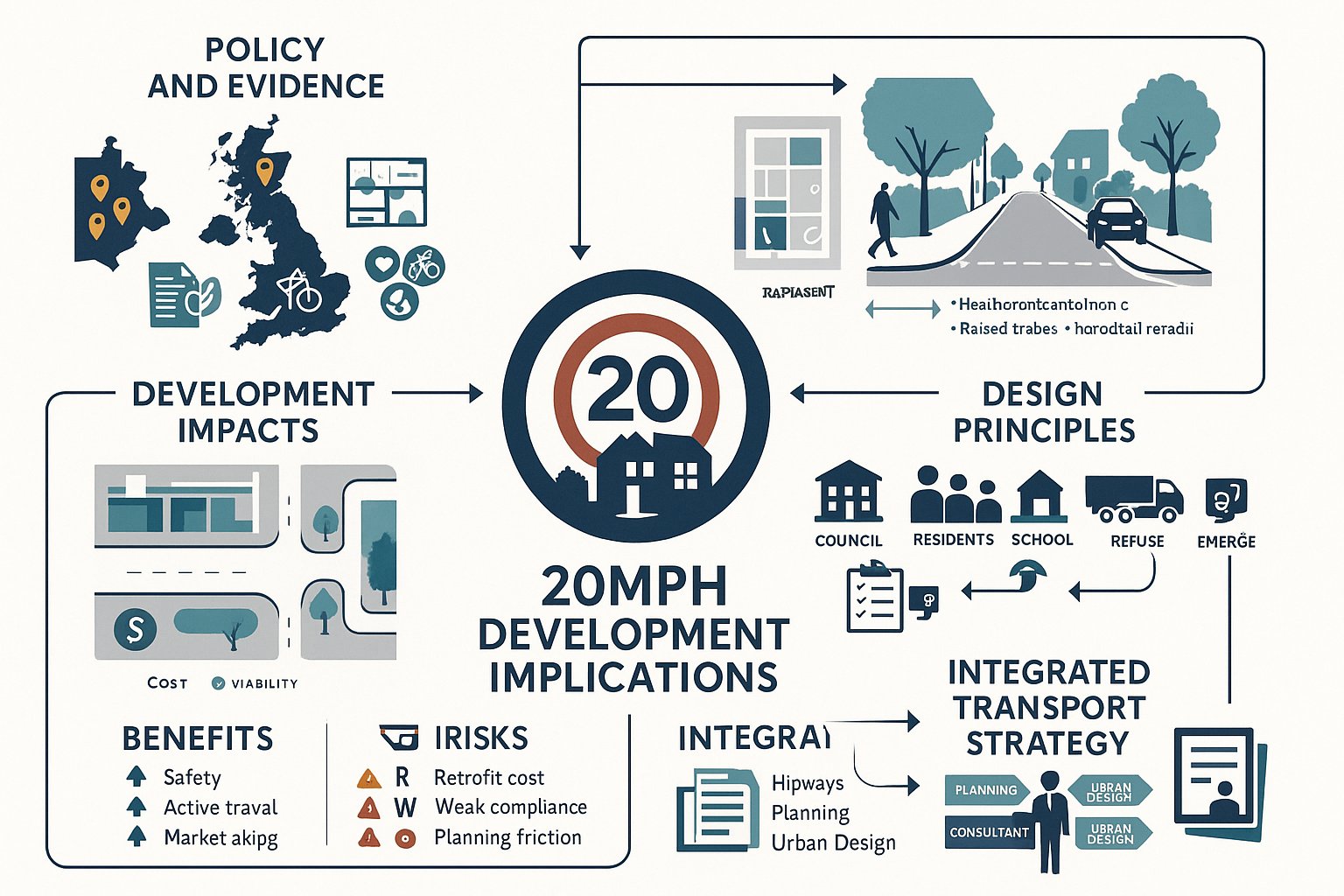
Category: High Frequency Posts

  • 20mph speed limit development implications: what developers need to know in 2026

    20mph speed limit development implications: what developers need to know in 2026

    Planning teams are seeing the same question come up more often, and earlier: what do 20mph speed limit development implications actually mean for a scheme’s design, viability and planning case? It’s a fair question. A 20mph limit sounds simple on paper, but in practice it sits at the junction of road safety, placemaking, active travel, local authority policy and engineering detail.

    We’ve found that the biggest mistake is treating 20mph as a sign-only decision. It rarely works that way. Speed outcomes depend much more on the character of the street, the way junctions are laid out, where people cross, how parking is arranged, and whether the route feels like a place rather than a distributor road. For developers, that has direct implications for layout efficiency, planning support, Section 38 conversations and long-term scheme quality.

    Below, we set out the essentials: the evidence base, the practical development impacts, and why a design-led approach matters if you want 20mph streets that actually behave like 20mph streets.

    Key Takeaways
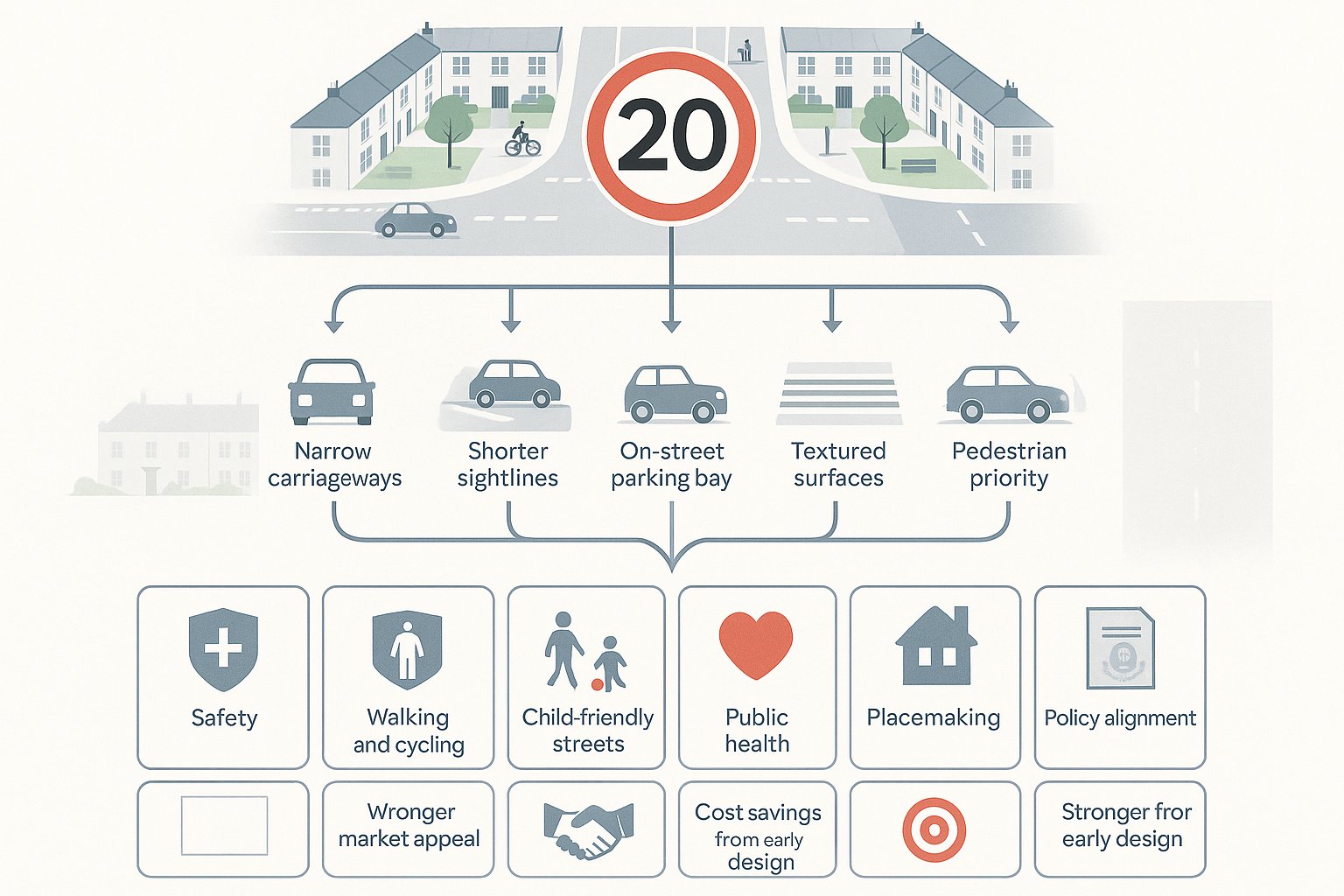
    Infographic showing how 20mph street design shapes safer UK development outcomes.

    If you need the short version, here it is.

    • 20mph limits can support safer, more liveable development, especially where a scheme is meant to prioritise walking, cycling, frontage activity and a stronger sense of place.
    • Signs alone usually don’t do enough. UK evidence has repeatedly shown that signed-only 20mph limits often produce modest speed reductions, but not necessarily a clear short-term casualty reduction without wider supporting measures.
    • Street design matters more than the number on the roundel. Width, forward visibility, corner radii, on-street parking, crossings, surface treatment and horizontal deflection all shape how fast drivers feel comfortable travelling.
    • For new development, 20mph is often easiest to achieve at the masterplanning stage. It’s much cheaper to build the right geometry in from day one than retrofit traffic calming after residents move in and complaints start landing.
    • Planning benefits are real. Lower-speed environments can strengthen arguments around sustainable transport, public health, child-friendly design, placemaking and compliance with local policy expectations.
    • Compliance still needs thought. Even in a well-designed layout, some locations may need targeted interventions, communications or enforcement support, particularly on longer straight links or routes with a more ‘road-like’ character.
    • The commercial angle shouldn’t be ignored. Streets that feel safer and quieter are often more attractive to buyers, occupiers and local authorities. That can improve both marketability and long-term value.

    In other words, the real 20mph speed limit development implications are strategic, not cosmetic. They affect transport evidence, highway negotiations, urban design, cost planning and eventually the quality of the place you’re creating.

    From a policy and evidence perspective, the direction of travel is clear. National and local planning frameworks increasingly support development that reduces car dominance, improves active travel conditions and creates healthier neighbourhoods. A 20mph environment can fit that brief very well. But the phrase can fit matters. If the street still reads like a 30mph road, drivers tend to behave accordingly.

    That’s why we approach 20mph questions as part of a broader development strategy. We’re not just asking whether a limit can be posted. We’re asking whether the proposed network, plot arrangement and public realm will naturally support the outcome that planning officers, highway authorities and future residents expect.

    And yes, there’s a practical side too. On many schemes, getting this right early helps avoid the familiar late-stage scramble: redesigning junctions, justifying inconsistent speed strategy, or trying to explain why a nominally low-speed neighbourhood has long straights and oversized radii that invite the opposite behaviour.

    Table of Contents
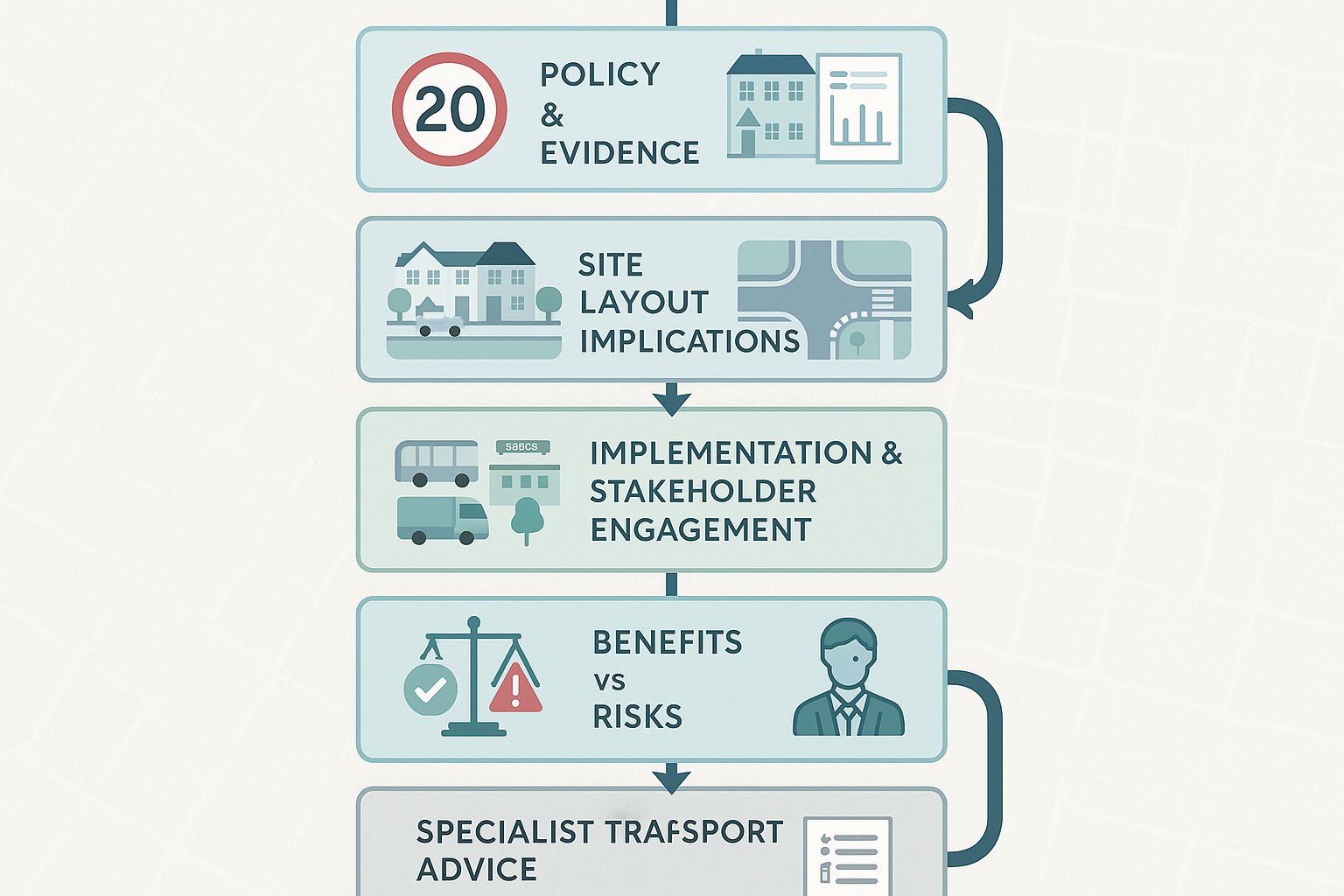
    Six-part infographic showing 20mph development planning and street design in the UK.

    A useful way to think about 20mph speed limit development implications is through six linked themes. They tend to show up on almost every scheme, whether it’s a small residential site or a major mixed-use allocation.

    1. Policy and evidence context

    Local authorities increasingly expect developments to support safer, healthier and lower-carbon travel choices. That means 20mph is rarely just a highways question: it often overlaps with planning policy, design coding, public health priorities and climate commitments. The evidence base also matters. Studies from across the UK suggest that lower limits can support broader liveability goals, but signed-only approaches often achieve only limited speed reduction. So the detail of implementation becomes critical.

    1. Implications for new developments

    For developers, 20mph affects the structure of the site. It can influence street hierarchy, block length, junction spacing, parking strategy, visibility standards, servicing routes and the relationship between carriageway and public realm. In some cases it also affects viability decisions, because the cheapest highway layout upfront isn’t always the most efficient option once planning risk, future retrofit costs and adoption discussions are factored in.

    1. Design principles for effective 20mph environments

    This is where good schemes separate themselves from performative ones. If a street is visually wide, linear and forgiving, drivers will tend to travel faster. If it feels enclosed, active, interrupted and pedestrian-oriented, speeds usually come down more naturally. Measures can include tighter geometry, horizontal deflection, raised tables, regular crossing points, street trees, parking bays and materials that communicate a lower-speed place function.

    1. Implementation, engagement and enforcement

    Even well-designed developments need a delivery plan. Local authority expectations differ. Some councils are comfortable with area-wide 20mph strategies: others want stronger evidence of self-enforcing design. Residents may support slower speeds in principle but object to certain calming features once they see them on a drawing. Schools, bus operators, refuse teams and emergency services may all have a view. Getting alignment early usually saves time later.

    1. Summary: development-scale benefits and risks

    The upside is strong: safer-feeling streets, better active travel conditions, stronger placemaking, and a planning narrative that aligns with current policy direction. The risk is equally familiar: a weakly designed 20mph proposal that satisfies nobody, fails to secure meaningful compliance, and stores up future problems.

    1. Why choose ML Traffic Engineers UK for your project

    This is where specialist transport input matters. A good consultant won’t simply label roads 20mph and hope for the best. We need to interpret evidence properly, understand local adoption and planning thresholds, and integrate speed strategy with the full transport and design story of the site.

    Those six themes are worth keeping together because they’re connected. For example, a planning officer may support lower speeds because of placemaking and health outcomes, while a highway authority focuses on geometry and compliance. A developer, understandably, is looking at programme, cost and deliverability. Our job is to bridge those conversations so the proposal is robust from all sides.

    There’s also a timing issue that often gets overlooked. The earlier 20mph strategy is embedded, the more efficient it becomes. At concept stage, we can shape the street pattern, hierarchy and frontages around the intended speed environment. By reserved matters or technical design stage, options narrow quickly. At that point, teams are sometimes left choosing between awkward compromises: adding stronger calming features than they wanted, accepting weaker compliance than they promised, or reopening layout decisions that should have been settled months earlier.

    So while this section is labelled a table of contents, it also works as a checklist. If a scheme team hasn’t seriously addressed all six themes, there’s a decent chance the 20mph strategy is still too superficial.

    Why choose ML Traffic Engineers UK for your project

    At ML Traffic Engineers UK, we help clients turn policy aspirations into practical, consentable and buildable transport strategies. That matters a great deal with 20mph proposals, because this is one of those areas where broad agreement on the goal can hide real disagreement on the detail.

    We bring more than 30 years of transport engineering experience to that problem. In plain terms, we know how to read a site, understand a highway authority’s likely concerns, and produce concise technical advice that doesn’t get lost in theory. On schemes involving 20mph speed limit development implications, that means we focus on what actually makes the difference: evidence, geometry, planning alignment and delivery.

    Evidence-led advice, not generic assumptions

    There’s no shortage of commentary on lower speed limits, but clients don’t need another opinion piece. They need applied judgement. We draw on major UK evidence, including work commonly referenced from Atkins, AECOM, PACTS, RoSPA and public-health research, and then test what that means for the actual site in front of us.

    That distinction matters. A signed-only 20mph limit on an existing road network may deliver one result: a purpose-designed development street with active frontages, tighter geometry and lower design speeds may deliver another. We help clients make that distinction clearly in Transport Assessments, technical notes and planning submissions, so the strategy is credible rather than generic.

    Integrated design that supports natural compliance

    One of the most common failures in this area is expecting posted limits to compensate for street geometry that says something else. We don’t approach 20mph in isolation. We look at carriageway width, tracking, parking form, junction spacing, crossing demand, frontage activity, visibility, servicing and public realm together.

    That integrated view is especially important in residential-led and mixed-use schemes. A road can still accommodate refuse vehicles, emergency access and day-to-day movement without being overdesigned into a speed-friendly corridor. In fact, the strongest layouts usually feel calm because every element is pulling in the same direction.

    Where targeted measures are needed, we’ll say so. Raised tables, tighter corner radii, build-outs, surface changes or horizontal deflection may be appropriate at specific locations. But we also know that overengineering can create cost and adoption issues if it isn’t justified. The aim is proportionate design, not a catalogue of bolt-on features.

    Planning support that strengthens the consent case

    A well-handled 20mph strategy can do more than satisfy a transport condition. It can strengthen the wider planning story. National planning policy and many local plans now place real weight on sustainable transport, healthy places, road safety and good design. Lower-speed streets often support all four.

    We prepare Transport Assessments, Travel Plans and supporting technical reports that connect those threads properly. Instead of presenting speed strategy as a narrow highways note, we frame it within the scheme’s broader objectives: encouraging walking and cycling, improving child-friendly mobility, reducing conflict, supporting mixed-use vitality and creating streets that are places in their own right.

    That can be especially useful where planning officers, design officers and highway engineers are looking at the same drawings through different lenses. We help make the case in language each audience recognises.

    Local authority awareness and concise reporting

    Every authority has its own thresholds, priorities and tolerance for risk. Some are strongly supportive of 20mph environments but expect the layout to be visibly self-enforcing. Others may accept a more flexible approach if the route hierarchy is clear and the evidence is sound. Knowing how to pitch the strategy matters.

    Our reporting is built around that reality. Because we specialise in concise, accurate transport engineering reports, we avoid burying key points under unnecessary volume. Decision-makers are busy. Clear plans, focused justification and locally relevant evidence usually travel further than bloated documents.

    And that helps clients too. Better targeted reporting can reduce rounds of clarification, speed up review, and make technical submissions easier for the wider consultant team to work with.

    Stakeholder engagement that deals with real concerns

    The technical case is only part of the job. Residents, schools, councillors and operational stakeholders often have practical concerns: Will vehicles actually slow down? Will this affect access? Will emergency response be compromised? Are the calming measures going to feel intrusive? Those questions need straight answers.

    We support stakeholder discussions by translating transport engineering into plain English without oversimplifying it. Where concerns about compliance are justified, we identify them early. Where fears are overstated, we explain why. That helps build trust and often prevents the scheme being pushed into reactive redesign.

    Whole-life value, not just immediate layout efficiency

    A cheaper layout at planning stage isn’t always the better commercial decision. If the street environment later proves too fast, too hostile for walking, or too weakly aligned with policy expectations, the cost comes back in other forms: delayed approvals, extra conditions, retrofit works or reputational drag.

    We look at whole-life value. That means considering collision risk, future adaptability, adoptability, placemaking quality and the attractiveness of the development to end users. A genuinely calm street network tends to perform better across all of those metrics.

    In short, if you’re dealing with 20mph speed limit development implications, we can help you move beyond slogans and into a strategy that works on paper, on site and in front of decision-makers. Our role is to make the transport case clearer, more proportionate and more persuasive, while keeping a sharp eye on the practical realities of planning and delivery.

    For developers, land promoters, architects and planning consultants, that combination is usually what matters most. Not just whether 20mph can be mentioned, but whether it can be designed, justified and delivered properly.

    The bottom line? Lower-speed streets can absolutely add value to a development, but only when they’re thought through as part of the place from the start. That’s the approach we take, and it’s why clients bring us in early.

    Frequently Asked Questions about 20mph Speed Limit Development Implications

    What are the key development implications of introducing a 20mph speed limit?

    Implementing a 20mph speed limit affects street design, layout efficiency, planning support, and long-term quality. It influences junction spacing, parking strategies, and road geometry, requiring a design-led approach rather than relying on signs alone to ensure natural driver compliance and safer, more liveable environments.

    Why is a design-led approach important for effective 20mph speed limits in new developments?

    Because vehicle speeds depend more on street character—such as width, crossings, parking, and visual cues—than just posted limits. Designing roads with features like narrower lanes, horizontal deflection, and active frontages encourages natural compliance, making 20mph limits more effective and sustainable.

    Can a signed-only 20mph speed limit reduce accidents effectively?

    Evidence from the UK shows that signed-only 20mph limits typically produce modest speed reductions and do not achieve clear short-term casualty reductions without supporting engineering measures and wider interventions, such as enforcement and community engagement.

    How does a 20mph speed limit support planning and public health objectives?

    Lower speed environments promote active travel modes like walking and cycling, enhance child-friendly design, reduce road danger, and align with local policies focused on sustainable transport and healthier neighbourhoods, strengthening the planning case for developments.

    What challenges exist in enforcing 20mph speed limits in new developments?

    Even well-designed layouts may require targeted interventions to ensure compliance, especially on long straight roads or routes with a road-like feel. Enforcement, community communication, and stakeholder engagement are critical to maintain effective speed management.

    How can ML Traffic Engineers UK assist with 20mph speed limit strategies?

    They provide evidence-led advice integrating UK research with site-specific factors, support design that promotes natural compliance, prepare planning documents to strengthen consent cases, facilitate stakeholder engagement, and focus on whole-life value to balance safety, cost, and development attractiveness.

  • How to choose a highway consultant in Birmingham: 7 checks for a smoother planning process in 2026

    How to choose a highway consultant in Birmingham: 7 checks for a smoother planning process in 2026

    Choosing the right highways adviser can make the difference between a planning application that moves forward cleanly and one that stalls on transport queries, access concerns, or missing technical detail. In Birmingham, that choice matters even more because local context, authority expectations, and programme pressure often shape what support is actually needed.

    In our experience, the best way to approach how to choose a highway consultant in Birmingham is to start with the project itself: its planning stage, transport impacts, access constraints, and delivery timetable. From there, it becomes much easier to judge whether a consultant has the right local knowledge, technical capability, reporting standard, and process discipline.

    Below, we set out a practical framework architects, planners, surveyors, developers, and legal teams can use to compare options properly and appoint a consultant who helps the application progress rather than complicates it.

    Define The Highways Support Your Project Actually Needs

    Before comparing firms, we need to be clear on the actual highways input the project requires. This sounds obvious, but it is where many appointments go wrong. A consultant may be perfectly competent, yet still be the wrong fit if the brief is vague or the planning risks have not been identified early.

    For some schemes, the requirement is relatively focused: an access review, swept path analysis, visibility splays, or a short technical note to support a planning submission. For others, the scope is much wider and may involve a Transport Statement, Transport Assessment, Travel Plan, junction modelling, highway design, or support for Section 278 works under the Highways Act 1980.

    We usually recommend defining the brief around five questions:

    • What is being submitted? Outline planning, full planning, reserved matters, discharge of condition, appeal, or detailed highway approval.
    • What is the likely transport impact? Minor, moderate, or significant.
    • Is the issue mainly access, layout, traffic, parking, servicing, or off-site mitigation?
    • Will the project need drawings as well as reports?
    • Will support be needed after submission?

    That last point matters. Some consultants are strong at producing a report, but less involved once authority comments arrive. If the scheme is likely to attract technical queries, revised tracking, or negotiation around access geometry, we should look for a team that can stay with the project through review and amendment.

    A simple way to avoid overscoping or underscoping is to ask for a consultant’s view on the minimum viable highways package. A good adviser should explain what is essential now, what may be needed later, and what can probably be avoided. That saves cost, but more importantly it keeps the planning submission proportionate and credible.

    Check Birmingham Planning Experience And Local Authority Knowledge

    Technical skill is essential, but local planning and highway knowledge often determines how efficiently a project moves. Birmingham is not a place where generic transport advice is always enough. The consultant should understand how local authority expectations, urban constraints, existing network conditions, and nearby development context can affect transport evidence and design responses.

    We should hence look for consultants with real experience of Birmingham and the surrounding West Midlands area, not just a claim of national coverage. Relevant local experience can help with:

    • understanding common authority concerns around access, servicing, parking, sustainable travel, and cumulative impact
    • preparing reports in a format planning officers and highway officers can review quickly
    • knowing when junction analysis or further justification is likely to be requested
    • spotting issues early on constrained urban sites

    This does not mean a firm must be based in Birmingham to be effective. But it should be able to demonstrate that it has worked on similar local schemes and understands the planning context in practice.

    When reviewing this, we suggest asking for examples that are genuinely comparable. A consultant with experience on logistics parks outside the region may not be the best match for a city-centre residential scheme, a mixed-use infill site, or a constrained commercial redevelopment. Context matters.

    There is also a difference between understanding planning policy in theory and navigating local authority process in reality. We should favour consultants who can explain how they tailor their work to thresholds, likely consultation issues, and the evidence base needed for Birmingham submissions.

    At ML Traffic, for example, the emphasis is on concise, accurate transport engineering reports aligned to local authority thresholds and planning context. That kind of targeted approach is valuable because it reduces unnecessary documentation while still addressing the questions decision-makers are likely to ask.

    Assess Core Services, Technical Capability, And Report Quality

    Once the project brief and local context are clear, the next step is to assess whether a consultant can actually deliver the work to a high standard. We are not only looking for a list of services on a website. We are looking for evidence of competence, judgement, and clear output.

    A strong highway consultant in Birmingham should be comfortable across the core areas most planning-led projects rely on, such as:

    • Transport Statements and Transport Assessments
    • Travel Plans
    • Access appraisals
    • Vehicle tracking and swept path analysis
    • Visibility assessments
    • Junction capacity modelling, where needed
    • Highway design drawings
    • Section 278 or related approval support

    But service range alone is not enough. We should also review how the consultant works technically. Do they design in line with recognised standards such as Manual for Streets or DMRB, where applicable? Can they explain when each framework is relevant? Can they produce drawings and technical notes that are both compliant and practical to build?

    Report quality is one of the easiest differentiators. Good reports are:

    • clearly structured
    • proportionate to the scale of the scheme
    • supported by sound data and realistic assumptions
    • readable by planning teams, not just transport specialists
    • direct about risks, constraints, and mitigation

    Poor reports tend to be either too thin or too bloated. Thin reports leave gaps that generate authority questions. Bloated reports bury key points, slow review, and can make a straightforward project seem more contentious than it is.

    If possible, ask to see sample outputs. We would look for clarity in the executive summary, clean figures and drawings, a logical methodology, and conclusions that actually relate back to the planning case. This is especially important when the audience includes architects, solicitors, planning consultants, and local authority officers who all need to use the same material for different purposes.

    Compare Highway Consultants On Process, Timescales, And Communication

    Even technically strong consultants can become difficult to work with if their process is unclear or their communication is slow. For live development projects, that can be as damaging as a weak report. Deadlines move quickly, layouts change, and planning teams often need short-turnaround answers.

    We should hence compare not just capability, but delivery process. A reliable consultant should be able to explain, in plain terms, how the instruction will run from start to finish.

    A useful comparison checklist includes:

    • What are the project stages?
    • When will the site visit happen?
    • What information is needed from us at the outset?
    • How long will drafts and final reports take?
    • Who will be our day-to-day contact?
    • How are design changes handled mid-instruction?
    • What happens if planning comments require revisions?

    Clear timescales are especially important in Birmingham projects where highways input is one part of a wider planning package involving drainage, noise, air quality, heritage, and design teams. If the consultant cannot fit into that programme, the whole submission can drift.

    Communication style matters too. We should look for teams that respond promptly, flag risks early, and explain technical matters without turning every issue into a lecture. Concise communication usually reflects organised thinking.

    One practical test is to watch how a consultant handles the enquiry stage. If the quote takes weeks, key questions go unanswered, or the scope is vague, that often tells us what the delivery experience will be like later.

    In our view, the best consultants are predictable in a good way: clear programme, clear responsibilities, sensible updates, no surprises. That consistency is often what helps a planning application keep moving when the design team is under pressure.

    Review Fees, Scope, And What Is Included Before You Appoint

    Fee level matters, but fee structure matters more. A low quote can become expensive if important tasks are excluded, while a higher fee can be good value if it covers the full process properly. Before appointing anyone, we should read the scope line by line.

    A highways quote should make clear whether it includes:

    • initial review of the site and background material
    • site visit
    • liaison with the design team
    • required drawings and figures
    • data collection or third-party data costs
    • report drafting and final issue
    • a stated number of revisions
    • authority liaison or responses to comments
    • post-submission support

    This is where many misunderstandings arise. One consultant may price only the first report issue. Another may include revisions, meetings, and follow-up comments. On paper, the cheaper option looks attractive. In practice, it may not cover what the project actually needs.

    We should also check assumptions and exclusions carefully. For example, has the consultant excluded traffic surveys, junction modelling, Road Safety Audit input, or redesign work if the site layout changes? None of those exclusions is necessarily unreasonable, but they should be visible from the start.

    If the fee proposal is vague, ask for it to be tightened. Good consultants should be willing to define deliverables clearly. That protects both sides.

    A simple comparison table can help:

    ItemConsultant AConsultant BConsultant C
    Site visit includedYesNoYes
    Drawings includedYesLimitedYes
    Revisions included1 roundExtra cost2 rounds
    Authority responsesYesNoYes
    Programme stated10 daysNot clear7 days

    That sort of review often reveals the true value behind the headline fee.

    Ask The Right Questions Before Instructing A Consultant

    The final check before appointment is to ask direct, practical questions. Not generic sales questions, but the kind that reveal whether the consultant understands the project, has handled similar work before, and can reduce planning risk.

    We would usually ask questions such as:

    • Have you worked on similar schemes in Birmingham or nearby?
    • What highways documents do you think this project is likely to need, and why?
    • Are there any obvious access, servicing, parking, or safety issues at this stage?
    • What information do you need from us to start immediately?
    • What is your expected turnaround time?
    • Who will prepare the work and who will review it?
    • How do you deal with authority comments after submission?
    • What is excluded from your fee?
    • Can you share examples of similar reports or drawings?

    The answers should be specific. If we hear broad promises but no detail, that is usually a warning sign. A good consultant should be able to talk confidently about risk areas, likely scope, and how they would structure the work.

    It is also worth asking what makes them different from competing firms. The best responses tend to be practical rather than promotional: faster turnaround, more concise reports, stronger local knowledge, more senior technical input, or better integration between planning support and highway design.

    And we should pay attention to how honestly they answer. If a consultant tells us a piece of work may not be necessary yet, or flags uncertainty where more information is needed, that is often a positive sign. It shows judgement rather than over-selling.

    In short, the right questions help us move beyond brochure claims and assess whether the consultant will genuinely help the scheme progress.

    Choose A Consultant Who Can Help Your Application Progress Smoothly

    Eventually, the right appointment is not simply the cheapest fee or the biggest service list. It is the consultant most likely to help the application move through planning and highways review with minimal friction.

    That usually means choosing a team that combines three things well:

    • technical competence
    • Birmingham and local authority awareness
    • a practical, responsive delivery process

    Where possible, we should favour consultants who can support more than one stage of the journey. A multidisciplinary highways team can often add value beyond the initial planning report by assisting with design development, authority queries, and approval-related work as the project progresses. That continuity reduces re-briefing, avoids duplicated effort, and keeps advice consistent.

    This is particularly useful on schemes where planning, access design, and implementation are closely linked. If one consultant can understand the planning rationale, produce proportionate technical evidence, and then help with later highway matters, the project team is usually in a stronger position.

    For buyers asking how to choose a highway consultant in Birmingham, the decision should come down to fit. Does the consultant understand the scheme? Do they know the local context? Are the deliverables clear? Are the reports likely to be concise, accurate, and usable? Will they respond when the programme tightens?

    If the answer is yes, you are probably looking at the right partner. And if you can verify that with relevant examples, a clear scope, and a realistic programme, you can appoint with much more confidence.

    Frequently Asked Questions about Choosing a Highway Consultant in Birmingham

    What are the key factors to consider when choosing a highway consultant in Birmingham?

    Focus on defining your project’s specific highways needs, the consultant’s local Birmingham planning experience, technical skills in highway design, report quality, communication efficiency, and transparent fee structures including all necessary services.

    How important is local authority knowledge for a highway consultant in Birmingham?

    Local authority knowledge is vital as it ensures the consultant understands Birmingham’s specific planning requirements, authority expectations, and urban constraints, enabling them to produce targeted reports that facilitate smoother planning approvals.

    What types of highways support might my project require in Birmingham?

    Support can range from access reviews, swept path analysis, and visibility splays to comprehensive Transport Statements, Travel Plans, junction modelling, highway design, and Section 278 approval under the Highways Act 1980, depending on project scale and impact.

    How can I assess the technical capability and report quality of a Birmingham highway consultant?

    Review if they comply with recognised standards like Manual for Streets or DMRB, check sample reports for clarity, proportionality, and well-structured data, and confirm if their drawings and technical notes are practical and meet local authority expectations.

    Why should I consider a consultant’s process, timescales, and communication when choosing?

    Efficient communication, clear project stages, prompt response times, and practical handling of design changes are crucial for timely planning submissions and avoiding delays in Birmingham’s often pressured development programmes.

    What questions should I ask a potential highway consultant before appointment?

    Ask about their experience with similar Birmingham projects, expected highways documents needed, turnaround times, handling of authority comments, fee inclusions and exclusions, and request examples of comparable reports or drawings to ensure fit and reliability.