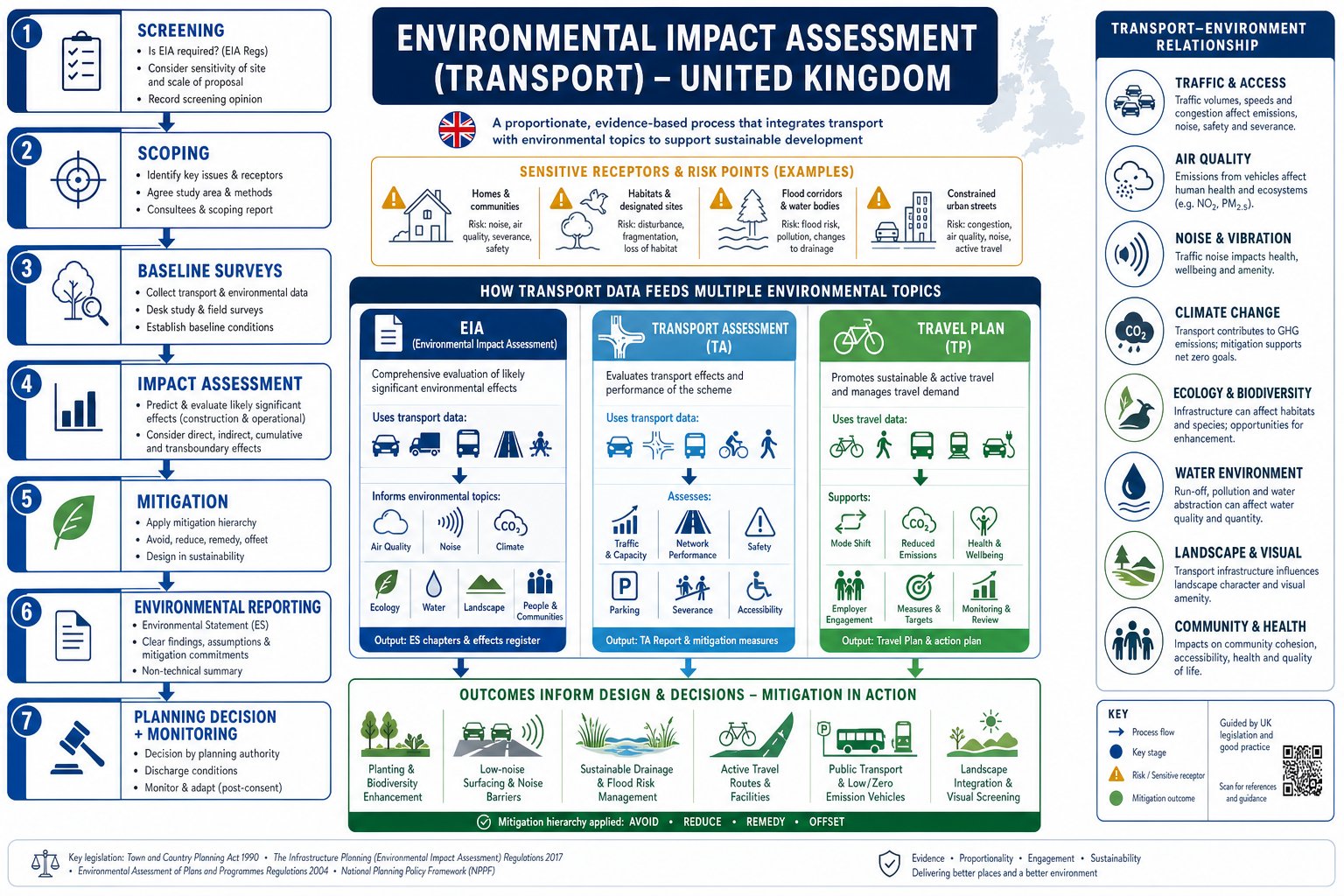
A transport scheme can look straightforward on a layout plan and still become the reason a planning application stalls for months. Often, the problem is not whether development should happen, but whether its environmental effects have been identified early enough, tested properly, and explained in a way a decision-maker can rely on.
That is where environmental impact assessment transport work becomes critical. In practice, Environmental Impact Assessment (EIA) is the framework that helps us identify likely significant effects, compare options, embed mitigation into design, and present robust evidence for planning and consenting. For architects, planners, lawyers, surveyors, developers, builders and local authorities, it is not a side exercise. It is often the structure that holds the whole planning case together.
In the UK, transport-related EIA sits at the intersection of planning law, engineering judgement, environmental science and consultation. That makes it technical, yes, but it also makes it highly practical. We need to know when EIA is required, how it connects with Transport Assessments and Travel Plans, what topics are likely to drive risk, and how to prepare evidence that can stand up to scrutiny.
This guide sets out the essentials for 2026 in a clear, planning-focused way. We will look at the legal context, the process, the common pitfalls and the habits that usually separate a smooth application from an expensive rewrite.
What Environmental Impact Assessment Means in a Transport Planning Context
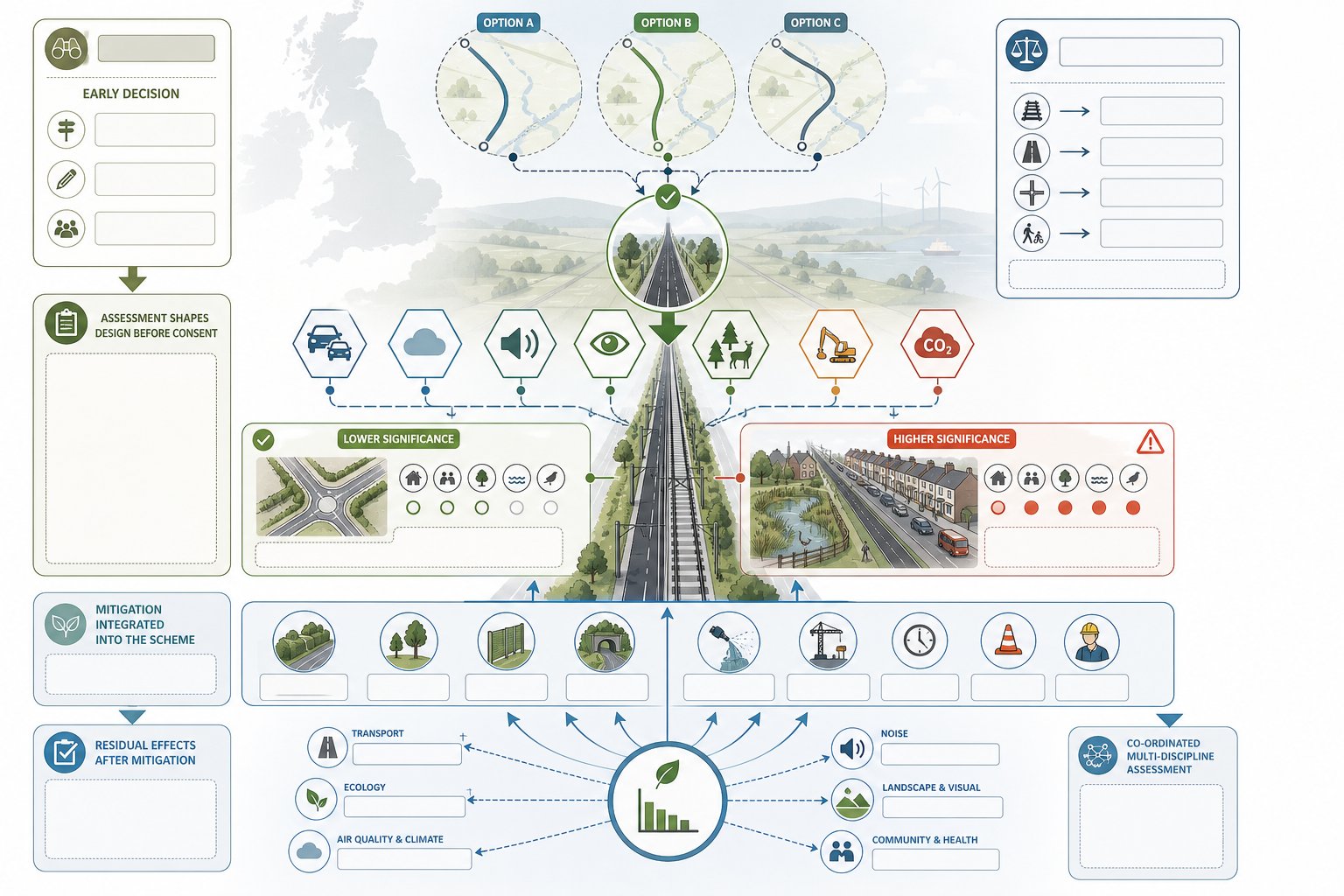
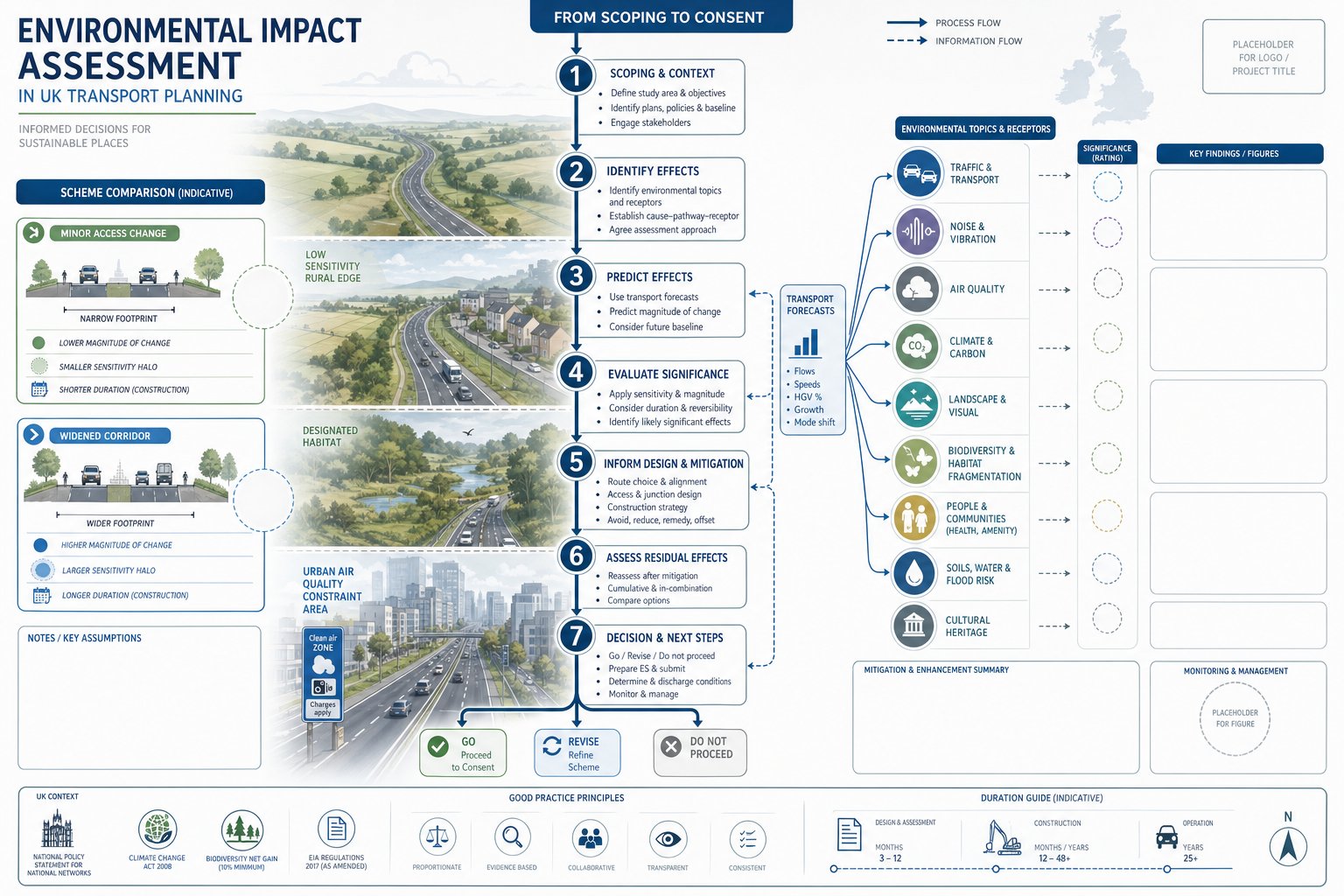
Environmental Impact Assessment, in a transport planning context, is a systematic process for identifying, predicting and evaluating the likely significant environmental effects of a scheme before consent is granted. That definition matters because EIA is not simply an environmental chapter added near submission. It is supposed to influence route choice, access design, construction strategy, mitigation and, sometimes, whether a proposal should proceed in its current form at all.
For transport projects, the key word is significant. Not every increase in traffic, noise or visual change triggers EIA-level concern. The exercise is about understanding whether effects, by virtue of scale, location, sensitivity or duration, may be significant in planning terms. A minor access change in a low-sensitivity setting is very different from a widened corridor near homes, designated habitats or constrained air quality locations.
We also need to separate EIA from routine planning support. A transport planning team may produce junction modelling, access reviews or parking analysis for many applications. EIA goes broader. It asks how traffic changes affect air quality, how a new alignment may fragment habitat, how construction noise could affect receptors, and what residual effects remain after mitigation.
That broader lens is why transport evidence often feeds into multiple EIA chapters. A traffic forecast may underpin air quality, noise and carbon analysis, not just highway capacity. In practice, strong coordination between environmental specialists and the transport team is what stops inconsistencies creeping into the submission.
When Transport Projects Require Environmental Impact Assessment
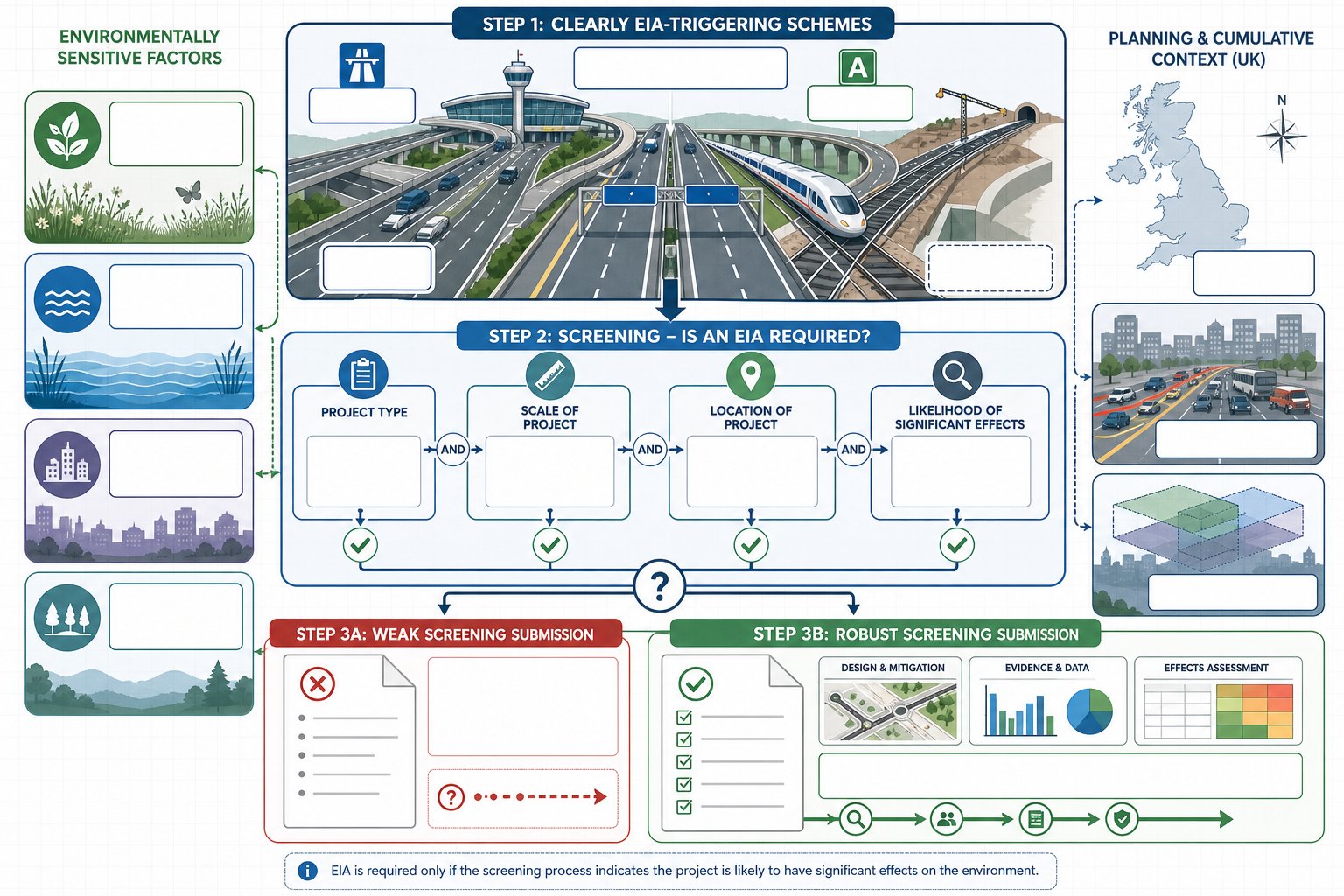
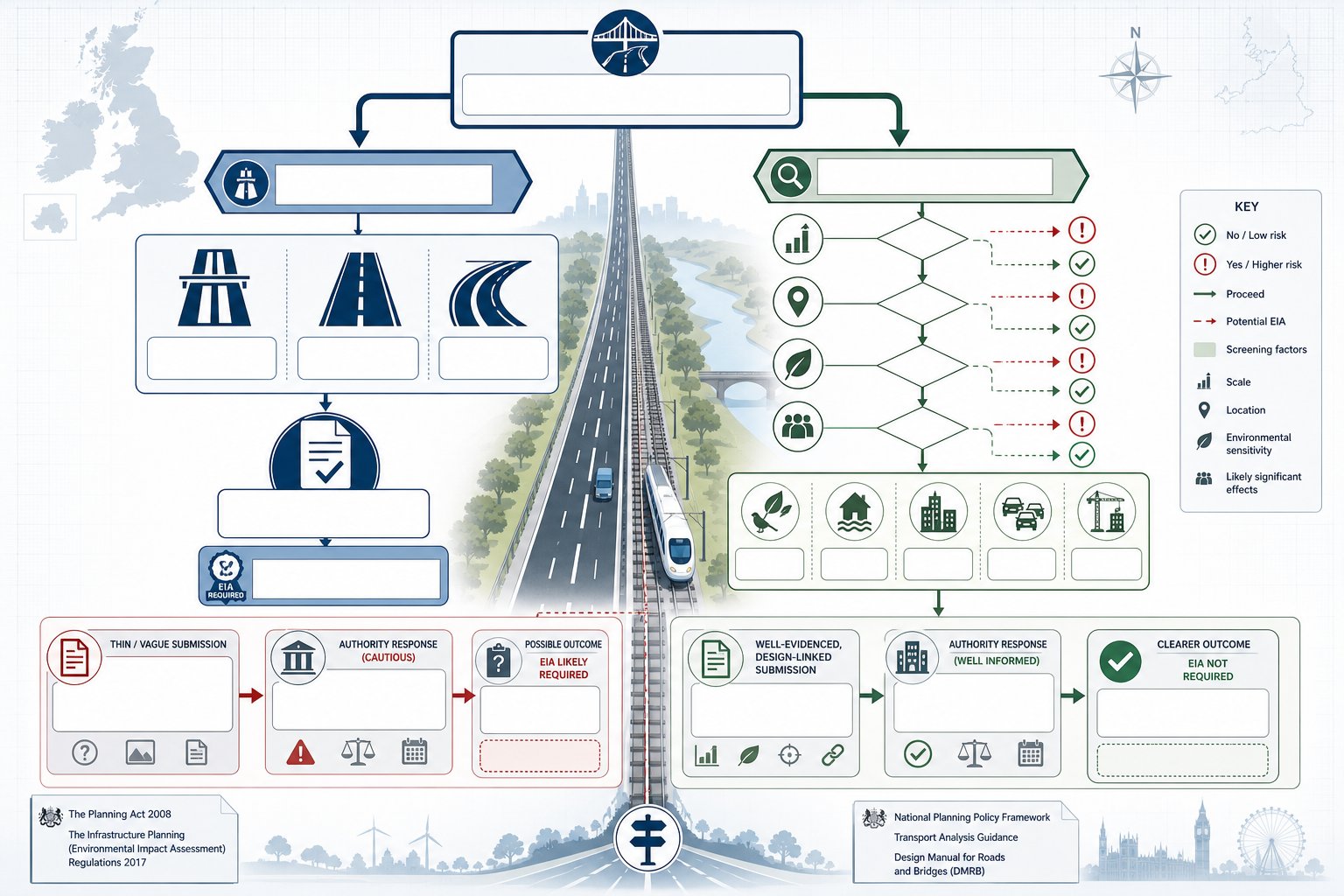
In the UK, whether a transport project requires EIA depends primarily on the type of development, its scale, its location and the likelihood of significant environmental effects. Some schemes fall into categories where EIA is effectively mandatory. Others require a case-by-case judgement through screening.
At the clearest end of the spectrum are major road schemes such as motorways, trunk roads, express roads and substantial new or widened routes. These are the kinds of projects typically captured by Annex I-style categories under the EIA framework, where significant effects are assumed because of scale and nature.
More commonly in day-to-day planning, we deal with Annex II-type development. Here, EIA is not automatic. Instead, the competent authority considers thresholds, site context and the sensitivity of receptors. A transport-related scheme may hence require EIA because it sits close to a Special Area of Conservation, passes through a flood-sensitive corridor, materially alters traffic at constrained urban receptors, or creates cumulative impacts alongside other committed development.
Screening is where many project teams either save time or lose it. If the screening request is thin, vague or disconnected from actual design information, the authority may take a cautious view. If it is well-evidenced, proportionate and honest about potential effects, the route forward is usually clearer. For development-led schemes, related work such as a transport assessment for the wider application often helps frame that judgement, but it does not replace EIA screening.
Key Legal And Planning Framework in the UK
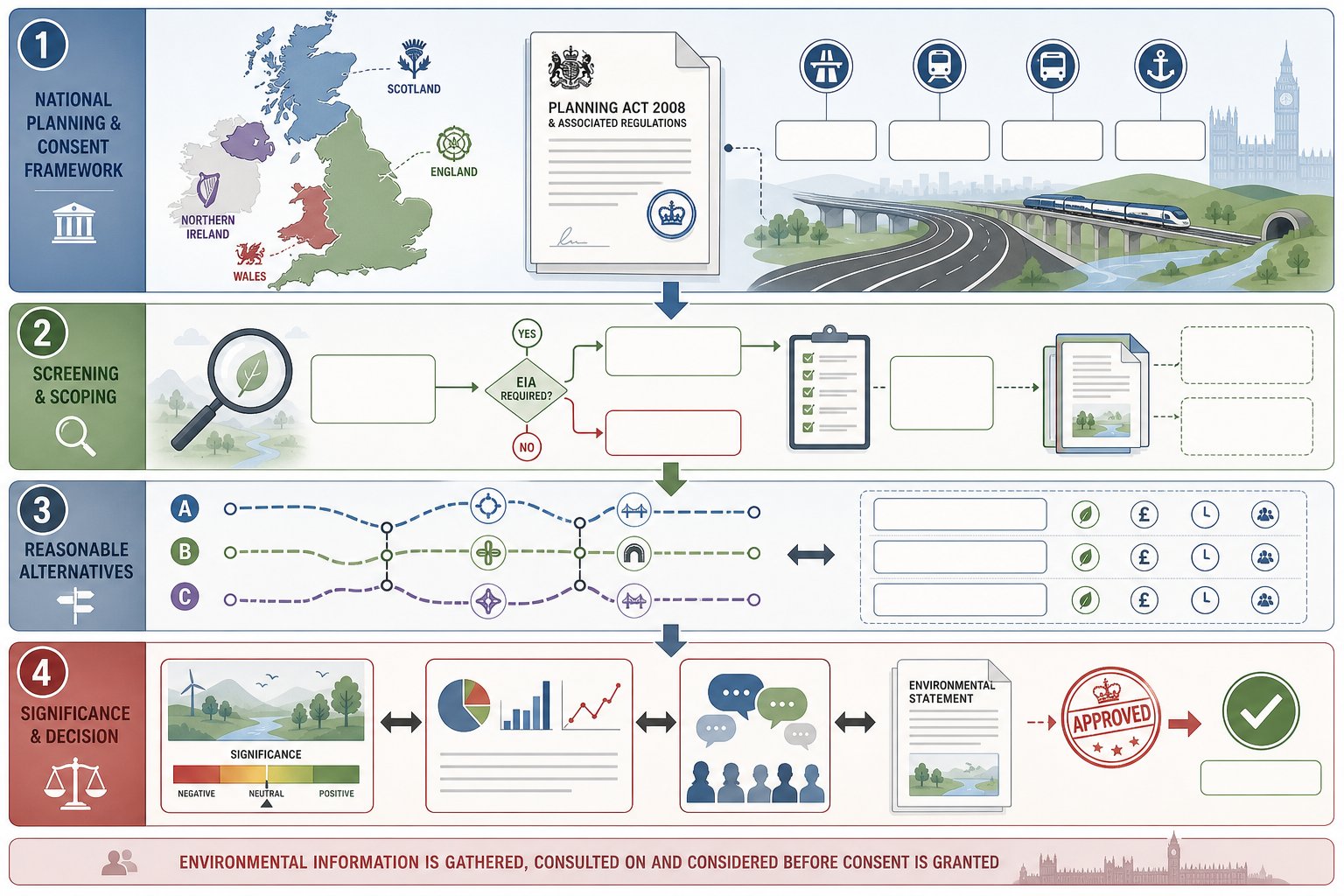
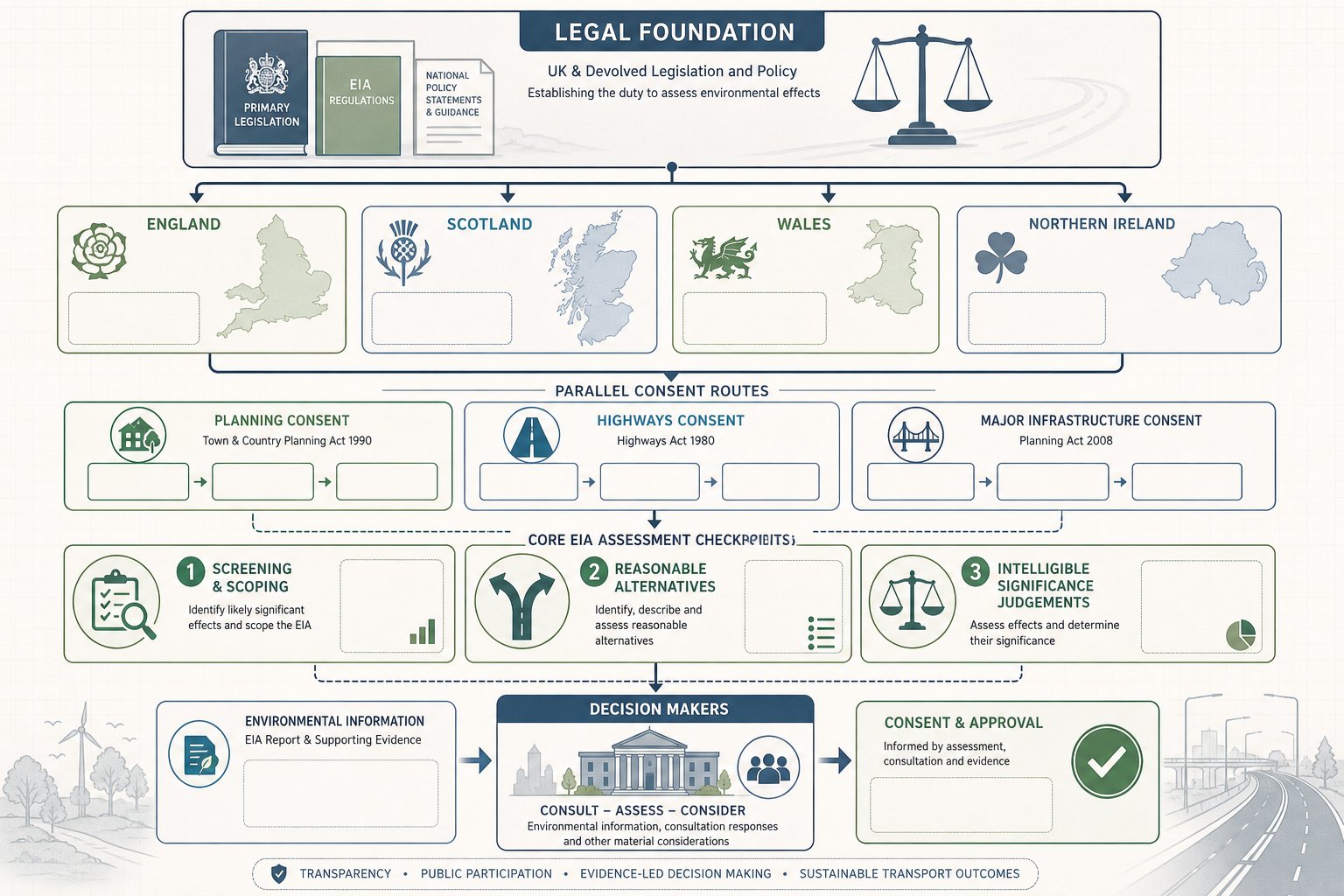
The UK legal framework for EIA is rooted in the EIA Directive, including the 2014/52/EU amendments, and implemented through domestic regulations across planning and sector-specific consenting regimes. In simple terms, the legal duty is not just to produce a report: it is to ensure environmental information is gathered, consulted on and taken into account before a decision is made.
For town and country planning, EIA requirements are embedded in planning regulations applying to England, Scotland, Wales and Northern Ireland, with differences in drafting but similar principles. Transport projects may also be consented under separate highways or infrastructure procedures, and those routes have their own EIA regulations. Scottish road schemes, for instance, operate under sector-specific legislation tied to the Roads (Scotland) Act framework.
For practitioners, three legal themes matter most.
First, screening and scoping need to be defensible. Authorities and applicants both need a transparent record of why topics were included, excluded or scoped down.
Second, reasonable alternatives matter. If route options, access strategies or design refinements were considered, the Environmental Statement should explain that clearly.
Third, significance judgements must be intelligible. A court is rarely interested in whether a model was aesthetically tidy: it is interested in whether the reasoning was lawful, evidence-based and understandable.
This is where planning law and technical transport advice meet. A traffic impact assessment might answer one part of the planning case, but EIA has a wider legal function: it informs the decision-maker about environmental consequences before consent is issued.
How Environmental Impact Assessment Relates to Transport Assessments and Travel Plans
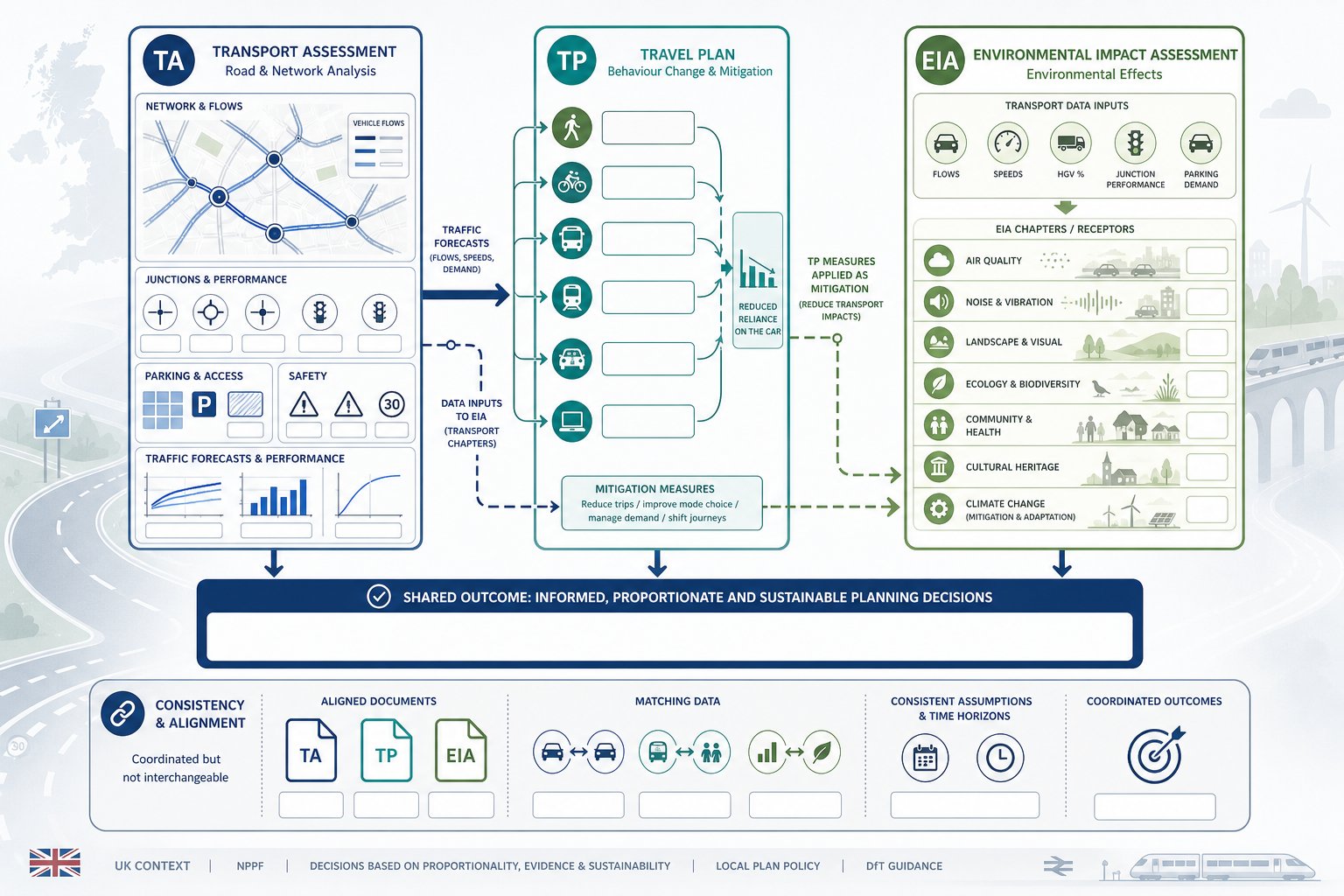
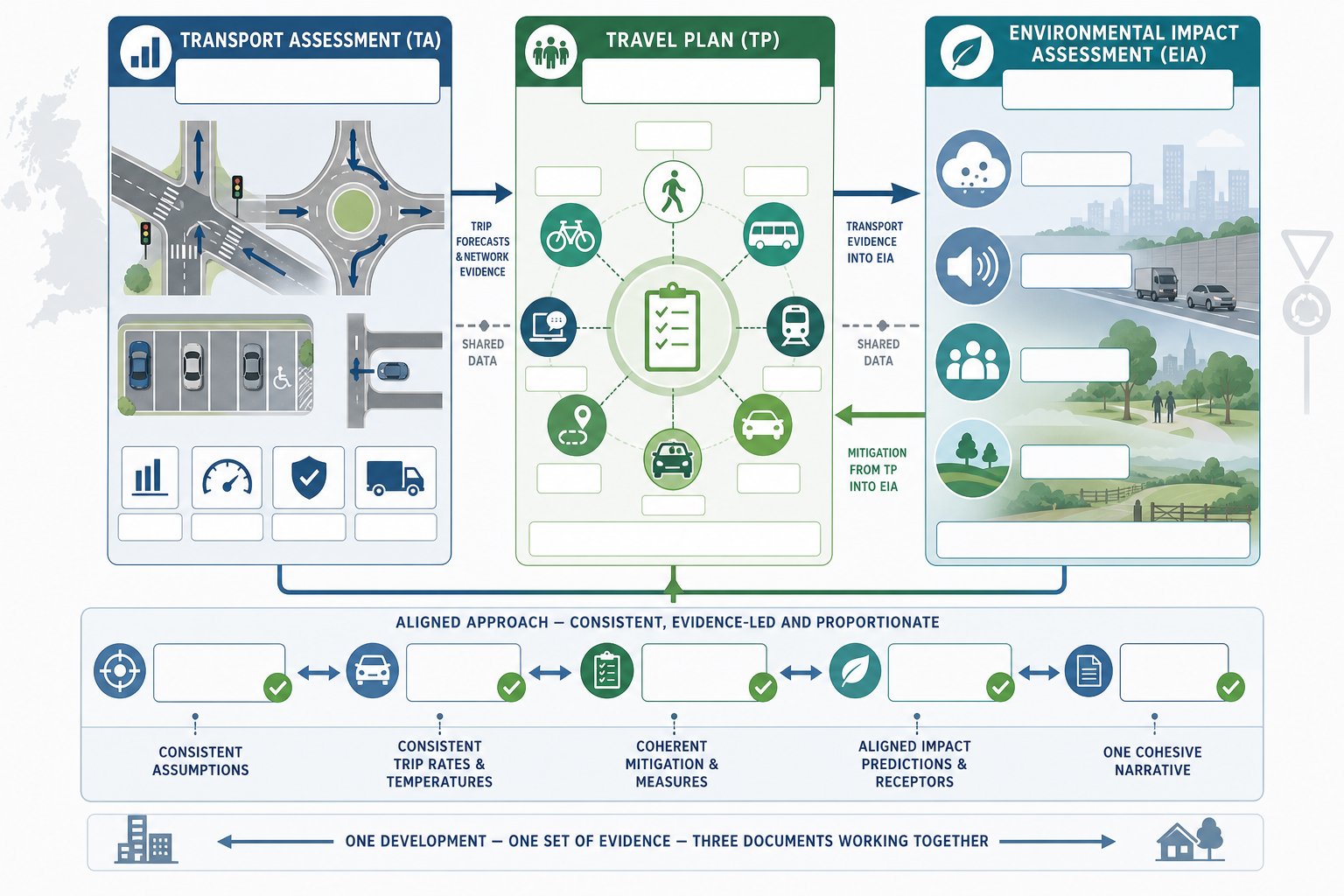
This is one of the most common areas of confusion in planning applications. A Transport Assessment (TA), a Travel Plan (TP) and an Environmental Impact Assessment are related, but they do different jobs.
A TA focuses on the transport consequences of development: trip generation, distribution, highway capacity, junction performance, sustainable access, road safety and, in many cases, servicing and parking. A TP then sets out measures to influence travel behaviour, reduce reliance on single-occupancy car trips and support walking, cycling, public transport and smarter travel choices.
EIA is broader. It uses transport evidence as an input, but it is concerned with environmental receptors and significant effects. So the TA may forecast traffic changes on the network: the EIA air quality chapter will use that data to assess pollutant concentrations, and the noise chapter may use it to estimate changes in operational sound levels. The TP, meanwhile, may form part of the mitigation package by reducing vehicle demand or shifting travel patterns.
In practice, the best submissions align these documents from the start. The trip rates in the TA should match the assumptions in the environmental assessments. The mitigation proposed in the TP should support the effects reported in the Environmental Statement. And the narrative across all documents should be consistent.
For development-led projects, a focused Residential Development Transport strategy may sit alongside EIA work, especially where local authority thresholds are triggered. But one document cannot simply stand in for the other: each has its own purpose, audience and evidential role.
The Main Environmental Effects Considered for Transport Development
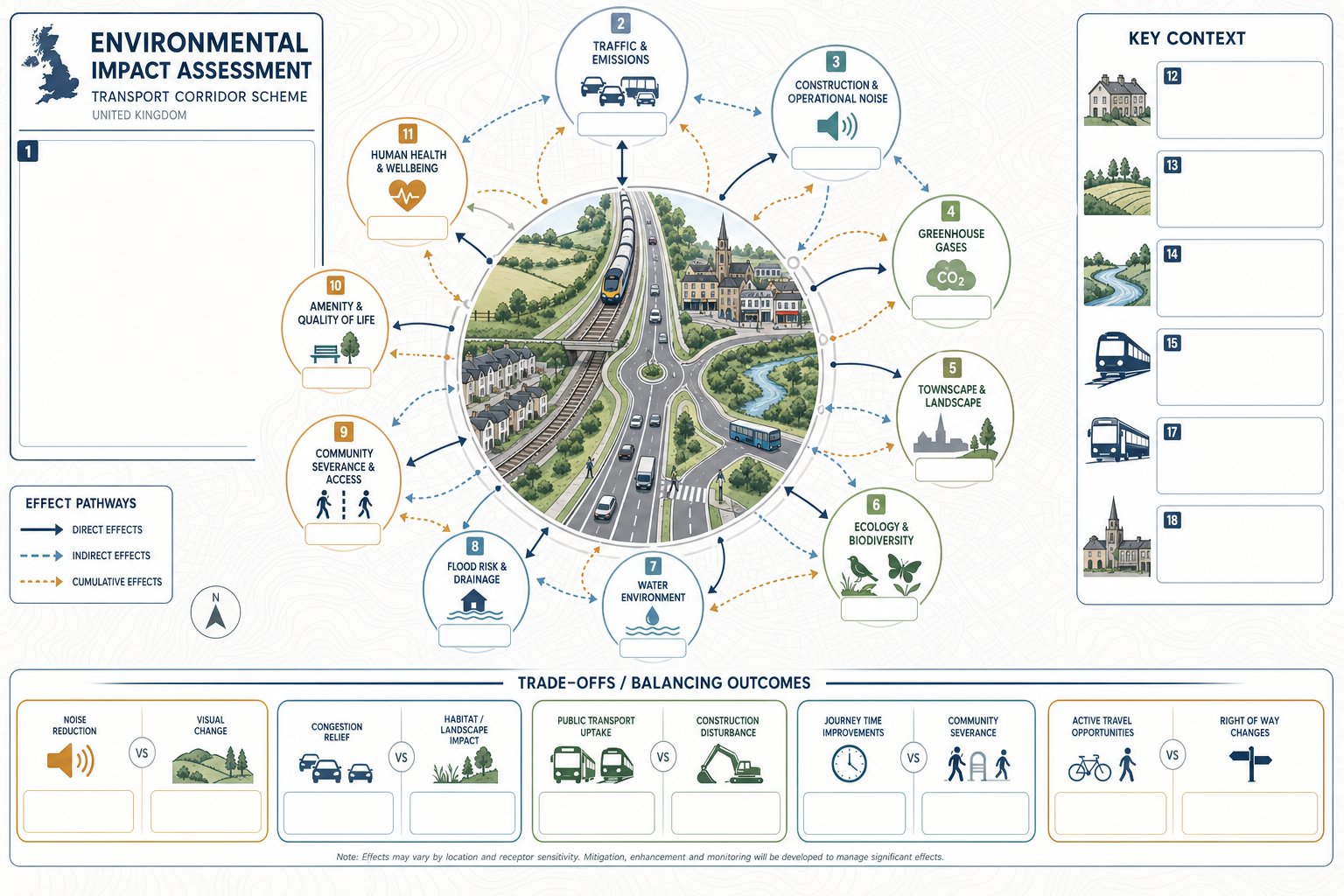
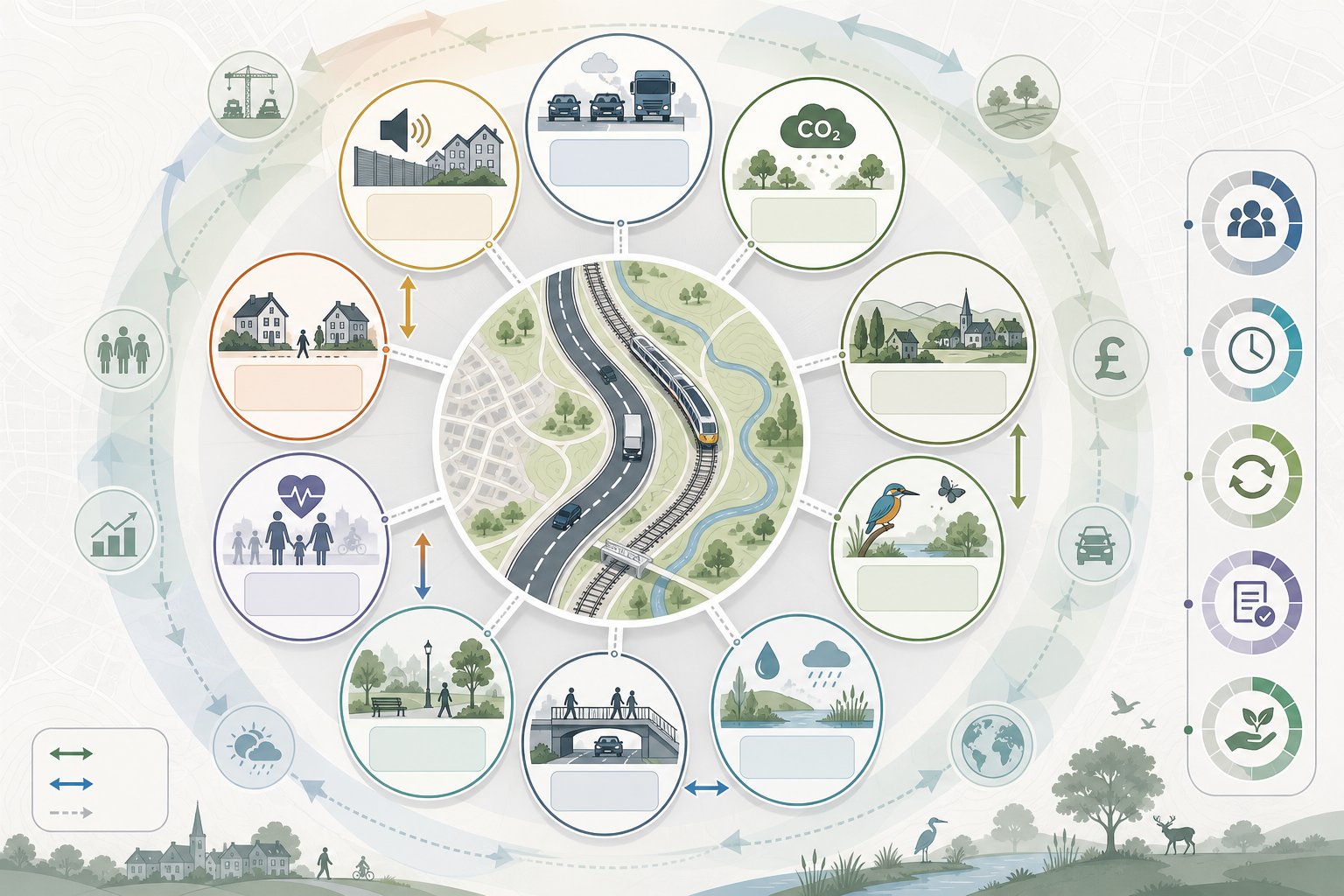
Transport development affects far more than movement. Even relatively modest schemes can alter exposure, accessibility, character and ecological conditions across a surprisingly wide area. The point of EIA is to test those effects systematically rather than react to them late.
Some effects are direct and easy to picture, such as extra vehicle movements at a junction or vegetation loss along a corridor. Others are indirect or cumulative: a redistribution of traffic that increases noise on one street while easing it on another, or a combination of several committed schemes that changes overall air quality and community experience.
The receptors considered will vary by project, but transport EIAs typically focus on traffic and emissions, construction and operational noise, greenhouse gas emissions, townscape and landscape effects, ecology, water environment, flood risk, community severance, amenity and human health. Importantly, significance is not judged in a vacuum. We need to understand receptor sensitivity, duration, reversibility, policy context and whether mitigation is built into the design.
What often makes transport schemes challenging is that one design move can improve one topic while worsening another. A noise barrier may reduce operational sound at properties but affect visual amenity. A new route may relieve congestion in a town centre but introduce impacts to landscape or habitat elsewhere. Good EIA makes those trade-offs visible.
Traffic, Air Quality, Noise, And Climate Effects
Traffic is usually the analytical backbone of transport EIA because it influences several environmental topics at once. Changes in flow, composition, speed and congestion can alter local air pollutant concentrations, operational noise levels, road safety conditions and greenhouse gas emissions.
Air quality assessment commonly focuses on nitrogen dioxide and particulate matter, especially where receptors sit close to heavily trafficked roads or within existing constrained urban areas. Construction dust and emissions may also matter, particularly for phased projects or sites near homes, schools or healthcare facilities. The key is not merely to show traffic growth, but to test whether the change is material enough to affect exposure in a meaningful way.
Noise and vibration are similarly context-specific. A small increase in traffic on an already busy road may be barely perceptible. The same increase on a previously quiet route can be far more noticeable. Construction effects often become a major concern because they are immediate, disruptive and highly visible to local communities.
Climate effects now carry much more weight than they did a decade ago. We are expected to address both greenhouse gas emissions and resilience. That means considering embodied and operational carbon, but also whether the scheme can function under hotter summers, intense rainfall and flooding stress. In many cases, vision led transport approaches help us avoid locking in patterns of movement that undermine long-term climate objectives.
Landscape, Ecology, Water, And Community Effects
Landscape and visual effects are sometimes underestimated in transport planning because teams focus heavily on capacity and movement. Yet a road alignment, bridge, retaining structure, lighting column or earthwork can alter the perceived character of a place very quickly. Effects may include visual intrusion, loss of enclosure, change in tranquillity and harm to valued landscape settings.
Ecology can be even more sensitive. Transport schemes may cause habitat loss, fragmentation, disturbance, mortality risk and hydrological change. Linear infrastructure in particular can sever ecological corridors. Since biodiversity net gain and habitat condition are now central planning considerations, ecological input needs to be integrated from the start rather than bolted on after alignment decisions are made.
Water effects usually cover runoff quality, flood risk, drainage capacity, effects on watercourses and, where relevant, hydromorphology. A layout that appears efficient in highway terms may create drainage problems or increase pollutant risk if not designed carefully.
Then there is the human side. Community effects can include severance, changes in access to local services, loss of amenity, safety concerns and differential impacts on more vulnerable groups. These issues often come into sharp focus during public consultation transport work, where residents explain impacts that may not be obvious from desktop mapping alone. Sometimes the biggest planning objection is not traffic growth itself, but what that growth means for everyday life on a street.
The Environmental Impact Assessment Process Step by Step
The formal process is well known, but the real value lies in how early and how intelligently we apply it. A transport EIA should not be treated as a linear box-ticking exercise. In reality, projects loop back. Screening shapes scoping: scoping reveals new survey needs: baseline data changes the design: mitigation alters the impact assessment: consultation prompts refinement again.
Still, there is a practical sequence that most successful schemes follow. We start by establishing whether EIA is required. We then define the scope, collect baseline information, assess likely effects, design mitigation, report the findings and support consultation, determination and monitoring. The difference between a robust submission and a fragile one is usually not the headline methodology. It is whether the process has been integrated with design evolution and planning strategy throughout.
Screening, Scoping, And Baseline Data Collection
Screening is the gateway question: is EIA required? For transport schemes, that means checking the relevant regulatory schedule, thresholds and selection criteria, then applying professional judgement to the characteristics of the proposal and its setting. Sensitive locations, cumulative development and complex traffic effects can all push a scheme toward EIA even where scale alone does not.
Once screening points toward EIA, scoping becomes crucial. This is where we agree the likely significant topics, study areas, assumptions, consultees and methods. Good scoping saves months. Bad scoping stores up pain for later, especially if a topic has to be re-opened after consultation because the study area was too narrow or baseline assumptions were weak.
Baseline data collection then gives the assessment its factual footing. For transport-led projects, that often includes traffic counts, queue observations, collision data, walking and cycling audits, public transport context, air quality monitoring, noise surveys, ecological surveys, flood information, landscape appraisal and community receptor mapping. Timing matters. Seasonal ecological surveys cannot be magicked into existence in November because a submission date suddenly moved.
We have found that early coordination between design, environmental specialists and those preparing the core environmental impact assessment transport evidence usually reduces later disagreement over assumptions, study extents and data quality.
Impact Assessment, Mitigation, And Environmental Reporting
Impact assessment turns baseline information and design details into a reasoned judgement about likely significant effects. For transport projects, that usually means forecasting construction and operational scenarios, modelling changes where appropriate, evaluating receptor sensitivity and then assigning significance with clear criteria.
Mitigation should follow the classic hierarchy: avoid, reduce, then remedy or compensate. In transport terms, avoidance may mean changing a route alignment, moving an access point or dropping a problematic construction compound. Reduction could involve speed management, low-noise surfacing, planting, drainage treatment, timing controls or demand-management measures embedded in the Travel Plan. Compensation may include habitat creation or off-site measures where residual effects cannot be fully removed.
The Environmental Statement, or Environmental Report where the process requires that terminology, needs to explain all of this in a structured and readable way. Methods, assumptions, limitations, alternatives, mitigation and residual effects should be transparent. The non-technical summary matters more than some teams think: many planning committee members and local residents will start there, and if it is evasive or impenetrable, confidence drops fast.
At this stage, consistency is everything. The drawings, the TA, the construction management assumptions and the environmental chapters all need to say the same thing. If the transport chapter assumes one access arrangement and the landscape chapter illustrates another, people notice. And once they notice, they tend to doubt everything else too.
Common Challenges in Transport Environmental Impact Assessment
Transport EIA rarely falls over because teams do not know the textbook stages. It usually falters because reality is messier than the textbook.
One major challenge is modelling uncertainty. Traffic assignment, future year assumptions, background growth, committed development, mode share changes and policy interventions all introduce moving parts. If those assumptions are not transparent, the environmental conclusions built on them become vulnerable.
Cumulative and in-combination effects are another headache. A single scheme might seem manageable, but add nearby housing, employment growth, highway upgrades and public realm changes, and the total effect can be quite different. Corridor-scale schemes are especially difficult because impacts can shift geographically rather than disappear.
Climate change adds a double layer of complexity. We need to assess emissions from the project while also designing for resilience to heat, flood and extreme weather. Biodiversity net gain can create similar tension when transport land requirements compete with ecological enhancement space.
Then there is programme pressure. Design changes late in the process can invalidate survey assumptions, alter study areas and require re-running models. That is one reason clients often need concise, locally aware technical input early: experienced teams providing traffic impact assessment developers advice tend to spot authority-specific risks before they become submission-stage problems.
Best Practice for Preparing Robust Planning Evidence
Robust planning evidence is rarely about producing the thickest document. It is about producing evidence that is proportionate, internally consistent, policy-aware and easy for a reviewer to follow.
The first best-practice principle is early integration. EIA works best when it informs option selection and design, not when it audits decisions that have already hardened. If an access strategy creates avoidable effects, it is much cheaper to revise it at concept stage than defend it after environmental objections land.
Second, engagement matters. Statutory consultees, local planning officers, highway authorities and communities often identify practical issues that desktop work misses. Not every concern will change the scheme, but ignoring them usually weakens the planning case.
Third, use the right tools and explain them plainly. GIS, remote sensing, traffic models, air dispersion tools and noise calculations are valuable, but they need transparent assumptions and sensible interpretation. A black-box model is not persuasive simply because it is complex.
Fourth, be explicit about significance criteria, uncertainty and alternatives. Decision-makers do not expect perfection: they expect honesty and professional judgement.
Finally, plan for monitoring and adaptive management. Post-consent travel monitoring, construction controls and ecological follow-up can validate assumptions and support compliance. For consultancy teams, that practical mindset is often where trusted advice stands out, especially when paired with quick, planning-focused reporting shaped around local thresholds and authority expectations.
Conclusion
Environmental Impact Assessment for transport is, at heart, a decision-making tool. It helps us understand what a scheme may do to people, places and environmental systems before those effects are locked in. For planning applications in 2026, that means more than producing a compliant report. It means joining up transport evidence, environmental analysis, legal requirements and design choices from the outset.
For architects, planners, lawyers, surveyors, developers, builders and councils, the practical lesson is simple: start early, align your assumptions, and treat EIA as part of project development rather than a late-stage add-on. The strongest applications are usually the ones where screening is clear, scoping is disciplined, modelling is transparent and mitigation is built into the scheme itself.
Done properly, environmental impact assessment transport work reduces planning risk, improves the quality of proposals and gives decision-makers confidence that the likely significant effects have been understood honestly. And in a planning system that rarely rewards avoidable ambiguity, that confidence is worth a great deal.
Environmental Impact Assessment Transport – Frequently Asked Questions
What is environmental impact assessment transport and why is it important?
Environmental impact assessment transport is a systematic process to identify, predict and evaluate significant environmental effects of transport projects. It ensures environmental impacts are considered early, guiding design choices and planning decisions to reduce risks and improve project outcomes.
When does a transport project require an environmental impact assessment in the UK?
In the UK, EIA is required for major schemes like motorways and trunk roads (Annex I) where effects are significant. Smaller projects may need EIA depending on size, location, and receptor sensitivity (Annex II), assessed case-by-case through a screening process.
How does environmental impact assessment relate to transport assessments and travel plans?
Transport Assessments focus on traffic and network effects, Travel Plans target behaviour changes to reduce car use, while environmental impact assessment transport uses these inputs to evaluate wider environmental factors like air quality, noise, ecology and climate effects.
What are the main environmental effects considered in transport EIAs?
Transport EIAs assess traffic impacts on air quality, noise, and greenhouse gas emissions, as well as landscape and visual effects, ecological impacts, water quality and flood risk, plus community health, safety, and amenity considerations.
What best practices ensure robust environmental impact assessment transport submissions?
Strong submissions integrate EIA early with design, engage stakeholders extensively including through public consultation transport, use transparent methods and models, clearly explain significance and alternatives, and plan for post-consent monitoring and adaptive management.
How can transport environmental impact assessments address climate change concerns?
EIAs consider both greenhouse gas emissions and resilience to climate effects like heat and flooding. They promote design choices that reduce carbon footprint and avoid locking in unsustainable travel patterns, supporting long-term climate objectives through vision led transport planning.