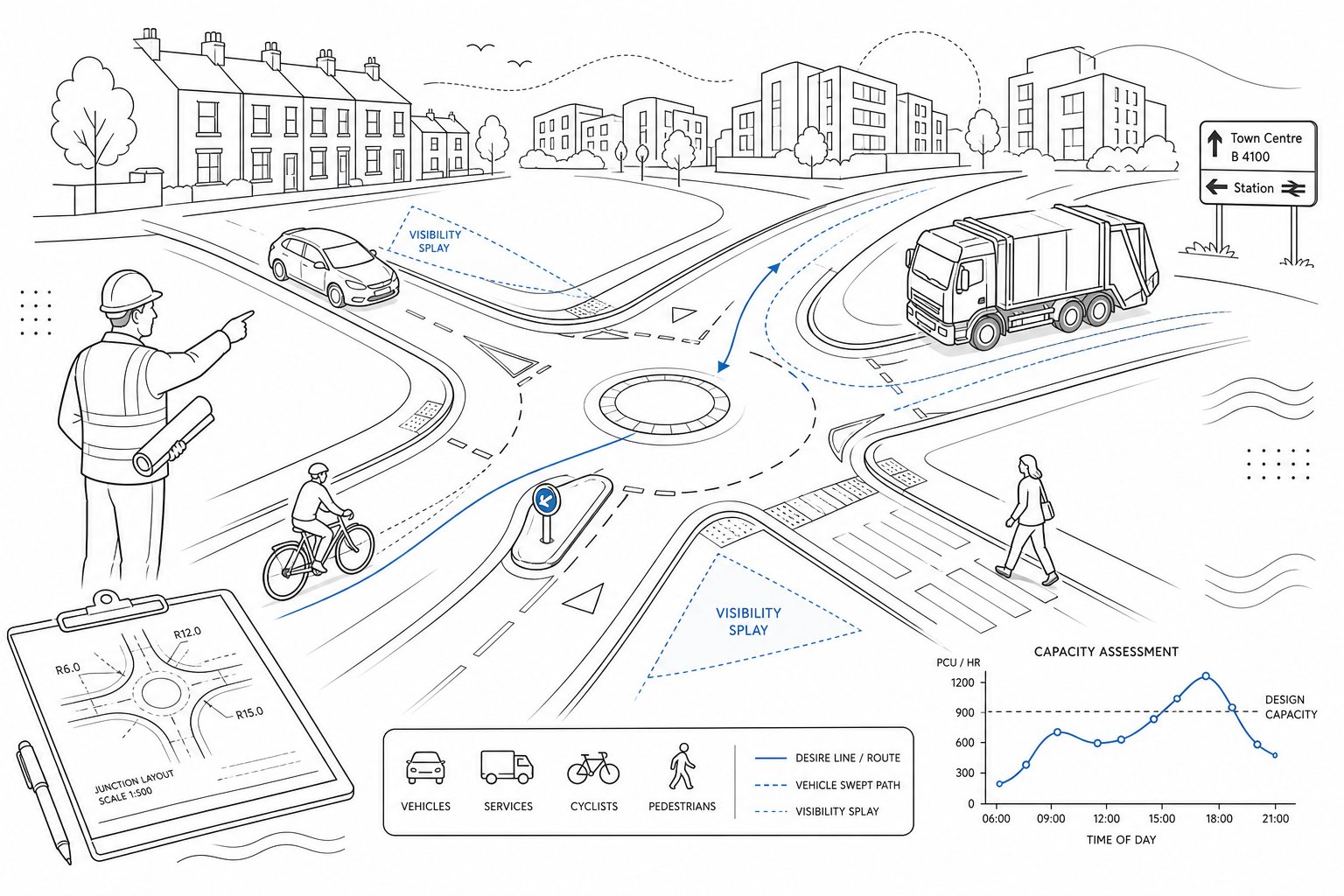
A junction can look deceptively simple on a drawing. A kerb line here, a ghost island there, a roundabout in the middle and everyone moves on. In practice, though, junction design is where planning ambition meets highway reality. If the layout is wrong, the consequences show up quickly: safety concerns from the highway authority, capacity objections, awkward servicing movements, redraws to the site layout, and planning delays nobody priced into the programme.
That is why junction design consultants matter. We’re not simply drawing road features: we’re testing whether an access will work for the vehicles that need to use it, fit the standards that apply, and perform acceptably within the surrounding network. For architects, planners, developers, surveyors and local authorities, that input often becomes the difference between a scheme that progresses smoothly and one that gets stuck in technical negotiation.
In 2026, that scrutiny is only getting sharper. Authorities expect a clearer evidence base, stronger justification for access strategy, and more visible consideration of safety, active travel and local design guidance. So, whether the project is a residential site, a commercial redevelopment or a highway improvement scheme, understanding how junction design consultants support planning is no longer a nice-to-have. It’s part of getting viable development over the line.
What Junction Design Consultants Do And When Their Input Is Needed
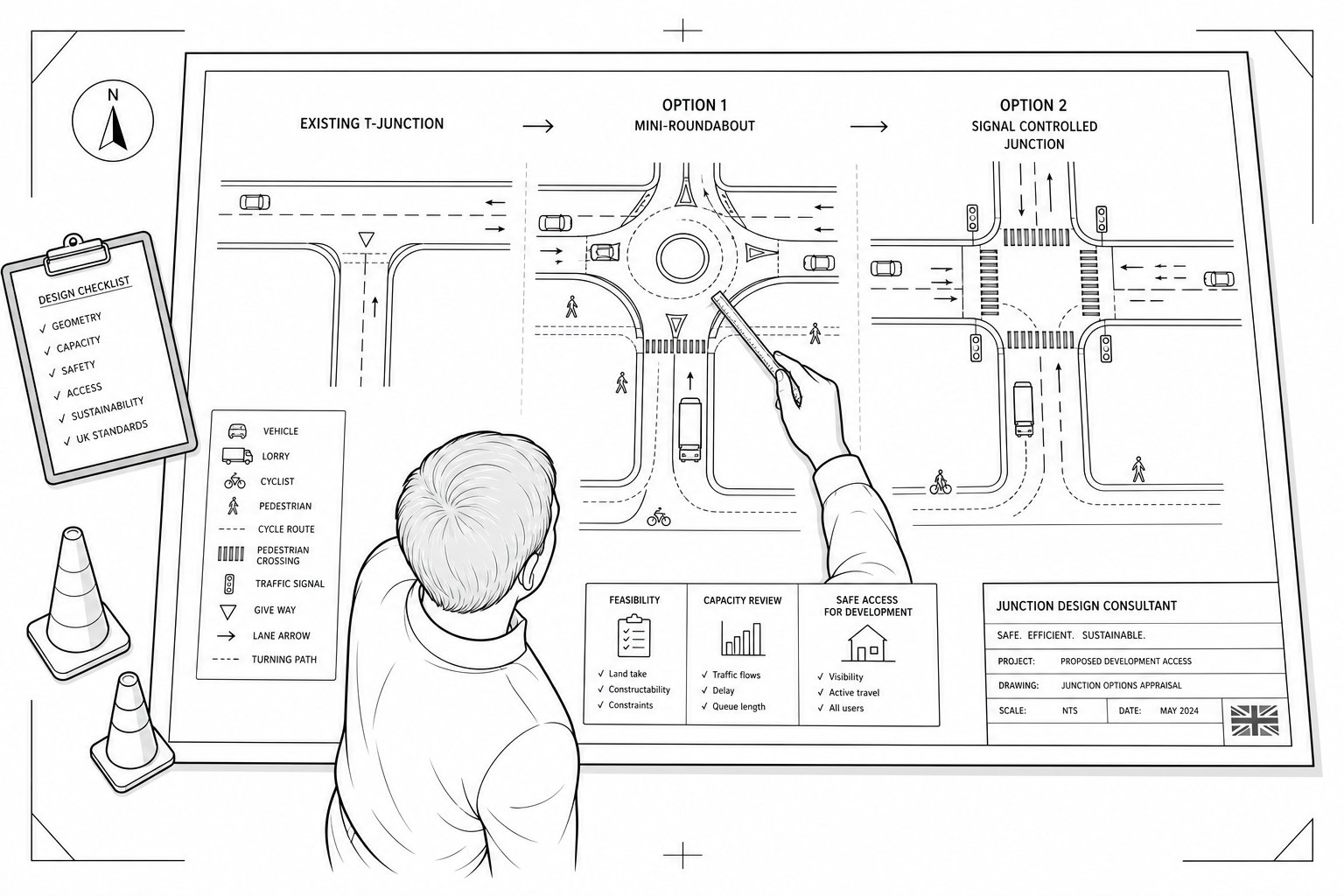
Junction design consultants are specialist traffic and highway engineers who plan, test and refine the way roads meet. That can involve a brand-new site access, a modification to an existing priority junction, a mini-roundabout, a signal-controlled layout, or a more complex package of off-site highway works tied to development.
Our role usually starts earlier than many teams expect. We may be asked to advise at feasibility stage, when land constraints, visibility, traffic generation and likely highway authority expectations are still being explored. From there, the work can continue through concept design, capacity testing, swept path analysis, planning support, technical approval, road safety input and sometimes detailed delivery drawings.
The trigger for junction design input is generally straightforward: if a proposal changes how vehicles, cyclists or pedestrians interact with the highway, junction design is likely to be relevant. That includes schemes creating a new access, intensifying use of an existing one, altering junction geometry, or affecting nearby network performance.
In planning terms, this often sits alongside transport assessments, transport statements and access strategy. On more involved schemes, the junction work becomes the technical backbone of the planning case, particularly where the acceptability of the development depends on safe and efficient access. In that wider context, Traffic Engineering Consultants: What often frame junction design as one part of a broader package of highway evidence.
Projects That Commonly Require Junction Design Support
The most common projects are residential, retail, commercial and mixed-use developments, especially where new trips will materially alter local turning movements. But the list is broader than many assume.
We regularly see junction design needed for:
- new housing accesses onto local or classified roads
- employment and logistics schemes with servicing demands
- care homes, schools and roadside uses with peak-hour sensitivity
- redevelopment sites where existing access is substandard
- highway improvement schemes and safety-led alterations
- active travel projects that change junction priority or geometry
- traffic-calming works affecting movement through side roads
Sometimes the issue is obvious, such as a proposed roundabout to serve a strategic allocation. Sometimes it is much smaller: a single altered access that now needs to accommodate refuse vehicles without overrunning footways. Either way, the consultant’s value lies in identifying whether the proposed form is suitable before assumptions harden into expensive design commitments.
How Junction Design Fits Into The Planning Application Process
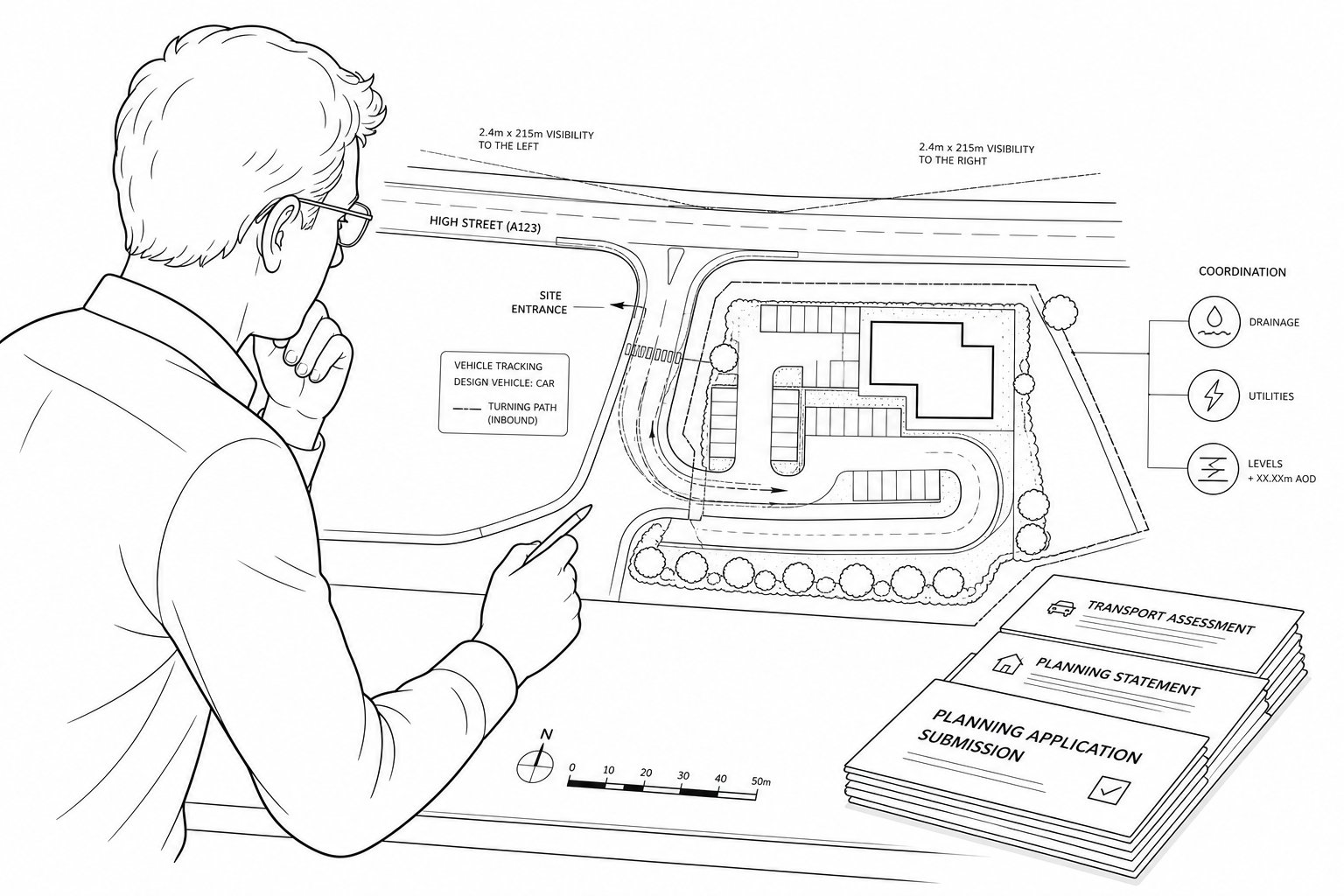
Junction design is rarely a standalone exercise. It feeds directly into planning strategy, site layout, viability and the transport evidence submitted with an application.
At concept or masterplanning stage, we usually help define what form of access is realistic. That early view influences frontage design, internal road alignment, building placement, parking layout and servicing strategy. If a site can only achieve policy-compliant access from one point, the whole development framework may need to pivot around that fact.
Pre-application engagement is often where junction design earns its keep. Highway authorities want confidence that the applicant understands the likely technical issues before formal submission. A sensible preliminary design, backed by visibility checks, vehicle tracking and proportionate capacity analysis, gives those discussions substance. It also helps identify whether the authority is likely to accept a simple priority junction, prefer a ghost island right-turn lane, or expect something more robust.
When the planning application is prepared, junction design material commonly appears in several places: the transport statement or assessment, access drawings, engineering appendices, road safety commentary and design rationale. The package needs to show not just what is proposed, but why it is appropriate for the scale and type of development.
This is also where coordination matters. Access design should align with drainage, levels, utilities, land ownership and visibility controls. We often find that strong Junction And Access Design work reduces planning queries because the submission feels coherent rather than stitched together from separate disciplines.
Done properly, junction design supports planning by making the highway case legible: safe access, suitable geometry, acceptable operation and compliance with the standards the decision-maker will rely on.
Why Early Design Advice Reduces Delays, Objections And Redesign Costs
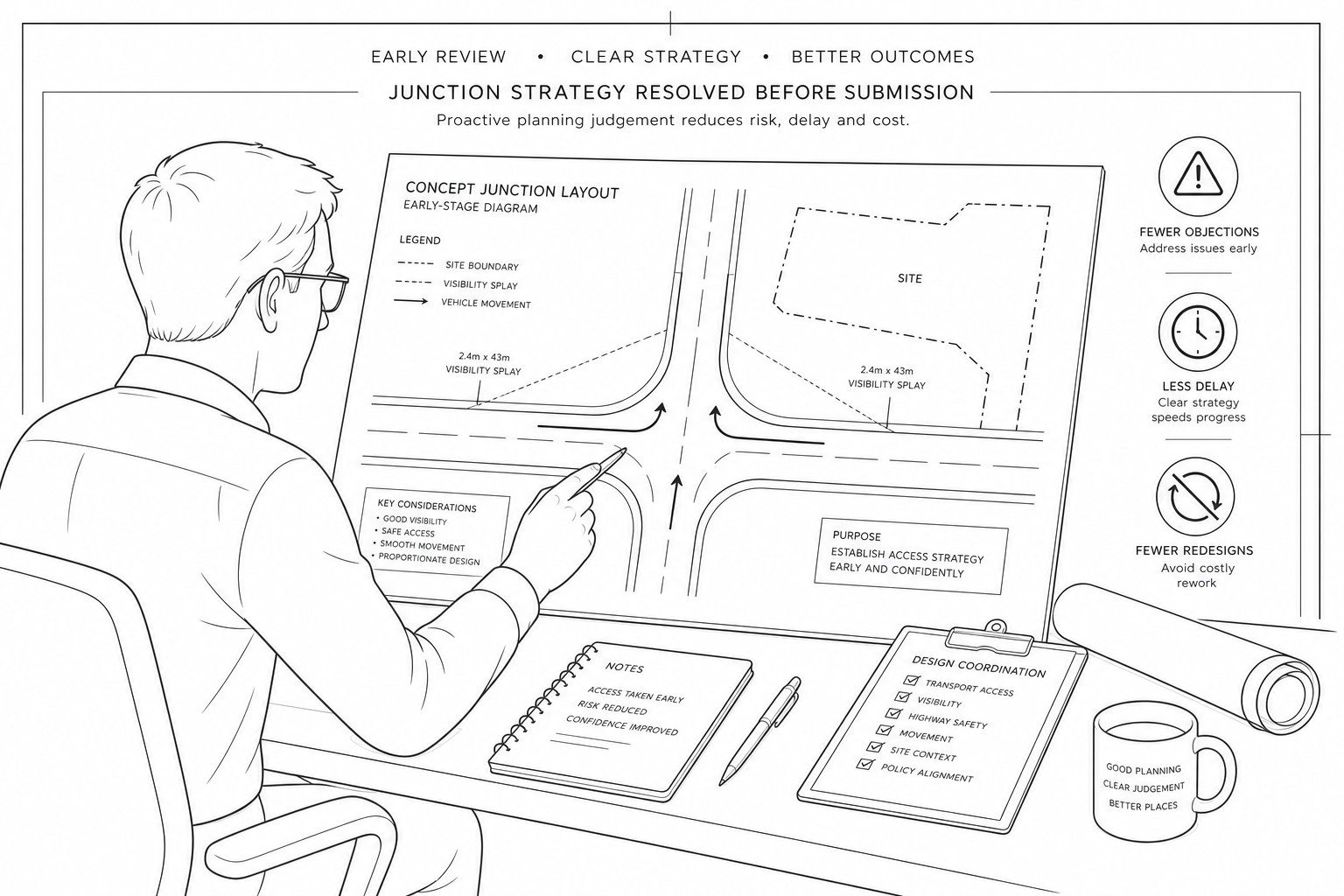
Early advice saves time partly because it prevents false starts. Teams sometimes develop a layout around an assumed access point, only to discover later that visibility is constrained by land outside the red line, the junction sits too close to another arm, or the turning demand would push the authority towards a different form of control. By then, changing course is expensive.
Councils and highway officers generally expect the broad junction strategy to be established at concept stage. They may accept detail being refined later, but they are far less tolerant of applicants arriving with unresolved fundamentals. If the access arrangement is uncertain, they tend to question whether the wider scheme is actually ready for determination.
Early junction input reduces three common sources of delay:
- Technical objections based on safety, geometry or capacity.
- Late redesign caused by poor coordination with architecture and site planning.
- Programme drift when additional surveys, modelling or land checks are requested after submission.
There is a commercial angle too. Revising internal roads, parking courts, servicing yards or boundary treatments after highway comments can ripple through the whole consultant team. A modest early design commission often avoids much larger downstream redesign fees.
We see this especially on constrained sites, where one technical oversight can trigger several others. A tighter, earlier review usually exposes the awkward bits when they are still manageable. And because local authority expectations vary, practical experience matters as much as textbook knowledge. Teams looking at wider access implications often benefit from input similar to that provided by highway design consultants, particularly where planning success depends on balancing standards with local judgement.
In short, early advice does not just make designs better. It makes projects more predictable.
Core Elements Of A Junction Design Assessment
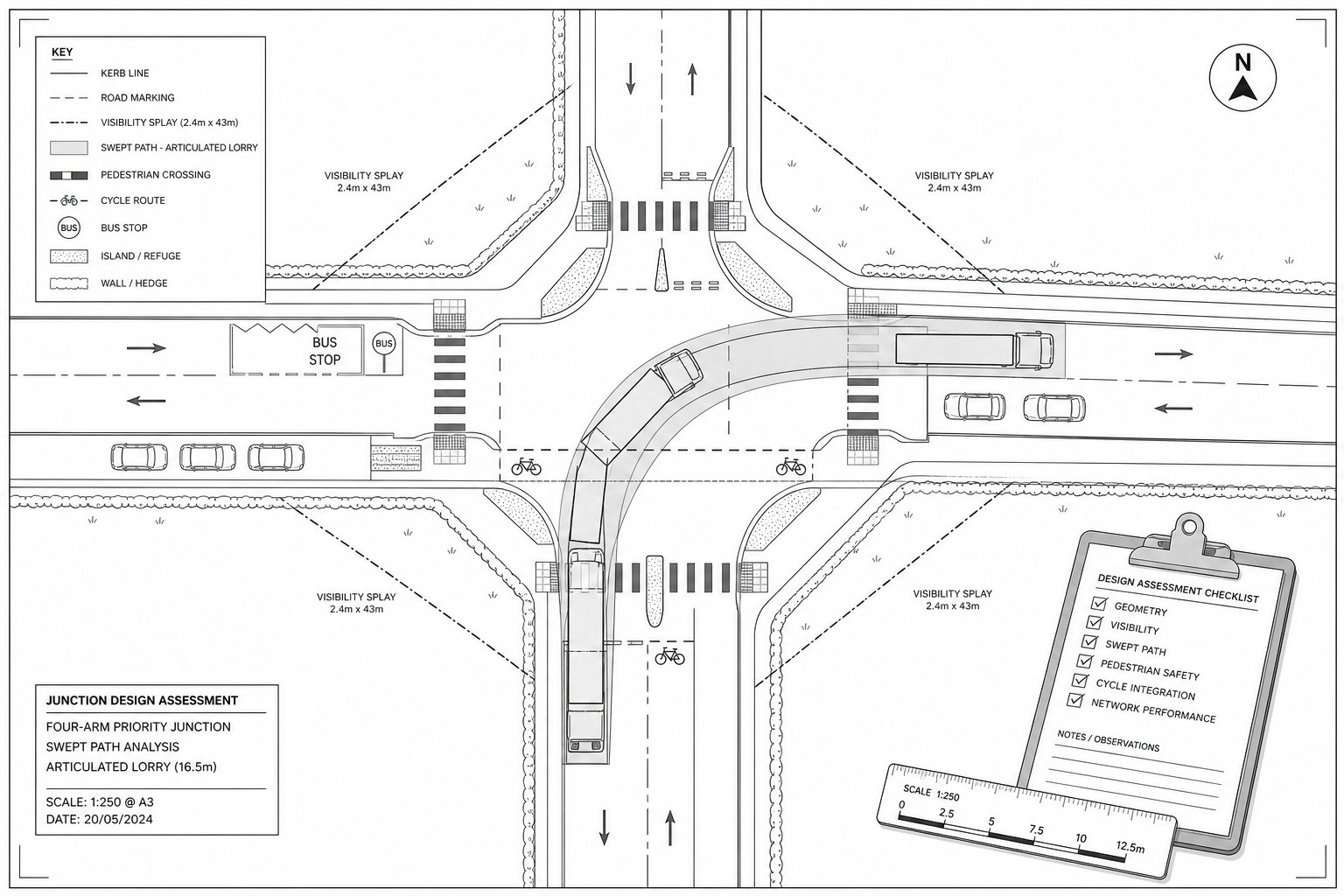
A proper junction design assessment is more than a drawing exercise. It pulls together geometry, safety, operational performance and policy fit into one technical narrative. The exact scope depends on the site, but several core elements appear again and again.
We begin by asking practical questions. Can drivers see and be seen? Can the intended vehicles turn without conflict? Is the spacing to nearby accesses acceptable? Will queues interfere with other movements? Does the proposal create undue risk for pedestrians and cyclists? And, crucially, will the highway authority view the evidence as proportionate and credible?
Most assessments combine desk-based review, site observation, geometric design and analytical testing. On some schemes that means straightforward visibility checks and swept paths. On others it expands into capacity modelling, traffic surveys, personal injury collision review, speed data analysis or more detailed design development.
What matters is that the assessment matches the decision being made. A low-intensity access onto a lightly trafficked road should not be overloaded with unnecessary analysis. But a larger site near an already stressed junction plainly requires more robust evidence. Good consultants know the difference.
Visibility, Geometry And Vehicle Tracking Requirements
Visibility is usually the first make-or-break issue. If the required splays cannot be achieved, either because of alignment, boundary constraints, vegetation, walls or third-party land, the proposed access may be unacceptable regardless of what the capacity results later show.
Geometry then shapes how comfortably and safely users move through the junction. Entry widths, kerb radii, lane allocation, crossing provision, gradients and spacing to adjacent features all matter. The right answer is rarely just “make it bigger”. Oversized geometry can increase vehicle speeds, lengthen crossing distances and undermine placemaking.
Vehicle tracking is the reality check. It tests whether the design works for the largest vehicles reasonably expected to use it, such as refuse vehicles, articulated HGVs, buses or delivery vans. A junction that works nicely for a car but forces a fire appliance across opposing lanes or over a footway is not a workable design.
This is where detail catches people out. A gate set back too shallow, a central island that clips trailer paths, or an internal bend that prevents a clean exit movement can all become planning problems. Careful tracking and geometric review flush out those issues early.
Capacity, Safety And Network Performance Considerations
Capacity analysis asks whether the junction can operate acceptably under forecast conditions. Depending on the form of junction, that may involve modelling delays, queue lengths, reserve capacity or signal performance in future assessment years. The purpose is not to chase theoretical perfection: it is to establish whether the development impact remains acceptable in planning terms.
Safety is broader than collision history alone. We look at conflict points, driver expectation, visibility, speed environment, pedestrian crossing desire lines, cycling provision and the clarity of priority. Some layouts are mathematically capacious but intuitively poor. Highway officers notice that quickly.
Network performance matters as well. A junction can appear acceptable in isolation yet create knock-on effects at nearby nodes, block back into existing accesses or weaken bus movement and active travel conditions. In 2026, authorities increasingly expect applicants to show awareness of all modes, not just private cars.
That means assessing whether the design fits within the surrounding street function. On urban sites, a technically workable junction may still need refinement to support walking routes, side-road crossing safety or cycle continuity. Strong assessment balances all of that rather than treating the carriageway as the only thing that counts.
Types Of Junctions Consultants Commonly Design
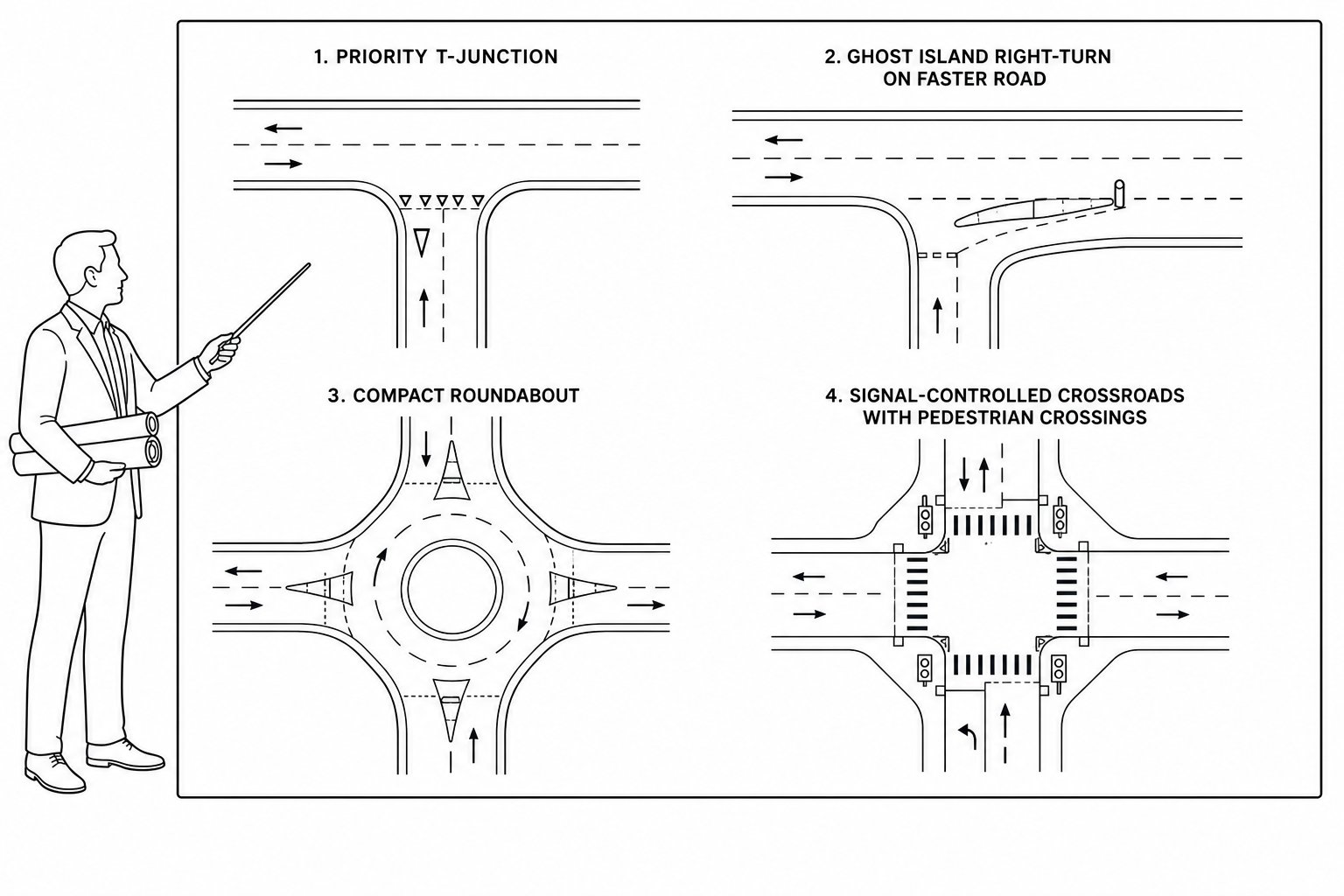
The best junction type is the one that suits the traffic demand, speed environment, road hierarchy, site constraints and policy context. There is no universal “preferred” layout, even though how often project teams hope for one.
In practice, consultants work across a broad spectrum. Some schemes need a simple priority access with modest widening and visibility improvements. Others require a right-turn ghost island because through traffic speeds are higher or turning demand is more concentrated. Larger developments may justify a roundabout or signals, especially where multiple turning movements, pedestrian demands or network integration issues are involved.
What matters is choosing a form the authority can reasonably support and then designing it properly. That sounds obvious, but many planning delays come from selecting a junction type too early for commercial reasons, then trying to force the evidence to catch up.
Priority, Ghost Island, Roundabout And Signal-Controlled Layouts
Priority junctions remain common for smaller and medium-scale sites. They can be efficient, economical and straightforward to deliver where traffic flows are moderate and visibility is suitable. But they are not a default answer. Poor right-turn conditions or unbalanced flows can quickly make them unsuitable.
Ghost island junctions are often used where a dedicated right-turn lane improves safety and operation on a faster road. They can provide a sensible middle ground between a simple priority arrangement and a more intervention-heavy solution, though they need adequate width, taper length and visibility.
Roundabouts range from mini-roundabouts in urban settings to compact or full roundabouts on larger sites and distributor roads. They can help with speed reduction and balanced operation, but they are land-hungry and can create design tension where walking and cycling routes need to remain direct and legible.
Signal-controlled junctions are typically considered where turning movements are heavy, crossing demand is significant, coordination with nearby signals is needed, or network control is a priority. They can handle complexity well, but they bring issues around staging, queue management, maintenance and cost.
In some cases, more innovative or less standard arrangements may be explored. Those usually require especially clear justification, because local authorities will want confidence that the layout is understandable, auditable and maintainable.
How Junction Design Consultants Work With Architects, Planners And Developers
Junction design works best when it is integrated, not bolted on after the site layout is nearly finished. Architects, planners and developers each shape decisions that directly affect access design, and the junction engineer needs those conversations early.
With architects, the key interfaces are usually frontage treatment, building set-back, internal road alignment, parking layout, servicing and pedestrian routes. A small shift in building line can unlock visibility. A different bin collection strategy can change the required turning head. These are not marginal design tweaks: they can determine whether the highway solution is elegant or compromised.
With planners and planning consultants, the focus is often strategy and evidence. We help align the proposed access with policy language, pre-app feedback, transport documentation and committee risk. If a local authority is likely to be sensitive about pedestrian crossing distance, junction spacing or rat-running concerns, the planning narrative needs to address that directly.
Developers bring programme, cost and land realities. They need to know what is essential, what is negotiable and what might trigger off-site works or third-party agreements. Good junction advice is commercially aware without becoming technically soft.
That joined-up approach is central to how we think about planning support at ML Traffic. With over 30 years of transport engineering experience, our focus is on concise, accurate reporting that reflects local authority thresholds and real planning contexts rather than generic templates. The result is usually a stronger submission and fewer unpleasant surprises once comments start arriving.
In day-to-day terms, the consultant often becomes the translator between design ambition and highway acceptability. That is a useful role because those two things do not naturally speak the same language.
Standards, Guidance And Local Authority Expectations That Shape Design
Junction design in the UK is shaped by a mix of national standards, local guidance and professional judgement. That blend is important because planning outcomes rarely hinge on one document alone.
At national level, consultants frequently work with frameworks such as DMRB for trunk-road related contexts and Manual for Streets or Manual for Streets 2 for more urban, development-led environments. Depending on the project, other guidance on cycling, accessibility, road safety and traffic modelling may also come into play.
But local authority expectations often carry equal weight in planning. Many councils and highway authorities publish their own design guides, access standards, parking guidance and validation expectations. These can influence preferred junction types, visibility standards, adoption requirements, footway widths, tracking assumptions and thresholds for more detailed assessment.
That is why local knowledge matters. Two authorities may both refer to the same national guidance yet apply it differently in practice, especially on constrained sites. One may be open to context-sensitive departures backed by clear reasoning: another may expect a more literal standard-led approach.
For applicants, the practical lesson is simple: compliant design is not just about quoting guidance. It is about understanding which standards are likely to drive officer comments on that specific site. The strongest submissions explain the design logic clearly, reference the relevant standards accurately and acknowledge local expectations rather than pretending they do not exist.
In 2026, that clarity is increasingly valuable. Authorities are under pressure, review time is limited, and ambiguous highway submissions tend to attract more questions, not fewer.
What To Prepare Before Appointing A Junction Design Consultant
A consultant can start with limited information, but better inputs usually mean faster and sharper advice. If the aim is to assess feasibility quickly, there are a few items worth gathering before appointment.
At minimum, prepare:
- a site location plan and red line boundary
- topographical survey information, if available
- outline development proposals, including land use and quantum
- any draft site layout or masterplan material
- previous planning or highway correspondence
- traffic survey data, speed surveys or collision information, if already commissioned
- notes on known constraints such as third-party land, trees, utilities or level changes
The reason this matters is simple: junction design is highly context-driven. Without a decent understanding of the site and its intended use, advice becomes too generic to be useful. A consultant may still flag obvious issues, but the real value comes from tailoring the solution to likely vehicle movements, authority expectations and development objectives.
It also helps to be clear on the programme. Do you need a quick feasibility steer for land negotiations, a pre-app drawing package, or planning-ready assessment work? Those are different tasks with different levels of detail.
Where possible, share what has already been said by the council or county highway team. Previous objections, officer emails or committee concerns can save time and stop the project team from repeating the same weak assumptions. A well-briefed consultant is far more likely to give targeted advice than a cold-start technical review.
How To Choose The Right Junction Design Consultant For Your Project
Not all transport consultants offer the same depth of junction design capability, and that matters more than the brochure usually suggests. For planning-led projects, you need a team that can move comfortably between concept design, standards interpretation, capacity analysis and practical negotiation with highway officers.
Start with core technical competence. The consultant should be able to demonstrate experience in geometric design, visibility review, vehicle tracking, junction capacity assessment and planning support. If the project may evolve into detailed delivery, it also helps if they understand the route from concept through to technical approval and implementation.
Then look at relevance, not just reputation. A consultant who has handled schemes of similar scale, land constraints and local authority context is often a better fit than a larger practice with less directly comparable work. Ask how they approach pre-app discussions, what software and design checks they use, and how they typically coordinate with architects and planners.
Communication style matters as well. A good junction consultant should be able to explain risk plainly: what is likely to be acceptable, what is marginal, what evidence is still needed, and where costs may escalate. If every answer sounds overconfident, that is not always reassuring.
We would also look for speed and clarity in reporting. In planning, a concise and accurate technical note can be more valuable than a bulky report that leaves officers hunting for the point. That is one reason many project teams prioritise consultants with established planning experience, not just highway design credentials.
Eventually, the right choice is the team that can protect both technical quality and planning momentum. Those two things are inseparable, even if procurement processes sometimes treat them as separate lines on a spreadsheet.
A strong appointment at the right moment usually pays for itself. When junction strategy is handled well, the planning application reads more confidently, the authority has fewer reasons to object, and the development team can spend less time firefighting basic access issues and more time moving the project forward.
Frequently Asked Questions About Junction Design Consultants
What do junction design consultants specialise in?
Junction design consultants are specialist traffic and highway engineers who plan and assess how roads meet, ensuring safe, efficient, and policy-compliant access for new developments and road schemes.
When should I involve junction design consultants in a development project?
Consultants should be involved early, ideally at feasibility or concept design stages, whenever a project changes traffic flow, creates a new access, or alters an existing junction. Early input helps avoid planning delays and costly redesigns.
How do junction design consultants support planning applications?
They provide appropriate junction forms at masterplanning, assist pre-application discussions with highway authorities, and supply capacity assessments, vehicle tracking, safety analysis, and access drawings that underpin a robust planning submission.
What types of projects typically require junction design consultation?
Most commonly, residential, retail, commercial, and mixed-use developments need junction design support, as well as highway improvements, traffic calming, and active travel schemes that materially affect road junctions or accesses.
Why is early advice from junction design consultants important?
Early advice prevents false starts by resolving visibility, geometry, and safety issues before formal submissions, reducing objections, redesign costs, and programme delays associated with late technical challenges.
How do junction design consultants work with architects and planners?
They integrate access design with architectural site layout, parking, and servicing plans, align proposals with local highway design guides, and translate technical highway requirements into planning strategy that meets authority expectations.