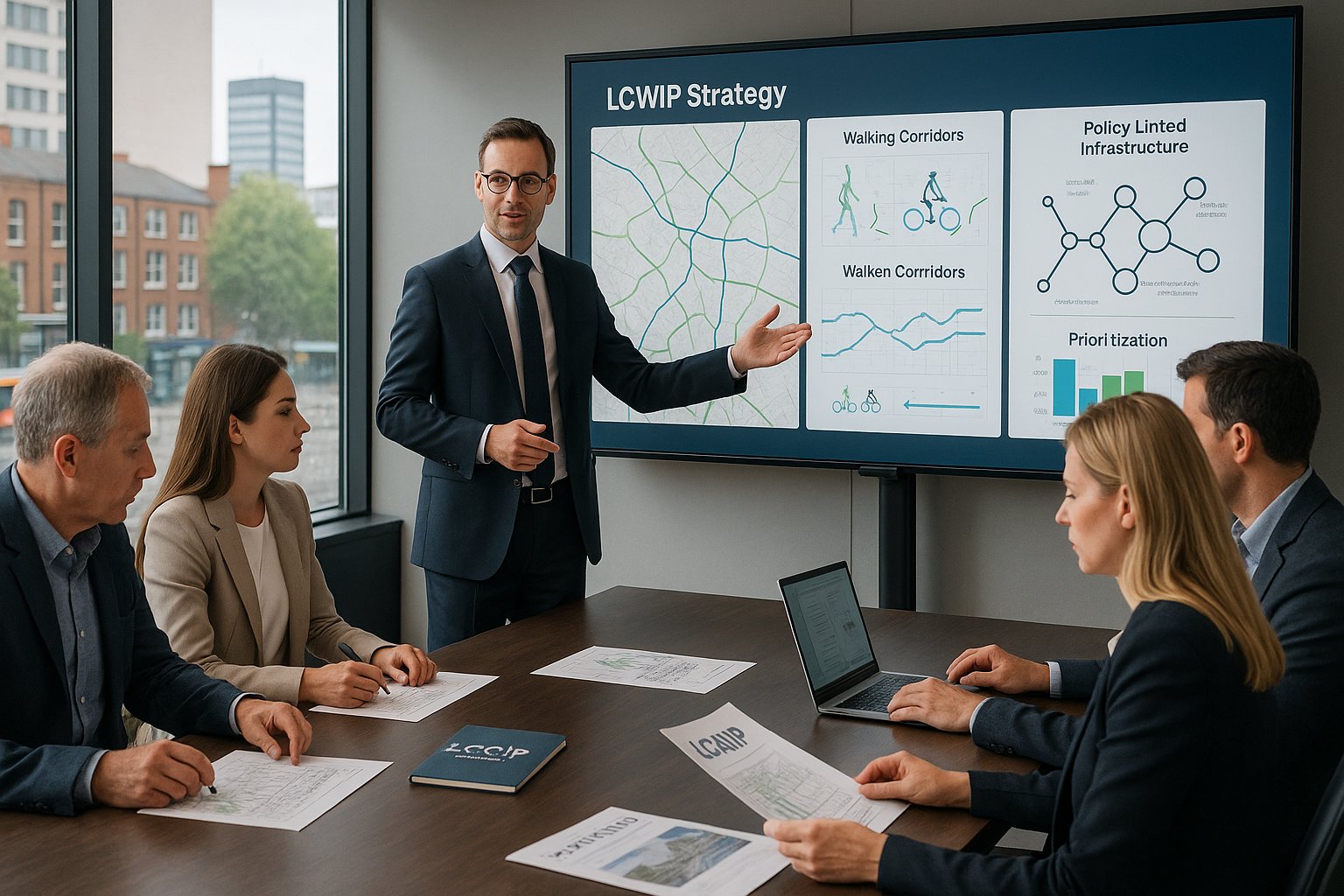
Walking and cycling schemes are no longer treated as nice-to-have add-ons in transport planning. In 2026, they sit much closer to the centre of policy, funding, placemaking and planning decisions. That shift has raised the bar. Councils need evidence that stands up to scrutiny. Developers need active travel strategies that genuinely fit local policy rather than being bolted onto a transport assessment at the last minute. And project teams need a clear route from ambition to deliverable schemes.
That is where LCWIP consultants come in. A strong Local Cycling and Walking Infrastructure Plan can shape investment for the next 10 to 15 years, influence Local Plans, support funding bids and create a defensible basis for planning decisions. But getting there takes more than drawing desire lines on a map. It requires technical analysis, policy fluency, stakeholder handling and reporting that can survive examination, committee questions and, sometimes, appeal.
We work with architects, planners, lawyers, surveyors, developers and local authorities that need concise, accurate transport evidence aligned to real planning contexts. In our experience, the value of specialist LCWIP support is not simply in producing a document. It is in creating an evidence-led framework that helps schemes move forward faster, with fewer surprises and a much stronger planning case.
What LCWIP Consultants Do And Why Their Role Matters

Local Cycling and Walking Infrastructure Plans, or LCWIPs, are long-term, evidence-based plans that identify where walking, cycling and wheeling investment should go across an area. Usually covering a 10 to 15 year period, they are meant to do two things at once: set a strategic network and create a prioritised pipeline of schemes.
The consultant’s role is to lead the technical process that turns policy ambition into something usable. That includes interpreting Department for Transport guidance, reviewing local context, building a defensible evidence base, mapping current and future demand, and recommending routes or zones for intervention. Good LCWIP consultants also translate between disciplines. Highways teams, planning officers, public health colleagues, elected members and developers often want different things. Someone has to join those dots.
Why does that matter? Because an LCWIP is only useful if people trust it. Authorities use it to support funding applications and programme investment. Developers rely on it when showing that a site connects properly into wider active travel networks. At examinations or appeals, weak analysis can unravel quickly.
Independent specialists bring structure and credibility. They can show why one corridor ranks above another, how safety or severance issues have been assessed, and whether recommendations align with policy and design standards. In practical terms, that often means fewer challenges later and a much clearer foundation for delivery.
How LCWIPs Fit Into Transport Planning And Development

LCWIPs do not sit in isolation. They are part of the wider machinery of transport planning and development management. At a strategic level, they help deliver the long-running policy goal of making active travel the natural choice for short journeys. At a local level, they become the main evidence base for where walking and cycling improvements should happen first.
For councils, that means LCWIPs typically feed into Local Transport Plans, infrastructure funding programmes, area-based regeneration strategies and Local Plan evidence. They also help align transport and public health objectives, especially where towns are trying to reduce car dependency, tackle congestion or improve access to centres, schools and stations.
For development teams, the relevance is more immediate. A well-prepared LCWIP can shape site access strategies, off-site mitigation, internal street layouts and travel plan measures. If a strategic corridor is identified nearby, a planning application that ignores it will look incomplete. If the proposal supports that corridor, the planning case is usually stronger.
We often find that the most successful projects treat the LCWIP as a framework, not a separate exercise. It should inform masterplanning early, guide transport assessments, and help negotiations over Section 106 or Section 278 works. Done properly, it reduces friction between policy aspiration and what actually gets built.
The Core Components Of An Effective LCWIP

An effective LCWIP is more than a route map with good intentions. It needs three things working together: a clear network plan, a robust evidence base and a prioritised programme of interventions.
At authority level, the document should identify the most important walking and cycling links across the area, including connections to town centres, employment sites, schools, transport hubs and growth locations. It should explain why those links matter, what barriers currently exist, and how they relate to future development.
It also needs a prioritised programme. Most authorities cannot fund everything at once, so the plan must distinguish between strategic importance and immediate deliverability. That is where route ranking, package testing and phasing come in.
Finally, the reporting itself matters. A strong LCWIP shows the methodology, assumptions, data sources and design principles behind each recommendation. Without that transparency, even sensible proposals can be challenged.
Below are the two technical areas that usually make or break the quality of the plan.
Network Planning For Walking And Cycling
Network planning is the backbone of the whole exercise. The aim is to identify a joined-up system rather than a collection of isolated improvements. That means looking at how people actually move across an area, where they want to go, and what stops them now.
For walking, that might include missing crossings, indirect links, poor permeability, severance created by major roads, and weak connections to local centres or public transport. For cycling, it often means identifying corridors where direct, coherent and safe routes could unlock a high number of short trips.
The best consultants do not just trace existing roads and call that a network. They test links against trip generators, planned growth, topography, traffic conditions and the quality expected by current design standards. In many cases, the answer is a combination of corridor routes, neighbourhood improvements and town-centre access measures.
For developers, this matters at site scale too. A new scheme should not sit as an island. Internal street design, frontage access, crossing points and boundary connections need to tie into the wider network logic set by the LCWIP. If they do, the proposal feels planned. If they do not, it feels forced.
Evidence, Demand Analysis And Route Prioritisation
Evidence turns an LCWIP from aspiration into planning-grade infrastructure strategy. That evidence usually combines census and travel data, collision records, deprivation and health indicators, school and employment locations, accessibility mapping, public transport interchange data and information on planned development.
Consultants then use that baseline to assess existing demand and future potential. Depending on the project, that may include GIS analysis, route audits, accessibility tools, propensity-to-cycle datasets and targeted surveys. The goal is not just to show where people travel now, but where better infrastructure could change behaviour.
Prioritisation follows from that analysis. A credible ranking system usually weighs several factors: strategic value, expected uptake, safety benefit, social equity, deliverability, cost, and compatibility with planned growth. Transparent scoring is important because route choices can become politically sensitive very quickly.
We have seen the difference this makes in real planning contexts. When an authority or applicant can explain, with evidence, why a corridor has been promoted ahead of others, discussions become far more productive. The conversation shifts from opinion to method. That tends to be healthier for everyone involved.
When To Appoint An LCWIP Consultant
Timing matters. Bringing in specialist support too late usually means trying to retrofit evidence into a decision that has already drifted in another direction.
The obvious point to appoint an LCWIP consultant is when an authority needs its first plan, an update to an older one, or an extension covering new growth areas. But there are other moments when the need becomes just as urgent. One is before a funding bid. Active travel funding rounds increasingly expect a clear strategic rationale, deliverable pipeline and evidence of need. Another is ahead of Local Plan examination, where walking and cycling infrastructure needs to be tied more closely to growth strategy.
For developers and landowners, the right time is often much earlier than expected. If a site is large enough to influence local movement patterns, active travel planning should begin during masterplanning, not after the access strategy is fixed. Early input can shape street hierarchy, permeability, links to neighbouring land and off-site mitigation.
There is also a more tactical reason to appoint a consultant: when multiple schemes exist but do not yet form a coherent network. In that situation, an LCWIP process can stop fragmented investment and create a stronger basis for delivery, negotiation and programme management.
LCWIP Support For Local Authorities, Landowners And Developers
Different clients need different forms of LCWIP support, even when the technical principles are shared.
For local authorities, the brief may involve full plan preparation, peer review of an existing LCWIP, updates to reflect new growth allocations, route prioritisation workshops, evidence reviews, mapping, consultation support or staff training. Some councils also need help converting a strategic LCWIP into funding-ready packages with clearer phasing and cost assumptions.
For landowners and developers, the support is more site-facing. We typically see a need to align proposed access arrangements and internal layouts with the authority’s active travel priorities, whether set out in an adopted LCWIP or emerging evidence. That can affect frontage design, route safeguarding, crossing provision, public realm layout and the relationship between on-site and off-site works.
This is particularly useful where planning applications need transport assessments that address walking and cycling in a meaningful way. A consultant can show how the proposal contributes to wider network objectives rather than merely claiming compliance.
At MLTraffic, our role often sits in that practical middle ground: concise, accurate transport reporting delivered quickly, but still tailored to the local authority context and planning threshold in question. That balance is valuable when programmes are moving fast and evidence still needs to hold up under scrutiny.
How Consultants Align LCWIPs With Planning Applications And Transport Assessments
This is where strategy becomes planning evidence. An LCWIP on its own is useful, but its real value often appears when it is translated into site-specific material for a planning application.
Consultants do that by identifying the relevant routes, connections and standards from the LCWIP and then showing how a development responds. In a transport assessment, that may include active travel catchment analysis, route quality audits, links to schools or local centres, proposed off-site improvements, and a reasoned assessment of likely walking and cycling trips. In a travel plan, it might shape measures, targets and monitoring.
For larger sites, the LCWIP can help justify a package of mitigation rather than one isolated highway intervention. That is especially helpful in discussions around Section 106 contributions, Section 278 works or phased delivery obligations. If the improvements support a published strategic corridor or priority area, the ask tends to feel more proportionate and policy-led.
There is a legal and evidential benefit too. Planning applications are stronger when active travel measures are linked to an accepted local framework rather than presented as generic good practice. It shows the proposal has engaged with local policy, local need and local infrastructure priorities. In appeal situations, that can make a noticeable difference.
Stakeholder Engagement, Public Consultation And Policy Coordination
Even the most technically sound LCWIP can stall if engagement is weak. Walking and cycling proposals are intensely local. Residents know where crossings feel unsafe, where routes flood, where school pick-up creates chaos, and which shortcuts are actually used. That knowledge matters.
Specialist consultants structure consultation so it informs the plan without letting the process drift into anecdote-led decision making. That might involve stakeholder workshops, online mapping tools, surveys, meetings with disability groups, member briefings and targeted engagement with schools, businesses or public transport operators. The method should be proportionate, but it needs to be real.
Policy coordination is equally important. LCWIPs sit across planning, highways, public health, regeneration and climate policy. They may also need to align with neighbouring authorities where commuter routes or strategic corridors cross boundaries. If those conversations do not happen early, inconsistencies show up later.
We often find the consultant’s role here is part technical lead, part translator. Different teams use different language and different priorities. Good engagement helps build consensus around a shared evidence base, which is usually more durable than consensus built around vague aspiration. And yes, it saves time later when committees or stakeholders ask why certain choices were made.
Common Challenges In LCWIP Preparation And How Specialists Solve Them
Most LCWIP projects run into the same pressures, just in different combinations.
One common issue is patchy data. Smaller authorities or edge-of-settlement growth areas may not have enough recent local survey information. Specialists usually solve that by combining open datasets, GIS tools, collision records, accessibility modelling and targeted sitework to build a credible baseline. It is not perfect, but it is far better than guessing.
Another challenge is conflicting local opinion. A route that looks obvious on a plan may cut across concerns about parking, traffic, land ownership or town-centre servicing. Consultants deal with that by using transparent criteria and explaining trade-offs clearly. People may still disagree, of course, but the reasoning is visible.
Funding uncertainty is a third problem. Authorities often know what should happen but not when the money will appear. A good LCWIP hence phases schemes, identifies quick wins, and creates an investment-ready list that can be matched to different funding streams over time.
Then there is deliverability. Some ambitious corridors look excellent strategically but face utility conflicts, third-party land issues or severe highway constraints. Specialists test those constraints early, so the final plan is not full of schemes that look good in committee papers and go nowhere afterwards.
What To Look For When Choosing An LCWIP Consultant
Not all transport consultants are equally equipped to deliver LCWIP work. The skill set is broader than many clients first expect. You need policy understanding, GIS capability, route planning judgement, stakeholder handling and strong planning evidence writing. And those things do not always come together in one team.
As a starting point, look for demonstrable experience preparing or reviewing LCWIPs, or at least active travel evidence that closely follows Department for Transport guidance and current design standards. Ask how the team approaches network definition, prioritisation and consultation. Ask what tools they use. Ask how they defend methodology when challenged.
It is also worth looking at how they work with planning applications and Local Plan evidence. For many clients, especially developers and councils managing growth, the point of the LCWIP is not just to exist. It is to inform decisions, unlock funding and support delivery.
Two qualities, in our view, deserve particular scrutiny.
Experience In Local Authority Standards And Planning Evidence
A consultant may understand active travel in principle and still struggle in a live planning environment. Local authority standards, validation requirements and decision-making culture matter a great deal.
The right team should understand how different councils apply transport policy, what level of evidence is expected at each application stage, and how LCWIP recommendations interact with Local Plans, site allocations, masterplans and transport assessments. They should also be comfortable working alongside architects, planning consultants, solicitors and highway officers without turning the process into a technical turf war.
This is especially important where active travel infrastructure becomes part of a contested planning case. Evidence may be tested through committee reports, statement of common ground discussions, funding submissions or appeals. Consultants who have worked in that space tend to write more carefully, define assumptions more clearly and avoid over-claiming.
In short, look for people who know both transport planning and the realities of development management. That combination is often the difference between a report that is merely informative and one that is genuinely useful.
Ability To Deliver Clear, Timely And Defensible Reporting
This sounds obvious, but it is where many projects wobble. A technically capable consultant who cannot produce clear, auditable reporting on time will create problems for everyone else in the team.
Defensible reporting means more than neat formatting. It means transparent methodology, traceable data sources, clear mapping, logical route scoring and recommendations that follow from the evidence. If assumptions are made, they should be stated. If constraints exist, they should not be hidden in footnotes. Decision-makers are far more likely to trust a report that is straightforward about what it knows and what it does not.
Timeliness matters just as much. Planning applications, committee cycles and funding windows do not wait for endless perfecting. Consultants need to work at the pace of the project while keeping the quality high. That is one reason clients often value concise reporting: it is easier to review, easier to use and harder to misinterpret.
At its best, a good LCWIP report becomes a working document rather than shelfware. Officers can rely on it, applicants can respond to it, and stakeholders can see how conclusions were reached. That is what clients should be buying.
Frequently Asked Questions about LCWIP Consultants
What is the role of LCWIP consultants in transport planning?
LCWIP consultants lead the technical process of creating Local Cycling and Walking Infrastructure Plans, interpreting national guidance, analysing local data, engaging stakeholders, and producing evidence that supports funding bids and planning decisions.
How do LCWIPs influence local development and planning applications?
LCWIPs provide a strategic framework for walking and cycling infrastructure, guiding site access strategies, off-site mitigation, and transport assessments, which strengthens planning applications by aligning proposals with local active travel priorities.
When should a local authority or developer appoint an LCWIP consultant?
Appointments are ideal when preparing a first or updated LCWIP, during funding bid preparations, ahead of Local Plan examinations, or early in masterplanning to ensure active travel networks are integrated from the start.
What are the core components of an effective LCWIP?
An effective LCWIP comprises a clear network plan showing key routes, a prioritised programme of infrastructure schemes, and comprehensive reporting detailing data sources, analysis methods, and design principles used.
How do LCWIP consultants handle conflicting local opinions during plan preparation?
Consultants apply transparent criteria-based scoring and clearly communicate trade-offs, ensuring decision-making is evidence-led and that community concerns are acknowledged while maintaining methodological rigor.
What key qualifications should I look for when selecting an LCWIP consultant?
Look for consultants with proven LCWIP project experience, familiarity with local authority standards and planning evidence, strong GIS and demand modelling skills, effective stakeholder engagement capabilities, and a track record of delivering clear, defensible reports on time.