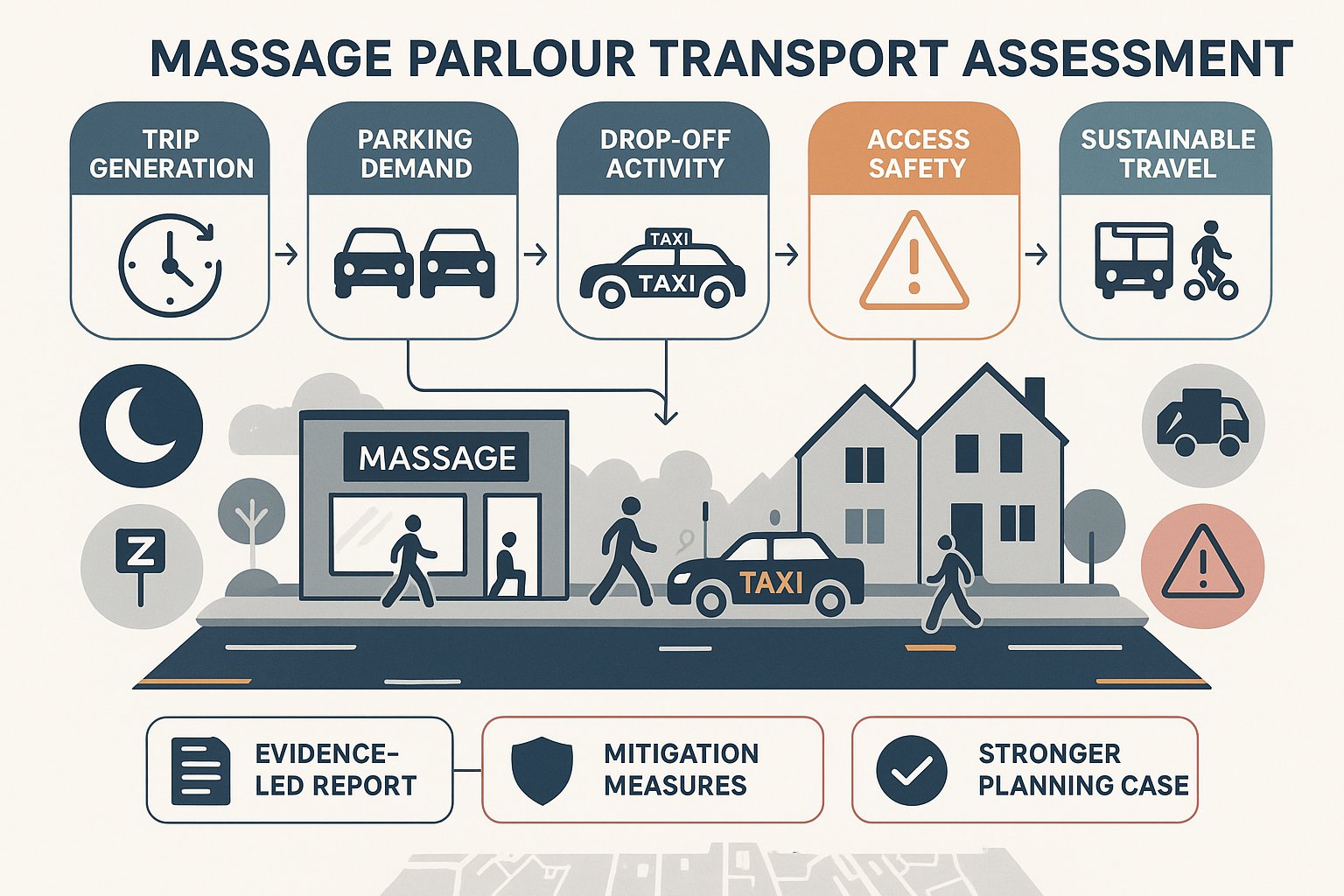
A massage parlour transport assessment is rarely the first issue applicants think about. Usually, attention goes to the use class, licensing, neighbour representations, opening hours, and whether the site will attract policy scrutiny for town centre, amenity, or character reasons. But in practice, transport can become one of the points that determines whether an application moves smoothly or stalls.
That is because planning authorities do not look at this type of proposal in the abstract. They look at how people will actually arrive, where they will park, whether taxis and private hire vehicles will stop on the frontage, and what happens at 8pm, 10pm, or later when background traffic conditions and local sensitivities are different from the daytime pattern. A small premises on a highly accessible high street may need only proportionate transport evidence. A larger or late-opening scheme in a constrained street can trigger far more detailed scrutiny.
In 2026, that scrutiny is increasingly evidence-led. Local planning authorities want a clear, policy-based explanation of trip generation, parking demand, access safety, servicing, and sustainable travel options, all presented in a way that matches the scale of the proposal. In this guide, we set out what a robust massage parlour transport assessment should cover, the objections it needs to anticipate, and how it supports a stronger planning case overall.
What A Massage Parlour Transport Assessment Is And When It Is Needed
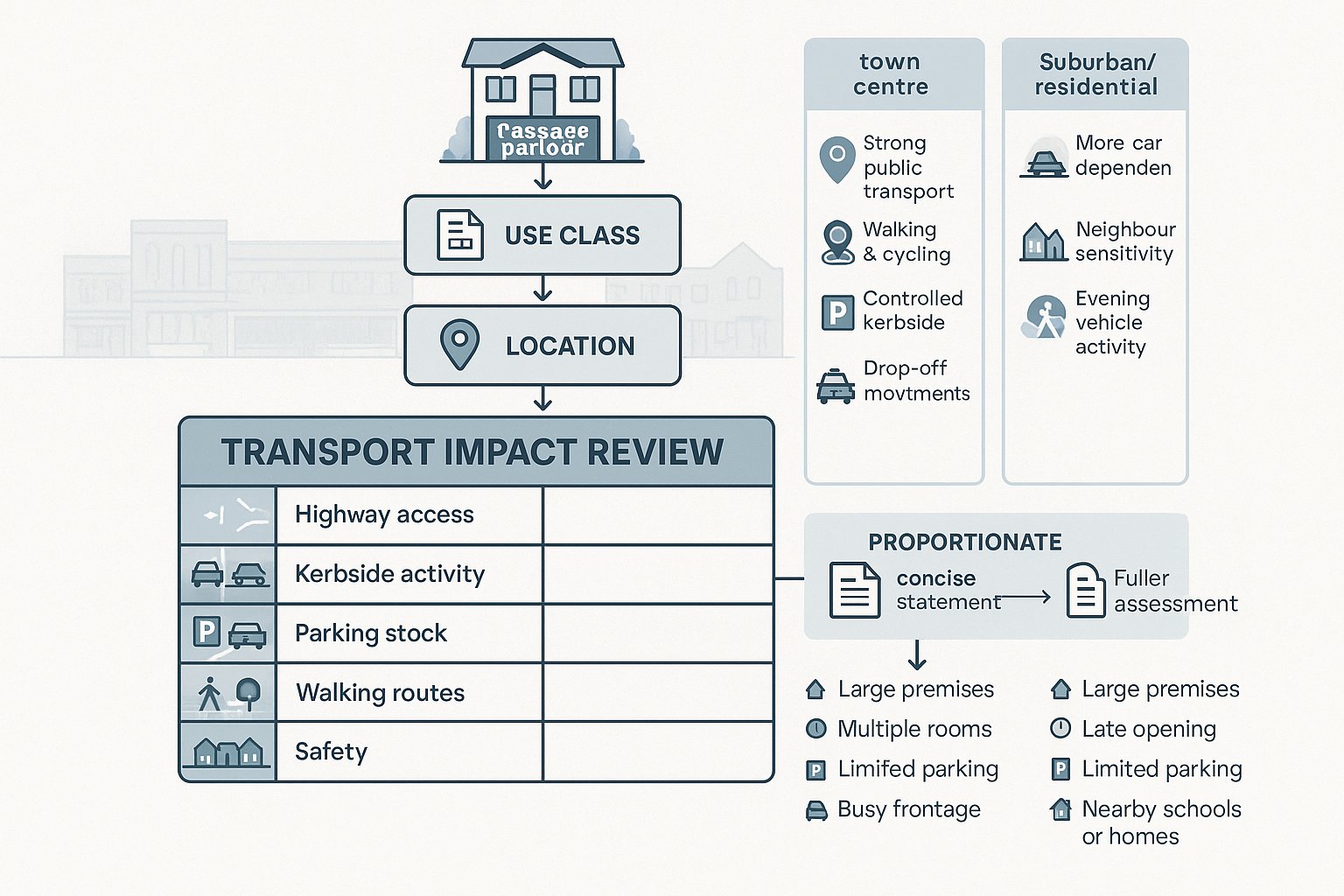
A massage parlour transport assessment is a planning report that examines how a proposed new venue, change of use, intensification, or extension could affect the surrounding transport network. In simple terms, it tests whether the local highway, kerbside, parking stock, and access arrangements can accommodate the use safely and acceptably, and whether any mitigation is needed.
The report may be prepared as a concise Transport Statement or as a fuller Transport Assessment, depending on scale and likely impact. That distinction matters. Authorities generally expect a proportionate response, but “proportionate” does not mean superficial. If a proposal has evening activity, constrained frontage conditions, or a realistic prospect of attracting taxis and car-based visitors, a thin report often invites objections rather than resolves them.
In most cases, the need for transport evidence arises where one or more of the following apply:
- the premises is relatively large or has multiple treatment rooms:
- opening hours extend into the evening or late night:
- the site sits on a busy high street, near a junction, or on a road with waiting restrictions:
- there is limited on-site parking and a risk of overspill:
- the location is close to residential properties, schools, or other sensitive receptors:
- the council’s local validation requirements or transport thresholds call for supporting analysis.
National policy still turns on whether residual cumulative transport impacts would be severe, but local authorities typically assess this through very practical questions: will people park legally, will drop-offs interfere with traffic, and is the access arrangement genuinely safe?
How Use Class, Location, And Scale Affect Transport Requirements
Use class, location, and operational scale shape the whole assessment. If the proposal falls within a use the authority treats as sui generis or otherwise operationally distinct, transport expectations often become more tailored because standard daytime assumptions do not fit neatly. A town centre location with strong public transport links may support lower parking demand assumptions. A suburban or edge-of-centre unit usually will not.
Scale is equally important. A premises with a small number of rooms and tightly managed appointments may generate modest movements. Increase the number of rooms, overlap appointment slots, add longer opening hours, and the parking accumulation picture changes quickly. Staff shifts can overlap too, which is often where underestimation creeps in.
Location then determines policy emphasis. On a central high street, we would normally expect stronger analysis of walking routes, bus accessibility, cycle provision, and kerbside controls. In residential streets, the focus usually shifts towards neighbour impact, overspill parking, manoeuvring, and late-evening vehicle activity. That is why a credible assessment is never generic: it has to be written around the actual site and the way the use will operate.
Why Massage Parlours Raise Distinct Transport Planning Considerations
This use raises transport issues that differ from many standard retail or office assumptions. The key reason is timing. Visitor arrivals are often appointment-led and concentrated outside normal business hours, when neighbouring uses may be closed, public transport may be less frequent, and residents are more sensitive to noise and kerbside activity.
There is also a behavioural element. Many customers prefer direct, discreet arrival by car, taxi, or PHV rather than a longer walk from remote parking. That can increase pressure at the frontage even where total trip numbers are not especially high. So the transport issue is not always network capacity in the traditional sense: often it is the localised effect of a small number of poorly managed stopping and parking movements.
Planning authorities also know that objections are rarely framed only in technical transport language. Residents may talk about disturbance, car doors slamming, engines idling, vehicles waiting, awkward turning, or people being dropped close to the entrance. Those are amenity concerns, but they are transport-related amenity concerns. A strong report recognises that reality and addresses it directly.
Typical Trip Generation, Staff Travel, And Visitor Arrival Patterns
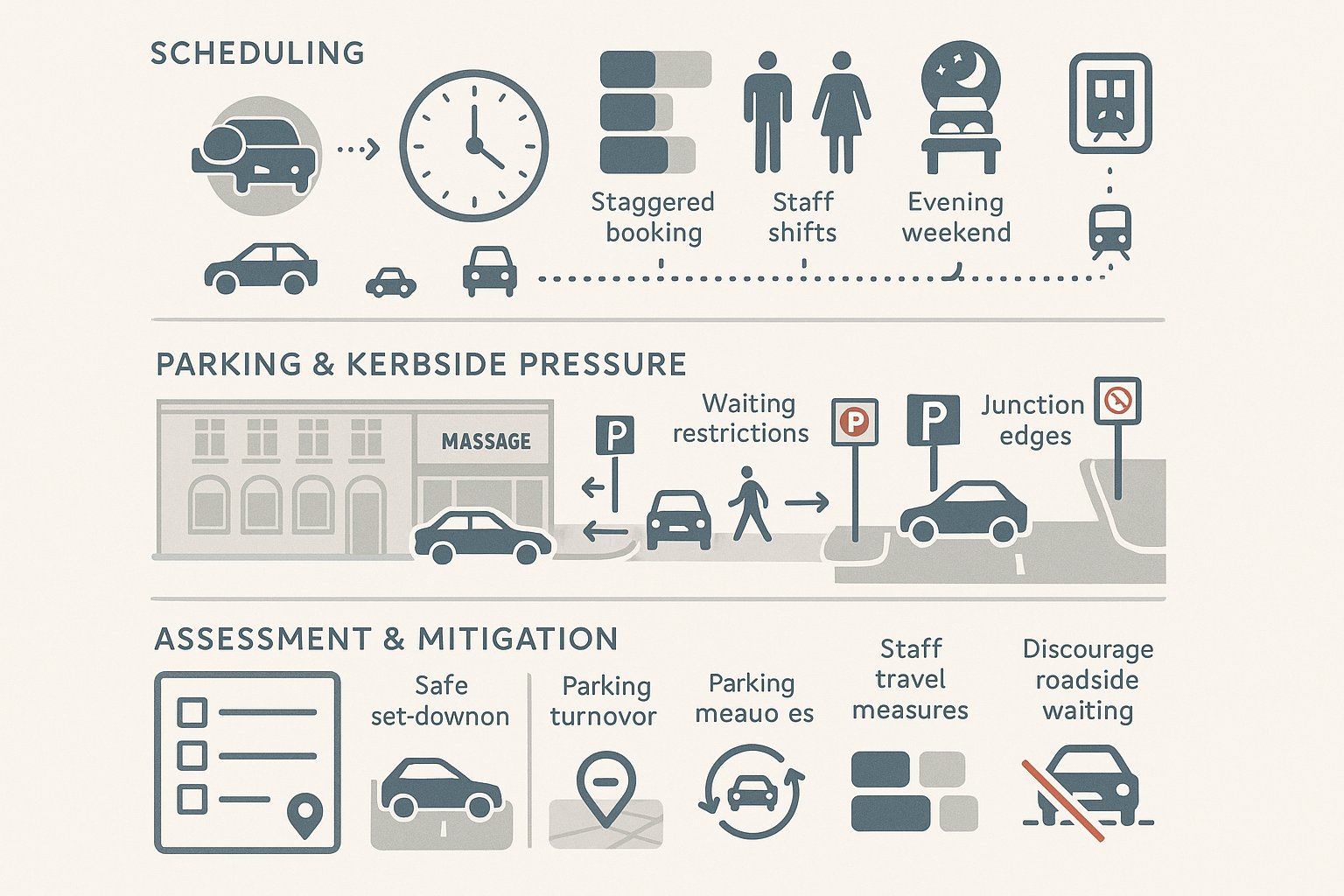
Trip generation for this type of use should be based on how the business will actually function, not on borrowed assumptions from a generic town centre unit. Appointment-based operations usually mean arrivals are relatively predictable. That can help. If bookings are staggered, arrivals and departures can be smoothed rather than peaking sharply.
But the detail matters. We need to test:
- number of treatment rooms in use at one time:
- average appointment duration:
- overlap between bookings:
- staff shift start and finish times:
- busiest trading periods, including evenings and weekends:
- likely mode split by location.
In accessible centres, some visitors will come on foot or by public transport. Elsewhere, car and taxi mode share may dominate. Staff patterns can be a hidden issue because employees often stay for longer periods, consuming spaces for hours rather than minutes. If there are shift overlaps, parking accumulation can rise even if customer turnover is controlled.
A robust assessment hence combines operational assumptions with local accessibility evidence. It should show not only how many trips are expected, but when they occur and how they distribute by mode.
Parking Demand, Drop-Off Activity, And Kerbside Pressure
Parking demand for massage parlours is rarely just a simple “spaces per square metre” exercise. Demand is driven more by operational intensity: treatment rooms, overlapping appointments, average dwell time, staffing, and whether visitors are likely to be dropped off.
Kerbside pressure is often the sharp end of the planning debate. Taxi and PHV activity can result in short-stay stopping on double yellows, in bus lanes, across accesses, or close to junctions. Even when the stop lasts only a minute or two, repeated events can create friction with through traffic and fuel local objections.
That is why we usually assess:
- on-site parking supply and turnover:
- nearby public parking and its restrictions:
- resident permit controls and waiting restrictions:
- likely drop-off and pick-up frequency:
- whether any frontage can safely accommodate set-down activity.
Sometimes the solution is not more parking, but better management: staggered appointments, staff travel measures, signed drop-off arrangements, and clear instructions discouraging waiting on the highway. In constrained locations, those operational commitments can be just as important as the physical layout.
How Local Planning Authorities Assess Highway And Access Impacts
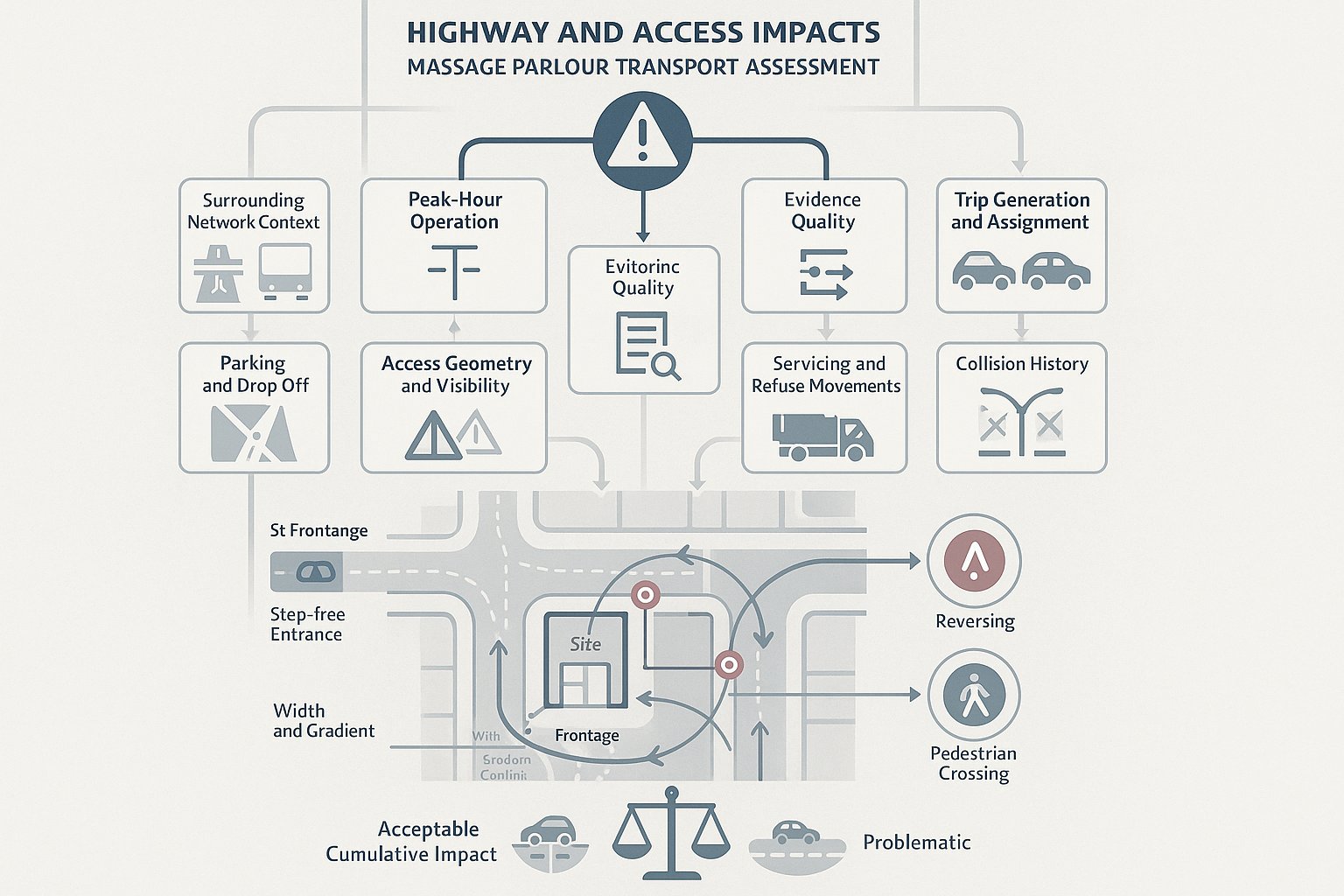
Local planning authorities usually start with one broad question: would the proposal create an unacceptable impact on highway safety or a severe residual cumulative impact on the road network? But that broad policy test breaks down into a series of smaller practical checks.
First, the authority will look at the surrounding network. Is the site on a classified road, near a signalised junction, on a bus corridor, or in a street already under parking stress? Second, it will look at operation. What are the busiest hours, and do those align with commuter peaks, school activity, evening leisure traffic, or quieter periods? Third, it will consider whether the applicant has provided evidence rather than assertion.
For many schemes, the key issue is not that the proposal generates huge traffic volumes. It is whether the additional movements, but modest, compound an already awkward local situation. A handful of extra cars in the wrong place can attract more concern than a larger number in a well-designed town centre setting.
Authorities hence expect the assessment to address highway impact in proportionate but specific terms, often including:
- local traffic conditions and network constraints:
- trip generation and assignment:
- parking and drop-off demand:
- access geometry and visibility:
- servicing and refuse arrangements:
- collision history and safety context:
- pedestrian quality, especially after dark.
The quality threshold in 2026 is pretty clear: applicants need a site-specific explanation tied to local policy and measurable evidence, not a recycled report with the use name changed.
Safe Access, Visibility, Servicing, And Highway Safety Issues
Access design can make or break the acceptability of a proposal. If vehicles must reverse into the highway, wait in the carriageway, or turn in a way that conflicts with pedestrians, the authority is likely to probe hard. The same applies where visibility is constrained by parked cars, street furniture, bins, or frontage activity.
A sound assessment should consider access width, gradient, visibility splays where relevant, pedestrian routes across the frontage, and whether inclusive access has been properly thought through. Step-free entry matters not only from an accessibility perspective but from an operational one too, because awkward entrances can slow movement and cause bunching at the frontage.
Servicing is often underestimated. Even a relatively small premises may need refuse collection, laundry deliveries, consumables, maintenance visits, and occasional larger deliveries. If those vehicles cannot enter, turn, and leave safely, they may stop on-street and create avoidable conflict.
Highway safety review should also include recent collision data, commonly covering the previous three to five years. That does not mean every recorded collision is attributable to the development, of course. But patterns matter. If there is a history of shunt-type collisions, pedestrian incidents, or turning conflicts near the site, the assessment should explain why the proposal would not worsen that risk, and what mitigation is offered if necessary.
Public Transport, Walking, And Accessibility Expectations
Authorities now expect sustainable access analysis even where a use has a clear car-based element. For a massage parlour, that means the report should not simply state that bus stops exist nearby. It should examine whether those alternatives are genuinely usable at the times the business operates.
That usually includes walking distances to bus stops and rail stations, service frequency, evening operating hours, route coverage, interchange convenience, and the quality of onward walking routes. Lighting, natural surveillance, crossing points, footway width, and perceived personal safety all matter more when customers and staff may be travelling after dark.
In practice, we would normally assess accessibility under four headings:
- Walking: directness of routes, pavement quality, crossing facilities, gradients, and lighting.
- Public transport: timetable frequency, span of service, evening reliability, and proximity to the site.
- Cycling: nearby cycle routes, secure parking provision, and whether cycling is realistic for staff.
- Inclusive access: ease of access for users with reduced mobility, including step-free arrival.
For central locations, stronger sustainable mode share assumptions may be justified, but they still need evidence. For suburban sites, authorities may accept a higher car mode share, yet expect realistic mitigation to reduce unnecessary vehicle trips. That can include staff travel planning, cycle parking, customer booking messages encouraging non-car travel where practical, and management of appointment timings to avoid bunching.
And there is a subtle point here. Good accessibility analysis does not only support policy compliance: it can also defend the parking case. If we can show that genuine non-car options exist for a meaningful proportion of users, parking accumulation assumptions become more credible and often more robust under scrutiny.
What Data And Surveys Are Usually Required For A Robust Assessment
The best transport reports are built on evidence that matches the proposal. For a massage parlour transport assessment, that usually means a combination of baseline site review, operational data, local parking analysis, and highway safety evidence.
At minimum, we would expect a robust submission to cover:
- a description of the site, surrounding road network, and relevant constraints:
- local parking controls, permit zones, waiting restrictions, and public car parks:
- existing access arrangements for vehicles, pedestrians, and servicing:
- traffic conditions at relevant times, including evening periods if applicable:
- trip generation estimates based on comparable sites or reasoned occupancy assumptions:
- parking accumulation for staff and visitors on typical and busiest days:
- collision data review for the surrounding network:
- service and refuse vehicle tracking or swept-path analysis where needed:
- public transport, walking, and cycling accessibility:
- mitigation and, where appropriate, a Travel Plan framework.
Survey requirements vary by site. Some smaller schemes can be supported by desk-based analysis and carefully reasoned assumptions. Others need parking beat surveys, junction counts, frontage observations, or on-street occupancy surveys, especially where local objection risk is high.
Comparable survey evidence can be particularly useful, but only if the comparator is genuinely comparable in size, location, operating hours, and business model. Using poor comparators is one of the quickest ways to weaken credibility.
What authorities generally want is not the most data possible, but the right data, collected at the right times, interpreted honestly.
Common Planning Risks, Objections, And How To Address Them Early
The predictable objections are usually the ones worth addressing upfront. For massage parlour proposals, those objections commonly centre on late-night traffic, neighbour disturbance, overspill parking, taxi stopping, and conflict with sustainable transport policy.
We can often reduce those risks well before submission by testing the scheme as an operator would actually run it. That means asking awkward but necessary questions. How many people may arrive within a fifteen-minute window? What happens if two appointments overrun? Where does a PHV wait if the customer is delayed? Where do staff park on the busiest evening?
Early mitigation may include:
- limiting concurrent appointments:
- staggering booking slots and shift changes:
- providing managed off-street parking where feasible:
- formalising refuse and delivery timings:
- designing a set-back drop-off space, if the site can accommodate one:
- adding signage and customer booking instructions to discourage unsafe stopping:
- committing to a Travel Plan or parking management plan.
Just as important is framing the impact properly. Some authorities and neighbours assume this use will generate intensive traffic by default. If the actual trip levels are modest relative to existing background flows, the report should demonstrate that clearly with numbers, not reassurance alone.
Where the site is in a sensitive residential street, honesty matters. If there is a kerbside issue, we should identify it and explain how it will be managed. Trying to glide over it usually backfires.
Common Planning Risks, Objections, And How To Address Them Early
Planning risk on these applications is often cumulative. A single concern about parking might be manageable. But combine parking pressure with late opening, neighbour sensitivity, weak public transport, and a narrow frontage, and the proposal can quickly look harder to defend than it really is.
The most common risk areas tend to be:
- overspill parking into nearby residential streets:
- obstruction of private driveways or informal frontage parking:
- frequent taxi and PHV stopping close to junctions or on restrictions:
- additional evening noise from arrivals and departures:
- policy concerns that the use is overly car-dependent in a sustainable location:
- concerns over personal safety and pedestrian conditions after dark.
Addressing them early means integrating transport thinking into the design and planning strategy from the start. We should not wait until the planning statement is drafted to ask where deliveries happen or whether a customer can be dropped off without blocking the carriageway.
In practical terms, early action often includes a site visit in the evening, review of local parking beat patterns, dialogue with the design team, and a realistic operational schedule. If the authority is known to be sensitive to kerbside issues, a targeted parking survey or frontage observation can save weeks later.
The strongest responses are specific. If neighbours are likely to fear overspill, show parking accumulation and local capacity. If the issue is drop-off activity, demonstrate how the frontage operates and what management measures apply. If the concern is sustainable transport policy, evidence the actual accessibility profile and commit to proportionate travel measures.
Done well, this does more than answer objections. It changes the tone of the application from defensive to credible.
How A Transport Assessment Supports Planning Statements And Related Reports
A transport assessment does not sit in isolation. It is one of the reports that helps the wider planning narrative hold together. For this type of proposal, that role is especially important because transport issues often overlap with amenity, design, town centre policy, accessibility, and operational management.
A strong assessment gives the planning statement quantified evidence on:
- expected trip generation and how it compares with background traffic:
- parking demand and whether on-site or nearby supply is adequate:
- whether highway safety risks have been identified and mitigated:
- how the proposal aligns with local parking standards and transport policy:
- what conditions or obligations, if any, are reasonable and necessary.
It can also support related reports. For example, an amenity report may rely on the transport evidence to explain likely evening arrival patterns and associated disturbance. A design and access statement may draw on the assessment’s inclusive access analysis. A planning statement may use the findings to justify proposed opening hours, servicing arrangements, or Travel Plan commitments.
This is where coordination matters. If the transport report assumes staggered appointments but the planning statement describes unrestricted operation, decision-makers will notice. Likewise, if the access drawing shows one arrangement and the swept-path assessment assumes another, credibility drops.
At ML Traffic, this is exactly why concise reporting still needs to be carefully joined up. Fast turnaround is useful, but only if the final package speaks with one voice. When the transport evidence, plans, and planning case align, authorities have a much clearer basis to conclude that impacts are understood, proportionate, and manageable.
Conclusion
A well-prepared massage parlour transport assessment is not just a technical appendix. It is often the document that translates a potentially contentious proposal into something measurable, policy-compliant, and manageable.
In 2026, planning authorities expect more than generic statements about modest traffic generation. They want evidence on how the premises will operate, when people will arrive, where they will park, how taxis and servicing will be handled, and whether the site remains safe and accessible after dark. The closer the site is to residential streets, constrained kerbsides, or sensitive frontages, the more important that detail becomes.
Our advice is simple: treat transport early, and treat it realistically. If the report reflects the actual business model, local highway conditions, and likely objections, it becomes far easier to support the planning statement, answer consultee concerns, and keep the application on track. That is usually the difference between a report that merely accompanies an application and one that actively helps secure permission.
Frequently Asked Questions about Massage Parlour Transport Assessment
What is a massage parlour transport assessment and why is it important?
A massage parlour transport assessment evaluates how a proposed or expanded venue affects local transport, parking, and highway safety. It is important because it ensures that impacts like trip generation, parking demand, and access safety are manageable and meet planning policy requirements.
When is a full Transport Assessment required for a massage parlour?
A full Transport Assessment is needed when the massage parlour is large, has multiple treatment rooms, operates late into the evening, or is located in a sensitive or constrained area with likely significant transport impacts, exceeding thresholds that require detailed analysis beyond a simple Transport Statement.
How do use class, location, and scale affect transport assessment requirements for massage parlours?
Use class defines parking and access standards; town centre or high street locations demand more emphasis on sustainable travel. Larger premises and extended hours increase trip generation, often requiring comprehensive transport evidence tailored to the site’s accessibility and operational scale.
What are the common transport concerns related to massage parlours?
Common concerns include late-night vehicle arrivals, overspill parking onto residential streets, taxi and private hire vehicle stopping near entrances, kerbside obstruction, and potential noise or disturbance to neighbours, all of which can impact local amenity and highway safety.
How do planning authorities assess highway and access impacts for massage parlour proposals?
Authorities examine local traffic conditions, network constraints, parking demand, access safety, pedestrian quality, and collision history. They assess whether additional trips cause severe residual impacts and expect evidence-based, site-specific assessments aligned with local policy.
What data and surveys are typically required for a robust massage parlour transport assessment?
A thorough assessment usually includes site and network descriptions, local parking restrictions, trip generation estimates based on appointment schedules, parking accumulation studies, collision data review, swept-path analysis for servicing vehicles, and accessibility analysis for all transport modes.