Planning officers rarely object to an office scheme because of one dramatic traffic flaw. More often, an application starts to wobble because the transport evidence feels thin, generic or out of step with the site’s actual context. A junction has been modelled, but the wrong peak hour was used. Parking has been justified, but not against local restraint policies. Hybrid working has been mentioned, yet not evidenced. And suddenly a perfectly viable proposal is stuck in rounds of transport queries.
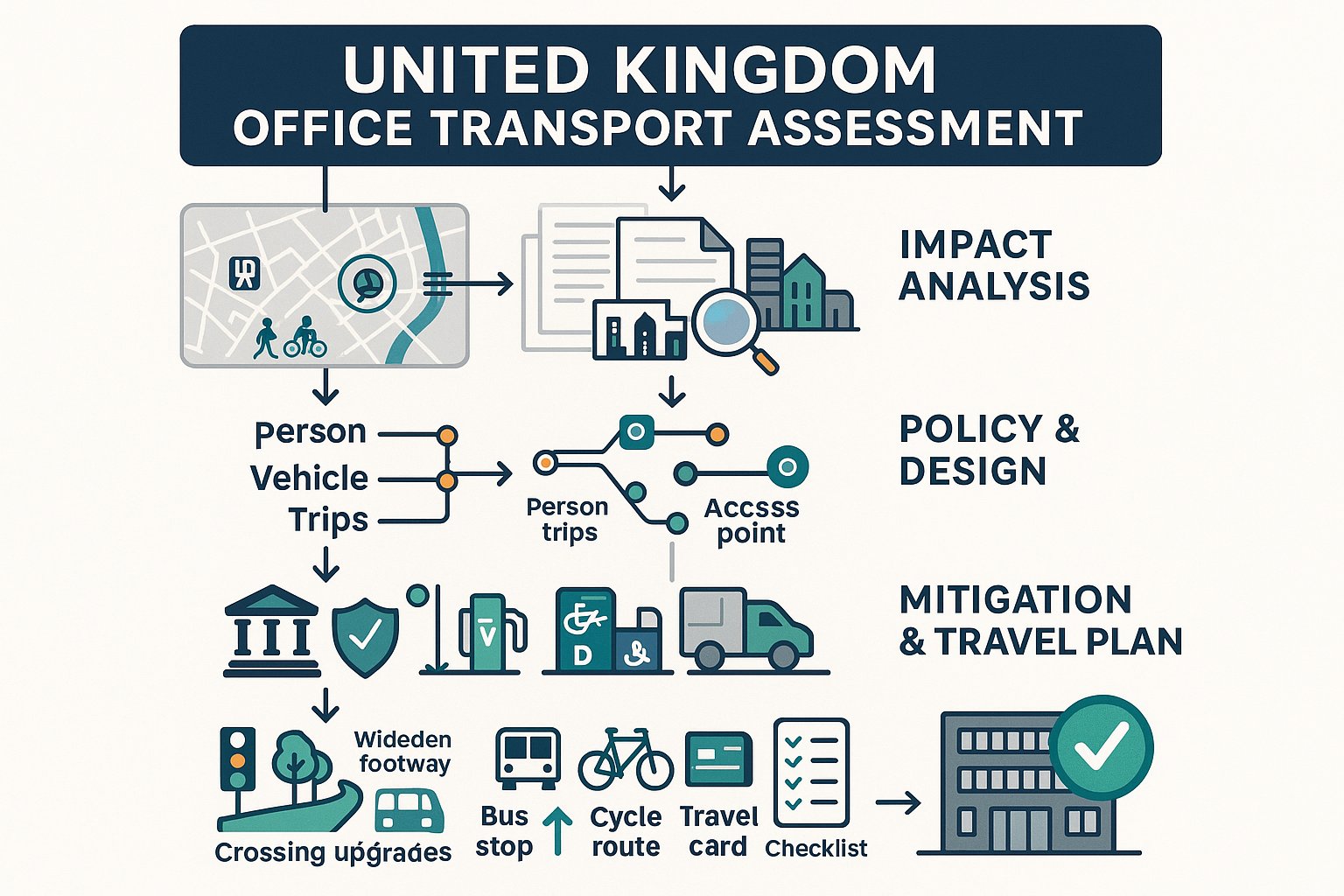
That is why an office transport assessment still matters so much in 2026. For architects, planners, lawyers, surveyors, developers and local councils, it is the document that ties the transport case together: existing conditions, trip generation, access design, sustainable travel, parking, servicing, mitigation and policy compliance. When it is done properly, it does more than satisfy validation requirements. It helps show that an office development can be accommodated safely, efficiently and in a way that supports wider planning goals.
In our experience, the strongest assessments are proportionate, evidence-led and shaped early with the local highway authority. They are also grounded in local realities rather than boilerplate assumptions. Below, we set out what an office transport assessment needs to cover, where office schemes most often come unstuck, and how teams can prepare a report that stands up well at planning stage.
What An Office Transport Assessment Is And When It Is Required
An office transport assessment is a structured appraisal of how a proposed office development will affect travel demand, the local highway network, access arrangements and sustainable transport choices. In simple terms, it asks: how many people and vehicles will the scheme generate, where will they go, can the network cope, and what needs to be done to make the development acceptable in transport terms?
In England, the starting point is usually the Department for Transport’s guidance on Transport Assessments and Travel Plans, read alongside the National Planning Policy Framework and local plan policy. There is no single national threshold that applies to every site in every authority. Some councils publish floorspace triggers: others rely more on likely trip impact, site sensitivity or location. That means a modest office building in a constrained town centre could require more detailed analysis than a larger scheme in a highly accessible commercial area.
Typically, an assessment is required where material traffic, access or road safety effects may arise, or where the authority needs evidence on parking, servicing, public transport accessibility or active travel provision. For smaller, lower-impact schemes, a Transport Statement may be enough.
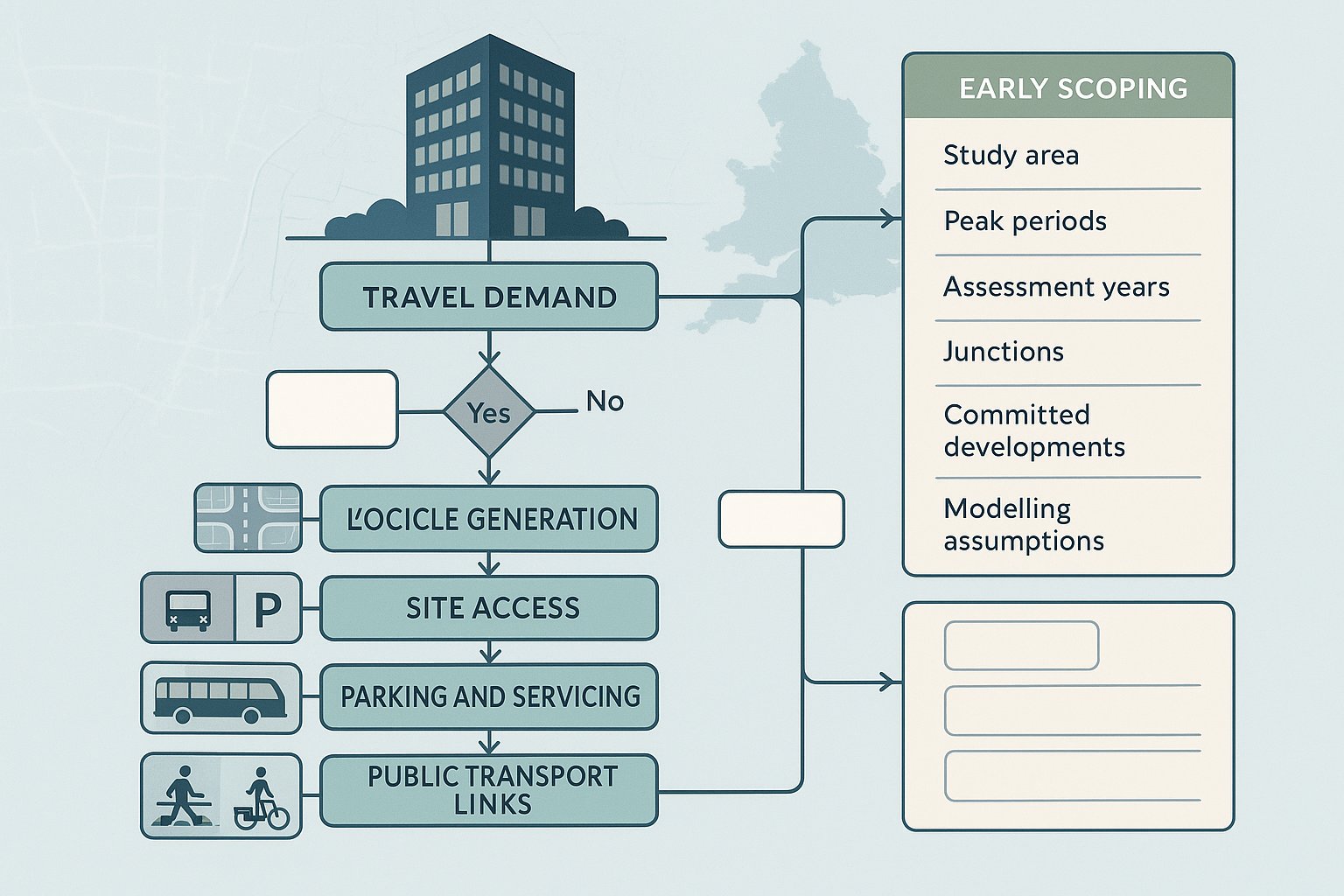
The sensible move is to scope the work early. We usually recommend agreeing the study area, assessment years, peak periods, junctions, committed developments and modelling assumptions with the local highway authority before analysis begins. That early agreement can save weeks later on.
How Office Development Type, Scale And Location Affect Assessment Scope
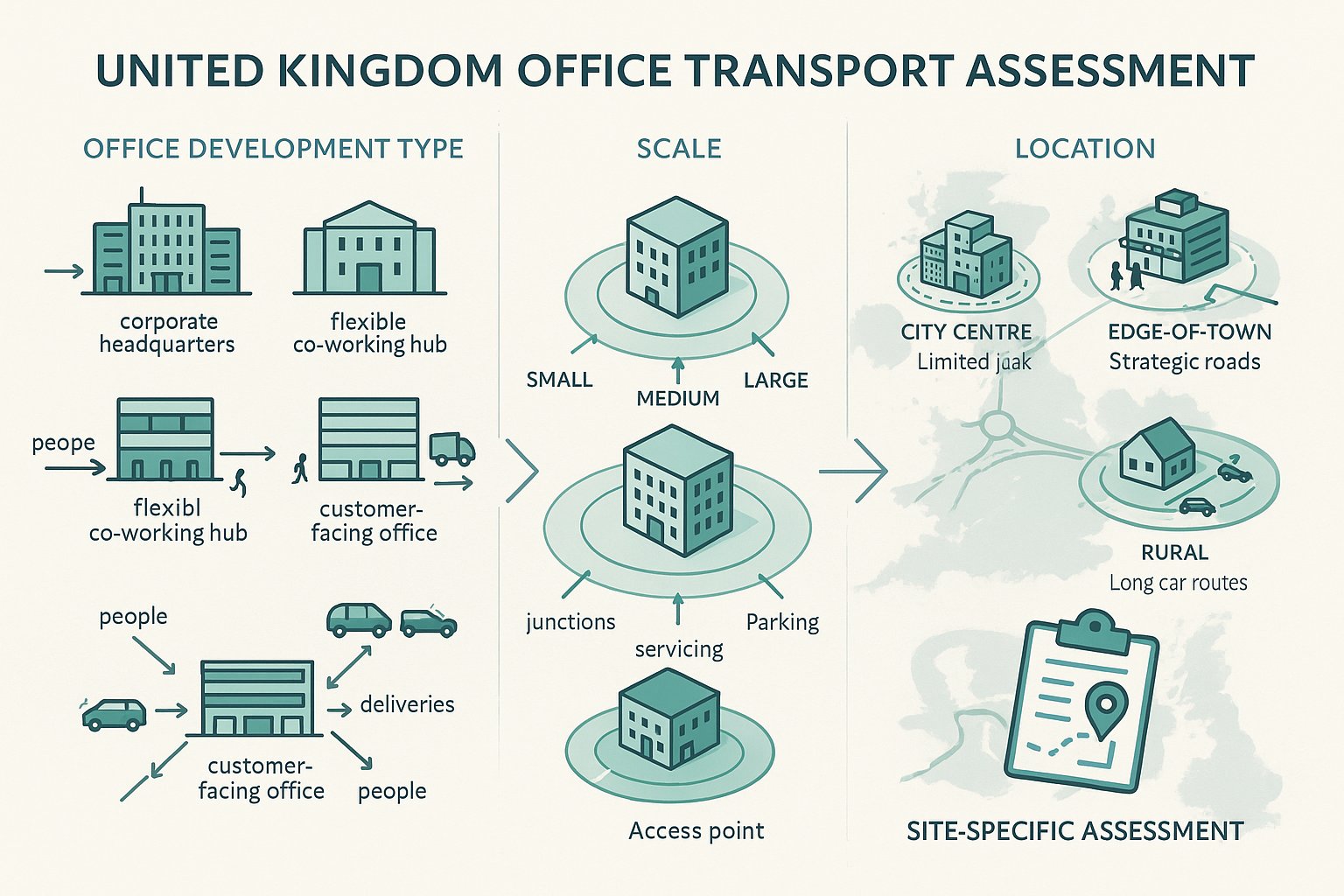
Not all office schemes behave the same way. A headquarters building, a public sector office, a flexible co-working hub and a call-centre style operation can produce very different travel patterns even if the gross floorspace looks similar on paper.
Type matters because occupancy density, working hours, visitor activity and operational needs vary. A traditional multi-let office may have relatively predictable commuter peaks. A serviced office with short-term occupiers may show more dispersed arrivals through the day. A customer-facing office use can also create higher visitor and taxi activity than a back-office function.
Scale matters because larger schemes tend to trigger more extensive analysis. Authorities may expect broader study areas, more junction testing, stronger evidence on mode split, and greater detail on parking and servicing as floorspace and employment numbers rise. Sometimes the issue is not just size, but concentration: a compact office campus can load a small number of access points very heavily.
Location often has the biggest effect on scope. A city-centre office next to a rail station may justify low parking and a strong public transport mode share, but it still needs to show how pedestrian flows, servicing and drop-off activity will work. Edge-of-town schemes near strategic roads often require more detailed junction and access analysis. Rural offices may face tougher questions on car dependence and sustainable accessibility.
So the right scope is always site-specific. Good assessments reflect the actual place, not a template.
Planning Policy And Local Authority Expectations
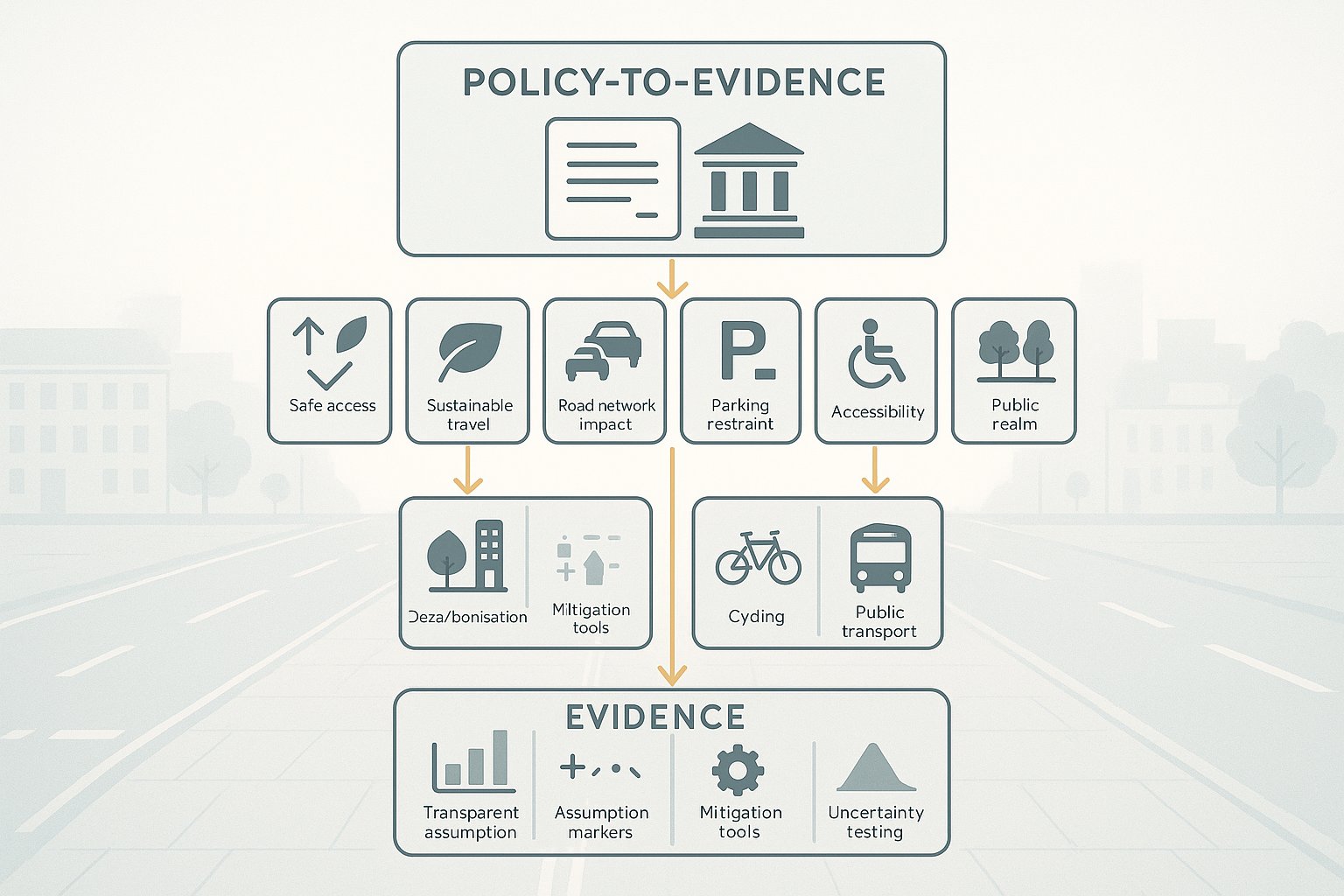
Transport evidence for office development sits within a planning policy framework, not a technical vacuum. In practice, local authorities want to see that an office scheme aligns with national policy objectives on safe and suitable access, sustainable travel and avoiding severe residual cumulative impacts on the road network.
The NPPF remains central, particularly where it deals with promoting sustainable transport, managing impacts of development and ensuring safe access for all users. But local plan policy is where much of the real detail sits. Parking restraint standards, cycle parking requirements, servicing expectations, accessibility thresholds, public realm priorities and junction-specific concerns often come directly from local policy, supplementary planning documents or authority guidance notes.
By 2026, many councils also expect transport documents to engage properly with decarbonisation, healthy streets and active travel objectives, not simply vehicle capacity. That means an office transport assessment should not read like a highway-only submission. It should explain how the scheme supports walking, cycling and public transport, and how design choices reinforce those outcomes.
Authorities also expect proportionality. They do not always want a mountain of modelling: they want the right evidence, clearly presented, based on transparent assumptions. If there are constraints, they want to see mitigation. If there are uncertainties, they want those acknowledged and tested.
In short, the best reports speak both languages: technical transport analysis and policy-led planning judgment.
Key Trip Generation Principles For Office Schemes
Trip generation is often the most scrutinised part of an office transport assessment because it drives almost everything else: distribution, junction modelling, parking demand, Travel Plan targets and the case for mitigation.
For office schemes, we need to assess not only vehicle trips but person trips by mode. That distinction matters. A development in a highly accessible urban location may generate substantial footfall and public transport demand with relatively modest additional car traffic. If the assessment focuses only on vehicle movements, it can miss important design and operational issues.
Weekday AM and PM peak periods usually remain the key assessment windows, but they should reflect local network conditions rather than assumption alone. In some centres, rail station activity, school traffic or adjacent uses can shift the critical period. Office uses can also interact differently with network peaks than retail or education uses nearby.
Trip rates should be proportionate to the proposed office type, occupancy assumptions and parking provision. Authorities often challenge generic rates where there is no attempt to reflect site-specific context. Likewise, ambitious low-car assumptions need a proper basis in accessibility, comparable evidence and proposed mitigation.
A sound approach combines recognised data sources with local observation and professional judgment. It should also explain what has been excluded, adjusted or sensitivity-tested. The clearer the chain from data to conclusion, the stronger the assessment.
Using Robust Data Sources And Comparable Sites
Recognised databases such as TRICS are commonly used to derive trip rates for office development, but raw outputs are not enough on their own. The quality of the analysis depends on selecting genuinely comparable sites and explaining why they are relevant.
We would usually look at office type, urban context, public transport accessibility, parking provision, scale, local catchment and whether the benchmark sites are owner-occupied, multi-let or flexible workspace. A suburban office with generous parking is rarely a sensible comparator for a station-adjacent city-centre scheme.
Robust evidence also draws on more than one source. Classified traffic counts, turning counts, census journey-to-work data, local public transport information, observed active travel conditions and committed development flows all help build a more credible picture. Where available, local survey data from existing offices can be especially useful.
And transparency matters. If a site has been removed from a comparison set, we should say why. If an average has been moderated by local evidence, we should show the steps. Decision-makers are far more comfortable with a clear, auditable methodology than a black-box number.
Accounting For Hybrid Working, Peak Spreading And Multi-Modal Travel
Hybrid working changed the office market, but it did not remove the need for careful transport analysis. In fact, it made assumptions more delicate. Many offices now have variable attendance by day, staggered start times and more fluid use of space. That can reduce traditional commuter peaks, yet some schemes still experience pronounced midweek surges.
So if we adjust trip rates for home working or peak spreading, we need evidence. That might include occupier data, sector-specific attendance patterns, tenancy strategy, flexible working policies or surveys from comparable developments. Unsupported claims that “people work from home now” will not carry much weight with a highway authority.
Multi-modal travel is equally important. A robust office transport assessment should present person trips by car driver, car passenger, rail, bus, walk and cycle where relevant. In mixed-use or campus-style developments, there may also be internal capture between uses, but again it needs to be justified rather than simply assumed.
The goal is realism. Neither overstate traffic to the point of distorting design decisions nor understate it to make a scheme look easy. Authorities tend to respond best when the analysis recognises uncertainty and includes sensitivity tests where appropriate.
Junction Capacity, Access Design And Highway Impact
Once trip generation and distribution are understood, the next question is whether the surrounding network and site access can safely and efficiently accommodate the development.
For office schemes, that usually means testing key junctions and access points in the base year, future baseline year and future year with development. Depending on the network and authority preference, that may involve priority junction assessments, signal modelling, roundabout analysis or wider network tools. The exact software matters less than whether the approach is suitable, agreed where possible, and interpreted properly.
Capacity is only part of the story. A technically acceptable ratio of flow to capacity does not automatically mean an access arrangement works well on the ground. Authorities will look closely at visibility, lane geometry, pedestrian crossing desire lines, cycle movements, refuse vehicle tracking, entry barriers, taxi activity and the potential for queues to block internal circulation.
Office developments can create awkward frontage conditions, especially where there is pressure for drop-off, blue badge parking, servicing and cycle access in a constrained urban edge. These details often make the difference between a clean review and a long list of comments.
We also need to frame impact in planning terms. The issue is not whether there is any additional traffic, there usually is, but whether the residual cumulative impact is acceptable, whether access is safe, and whether mitigation can resolve identified pressure points.
Sustainable Transport, Accessibility And Active Travel Considerations
An office transport assessment that treats sustainable transport as an afterthought tends to look dated very quickly. Local authorities increasingly expect a genuine accessibility-led narrative: can people reach the site conveniently without relying on a private car, and what improvements are proposed where current conditions are weak?
That starts with a clear audit of walking routes, cycle connections and public transport options. We would normally examine footway continuity, crossing points, gradients, lighting, personal security, cycle route quality, bus stop proximity, service frequency, rail access and interchange conditions. For many office occupiers, the quality of the last 400 to 800 metres matters as much as the headline distance to a station.
Good analysis then links accessibility to the proposed design. Secure cycle parking, showers, lockers, wayfinding, pedestrian-priority access, safe crossing provision and well-designed entrances are not decorative extras. They support the modal assumptions used elsewhere in the assessment.
Where gaps exist, the report should identify realistic opportunities for improvement. That might include upgraded crossings, footway widening, dropped kerbs, cycle parking enhancements, bus stop works or contributions toward wider local measures.
This is one area where early coordination with architects and planners pays off. If sustainable travel measures are embedded in the site layout from the outset, the transport case becomes much more persuasive.
Parking Strategy, Servicing And Operational Movement
Parking is rarely just a numbers exercise. For office schemes, it sits at the intersection of local standards, accessibility, occupier expectations, viability and transport policy.
A defensible parking strategy should explain the proposed level of car parking in relation to local maximum or restraint standards, public transport accessibility, likely workforce profile, disabled parking requirements, electric vehicle charging and demand management measures. In accessible town-centre locations, lower parking provision may be entirely appropriate, but the rationale needs to be explicit. In less accessible areas, an authority may accept a higher level if sustainable measures are still credible and the layout works safely.
Cycle parking deserves equal attention. Quantity, security, convenience and weather protection all matter, as do supporting facilities such as showers and lockers. Weak cycle provision can undermine wider mode share assumptions surprisingly quickly.
Servicing and operational movement are another common pressure point. Even relatively straightforward office schemes need safe arrangements for deliveries, refuse collection, maintenance access and occasional larger vehicles. Swept path analysis, routing strategy and loading bay design should demonstrate that vehicles can enter, manoeuvre and leave without hazardous reversing onto the highway or obstructing pedestrians.
If the site relies on timed restrictions, shared yards or tightly managed loading periods, the assessment should say so clearly. Operational realism beats optimistic diagrams every time.
Travel Plans, Mitigation Measures And Planning Obligations
A well-prepared Travel Plan is not a bolt-on appendix: it is the behavioural counterpart to the technical assessment. For office development, it should show how the occupier or estate management will actively encourage sustainable travel once the building is occupied.
Typical measures include public transport information, season-ticket loans, cycle parking and repair stands, showers, lockers, car-share promotion, parking management, EV charging, flexible working support and induction material for new staff. But the strongest Travel Plans go beyond listing measures. They identify a coordinator, set mode share targets, define monitoring arrangements and explain what happens if targets are missed.
Mitigation measures identified through the assessment may be on-site or off-site. They can include junction improvements, crossing upgrades, footway links, cycle infrastructure, signing, access amendments or operational controls. The key is proportionality: mitigation should directly address identified impacts and be deliverable within the planning and implementation framework.
Where off-site works or financial contributions are needed, these may be secured through planning obligations or conditions, depending on the authority’s approach and the nature of the measure. By this stage, transport analysis, design and legal drafting need to line up. There is little value in a technically elegant mitigation package that cannot realistically be secured.
This is also where an experienced consultant helps. On projects such as those we support at ML Traffic, speed matters, but so does getting the strategy right for the authority reviewing the application.
Common Reasons Office Transport Assessments Are Challenged
Most challenged assessments are not rejected because of one fatal flaw. They are challenged because several small weaknesses create doubt about the overall reliability of the case.
A common issue is unrealistic trip generation. Sometimes rates are imported from poorly matched comparator sites. Sometimes mode share assumptions are too optimistic for the location, especially where parking is generous or public transport quality is patchy. Hybrid working can also be misused as a blanket justification for reduced impacts without supporting evidence.
Another recurring problem is incomplete baseline analysis. Authorities will quickly spot when committed developments, local traffic growth, nearby consented schemes or known junction issues have not been factored in. Likewise, if the assessment tests only the applicant’s preferred peak hour and ignores a locally sensitive period, expect questions.
Sustainable transport analysis is often weaker than it needs to be. A map of nearby bus stops is not the same as an accessibility assessment. Nor is a line in the report about encouraging cycling enough if the route quality is poor and cycle parking is minimal.
Then there are presentation issues: missing appendices, unexplained assumptions, inconsistent figures across documents, outdated counts, vague mitigation and little connection to site design. Those are avoidable problems. They may seem minor, but together they can erode confidence fast.
How To Prepare A Strong Assessment For A Planning Application
The strongest office transport assessments usually have one thing in common: they start early enough to influence the scheme, not merely describe it after decisions have already been made.
First, agree scope as soon as the development parameters are stable enough. A concise scoping note to the local authority can flush out likely concerns on study area, junctions, peak periods, parking standards, accessibility issues and Travel Plan expectations. That early dialogue is often worth more than pages of later explanation.
Second, build the assessment on reliable and current evidence. Use robust traffic counts, sensible comparators, clear distribution assumptions and policy references that are actually up to date. If there is uncertainty, and there usually is, test it. Sensitivity scenarios on trip generation, occupancy or network performance can make the final report feel more credible, not less.
Third, integrate disciplines. Access design, highways, active travel, parking, servicing and Travel Plan measures should tell one coherent story. If the architect proposes excellent cycle facilities but the transport report assumes negligible cycling, something has gone wrong.
Finally, write for the decision-maker. Technical depth matters, but clarity matters too. The report should explain why the office scheme can be accommodated safely and efficiently, what mitigation is proposed, and how the development supports sustainable travel objectives. If that message gets lost in jargon, the assessment is doing less work than it should.
Conclusion
A credible office transport assessment is not just a planning formality. It is often the document that shows whether an office scheme truly fits its transport context, on the network, at the access point, and in day-to-day operation.
In 2026, that means taking a broader view than traffic alone. Trip generation still matters, of course, but so do active travel links, public transport accessibility, parking restraint, servicing practicality, hybrid working patterns and policy alignment. The most successful submissions are the ones that join those strands up early and present them clearly.
For developers, design teams and public sector applicants alike, the message is fairly simple: scope early, use sound evidence, test assumptions honestly and make sure the transport story matches the place. Do that, and the assessment becomes more than a report. It becomes a practical tool for getting better schemes through planning with fewer surprises.
Office Transport Assessment FAQs
What is an office transport assessment and when is it required?
An office transport assessment is a detailed report evaluating how a proposed office development affects travel demand, access, and the local highway network. It is required when developments have potential traffic or access impacts, as triggered by local policy or floorspace thresholds, and is scoped early with the highway authority.
How do office type, scale, and location influence the scope of a transport assessment?
The type of office (e.g., HQ, co-working), its size, and location (city centre, edge-of-town, rural) affect trip generation, mode share, and network impact. These factors determine study area extent, junctions assessed, and modal travel considerations to ensure the assessment is site-specific and proportionate.
Why must office transport assessments consider sustainable transport and active travel?
Sustainable transport and active travel elements ensure access without reliance on private cars. Assessments audit pedestrian and cycle routes, public transport quality, and propose improvements like secure cycle parking and better crossings to support walking, cycling, and public transport use consistent with planning policies.
How does hybrid working impact trip generation in office transport assessments?
Hybrid working affects attendance patterns, reducing traditional peak trips and spreading travel across the day. Assessments must provide robust evidence on working patterns and adjust trip rates accordingly rather than assuming blanket reductions, ensuring realistic modelling of travel demand by all modes.
What are common reasons for an office transport assessment being challenged by local authorities?
Assessments are often challenged for unrealistic trip generation or mode split assumptions, ignoring committed developments, inadequate or narrow junction modelling, weak sustainable transport analysis, poor data transparency, or failure to align with planning policies and guidance.
What key elements should a strong office transport assessment include to support planning applications?
A strong assessment agrees scope early with authorities, uses robust, transparent data and comparable sites, models junction capacity realistically, integrates sustainable travel and parking analysis, and includes a well-prepared Travel Plan. Clear presentation of mitigation and alignment with local policies is essential.