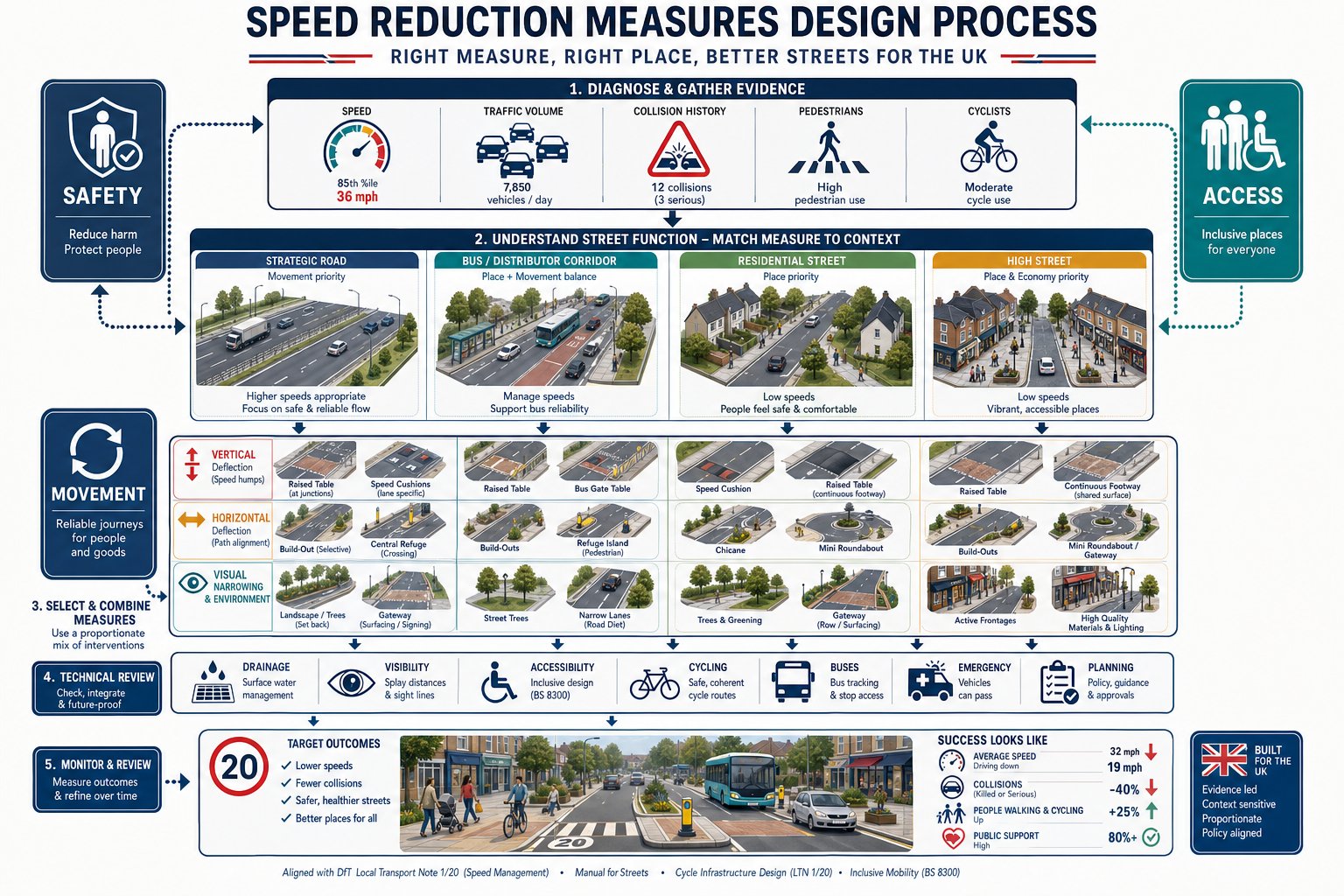
Getting vehicle speeds down is rarely about putting up another sign and hoping for the best. In practice, the most successful speed reduction measures design creates streets that feel slower to drive on, function better for the people using them, and stand up to scrutiny in planning, adoption, and detailed design reviews.
That matters for our audience. Whether we’re preparing a transport assessment for a planning application, advising on an estate road for adoption, or reviewing a retrofit scheme near schools and shops, speed management has to work on several levels at once. It needs to reduce operating speeds, cut collision risk, support pedestrians and cyclists, and still accommodate buses, servicing, refuse vehicles, and emergency access.
In the UK, local authorities increasingly expect a clear line between street function, target speed, and physical layout. A residential street designed as if it were a distributor road will invite the wrong behaviour. Equally, an over-engineered calming package on a key bus route can create accessibility, noise, and maintenance problems of its own.
In this guide, we set out a practical framework for speed reduction measures design in 2026: what these schemes are meant to achieve, how to assess the existing road environment, which traffic calming tools are commonly used in UK schemes, and where teams often go wrong. Drawing on the kind of planning and transport engineering work we support at ML Traffic, the aim is simple: help us choose measures that are safer, proportionate, and policy-compliant.
What Speed Reduction Measures Design Aims To Achieve
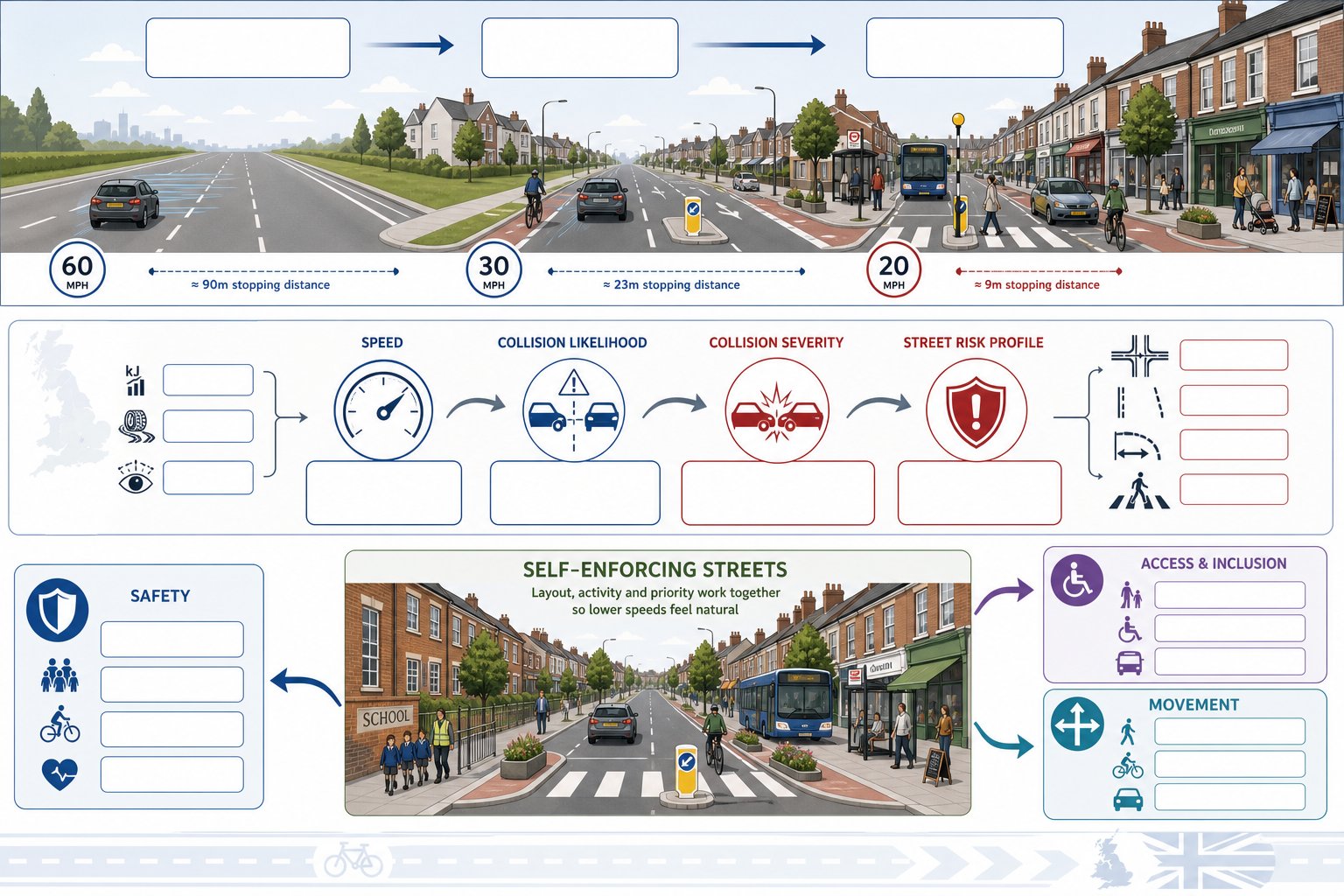
At its core, speed reduction measures design is about changing real driving behaviour, not just the posted limit. The target is usually a lower mean speed and lower 85th percentile speed, because those figures tell us far more about how a street actually operates than the number on a signpost.
When speeds fall, both the likelihood and severity of collisions tend to fall as well. That is especially important on local and mixed-use streets where pedestrians, cyclists, school children, older people, and turning vehicles are all interacting in relatively tight space. A small reduction in average speed can make a disproportionate difference to stopping distance and injury outcome.
But safety is not the only objective. Well-designed measures can also discourage rat-running, reduce the dominance of through traffic, and make residential streets feel liveable again. On newer developments, they help streets operate as intended from day one rather than needing retrofitted fixes later.
The best schemes are self-enforcing. In other words, the geometry, frontage activity, priority arrangement, and overall character of the street encourage appropriate speeds naturally. Drivers should not feel that the road says “40” while a terminal sign says “20”. If there is that mismatch, the layout usually loses.
How Vehicle Speed, Street Function, And Risk Interact
Vehicle speed affects risk in two linked ways: it alters both the chance of a collision occurring and the consequences if one does. The physics is straightforward. As speed rises, kinetic energy rises sharply, and the margin for driver reaction shrinks. A street that tolerates high approach speeds hence carries a very different risk profile from one that signals caution and lower speed through its design.
Street function matters just as much. A strategic or primary route may need to prioritise movement and network resilience, even in an urban setting. A residential street, by contrast, is fundamentally about access, frontage, crossing, parking, and social activity. We should not expect the same geometry to suit both.
This is where design controls become powerful. Carriageway width, forward visibility, junction spacing, alignment, crossing points, and priority arrangements all influence operating speed. Wide, straight corridors with generous radii invite acceleration. Narrower lanes, vertical shifts, frequent junction activity, and visible pedestrian demand tend to moderate it.
So when we assess speed reduction options, we are really asking a broader question: what kind of street is this, and what sort of driver behaviour does its current form reward?
Why Design Must Balance Safety, Access, And Movement
Reducing speed is not an excuse to ignore how a route actually functions. A scheme that slows private cars but creates unacceptable delay for buses, obstructs emergency access, or introduces barriers for disabled users is not a successful scheme, it is just a different problem.
That balance is particularly important on streets with overlapping roles. A town-centre street may need to support loading, bus movements, pedestrian crossing, short-stay parking, and cycle access at the same time. A suburban distributor may need calmer speeds near schools without losing its wider network role.
In practice, we are balancing three things:
- Safety: lower speeds, better crossing conditions, fewer severe collisions
- Access and inclusion: usable layouts for residents, deliveries, wheelchair users, visually impaired pedestrians, cyclists, and public transport
- Movement: keeping the network legible and functional for its intended traffic role
That is why one-size-fits-all traffic calming rarely performs well. We need measures matched to place. Sometimes that means raised tables and tighter geometry. Sometimes it means visual narrowing, refuge islands, or route management instead of aggressive vertical features. The right answer is usually the one that fits the street’s hierarchy and user mix, not the one with the strongest headline effect in isolation.
Assessing The Existing Road Environment Before Choosing Measures
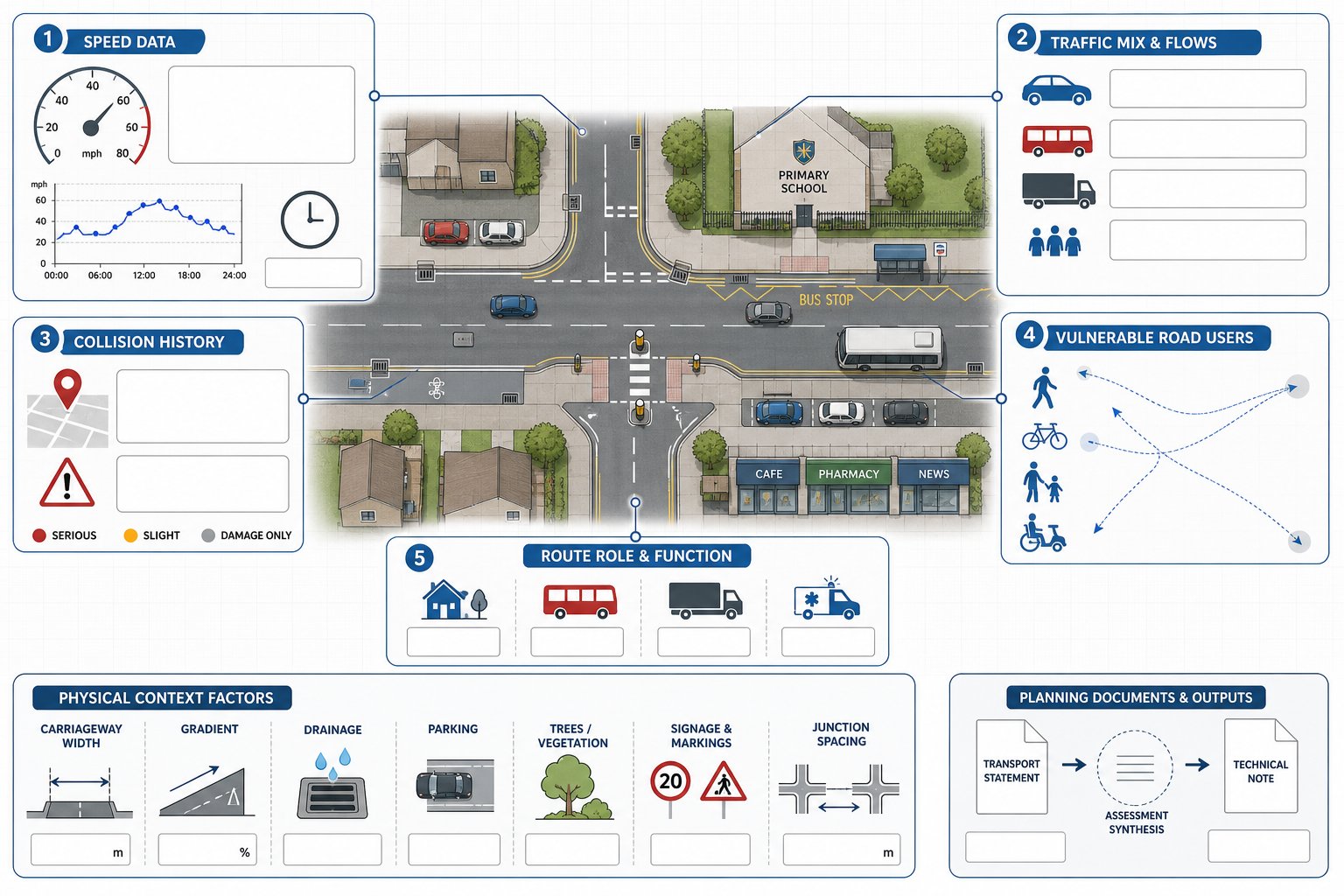
Before selecting any device, we need a clear diagnosis of the road environment. Too many schemes begin with a preferred measure, humps, cushions, build-outs, before the underlying problem has been properly defined. That is how costly, awkward layouts get approved and then underperform.
A robust assessment typically starts with evidence:
- Speed data: mean speeds, 85th percentile speeds, and where feasible speed profiles by time of day
- Traffic volumes and composition: including HGV content, bus movements, and school-run peaks
- Collision history: not only total incidents, but pattern, severity, contributory factors, and location
- Vulnerable road user activity: pedestrian desire lines, cycle flows, mobility scooter use, school access, and frontage crossings
Then we step back and look at the route’s role in the wider network. Is it a residential access street, a bus corridor, a freight route, an emergency response route, or some uncomfortable hybrid? A measure that is highly effective on a cul-de-sac may be wholly unsuitable on a key link road.
Physical context matters too. Width, alignment, gradient, drainage constraints, parking behaviour, trees, existing signing, junction spacing, and frontage activity all influence what can be delivered. Schools, local shops, community facilities, and high pedestrian turnover often justify stronger place-led interventions.
For development proposals, this assessment should feed directly into the transport statement, transport assessment, or technical note supporting the planning application. At ML Traffic, for example, the value often lies in tailoring recommendations to the exact thresholds, local standards, and policy language that a particular authority expects. That saves time later.
The point is simple: if we do not understand current conditions properly, we are not designing a speed reduction scheme. We are guessing.
Traffic Calming Features Commonly Used In UK Schemes
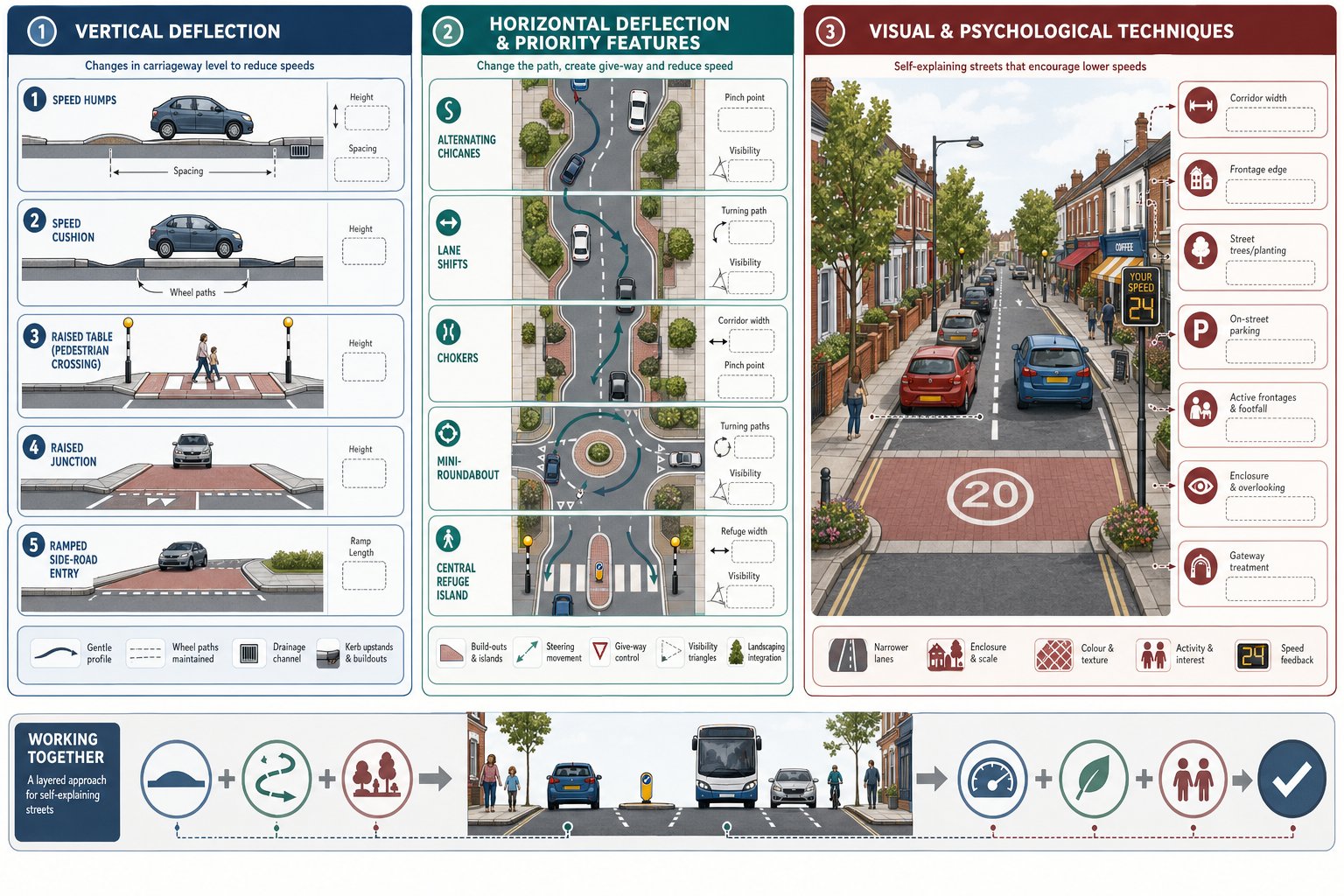
UK traffic calming schemes usually draw from three broad families of intervention: vertical deflection, horizontal deflection and priority features, and visual or psychological techniques. Some schemes also include closures, modal filters, or movement restrictions, but the principle is similar: alter the street environment so the desired speed feels natural.
The strongest results often come from combining measures rather than relying on one device. A raised table at a crossing may work better when reinforced by tighter kerb geometry, active frontage, and gateway treatments. Likewise, a chicane can lose much of its effect if the surrounding corridor remains visually over-wide and straight.
Choice depends on street type, traffic composition, available width, network role, maintenance implications, and user comfort. Councils and designers also need to account for local authority supplements to national guidance such as Manual for Streets, traffic signs requirements, and where relevant DMRB principles for higher-order roads.
What follows is not a universal recipe. It is a practical overview of the tools most commonly used in UK-style schemes, and the design considerations that tend to determine whether they succeed or become a source of complaints.
Vertical Deflection Measures
Vertical deflection measures physically interrupt a driver’s path and are often among the most reliable ways to reduce speed on local streets. They are particularly common where a 20 mph environment is the aim and where through movement is less important than frontage access and pedestrian safety.
Typical examples include:
- Speed humps: rounded or sinusoidal profiles, often used in a series so drivers cannot simply accelerate between them
- Speed cushions: narrower features that some emergency vehicles and buses may straddle, subject to track width
- Speed tables and raised junctions: flat-topped features that combine speed control with improved pedestrian crossing conditions
- Raised entry treatments: ramped side-road entries that slow turning traffic and clarify pedestrian priority
These measures can be highly effective, but they are not plug-and-play. Ramp gradients, heights, spacing, and transitions all affect comfort, noise, and compliance. If humps are spaced too far apart, speeds rebound between features. Too close together, and complaints about noise, vibration, and discomfort tend to follow.
Drainage is another recurring issue. Raised features can create ponding if channels, kerb upstands, and crossfall are not handled carefully. And on bus routes or emergency corridors, vertical measures often require explicit agreement because the operational impacts can be significant.
Horizontal Deflection And Priority Features
Horizontal measures work by disrupting the straight, forgiving alignment that encourages speed. They ask drivers to steer, negotiate, or yield, which introduces just enough friction to change behaviour.
Common options include:
- Chicanes using alternating build-outs or parking bays
- Lane shifts through kerbing, islands, or markings
- Chokers and pinchpoints that narrow the carriageway locally, sometimes with priority control
- Mini-roundabouts or small traffic circles at junctions
- Central islands and medians that visually narrow lanes and can provide crossing refuge
These features can be very effective where full vertical calming is undesirable, for example on bus routes or streets where ride quality is a concern. They also have placemaking benefits, especially when paired with crossing improvements or planting.
But they are less forgiving of sloppy geometry. If the lateral shift is too gentle, drivers barely react. If it is too tight, larger vehicles overrun kerbs or conflict with opposing traffic. Pinchpoints are a particular risk for cyclists if bypass space or adequate lane width is not provided. Swept-path analysis is hence essential where buses, refuse vehicles, or HGVs use the route.
Visibility and priority control also need attention. A one-lane narrowing that is legible in daylight can become ambiguous at night if signs, markings, or lighting are weak.
Visual And Psychological Speed Reduction Techniques
Not every successful intervention needs a jolt or a hard steering input. Visual and psychological measures rely on perception: if the road feels narrower, busier, more enclosed, or more pedestrian-oriented, many drivers instinctively moderate speed.
This family of measures includes:
- Lane narrowing or road diets that reallocate excess width
- On-street parking that reduces the effective running corridor
- Street trees and planting that create enclosure
- Active frontages and tighter building lines in new developments
- Coloured surfacing or high-friction materials at gateways and crossings
- Speed feedback signs showing live driver speed
These measures are especially valuable on higher-order urban streets where aggressive vertical calming would be inappropriate. They can also help new developments avoid the classic problem of over-wide, under-enclosed estate roads that invite speeding from day one.
Used alone, their effect may be modest. Used well, in combination with crossings, kerb build-outs, or raised features, they can be the difference between a street that merely posts a lower limit and one that genuinely supports it. We should think of them as part of the language of self-enforcing design, not decorative extras.
Selecting The Right Measure For Different Street Types
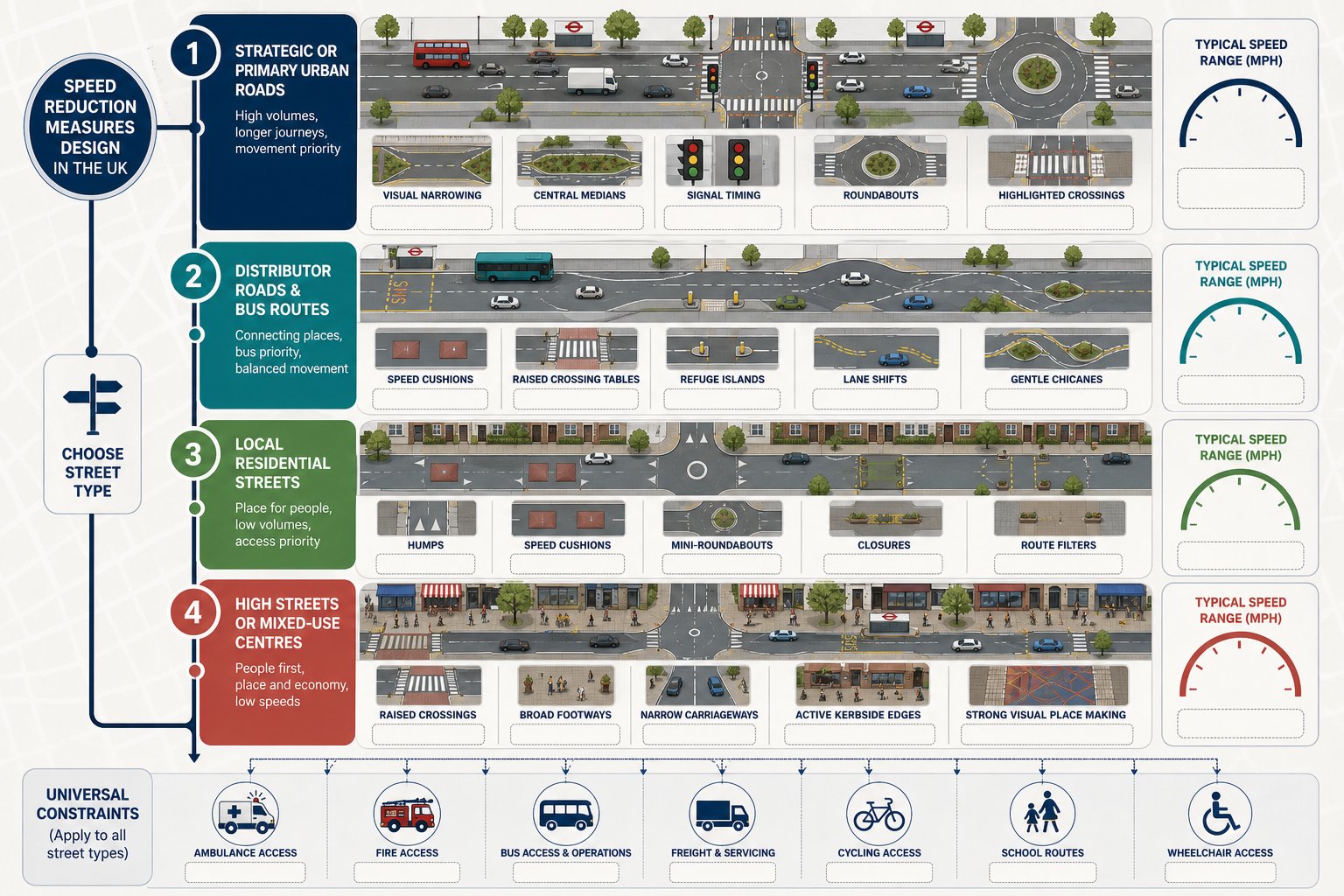
The right measure depends less on fashion and more on context. A device that works well on a short residential street may be entirely wrong for a high street, a distributor road, or a strategic corridor. That is why speed reduction measures design should always begin with street type and network role.
For strategic, trunk, or primary urban roads, typical speed aims may still sit in the 30–50 mph range. Here, designers usually lean towards visual narrowing, medians, signal timing strategy, roundabouts, and targeted crossing treatments rather than humps or cushions. Heavy traffic, buses, and HGVs make severe vertical deflection hard to justify.
For distributor roads and bus routes, 20–30 mph may be appropriate depending on context. Speed cushions, raised tables at crossings, refuge islands, lane shifts, and carefully designed chicanes can work, but only if they respect bus operation, passenger comfort, and emergency access.
For local residential streets, especially where 20 mph is the aim, a broader toolkit is available: humps, cushions, mini-roundabouts, chicanes, closures, and route filters. These streets usually place access and place function ahead of movement, so stronger calming is often justified.
For high streets and mixed-use centres, lower design speeds, sometimes 10–20 mph, are often desirable. Raised crossings, tables, narrow effective carriageways, active kerbside use, and strong visual cues tend to outperform harsh vertical features that disrupt buses and cycling.
Across all street types, we still need to test the same constraints: emergency response routes, freight access, cycle desire lines, school travel patterns, and inclusive design needs. Good selection is really a matching exercise between speed aim, street function, and technical reality.
Design Standards, Visibility, Drainage, And Accessibility Checks
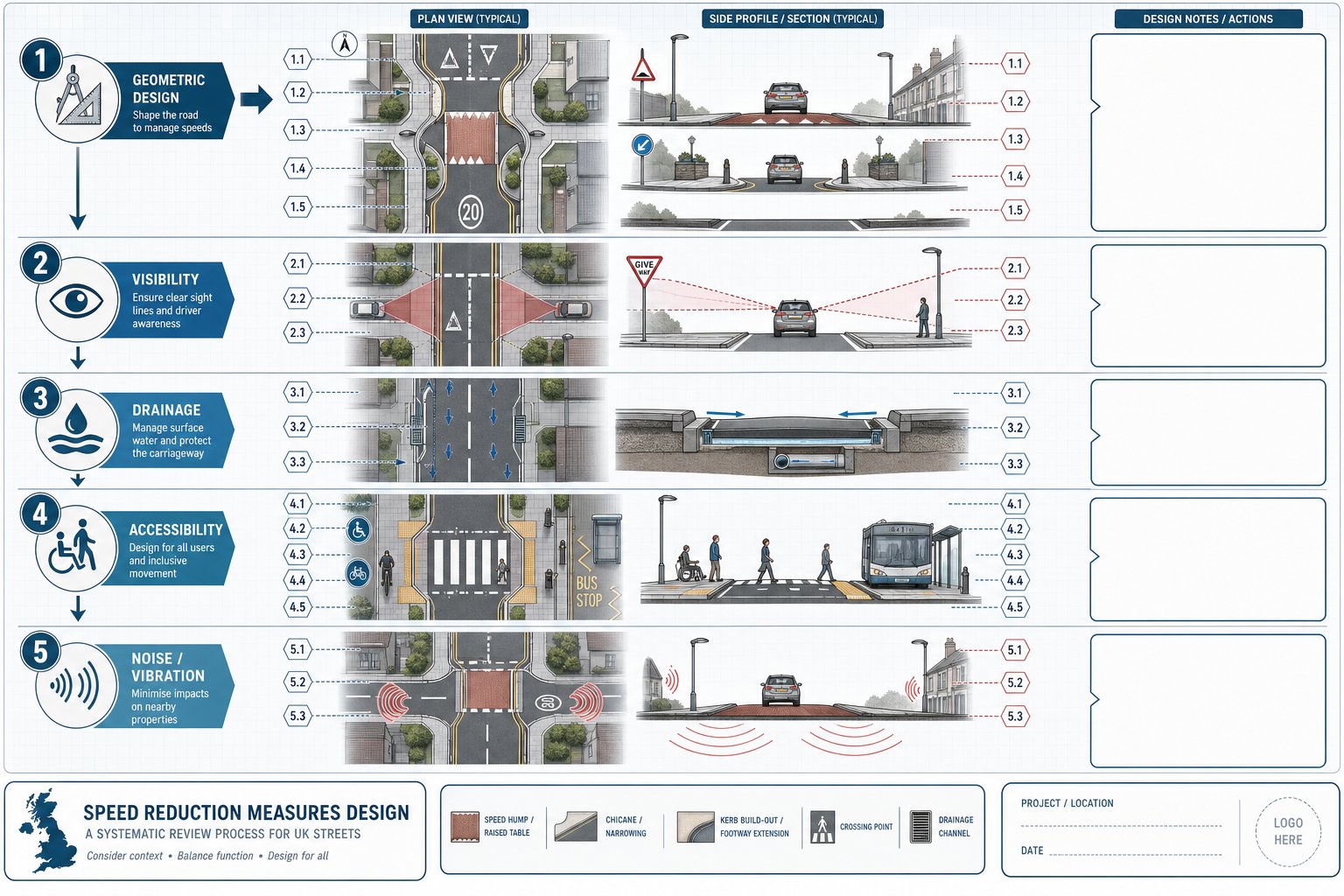
Once a preferred approach has been identified, detailed design discipline matters. Plenty of schemes fail not because the concept was wrong, but because the technical checks were weak.
Geometric design comes first. Vertical features need suitable ramp gradients, heights, and spacing. Horizontal features need enough deflection to influence speed, but not so much that larger vehicles cannot pass safely. Lane widths should align with the target speed and route role rather than defaulting to overly generous dimensions.
Visibility is another non-negotiable. Drivers need adequate stopping sight distance to any feature, crossing, priority arrangement, or abrupt alignment change. Hidden humps, poorly signed build-outs, and late-visible priority pinchpoints are an invitation to braking events and side-swipe risk.
Drainage deserves more attention than it usually gets. Raised tables, side-road entries, and kerb build-outs can trap water if crossfall continuity and drainage paths are interrupted. Ponding is not only a maintenance issue: it can create slip risk, winter icing, and accessibility problems at crossing points.
Accessibility checks should run through the whole design, not be added at the end. That means considering tactile paving, crossing gradients, wheelchair and mobility scooter movement, bus boarding conditions, and the experience of visually impaired pedestrians. Cyclist comfort matters too. Narrowings that force riders into conflict with overtaking traffic are a common design fault.
And then there is noise and vibration, especially with vertical features near housing. Residents tend to notice repeated braking, acceleration, body slap from poorly designed humps, and loose utility covers very quickly. A scheme that is technically compliant but operationally unpleasant will struggle in the real world.
In UK practice, these checks usually sit within national guidance, local standards, and road safety audit requirements. We ignore any one of them at our peril.
Planning, Adoption, And Coordination With Local Authorities
For planning-led schemes, the technical design is only half the job. The other half is navigating authority expectations, adoption requirements, and the practical coordination needed to get a scheme approved and built.
The process works best when we engage early and define the problem clearly. Local highway authorities are far more likely to support a proposal when it is backed by speed data, traffic counts, collision records, frontage context, and a reasoned explanation of why the chosen measures suit the street. Vague claims about “traffic calming if required” rarely survive detailed review.
Coordination normally extends beyond the authority itself. Bus operators, emergency services, refuse teams, schools, local members, and frontagers may all have legitimate concerns. A raised table that improves crossing safety, for instance, might also affect bus ride quality or drainage over a utility corridor. Better to surface those issues early than discover them at technical approval stage.
Some interventions require statutory processes, including Traffic Regulation Orders for speed limits, waiting restrictions, one-way working, or movement restrictions. Temporary or trial layouts can be useful where behaviour is uncertain, particularly in town centres or low-traffic neighbourhood contexts.
For new developments, speed reduction measures often need to be baked into the planning application and agreed before reserved matters or technical approval. If roads are intended for adoption, local standards, construction quality, road safety audits, and as-built compliance all become critical.
This is where experienced reporting helps. On projects where deadlines are tight, concise and authority-aware technical work, the sort of service ML Traffic provides, can make the difference between a clean planning response and weeks of avoidable queries.
Post-implementation monitoring should also be planned from the outset. We should know how success will be measured: speeds, traffic redistribution, collisions, compliance, or public feedback. Otherwise the scheme finishes the day construction ends, which is rarely enough.
Common Design Mistakes And How To Avoid Them
Most disappointing schemes do not fail because speed management is ineffective as a concept. They fail because the measures are mismatched, isolated, or under-designed.
One of the most common mistakes is relying on a single isolated feature. A lone hump, refuge, or table may slow drivers at one point and nowhere else. If the wider route still feels open and fast, overall operating speed may barely shift. Whole-route thinking is usually more effective than point solutions.
Another frequent problem is poor spacing of vertical measures. Too far apart, and drivers accelerate between them. Too close together, and the result can be noise, discomfort, and backlash from residents and bus users. The spacing has to reflect both target speed and local context.
Designers also sometimes choose measures that are incompatible with route function. Severe humps on a primary bus route, for example, are asking for objections. In those situations, cushions, raised crossings, visual narrowing, or horizontal deflection may achieve more with fewer side effects.
A subtler issue is insufficient deflection or narrowing. Some build-outs and chicanes look impressive on plan but are so forgiving on site that drivers barely change line or speed. If we are not creating a meaningful behavioural cue, we are mostly building expensive kerbs.
Then there are the technical misses: ignored drainage causing ponding, cyclist pinchpoints at narrowings, weak signing or lighting, and no follow-up monitoring. None is glamorous. All are common.
The fix is not complicated, though it does require discipline:
- diagnose the problem with data
- design at route level, not just point level
- match measures to street function
- test vehicles, drainage, visibility, and accessibility properly
- review the scheme with a multidisciplinary team
- monitor outcomes and adjust if needed
That combination avoids a lot of regret, and a fair number of angry emails.
Conclusion
Good speed reduction measures design is not about choosing the harshest traffic calming feature available. It is about creating a street that naturally supports the right speed for its function.
In practice, that means starting with evidence, understanding how the route works, and then combining vertical, horizontal, and visual measures in a way that balances safety, access, and movement. A local residential street, a bus corridor, and a high street will not need the same answer, and they should not look as if they do.
For architects, planners, surveyors, developers, and councils, the real challenge is joining policy, design detail, and deliverability. If we get that right, speed management becomes easier to justify at planning stage, easier to approve with the highway authority, and more likely to perform once built.
And that is really the standard to aim for in 2026: schemes that are not only compliant on paper, but calmer, safer, and more legible in everyday use.
Frequently Asked Questions about Speed Reduction Measures Design
What are the main objectives of speed reduction measures design in UK streets?
Speed reduction measures design aims to lower actual vehicle speeds, reduce collision likelihood and severity, discourage cut-through traffic, improve street liveability, and create self-enforcing environments that naturally encourage appropriate speeds based on street function.
How does street function influence the choice of speed reduction measures?
Street function determines appropriate target speeds and suitable measures. Residential streets prioritise low speeds and access, using vertical deflection like humps, while primary or strategic roads prioritise movement, favouring visual narrowing, medians, or signal timing to manage speed without disrupting traffic flow.
What types of traffic calming features are commonly used in UK speed reduction schemes?
Common UK features include vertical deflection devices (speed humps, cushions, raised tables), horizontal deflection and priority features (chicanes, lane shifts, mini-roundabouts), and visual or psychological measures (lane narrowing, street trees, coloured surfacing) often combined to reinforce lower speeds.
Why is it important to assess the existing road environment before choosing speed reduction measures?
A thorough assessment of speeds, traffic volumes, collision history, street type, geometry, drainage, and vulnerable user activity ensures measures address the real problems and fit the street’s function, preventing ineffective or problematic designs and improving scheme success and compliance.
How do designers balance safety, access, and movement when planning speed reduction measures?
Designers ensure speed reduction does not compromise emergency access, bus operations, freight deliveries, or disabled user accessibility by selecting suitable measures that lower speeds safely while maintaining the street’s intended traffic function and accommodating all users inclusively.
What are common design mistakes in speed reduction schemes and how can they be avoided?
Mistakes include relying on isolated features, poor spacing of vertical measures, incompatible devices for the street function, insufficient deflection, ignoring drainage and accessibility, and lacking monitoring. Avoiding these requires robust diagnostics, route-level design, adherence to standards, and multidisciplinary reviews.