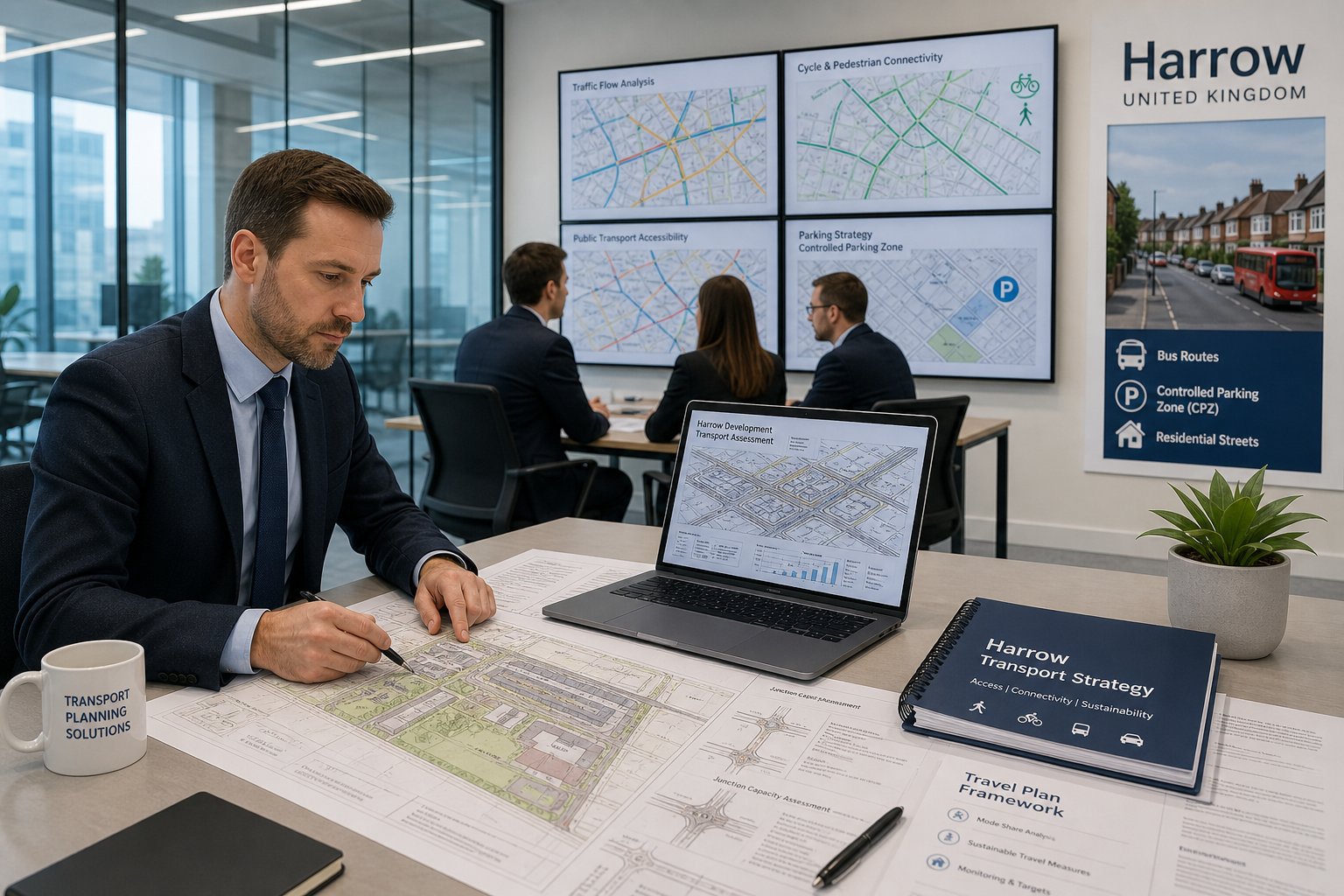
Planning in Harrow rarely turns on design alone. A scheme can look excellent on paper and still run into delay if the transport case is thin, the parking position is weak, or access hasn’t been tested properly against local constraints. That’s why bringing in a traffic engineer in Harrow early is often the difference between a smooth planning submission and a long exchange of objections, revisions, and avoidable cost.
We work with architects, planners, solicitors, surveyors, developers and project teams who need transport evidence that is concise, technically sound and grounded in the realities of London borough decision-making. In Harrow, that usually means more than just counting vehicle trips. It means understanding how a proposal relates to public transport, walking and cycling policy, controlled parking zones, servicing pressure, school traffic, local junction performance and the practical expectations of highway officers.
In 2026, the bar is still clear: planning submissions need proportionate evidence, not bloated paperwork, but they also need enough technical depth to answer the questions Harrow Council and, where relevant, Transport for London are likely to ask. In this guide, we explain what a traffic engineer does, when transport input becomes necessary, which reports are commonly required, and how the right advice can help move a Harrow scheme towards approval faster and with fewer surprises.
Key Takeaways
- A traffic engineer in Harrow provides essential transport evidence that ensures planning applications meet local requirements and are more likely to gain swift approval.
- Early transport input is crucial to address access, parking, servicing, and safety issues, significantly reducing delays and objections in Harrow development projects.
- Transport reports such as Transport Assessments, Statements, Travel Plans, and Parking Reviews must be proportionate, technically robust, and tailored to the specific site context in Harrow.
- Understanding Harrow’s unique planning and highway considerations, including local traffic patterns and controlled parking zones, is vital for creating practical and policy-compliant transport solutions.
- Coordinated transport advice that aligns with architectural and planning documentation improves the credibility and effectiveness of a planning submission.
- Choosing a traffic engineer with direct Harrow experience and the ability to produce clear, concise, and locally informed reports accelerates project progress and reduces unnecessary costs.
What A Traffic Engineer In Harrow Does For Planning Applications
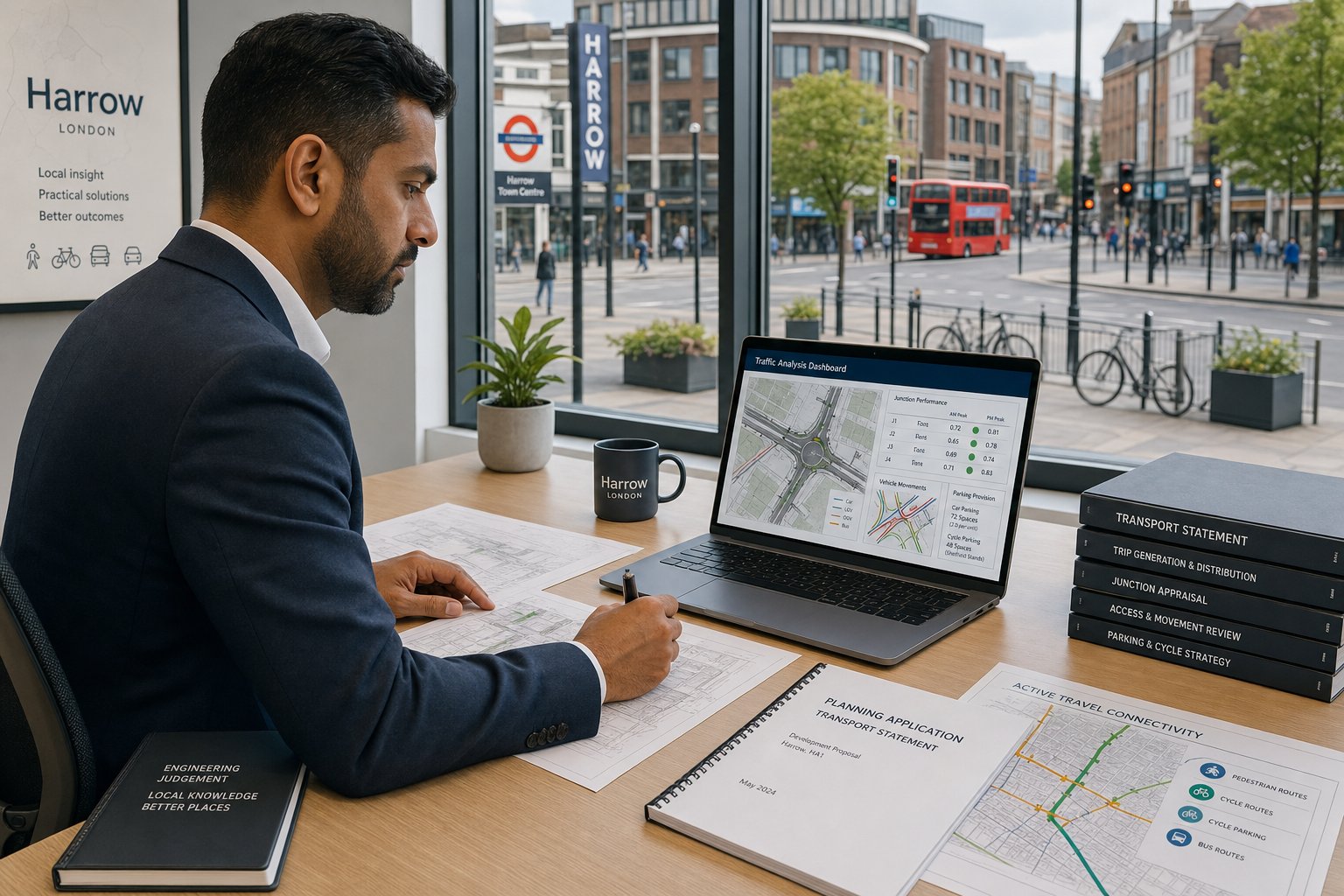
A traffic engineer in Harrow provides the transport evidence that helps a planning application stand up to scrutiny. At a practical level, that means assessing how people and vehicles will reach a site, whether the local highway network can accommodate the proposal, and what measures are needed to make the scheme safe, policy-compliant and realistic to operate.
For some sites, our role is proportionate and focused: a short Transport Statement, a parking review, or access advice to support an application drawing set. For larger or more sensitive schemes, we may prepare a full Transport Assessment, estimate trip generation using TRICS, review collision data, test junction effects, and recommend mitigation or design changes before submission.
The work sits at the intersection of planning and engineering. We interpret national guidance such as the National Planning Policy Framework and Manual for Streets, but we also translate borough-specific expectations into clear technical advice. That local layer matters. A Harrow scheme near a town centre, bus corridor or constrained residential street won’t be assessed in the same way as an out-of-centre site with generous frontage and low parking pressure.
In many cases, we also shape the proposal itself. That may involve refining site access geometry, reviewing swept paths for refuse or service vehicles, advising on disabled and cycle parking, or helping the team justify a car-lite approach. The wider discipline covered by Traffic Engineering Consultants: is broad, but in planning terms the aim is simple: remove technical uncertainty before it becomes a planning problem.
When You Need Transport Input For A Harrow Development Project
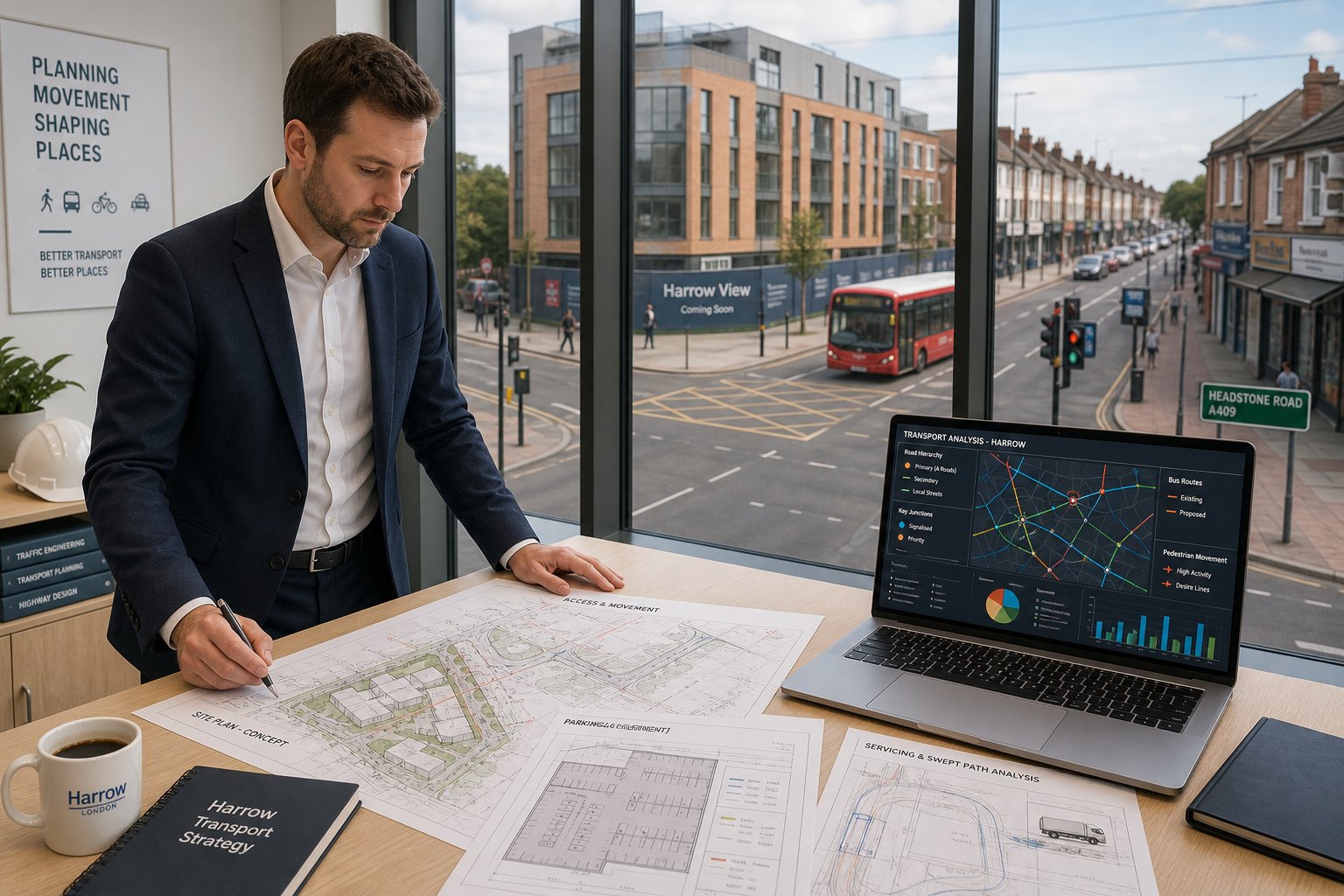
Not every development in Harrow needs a lengthy transport submission, but many need some level of transport input much earlier than clients first assume. The trigger is not only scheme size. It is also sensitivity, location and the likely questions a planning officer or highway engineer will raise.
We’re commonly instructed on residential, mixed-use, commercial, education, healthcare and place of worship projects. New-build schemes are obvious candidates, but changes of use can be just as transport-sensitive, especially where they increase staff numbers, visitor trips, servicing activity or parking stress. Intensification on an existing site often falls into the same category.
Location is often the deciding factor. If a proposal fronts a classified road, sits near a signalised junction, affects a bus route, or relies on access from a narrow residential street, transport analysis tends to become important quickly. The same is true in town centre settings where pedestrian movement, loading restrictions and limited kerb space can turn a straightforward application into a more technical one.
Early advice is especially valuable when the design is still flexible. That gives time to test whether an access can work, whether parking provision is defensible, and whether servicing arrangements are realistic. We often find that modest changes at concept stage save weeks later on. The broader planning context outlined in Traffic Engineer In London: is relevant here too, because Harrow projects are shaped by the same London-wide emphasis on sustainable travel, restrained car use and site-specific evidence.
Transport Reports Commonly Required In Harrow

The right report depends on the scale and likely effect of the development. Harrow does not need every scheme to carry a thick transport appendix, but it does expect the submission to match the proposal. A small application with limited impact may only need a concise statement. A larger or more sensitive project may need a full suite of transport documents.
In practice, the most common reports are Transport Assessments, Transport Statements, Framework or Full Travel Plans, parking reviews or car-free justifications, Delivery and Servicing Plans, and Construction Logistics Plans. Sometimes these are standalone reports. Sometimes they are bundled as coordinated evidence so that access, travel behaviour, parking and servicing all tell the same story.
The best submissions are proportionate and joined-up. If the transport case says one thing, the site plan shows another, and the refuse strategy says something else entirely, planning officers notice. That is why we coordinate closely with architects and planning consultants rather than treating transport as an isolated appendix.
Transport Assessments And Transport Statements
A Transport Assessment is generally prepared for larger proposals or sites where the local network context is sensitive. It reviews existing conditions, forecasts future demand and tests whether the development would create a material impact. That can include trip generation, distribution, modal split, parking demand and, where needed, junction capacity analysis or queue review.
A Transport Statement is lighter but still evidence-based. It is usually suitable where impacts are expected to be limited, though it must still explain baseline transport conditions and show why the development is acceptable. A short report does not mean a casual one.
Both documents rely on robust inputs. We may use TRICS for trip generation, policy review for parking and mode share context, and site observations to check whether the theoretical picture matches reality. The wider discipline behind Traffic Engineering and Transportation is useful here because effective reports combine modelling, design judgement and practical planning strategy.
Travel Plans, Parking Reviews, And Delivery Management Documents
Travel Plans are often required where a scheme should actively encourage non-car travel. In Harrow, that usually means setting out measures to support walking, cycling and public transport use, together with targets, monitoring and management responsibilities. For schools, workplaces and larger residential schemes, that can be a significant part of the planning package.
Parking reviews matter when provision is constrained, car-free or car-lite, or where the risk of overspill is a concern. We look at local parking controls, existing on-street demand, disabled parking, visitor arrangements, cycle parking and electric vehicle charging. The balance is rarely just a numbers exercise: it is about how the site will function day to day.
Delivery and Servicing Plans and Construction Logistics Plans address how vehicles interact with neighbours and the road network. They typically cover routing, timing, vehicle size, loading arrangements and site management controls. On constrained sites, these documents can carry real weight because they show the council that the development will be managed, not simply assumed to work. Detailed thinking on parking strategy traffic often supports this part of the case, especially where parking pressure and servicing compete for limited space.
How Harrow Planning And Highway Considerations Shape Transport Advice
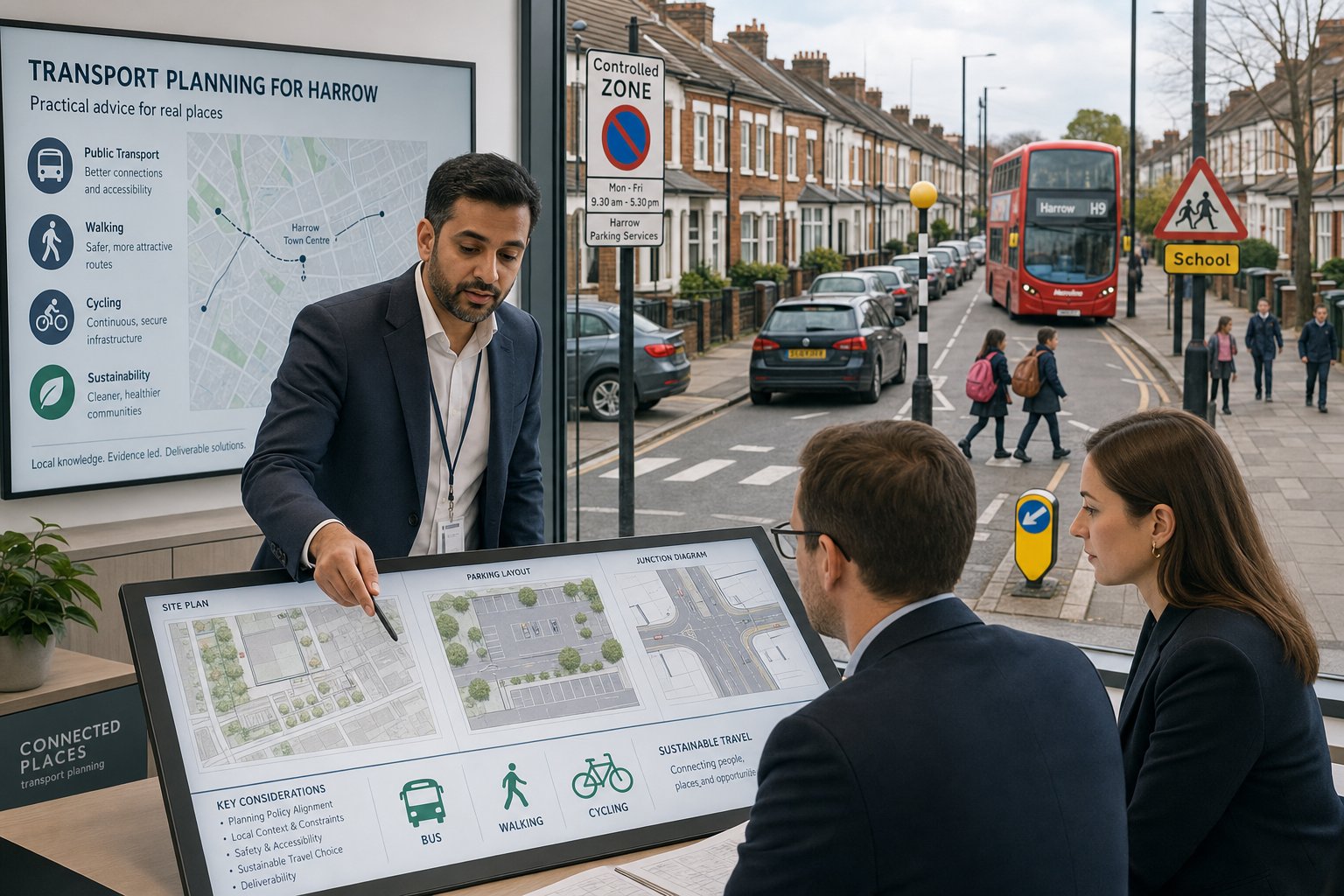
Transport advice in Harrow is shaped by policy, but never by policy alone. The London Plan, local plan policies, TfL guidance and national standards set the framework: the actual site context determines how that framework is applied. That’s where experienced judgement matters.
Across London boroughs, planning policy strongly favours public transport, walking and cycling, while taking a cautious line on private car use and parking oversupply. In Harrow, those themes are filtered through local conditions: suburban neighbourhoods with narrow roads, areas of controlled parking, busy district centres, school-run congestion, bus corridors and junctions already operating under pressure.
So our advice changes from site to site. A residential proposal near a station with strong local services may support a car-lite strategy more easily than an edge location with weaker connectivity. A commercial scheme on a strategic route may need more careful servicing analysis than one with rear service access. A place of worship or education use may attract very distinct peak patterns that standard assumptions would miss.
This is also why early scoping helps. If officers are likely to focus on highway safety, parking displacement or delivery management, it is better to know that before the design is fixed. A strong report is not just technically correct: it responds to the concerns the authority is likely to prioritise.
There is a reason Highway And Traffic Engineering has to be treated as both a design and planning discipline. In Harrow, successful advice usually comes from understanding not only what standards say, but how those standards play out on ordinary local streets with real residents, buses, school traffic and limited kerb space.
Key Issues A Traffic Engineer Will Review At Your Site
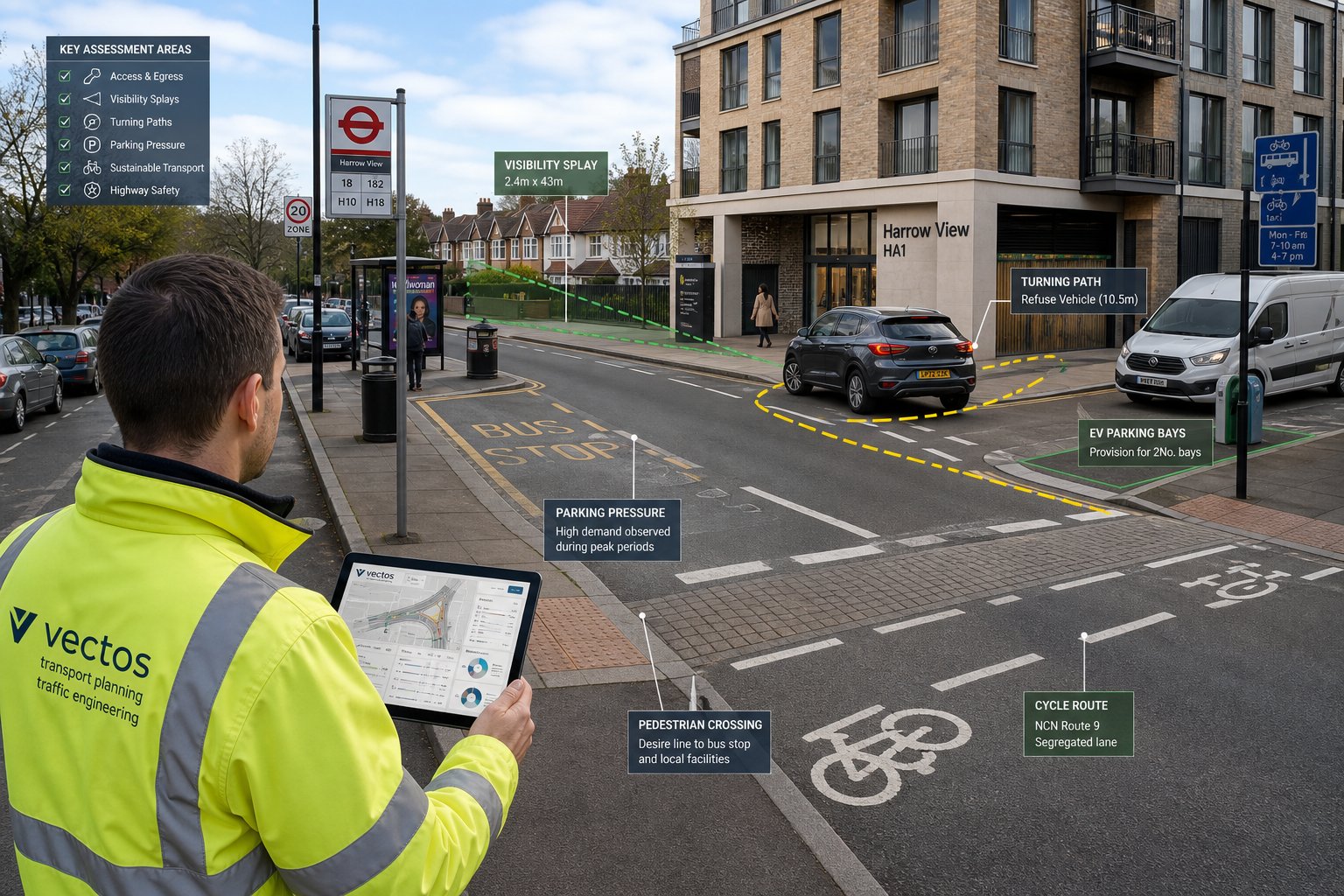
Every site starts with the same broad question: can the proposal function safely and acceptably within its transport context? But the way we answer that varies considerably. A constrained infill site in a residential road raises one set of issues. A larger town centre redevelopment raises another.
We usually begin by reviewing transport accessibility, surrounding land uses, the character of the road network, existing parking conditions and the relationship between the site and nearby junctions, crossings, bus stops and cycle routes. We also look at the practical operation of the proposal: who arrives when, by what mode, using what vehicles, and where those movements will happen.
Collision history, observed traffic behaviour and local bottlenecks often tell us as much as formal standards do. A drawing may show a technically possible access, for example, but a site visit might reveal school pick-up activity, informal parking or poor driver behaviour that changes the risk profile.
Access, Visibility, And Highway Safety
Access is often the first point of challenge in a planning application. We review whether vehicles can enter and exit without unsafe manoeuvring, whether reversing onto the highway can be avoided, and whether the geometry suits likely vehicle types. On some sites the issue is not simply width, but the angle of approach, local speed environment or nearby kerbside activity.
Visibility is equally important. We assess splays for drivers, pedestrians and cyclists in line with relevant UK standards and the street context. That includes considering bends, gradients, parked vehicles, crossings, bus stops, trees, street furniture and anything else that can interrupt sight lines or driver awareness.
Sometimes a small access amendment solves a big planning risk. Adjusting gates, setting back boundary treatment, relocating a bay or changing internal circulation can turn an access from questionable to robust. Practical guidance on access design highway supports this stage, particularly where planning drawings and highway functionality need to align tightly.
Parking Demand, Servicing, And Trip Generation
Parking is rarely just about meeting a maximum or minimum ratio. In Harrow, the real question is whether the proposed provision is justified by accessibility, local policy and observed street conditions. We review likely resident, staff, visitor and disabled parking demand, then consider cycle parking, EV charging and the risk of overspill into surrounding roads or controlled parking zones.
Servicing is another regular pressure point. Refuse collection, deliveries, maintenance and emergency access all need to work without creating conflict on the highway. We test whether service vehicles can reach the site, turn where necessary and operate without blocking key routes or forcing unsafe movements.
Trip generation underpins much of the wider assessment. We estimate likely person trips and vehicle trips, identify peak periods and decide whether capacity testing or further mitigation is needed. That is especially important for mixed-use and Commercial Traffic Engineering schemes, where servicing patterns and peak demand can be less predictable than a standard residential site.
The Process From Initial Enquiry To Completed Transport Report
A good transport report is rarely produced by dropping numbers into a template. The process is iterative, and when it works well it supports the whole planning strategy rather than trailing behind it.
We usually start with a scoping discussion. At that point, we review the proposal, planning status, likely submission route, and whether Harrow officers or TfL may need to be engaged. This first step is about identifying the real transport issues early. Sometimes the answer is a straightforward Transport Statement. Sometimes the scheme clearly needs a wider package including a Travel Plan, parking justification and servicing documentation.
The next stage is evidence gathering. That may include a site visit, traffic counts, parking beat surveys, collision data review, public transport accessibility checks, policy analysis and a review of the surrounding highway layout. If the site is complex, we often coordinate with the design team at this stage so that access and layout questions are tested before drawings are finalised.
Assessment and design come next. We calculate trip generation, review likely routeing, consider capacity effects where relevant, test access and servicing arrangements and identify mitigation if required. This is also where our local experience matters most: the report has to answer the authority’s likely concerns in a clear, proportionate way.
A draft report then goes to the client team for review. We refine wording, incorporate design updates and make sure the transport submission aligns with planning statements, refuse strategy and site plans. Once finalised, the report is submitted as part of the planning application, and we support responses to officer comments, revisions or technical follow-up notes where needed.
At firms with long-standing borough experience, including the approach reflected across Traffic Engineering: Your, speed matters, but not at the expense of precision. The best outcomes usually come from concise reports that are defensible line by line.
Choosing The Right Traffic Engineer For Harrow Projects
Not all transport consultants are equally suited to a Harrow planning project. Technical competence is essential, of course, but so is judgement, report-writing quality and familiarity with how London boroughs assess development proposals in practice.
We would look first for direct experience of Harrow and neighbouring boroughs. That does not mean generic London experience alone: it means understanding the rhythm of local applications, common transport concerns and the level of evidence likely to be expected for different types of site. A consultant who knows when a concise statement will suffice, and when a fuller assessment is necessary, can save a team both time and cost.
Breadth of service matters too. The right consultant should be able to produce Transport Assessments and Statements, Travel Plans, parking studies, Delivery and Servicing Plans, Construction Logistics Plans and access advice without fragmenting the strategy across multiple suppliers. Planning teams benefit when one transport lead can connect the evidence coherently.
Professional standards are another indicator. Membership of bodies such as CIHT, ICE or CILT is useful, but the strongest signal is often the quality of recent reports: are they clear, proportionate, policy-aware and persuasive without being inflated? Can the author negotiate with officers and respond calmly when comments come back?
For many clients, turnaround is also critical. At ML Traffic, the value lies in producing concise, accurate transport reports quickly, backed by more than 30 years of experience and tailored to local authority thresholds and planning contexts. That combination, speed, clarity and local judgement, is usually what moves a Harrow scheme forward with the fewest detours.
Conclusion
For a Harrow planning application, transport input is not a box-ticking exercise. It is often the technical thread that connects site access, parking, servicing, safety and policy compliance into a case the council can realistically support.
A well-judged traffic engineer in Harrow helps define the right scope from the outset, prepares evidence that is proportionate to the proposal, and resolves predictable concerns before they slow the application down. That matters whether the project is a small residential scheme, a change of use, or a more complex mixed-use or commercial development.
In our experience, faster approvals usually come from earlier transport advice, clearer reporting and a strong understanding of local planning context. When the transport story is coherent from day one, the rest of the application tends to move more smoothly too.
Frequently Asked Questions About Traffic Engineers in Harrow
What does a traffic engineer in Harrow do for planning applications?
A traffic engineer in Harrow provides transport evidence essential for planning submissions, including Transport Assessments or Statements, advising on safe site access, parking, servicing, and highway safety in line with local and London-wide policies.
When is transport input required for a development project in Harrow?
Transport input is needed for new residential, mixed-use, commercial, education, healthcare, or place of worship developments, changes increasing trip generation or parking pressure, and any proposals impacting classified roads, signalised junctions, or town centre streets.
What types of transport reports are commonly required by Harrow Council?
Commonly required reports include Transport Assessments for larger schemes, Transport Statements for smaller impacts, Travel Plans, Parking Reviews or car-free justifications, Delivery and Servicing Plans, and Construction Logistics Plans to manage traffic and parking effectively.
How do Harrow’s planning and highway considerations influence traffic engineering advice?
Harrow’s policies promote public transport, walking and cycling, with careful control over car use and parking. Traffic engineering advice is tailored based on local road constraints, congestion, school traffic, and controlled parking zones to ensure realistic and compliant proposals.
What key issues will a traffic engineer review at a development site in Harrow?
A traffic engineer examines transport accessibility, nearby land uses, existing traffic flows, parking, safety including access and visibility, trip generation, servicing needs, and local collision histories to ensure a scheme functions safely and meets planning requirements.
How can early involvement of a traffic engineer speed up planning approval in Harrow?
Early traffic engineering advice helps identify access, parking and servicing issues while designs are still flexible, preventing costly revisions and delays. Clear, proportionate transport evidence aligned with Harrow Council expectations facilitates smoother and faster approvals.