
Southampton is not a city where transport can be treated as a planning afterthought. By 2026, that is even more true. Development proposals are being judged not only on land use, design, and policy fit, but also on whether they support a wider shift in how people move around the city: less car dependency, better public transport, safer streets, and stronger walking and cycling connections.
That changes the practical reality for developers, architects, planners, and consultants. A scheme with weak access logic, thin parking justification, or vague sustainable travel measures can lose time very quickly. Sometimes the problem is not the proposal itself, but the transport evidence submitted with it. If the right work is not done early, validation can stall, objections can grow, and decisions can drag on.
We see this regularly when preparing transport reports for planning applications. In Southampton, the strongest submissions tend to do three things well: they understand local thresholds, they respond to the city’s transport direction, and they explain impacts in a concise, defensible way. That is exactly where good transport planning earns its keep.
In this guide, we set out what developers need to know about transport planning in Southampton in 2026, including when a Transport Statement, Transport Assessment, or Travel Plan is likely to be needed, what decision-makers usually scrutinise, and how to avoid the common mistakes that slow approvals down.
Why Transport Planning Matters For Southampton Development

Transport planning sits at the point where development ambition meets day-to-day network reality. In Southampton, that matters because the city is growing while also trying to reshape travel behaviour. New housing, employment floorspace, education uses, logistics activity, and town centre regeneration all place pressure on streets, junctions, parking, and public transport. If those effects are not properly understood and managed, planning risk rises.
For applicants, the value of transport planning is not just technical compliance. It helps us answer the questions that planning officers, highway officers, councillors, and sometimes local residents will ask anyway: Can people get to the site safely? Will the development overload nearby roads? Is parking sensible? Can delivery vehicles turn without conflict? Are there realistic alternatives to driving?
In Southampton, those questions are increasingly tied to wider public policy. The city’s long-term transport direction is not simply about accommodating vehicle movements. It is about improving movement overall, with stronger active travel links, better bus priority, lower emissions, and a more attractive urban environment. So even relatively straightforward schemes can face scrutiny if they appear to lock in poor travel patterns.
Done well, transport planning reduces uncertainty. It helps shape layouts before they harden, identifies issues while there is still room to fix them, and gives decision-makers confidence that a development is workable in transport terms. For faster approvals, that confidence is worth a great deal.
Southampton’s Planning And Transport Context In 2026
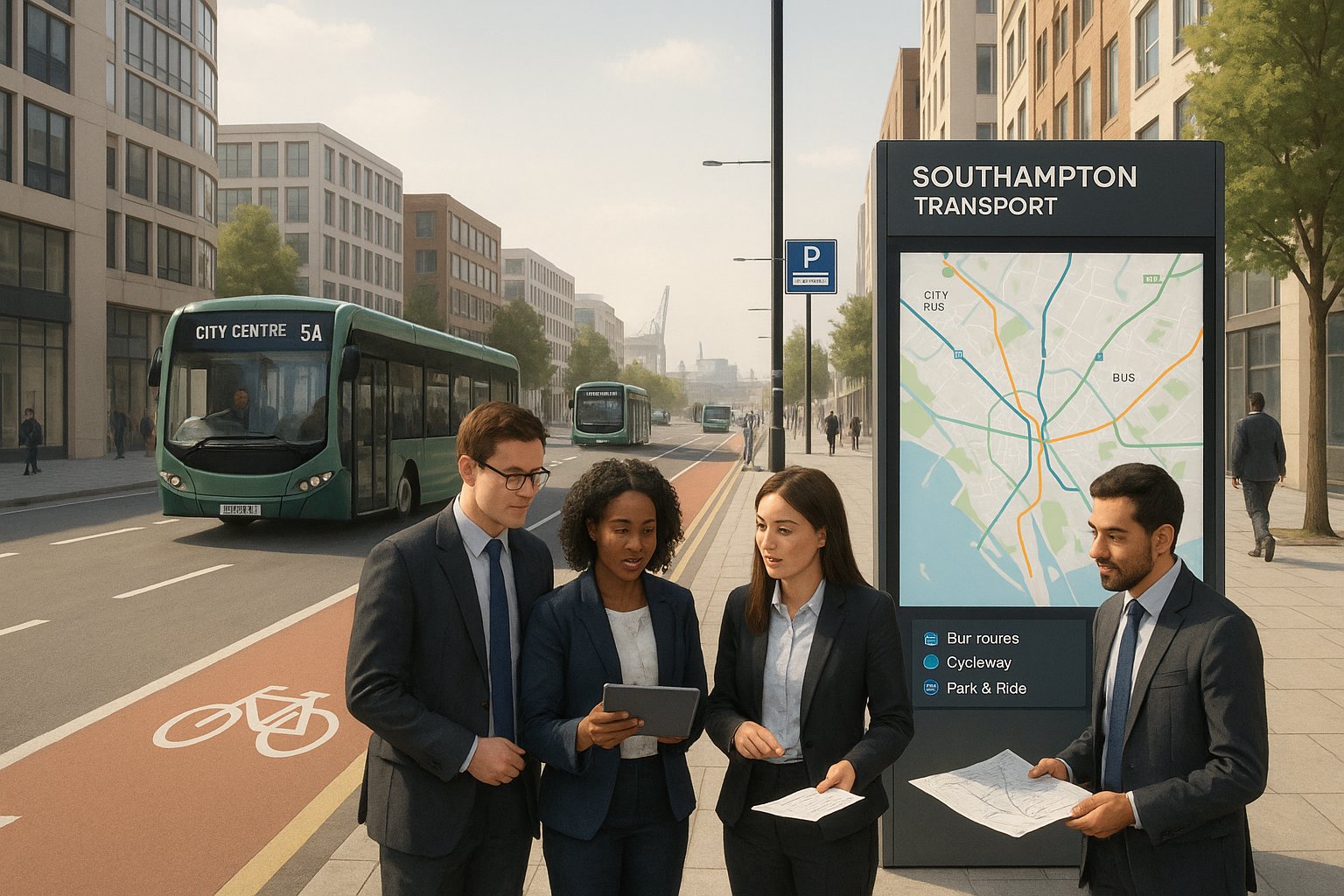
By 2026, transport planning in Southampton is being influenced by a clear strategic direction. The city’s draft Connected Southampton – Transport Strategy 2040 sets out a long-term vision for a thriving city supported by high-quality, lower-carbon movement. The detail matters. This is not a vague aspiration document: it points towards practical changes in street design, network priorities, public transport enhancement, and active travel investment.
The strategy proposes around 75 transport projects, including mass rapid transit, expanded cycling infrastructure, a more walkable city centre, park-and-ride, and progress towards a zero transport emission city. Whether every project lands on the same timetable is one thing. But as a planning context, the message is unmistakable: development is expected to work with that trajectory, not against it.
That has a few direct consequences for applicants. First, transport impacts are looked at in a broader way than simple junction capacity. Second, car parking and access arrangements often need firmer justification, especially in more sustainable locations. Third, schemes that actively support mode shift tend to sit more comfortably within the local direction of travel.
We should also be realistic. Southampton has a complex transport character: a major port city, constrained corridors, busy commuter movements, freight pressures, university and hospital travel demand, and sensitive residential streets. So the planning and transport context is not theoretical. It is rooted in a city where movement is already under pressure, and where decision-makers expect evidence, not assumptions.
Key Development Types That Commonly Require Transport Input

Not every planning application in Southampton needs a full suite of transport reports, but many more need transport input than applicants first assume. The obvious category is major residential development. Larger housing schemes can create meaningful trip generation, parking demand, servicing needs, and pressure on nearby walking routes, bus stops, and junctions.
Mixed-use and town centre redevelopment also commonly require transport planning input because they combine several movement patterns in one proposal: residents, staff, deliveries, visitors, taxis, and cyclists, often on constrained urban plots. These schemes usually need careful work on access, servicing, and sustainable travel integration.
Employment, retail, leisure, education, and healthcare proposals are also frequent triggers. A warehouse or trade counter may raise HGV and servicing questions. A school or healthcare use may create sharp peak-hour demand and road safety concerns. A gym, foodstore, or drive-through can intensify local traffic in ways that are not obvious from floor area alone.
And then there are smaller schemes that still need transport evidence because of their characteristics rather than their scale. A change to site access, a parking reconfiguration, intensified delivery activity, or development on a constrained frontage can all prompt transport review. In practice, if a scheme materially changes how people or vehicles reach, use, or move through a site, some level of transport planning is often sensible, even where it is not formally extensive.
When A Transport Statement, Transport Assessment, Or Travel Plan Is Needed
The right transport document depends on the likely scale and effect of the proposal. Broadly, a Transport Statement is used where development has relatively limited transport impacts. It explains existing conditions, access arrangements, parking, servicing, and likely trip effects in a proportionate way. For smaller or less intensive schemes, that may be enough.
A Transport Assessment is usually needed where a proposal could have a material effect on the transport network. That does not only mean very large developments. It can also apply where there are sensitive local conditions: constrained junctions, collision history, difficult access geometry, heavy pedestrian demand, or a use that generates significant peak-hour trips.
A Travel Plan serves a different, but related, purpose. Rather than only assessing impact, it sets out how travel to and from the site will be managed over time. Measures might include public transport information, cycle parking, showers and lockers, car club measures, staff travel incentives, welcome packs, monitoring, and targets to reduce single-occupancy car trips.
In Southampton, we usually advise clients not to treat these documents as interchangeable labels. The document type affects the level of evidence expected, the modelling or analysis required, and the credibility of the application. Calling something a Transport Statement when the authority expects a Transport Assessment rarely saves time: more often, it invites delay.
How Local Validation Requirements And Thresholds Shape Applications
Local validation requirements are often where timing is won or lost. Before the authority even reaches the planning merits, it may check whether the submission includes the transport evidence expected for that type of development. If the required material is missing, unclear, or under-scoped, an application can stall before proper consideration begins.
In Southampton, thresholds are typically shaped by several factors: development scale, proposed land use, predicted trip generation, parking provision, servicing activity, and whether the scheme changes access arrangements. Site context matters too. A modest proposal in a highly constrained urban location may attract more scrutiny than a larger one in a less sensitive setting.
This is why a threshold-led, locally informed approach matters. We need to look beyond national guidance in the abstract and consider what the authority is likely to expect in practice. That may include a Transport Statement, a fuller Transport Assessment, a Travel Plan, swept path analysis, visibility evidence, access drawings, or supporting notes on servicing and refuse collection.
For developers, the lesson is simple: scope the transport package early and against local requirements, not assumptions from another borough or an old project file. Southampton has its own planning context, its own network pressures, and its own validation expectations. Getting that right at the start is one of the easiest ways to protect programme.
Core Transport Planning Documents For Southampton Planning Applications
Most transport submissions in Southampton are built around a core set of documents and drawings. Which ones are needed depends on the proposal, but the aim is consistent: to give the local planning authority and highway officers enough evidence to understand the scheme’s transport effects and decide whether they are acceptable.
At the centre are Transport Statements or Transport Assessments. Around them sit the supporting pieces that often make the difference between a merely adequate submission and a convincing one: Travel Plans, access and parking layouts, delivery or servicing notes, swept path analysis, visibility splays, road safety information, and sometimes junction analysis or operational reviews.
The quality of this package matters as much as the quantity. Decision-makers are not helped by a bulky report that ducks the difficult questions. They want clear baseline conditions, proportionate forecasting, a reasoned parking and servicing strategy, and practical mitigation where needed. Shorter reports can be very effective if they are targeted and complete.
We take the same view in our own work at ML Traffic: concise does not mean thin. A report should be efficient to read, but robust enough to withstand officer review, design team queries, and, where necessary, committee-level scrutiny. That balance is what developers usually need when time is tight and certainty matters.
Transport Assessments And Transport Statements
A strong Transport Assessment or Transport Statement should do more than recite traffic flows and quote policy. It should tell the transport story of the site. What is there now? How do people currently arrive? What changes will the proposal introduce? Where are the pinch points, and how have they been tested?
For Southampton applications, this usually means covering existing highway conditions, nearby walking and cycling links, public transport accessibility, personal injury collision records where relevant, access arrangements, parking provision, servicing, and forecast trip generation. Depending on the scale and location, we may also need junction capacity analysis, comparative trip-rate evidence, or a reasoned justification for reduced parking in sustainable locations.
The distinction between a Statement and an Assessment is mainly one of depth and impact. A Statement is proportionate and lighter-touch. An Assessment goes further, often including more detailed forecasting, operational analysis, mitigation, and explicit consideration of cumulative effects.
Either way, proportionate does not mean vague. If a site has awkward visibility, constrained servicing, or a nearby junction already under pressure, those issues need proper treatment. The best reports are candid about constraints and practical about solutions. That tends to build trust with officers far more effectively than optimistic spin.
Travel Plans, Delivery Management, And Supporting Notes
Travel Plans are sometimes treated as a standard add-on, but in Southampton they can be a genuinely important part of the planning case. If the city is pushing towards better public transport use, stronger active travel, and lower emissions, then a decent Travel Plan helps show that the development will not simply default to private car reliance.
A useful Travel Plan should be specific to the site and user group. Staff-focused measures for an employment scheme will not look the same as resident measures for a housing-led development. Typical components include cycle parking, pedestrian wayfinding, bus information, incentives, welcome packs, appointed coordinators, monitoring frameworks, and realistic mode-share targets.
Supporting notes are just as important when they address the issues most likely to concern officers. A Delivery Management Plan or servicing note can explain when vehicles arrive, where they wait, how they turn, and how conflicts with pedestrians or neighbouring uses will be minimised. Refuse collection details are often overlooked, but not by decision-makers.
These supporting documents can feel minor compared with a headline Transport Assessment. They are not. Quite often, a planning application becomes delayed because the broad transport case is acceptable, but the day-to-day operational details have not been nailed down. That is frustrating, and usually avoidable.
The Main Transport Issues Reviewed By Southampton Decision-Makers
When Southampton decision-makers review transport evidence, they are usually not looking for theoretical perfection. They are looking for confidence that the proposal is safe, workable, and aligned with policy. In practice, that review tends to cluster around a handful of recurring themes.
Access is first. Is the proposed access safe and suitable for all users? Can vehicles enter and leave without undue conflict? Are pedestrian and cycle routes legible and protected?
Network impact is next. Will the development add significant traffic to already sensitive corridors or junctions? If so, has that been properly assessed and, where necessary, mitigated?
Parking and servicing are perennial points of pressure. Are spaces sufficient, usable, and well laid out? Is there overspill risk? Can delivery and refuse vehicles operate on site without awkward reversing or obstruction?
Road safety also matters, both in engineering terms and in perception. Collision records, visibility, crossing points, vehicle tracking, and conflict with vulnerable users all come under review.
And increasingly, sustainable travel is not a side issue. Officers want to know whether walking, cycling, and public transport have been designed in from the outset or simply mentioned at the end of a report. In Southampton, that distinction can be the difference between a smooth recommendation and a long list of transport queries.
Access, Parking, Servicing, And Road Safety Considerations
These are often the make-or-break transport issues because they are tangible, easy to test, and difficult to wave away. If access geometry does not work on a drawing, or a refuse vehicle cannot turn, the problem is visible to everyone in the process.
For access, Southampton officers are likely to focus on whether the arrangement is safe and suitable in line with the character of the road and the users around it. That includes vehicle entry and exit, pedestrian priority, visibility splays, gradients, and interaction with cyclists. On tighter urban sites, even a technically possible access can be judged poor if it creates unnecessary conflict.
Parking needs a clear rationale. Too little parking without a robust location-based justification can trigger overspill concerns. Too much can cut against sustainable travel objectives and weaken design quality. The right answer depends on land use, location, accessibility, and user profile, but the explanation has to be coherent.
Servicing is another common friction point. Delivery vans, larger goods vehicles, and refuse collection all need workable arrangements. Swept path analysis is often essential, but drawings alone are not enough: the operational logic matters too.
Then there is road safety. Existing collision patterns, likely conflict points, crossing demand, manoeuvring space, and vulnerable road user experience should all be addressed with care. If the proposal changes how movement happens on the ground, safety evidence needs to be front and centre.
Sustainable Travel, Active Travel, And Public Transport Integration
This is where transport planning in Southampton has shifted most clearly. A few years ago, some applications could get by with a short paragraph about nearby bus stops and a token cycle store. In 2026, that is rarely persuasive on its own.
Southampton’s long-term transport direction gives real weight to active travel and public transport integration. So applications should show how the site connects to surrounding footways, crossings, cycle routes, bus corridors, and key destinations. That means practical detail: walking distances, route quality, crossing opportunities, cycle parking type and quantity, end-of-trip facilities, and whether the street environment genuinely supports non-car access.
For larger or more prominent schemes, we should also think about contribution to the wider network. Does the proposal help complete a route, improve frontage conditions, support bus access, or reduce conflict at the site edge? Even small interventions can matter if they remove friction from everyday trips.
A good sustainable travel case is not anti-car theatre. It is about giving people credible choices. In a city aiming for better air quality, lower emissions, and more efficient movement, those choices carry planning weight. And frankly, decision-makers can tell when sustainable travel has shaped the scheme versus when it has been pasted into the application at the eleventh hour.
How To Prepare A Stronger Transport Submission From The Start
The strongest transport submissions usually start earlier than clients expect. Not because transport is always the lead issue, but because it influences so many design decisions: access points, internal layout, parking quantum, bin collection, cycle storage, frontage treatment, and the relationship between the site and surrounding streets.
Our advice is straightforward. Bring transport input in before the layout is fixed. Test access options early. Check whether servicing actually works. Sense-check parking strategy against local expectations and site context. Review nearby walking, cycling, and bus links while there is still time to improve them through design or planning obligations.
It also helps to scope the reporting package with discipline. Not every scheme needs everything, but every scheme needs the right things. If Southampton’s local validation requirements point towards a Transport Statement, Travel Plan, and swept path analysis, we should know that at the outset and coordinate the drawings accordingly.
Clarity is another advantage. A well-prepared submission explains the proposal in plain English, backs up key judgments with evidence, and directly addresses the issues officers are likely to raise. That sounds obvious, yet many reports still dodge weak points. We are better off acknowledging constraints and showing how they are managed.
And one more thing: align the scheme with the city’s transport objectives wherever honestly possible. In 2026, that is not box-ticking. It is strategic common sense.
Common Reasons Transport Evidence Delays Planning Decisions
Most transport-related planning delays are not caused by obscure technical arguments. They come from familiar weaknesses that could have been avoided with earlier and sharper preparation.
The first is incomplete evidence. A report may mention access, parking, and servicing, but only partially address them. Or a Travel Plan is promised later when the authority expects it on submission. Validation issues follow, then queries, then time slips.
The second is a weak rationale. Parking numbers are presented without explaining why they suit the location. Access is shown on plan, but not justified against safety conditions. Trip generation is estimated, but without robust comparators. Officers tend to push back when conclusions arrive before the reasoning.
Third, servicing and refuse arrangements are often undercooked. This is remarkably common on constrained sites. The broad land use case may be acceptable, yet the application slows because nobody has fully resolved how larger vehicles will operate.
Fourth, road safety evidence can be too thin, particularly where there are known collision issues, school routes, or heavy pedestrian movement.
Finally, there is poor alignment with sustainable travel objectives. In Southampton, that increasingly matters. If the submission reads as though the city’s transport strategy does not exist, officers notice.
The good news is that these are solvable problems. With early scoping, locally informed judgment, and concise but robust reporting, transport planning can move from being a planning obstacle to being one of the reasons an application progresses more smoothly. In a city changing how it moves, that is not a luxury. It is part of getting development approved.
Transport Planning in Southampton: Frequently Asked Questions
What is the importance of transport planning in Southampton’s development process?
Transport planning is vital in Southampton as it ensures new developments support the city’s strategy to reduce car dependency, improve public transport, and enhance walking and cycling. Proper planning helps manage traffic impact, parking, safety, and aligns projects with Southampton’s long-term transport goals.
When is a Transport Statement, Transport Assessment, or Travel Plan required for a Southampton planning application?
A Transport Statement is needed for smaller proposals with limited impact, a Transport Assessment is required when a development significantly affects the transport network, and a Travel Plan is used to manage travel behaviour and reduce private car use, especially for larger or complex sites.
Which types of developments in Southampton commonly require transport planning input?
Major residential schemes, mixed-use and town centre redevelopments, employment, retail, leisure, education, healthcare proposals, and projects with notable trip generation, parking demand, delivery activity, or changes to site access generally require transport planning evidence in Southampton.
How does Southampton’s Connected Southampton – Transport Strategy 2040 influence planning decisions?
This strategy sets out a vision for a thriving city with high-quality, lower-carbon transport options. Planning decisions in 2026 are expected to align with projects like mass rapid transit, expanded cycling infrastructure, walkable city centres, and progress towards zero transport emissions, ensuring developments contribute positively to these goals.
What are the common reasons transport evidence delays occur in Southampton planning applications?
Delays often result from incomplete transport reports, weak parking or access justification, unresolved servicing arrangements, insufficient road safety data, and poor integration with sustainable travel objectives. Early, clear, and locally tailored transport evidence helps avoid these common delays.
How can developers prepare stronger transport submissions for Southampton planning applications?
Developers should engage transport specialists early, test access and parking options before finalising designs, provide clear sustainable travel measures, align proposals with Southampton’s transport strategy, and ensure comprehensive, concise, and evidence-backed transport documentation to facilitate smoother approvals.