
A planning application can be technically strong, commercially sensible, and still get stuck on one stubborn issue: highways. That happens more often than many teams expect. A site may look straightforward on a location plan, but once vehicle tracking, visibility, parking pressure, servicing, pedestrian movement, and policy compliance enter the conversation, the margin for error shrinks fast.
For architects, planners, developers, lawyers, surveyors, and local authorities, choosing the right highway design consultants Birmingham teams can rely on is rarely a box-ticking exercise. It affects programme, planning risk, negotiation with highway officers, and eventually whether a scheme moves forward without expensive redesign.
In Birmingham, that challenge is sharper. The city combines dense urban streets, major strategic routes, active travel policies, public transport priorities, parking constraints, regeneration corridors, and Clean Air Zone considerations. A design that might pass in one authority area can draw detailed objections here if it misses local expectations.
We’ve seen the difference good highway input makes: clearer access strategies, stronger technical evidence, quicker responses to consultation comments, and planning submissions that feel joined up rather than rushed. In this guide, we’ll break down what highway design consultants actually do, where Birmingham-specific knowledge matters most, what local officers usually want to see, and how to choose a consultant who can support planning success in 2026.
What Highway Design Consultants Do And When You Need One

Highway design consultants are specialist civil and transport engineers who shape how vehicles, pedestrians, cycles, and servicing movements work in and around a development. Their role sits somewhere between design, policy compliance, and evidence-building. In practical terms, they turn a concept into something a planning officer and highway authority can assess properly.
That usually includes access design, junction arrangements, on-site circulation, parking strategy, servicing layouts, swept path analysis, and technical drawings that demonstrate compliance with standards such as Manual for Streets, DMRB where relevant, and local design guidance. On more complex schemes, they also support negotiations around mitigation, off-site works, road safety concerns, and adoptable infrastructure.
You typically need one when a development changes how a site connects to the public highway, creates material traffic impact, introduces delivery or refuse movements, or triggers planning requirements for a Transport Statement or Transport Assessment. Even smaller schemes can need input if the access is awkward, visibility is constrained, or parking and turning space are tight.
For many planning teams, bringing in highway input early avoids the classic late-stage problem: a polished planning pack held up because the access can’t be justified. That’s why schemes often benefit from coordinated transport and design support from the outset, particularly where a local Traffic Engineer In Birmingham: can align reports and drawings before submission.
Why Birmingham Projects Require A Local Highway And Planning Perspective
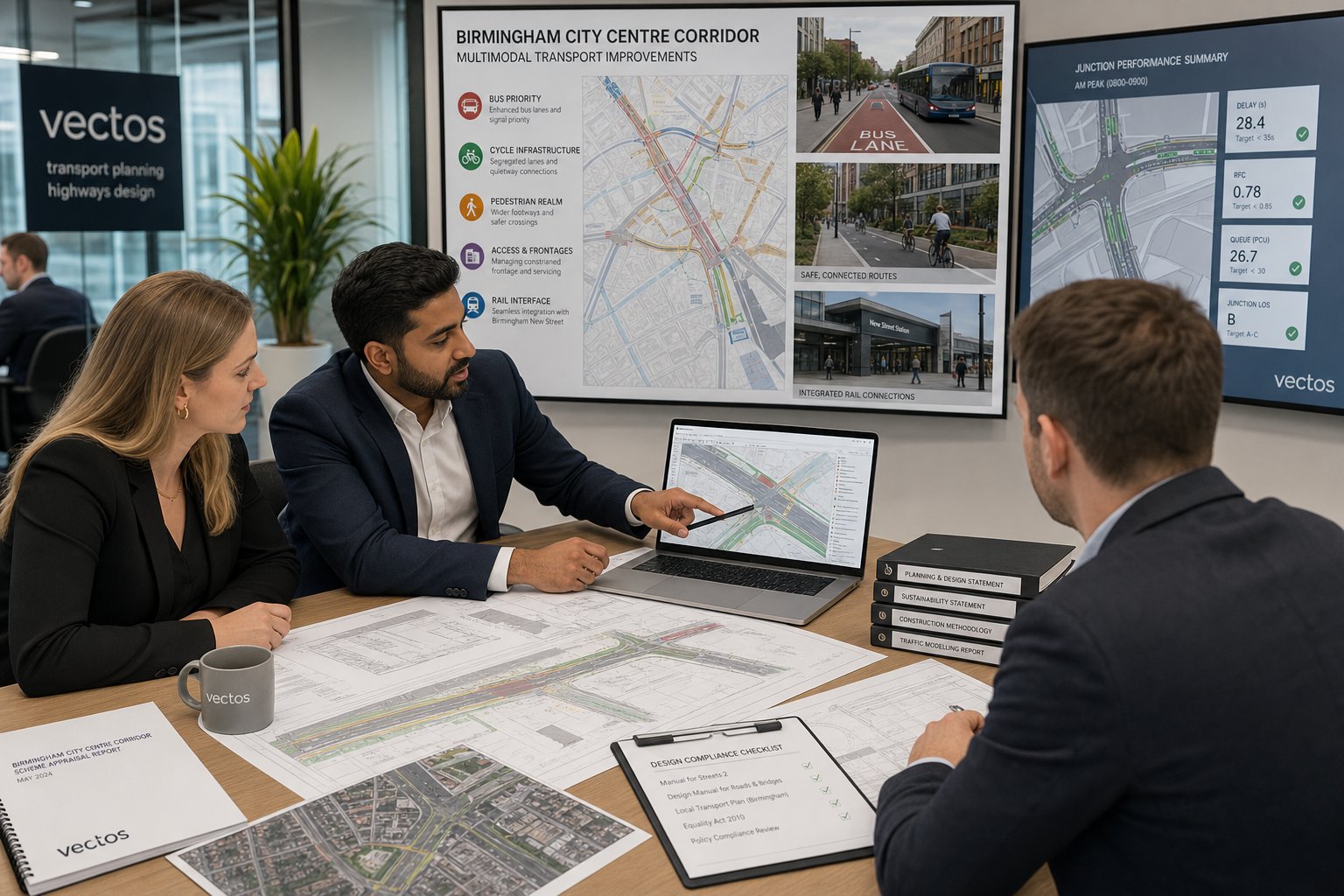
Birmingham is not a place where generic highway advice goes very far. The city’s planning context is shaped by busy radial routes, constrained urban frontage, major regeneration areas, bus priority measures, cycle infrastructure, rail interfaces, and neighbourhoods where on-street parking pressure is already sensitive. Add the Clean Air Zone and the strategic influence of the West Midlands Combined Authority and National Highways on some corridors, and local knowledge starts to matter a lot.
A consultant with Birmingham experience understands the practical side of that landscape, not just the policy wording. They know where congestion is persistent, where junction capacity is politically sensitive, where schools and pedestrian flows create road safety concerns, and where a seemingly simple access proposal is likely to be challenged by officers.
There’s also a softer advantage, though it’s not really soft at all: familiarity with how local highway officers review submissions. Good consultants don’t rely on relationships instead of technical quality, but they do understand what level of drawing detail, justification, and responsiveness tends to keep a project moving. That can save weeks.
For schemes that move beyond planning into delivery, broader knowledge of highway infrastructure design also helps. Birmingham projects often need a consultant who can think past the application stage and anticipate what will actually be buildable, adoptable, and acceptable on the ground.
Common Developments That Need Highway Design Input

Not every site needs a full-scale design package, but a surprisingly wide range of developments need some degree of highway input to satisfy planning requirements. The common thread is simple: if a proposal changes access, movement, parking, loading, or highway safety conditions, technical design usually follows.
Applications also become more likely to need specialist input where sites are constrained, urban, heavily trafficked, or politically visible. Birmingham has plenty of all four, so even modest schemes can benefit from an early highways review rather than a reactive one.
Residential Schemes
Residential development is one of the most frequent triggers for highway design work. That includes infill plots, backland developments, apartment schemes, student accommodation, estate road layouts for larger housing sites, and conversions that intensify use. The issues are familiar but rarely trivial: can vehicles enter and leave safely, is there enough visibility, can refuse vehicles manoeuvre properly, and does the parking layout work in the real world rather than just on paper?
On larger schemes, the design scope widens to include estate roads, pedestrian links, cycle access, tracking for emergency and servicing vehicles, and sometimes traffic calming or adoption strategy. On smaller sites, the key battleground is often access geometry and whether turning can happen on site without vehicles reversing onto the highway.
Commercial, Industrial, And Mixed-Use Sites
Commercial and industrial sites often face even closer scrutiny because vehicle types are more varied and peak movements can be sharper. Retail parks, supermarkets, trade counters, logistics units, warehousing, employment parks, leisure uses, and city-centre mixed-use schemes all raise slightly different design questions.
A warehouse may hinge on articulated vehicle tracking. A supermarket may depend on servicing without conflict with customer parking. A mixed-use city-centre scheme may need a very careful balance between access, servicing windows, pedestrian priority, and cycle movement. Regeneration projects can be broader still, involving phased access arrangements and off-site interventions.
In these cases, highway design is not just a drafting exercise. It becomes part of the planning argument, showing that the development can function safely and efficiently from day one.
Key Highway Design Services For Planning Applications
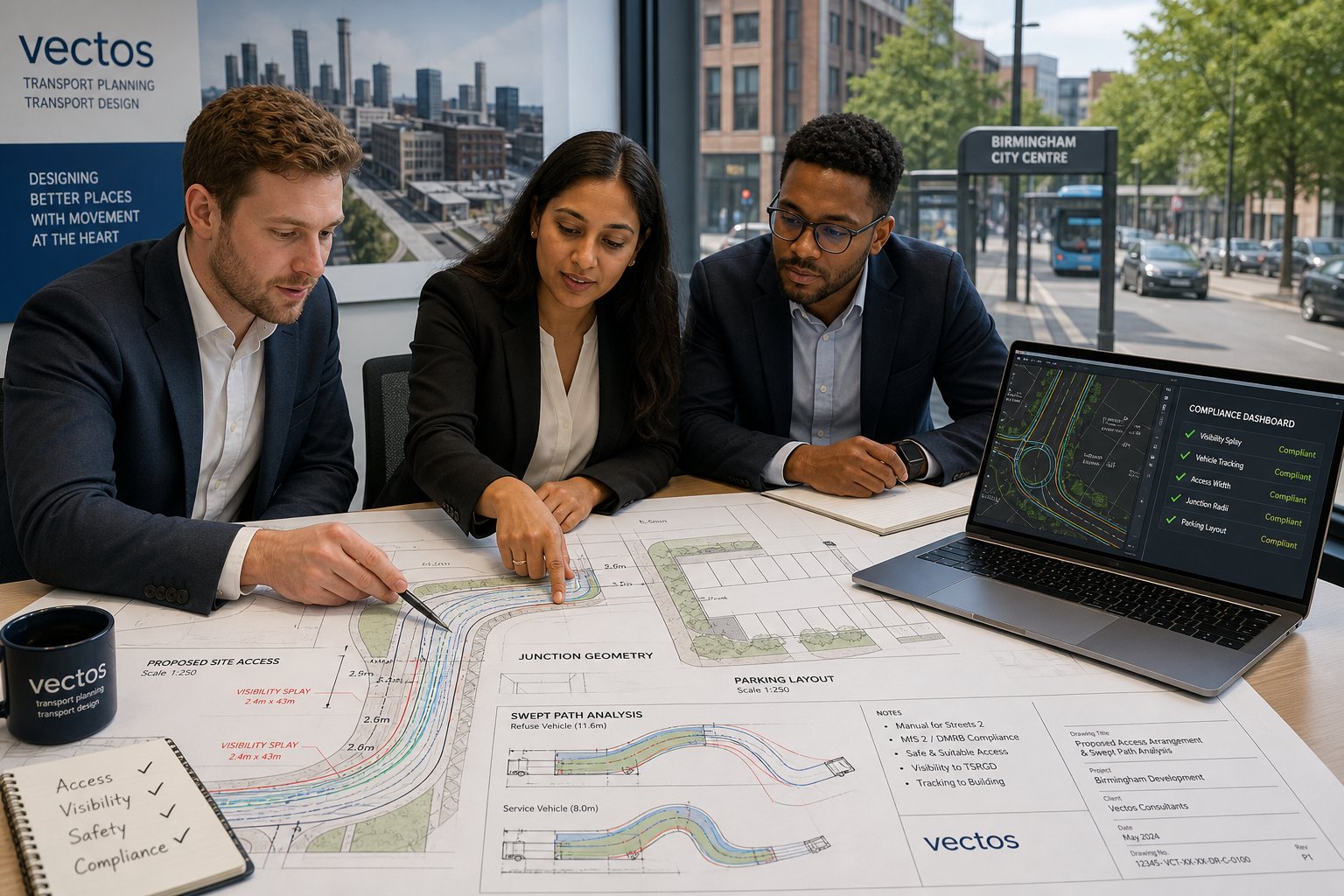
Planning-stage highway design is really about evidence. The drawings and analysis need to prove that a site can operate safely, fit within policy, and avoid causing unacceptable effects on the surrounding network. For Birmingham projects, the most valuable consultants are usually those who can move comfortably between concept design, standards compliance, and planning negotiation.
Access Design, Visibility Splays, And Junction Layouts
Access design is usually the first thing officers look at because it sets the terms for everything else. Is the entry point in the right place? Can cars, vans, refuse vehicles, and emergency vehicles use it safely? Are gradients acceptable? Is there enough visibility in both directions? And does the proposed arrangement respect local character and highway constraints?
Visibility splays sound simple, but they often become a point of challenge on urban sites with walls, parked cars, street trees, bus stops, or neighbouring frontages. A credible design has to reflect actual conditions, not idealised assumptions. Junction layouts may also need to show radii, lane positioning, pedestrian crossing considerations, and tie-ins to the existing carriageway or footway.
These are the drawings that often make or break a submission. When prepared well, they reduce ambiguity and help support wider planning documents, including work typically coordinated by highway design consultants Birmingham teams handling officer queries under tight timescales.
Swept Path Analysis, Parking Layouts, And Servicing Strategy
If access gets a vehicle onto the site, swept path analysis shows whether that vehicle can actually use it. This is critical for refuse vehicles, fire appliances, delivery vans, rigid HGVs, and articulated vehicles where relevant. Councils want to see that turning is practical, not theoretical, and that manoeuvres do not create conflict with parking bays, soft landscaping, or building edges.
Parking layouts are another common weak point. It isn’t enough to hit a numerical standard if bays are unusable, doors can’t open properly, disabled spaces are poorly positioned, or circulation aisles are too tight. Servicing strategy matters just as much. Officers will ask where loading happens, how long vehicles dwell, whether they reverse, and whether customer and service routes clash.
Strong consultants tie all of this together. They don’t issue separate drawings that contradict one another: they produce a coherent package that explains how the site works operationally as well as geometrically.
How Highway Design Supports Transport Statements And Transport Assessments

Transport Statements and Transport Assessments are often discussed as report-led exercises, but they are heavily dependent on design. Without a clear highway design basis, the trip analysis and planning narrative can feel detached from the actual site layout. That’s where many submissions become vulnerable.
Highway design feeds these reports in several ways. First, it defines the access arrangement being assessed. Second, it clarifies parking supply, servicing, internal circulation, and sustainable travel connections. Third, it shapes mitigation: if modelling identifies a problem, the solution must be physically deliverable. There’s no value in promising improvements that don’t fit the frontage or fail safety standards.
For smaller schemes, a Transport Statement may be enough, but even then the credibility of the report depends on accurate design assumptions. For larger or more sensitive proposals, a full Transport Assessment may need junction capacity testing, road safety review, active travel measures, and phased mitigation proposals. In all cases, highway drawings should support the conclusions rather than lag behind them.
That joined-up approach is one reason many project teams prefer consultants who can produce concise reports quickly while understanding local thresholds and planning triggers. A well-scoped package reduces the risk of submitting transport evidence that officers can’t reconcile with the site layout.
What Local Authorities And Highway Officers Usually Expect To See
Highway officers generally want clarity before they want complexity. If a submission makes them work to understand how access, parking, servicing, and safety fit together, objections become more likely. Birmingham and neighbouring authorities may differ in emphasis, but the basics are pretty consistent.
At planning stage, officers usually expect site access drawings, visibility splays, a General Arrangement showing on-site roads, footways and parking, and swept path analysis for relevant vehicle types. They also expect the design to reference the right standards and explain any departures. If the proposal has transport impacts, they’ll want those impacts set out honestly, with mitigation shown clearly rather than buried in narrative.
They may also look for road safety reasoning, pedestrian and cycle links, refuse strategy, disabled access provision, and evidence that the design can operate under day-to-day conditions. On urban sites, kerbside interaction matters more than some teams assume. Existing waiting restrictions, bus stops, crossing points, and informal parking habits can all influence officer comments.
Another point that gets overlooked: consistency. If the layout drawing, transport report, swept paths, and planning statement describe slightly different schemes, confidence drops immediately. Strong submissions usually have one integrated technical story, often informed by wider highway infrastructure design UK: principles as well as the local authority’s own expectations.
How To Choose Highway Design Consultants In Birmingham
Choosing a consultant is partly about technical skill, but not only that. The right team for a Birmingham project should understand planning risk, local authority behaviour, and the commercial reality that deadlines rarely move just because consultation comments arrive late on a Friday.
Start with relevant local experience. Have they supported schemes in Birmingham and nearby authorities? Do they understand when a project needs only a focused access package and when it needs a broader design-and-assessment strategy? Can they show examples across residential, commercial, industrial, and mixed-use sectors?
Then look at capability breadth. Some consultants are strong at reports but weaker on detailed geometry. Others can draw well but struggle to defend schemes through planning comments. The best fit is usually a team that can handle access design, swept paths, parking, servicing, and transport evidence in one coordinated workflow.
Responsiveness matters more than websites admit. Highway objections often turn on how quickly and clearly a consultant can answer officer questions, revise a layout, or justify a technical point without becoming defensive. We’d also look for concise communication. If a consultant can’t explain the issue plainly to an architect or solicitor, they may not be the best partner when planning gets tense.
Finally, check whether they tailor work to local thresholds rather than overscoping by default. Efficient reporting is part of technical competence. Firms with established Birmingham planning experience, including those offering Traffic Engineer In support alongside design input, often add value because they keep the package proportionate as well as defensible.
Common Reasons Highway Designs Are Delayed Or Challenged
Most highway design delays are avoidable, which is the frustrating bit. The same issues come up again and again: access arrangements tested too late, visibility constrained by real-world conditions, parking squeezed in after the architecture is fixed, servicing not thought through, or transport reporting commissioned after the design assumptions have already drifted.
One common problem is overconfidence in a marginal access. What looks acceptable on a preliminary plan can become difficult once levels, boundary features, pedestrian desire lines, and vehicle tracking are reviewed properly. Another is under-designed servicing. A scheme may technically include a loading space, but if the vehicle can’t reach it without blocking circulation or reversing awkwardly, officers will notice.
Timing also causes trouble. If a Transport Statement or Transport Assessment arrives late, or is based on an outdated layout, the planning authority may question the whole submission. Mismatch between reports and drawings is a classic credibility killer.
And then there’s policy alignment. Designs that ignore local parking expectations, active travel priorities, or established standards often trigger revisions that could have been avoided with early review. That’s why experienced teams tend to stress front-loaded technical checking. It is usually quicker to resolve layout issues before submission than to defend a weak design in response to objections.
Conclusion
Choosing highway design consultants Birmingham project teams can trust is really about reducing uncertainty. The right consultant doesn’t just draw an access and hope for the best. They help shape a scheme that works on site, aligns with planning policy, answers likely officer concerns, and supports the wider transport case from the start.
In Birmingham, local context matters: congestion, public transport priorities, parking pressure, Clean Air Zone considerations, and officer expectations all influence how a design is received. That means technical competence on its own isn’t enough. You want a team that combines sound engineering, planning awareness, and quick, practical communication.
For architects, planners, developers, surveyors, lawyers, and councils, the simplest test is this: can the consultant make the project easier to approve, easier to explain, and easier to deliver? If the answer is yes, you’re probably talking to the right partner for 2026.
Frequently Asked Questions about Highway Design Consultants in Birmingham
What do highway design consultants in Birmingham typically do?
Highway design consultants in Birmingham specialise in planning safe and efficient access, vehicle tracking, parking, and servicing layouts. They ensure developments comply with local policies like those of Birmingham City Council and provide technical evidence for planning submissions, including access design, swept path analysis, and junction layouts.
When is it necessary to hire highway design consultants for a development project in Birmingham?
You need highway design consultants when a development alters site access, causes significant traffic impact, or requires planning assessments such as Transport Statements or Transport Assessments. Even small sites with constrained access or parking often need their input to satisfy Birmingham’s local highway standards.
Why is local Birmingham expertise important for highway design consultants?
Birmingham’s complex urban environment, Clean Air Zone, bus priority, and cycle routes require consultants to understand local traffic patterns, officer expectations, and planning policies. Local experience helps navigate congestion hotspots and ensures designs meet regional standards and can be delivered feasibly on site.
How do highway design consultants support Transport Statements and Transport Assessments?
They provide accurate access design, parking layouts, and servicing plans that underpin trip generation, junction capacity tests, and road safety assessments. This ensures Transport Statements and Assessments reflect realistic site operations and viable mitigation measures aligned with Birmingham’s highway requirements.
What are common reasons for delays or challenges in highway design approvals in Birmingham?
Delays often result from late or mismatched transport reports, insufficient visibility splays, poorly designed servicing or parking layouts, and lack of alignment with local policies. Early engagement with highway consultants can avoid these by ensuring designs are technically sound and meet Birmingham officer expectations.
How should I choose the right highway design consultants in Birmingham?
Select consultants with proven local experience in residential and commercial schemes, who handle both design and planning negotiation. Quick responsiveness, clear communication, and knowledgeable integration of technical drawings with transport evidence ensure smoother planning approvals in Birmingham.